




 texto em
  Inglês (pdf)
 Artigo em XML
 Tradução automática
 Enviar este artigo por email
 Permalink

My eyes are eyes,
And it’s with these eyes that
I see in the world of stumbling blocks
where others, with other eyes,
they don’t see any pitfalls.
. . .
It's useless to follow neighbors,
to be after or to be before.
Each one has its own paths.
Where Sancho sees windmills
Don Quixote see giants.
Does he see windmills? They are windmills.
Does he see giants? They are giants.
(António Gedeão, 1956, own translation)
Introduction
The invention of the modern school emerged laden with promises of personal, social, and professional fulfilment - of shifting horizons, and of the passage from a predominantly rural and vassalic order to an industrial one grounded in emancipation and liberation. Yet this promise soon proved elusive, as vividly portrayed in Charlie Chaplin’s Modern Times. The mass school, conceived to serve the consolidation of the modern state and the industrial revolution, has remained captive to a functional architecture in which students were treated as “cogs in a machine”, constrained within a system that often asphyxiated them.
We have inherited a history that urges the reinvention of students’ presence and voice within schools. It compels educators and policymakers to listen actively to how young people perceive and experience school today. Students can no longer remain absent from educational policies and practices; their participation is essential for a full1 understanding of schooling - in both its visible and invisible dimensions, its light and its shadow - so that socialization becomes a response to real and situated human experiences.
According to António Nóvoa (2025), schools need to become learning organizations, capable of critically reflecting on their practices and reinventing themselves by listening to their stakeholders. For Nóvoa, institutional learning extends beyond continuous teacher training and demands an organizational culture open to change, experimentation, and collaboration.
In the same vein, Rui Canário (2025, p. 203, own translation) reinforces this view by asserting that “a learning school is one that questions itself, listens to its students and teachers, and builds knowledge from the lived experience of everyday school life”. For Canário, organizational learning is inseparable from the democratization of schooling and the valorization of local and relational knowledge.
Similarly, Joaquim Azevedo (2018) contends that schools that learn are those that recognize the discomfort of their students and teachers and, rather than silencing it, transform it into a catalyst for pedagogical innovation and the humanization of educational relationships. Azevedo further emphasizes that institutional learning requires courage to break away from standardized models and to embrace the complexity of the contemporary world.
Guided by these perspectives, we sought to hear directly from students - to explore how they interpret and feel about the “solar” and “lunar” sides of school. Using two metaphors, we invited them to consider whether, and where, the “school of hell” and the “school of paradise” exist. From 104 narratives written by students aged 14 to 18, our analysis revealed that the “school of hell” manifests primarily in teaching methodologies, assessment practices, bullying, curricula disconnected from lived contexts, and the still factory-like organization of schooling. Conversely, the “school of paradise” becomes visible in human relationships, pedagogical engagement, and the resilient learning that, despite adversity, continues to germinate within the school.
The student’s craft
On 14 July 2021, the Conselho Nacional de Educação [National Council of Education] (CNE) issued a recommendation on “The Voice of Children and Young People in School Education” (Recomendação n. 2, 2021, own translation). This is a significant document that systematizes a set of reflections on the importance of students’ voices within educational contexts. In an influential text, Perrenoud (2002) draws attention to the notion of the apprentice status associated with the student’s role, whose fundamental task is to learn. This is a demanding and complex endeavour - when students fail to learn, or lose the will to learn, the risk of school dropout and, consequently, social exclusion increases.
The school’s mission, therefore, is to enable children to learn - “to help them grow, to share the discovery of knowledge, and to teach them how to live together” (Guerra, 2003, p. 152, own translation). To fulfil this mission, it is essential to activate an educational paradigm centred on the student as a person (Alves, 2010; Azevedo, 2011). What truly matters is the creation of opportunities, strategies, and educational programmes that integrate knowledge, learning, and values within a plural and humanistic society. The student’s voice - “as an instrument of interaction, of participation, of appropriation of knowledge and of social empowerment” (Recomendação n. 2, 2021, p. 75, own translation) - is vital for the improvement of schools and education, as it enables the promotion of student participation and engagement in the school’s mission (Resolução do Conselho de Ministros n. 90, 2021). Regarding active listening, Crozier (1998) stresses the imperative that teachers must listen to their students, warning that failure to do so undermines their very identity as teachers.
Contemporary educational research continues to affirm the intrinsic value of education (Savater, 2006) and the importance of Reimagining Our Futures Together: A New Social Contract for Education (United Nations Educational, Scientific and Cultural Organization [Unesco], 2022). It consistently highlights the centrality of communication, interaction with others, collective growth, and the creation of communities of meaning, awareness, and affection (Recomendação n. 2, 2021, p. 76).
The call for change and the transition toward a new educational paradigm centred on the craft of the student have inspired new directions in Portuguese education policy. These include the Profile of Students Leaving Compulsory Education (Paseo) (Despacho n. 6.478, 2017), the promotion of inclusive education (Decreto-Lei n. 54, 2018), and the flexibility of curriculum management (Decreto-Lei n. 55, 2018). Together, these initiatives aim to operationalize the principles of educability (Lei n. 46, 1986; Lei n. 85, 2009) and to affirm the values of universality, equity, and quality.
From this perspective, each educational community must develop teaching and learning models capable of contributing to the holistic development of the person. According to Delors et al. (1997), children and young people must therefore have access to every possible opportunity for discovery and experimentation - aesthetic, sporting, scientific, cultural, and social - that enriches their understanding of what past and present generations have created in these areas.
The challenges facing education are endless (Grilo, 2002), despite undeniable progress, particularly in terms of its “human and social impact, both for democracy and social participation, and for the personal and cultural development of the community as a whole” (Azevedo, 2011, p. 47, own translation). Nonetheless, in some school communities, traditional approaches and conceptions of the curriculum still prevail, characterized by rigid, preordained plans (Perrenoud, 2002) that leave little room for the voices of children and young people. The student’s voice encompasses far more than opinions about an exam or a lesson plan; it reflects their interests, hobbies, passions, cultural background, values, and beliefs (Teixeira, 2015).
Analysis of narratives collected from more than one hundred students (n = 104) reveals a hidden layer of suffering - a sense of anguish within the corridors of compulsory schooling - which largely explains the predominance of the metaphor of the school of hell. Student participation and active listening are therefore crucial for preventing bullying (Cunha & Leitão, 2011), demystifying the anxiety surrounding assessment (Alves & Cabral, 2015), challenging the “one-size-fits-all, ready-to-wear” curriculum (Formosinho, 2007, own translation), and transforming directive pedagogical practices (Araújo & Palmeirão, 2023).
In this regard, António Nóvoa (2022, pp. 16-17) argues that schools must rethink their organization and pedagogical approaches. Schools are not only teaching institutions but also learning organizations. Nóvoa (2025) contends that schools must be capable of critically reflecting on their practices and reinventing themselves through active listening to their stakeholders.
A learning school is one that questions itself, listens to its students and teachers, and constructs knowledge from daily lived experiences (Canário, 2025). In this sense, learning schools recognize the discomfort of students and teachers and, instead of silencing it, transform it into a catalyst for pedagogical innovation and the humanization of educational relationships (Azevedo, 2018). This entails:
replacing homogeneous groupings with diversified forms of student organization that, depending on the task, promote individualized and differentiated learning pathways;
replacing the single-teacher model with co-teaching and pedagogical counselling structures that foster collaborative pedagogy;
replacing a normative, discipline-bound curriculum with a flexible framework that values interdisciplinary convergence and inquiry-based learning.
If the traditional school model once served the purposes and needs of the twentieth century, its transformation is now indispensable (Nóvoa, 2022). Education must value each student’s potential, creativity, and critical sense (Palmeirão, 2023). The future remains uncertain, which only amplifies the importance of what we teach and what we must learn. As Han (2014, p. 161, own translation) reminds us, “the gift of listening is grounded in the capacity for deep and contemplative attention - a capacity forbidden to the hyperactive ego of our time”.
Beyond these tensions, new social phenomena - including issues of individual and cultural identity, uncontrolled migration, and armed conflict - demand that “all children and young people be guaranteed the opportunity to discover and develop their natural abilities” (Azevedo, 2011, p. 305, own translation). Meeting this challenge requires an education that is plural, inclusive, and devoted to human development (Alves & Baptista, 2018).
Methodology
In this study, a qualitative research design was adopted (Creswell, 2014). This approach, by focusing on the ways individuals interpret and assign meaning to their experiences, is recognized for the breadth of understanding it provides regarding a given phenomenon. As Haguette (2005, p. 63, own translation) notes, “qualitative methods emphasize the specificities of a phenomenon in terms of its origins and its reason for being”, while González Rey (2005, p. 80, own translation) adds that they are “oriented toward the construction of comprehensive models of the object under study”.
The research process involved collecting data in the participants’ natural environment, in the year 2022 - in this case, within the school setting. Accordingly, it was necessary to select a sample that would ensure the representativeness of the findings, allowing for more accurate interpretations and enhancing the reliability of the results. Recognizing that the robustness of the sample is essential for the validity of conclusions drawn from the data, the following strategy was employed: each participant - students from grades 9 to 12, enrolled in schools within the Territórios Educativos do Programa de Intervenção Prioritária [Educational Territories of Priority Intervention Program] (Teip) located in northern Portugal - was invited, through the mediation of the school principal, to produce a free narrative (500-1,000 words) using a Google Form. The goal was to identify and characterize their perceptions and feelings about school by responding to two metaphors - School of Paradise (SoP) and School of Hell (SoH) - through the guiding question, “How do you see and feel about school?”.
After fulfilling all ethical requirements, the data corpus comprised 142 student narratives from 10 differente schools. Each text was entered into an Excel spreadsheet, coded per participant (e.g., F12º-17 or M12º-17), along with the corresponding narrative. Of these, 37 were excluded for the following reasons: (a) lack of argumentative content supporting the chosen metaphor, and (b) inclusion of students from grades 5 and 8, which fell outside the target group. The final sample consisted of 104 valid narratives.
Subsequently, the Excel dataset was imported into the NVivo qualitative data analysis software, which enabled the coding of the students’ words, phrases, and text excerpts according to twelve predefined categories (n = 12), each aligned with the objectives of the study.
Presentation and discussion of results
Participants
The sample for this study comprises 104 narratives, each corresponding to one student participant.
Table 1 presents the distribution of participants by age and gender, along with total counts for each category. Participants’ ages range from 14 to 18 years, and gender is classified as “Female” or “Male.” For each age group, the table displays the number of participants in each gender category, as well as the total for that age group. At the bottom of the table, overall totals are provided for each gender and for the combined sample. These demographic data offer relevant contextual information for understanding the distribution of the population across different ages and genders.
Table 1 Distribution of students by age and gender
| Age | Gender | Total | |
|---|---|---|---|
| Feminine | Masculine | ||
| 14 | 4 | 2 | 6 |
| 15 | 19 | 7 | 26 |
| 16 | 16 | 6 | 22 |
| 17 | 21 | 20 | 44 |
| 18 | 4 | 2 | 6 |
| Total | 67 | 37 | 104 |
Source: Authors’ elaboration based on the collected data.
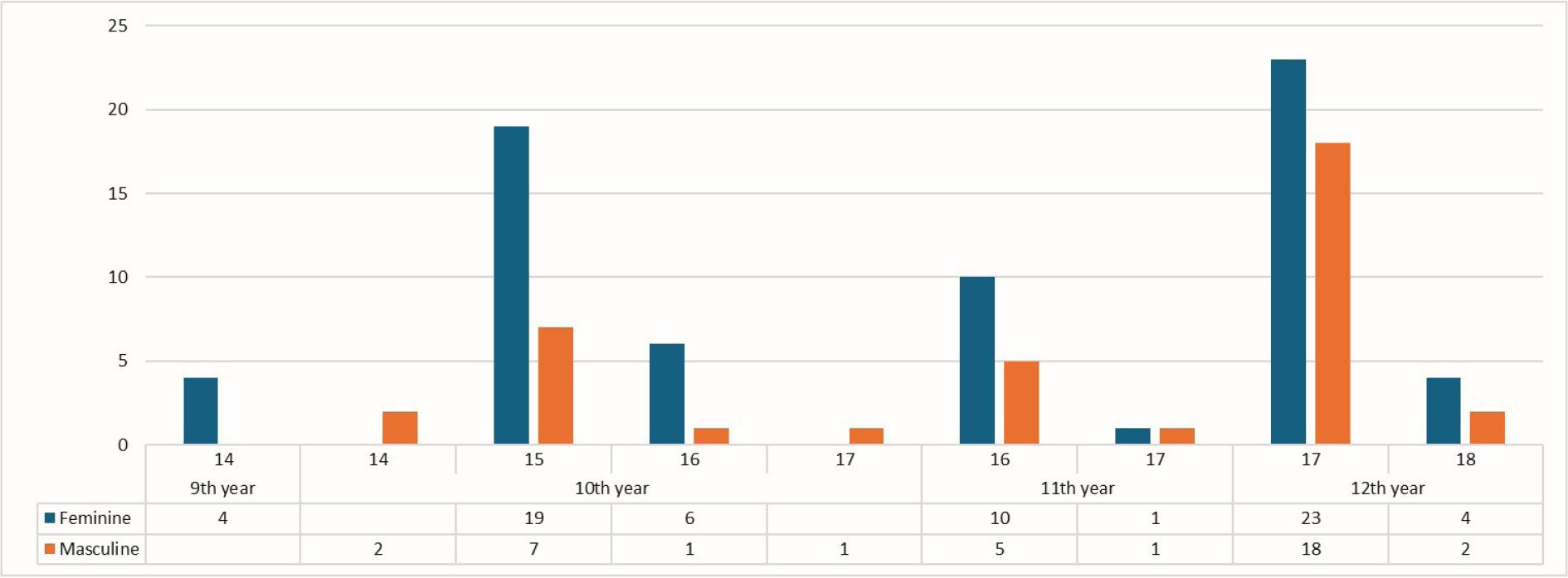
Figure 1 illustrates the distribution of students according to three variables: gender, grade level, and age. The data are presented visually, allowing for observation of how the number of students varies across these characteristics.
From the School of Hell to the School of Paradise
Of the 104 narratives analyzed, 62 were classified under School of Hell (SoH) and 42 under School of Paradise (SoP). Among these, 26 (25%) reflected mixed positions; however, their original classification remained predominant - with 11 narratives (10.6%) primarily aligned with SoH and 15 (14.4%) with SoP. After importing the Excel dataset into the NVivo qualitative data analysis software, the content was coded into twelve categories (n = 12). The resulting classification enabled the inclusion of each narrative within the corresponding SoH or SoP category, as summarized in Table 2.
Table 2 Categories for coding of the narrative content
| Categories | |||
|---|---|---|---|
| School of Hell (n = 62) | Frequency (nf) | School of Paradise (n = 42) | Frequency (nf) |
| Stress and anxiety | 75 | Teachers | 30 |
| Teaching methods | 69 | Learning | 23 |
| Assessment as a threat and sanction | 49 | Well-being | 23 |
| Bullying | 24 | Personal relations | 23 |
| Rigid and obsolete curriculum | 23 | Development | 15 |
| Mechanical organization | 12 | ||
| Pandemic | 11 | ||
Source: Authors’ elaboration based on the collected data.
School of Hell
The attribution of the School of Hell (SoH) metaphor arises for reasons of various natures. In this case, seven emergent codes were identified: (a) stress and anxiety (nf = 75); (b) teaching methods (nf = 69); (c) evaluation as threat and sanction (nf = 49); (d) bullying (nf = 24); (e) rigid and obsolete curriculum (nf = 23); (f) mechanical organization (nf = 12); and (g) pandemic (nf = 11).
We now proceed with a detailed analysis of each category related to the School of Hell.
a) Stress and anxiety
The regulatory and formative role of learning assessment has been the subject of extensive debate for decades, prompting reflection and highlighting the need for specialized training (Fernandes, 2006). However, assessment in practice - particularly in students’ lives - tends to focus more on final grades than on the learning process itself. This emphasis has significant effects on stress and anxiety experienced by children, adolescents, and adults, as it is closely linked to knowledge verification, national examinations, ranking, and exclusion (Álvarez Méndez, 2002).
Analysis of students’ written narratives reveals that the sources of school-related malaise extend beyond grading alone. Factors such as curriculum management, peer relationships, and teaching methods and pedagogy also contribute substantially to students’ discomfort (Carvalho et al., 2024). As one student observes: “Classes and the constant pressure we are under make me anxious all the time” (F12º-17). Another notes, “The average anxiety level of a high school student today is equal to the anxiety levels of asylum patients for the mentally ill in the 1950s” (F12º-17). Similarly, “The standard model that dominates education focuses on a reductive and rigid approach” (F10º-15). One student describes the personal impact: “The pressure on us to get good grades in all subjects leaves me in a state of anxiety 90% of the time, affecting my well-being and interfering with my relationships with family and even friends” (F12º-17). Such experiences generate profound negative emotions: “I’ve never hated anything in my life like I hate being a student” (F11º-16).
This scenario has been critiqued by several scholars advocating for a fundamental renewal of educational practice. Nóvoa (2025) warns against educational policies that, rather than fostering critical reflection, merely replicate prior logics. Canário (2025) emphasizes that schools today operate in a “time of uncertainty”, characterized by the failure of promises of democratization and social mobility. He highlights that “the expansion of school systems and changes in the world of work tend to accentuate the discrepancy between the increase in the production of diplomas by schools and the scarcity of corresponding jobs” (Canário, 2025, p. 203, own translation). This situation appears further reinforced by school models centered on exam preparation and the standardization of learning (Azevedo, 2018).
Taken together, these perspectives underscore the urgent need to rethink assessment and curriculum design, promoting a more humane and inclusive school environment focused on the holistic development of students.
b) Teaching methods
The uniformist and transmissive system of curricular organization persists, that at its base, is the practice of traditional teaching methods, designed for homogeneous groups of students and therefore incapable of “conceiving and managing problem situations adjusted to the level and possibilities of the students” (Perrenoud, 2000, pp. 42-45, own translation). The art of teaching and the success of students presuppose interactive pedagogical relationships, communication and the construction of feasible projects to reach the future. Differentiation and inclusion are the prerogative of activating one’s own will and, in this way, teaching those who do not want to learn (Alves, 2021; Figueiredo, 2021; Orts, 2007).
We’re not robots, and we’ve had enough of the horrible ways teachers come up with to teach subjects. (F9º-14).
Children [and young people] need time to play and increase their imaginative and creative “power”, but if they are forced to spend seven hours sitting listening to a teacher talk everything over and over again and we are forced to listen to everything, or pretend to listen, while we are sitting in wooden chairs that break our backs. It will make all the kids ordinary and some considered dumb or not very hard working because they can’t keep up with several hours of torture. (F11º -16).
In the six years I’ve been here, every class (with a few exceptions) falls into the same routine. They have been taught the same way for twenty years, and when they aren’t, teachers don’t know how to adapt the class to the change or how to manage it. Monotony is the rule. (F12º-17).
In sum, the persistence of uniformist and transmissive pedagogical models continues to undermine both equity and the quality of learning, perpetuating routines that, as Azevedo (2018) argues, keep the school anchored in past logics and unable to respond to contemporary challenges. This reinforces the urgency of adopting differentiated, dialogic, and responsive practices that acknowledge students’ singularity and break with the structural monotony that still characterizes much of school life.
c) Assessment as a threat and sanction
The expansion of schooling and the increasing heterogeneity of the student population pose significant challenges, particularly in relation to assessment, which is closely tied to grades, examinations, and access to higher education (n = 39). This issue was already questioned in 1987 by Eurico Lemos Pires, who argued that “The articulation between the cycles should follow a progressive sequence, assigning to each cycle the function of completing, deepening, and extending the previous cycle, within a perspective of the overall unity of basic education” (Lei n. 46, 1986), rather than a “regressive sequence”, as has often been observed under the current system of access to higher education. The pressure to transmit exam-oriented content renders both teachers and students captives of a metaphorical hell. The examples transcribed below illustrate this phenomenon:
From my perspective, formal assessments or tests capture only a minimal portion of a student’s work and knowledge, and often serve as misleading indicators. It is absurd, for instance, that final grades can be calculated using formulas such as 95% tests and 5% civic skills. (F12º-17).
I believe schools should place less emphasis on grades and prioritize students’ mental health, as in many cases students are struggling and exhausted, yet feel compelled to continue their work out of fear of jeopardizing their future. (F11º-16).
What often seems to matter most in our lives are our grades. For instance, when we attend a family dinner, the first question we are typically asked is, “How are your grades?”. If the response is positive, the conversation continues. However, if the response is negative, interest tends to wane, and the discussion often concludes with the admonition: “You have to try harder”. (M10º-15).
I do not like school because I believe that the pressure imposed on us regarding grades is detrimental, both psychologically and even physically. . . . From high school onward, with the introduction of averages, the pressure and fear of failure increase dramatically, as we suddenly become fully aware that a single mistake can permanently affect our progress and our ability to achieve our ideal future. (F12º-17).
This reality calls for a critical reassessment of assessment models and prevailing pedagogical practices. Nóvoa (2025) cautions against the institutional blindness that has taken hold in the European educational context, where solutions are devised that overlook the complexity of students’ school trajectories and the emotional impact of schooling. Canário (2025) emphasizes that schools must reinvent themselves, fostering more humane environments that move beyond a purely classificatory logic. Azevedo (2018) advocates for the revitalization of vocational education as a legitimate alternative, capable of valuing diverse educational pathways and alleviating the pressures associated with a single, higher-education-oriented model.
d) Bullying
School bullying has emerged as a matter of global concern (Deutsch et al., 2006), as it creates numerous situations of vulnerability, including stress, low self-esteem, insecurity, fear, and social isolation (Cabestany, 2023).
Bullying doesn’t just come from other children, many teachers put students down thinking they are helping them, in fact they only shame and humiliate them in a crowd. (M12º-17).
I experienced one of the most traumatic periods of my life at this school, where I was repeatedly sexually harassed by a classmate. This led to a persistent fear of attending school and of physical contact in general. When I reported the incidents to the school administration, I was accused of lying and being hysterical. The staff sided with the perpetrator, making comments such as, “Boys are like that”, “What clothes were you wearing?” and “You must have provoked him”. (F11º-16).
I started being bullied in the 7th grade. They said I was overweight, they made jokes about my appearance, the way I dressed, the way I talked, the way I acted. I’ve never hurt anyone, I’ve never wished anyone any kind of misfortune, I’ve always asked for help and advice, but they’ve never been there for me. I gradually began to close myself off, to become more and more reserved and quiet, and so it went until my 9th grade. (F10º-16).
A long time ago, being more specific in 2018, I moved from Brazil to Portugal and obviously I had to change schools, I’m not one to make friends very fast so I didn’t adapt easily, alone and without knowing anyone I started to suffer bullying/prejudice from my class for being very quiet and from a different country. (F9º-14).
These accounts call for profound reflection on the role of schools as spaces for protection, inclusion, and human development. Nóvoa (2025) criticizes the institutional blindness prevalent in education, where solutions are devised that disregard students’ emotional and social realities. Canário (2025) underscores the necessity of schools that embrace diversity and foster educational justice, particularly in vulnerable contexts. Azevedo (2018) advocates for a revitalization of vocational education as a pathway capable of promoting more humane, less competitive, and more responsive educational trajectories that attend to the individual needs of young people.
e) Rigid and obsolete curriculum
One of the priorities of the 21st Constitutional Government, and reiterated by the current 25th Government (of 2025), has been the implementation of a people-centred policy that promotes interdisciplinary dialogue, universally applicable measures, and “a myriad of new opportunities for human development” (Decreto-Lei n. 55, 2018, own translation). The guiding principle is to foster positive, open, and dynamic learning environments, even though the prescribed curriculum - both official and formal - continues to shape the practices of many schools and teachers. The intended goal is “to adopt different forms of organizing school work, namely through the creation of educational teams that allow teaching to be coordinated and student-centred”, thereby facilitating the “enhancement of project-based work and the development of communication and expression skills across oral, written, visual, and multimodal modalities, valuing students as authors and providing them with meaningful learning experiences” (Decreto-Lei n. 55, 2018, own translation). As one student observed:
The school’s biggest problem is that it’s outdated. I think there are many contemporary issues that should be addressed by the school. I believe schools should offer new subjects that help us manage and prepare for our future in a more practical way. (M12º-17).
Considering the value of all components of the curriculum, one student suggested: “It would be interesting to create a new, more practical subject focused on preparing students for the future of business, teaching them to perform seemingly simple tasks that are never taught to us” (M12º-17). Another student expressed frustration: “It is frustrating to attend a school that spends time on unnecessary subjects and does not adapt to the challenges that today’s students face” (M11º-16).
We spend our childhoods seated at desks, absorbing material and being judged for grades, with little time to play or to truly get to know those around us. For what purpose? To learn things that do not prepare us for real life, but rather to internalize the notion that there is only one correct answer, that our opinions do not matter, and that even if we excel, it is never enough unless we are exceptional - otherwise, we are considered insignificant. This is the world we live in; this is how we spend the majority of our childhood. (M10º-15).
These youthful voices directly challenge the educational system, calling for a school that is more attuned to reality, practically oriented, and fundamentally humane. Nóvoa (2025) cautions against the institutional blindness that pervades educational spaces, where solutions are devised without regard for students’ concrete needs. Canário (2025) underscores the necessity of rethinking schools, particularly in rural areas, advocating for an education that values experience, diversity, and active student engagement. Azevedo (2018) advocates for the revitalization of vocational education as a legitimate alternative, capable of addressing contemporary challenges and equipping young people for a more conscious and effective integration into adult and professional life.
f) Mechanical organization
Students’ perceptions continue to reflect the idea that the school remains bound to a standardized, mechanical, and passive system, modeled on assembly-line principles. Within this system, students are seated rigidly and are not granted the prerogative to speak. As Gil (2005, p. 40) observes, “fear prevents criticism”. Pedagogical logic remains anchored in the concept of the “average student”, attempting to teach all students as if they were identical. (Azevedo, 2011; Fullan, 2003; Robinson & Aronica, 2010).
The school is not designed for students who face the greatest challenges, nor for those who exceed the so-called norm, making it a difficult environment for both extremes. (F12º-17).
Unfortunately, many teachers and parents expect us to be like machines - literally exemplary students who achieve excellent grades, never get distracted, and participate actively in class. As a result, students often become anxious, as society as a whole places immense pressure on us. (F11º-16).
This scenario has been criticized by several authors who advocate for a more humane and inclusive school, one that prioritizes the holistic development of students. Canário (2025) emphasizes the need to rethink schools by promoting pedagogical practices that value students’ experiences and active participation. Azevedo (2018) proposes a revitalization of vocational education as an alternative capable of fostering educational pathways better aligned with the vocations and potential of young people, thereby challenging the uniform logic that continues to dominate the educational system.
g) Pandemic
The closure of schools and the prolonged disruption of access to education created situations of vulnerability, anxiety, fear, isolation, and significant challenges (Alves & Cabral, 2021). Diligence, dedication, care, and commitment were principles embraced by all. As one student remarked, “I hated having school like this, even though I understood the necessity for all of us to stay at home” (F12º-17).
In 8th grade, things settled down somewhat because, midway through the year, we had to stay home due to the pandemic. Online classes were extremely disorganized, as no one knew how to navigate the system or attend other teachers’ classes, and the necessary materials were often unavailable. (F10º-15).
The abrupt shift to remote learning exposed structural inequalities and gaps in the technological readiness of schools, teachers, and students, thereby compromising pedagogical continuity and student well-being. This situation calls for critical reflection on teaching models and the capacity of educational institutions to respond to crises with both equity and effectiveness.
Nóvoa (2025) underscores the institutional blind spots that hinder the development of responses tailored to students’ actual needs, particularly in vulnerable contexts. Canário (2025) emphasizes the importance of reimagining schools as spaces for inclusion and human development. Azevedo (2018), in turn, advocates for alternative approaches that can foster the valorization of practical skills and the reconstruction of more meaningful and resilient educational trajectories.
School of Paradise
The affiliation with the School of Paradise is characterized by five qualities: (a) teachers (nf = 30); (b) learning (nf = 23); (c) well-being (nf = 23); (d) reason (nf = 23); and (e) development (nf = 15).
We now proceed with a detailed analysis of each of the categories pertaining to the School of Paradise.
a) Teachers
The teacher’s attitude, the relationships they foster, and the ways in which, through their practice, students find space to develop as individuals leave an indelible mark on young people, as documented.
There are teachers who give everything they have to their students and teach us things that we would never learn elsewhere. These teachers mark a student for life. (F12º-17).
I believe that upon completing my schooling [11th and 12th grade], I will always remember the exceptional school I attended, along with its teachers and classes. (M11º-17).
For me, one of the factors that most strongly influences students’ opinions and their interest in a subject is the teacher and their teaching approach. I am aware that, even when we are not particularly interested in a subject, having - or lacking - a teacher who can effectively engage students and explain the material clearly can entirely change our perception and level of attention. (F11º-16).
When students have imaginative teachers, classes are never boring. However, this is beyond the students’ control; it is a matter of luck, and ironically, those who experience it often do so without realizing it. (F10º-15).
These testimonies illustrate that the quality of the pedagogical relationship and teacher creativity are pivotal for student engagement and the cultivation of meaningful educational experiences. As Nóvoa (2025) highlights, there is an urgent need to reconsider the role of teachers in education, emphasizing their capacity to foster humanized and relevant learning environments. Canário (2025) reinforces this view by advocating for schools that acknowledge the centrality of the educational relationship, where the bond between teacher and student can be a decisive factor. Similarly, Azevedo (2018) underscores the significance of educational pathways that prioritize pedagogical practice and relational closeness as means to promote more contextualized and effective learning.
b) Learning
Students recognize the role of the school in their holistic education and are able to appreciate the heritage of knowledge in transit - both academic and beyond.
At times when I feel less motivated regarding my academic situation, I remind myself that school contributes to our development not only by imparting knowledge but also by shaping our character. (F12º-17).
In addition to facilitating learning, the school serves other functions, such as fostering socialization, promoting various projects, and preparing us for the future. (M12º-17).
In our lives, its role [that of the school] is indisputable, as its contribution extends far beyond the mere transmission of theoretical knowledge within curricular subjects, encompassing the formation of citizens and the promotion of social transformation for the common good. (F10º-15).
School imparts values that shape us as citizens and human beings, preparing us to take responsibility for our careers and our future, as well as for the future of those around us and of our country. (F10º-15).
These testimonies indicate that students perceive school as a space for identity formation, active citizenship, and preparation for life’s challenges. This perspective aligns with Nóvoa (2025), who advocates for a school that is more conscious of its formative and transformative role, capable of responding to contemporary demands with openness and innovation. Canário (2025) further underscores the significance of a school that values local contexts and fosters a student-centered education. Likewise, Azevedo (2018) highlights the importance of an education that is practical, meaningful, and oriented toward the future for young people.
c) Well being
It is the emotional dimension that shapes students - twelve years spent within a school context are crucial in forming one’s identity as a learner and can influence one’s entire lifelong relationship with knowledge.
For me, attending school represents an opportunity to grow and learn. (F12º-17).
When I leave school, I will feel that it was the best decision I have ever made. I have made friends and met remarkable people who uplifted me and brought me happiness again, despite everything that has happened. (M11º-17).
We can meet people and form friendships, some of which may last a lifetime. Friends play a crucial role in a student’s life, serving as a source of motivation to attend school. While school itself can be an enjoyable experience, it becomes even more meaningful when shared with good friends. (M11º-17).
Contrary to what many people think, school provides us with a foundation that shapes our entire future; it is where it all begins. I am not necessarily someone who loves school, yet I recognize that it has imparted much of the knowledge I possess today. (F10º-15).
These testimonies indicate that school is experienced as a space for holistic development, where cognitive, social, and emotional competencies are nurtured. As Nóvoa (2025) contends, it is essential for educational environments to recognize and value this human dimension of schooling, fostering learning spaces that respect the diversity of individual trajectories. Canário (2025) further emphasizes the importance of a school grounded in its local territories and communities, capable of addressing students’ real needs and promoting their well-being. Azevedo (2018), in turn, underscores the necessity of a formative pathway that enhances the significance of the school experience, making it more meaningful and future-oriented for young people.
d) Personal relations
It is within interpersonal networks that the acquisition of values and the formation of the self, as well as the management of relationships and sociability networks that young people discuss, take place.
The school fosters a friendly and welcoming environment, characterized by a spirit of mutual support, as all the teachers are consistently willing to assist us and guide us along the best paths. (M11º-17).
I enjoy school because it offers a distinct environment and provides opportunities to socialize and communicate with others. (M11º-16).
Regarding the relationship between students and teachers, I believe there is trust, not only with the teachers but also with the staff. (F10º-15).
These testimonies indicate that school is experienced as a relational space, where meaningful bonds are formed and social skills essential to community life are developed. As Nóvoa (2025) contends, it is imperative that educational settings recognize and value the human dimension of schooling, fostering learning environments that respect and enhance interpersonal relationships. Canário (2025) reinforces this view by underscoring the importance of school as a space for coexistence and collective growth, where closeness among members of the educational community is particularly significant. Azevedo (2018), in turn, emphasizes that vocational education can serve as a privileged avenue for strengthening these social networks by promoting more collaborative educational contexts that are attuned to students’ realities.
e) Development
The multifaceted nature of knowledge becomes particularly evident in the context of global development and future social integration.
The school continually seeks to reinvent itself by engaging in new initiatives involving other schools, such as Eco-Schools, the Youth Parliament, the European Youth Parliament, and the National Reading Competition, among others. (F12º-17).
School plays a fundamental role in our development: it is where we meet most of our friends and where we acquire a significant portion of our knowledge. (M12º-17).
It is a place where we are shaped as citizens. From there, your thoughts and values are formed, influenced by the environment - including friends, teachers, and even the structure of the school. (M11º-17).
The value of schooling should always be recognized, as education constitutes one of the pillars of society and enables the development of a better future. (F10º-15).
Indeed, “the value of school for students is fundamental, as it is in school that knowledge about the world is acquired” (F10º-15).
In this context, the voice of students, emerging as a growing movement within education, benefits both learners and teachers. Its primary aim is to engage and empower students, both individually and collectively (Bell & Aldridge, 2014; John & Briel, 2017). The initiative seeks to activate and integrate new approaches to teaching and learning, emphasizing student-centred methods within a renewed paradigm of schooling.
This perspective is supported by Nóvoa (2025), who advocates for a school that is more open to innovation and student participation, capable of responding to contemporary challenges with flexibility and a human-centred approach. Similarly, Canário (2025) underscores the importance of schools that recognize local contexts and foster a person-centred education.
Conclusion
Although there have been advances in listening to students’ voices, and their perspectives both inside and outside the classroom are increasingly valued, we are still far from achieving sufficient mastery in this regard.
Within and beyond the classroom, we need to foster the desire to speak and write about experiences, learning, expectations, joys, and sorrows. If we aim to move beyond the rhetoric of placing students at the center of the education system and the school, we must do much more, both formally and informally.
Achieving this requires multiplying opportunities for interaction and attending to the reasons and emotions of all members of the school community. By the end of this study, we are convinced that students learn best when they are actively engaged in their own learning processes. The ways in which they are involved and assessed are varied and depend largely on the capacity of schools to listen to them. To promote effective participation, it is essential to establish interactive, creative, and challenging dynamics. In this regard, James McCash (as cited in Ratcliffe, 2014) observes that students engage in debates about education and other broader issues when they are genuinely given the floor and a real opportunity to participate in learning processes.
Based on the voices expressed, we derive three key insights and a proposition for action at the level of our schools (Alves, 2021): (1) the centrality of authentic listening; (2) the need to address the concerns of students who do not speak; and (3) the possibility of an alternative model of schooling.
For these changes to occur, no decree from the Ministry of Education is required. School leadership and general councils have both the authority and the responsibility to create positions dedicated to listening to students, particularly those who are experiencing difficulties. Suffering impedes learning and, above all, undermines human well-being. It is imperative to humanize schools and relationships, fostering authentic communities of learning and happiness.
In this context, the testimonies collected throughout this study reveal that students deeply value interpersonal relationships, as well as the warmth, trust, and support of teachers and staff. They perceive school as a space for growth, identity formation, civic development, and social engagement. School is experienced not only as a place for learning but also as a space where one feels, shares, and transforms. As Nóvoa (2025), Canário (2025), and Azevedo (2018) argue, it is imperative to create a more humane school - one that is closer to students and more committed to their well-being and holistic development.
It is therefore crucial to awaken the awareness of all those who have the power to shape and transform school realities - school boards, general councils, and pedagogical councils - and, through them, to mobilize intentions and commitments.
The Ministry does not need to enact the metamorphosis that these urgent calls demand. What is needed is our own will and dedication. We place our trust in schools and teachers, confident that through them a different reality can be built and realized.

