




Serviços Personalizados
Journal

Artigo
 texto em
  Inglês (pdf)
 Artigo em XML
 Tradução automática
 Enviar este artigo por email
Compartilhar

 Permalink
Educação e Realidade
versão impressa ISSN 0100-3143versão On-line ISSN 2175-6236
Educ. Real. vol.49 Porto Alegre 2024
https://doi.org/10.1590/2175-6236132705vs01
OTHER THEMES
Gender School: perspective, approach and ideology in secondary education
Carlos Andrés Alberto Suárez is a PhD candidate in Social Sciences at the University of Buenos Aires and holds a Master's degree in Philosophy of Law. He earned his degree in Philosophy from the National University of Colombia. He is a professor of Philosophy and Human Sciences, and a research teacher on topics such as Feminist Epistemology, Epistemic and Structural Injustices, Memory and Conflict, and Pedagogy and Gender Equity.
I http://orcid.org/0000-0001-5608-1426
Olga Lucía Arias Romero is a Professional in Social Sciences and Education, with a Master’s degree in Education from the Universidad Externado de Colombia. She has 20 years of experience in secondary education and is a full-time teacher at Colegio Sorrento in Bogotá.
IIhttp://orcid.org/0009-0000-4792-935X
Yefrey Antonio Ramírez Agudelo holds a degree in Philosophy from the Universidad Santo Tomás, and a Master’s and PhD in Philosophy from the University of Salamanca. His research has focused on phenomenology, existentialism, and hermeneutics. He has specialized in contemporary philosophy, within which gender philosophy has emerged, and he has also conducted research on pedagogy.
Ihttp://orcid.org/0000-0001-7972-5095
IUniversitaria Agustiniana (Uniagustiniana), Bogotá/DC – Colombia
IIColegio Sorrento IED, Bogotá/DC – Colombia
Education in general is permeated by identity and androcentric prejudices that make it difficult for the school context to be an equitable space for girls and boys belonging to subordinated and excluded minorities. This situation is difficult to overcome due to epistemic and structural injustices anchored in the school environment. This study identifies aspects that influence the reproduction of biases, stereotypes and identities in the school that hinder the implementation of a gender perspective and its impact on the quality of education. Methodologically, participatory action research (PAR) is taken as a reference within the paradigm of critical theory, guided by feminist epistemology and cartography.
Keywords Gender; Epistemic Injustice; Structural Injustice; Perspective; Approach
La educación en general está permeada por prejuicios identitarios, androcéntricos, que dificultan que el contexto escolar sea un espacio equitativo para niñas y niños pertenecientes a minorías subordinadas y excluidas; situación difícil de superar a causa de injusticias epistémicas y estructurales ancladas en el espacio escolar. El presente estudio logra identificar aspectos que inciden en la reproducción de sesgos, estereotipos e identidades en la escuela que dificultan la implementación de una perspectiva de género y su impacto en la calidad educativa. Metodológicamente se toma como referente la investigación acción participación (IAP) dentro del paradigma de la teoría crítica, orientado por la epistemología y cartografía feminista.
Palabras clave Género; Injusticia Epistémica; Injusticia Estructural; Perspectiva; Enfoque
On the Importance of the Gender Perspective in School
This research is a case study on the implementation of the gender perspective (GP hereafter) at the Sorrento District Educational Institution (IED) in the Puente Aranda district of Bogotá. This investigation stems from the concern about what is happening with the implementation of GP in basic and secondary education, guided by the intuition that schools remain permeated by heteropatriarchal, androcentric logics that make it difficult for the school environment to be an equitable, just, and inclusive space for both girls and boys, as well as for members of subordinated and excluded minorities. This situation, in particular, is hard to overcome due to epistemic and structural injustices, which directly affect the quality of education.
Therefore, this study aims to combine empirical and theoretical inputs to understand how epistemic and structural injustices operate in schools and their effects on the implementation of GP. To this end, we draw on the following theoretical resources to guide the reflection and analysis of the data collected at the IED: Miranda Fricker's concept of "epistemic injustice" (2017); Linda Alcoff's notion of "gender" as a "position" regarding the production of knowledge (2006); and Iris Marion Young's conception of "structural injustice" (2011). Additionally, we reflect on the concepts of "perspective," "approach," and "gender ideology" to avoid ambiguities in their usage.
Studies on gender and GP in education at different levels agree on the need for their implementation to improve not only the quality of education (Donoso-Vázquez; Montané; Pessoa de Carvalho, 2014; Gamba, 2008; Rosas, 2022) but also the development of identities and the formation of political subjects (Flores, 2005). These inquiries also bring to the forefront a vital issue of social justice: gender equity, respect for difference, and the plurality of oppressed and excluded minorities (Busquets, 2003). All of this contributes to the development and formation of new identities with civic, empathetic, diverse, and inclusive competencies.
It is argued that the school, in particular, is a space historically constituted by hetero-patriarchal, dualistic, and androcentric logics and dynamics that are self-perpetuating, tending to produce and reproduce models, thereby resisting substantial changes and transformations (Walsh, 2007; Zapata, 2014). As a result, "[...] although educational institutions can be a positive space for fostering change, they are also places where sexist stereotypes and practices exist and are reproduced" (Valenzuela; Cartes, 2020, p. 4).
In response to this context, various feminist movements have gained significant importance in recent years for their contributions to the subject of this research. Alongside them, other minorities belonging to movements focused on sexual orientation, gender identity and expression, and diverse sexual characteristics (LGTBIQ+), indigenous movements, and other subaltern minority sectors have succeeded in highlighting "[...] the conditions of inequality they suffer in multiple spheres of daily life" (Leñero, 2011, p. 52). However, we are still far from meeting the basic standards set by international policies such as those proposed by the UN (2018) and UNESCO (Rojas, 2020).
Despite this need, there are significant resistances and counter-narratives opposing the implementation of GP, which delegitimize its progress from various sectors of society and ideologies. Many of these positions are conservative, religious, and even dogmatic fundamentalist views that resist accepting expressions of diversity (Leñero, 2011). This causes progress to be extremely slow, or even results in the maintenance of the status quo. Consequently, schools tend to become outdated and disconnected spaces that hinder progress toward achieving equality and equity within the diversity of the student body.
In this context, it becomes interesting to trace the dynamics occurring within the school space regarding GP, its achievements, challenges, opportunities, as well as its failures and resistances. Schools are understood as central spaces for transformation and as unique opportunities to reshape the social and cultural fabric, not only because they represent an area—"not the only one" (Connell, 2001, p. 158)—that tends to be heard, validated, and resonate, but also because they are settings that inherently embody all inequalities, as these are materialized, produced, and reproduced there. It is in light of these conditions that it becomes essential to describe and delve into gender inequalities to make them visible, denaturalize them, and show how they shape the ways in which women, oppressed, and excluded minorities inhabit and navigate the school space, thus configuring a critical, "counter-hegemonic and transformative" stance (Martínez, 2016; Blaise, 2009).
The issues surrounding the phenomenon of implementing GP in schools are influenced by various multidimensional factors and agents. These include, in part, stigmatization (media distortion), the influence of mass media in shaping identities, teacher biases, moralizing discourse, denial of the problems related to gender-based inequalities and inequities, the tendency to normalize certain unjust and discriminatory practices and attitudes justified by tradition and "adult-centric" morality, and the lack of knowledge regarding gender policies and their application both inside and outside the school space. It is also important to mention the construction of excluded and marginalized subjectivities, infantilization and ridicule as tools of social control, and the disputes and struggles with tradition, counter-narrative discourses, and powers that in various ways deny and oppose the implementation of GP in the school context.
Conceptual Contextualization: gender perspective, approach, and ideology
Before addressing the theoretical frameworks of this research, it is important to establish a conceptual distinction between the notions of "gender perspective" (GP), "gender approach" (hereafter GA), and "gender ideology" (hereafter GI), and their relationship with feminism. This differentiation will guide the description and analysis of GP implementation in this case study. Much of the literature on gender topics provides little emphasis on such distinctions.
The gender perspective is understood as a tool aimed at impacting laws, institutions, and organizational systems across society with the ideal of achieving not only formal but also material equality between men and women. For this reason,
[…] it constitutes an essential tool for understanding fundamental aspects related to the cultural construction of personal identity, as well as for comprehending how certain hierarchies, relations of domination, and social inequalities are generated and reproduced." The gender perspective began to be used as an analytical tool to detect situations of discrimination against women.
(Miranda-Novoa, 2013, p. 347).
As Niño (2019, p. 18) clearly states when reflecting on the differences between perspective and approach in the field of law,
The theories that build models of justice, specifically from a feminist standpoint, refer to the perspective, which constructs and justifies a different lens for understanding women's issues. In other words, the gender perspective encompasses those theories and models of justice that justify a differentiated approach to addressing women's problems.
The gender approach refers to the method (Miranda-Novoa, 2013; Niño, 2019), that is, the way in which the demands, claims, and projects for achieving gender equity, equality, and recognition are practically implemented in different contexts. In other words, it has a programmatic and methodological nature. Research suggests that GA is the way in which GP is introduced and implemented across different social spaces and dimensions through mainstreaming (Buquet, 2011; González, 2009; Montes-de-Oca-O'Reilly, 2019). Mainstreaming is understood as the set of "[...] processes aimed at ensuring that GP permeates all educational mechanisms, as well as the systems, structures, and procedures of the school itself" (Montes-de-Oca-O’Reilly, 2019, p. 108). In this sense, mainstreaming seeks to permeate and impact all areas of education as a fundamental commitment to the rights of women and marginalized minorities.
Gender ideology is perhaps the most contentious aspect of gender-related issues, partly due to the ambivalent and paradoxical nature of the term "ideology" and the way it has been received in the collective imagination of Western culture. As Terry Eagleton (2003) points out in his reading of Gramsci, the term’s most widely accepted meaning carries a negative connotation: it is seen as dogmatic, diminishing, and promoting false consciousness, exercised by hegemonic groups, the status quo, or the establishment. Consequently, and paradoxically, this understanding of the concept of ideology is often used to discredit and censor gender groups and feminist movements by conservative groups and the establishment. GI is used pejoratively to delegitimize the struggles, demands, and claims made by these minority and oppressed groups, leading to the stigmatization and delegitimization of women and militant members of these minority and oppressed groups (Young, 2000).
Now, following Eagleton (2003, p. 220), we can understand the other aspect of the concept of ideology: it is with Gramsci that the crucial transition is made from ideology as "systems of ideas" to ideology as a lived and habitual social practice, which should include the unconscious and unarticulated dimensions of social experience, as well as the functioning of formal institutions. It is this second sense that we adopt to understand GI, not merely as a negative concept, but as one that encompasses a horizon of meaning and political struggle. In this light, the concept of ideology becomes complex, not only because it is permeated by a blend of political, social, and cultural imaginaries from different, and sometimes even divergent, traditions, but also because it is unlikely that a general category of GI can fully encompass its diversity without affecting some of its factions or parts.
Thus, it is not surprising to find influences from political, economic, and theoretical schools of thought, such as Marxism, psychoanalysis, reflections on cultural determination in identity (cultural studies), the discoveries of critical theory, and decolonial thinking in opposition to hegemonic and ethnocentric thought, standing alongside hermeneutics and ideas of contextual and situated thinking, the rejection of essentialism, and the anti-biological reduction, among many other prominent ideas of advanced thought in contemporary reflection proposed by gender studies.
Here, gender ideology is understood as a set of political imaginaries, claims, struggles, and militant actions aimed at achieving the minimum standards of justice deemed necessary to ensure the conditions for gender equality and equity in all spaces of social interaction. Some of its proposals focus, for instance, on seeking a radical solution to the problem of women's subordination. It was concluded that the absolute supremacy of men in the domains of sexuality and reproduction must be challenged. This was the proposal of radical feminism to break free from the "sex equals gender" trap and dismantle the last barrier preventing women’s full liberation: sexual servitude. Gender ideology adopts the slogan "the personal is political" (Millet, 1995), where the public and private spheres are seen as being determined or influenced by political, legal, economic, and cultural ideas from hetero-patriarchal hegemonies. The public sphere, almost boundless, is the domain of the masculine, while the private, domestic sphere is the refuge of the feminine.
Epistemology in the Construction of Identity and Individuals with Political Agency
Gender is, among other things, a position from which one can act politically (Alcoff, 2006). It is not a determined, stable, or essential entity, but rather a position that depends on experience, context, the body – both biological and cultural – historical circumstances, and one's relationships with others. This position, in addition to having strong political potential, also holds epistemic (knowledge-related) possibilities, which are not disconnected from the political sphere.
Identity does not determine a fixed or immovable point of view. It allows for the emphasis and articulation of perspectives different from the hegemonic one, precisely because the latter considers itself neutral, failing to recognize that it is just one perspective among many. The objectivity it claims can only be understood as a fixed vision. However, the viewpoints of the subjugated are not naïve or innocent positions; they are not exempt from critical evaluation, decoding, deconstruction, and interpretation (Haraway, 1995). If gender identity is a position, as Alcoff (2006) suggests, then critical positioning depends on identity, which is continuously examined as a condition of possibility to see from a certain place, in an embodied way, and to critique the hegemonic vision. Without this identity position, critical knowledge is not possible.
Iris Marion Young also defends the thesis of gender as a position. Gender is constituted as a social relation and as a process that determines the social position and role people occupy. For Young, this position depends on a social structure: “It is an account of gender difference as a structural difference” (Young, 2002, p. 93). Thus, this account, as a position in the social structure, ultimately shapes life choices, desire, sexuality, legal status, educational and employment opportunities, access to resources, political recognition, authority/subordination roles, prestige, and acknowledgment. In the case of women, this position ends up constituting an injustice against them (Fricker, 2017), and this becomes even more pronounced when gender identities intersect with other social identity prejudices such as race, class, nationality, or ethnicity.
Young (2000) also recognizes the political and epistemic potential of gender as an inclusive political resource, because “[...] it helps to correct the biases of dominant partial perspectives through the communication of experience and knowledge derived from different social positions” (Rosas; Álvarez, 2022, p. 5), thereby expanding the knowledge we have of society. Gender’s position in the social structure gives voice to the needs, interests, and perspectives of those at a disadvantage, paving the way for more just decision-making and the possible transformation of “social structures based on domination and oppression” (Young, 2000, p. 68).
This expansion of social knowledge, which addresses partial and biased perspectives, aligns with Miranda Fricker’s proposal. In her seminal work titled Epistemic Injustice (2017), Fricker analyzes, from a feminist perspective, the dynamics of understanding and interpreting social relations and individuals' roles, explaining how unjust conditions are created for oppressed and segregated minorities. When reflecting on "epistemic injustice," she divides it into two dimensions: "testimonial" and "hermeneutical" (Fricker, 2017).
Regarding the first, it occurs when certain types of individuals are not granted credibility in their testimonies due to prejudices or identity-based powers that discriminate against and marginalize them. One might think of the case of a woman who seeks justice but is not believed when she accuses her abusers or attackers simply because she is a woman, or of Black people whose testimonies are discredited because of their race. Their words hold less credibility compared to other subjects: the testimony of a white police officer versus that of a Black citizen, or that of Indigenous or gay individuals against heteronormative individuals.
In the hermeneutical dimension, Fricker argues that "identity power" operates through the creation of institutions, social structures, and cultural frameworks that prevent the interpretation and understanding of the unjust and disadvantaged situations faced by certain individuals in specific roles and social interactions. Some aspects of individuals' lives become inexplicable and incomprehensible in light of the epistemic resources established by the culture. Consider, for example, the guilt felt by a homosexual person because the culture labels them as abnormal. Or women who were sexually harassed at a time when abusive touching was normalized, and the concept of "sexual harassment" had not yet been established. Thus, hermeneutical injustice is a central concept for explaining injustices and inequities in different spaces, as well as the reproduction of biases and stereotypes, and schools are no exception. Due to the partiality created by identity-based prejudices, there is a risk that "[...] some significant portion of one’s social experience will be obscured from collective understanding because of a structural identity prejudice in the collective hermeneutical resources" (Fricker, 2017, p. 254). In other words, this "risk" means becoming a victim or cause of what she calls hermeneutical injustice, produced by this bias or identity partiality, which leads to the inability to understand or make sense of experiences that cause discomfort but have been normalized by society.
Thus, conceiving GP in the concrete context of schools allows for the development of a critical perspective on the inequalities, hierarchies, and forms of discrimination present in educational institutions, particularly those caused by gender. In this sense, it is committed to models of justice and differentiated approaches aimed at explaining and proposing strategies to address the issues faced by children who are discriminated against, "victims of gender-based violence" (Leñero, 2011, p. 50). However, GP in schools also calls for changes in "[...] teaching and learning processes, conceptual content, non-distorted knowledge, unbiased methodologies, identification of cultural elements that tend toward domination, didactic strategies for change, and the deconstruction of identities" (Bolaños; Jiménez, 19961 apud Donoso-Vázquez; Montané; Pessoa de Carvalho, 2014, p. 162).
Thus, GP includes changes in institutional culture, its practices, laws, and structures, but it also introduces fundamental epistemic modifications to each academic discipline and teaching method. Academic feminism has produced the relevant scientific knowledge needed to identify and challenge forms of discrimination in various spaces, but schools have not “[...] embraced the subject matter or its processes of institutionalization within their communities” (Buquet, 2011, p. 212). This framework does not constitute an already constructed perspective; rather, it functions as a horizon of meaning and critical positioning that enables the ongoing struggle to reduce discrimination, violence, and inequalities.
Methodology
Methodologically, the research employs the Participatory Action Research (PAR) approach within the paradigm of critical theory, guided by feminist epistemology and cartography. It is a qualitative-interpretive methodology with a gender perspective (GP), in the sense that, as feminist epistemology emphasizes, knowledge is always situated (Haraway, 1995); that is, it exists within historically material, contextualized, embodied, and concrete conditions, without claims to universalization and neutral objectivity. For data collection, it was deemed pertinent to use "focus groups" or "discussion groups" (Valles, 1997, p. 288-289). This technique is commonly used to conduct “[...] phenomenological research on people’s views and understanding of certain phenomena” (Wilkinson, 1998, p. 184).
The focus groups, mostly made up of students from different grades, allowed the issues to be situated from their perspectives and facilitated the identification of emerging categories for interpretation, understanding, and the proposal of strategies for the implementation of GP in the institution. In this way, it addresses how they inhabit, navigate, and improve the school environment and the conditions of equity between girls and boys.
The contributions of teachers and alumni provided a more comprehensive, situated, and objective perspective on how the institution has, over time, addressed the challenges posed by the implementation of GP. The insights and contributions from alumni are of great importance, as they offer a comparative view and evaluation in relation to the descriptions of current students and their own experiences during their time at the institution. Likewise, the perspectives of participating teachers enriched the discussion and interpretation of the issues addressed in each focus group, informed by their discipline and expertise.
In accordance with these considerations and in line with the research objective, a Participatory Action Research (PAR) methodology was implemented based on four phases: a) diagnosis of institutional issues related to GP from the perspective of participating students; b) design and implementation of spaces for reflection and new collaborations based on the results of the diagnosis and the potential of educational communities for transformation and improvement of initial conditions; c) communities of inquiry composed of teams of students, teachers, and members of partner institutions invited to support and enrich the process. These communities facilitated new representations, knowledge, and pedagogical practices regarding GP and GA, fulfilling the methodological purpose of PAR, which is to contribute to the improvement of the educational community directly involved in the research. And d) strategies and practices carried out within the institution as examples of GA. Below, some additional methodological data are presented.
Table 1 Additional Background to the Methodology
| Territory | |||
| - Urban Bogotá (District School, Puente Aranda Locality) | |||
| Target | |||
| - High school students, primarily from the eleventh and tenth grades. - Alumni. - Primary and Secondary School Teachers, and University Researcher. - Mothers of Students. | |||
| Criteria for Systematization, Analysis, and Creation | |||
| Methodological Phases | Data Collection | Systematization | Creation |
| Diagnosis | Document Analysis and Focus Groups. | Prioritization Matrix | Collaborative Gatherings. |
| Instruments | Document Analysis, Focus Groups and Workshops. | Prioritization Matrix | Collaborative Gatherings Pedagogical and Awareness-Raising Sessions |
| Analysis and Reflection | Document Analysis and Focus Groups. | Inductive Analysis Matrix | Inquiry Communities |
| Ethical Considerations | |||
| The collected data was confidential and anonymous; no names or identification documents were used, and informed consent was obtained from each participant. For underage participants, authorization was requested from parents or guardians in order to allow their participation in the workshops, as well as in the training and discussion groups (informed consent). It was emphasized that participants were not seen as objects of the research, but as active agents in the construction of findings and knowledge. Thus, a dialogical, non-hierarchical communicative relationship was established, in which forms of understanding were constructed and deconstructed through the exchange of experiences and knowledge. The data collection process took place over approximately eight (8) months, during which consecutive meetings were held to conduct training workshops such as parent schools and teacher training schools. Additionally, focus groups and interviews were conducted every 15 to 20 days, using the school’s facilities in all cases, with approximately 12 to 15 participants per session. | |||
| Number of Focus Groups | |||
| 10 | |||
Source: Prepared by the authors.
Results Analysis
The findings from the analysis of the data collected during the focus groups reveal the emerging subcategories as the key aspects that most influence the production and reproduction of biases, stereotypes, and identity-based powers that perpetuate inequalities and inequities (Fricker, 2017) in the experience of inhabiting and navigating school spaces. These subcategories serve as examples of epistemic and structural injustices (Young, 2011), the two categories outlined in the theoretical framework guiding this analysis (Table 2).
Table 2 Emerging Categories
| Categories Theoretical Framework |
Subcategories Results |
Extended Description |
|---|---|---|
| Epistemic and Structural Injustices | Denial and Concealment | 1. Tacitly deny the issues and practices addressed and exposed by the gender perspective as concrete and real occurrences (facts) within the academic space. |
| Stereotype Reproduction | 2. The configuration of subjectivities and marginalities that are excluded, rejected, and rendered invisible across different spaces of the institution and at all levels. | |
| Ignorance and Outdated Information | 3. Lack of knowledge about gender policies and their application in schools. | |
| Identity Power and Misinformation | 4. Members of the teaching staff who openly oppose or deny the need for and importance of implementing the gender approach in various dimensions of the school context. | |
| Delegitimization and Distortion | 5. The infantilization and ridicule of individuals who defend arguments from gender perspectives. | |
| Rigid Structures | 6. Disputes and struggles with tradition; counter-narrative discourses and powers. Adult-centric positions anchored in tradition and religious morality. | |
| Tergiversation mediatic | 7. Stigmatization of feminism and/or gender perspectives as a result of media and cultural distortion through mass media. | |
| Violence and Legitimization | 8. Sexual violence and harassment against girls in the various spaces they inhabit and navigate. | |
| Identity Prejudices | 9. Prejudices in teacher training and moralizing discourse regarding the gender perspective. | |
| Curriculum and GP | 10. Outdated and disjointed academic content, lacking a GP. |
Source: Prepared by the authors.
These inquiries and descriptions, like the most recurrent ones in the production of identities and political agencies, revealed the level of reflection and awareness within the educational institution regarding gender-related issues, which can be addressed through new collaborations. This awareness and informed reflection allowed for “the creation of a school within the school” (FG4), an expression used by a student leader who emphasized the need to think about the gender perspective (GP) from a safe, dialogical, and transformative space. “A discursive approach for deconstruction, unlearning, and empowering not only those involved but also those to whom it is shared” (Teacher, FG4).
First Phase: Approach and Diagnosis (FG1 and FG2)
In 2022, the development and documentation of the case study at Sorrento District Educational Institution (IED) in Bogotá began. As a first step, a group of students who, independently, became interested in investigating gender issues within the institution was used as a reference. In 2020, these students created the Gender School, called Verbenas. They began an inquiry into the dynamics established among the different bodies and roles of the academic community, the ways in which spaces are configured, identities, rules of coexistence, dress codes, and how the school space is navigated. These questions became the basis for creating study groups that continued these reflections, leading to new knowledge regarding feminism, GP, GA, and GI, the creation of communities of inquiry, new collaborations, and disruptive proposals, all guided by the social sciences and philosophy tutor.
During the focus group meetings, the progress of gender projects developed by these different student groups was shared. The first representative group was named “Breaking Schemes of Complexity” (FG1), consisting of students who decided to focus on homosexuality in both men and women, starting with the following questions: “Is there discrimination against homosexuals at Sorrento School? How is this discrimination evidenced? How can we raise awareness among students to reduce discrimination?” (FG1). The group’s specific inquiries led them to conceptual exploration around gender orientations, comprehensive education, and inclusive education, revealing that in the institutional context, deeply rooted conservative and religious positions continue to prevail, which tend to legitimize discriminatory practices against those who express diverse identities.
In their investigations, they denounce that gender diversity is rarely addressed within the institution, making the school appear as an unsafe space for any member of the LGTBIQ+ community. Some teachers even normalize hostile attitudes towards members of this group. One teacher from the IED stated, “Negative value judgments are made about the identities and bodies of these individuals. It has even been said that they set a bad example for the rest of the community, justified by moral categories rooted in religion” (Teacher, FG1).
During discussions, the group reiterated the tendency towards a double standard adopted by some teachers, who maintain a politically correct stance, but in practice, on a daily basis, delegitimize certain bodies and identities, judging them as negative for the rest of the community. Homophobic and sexist prejudices are imposed as validation criteria for some bodies and identities over others, justified by the normal-abnormal dichotomy as a structural feature. The “identity power” Miranda Fricker (2017) speaks of, as a structural feature of social relations that determines hermeneutical injustices, can be observed operating at these levels.
In (FG2), the experiences of the study group named “Ela Femenina” were shared, where a reflective exercise turned into a denunciation of the sexist practices, language, and gender roles present in the school environment. This space served to expose the impact of these practices on the equitable participation of boys and girls in various spaces, and to show how they inhibit the development of girls and minorities in different areas of the school: academic, recreational, and social.
The students who created this project began by reviewing theoretical references that helped them understand the importance of language in the naturalization of power and the heteropatriarchal logics present in the classroom and most institutional spaces. For them, the feminist philosopher and activist Judith Butler was the initial reference for analyzing sexist language and the implications of power within the school, the pressure exerted, and the performative constraints through jokes, nicknames, and verbal games. They uncovered stereotypes transmitted through conversations about the role women should play in school (Butler, 1997).
For example, they reflected on the dynamics in the schoolyard or sports field during academic breaks: “[...] the boys always occupy the fields to play soccer, while the girls stay around the periphery. The spaces occupied by the girls during breaks are noticeably much smaller; the dynamics are quite rough and aggressive, with pushing and balls being kicked at them” (Student, FG2). The school thus manifests itself as a hostile place for girls (Blaise, 2009), where masculine perspectives position men as active subjects and women as passive subjects (Marín del Ojo; Cancelas-Ouviña, 2021).
One possible explanation lies in the heterosexual stance, focused on male pleasure, the sexualization, and objectification of women as expressions of the normalization of patriarchal behaviors. One of the students noted:
This becomes evident when a male classmate feels entitled to comment on and hypersexualize his female classmates. A recent case occurred in ninth grade, where a male student was sharing photos of the girls in the class with his friends using technological tools. When confronted, there was some discomfort because the boy was considered academically diligent. Why is there more discontent about accusing a high-achieving student than about the fact that an instance of gender-based violence occurred in the school? This perspective also allows for verbal violence against girls to occur on a daily basis, for example, when a male teacher says: 'Your skirt is too high; it shouldn’t be more than four fingers above the knee because you’ll provoke your classmates and give a bad image of the institution' (Student, FG2).
The school has been structured around perspectives of female beauty that must align with the institution’s collectivized mandates and heteronormative imaginaries, which focus on female bodies as their only attribute, disregarding other female potential, such as academic abilities.
This creates conflicting dynamics at school, as many girls equate a classmate's aesthetics and physical appearance with her only qualities, overlooking her academic abilities. They often assume that a classmate who has made advances to the teacher has failed the subject. In spaces like the playground or hallways, remarks such as 'I will never have a boyfriend; I’m not as pretty as her' are common, which diminishes the importance of a broader feminine perspective at school. Does beauty provide more academic or social opportunities than a person's intellectual abilities? GF2).
In their narratives, the students demand the recognition of bodies as they are; in other words, they seek freedom in how they navigate the search for an aesthetic and ethical identity. An aesthetic that strives to exist without the social judgments that stereotype, label, and generate various forms of violence, justified by appearance and adornment. An ethical behavior that seeks sorority as a fabric of support to confront situations that objectify, discomfort, and allow vulnerability. The affirmation of the body is expressed through the need to occupy spaces traditionally denied due to the presence of males, such as play areas and spaces for movement. As García (2007, p. 49) states
[…] when inclusion is considered within the framework of pedagogy, it refers to the challenges that all forms of diversity pose to the school: gender, ethnic-racial background, social class, the presence or absence of physical or cognitive disabilities, cultural background... with diverse affective-erotic orientations and gender identities being the most recent and complex challenge.
The understanding of diversity, the need for authenticity, the expression of emotional states, and the liberation from the alienation of stereotypes and identity-based powers clash with the uniform as a device that plays a homogenizing and regulatory role. In this regard, a teacher from the IED commented: “In the hallways and certain classroom spaces, timid voices can be heard suggesting that girls wear pants, seeking approval and particularly challenging the behavior coordination office” (FG3).
In fact, the girls from the gender school denounce the ambiguous interference of teachers who, supported by the school’s code of conduct, seek to regulate makeup, claiming it should align with their idea of aesthetic moderation, which is rooted in their own subjective interpretation of the uniform. Historically implemented female models and aesthetics in the school limit motor development. A simple device like the uniform, specifically the skirt, marks the spaces and dynamics of some versus others. The school skirt thus becomes a device that limits certain types of movements and the way spaces are navigated (FG2).
Additionally, in the opening of FG3, titled Post-Pandemic and Feminism, inquiries were made about the return to in-person classes following the pandemic, which forced lockdowns, in order to gather insights into the effects of this period and related gender issues. A meeting was held with tenth-grade students from Colegio Sorrento IED, where various situations the girls had experienced were shared, such as difficulties accessing virtual classes and acquiring the knowledge taught through distance education. Among the most relevant aspects, the following were highlighted:
[...] the caregiving role that many girls had to assume, whether for their younger siblings while family members sought to provide for the household. This caregiving role made it difficult for them to access and pay attention to the synchronous classes, which were mostly attended via a cellphone with a data connection (Teacher, FG3).
Additionally, the girls were affected by intrafamilial violence caused by the challenges of living with multiple people in confined spaces. In the reports from the evaluation committees of the teaching staff, cases of mistreatment by adult caregivers were described, particularly in relation to assisting with schoolwork, especially affecting younger girls and boys. It is important to mention these direct effects of the pandemic, as they have carried over into the school environment, particularly among many girls who remain silent and hesitant to demonstrate their cognitive progress or take an active role in school participation for fear of being questioned about their opinions and decisions.
Second Phase: communities of inquiry
The situations described above outlined the meeting space as a proposal to analyze, from a gender perspective (GP), the daily routines and curricular activities that have normalized and concealed ignorance, discrimination, stigmatization, and the reproduction of exclusionary identity positions towards the diverse groups present in the school. These spaces were opened with FG4 and FG5, giving rise to the communities of inquiry. These communities were enriched by various lines of inquiry, which became work pathways formed by teams of eleventh- and tenth-grade students. The initiative was supported by an alumna who initiated the proposal, the team of teachers from the Humanities emphasis, and with the support of a university education researcher.
These communities of inquiry provided important opportunities for change, leading to one of the fundamental tasks of the Gender School: the study and analysis of public policies being implemented in various settings across the city and the local district. The interinstitutional collaboration facilitated a dialogical integration with the “Casa de Igualdad de Oportunidades” (House of Equal Opportunities)2, which actively participated in the school environment by conducting targeted workshops for tenth-grade students in 2022. This participation opened several spaces for discussions on reproductive and sexual rights, as well as engagement with some parents to prevent gender-based violence. Additionally, a space called Weaving Worlds of Equality was created to commemorate International Day of the Girl Child on October 11, 2022, with the participation of sixth-grade students, along with a pilot workshop to commemorate November 25th3.
The Local School of Women and Gender Equity stands out for conducting an in-person workshop on the history of feminisms in Colombia (FG5), where epistemic tools were provided to bring the educational community closer to the following topics: what feminism is, the main currents of feminism, and the processes of recognition for women in the Puente Aranda locality to promote visibility and connection. Also noteworthy are the meetings held by the Culicagadas Feminist Collective4, which aimed to bring visibility to the experiences of young university students in organizing against the harassment they have faced, how they confronted it, and how they made their public denunciation through the organization. Lastly, recognition is given to the participation of the gender school in INCITAR for Peace5, which allowed for the creation of new networks that enhance the political training space for members of the gender school, especially with the Juntanza Violetas y Colores.6.
Third Phase: New Collaborative Gatherings. y and Disruptive Exercises
The focus groups GF6, GF7, and GF8 provided spaces for the empowering force of words and listening within the gender school, facilitating different collaborations and disruptive proposals. These meetings were organized through the Verbenas Gender School, with the objective of promoting political participation among students from 6th to 11th grades, aiming to create opportunities and visibility in the conflicting frameworks of learning and coexistence spaces at Sorrento IED. In these groups, feminist references were studied and reflected upon, theoretical feminist frameworks were reviewed, and experiences from other feminist collectives and institutions in the locality were shared.
In each gathering, alongside reflections on the epistemologies of feminist philosophies, members of the gender school were encouraged to identify with their individual selves and were embraced as protagonists of their own stories. This process helped to demystify discourses that recognize women as passive subjects, who are “behind others and are beings for others” (Lagarde, 1990, p. 2). This is fundamental because
the critical assessment of everyday situations that allow for complicit silences, aggressive language, and the normalization of behaviors must be replaced by critical questioning that enables the reevaluation, deconstruction, and re-signification of private constraints that inhibit public participation (Teacher, FG6).
Thus, these meetings served as spaces for the exchange of knowledge and experiences, covering a wide range of topics and nuances—from the personal (emotional-affective) to addressing technical issues related to epistemology, psychology, and feminist politics, among others. These topics were approached, on the one hand, from the perspective of technical knowledge from academia, guided and oriented by tutors, teachers, and expert professionals invited to the gender school, and on the other hand, enriched and contextualized by the experiences of students and parents who shared their concerns. This diversity allowed for a more enriched perspective in conceptual terms, while also accounting for the individual interests and unique experiences of the participants, who ultimately sought to understand, give meaning to, interpret, and better comprehend the dynamics that have affected and victimized them. This exercise also provided them with epistemic tools to think and act differently in response to traumatic experiences. Regarding this, one student expressed:
At some point, all of us recognize and feel ourselves as victims. As we have seen, we have gone through many horrible things—from vulgar catcalls on the street about our bodies, to infantilization by some teachers, to not being believed by adults, and even abuse within our own families. It feels like there is something systematic in every place, even at school. Aggression toward women can be seen everywhere" (Student, FG7).
As evidence of these words, it was significant that, through these gatherings, many of the participating women acknowledged having been victims of some form of sexist aggression or having been affected by attitudes or mechanisms that placed them in a position of disadvantage and vulnerability compared to men. These issues range from normalized street harassment, discriminatory attitudes from classmates, professors, and parents to sexual abuse within their own families. 'Violence in schools shares traits with what happens in other spaces, such as the home, the street, the workplace, or among peers, but it also possesses specific characteristics in particular spaces and with specific actors' (Zapata, 2014, p. 14). Thus, the dynamic allowed participants to externalize private experiences that were distressing and traumatic, yet at the same time significant, as they provided conceptual tools and emotional strategies to give meaning and understand the conditions girls have experienced due to androcentric, predatory, competitive, selfish logics that are uncaring or indifferent to others (Young, 2002; Alcoff, 2006).
Fourth Phase: concrete actions for gender approach
The focus groups GF9 and GF10 served as a platform to share and discuss concrete actions that have been implemented regarding the gender approach. Participants discussed how the teacher training session on gender perspective, approach, and ideology had been conducted, as well as the challenges encountered during the review of the Institution's Code of Conduct. Additionally, the gender perspective awareness day with the entire educational community was also addressed.
Pedagogical Session on Perspective, Approach, and Ideology
The group of teachers and administrators showed receptiveness and attention to the integrative discourse and proposal regarding the implementation of the gender perspective (GP) in the institution’s core processes and functions. Most of them acknowledged the need for and the impacts that GP has on the interaction dynamics within the different educational bodies and on improving educational quality. It was also recognized that this implementation is a manifestation of social and political justice, as it helps reduce gender gaps, discrimination, unfair treatment, and inequities. However, it was also acknowledged that there are subtle resistances from some teachers who, covertly, discredit, obstruct, or express their disagreement by distorting and caricaturing the discourse in classroom spaces and with their students. For example,
There is a particular teacher who is aggressive and reactive toward the proposal and discourse surrounding the implementation of the gender perspective (GP) in the institution. He views it as something negative that distorts the good principles and morality of the community. He makes disparaging comments about the teachers who are leading the process (Teacher, FG10).
Review of the Code of Conduct with a GP
During this discussion, the achievements, progress, and limitations of this process were characterized. It was determined that a deeper reflection is needed, based on the guidelines for updating and adjusting the institution's regulatory frameworks, considering the gender perspective (GP). Additionally, it was acknowledged that at least the first steps in implementing the GP have already been taken:
The school has taken the first step in making adjustments to the Code of Conduct, recognizing that, according to the guidelines for strengthening, reviewing, and updating it—particularly concerning the rights-based approach, differential approach, and the gender approach (GA) as a transversal element across all educational bodies, including the curriculum—there are significant gaps, and it has not been thought through using these frameworks, as indicated by the Bogotá Secretary of Education7(Teacher, FG9).
The initial findings highlighted important adjustments that need to be made to the Code of Conduct, based on a preliminary review by the teachers, to allow for the beginning of a reflection on the implementation of the gender perspective (GP) (Teacher, FG9). In this regard, the following criteria were established:
The need to adjust the Code of Conduct to align with the principles of School Restorative Justice;
The conceptual review of the document, clarifying the frameworks and references that the community (teachers, students, and guardians) envision for the education of children and adolescents;
Review the ambiguous language, which relies on individual subjectivities rather than the consensus of the educational community members;
The review of the articles that restrict the development and expression of sexual, identity, and cultural diversities among the members of the educational community;
Integrate inclusive language that acknowledges and affirms gender diversity and sexual orientations;
Develop an Institutional Coexistence Plan that allows for the establishment of a pact in favor of defending the dignity and rights of children and adolescents (FG9).
Awareness Day on GP with Students and Teachers
One of the central activities carried out as a concrete expression and application of all the discussions and learning related to the GP—led by the students of the gender school and the teachers leading the initiative—was a pedagogical session on GP with the entire institution, held on August 23, 2022. Group directors, teachers, and students participated in this session. It was structured around a guide prepared by the gender school and the female leaders interested in identifying key aspects of gender-related issues at the institutional level. In the workshop, participants were asked to reflect on the school environment and the expression of diverse identities in a safe space. The question posed was: "In your role within the academic community, how can you contribute to making the school a space of diverse and inclusive coexistence?" The responses from each group were categorized into six proposals based on priority and relevance, with the aim of incorporating them into the review of the Code of Conduct (see Graph 1).
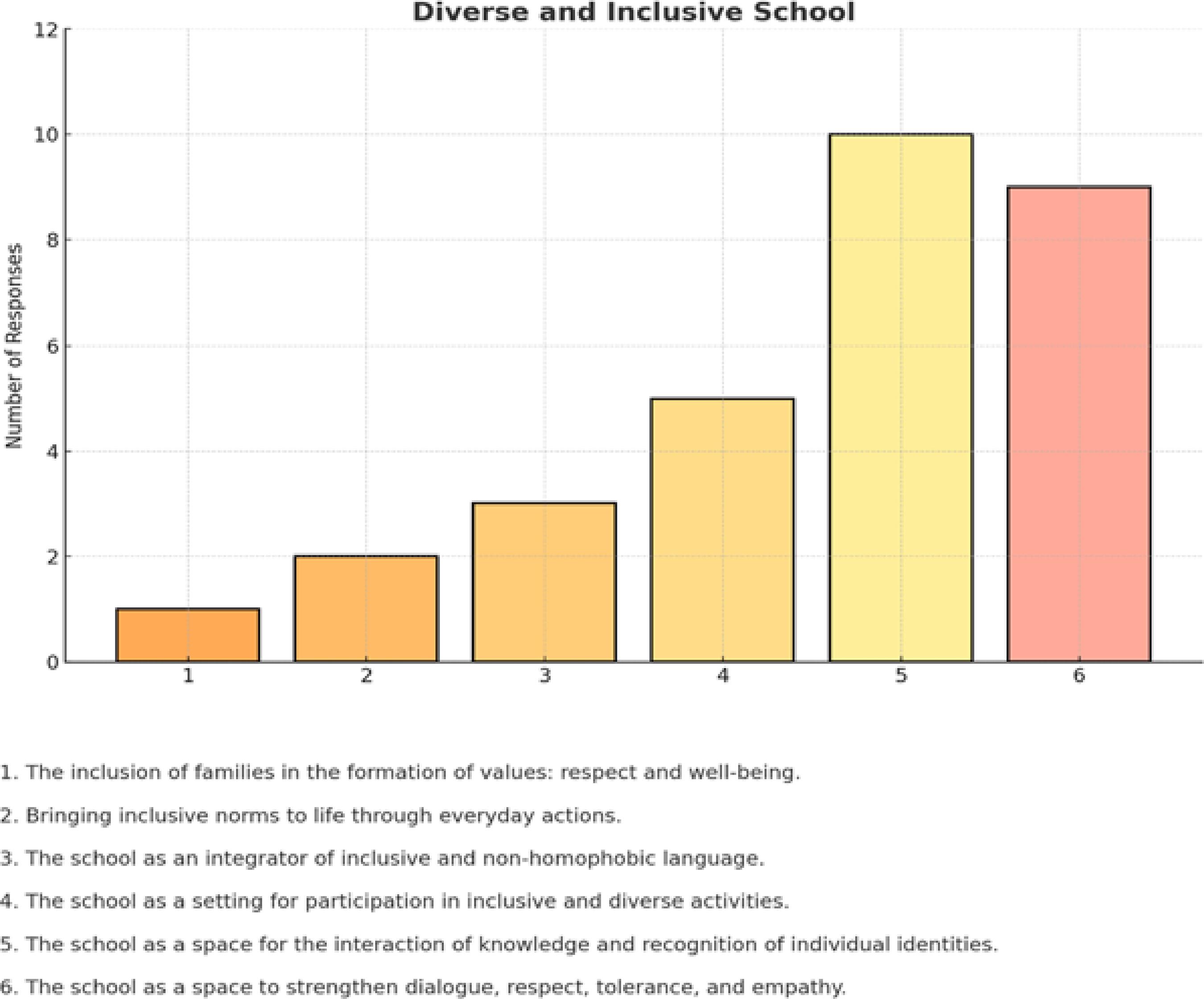
Based on the frequency and repetition of the responses, the important role of the school in facilitating the interaction of knowledge and the recognition of individualities and their identities, without the establishment of predetermined roles, is acknowledged.
This proposal demonstrates a clear potential for reviewing the behavioral norms that create settings of discrimination and lack of recognition of diversity, along with strengthening behaviors that promote dialogue, respect, tolerance, empathy, and solidarity (Teacher, FG10).
In particular, the student group recognized the need to integrate arts, sports, and cultural activities that break away from the frameworks that generate generic gender stereotypes, which have evidently excluded girls and other diverse and minority identities.
Today's society calls for the promotion of an inclusive, non-discriminatory school that genuinely fosters gender education. Various studies and research have shown that sexist attitudes and stereotypes follow students throughout their entire educational process—from early childhood education to high school—and that these shape their behaviors, conduct, and worldviews
(Marín del Ojo; Cancelas-Ouviña, 2021, p. 69).
The School as a Space for Self-Care and Care for Others
In this work, we have sought to understand the meaning, necessity, presence, and absence of a gender perspective (GP) and its relationship with the school. Following theoretical contributions and mapping practical ones, we emphasize the political and epistemic dimensions of this perspective. These dimensions are fundamental as they offer new ways of understanding and potential transformations of spaces and identities (Alcoff, 2006). The epistemic relevance of a GP in the school lies in its transformative potential regarding concepts, methodologies, hegemonic interpretations, and pedagogies within disciplines. Its political importance is reflected in the attention to the absence of women and non-heteronormative subjects in masculine cognitive canons, the hierarchical relationships within the school, and the implementation of actions aimed at reducing inequality and discrimination (Young, 2002).
Only a critical positioning within the social space allows for significant changes in the school space. Although this critical positioning is materially grounded in the bodies, histories, and situations of women, this perspective rises beyond its material base to be imagined, understood, and affirmed by those fighting for the transformation of spaces, classrooms, and stereotyped identities. While personal experiences serve as the initial connection with inequality and discrimination, and are a condition for adopting a GP, encountering some form of education that addresses feminism and allows for power-sensitive questions and reflections is crucial for making sense of past experiences (Fricker, 2017), transforming the present, and enabling a more equal school in the future, one that highlights power relations within knowledge institutions. “Education is one of the fundamental tools for change, a crucial element for laying the groundwork to promote effective gender equality” (Marín del Ojo; Cancelas-Ouviña, 2021, p. 68).
The GP is both a starting point and a horizon of meaning for the transformation of culture itself, raising awareness of the gender inequalities that permeate all spheres of culture: family, work, politics, organizations, art, business, health, science, sexuality, history, and ultimately all cultural institutions. The gender perspective is not exclusively a women’s issue, nor is it solely directed at them. Being a perspective of the concrete world and life itself, the most relevant aspect is understanding the problems that encompass vital commitments. All epistemic transformation is, ultimately, a political struggle—a struggle for recognition, for the transformation of spaces to be inhabited more justly, equally, and equitably.
Notes
1BOLAÑOS, Lucy Mar; JIMÉNEZ, Rocío. La formación del profesorado en género. Revista de Investigación Educativa, v. 25, n. 1, p. 77‐98, 1996.
2The Casas de Igualdad de Oportunidades (Houses of Equal Opportunities) are meeting spaces for women to learn about their rights and engage in processes aimed at social and political empowerment.
3International Day for the Elimination of Violence Against Women. In November, the 25th is commemorated as 25N.
4Feminist Collective Culicagadas, from Javeriana University, Bogotá. It aims to raise awareness of women's rights, denounce harassment and machismo through a symbolic and resilient narrative.
5INCITAR for Peace is a strategy for empowering and mobilizing educational communities to transform realities, contributing to the consolidation of Bogotá as a city that fosters peace and reconciliation, as proposed by the Secretary of Education.
7The teacher refers to Bogotá (2021), a legal publication issued by the Secretary of Education of Bogotá.
REFERENCES
ALCOFF, Linda. Visible identities: race, gender, and the self. New York: Oxford University Press, 2006. [ Links ]
BLAISE, Mindi. “What a Girl Wants, What a Girl Needs”: responding to sex, gender, and sexuality in the early childhood classroom. Journal of Research in Childhood Education, v. 23, n. 4, p. 450-460, 2009. [ Links ]
BOGOTÁ. Secretaria de Educación de Bogotá. Orientaciones para el fortalecimiento, actualización y revisión de los Manuales de Convivencia de las Instituciones Educativas. Bogotá: Alcaldía Mayor de Bogotá, 2021. [ Links ]
BUQUET, Ana. Transversalización de la perspectiva de género en la educación superior. Problemas conceptuales y prácticos. Perfiles Educativos, Coyoacán, UNAM, v. 33, p. 211-225, 2011. [ Links ]
BUSQUETS, María. Educación. Derechos Sociales y Equidad. México: Grupo Ideograma, 2003. [ Links ]
BUTLER, Judith. Lenguaje, poder e identidad. Barcelona: Síntesis, 1997. [ Links ]
CONNELL, Robert. Educando a los muchachos: nuevas investigaciones sobre masculinidad y estrategias de género para las escuelas. Nómadas, Universidad Central, Colombia, v. 14, p. 156-171, 2001. [ Links ]
DONOSO-VÁZQUEZ, Trinidad; MONTANÉ, Alejandra; PESSOA DE CARVALHO, María. Género y calidad en Educación Superior. Revista Electrónica Interuniversitaria de Formación del Profesorado, Universidad de Murcia, Murcia, v. 17 n. 3, p. 157-171, 2014. [ Links ]
EAGLETON, Terry. La ideología y sus vicisitudes en el marxismo occidental. En: ŽIŽEK Slavoj (Comp.). Ideología: un mapa de la cuestión. Buenos Aires: Fondo de Cultura Económica (FCE), 2003. P. 199-252. [ Links ]
FLORES, Raquel. Violencia de género en la escuela: sus efectos en la identidad, en la autoestima y en el proyecto de vida. Revista Iberoamericana de Educación, Madrid, Organización de Estados Iberoamericanos, v. 38, p. 67-86, 2005. [ Links ]
FRICKER, Miranda.Injusticia epistémica: el poder y la ética del conocimiento. Barcelona: Herder, 2017. [ Links ]
GAMBA, Susana. ¿Qué es la perspectiva de género y los estudios de género? Mujeres en red – el periódico feminista, Madrid, 2008. Disponible en: http://www.mujeresenred.net/spip.php?article1395. Accedido el: 2 ago. 2023. [ Links ]
GARCÍA, Carlos.Diversidad sexual en la escuela: dinámicas pedagógicas para enfrentar la homofobia. Bogotá: Colombia Diversa, 2007. [ Links ]
GONZÁLEZ, Rosa. Estudios de Género en educación: una rápida mirada. Revista Mexicana de Investigación Educativa, Ciudad de México, Consejo Mexicano de Investigación, v. 14, n. 42, p. 681-699, 2009. [ Links ]
HARAWAY, Donna. Ciencia, cyborgs y mujeres. Madrid: Ediciones Cátedra, 1995. [ Links ]
LAGARDE, Marcela. Identidad femenina. Centro de Investigaciones y Estudios Superiores en Antropología Social (CIESAS). Antropowiki, Costa Rica, Secretaría Nacional de Equidad y Género, p. 25-32, 1990. Disponible en: https://antropowiki.alterum.info/index.php/Identidad_femenina. Accedido el: 17 mayo 2022. [ Links ]
LEÑERO, Martha. Equidad de género y prevención de la violencia en secundaria. México: Secretaría de Educación Pública, 2011. [ Links ]
MARÍN DEL OJO, Patricia; CANCELAS-OUVIÑA, Lucía. Docencia con perspectiva de género en Educación Secundaria: propuesta de Guía Didáctica de mujeres anglosajonas en lengua inglesa. Revista Lenguaje y Textos, Universitat Politècnica de València, España, n. 54, p. 67-82, 2021. [ Links ]
MARTÍNEZ, Irene. Construcción de una pedagogía feminista para una ciudadanía transformadora y contrahegemónica. Foro de Educación, Salamanca, v. 14, n. 20, p. 129-151, 2016. [ Links ]
MILLETT, Kate. Política sexual. Madrid: Cátedra, 1995. [ Links ]
MIRANDA-NOVOA, Martha. Diferencia entre la perspectiva de género y la ideología de género. Díkaion, Colombia, Universidad de la Sabana, v. 21, n. 2, p. 337-356, 2013. [ Links ]
MONTES-DE-OCA-O’REILLY, Alejandra. Dificultades para la Transversalización de la Perspectiva de Género en una Institución de Educación Superior. Revista Latinoamericana de Educación Inclusiva, Santiago, Universidad Central de Chile, n. 13, p. 105-125, 2019. [ Links ]
NIÑO, Natali. Perspectiva y enfoque de género: herramienta para la toma de decisión judicial. Temas Socio-Jurídicos, Colombia, Universidad Autónoma de Bucaramanga, v. 38 n. 77, p. 11-28, 2019. [ Links ]
ONU. Organización de las Naciones Unidas. La Agenda 2030 y los Objetivos de Desarrollo Sostenible: una oportunidad para América Latina y el Caribe. Santiago: ONU, 2018. [ Links ]
ROJAS, Angie Ruíz. “Violetas y colores”, la escuela que fortalece el liderazgo de niñas y mujeres. Bogota.gov.co, Alcaldía de Bogotá, 25 mar. 2022. Disponible en: https://bogota.gov.co/mi-ciudad/educacion/inauguracion-la-escuela-violetas-y-colores-para-ninas-y-mujeres. Accedido el: 11 jun. 2022. [ Links ]
ROJAS, Caroline Muñoz. Políticas de igualdad de género en la Educación y Formación Técnica y Profesional (EFTP) en América Latina. Buenos Aires: UNESCO; IIEP, 2020. [ Links ]
ROSAS, Ana; ÁLVAREZ, José. Injusticias epistémicas en la educación de personas con Discapacidad mental. Educação & Realidade, Porto Alegre, UFRGS, v. 47, p. 1-20, 2022. [ Links ]
VALENZUELA, Amanda; CARTES, Ricardo. Perspectiva de género en currículums educativos: obstáculos y avances en educación básica y media. Revista Brasileira de Educação, Rio de Janeiro, v. 25, p. 1-19, 2020. [ Links ]
VALLES, Miguel. Técnicas cualitativas de investigación social: reflexión metodológica y práctica profesional. España: Síntesis Sociología, 1997. Disponible en: https://dialnet.unirioja.es/servlet/libro?codigo=84047. Accedido el: 1 jul. 2022. [ Links ]
WALSH, Catherine. Interculturalidad, colonialidad y educación. Revista Educación y Pedagogía, Colombia, Universidad de Antioquia, v. 19, n. 48, p. 25-35, 2007. [ Links ]
WILKINSON, Sue. Focus group methodology: a review. International Journal of Social Research Methodology, v. 1, n. 3, p. 181-203, 1998. [ Links ]
YOUNG, Iris. La justicia y la política de la diferencia. Madrid: Ediciones Cátedra, 2000. [ Links ]
YOUNG, Iris. Inclusion and democracy. Oxford: Oxford University Press, 2002. [ Links ]
YOUNG, Iris. Responsabilidad por la justicia. Madrid: Morata, 2011. [ Links ]
ZAPATA, Emma; AMAYA, María del Rosario. Políticas de equidad de género: educación para una escuela libre de violencia. Revista Ra Ximhai, México, Universidad Autónoma Indígena de Mexico, v. 10, n. 7, p. 1-21, 2014. [ Links ]
Received: May 24, 2023; Accepted: January 23, 2024
 Este es un artículo publicado en acceso abierto (Open Access) bajo la licencia Creative Commons Attribution, que permite su uso, distribución y reproducción en cualquier medio, sin restricciones siempre que el trabajo original sea debidamente citado.
