




Serviços Personalizados
Journal

Artigo
 texto em
  Inglês (pdf)
 Artigo em XML
 Tradução automática
 Enviar este artigo por email
Compartilhar

 Permalink
Educação em Revista
versão impressa ISSN 0102-4698versão On-line ISSN 1982-6621
Educ. rev. vol.40 Belo Horizonte 2024 Epub 12-Dez-2024
https://doi.org/10.1590/0102-469845809
Relacionado com: 10.1590/SciELOPreprints.5906
Articles
NUCLEAR COMMUNICATIVE FUNCTION AS TEACHING STRATEGY FOR GERMAN MODAL PARTICLES: RELEVANCE OF THE MINIMALIST APPROACH1

1 Universidade de São Paulo - USP. São Paulo, São Paulo (SP), Brasil.
This work aims to introduce a proposal for teaching and learning German Modal Particles (MP) through their nuclear communicative functions. By having a highly structured internal paradigmatic organization, the minimalist approach considers each particle as having a specific communicative function, wherein their pragmatic meaning must be retrieved both by the recognition of their nuclear function, as well as by the interpretation of the communicative situation (AQUINO, 2023; DIEWALD, et al. 2017). Despite being of great importance for everyday interaction in German, MPs are rarely properly addressed in the context of German as an additional language (GAL) (AQUINO, 2020). In light of the experience in an extension course with teachers of GAL in Brazil, we argue that the description of the nuclear functions of MPs represents an innovative, objective and reliable tool for teaching of these modal elements in beginners to more advanced groups of students. As a didactic proposal we present: (i) a descriptive table with the nuclear functions of 15 MPs; (ii) a practical application of teaching MPs through their nuclear functions within authentic uses of doch and ja. Considering the gap of suitable didactic materials for teaching MPs, this proposal represents a significant contribution for GAL.
Key-words: teaching modal particles; nuclear communicative function; learning strategies; German as an additional language
Este trabalho tem como objetivo apresentar uma proposta para o ensino e aprendizado das Partículas Modais (PM) em alemão através de suas funções comunicativas nucleares. Com uma organização paradigmática interna altamente estruturada, a abordagem minimalista considera cada partícula como tendo uma função comunicativa específica, em que seu significado pragmático deve ser recuperado tanto pelo reconhecimento de sua função nuclear quanto pela inferência da situação comunicativa (AQUINO, 2023a; DIEWALD, et al., 2017). Apesar de serem de grande importância para a interação cotidiana em alemão, as PM raramente são abordadas adequadamente no contexto do alemão como língua adicional (ALA) (AQUINO, 2020). Com base na experiência em um curso de extensão com professores de ALA no Brasil, argumentamos que a descrição das funções nucleares das PM representa uma ferramenta inovadora, objetiva e confiável para o ensino desses elementos modais para grupos de estudantes desde iniciantes até avançados. Como proposta didática, apresentamos: (i) uma tabela descritiva com as funções nucleares de 15 PMs; (ii) uma aplicação prática do ensino das PMs através de suas funções nucleares dentro de usos autênticos de doch e ja. Considerando a falta de materiais didáticos adequados para o ensino das PMs, esta proposta representa uma contribuição significativa para o ensino de ALA.
Palavras-chave: ensino de partículas modais; função comunicativa nuclear; estratégias de aprendizado; alemão como língua adicional
Este trabajo presenta una propuesta para la enseñanza de las partículas modales alemanas (PM) a través de sus funciones comunicativas nucleares. Según el enfoque minimalista, cada partícula posee una función comunicativa específica, en la que su significado pragmático depende tanto de su función nuclear como del contexto comunicativo (AQUINO, 2023; DIEWALD, et al., 2017). Aunque fundamentales en la interacción cotidiana en alemán, las PM rara vez se abordan de manera adecuada en el contexto del alemán como lengua adicional (ALA) (AQUINO, 2020). Basados en la experiencia de un curso de extensión para profesores de ALA en Brasil, proponemos que la descripción de las funciones nucleares de las PM es una herramienta innovadora y eficaz para enseñar estos elementos modales a estudiantes de distintos niveles. La propuesta incluye: (i) una tabla descriptiva de las funciones nucleares de 15 PM; (ii) una aplicación práctica para la enseñanza de doch y ja en contextos auténticos. Ante la carencia de materiales adecuados sobre PM, esta propuesta contribuye significativamente al ALA.
Palabras-clave: enseñanza de partículas modales; función comunicativa nuclear; estrategias de aprendizado; alemán como idioma adicional
INTRODUCTION
The teaching and learning of any Additional Language (AL) needs to go beyond the study of only grammatical rules and structures, hence it is critical to expose students to different experiences and perspectives of the target language and society. In the German language, the Modal Particles (MP) represent a word class responsible for conveying the speaker's attitude and intentions, just as the listener's expectations and knowledge, reflecting, therefore, the domain of social and interpersonal cohesion in communication. Considering that learning an Additional Language (AL) means to experience and reflect on the source and target social practices of that language, pragmatic knowledge, such as MPs, orientates linguistic and intercultural interactions. Even though MPs are highly frequent (in written and spoken contexts) and pragmatically relevant for daily interactions in German, their understanding and use can be challenging for non-native speakers as their meaning has to be inferred from the pragmatic pretext and the contextualized situation (THURMAIR, 2010). Nevertheless, according to the minimalist approach, each particle carries a specific communicative function, recurrent in all its occurrences, for example: doch expresses a contradiction or opposition to a previous statement or situation; ja indicates an agreement or shared knowledge between the interlocutors; halt expresses a matter-of-fact situation, suggesting that something cannot or should not be changed.
Currently, some researches seem to agree that the analysis and teaching of MPs should be based on the minimalist approach, which sustains that the meaning of each particle can only be accessed by semantic-lexical parameters within a specific context (ABRAHAM, 1991; WEYDT, 1983; HENTSCHEL; WEYDT, 2013, DIEWALD, 2013; SCHOONJANS, 2018; AQUINO, 2020, 2023). Unlike the maximalist approach, the minimalists doesn't attempt to give a list of specific definitions of each MP, but rather describe its main communicative function, wherein the pragmatic meaning is retrieved from context. To better realize these two approaches, the following analysis with the MP doch is well-suited: Anna tells Claudia that Jonas is going to give her a ride home, but Jonas is clearly intoxicated, so Claudia says to Anna: "Er ist doch betrunken". In the minimalist point of view the MP doch indicates in this exemple, as in all its occurrences, a contradiction, which in this context lies in the fact that Anna needs to take into account or recognize the fact that Jonas is drunk and, therefore, cannot drive or give her a ride. The maximalist analysis places emphasis on the specific pragmatic meaning within each communicative situation, in this case a warning or surprise, thus resulting in the definition of the meaning of each MP being a list of variables dependent on the specific situation in which the particle occurs.
Overall, both approaches have their strengths and weaknesses in explaining MP meaning. The minimalist approach is useful for understanding MPs as having a recurrent nuclear function, while the maximalist provides a more detailed analysis of their meaning within each context of use. Ultimately, our choice to work with the minimalist approach is justified by the objectivity of its proposal, i.e., the focus on a nuclear function - that is always present in all occurrences of each particle. This proposal allows for a more reflective learning that takes into account the capacity for meta-representation, rather than attempting to memorize a list of possible meanings of each particle. With the knowledge of the nuclear functions and the analysis in context, the students may develop a more intuitive, reflexive and autonomous understanding of their usage, meaning and importance to discurs.
The teaching of MPs in German as an additional language (GAL) has always been a challenging task, partly due to the lack of didactic material that specifically focuses on these linguistic elements, or due to the superficial (and often wrong) description in the textbooks available in the market (AQUINO, 2023; AQUINO; FERREIRA, 2023). Modal particles, such as aber, denn, doch, mal, ja, halt and wohl, are essential components of spoken and written German, and mastering them is crucial for proficiency and sociocultural participation in the target language. However, despite their importance, many German language teaching materials do not provide adequate explanations of these particles, leaving learners and teachers confused and frustrated (AQUINO, 2023, p. 171).
One of the main reasons for the lack of didactic material for teaching MPs is the difficulty in defining and translating them. Taking that into consideration, our research group has offered a few seminars and workshops for students and German teachers, with the aim of sharing a more in-depth understanding of MPs usage and functions, as well as understanding the needs and experiences of our target audience in local contexts. In 2023, we offered an extension course at the University of São Paulo (USP) on teaching strategies for MPs in GAL. The course had only 40 vacancies, but it had a total of 150 registrations (in two weeks) which demonstrates how relevant and current this topic is. In this course we introduced a theoretical and practical foundation for the teaching of MPs based on their formal structure and communicative functions. This approach was very well received by the participants, which encouraged us to develop this article as a way of disseminating our didactic proposal, i.e., the teaching of MPs through nuclear functions within authentic (texts not produced for teaching purposes) and contextualized uses.
Based on the experience in this extension course, we developed in this work a didactic proposal in two steps: (i) a table with the nuclear functions of 15 MPs including examples; (ii) a practical application through nuclear functions of doch and ja in written Instagram posts within the comparison strategy (the same sentence with and without a MP or the same sentence with different MPs) and a contrastive analysis (with MPs aí and bem que in Portuguese). Even though there are researches that defend the minimalist approach for the teaching of MPs in GAL, to the best of our knowledge, no concrete proposal has yet been introduced, neither in teaching materials, nor in academic papers. Thus, this article presents an innovative, objective and reliable proposal for teaching MPs in GAL. No methodology of material is absolute, even more so taking into account the different learning contexts, but for the university environment and teacher training, we believe that this proposal can be of great relevance. Furthermore, working with simple, contextualized and authentic examples taken from Instagram posts can result in a motivating basis for the learning and use of MPs, as well as a starting point for discussions of other linguistic and intercultural issues.
In the next section we present a description of the German MPs and their nuclear communicative function through a table with the fifteen most frequent and grammaticalized MPs (DUDEN, 2016). In the third section we introduce a discussion about the possibilities and approaches of teaching the MPs doch and ja via nuclear functions in non-didactic examples within written Instagram posts. In the final section we conclude this work with a general discussion and future perspectives.
MODAL PARTICLES AND THE DESCRIPTIVE TABLE
The MPs are pragmatic elements essential to communication and to interpersonal cohesion, as they indicate the negotiation of meaning between interlocutors, as well as the type of social act performed. The elements of this word class can be classified as: not inflected; not being negated (kein, nein) and intensified (mehr, viel); not being able to answer questions (yes and no); not forming a sentence alone; positioned in the central field (Mittelfeld), between rheme and theme; having scope in the whole sentence; occuring in specific types of sentences (questions, affirmations, exclamations); being able to be combined with other MPs (for example doch mal); having a non-modal homonyms in other word classes (for example aber as a conjunction); having inferential meaning and specific communicative functions (AQUINO, 2020). There is not always a consensus on which items should be considered as belonging to the word class of MPs, but according to Duden Grammatik (2016) the core set of German MPs are: aber, auch, bloß, denn, doch, eben, eigentlich, etwa, halt, ja, mal, nur, schon, vielleicht, wohl. In general, the most grammaticalized particles, that is, those that are most distant from their non-modal homonym (in formal and pragmatic aspects), are those that are easiest to define as MPs. In this sense, we selected these 15 particles because they present well-defined characteristics of their word class and, therefore, clear communicative functions that distinguish them from their non-modal homonyms (for example: adverbs, conjunction, verbs and discursive markers).
As discussed in the introduction, the nuclear function of the MPs provides an objective framework for learners to understand how they modify the meaning of a sentence. The sentence "Ich komme später" (I will come later) represents a simple declarative utterance, however, the addition of the MP doch marks a contradiction or adversity. By using a specific MP the speaker indicates that the proposition in the utterance with MP is communicatively presupposed, which represents a logical inference of what was expressed in the utterance (AQUINO, forthcoming). Being that, the recovery of the specific meaning depends on the inference from the context, with "Ich komme doch später", the speaker could indicate that they will come later, despite what the interlocutor may think, or the MP is used as a way of inviting the listener to remember this information. Thus, we consider in this article that, by focusing on the nuclear function of each MP in a context, learners can develop a better understanding of their usage and its communicative potential.
To present and discuss approaches, strategies and materials to learn and teach the MPs based on their nuclear functions was the main proposal for the extension course offered in 2023. At the end of the course, we collected data through an online questionnaire and, among other questions, we asked whether working with the nuclear function approach was relevant to the participant's in their contexts (of learning and teaching) and which of the strategies discussed in the course were most relevant for them. The participants were greatly receptive to this didactic perspective, saying that at the end of the course (only six weeks) they were able to better understand, teach and use the MPs. The participants also highlighted that this approach is quite clear and objective, and can be adapted to different learning necessities and levels of knowledge of the target language. Regarding the strategies, the most interesting (in order of preference) were the following: the comparison strategy, to compare the same sentence with and without a MP or the same sentence with different MPs; to work with authentic materials (Instagram posts, series/films, comics); the contrastive strategy with MPs in other languages, like Portuguese or English. Thus, in the next section we present some suggestions for teaching the nuclear functions of doch and ja using these strategies.
In the table below we introduce the nuclear functions of 15 MPs. In addition to examples of sentences, teachers can include some context, or even better, create communicative situations (short stories) together with students, stimulating creativity, activating previous knowledge and motivating the participation. We always recommend working with authentic (non-didactic) texts for teaching MPs, however, to the first sensibilization about their importance and communicative function, the activity of creating contexts and situations can be quite relevant. Furthermore, we suggest working with just a few MPs at a time, so that it is possible to explore their function in different contexts and have time for production and critical discussion phases.
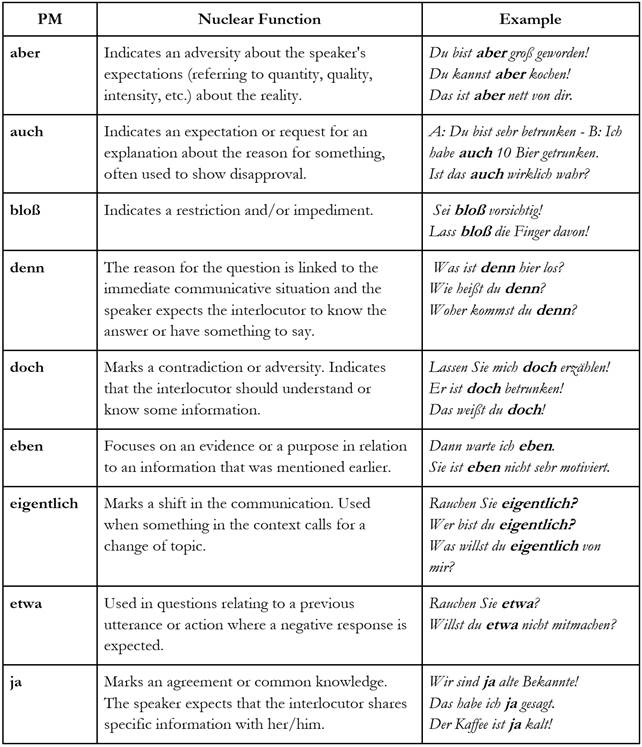
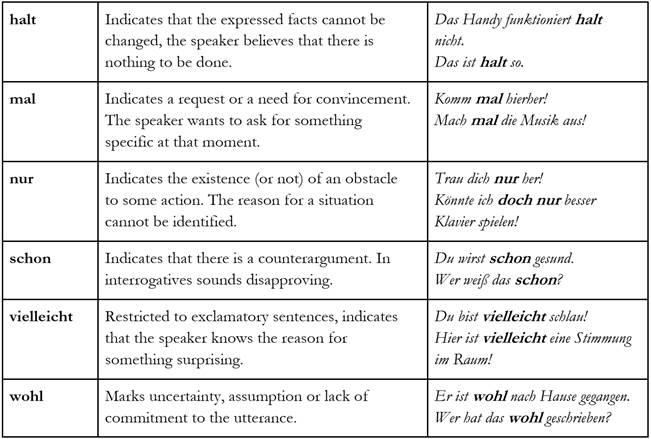
PRACTICAL APPLICATION OF THE DESCRIPTIVE TABLE
By having a highly structured internal paradigmatic organization, we consider in this article that each MP articulates a main communicative function which is present in all occurrences of each particle. Nonetheless, the specific pragmatic meaning of any MP must be understood both by the recognition of the nuclear function, as well as by the interpretation of the dialogic setting (AQUINO; ARANTES, 2020, p. 172). As was evidenced earlier, the nuclear function is not the same as pragmatic meaning, for example, in the utterance "Du kannst aber kochen", the nuclear function of the MP aber is to indicate that the speaker's expectation is different from the reality (AQUINO, 2023, p. 172). However, the pragmatic meaning depends on the comprehension of the dialogic setting in which the sentence with the MP refers, i.e., in the previous utterance the meaning could be either a compliment or an ironic comment on the lacking culinary skills of the interlocutor.
Thus, even in different contexts - with the specific meaning of praise or irony, as in the example above -, the communicative function of aber stays the same, which reiterates the validity of a nuclear function-based teaching approach. Regardless of the approach (minimalist or maximalist) the context must always be taken into account for the study of MPs, since their purpose is to anchor the utterance in a dialogic setting in a unique way (AQUINO, forthcoming). However, a clear advantage of the minimalist approach is that, once the communicative function of MPs is understood, students do not depend on memorization or on the various dialogic variables, they have access to a clear and objective definition of each MP. In addition to the work with the table of nuclear functions presented in the previous section, we consider authentic texts to be very relevant for teaching MPs in various learning contexts.
Considering the lack of authentic marks in textbooks of GAL (AQUINO; CHERCHIGLIA, 2021; MAIJALA, 2007), one of our aims in this section is to develop a didactic model using examples of occurrences of MPs doch and ja in Instagram postings from the following accounts: buzzfeedgermany, buzzfeedaustria, Hannoversche Allgemeine Zeitung and Funk for the German sample; leandro_assis_ilustra, tirasarmandinho (for the Brazilian Portuguese sample). The activities suggested in the next subsection can be adapted for different levels of language knowledge (between A2 and C1) and learning necessities. Using authentic texts in GAL permits the confrontation with different sociocultural realities allowing for greater engagement and participation with the language in use (AQUINO, 2023, p. 174). The social media Instagram is part of students' daily reality, and therefore, can be a motivating and practical teaching tool. In addition to offering linguistic inputs for teaching MPs, Instagram posts provide learners with a glimpse into the culture and context of the language, making language learning more meaningful and enjoyable.
In the next subsections, we present suggestions for activities with the MPs doch and ja based on their nuclear function, the comparison strategy (the same sentence with and without a MP or the same sentence with different MPs) and a contrastive analysis (MPs aí and bem que in Brazilian Portuguese).
Doch
One of the most frequent German MPs, doch marks a contradiction relation between the pragmatic pretext and the situation presented in the utterance. With doch the speaker indicates some kind of adversity, as it shows that the pragmatically presupposed unit should be available as part of the common knowledge shared by the interlocutors, reminding them of what is relevant for communication in a certain context (AQUINO, 2020, p. 142). Imperatives with the MP doch are very common, especially in spoken language, referring to an advice or invitation, or just impatient or excited accusations (SCHOONJANS, 2018, p. 42). According to Diewald et al. (2017), in imperative sentences the MP doch stresses the necessity of urgency of the expressed proposition, which is supposed to be already acknowledged by the addressee, as in the example:
(1) Lassen Sie mich doch kurz erzählen Let me tell you this, meaning: I want to say something now, let me speak
In declarative sentences the MP doch emphasizes that the speaker adheres to his/her opinion despite possible contrary views. The concessive-adversative function expressed by the MP doch in a declarative sentence can be exemplified in sentences such as:
(2) Das sagt doch keiner, dass die Ausländer rausgeschmissen werden But nobody is saying that foreigners will be kicked out, meaning: I know what I'm saying to you, please don't argue
Summing up, the nuclear function of doch is to indicate a contradiction or adversity. The speaker uses this particle to articulate that his/hers interlocutor should recognize or remember something: I say this because I want to advise/instruct you to realize or do something. With the following two Instagram posts, the teacher can support the definition of the nuclear function of doch and discuss the pragmatic meaning within the context.

In the example above, "Wir sind doch nur übers Wochenende weg"2 the MP doch presents its usual function of contradiction, the adversity can be understood by the relation between the utterance and the context presented by the image. The speaker chooses to use the MP doch to suggest a contradiction between the pragmatic pretext (the image with a woman with a huge pile of suitcases) and the situation presented in the utterance (they are going for a weekend trip). Thus, the speaker shows to his/hers interlocutor the need to take something into account, in this example, that for a trip of just a few days you don't need as much luggage.
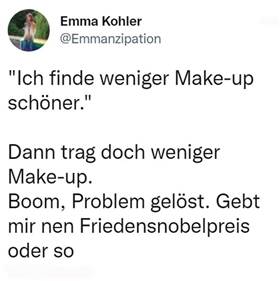
In this next exemple, someone says they think it's prettier when people wear less makeup (Ich finde weniger Make-up schöner). To demonstrate the adversity of this statement, the speaker responds using the MP doch: "Dann trag doch weniger Make-up".3 The MP doch is used here to indicate a contradiction through irony, that is, if you don't think a lot of makeup is beautiful, then simply don't use it - and stop criticizing other people. The nuclear function of doch is , therefore, preserved in this example, and what changes is the pragmatic meaning, in this case (image 2) an ironic confrontation and in the former example (image 1) a suggestion or advice.
With these two examples taken from Instagram posts, we were able to underline the nuclear function of the MP doch (contradiction or adversity) and recognize its specific meaning within the context (suggestion, irony). To better delineate the features of the MP doch, we propose a comparison strategy, first using the same sentence with and without a MP with the purpose of outline the MP specific function and pragmatic meaning as opposed to a sentence without a modal component, as following:
(a) What's the difference between the two sentences?:
Setz dich!
Setz dich doch !
The sentence without the MP represents a mere imperative statement (Sit down), whereas with doch the speaker wants to negotiate a meaning by expressing his/hers expectations and intentions. In this communicative situation, a contradiction is made known, for example, that the person is standing at the door for a long time and he/she is not considering coming in and sitting down, therefore, with the meaning of invitation or suggestion. Another interesting possibility to explain the function of the MPs doch is through a contrastive strategy with comparison to other languages (of MPs or other linguistic elements), as is the case of the MP aí in Brazilian Portuguese (AQUINO; KAHIL, 2022), as in the following example:
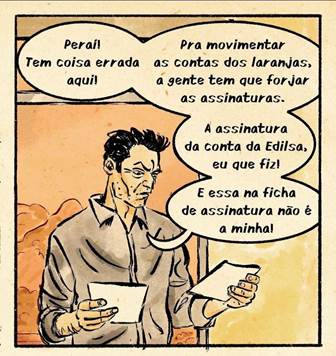
According to Johnen (1997), one of the first indications to recognize the modal function of aí is through a test with the question “where?”, i.e., if the sentence could be answered with where, aí is an adverb: "O arroz está aí na mesa - Onde está o arroz? - Aí na mesa".4 However, in a sentence like, "Peraí tem coisa errada aqui",5aí does not indicate a location to stop (parar), instead it has the function of request, invitation in a contradictive state of affairs: We need to pay attention to a problem that I just noticed. Furthermore, aí as an MP is used to intensify or attenuate imperative sentences with the main goal of convincing the listener to perform a certain action, in the example above the speaker wants to draw attention to the fact that something is wrong.
Ja
The MP ja marks an agreement or common knowledge, that some information in the utterance should be shared by the interlocutors, i.e., indicating an expectation of agreement in relation to what is being said (BRÜNJES, 2014, p. 144). Given that the information in the proposition should already be known to the listener, no contradiction is expected, i.e, the knowledge or expectations of the interlocutor were already taken into account (SCHOONJANS, 2018, p. 14). Thus, the nuclear function of the MP ja is to indicate an expectation of agreement about a shared knowledge or information in the context. The speaker uses this particle to confirm or assert the factualness of a given state of affairs: I say this knowing/hoping that you already know this or that you agree with me. As was discussed earlier, the exact meaning of each MPs can vary depending on the context. In the following, we address the communicative function of ja in two Instagram posts:
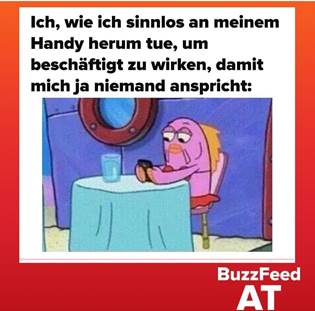
In the example above, "Ich, wie ich sinnlos an meinem Handy herum tue, um beschäftigt zu wirken, damit mich ja niemand anspricht"6 the speaker chooses to use the MP ja to indicate that he/she expects the interlocutor to activate a certain common knowledge or to agree with a particular piece of information. In this context, the humor of the post depends on the interlocutor, in this case we readers, identifying ourselves with the situation, that is, looking at our cell phone to avoid contact with other people. Such expectation of agreement about the pragmatic pretext (you know what I'm talking about, we use our phones in public places to avoid contact) is, therefore, marked by the nuclear function of MP ja. Irony is an important part of the pragmatic meaning. Thus, in this post the humor depends on the recognition of irony regarding the use of the phone to avoid talking to people.
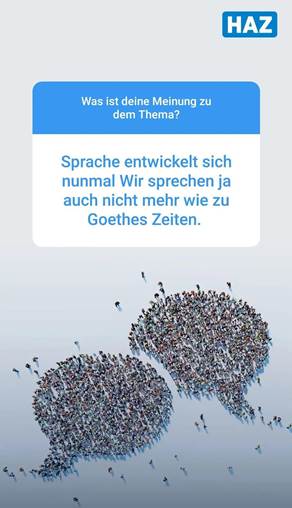
In the second example, the Hannoversche Allgemeine Zeitung asks in the stories about reader's opinion on the use of neutral language in German and a follower responds: "Sprache entwickelt sich nunmal, wir sprechen ja auch nicht mehr wie Goethes Zeiten"7. The follower uses the MP ja because of its nuclear function of agreement and shared knowledge, i.e., as a convincing argument: as everyone knows, or must know, we no longer speak the same language as in Goethe's time, because language changes constantly. Therefore, the MP ja agreement function is used to support an opinion through an argument that is (should be) a common knowledge shared by all newspaper readers.
With these two Instagram posts, it is possible to underline the nuclear function of the MP ja (agreement on a mutual knowledge) and recognize its specific meaning within the context (irony and a convincing argument). As in the subsection above, to better describe the features of the MP ja, we propose a activity with a comparison strategy, now the same sentence with different MPs, that can help outline the MP specific function and pragmatic meaning as opposed to a sentence without a modal component, as following:
(b) What's the difference between the two sentences?:
Die Katze ist ja gefüttert.
Die Katze ist doch gefüttert.
Given the nuclear functions of ja (agreement on a mutual knowledge) and doch (contradiction or adversity), the teacher could discuss with the students what change of meaning both MPs can bring to the utterance, "Die Katze ist gefüttert" (The cat has been fed). With the MP ja we suggest the following example: a couple are leaving the house, they are checking if everything is in order, then one of them says, "Die Katze ist ja gefüttert", meaning that, as the partner already knows, the cat is fed, so they can go. For the use of the PM doch, an example would be: before the couple leaves the house, one of them decides to feed the cat, while the other, who has already fed the cat, says, "Die Katze ist doch gefüttert", indicating a contradiction, namely, the interlocutor didn't know or didn't remember that the speaker already fed the cat. Another relevant approach of explaining the function of the MPs ja is through a contrastive analysis, as is the case of the MP bem que in Brazilian Portuguese (AQUINO; ARANTES, 2021), as in the following example:
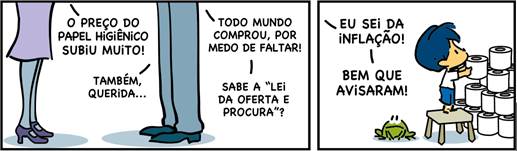
In the Portuguese normative grammars it is possible to find only the classification of bem (que) as an adverb, lacking any description for its modal function, a fact that is also true for all MPs of the Portuguese language (Brazilian and Portuguese). Aquino and Arantes (2021, p. 183) affirm that the MP bem que is used by the speaker to establish the validity of an assertion, referring to a strong expectation for the recognition of a shared specific information. In the context presented in the comics, the MP bem que refers to the situation during the pandemic where people bought too much toilet paper, which resulted in its price going up (inflation). The comic's humor is related to the irony, expressed by the MP bem que, that even though everybody knew that the price was going to increase if they buy too much, people still did exactly that. Therefore, "Bem que eles avisaram" (Well, they did warn us; Sie haben uns ja gewarnt) marks an expectation for the recognition of a shared specific knowledge, which makes the Comics ironic and the situation amusing.
CONCLUSION
Modal particles are essential components of everyday spoken and written German, understanding and using them is, thus, crucial for daily linguistic and social interaction. Despite their relevance, GAL textbooks and teaching materials do not provide adequate instruction and practical activities to teach MPs, leaving learners and teachers unsure about the subject. Taking these issues into account, the present work aimed to discuss an original proposal for teaching and learning MP through nuclear functions within the minimalist approach. This approach describes the particle's main communicative function, where the pragmatic meaning is analyzed within the context. The focus on a recurrent nuclear function for each MP allows for a more reflective learning process that encompasses the capacity for meta-representation, rather than memorization of possible meanings of each particle. With the understanding of the MPs nuclear functions, the students can progress to a more intuitive and autonomous use of these modal elements.
Based on the experience gained in a extension course for GAL teachers at USP, we presented in this work a didactic proposal in two steps: (i) a table with the nuclear functions of 15 MPs and some examples; (ii) a practical application through the nuclear functions of MPs doch and ja in written Instagram posts within the comparison strategy (the same sentence with and without a MP or the same sentence with different MPs) and a contrastive analysis (MPs aí and bem que in Portuguese). The didactic proposal was developed as a suggestion for a critical and reflexive application of the nuclear function table as a teaching tool for MPs. Therefore, our main goal was to introduce an organized, objective and practical foundation for the teaching of MPs in various learning contexts.
Much work still needs to be done in terms of linguistic research and teaching proposals of German Modal Particles. It is essential to continue developing specialized courses and materials that provide learners and teachers with a more comprehensive understanding of these modal elements, enabling them to use them effectively in their language learning journey. For future work, it would be meaningful to put this teaching proposal into practice and interview students and teachers about their perceptions and necessities. In addition, we consider it critical to develop local teaching materials with practical activities for proper instruction and discussion on these linguistic elements so essential for interaction.
REFERENCES
ABRAHAM, Werner. Discourse particles in German: how does their illocutive force come about? In: ABRAHAM, Werner. (Ed.). Discourse particles: descriptive and theoretical investigations on the logical, syntactic, and pragmatic properties of discourse particles in German. Amsterdam: Johns Benjamins, 1991. p. 203-252 [ Links ]
AQUINO, Marceli. Projeto Novela: uma abordagem comunicativa e intercultural no ensino de alemão como língua estrangeira. Pandaemonium Germanicum, São Paulo, v. 22, n. 38, 2019, p. 31-47. [ Links ]
AQUINO, Marceli. The teaching of German modal particles: didactic strategies in GFL. Revista Brasileira de Linguística Aplicada, Belo Horizonte, v. 20, n. 1, 2020, pp. 131-161. [ Links ]
AQUINO, Marceli. Das sieht ja ganz anders aus, wie fühlst du dich denn? Teaching Modal Particles ja and denn with the Queer Eye Germany series: a didactic model based on a Descriptive Format. Pandaemonium Germanicum, São Paulo, v. 26, n. 49, p. 170-195, 2023a. [ Links ]
AQUINO, Marceli. A description of the pragmatic function of mas e aí in Brazilian Portuguese: contrastive analysis on the functional equivalents of German Modal Particles. Revista Diálogo das Letras, Rio Grande do Norte, v. 12, p. e02304, 2023b. [ Links ]
AQUINO, Marceli; ARANTES, Poliana Coeli Costa. Partículas modais em alemão e seus equivalentes funcionais em português brasileiro: proposta de análise e classificação para o uso. Pandaemonium Germanicum, São Paulo, v. 23, n. 40, 2020, p. 166-190. [ Links ]
AQUINO, Marceli; CHERCHIGLIA, Adriano. Textos didatizados e não didatizados de alemão como língua adicional: uma análise quantitativa e qualitativa para o projeto Zeitgeist . Pandaemonium Germanicum, São Paulo, v. 24, n. 44, 2021, p. 421-451. [ Links ]
AQUINO, Marceli; KAHIL, Tamires. As partículas modais Mas e Aí pela perspectiva de falantes do português brasileiro: uma investigação da linguagem em uso. Revista Confluência, Rio de Janeiro, v. 2, n. 63, 2022, p. 198-399. [ Links ]
AQUINO, Marceli; FERREIRA, Mergenfel A. Vaz. German as an Additional Language with a decolonial focus: a discussion on didactic proposals for the Zeitgeist project. Domínios de Lingu@gem, Uberlândia, v. 17, n. 709, 2023, p. 1-33. [ Links ]
BRÜNJES, Lena. Das Paradigma deutscher Modalpartikeln: Dialoggrammatische Funktion und paradigmeninterne Opposition. Berlin: de Gruyter, 2014. [ Links ]
DIEWALD, Gabriele. Same same but different: modal particles, discourse markers and the art (and purpose) of categorization. In: Degand, L.; Pietrandrea, p.; Cornillie, B. (Ed.). Discourse markers and modal particles: categorization and description. Amsterdam: John Benjamins, 2013, p. 19 - 46. [ Links ]
DIEWALD, Gabriele; KRESIĆ, Marijana; BATINIĆ, Mia Angster. A format for the description of German modal particles and their functional equivalents in Croatian and English. In: Chiara , Fedriani; Sansó, Andrea (Ed.). Pragmatic Markers, Discourse Markers and Modal Particles: New Perspectives. Amsterdam: John Benjamins, 2017, p. 230-254. [ Links ]
HENTSCHEL, Elke; WEYDT, Harald. Handbuch der deutschen Grammatik. Berlin: De Gruyter, 2013. v. 4. [ Links ]
JOHNEN, Thomas. Aí como partícula modal do português. In: CONGRESSO INTERNACIONAL DA ASSOCIAÇÃO BRASILEIRA DE LINGÜÍSTICA, 2, Salvador. 1997 Atas do1 o Congresso Internacional da Associação Brasileira de Lingüística. Bahia: Universidade Federal da Bahia, 1997. p. 1-5. [ Links ]
maijala, minna. From the storybook to the modern textbook - The development of Finnish German textbooks in the 20th century. Neuphilologische Mitteilungen, v. 108, n. 1, 2007, p. 201 - 221. [ Links ]
SCHOONJANS, Steven. Modalpartikeln als multimodale Konstruktionen: Eine korpusbasierte Kookkurrenzanalyse von Modalpartikeln und Gestik im Deutschen. Berlin: De Gruyter, 2018. [ Links ]
THURMAIR, Maria. Alternative überlegungen zur didaktik von modalpartikeln. Deutsch als Fremdsprache, Regensburg, v. 47, n. 1, p. 3-9, 2010. [ Links ]
WEYDT, Harald (Org.). Partikeln und Interaktion. Tübingen: Niemeyer, 1983. [ Links ]
1Article published with funding from theConselho Nacional de Desenvolvimento Científico e Tecnológico- CNPq/Brazil for editing, layout and XML conversion services.
Received: April 13, 2023; preprint: April 13, 2023; Accepted: June 10, 2024
 Este é um artigo publicado em acesso aberto sob uma licença Creative Commons
