




Serviços Personalizados
Journal

Artigo
 texto em
  Inglês (pdf)
 Artigo em XML
 Tradução automática
 Enviar este artigo por email
Compartilhar

 Permalink
Educação em Revista
versão impressa ISSN 0102-4698versão On-line ISSN 1982-6621
Educ. rev. vol.40 Belo Horizonte 2024 Epub 12-Dez-2024
https://doi.org/10.1590/0102-469847923
Relacionado com: 10.1590/SciELOPreprints.6587
Articles
THREE BRAZILIAN MUSEUMS AND THE ATTENDANCE AT SCHOOLS (1890-1934): PEDAGOGIUM, MUSEU DO IPIRANGA, MUSEU NACIONAL1
1
, preparation, creation, or presentation of published work, specifically the display/presentation of data, active participation in the analysis of documents, organization of the text, and review of the final draft http://orcid.org/0000-0002-7790-2884
1
, active participation in the analysis of documents, writing of the text, organization of the text, and tableshttp://orcid.org/0000-0002-6309-7220
2
, active participation in the analysis of documents, writing of the text, organization of the text, and tableshttp://orcid.org/0000-0003-0508-2095
1Pontifícia Universidade Católica de São Paulo, São Paulo (SP), Brasil.
2Secretaria Municipal da Educação de São Paulo, São Paulo (SP), Brasil.
In different definitions of museums over time, it is possible to see their educational role; after all, exhibiting collections intrinsically intends to educate visitors. This article aims to problematize museums' historical and educational character to highlight different forms of relationship between the museum and the school, whose configurations are historically debated and often present conflicts. The study focuses on the attendance of schools, in the late 19th century and the early 20th century, in three institutions that were symbols of the museum expansionism period in Brazil: Pedagogium (RJ), the Museu do Ipiranga (SP), and the Museu Nacional (RJ). The research presents the relationship between the museum and schools privileging the field of history of education. It is supported by theoretical studies and broad critical analysis of documents such as legislation concerning the educational area, normative documents on museums, scientific and dissemination journals produced by the institutions, reports, requirements, letters, and scientific catalogs, among others. The results show that the institutions have practices for serving the school public, aligning themselves with educational determinations and innovative pedagogical precepts in each context. It is also possible to point out the limits and practices of those responsible through their scientific role or in the face of symbolic and political challenges specific to each institution.
Keywords: Education in museums; Teaching in museums; History of science teaching; History of museums
Em diferentes definições sobre museu, ao longo do tempo, é possível constatar a sua função educadora, mesmo porque o ato de expor coleções tem intrínseca a intencionalidade de educar os seus visitantes. Este artigo pretende problematizar este caráter histórico-educativo dos museus de modo a evidenciar diferentes formas de relacionamento entre o museu e a escola, cujas configurações são historicamente postas em debate e, não raro, apresentam conflitos. Foi privilegiado o estudo do atendimento ao público escolar, no final do século XIX e início do século XX, em três instituições símbolos do período de expansionismo dos museus no Brasil: o Pedagogium (RJ), o Museu do Ipiranga (SP), o Museu Nacional (RJ). A pesquisa apresenta a relação entre o museu e a escola privilegiando o campo da história da educação e está amparada em estudos teóricos e ampla análise crítica dos documentos tais como: legislações pertinentes à área educacional, documentos normativos referentes aos museus, revistas científicas e de divulgação produzidas pelas próprias instituições, relatórios, requerimentos, cartas, catálogos científicos, entre outros. Viu-se que as instituições possuem práticas de atendimento ao público escolar, alinhando-se às determinações educativas e aos preceitos pedagógicos inovadores em cada um dos contextos. Também é possível apontar os limites e as práticas dos responsáveis, mediante a sua função científica ou frente aos desafios simbólicos e políticos específicos a cada uma das instituições estudadas.
Palavras-chave: Educação em museus; Ensino em museus; História do ensino das ciências; História dos museus
En diferentes definiciones de museo a lo largo del tiempo, es posible verificar su función educativa, pues el acto de exponer colecciones tiene la intención intrínseca de educar a sus visitantes. Este artículo pretende problematizar este carácter histórico, educativo, de los museos para evidenciar diferentes formas de relación entre el museo y la escuela, cuyas configuraciones son históricamente puestas en discusión y, a menudo, presentan conflictos. Fue privilegiado el estudio de la atención al público escolar, a finales del siglo XIX y principios del XX, en tres instituciones que fueron símbolos del período expansionista de museos en Brasil: Pedagogium (RJ), Museo de Ipiranga (SP), Museo Nacional (RJ). La investigación presenta la relación entre el museo y la escuela privilegiando elcampo de la historia de la educación, está amparada en estudios teóricos y amplio análisis crítico de documentos tales como: legislación pertinente al área educativa, documentos normativos referentes a museos, periódicos científicos y de divulgación elaboradas por las propias instituciones, informes, requerimientos, cartas, catálogos científicos, entre otros. Se observó que las instituciones tenian prácticas de atención al público escolar, alineándose con determinaciones educativas y preceptos pedagógicos innovadores en cada uno de los contextos. También es posible señalar los límites y prácticas de los responsables, a través de su rol científico o frente a desafíos simbólicos y políticos propios de cada una de las instituciones estudiadas.
Palabras clave: Educación en museos; Enseñanza en museos; Historia de la enseñanza de las ciencias; Historia de los museos
INTRODUCTION
Even though the definitions of museums have been modified over time and the scope of their roles has changed, it is possible to see that their public education activities have been one of their most striking characteristics. Whether to preserve a legacy, a patrimony, to safeguard collections, to exalt the homeland and the nation, to gather objects from travelers, etc., displaying artifacts on public display denotes the intention of these institutions to educate their visitors, among them, the school community.
Today, we can see that concerns about the education of school audiences persist, as seen in the actions of the Museu Paulista, better known as the Museu do Ipiranga, one of the places in focus in this article, when presenting its educational proposal after undergoing a long process of remodeling its museum space, indicating the three axes of education for those who visit it: school-based, inclusive and spontaneous. Regarding the school audience, there has been an interest in establishing a close relationship with this group since the 19th century. This Museum shows that it is directly involved with the school community by disseminating its support materials aimed at teacher training, publicizing different content about its collections to encourage interrelationships between the parties, and making it clear that it is supported by the Common National Curricular Base (BNCC-Base Nacional Comum Curricular).2
However, in the 1990s, another discussion went against this perspective of closer relations, defending the possibility of “deschooling museums” (Etherington, 1989; Lopes, 1991). According to Etherington (1989, p. 69), museums should provide for the autonomy of their audiences. The very close relationship between museums and schools was criticized by this author because, according to her proposal, schooling would be sustained by a “coercive” link with teaching guidelines and, consequently, museums would reflect this position, often in line with school curriculums. Therefore, the author defended that museums should capture the messages of their audiences to dynamically integrate them into collections and exhibitions, enabling an education that is more attentive to the realities of the world, instead of being guided by the norms of the school universe. Contradictorily, she said that this action would be closer to skholé which, in the Greek sense, seeks knowledge through an ennobled leisure “dedicated to the contemplation of ideas” (Etherington, 1989, p. 71). That is, the school should not have the power to guide the practices of museums, since schools no longer contemplated the philosophical foundations of their Greek root focused on free thought.
Lopes (1991) supported the idea of deschooling museums by presenting a historical framework of their educational sections, viewing them as part of an educational agency when, in the 1930s, an association between museums and schools was encouraged by the action of the Escola Nova socio-educational movement. The Museu Nacional is exemplary as it was adjusted to public education as a solid complement to school knowledge to illustrate the programs of different subjects taught at the time. The author agrees with the contribution of the Museum to school education, but indicates them as centers of autonomous knowledge production so that they can even counter school discourses to uncover new knowledge.
Meneses (2000) also participates in the debate by presenting four debatable dimensions in the education and museums binomial at the beginning of the 21st century. At that time, the researcher was concerned about the number of schoolchildren who were merely scribes of captions and communication panels for museums, with the consent of the institution's teachers and staff. He notes that, in identity and memory, a museum must grant critical awareness of these meanings to the public by making them think with its collection. Providing them with information is not the same as providing knowledge. A museum educates because it provides more questions than answers, so knowledge passes through the artifacts, allowing access to the body and moving away from “exclusionary logocentrism” (Meneses, 2000, p. 99). This author, who was once a director of the Museu do Ipiranga, shows that those responsible for this space do not shy away from educational debates, highlighting practices considered the most appropriate for using spaces and collections in the name of knowledge. It also shows that the discussion about education in museums does not escape other elements of culture that are opposed to the fabric of the intended meanings of education while the museum absorbs new languages, knowledge, and innovations.
The ideas presented so far show a history of museums full of discussions about how these institutions should educate and the best ways to relate (or not) with the school, sometimes showing complete and well-founded adherence to educational guidelines. Sometimes they seek to dissolve them, pointing out that the museum has an autonomous nature from the school processes and, therefore, the relationship between the two institutions can be complementary, despite being distinct from each other. Thus, it is interesting to understand, through documentary analyses and studies primarily linked to the field of the history of education, the network of social relations responsible for making museums also educational spaces par excellence and in what way, more or less operationalized, they organize the work specifically aimed at the interests of the school public.
The identity and exhibitions of museums, at different times, are presented by a linguistic system to decode those who appreciate them, and this educational contact is dependent on the forms of communication between museums and their audiences, whose configurations are disputed over time. This permeates aspects linked to the character of the museum, the prevailing epistemologies of the reference sciences that guide it, the dynamics of practices and the production of knowledge in the museum field, among others. Furthermore, museums are not isolated from the world and, as such, are subject to the interests of the school community that has long been their loyal audience. Thus, the educational processes invented by museums lead us to think about the different theories about their function, exhibitions and education that, historically, are presented by studies of documentation of and about museums, at different times, indicating the possible variations in service to the school audience.
This article investigates how this relationship between the museum and the school came about, showing that such educational action is formalized within the limits of the museum and its collections but it is also dialogically structured by the knowledge and approaches given by innovative pedagogical references, according to the legal and time-varying educational purposes. The aim is to emphasize the educational actions within the limits of knowledge and scientific frontiers of each institution chosen for this analysis, focusing on the educational principles of serving the school population. Historically, the relationship between museums and schools is inevitable. For this reason, it is up to us to understand the different variations of this association.
Methodologically, we follow what Possamai and Julião (2019) say about the trinomial museum, history, and education, pointing out the relevance of presenting them through a unified analysis, questioning the relationship between education and museums in different spaces-times, to understand how the educational process takes place.
The museums chosen for this study stand out as important establishments in the era of museum expansionism in Brazil, with different purposes and values. They are: Pedagogium (RJ), an educational museum designed simultaneously to train teachers and as a showcase for teaching materials; Museu do Ipiranga (SP), a monumental institution that was born as a Natural History museum; and Museu Nacional (RJ), whose history dates back to the arrival of the royal family and also stands out as a Natural History museum. The similarities and differences in the purposes of the chosen museums are justified by the possibility of understanding what uses their collections and proposed activities are for the education of the school population, considering a dialogue between museological interests and the educational determinations of each context.
The presentation of their educational activities supports the development of the works, exhibition formats, training activities, etc., between the end of the 19th century and the 1930s, a period in which teaching by the intuitive method, the acceptance of knowledge through access and observation of things prevailed and, later, with the discussions of new innovative didactic perspectives based on the ideals of the Nova Escola. Lopes (2001) reiterates the historical position of museums as educational institutions, saying that at the end of the 19th century, museums and offices became institutions aligned with public education, supported by the idea that direct observation is the main source of knowledge through the exhibition of objects (Lopes, 2001). The reflections that intersect museum education, the pedagogical and legal determinations of public education, and the current teaching methods will be further explored throughout the text.
A broad theoretical and documentary discussion supported this study. From a theoretical perspective, it is understood that museum institutions were created for educational purposes and their relationship with the educational world is in line with a broader discussion on the formation of audiences, to promote republican citizens. Lafuente and Valverde (2022) explain that the movement to transform collections and their transition from the common world to the public world coincide with government actions to idealize the education of the people. This was another way of building a revolutionary invention: the “citizen.” A well-educated individual who represents the values of the Enlightenment. Many museums emerged to avoid dispersion and aim to guarantee the conservation of public heritage to educate this imagined citizen.
Thinking about the condition of training citizens, Poulot (2013, pp. 19-20) identifies that the field of museology has developed its meanings, further emphasizing its pedagogical character, as it is a place that increases the quantity and quality of knowledge. And when we say “field of museology”, we must consider that we are not talking about something lost in time and space, but about objective processes between people and institutions that organize the identity and identify the qualifications that characterize a given museum. For this reason, it is strange to think that a museum can be seen as detached from its immediate purpose of educating populations and, even less, from what is presented as the “future generation”.
The documentation analyzed follows the regulations pertinent to the educational and museum areas and is related to the particular histories of each museum analyzed. The presentation of the article is the result of a critical analysis of documents produced in their different contexts, which are listed here by typologies: legislation and presentations of standards (museum decrees and regulations); descriptions of the daily life of the institutions (annual reports, records in teaching yearbooks, guest books, etc.); journals produced by the museums (Revista Pedagógica, Revista do Museu [Paulista], Revista Nacional de Educação); the daily press (Gazeta de Notícias, A Imprensa, A Notícia, O Paíz, O Estado de S.Paulo); other printed material (Almanak, books, manuals); photographs and illustrations. The study of such documentation is intertwined with recent empirical research on the histories of the three museums presented and whose practices focus on the school population.
As we will see, the relationship between these institutions and the educational world is varied, depending on the type of museum and the historical processes that constituted it, including showing that the narrowing of ties between the two institutions did not necessarily occur as a result of the historical and educational processes of the Nova Escola, since, depending on the museum, its relationship with the processes of education are intertwined with the political conduct of their constitutions, when they are inaugurated within a structured and broad framework of Public Education, the core of which points to the composition of a network of scientific and educational institutions that, together, are the materiality of such a formative process of populations.
NATIONAL PEDAGOGICAL MUSEUM - PEDAGOGIUM: SHOWCASE OF TEACHING MATERIALS AND TEACHER TRAINING
The Museu Pedagógico Nacional - Pedagogium - was founded in 1890 by Decree Law number 667, but with Decree number 981 of 1890, which provided for the reform of primary and secondary education - Benjamin Constant Reform - its operation was fully established, as well as its objectives and organization were presented, considering, also, a complex process of collection transfers3. The Pedagogium was intended to offer the public and teachers, in particular, the means of professional instruction, the exhibition of the best methods, and the most advanced teaching material4. Throughout its operation, two people held the role of a director for the longest time: professors Menezes Vieira and Manuel Bomfim. The Pedagogium operated for 29 years and was closed in 1919, by determination of Decree number 1360 (07/19/1919).
The Pedagogium's main objective was to train teachers, although the documentation also points to other roles. This Museum offered teachers courses and conferences to improve their performance in implementing the so-called new and modern school programs. Thinking about teacher training was a reason for debates around its operation, both to justify the defense of its continuity and also to fuel feelings against its operation, under the allegation that the Normal Schools already fulfilled this role (Marchi da Silva, 2021).
This institution should be seen as an attempt by the republican government to centralize education in the country, with the Museum as a guiding body for pedagogical models and providing training based on the organization of its collections. The Museum roles as a body for presenting innovative pedagogical material to free public education (REVISTA PEDAGÓGICA, 1898, no. 48, p. 227). The primary and secondary education programs were essential for the characterization of the Museum as a systematic training body. In this case, these programs were the guiding items of what would be in the exhibition as a form of evidence of pedagogical modernity.
Following the law and in keeping with the requirements of public education, the Museum should offer courses that are immediately relevant to primary and secondary education levels, focused on the intuitive method, considering “practical” teaching mediated by the use of objects (Marchi da Silva, 2021). This teaching method understands that true knowledge depends on the physical and concrete presentation of things so that, intuitively, the student can expand their knowledge, starting from simpler to more complex elements.
The decree also determined that full professors and adjunct professors had the duty to faithfully execute the teaching programs and attend conferences whenever they were notified to do so by the General Inspectorate. This means that professors could be called to attend conferences offered by the institution and use the presentations for their practical classes.
The purpose of the space was to be a place for pedagogical complementation, both in terms of current courses and through the use of exhibitions for classes attended by students. The Pedagogium was a place for teacher training but also for appreciating teaching materials. By visiting this Museum, visitors and teachers would come into contact with teaching materials considered to be the most modern and come from the most renowned manufacturing companies in the world. Teaching teachers to use these materials was an obligation of the Museum (Marchi da Silva, 2021).
The courses were offered at night and were open to the public, with only the best seats reserved for teachers5. The room for open courses and lectures had a capacity for 120 people (ANNUÁRIO DE ENSINO DO RIO DE JANEIRO, 1895, p. 470), reaching over 4,000 spectators that year. The laboratory experiments would be carried out under the supervision of the museum's curator (REVISTA PEDAGÓGICA, 1894, nº 40, pp. 298-299).
The conferences published in the Pedagogical Journal show that such events also defend political positions beyond educational ones, making the space a stage for pressing issues of general interest, whether the educational, political, social organization, or the dissemination of science and technology. Teacher training was understood in a broad sense, as it was not limited to the specifically pedagogical subject (Marchi da Silva, 2021).
After this regulation, in 1895, training events appeared very frequently in the city's newspaper advertisements, along with the names of the responsible teachers:
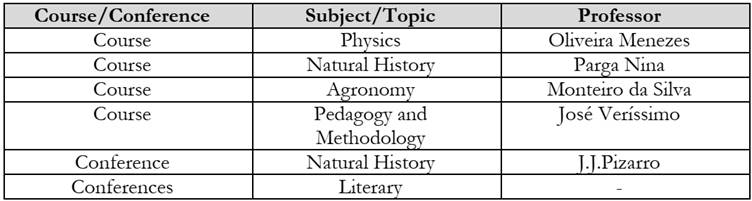
Source: Jornal Gazeta de Notícias (May to October 1895; Jornal do Commércio (1895)
Box 1 List of courses and teachers (1895)
In Box 1, we see different types of courses and conferences presented to the public, pointing out some examples of approaches to themes in such events to have an overview of the training processes through such classes. In his inaugural lecture, professor José Veríssimo proposed a discussion on the importance of Pedagogy, seeking to present the problems of education and its methods (REVISTA PEDAGOGICA, 1895, no. 44, pp. 139-140). The public lecture given by J.J. Pizarro, on June 8, 1895, entitled “The voice of the word from the point of view of language”, addressed the functioning of the voice and the development of language in the human species in different people (REVISTA PEDAGOGICA, 1895, no. 45, p. 194).
According to the Pedagogical Magazine, the Agronomy lectures by Professor Monteiro da Silva were attended by school inspectors, general inspectors, and primary school teachers. In addition, the professor used agricultural instruments, specimens from the Deyrolle Museum and wall charts, materials that could be found at his stands for examination and purchase (PEDAGOGICAL MAGAZINE, 1892, VOLUME 3, no. 18, p. 365).
In 1896, the number of courses was expanded and, in the same way, there was an increase in the number of attendees, totaling 4,916:
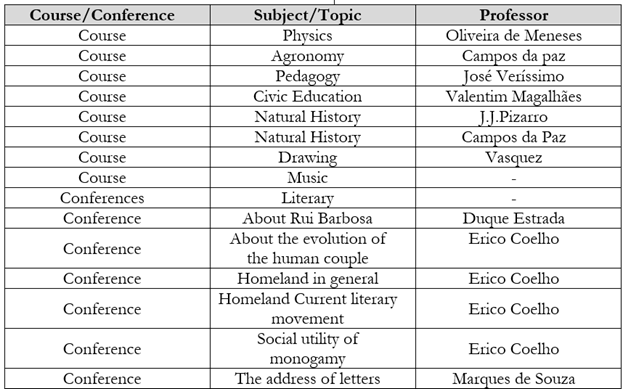
Source: Jornal Gazeta de Notícias (February to October 1896); Jornal do Commércio (1896)
Box 2 List of courses and teachers in 1896
The following year, we see professors Campos da Paz of Agronomy; José Veríssimo of Pedagogy; and professor Valentim Magalhães of Civic Education, presenting their respective courses (REVISTA PEDAGÓGICA, 1896, number 48, p. 238). In 1896, the Museum also offered more lectures than in the previous year, most by professor Erico Coelho, who devoted himself to a series of presentations on themes related to the teaching of Morals, presenting themes such as “Civic education: its importance and necessity” (REVISTA PEDAGÓGICA, 1896, no. 48, p. 227); or “Duty; your nation. Classification of duties” (REVISTA PEDAGÓGICA, 1896, no. 48, p. 232).
The Museum also supported the argument of training teachers through observation, through viewing its collections. In Figure 1, it is possible to recognize, from a specific angle, an example of the activities of collections for teaching through observation, through the use of their direct exposure: the Natural History collection.
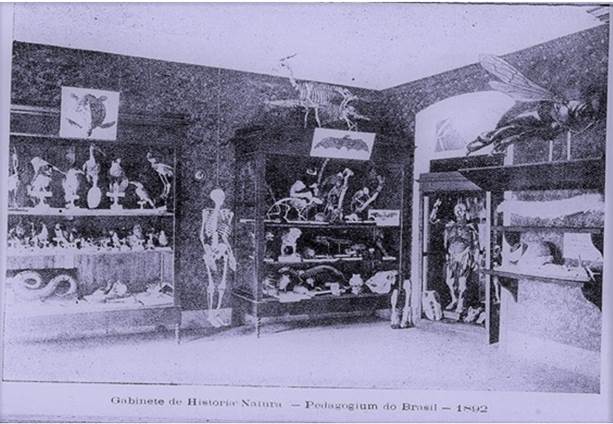
Source: Image taken from the Rio de Janeiro Education Yearbook (1895, n.p.)
Figure 1 Natural History Office of the Pedagogium- 1892
Figure 1 shows part of the natural history cabinet in its first location in 1892. When observing closely, we can see three display cabinets and fixed open shelves in the right corner. A descriptive summary shows the potential for directing the eye to a series of objects displayed for public viewing. The glass cabinet in the left corner holds a parietal painting with an illustration of a turtle hanging in the upper central part. It has three shelves filled with objects: on the first shelf from top to bottom, there are taxidermied birds; on the next shelf, you can see a large number of objects, many of which are also taxidermied birds; on the last shelf of this cabinet, there are objects fixed to wooden bases that can be hung on the wall. Between the two cabinets, there is a life-size human skeleton, mounted and held by a wire fixed to the ceiling.
Following the description in Figure 1, in another cabinet on the right, two animal skeletons mounted on the upper part can be seen. This cabinet also allows the identification of a parietal frame of what appears to be a bat, in its upper central part. Three shelves can also be identified: on the first, on the upper one, there are mounted skeletons and taxidermied species of monkeys, and on the right corner, there is a small frame representing a bird; on the shelf immediately below, there are more unidentified taxidermied animals. On the lower shelf, there are taxidermied pieces and skeletons of animal skulls. Next to the right of this cabinet, there is a new display cabinet, with a piece depicting a human body. This piece occupies a cabinet by itself and, like the human skeleton, is life-size.
Finally, in the right corner, there are open shelves fixed to the wall. On these shelves, there are three objects mentioned in the documentation as clastic pieces: a bee, on the first shelf from top to bottom; a silkworm, a piece on a wooden base that could be hung on the wall; and a snail. Even though it is not possible to see the entire cabinet, one gets an idea of the diversity of pieces in the Museum.
The visual organization of the Natural History Cabinet encourages visitors to compare objects, which are grouped according to their morphological classification, highlighting those that represent the human body. The Pedagogium also provided instructions for setting up school museums, indicating the most interesting objects for the composition of a good collection, the essential pieces, and a possible organization. Although at first the observer is faced with a grouping of objects, it is clear that the setting up of a school museum follows criteria responsible for the visual instruction indicated by the Pedagogium and, not coincidentally, encourages the purchase of products.
More than just offering courses and conferences, the Museum suggested models for organizing school collections, such as in the exhibition of its office. By visiting it, teachers would receive intellectual training and could observe, in practice, how a school museum should be set up in their teaching unit. The Museum was a training center that articulated different types of instruction; this meant that it suggested models for visual organization for school collections and offered what was considered modern, innovative, and technological. Because it was interconnected with similar museums in other countries, it was up-to-date, indicating to teachers how their perspective was appropriate to what was circulating worldwide in similar pedagogical museums. By attending the Pedagogium, teachers would have contact with the inventions of the market, making the space a museum of great novelties (Marchi da Silva, 2021).6
In part, the Pedagogium is an educational museum created specially to assist the school public and, therefore, follows the educational standards of the time to assist a specific community, legally encouraged to educate and consume innovative products. Its collection did not aim to create representations of the past, but rather the possibility of visualizing a future through idealizations, as it projects a type of visual and scientific education.
MUSEU PAULISTA: IPIRANGA RESEARCH, EDUCATION AND MONUMENT CENTER
According to Alves (2001), the process of establishing the Museu Paulista was quite turbulent and divided opinions. Even during the imperial period, the monarchists defended the construction of a monument dedicated exclusively to the memory of national independence. The Republicans, led by influential figures such as Rangel Pestana, defended the creation of a monument dedicated to education and the development of science. The construction of a palace in Ipiranga to celebrate the country's independence was a project that began during the Empire, in 1885, but that only started during the Republic, in 1890, having been appropriated by the Republicans. The creation of the Museu Paulista as a scientific institute contemplated both sides: the construction of a palace to commemorate independence, but occupied by activities and objects of education and science (Alves, 2001, p. 33, 40, and 44).
On the one hand, there was Rangel Pestana's public education project, which saw the palace monument to Brazil's independence as an opportunity to develop science and public education, that is, he indicated that “the commemoration was a means and education an end” (Alves, 2011, p. 39). In his understanding, education should promote the expansion of scientific knowledge as a way of helping the population of the time to achieve progress7. On the other hand, this same intellectual participated in the debate on education reforms, disseminating his educational project as a journalist for the journal A Província de S. Paulo (Hilsdorf, 1987). The intellectual and politician was also an advocate of pedagogical innovation through the application of the intuitive method, which became the official teaching method of the state of São Paulo.
The Museum was a knowledge-producing body, a scientific center, and an institution linked to the state's public education project, also comprising the following institutions: the School of Medicine, the Polytechnic School, the First Public Gymnasium of the Capital, and the Normal School of São Paulo (Braghini; Marchi da Silva, 2017). On the Museum, research into the Museu do Ipiranga clearly shows its dual character, scientific and educational, according to Alves (2001), Grola (2014), and Stepanenko (2015).
Alves (2001) presents it as a Natural History Museum, included in a broad public education project and linked to the ideals of the São Paulo republicans, historical reformers of education. Grola (2014) understands the public exhibitions and the presentation of the collections of this Museum as a dialogue with its public, in which nature was seen, highlighting species of animals, mainly South American. Stepanenko (2015) expands on the idea that the institution has assumed, since its foundation, this dual educational and scientific character. The speeches highlight the constitution of the Museum as a landmark of São Paulo's education also in its built heritage (boulevard, gardens, monument building) and its collections and exhibitions.
The establishment of the Museu Paulista occurred simultaneously with discussions on the process of schooling the working classes and the expansion of public education through the dissemination of school groups. Throughout the debates for its creation, there was a justification for its scientific nature in parallel with its educational function (Braghini; Marchi da Silva, 2017). This institution would be representative of a general plan of public education with projections that aimed to represent the ideal of the nascent republic.
According to Marchi da Silva (2015), Stepanenko (2016) and Braghini and Marchi da Silva (2017), three categories of activities developed by the Museu Paulista in its first years of operation and directly related to education stand out: receiving schoolchildren, scientists and the general public; using the collections and laboratories for the study and practical teaching of science; and providing objects and collections to schools, helping them set up their school museums.
Visits to the Ipiranga Palace-Monument began before the inauguration of the building by the general public, during its construction. Promoting educational processes in these external spaces was one of the concerns of its director since he demanded access for visitors through requests to the government for improvements in the supply and prices of transportation (Stepanenko, 2016).
The idea was that the building's architecture would be understood for its instructive character to record the grandeur of the country and promote the idea of a nation engendered by modernity after Independence. In addition, the Museum's external areas and gardens were also used for various activities, such as official ceremonies, civic rituals, school trips, and Independence celebrations, which attracted a significant number of people (Stepanenko, 2016).
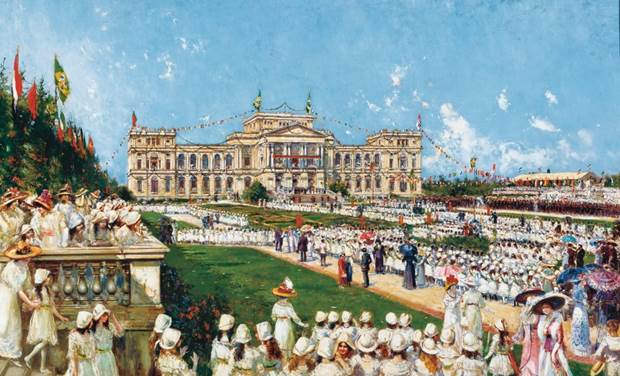
Teruel (1912). Oil on canvas 99x150 cm. Image is part of the collection of the Pinacoteca do Estado de São Paulo.
Figure 2 School Party in Ipiranga (1912)
This representation (Figure 2) shows a school party beautifully recorded in the gardens of the Museum. The gardens were constantly used for various activities but mainly for civic rituals such as the Brazilian independence celebration (Stepanenko, 2016). In the case of the image, we see the exploration of the color white, ritualized in different battalions of girls, lined up in front of the Museum and having military rites. This is not just any ceremony but a large presentation of the school public in front of a richly decorated museum. The newspaper O Estado de S. Paulo records one of these parties on September 7, 1912, the same year as the painting. It indicates that, at the independence celebration of that year, 10,058 students were present, sang the anthem, performed in front of the ceremonies, took part in a parade, and, finally, ate snacks and received sweets8.
The visitors to the Museu Paulista and its surroundings were scientists, distinguished figures, students, and ordinary people who used the space for research, instruction, and leisure. There are records of visits by professors representing their schools or accompanied by their students. The institution's visitor's book contains information about visits by the schools and other educational and research institutions, including visits by Professor Henrique C. de Magalhães Gomes, a professor at the Escola Polytechnica and Ginásio de São Bento. Ginásio Macedo Soares visited the museum on two occasions (VISITORS' BOOK, 1914, n.p.).
One of the great hallmarks of the Museum's relationship with its public came from requests from natural scientists, professors, and students to conduct studies on its premises. There are records of scholars in the Museum's laboratories, high school students, and candidates for competitive examinations who frequented its premises for this purpose (REVISTA DO MUSEU PAULISTA, 1914, pp. 5-6). An example of this was the record of Mr. Bel. Fausto Lex, who prepared for a competitive examination to occupy the chair of Natural History at the Campinas Gymnasium (Ihering, 1918, p. 15), and Professor Julio Costa, who used the laboratories on behalf of the group from the Escola Normal de Guaratinguetá (RELATÓRIO DO MUSEU PAULISTA, vol. 10, 1918).
One of the most important activities in the relationship between this Museum and the school public in their education was the provision of teaching materials. Marchi da Silva (2015, pp. 91-92) states that, in its first years of operation, the Museu Paulista provided the so-called “school museums”, presented as small collections of various items, rock samples, botanical examples, etc. The first publication of the Revista do Museu, in 1895, highlighted the importance of receiving collections for the composition of the Museu Paulista with the “intention of educating the population about the nature of South America and Brazil” (Marchi da Silva, 2015, p. 92).
There are complaints about the lack of universities for physical and natural sciences. For the director of the Museum, Hermann von Ihering, the lack of educational institutions in the scientific field was an obstacle to the practice of Brazilian teachers, compared to the training and performance conditions of teachers in Europe and other countries where better equipment placed scientific teaching and research at a more developed level (Marchi da Silva, 2015).
The director's intention was for the Museu Paulista to contribute to the development of scientific education and, part of these efforts, included the supply of materials and collections to teachers and students. Thus, the First Report of the State Museum of 1891 provided that the surplus material produced at the institution would be sent to schools for the formation of school museums:
Today, therefore, a more suitable location for these requirements must be acquired, the best one among all that immense number of duplicates must be chosen and the museum must be placed in its respective compartment. The remainder will be used to form museums in public or private educational institutes, contributing to the popularization of science; and in some ways, it may also be used to establish exchanges with museums in other states (FIRST REPORT OF THE MUSEU DO ESTADO DE SÃO PAULO, 1891, n.p.).
The director speaks of the production of small duplicate samples at the Museum to supply the teaching collections in public and private schools. Marchi da Silva (2015) shows how this relationship was established between the Museum and schools, with the sending of complete school museums or pieces for their formation or supply. In most cases, the shipment of materials was intermediated by the Secretary of the Interior who, at the request of the educational institutions, contacted the Museum to request the shipment.
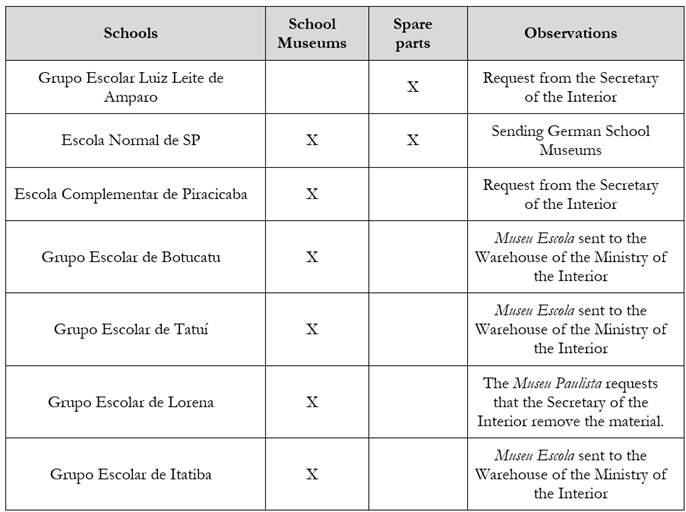
Permanent archive of the Museu Paulista, Museu Paulista collection, date 1896
Box 3 Sending of Materials Requested by the Secretary of the Interior of São Paulo to School Groups
Even before, it was noted that the shipment of materials could have been greater if there had been more investment by the State, as warned by another director of the Museu Paulista, Albert Loefgren, in a letter sent to the Secretary of the Interior, when he refused the request for materials due to a lack of employees (Marchi da Silva, 2015). The lack of employees at the Museum affected the acquisition of pieces for the institution (Grola, 2012).
The sending of school museums and pieces for their composition to schools continued even after the change in management of the Museu Paulista, with Afonso Taunay taking over. In 1919, the director informed the Secretary of the Interior that the shipments to the state's public schools had been greatly reduced. This was because the Museum's reserves were exhausted, after sending vast amounts of materials to normal schools and school groups. He explained that “new requests would soon be met” (Marchi da Silva, 2015, p. 94).
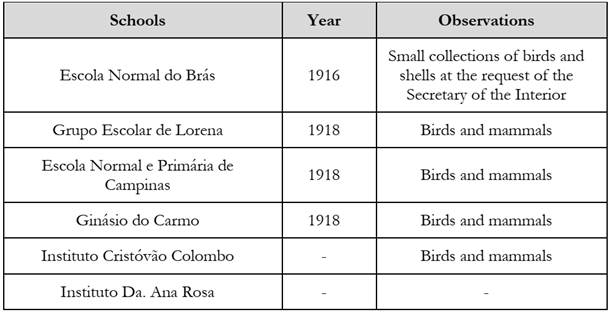
Source: Folder 70 - Permanent archive of the Museu Paulista, Museu Paulista collection, date 1896
Box 4 Sending materials to schools by Afonso Taunay, director of the Museum
The Interior Secretariat acted as a distribution center for the pieces between the scientific institution and the public schools, mediating the process of sending materials from the Museu Paulista to educational institutions in the state. There were efforts by the Museum, as a scientific institution supporting education, to meet the demands of educational institutions, although this was not fully possible given the insufficiencies of different types (Marchi da Silva, 2015). The efforts of Public Education to promote the concepts of the intuitive method were limited by the difficulty in providing schools with materials suitable for learning, which often prevented teachers from revisiting their practices and ways of teaching.
The relationship established between school museums and the teaching of natural sciences becomes clear in the case of the state of São Paulo, due to the debate over the founding of the Museu Paulista and its role in the São Paulo education project. The Museu Paulista was conceived as a scientific institute and its functions included providing objects and collections to educational institutions. However, it was not possible to meet all existing demand due to problems that directly affected the maintenance of the museum's collections, due to the lack of professionals and the difficulty in obtaining pieces.
In the case of this Museum, we see that the services provided to school audiences are varied, and, to a large extent, the independence celebrations are records of this union, while the spaces of the museum monument welcome schoolchildren to form the Republican, educated, and scientific unity. There were efforts to establish contact between these two worlds, considering the movement of those responsible for the Museum to supply schools with science teaching materials using the official State method. However, financial and labor limits are an obstacle to more powerful actions, according to the documents.
MUSEU NACIONAL: TEACHER TRAINING AND DIDACTIC RENEWAL
The arrival of the Portuguese court in Brazil in 1808 led to an intense movement of naturalists throughout the country, with the city of Rio de Janeiro standing out, with a significant emphasis on natural history studies and practical activities. In this context, the Royal Museum was founded in 1818 by D. João IV, whose function was to promote studies through the observation of a wide variety of objects, such as those related to the natural sciences of the Kingdom of Brazil and which could be used in commerce, industry, and the arts, in addition to being seen as “great sources of wealth” (BRAZIL, DECREE 6/6/1818). The Museum emerged in the context of the construction of national unity based on concepts about territory, nature, and people, and was responsible for disseminating knowledge about Brazil's cultural riches.9
Decree number 377A of 1890, which organized the State Secretariat for Public Education and Telegraph Affairs, affirmed its responsibility over museums and included them among institutions dedicated to education by establishing in its article 3:
The 1st section will be in charge of everything related to public education, primary, secondary, and higher; special and professional education; institutes, normal schools, academies, museums, and other similar establishments; associations of sciences, language, and arts (BRAZIL DECREE number 377, 5/5/1890).
The Museu Nacional was officially recognized in the institution's Internal Regulations as a place of public education, published in Decree number 810 of the same year and signed by Benjamin Constant, which determined the possibility of offering public night courses of concrete education, with a registration book for students. It had open classes for the dissemination of Physics and Chemistry, among other subjects, with an amphitheater. Article 87 expresses the desire to serve primary and secondary education (BRAZIL DECREE No. 810, 4/10/1890).
The Museu Nacional should facilitate access to materials for educational institutions, eliminating the need to import them, and at the same time promote the nation's values through representations of nature, people, and Brazilian culture. Until the end of the 19th century, teaching materials, such as teaching collections and Natural History murals, were imported from various European countries and their adoption was criticized for not being representative of the national reality (Sily, 2012).
During the Bruno Lobo administration (1915-1923), the Museu Nacional officially began to have as one of its objectives the promotion of Natural History, as can be seen in the 1916 regulations, to exhibit its knowledge to the public (BRASIL, Decree number 11.896, 1/14/1916). Under these regulations, the Museum was to present its organized scientific collections, but also to hold public lectures and specialization and improvement courses of a practical nature, held in laboratories by the decision of heads and assistants, with the director's authorization. The document determined the institution's support for the activities of educational institutions: “Teachers of all educational institutes of the Republic will be provided, upon request to the director and without prejudice to services, with room and material for their courses” (BRASIL, Decree number 11.896, 1/14/1916).
According to Sily (2012), when dealing with the educational processes of this Museum, in 1919, in response to several requests, 90 educational collections were distributed by the Museu Nacional, sent to around 60 educational institutions in all regions of Brazil, with emphasis on the Federal District, and six abroad, including gymnasiums, school groups, normal schools, colleges, high schools, institutes, colleges, higher education institutions, among others (Sily, 2012). Box 5 shows an overview of the distribution of educational products manufactured by the Museum:
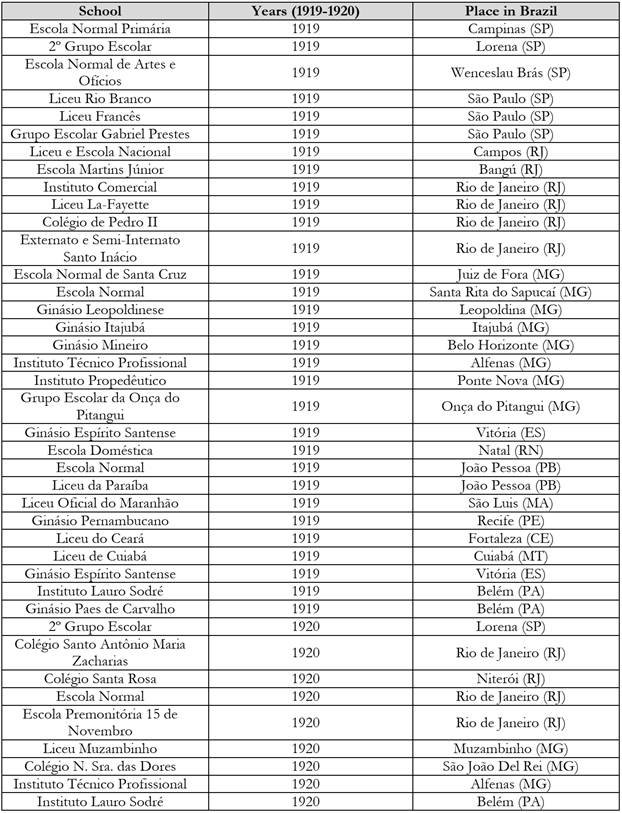
Source: Sily, 2022, pp. 279 e 281.10
Box 5 Support for schools in different locations in Brazil (1919-1920)
The data in Box 5 indicate the distribution of materials to different schools and regions of the country and, like the Museu do Ipiranga, they were sent on demand, a fact that indicates a technical-administrative undertaking, both in the organizations responsible for the materials sent and a logistical effort to issue such objects to different areas of the country.
Also, from 1919 onwards, the sections of the Museu Nacional began to produce Natural History murals, visual teaching material with images, and basic information on Zoology, Botany, Geology, and Anthropology, aimed at motivating educational activities. The first edition, with 14 murals, presenting brief texts and illustrations drawn and painted on starched canvas, was completed in 1922, produced and distributed by the Museum until 1942. In this case, we see an impulse to produce in-house materials for distribution in schools, different than the other museums studied. In 1920, 1,050 samples were registered from the Museum's Mineralogy section and 25 Zoology collections (Sily, 2012).
The collection of murals was entitled Elementary Pictures of Brazilian Natural History, organized by the Museu Nacional of Rio de Janeiro, and was prepared in the museum's sections under the guidance of the director and a team of teachers, assistants, and calligraphers. The pictures were made on starched paper, measuring 0.80 x 1.00, with watercolor drawings and paintings, and with short texts on basic knowledge of the subject in question. Copies of this collection were sent to public and private schools between the 1920s and 1940s (Sily, 2012, pp. 291-292). They were also asked to send educational collections, phytogeographic atlases, books, and scientific journals, as well as instructions on the procedure for organizing school museums (Sily, 2012, p. 294).
During this same period, for the Museu Nacional, producing and distributing educational collections was an insufficient action. The Nova Escola movement that spread throughout Brazil from the 1920s onwards demonstrated concern for new pedagogical models, considering the teacher-student relationship, since it shifted the educational initiative of learning to the student, placing the teacher as the sole promoter of learning. To carry out motivating educational activities, the spaces for stimulating personal skills and interests were expanded, which also began to mobilize the educational use of museums in this sense (Lopes, 1991). According to this author, Edgard Roquette-Pinto (1926-1935) “led the way” during his management at the Museu Nacional, in the sense of expanding the educational use of museums, and this action was marked by a strengthening of the relationship between the school and the museum, as previously stated (Lopes, 1991, p. 2). The institution should guide the uses, of their organization in the school space and inspect the teaching-learning actions made possible by these resources.
Under the direction of physician and professor Roquette-Pinto, the Museu Nacional's educational activities became a priority, reaching a wider audience and serving educational institutions at all levels11 Roquette-Pinto worked to promote the institution's educational mission. He expanded public visits, emphasized visual aspects in the preparation and organization of collections for exhibitions, encouraged the production of educational films and teaching devices, and promoted public courses and conferences illustrated with visual resources and practical demonstrations. Through his work, we can see the auditorium training, which attracted a large audience to courses taught by professors such as Alberto Sampaio, Betim Paes Leme, Bastos D'Avila, Mello Leitão, among others. The classes on Natural History were as practical as possible so that students could assimilate the content. On average, 200 students enrolled in each proposed course (Rangel, 2010).
On Roquette-Pinto's initiative, in 1927, the 5th section of the Museu Nacional was created, the Natural History Teaching Assistance Service (SAE-Serviço de Assistência ao Ensino), the first museum education sector in Brazil. (Pereira, 2010, p. 137) states that the 5th section had among its objectives the encouragement, establishment, and maintenance of school museums; teachers who sought the classes taught learned how to prepare collections and techniques for caring for collected specimens.
In addition, the SAE also offered courses for teachers interested in organizing herbaria, natural history cabinets, and school museums. Training sessions were held almost daily and were given in five or seven meetings by teachers and specialists from the institution (Sily, 2012). The department also prepared natural history materials (animal, plant, and mineral) sent by schools, generally collected by students and teachers. The preparation work involved scientific classification and ordering by specialists from the Museum before returning them to the educational establishment (Sily, 2012).
The SAE should concentrate on the educational activities developed by the Museum and, thus, enhance them for educators and students who attended the institution and sought guidance and support for teaching Natural History (Pereira, 2010). In Roquette-Pinto's conception, this section should mediate the other sections of the Museum so that its scientific productions would be directed to serving the public (Rangel, 2010).
This movement follows the determination of Decree number 19,890, of April 18, 1931, recognized as the “Francisco Campos Reform” which, at the national level, officially established a process of modernization, in this case, of secondary education that, among other things, modified school knowledge, strengthening the teaching of Natural and Physical Sciences (Dallabrida, 2009, p. 199). These actions are in agreement and, meanwhile, in the national education plan, there is a long debate about changing the secondary education curriculum between those who prefer to keep it as the consecration of the classical humanities and others who see the opportunity to expand scientific studies in the school environment.
The lessons advocated the production of knowledge based on students' experiences, encouraging curiosity and investigation through practical, concrete, and experimental teaching, which indicates their engagement with the new pedagogical theories of the Nova Escola. They highlighted the new technologies in schools that stimulated the observation of objects under study, according to new scientific methods (Sily, 2012).
Following this logic, the 1931 Regulation of the Museu Nacional established among its purposes: scientific research, the teaching of Natural History and the dissemination of natural sciences, the result of research and studies in publications, photographs, slides, scientific films, and radio transmission of conferences (BRAZIL, Decree No. 19,801, 3/27/1931).
The 1931 Regulation, in its chapter VI - Teaching -, on the instruction promoted by the Museu Nacional, presented the provisions already launched in the 1916 document, with the addition of the SAE's role, including allowing the use of its spaces and materials for teachers from public schools and private courses who “are deemed suitable” (BRAZIL, Decree No. 19,801, 3/27/1931).
The SAE allowed teachers to use the conference room, projection equipment, and other teaching resources available at the Museum, subject to authorization from the management and prior scheduling, at a time that would not interfere with activities. The production and distribution of Natural History teaching collections were considered insufficient by the Museum, without any prescription regarding the use of the materials, guidance for their organization in the school space, and monitoring of the activities of teachers using these items.
In the 1930s, the Museu Nacional began to produce and make available devices and films specifically for classes, courses, and conferences, replacing engravings; these resources, considered innovative, aroused great interest among teachers and students at the time (Sily, 2012). Among the materials, there was a preference for themes related to Botany and Zoology, such as “Babaçu”, “Carnaúba”, “Movement of plants and plants that capture insects”; “Life of bees”; “Mimicry”, “In the backlands of Mato Grosso” (Sily, 2012, p. 301). The audience and participation included a notable number of teachers and students.
Between 1932 and 1934, Roquette-Pinto was publishing the National Education Magazine (RNE-Revista Nacional de Educação), with support from the Ministry of Education and Public Health. RNE devoted part of its content to natural science lessons in short texts, with accessible language, illustrations, drawings, and graphs, organized from the most basic to the most complex, which indicates a didactic concern (Sily, 2012). The periodical reached an impressive circulation of around 12 thousand copies. Despite its short circulation period, 21 issues were published, with content that covered basic notions of botany, mineral extraction, agriculture, history, archaeology, drawing lessons, philosophy, Brazilian legends, arts, celestial maps of Brazil, geology, nature protection, as well as reports on expeditions to the national territory. The articles praised the educational role of the Museu Nacional, encouraged visits by teachers and students, and reinforced the need for schools to have collections for practical science teaching12, a fact that already had a certain tradition both in educational legislation and in the history of museum education.
The RNE also addressed the debate on national education in articles on regional and professional education, on the role of rural teachers, and rural education. Roquette-Pinto's actions were in line with the premises outlined by the group of “Pioneers of the New School” (“Pioneiros da Escola Nova”) in the recently created Brazilian Education Association (ABE-Associação Brasileira de Educação), having shared the organization's assumptions regarding the defense of public education and the idea of national reconstruction (Rangel, 2010, p. 263).
Bertha Lutz was another prominent scientist from the institution with a strong educational role. Among the many activities of this researcher, she was a member of committees that sought contact with other museums around the world, with frequent trips to the USA and Europe (1922 and 1932) to discuss innovative methods for the museum's educational sector (Souza, 2014). She visited educational establishments in the southeast region of Brazil to monitor educational activities based on collections for science teaching. With this work, she gathered different aspects that she considered interesting to disseminate the processes through education within the museum.
Bertha Lutz's reports on the visits also highlighted the receptiveness and care of the principals and teachers regarding the collections obtained, and the suggestions offered regarding the organization to make the best use of the collections, which indicates an element of merit in the relationship established with the schools (Sily, 2012). Based on one of these visits, she criticized the idea of setting up school museums in an arbitrary manner, indicating that: they should organize exhibitions according to experts; the practice of lending materials to schools was in decline, given that the materials were abandoned within the schools; in addition to reiterating that such organization created an accumulation of objects without any connection between them, degenerating them into “collections of curiosities” (Sily, 2012, p. 292).
Even though there was controversy about school museums, this Museum continued to promote this teaching material, even marking it as a certain tradition of the space, when the book “Organization and Preparation of School Museums” (“Organização e preparação de Museus Escolares”) by Paulo Roquette-Pinto was launched. Presented as an “heir to a glorious name” by zoologist Cândido Firmino de Mello Leitão, in this book he presented the results “during several years of internship in the laboratories of the 5th Section of the Museu Nacional” with the work of “assistance to the Teaching of Natural History”. The presentation of the book shows gathered and “slightly enlarged” classes given to teachers in the Federal District in 1934 (Roquette-Pinto, 1942, pp. 5 and 11).
This same professor explains that in 1936, SAE served 30 schools, with a total of 2,289 students and around 30 teachers. Furthermore, he indicates that these schools brought specimens collected in their vicinity for prospective preparation by the Museum, which forwarded the collected material to be exhibited in the respective school collections (Roquette-Pinto, 1942, p. 35).
In this case, school museums are conceived not as collections of exemplary objects, in which “no one seeks to see rare species, minerals, exotic plants or animals”. The presentation of common specimens from the region inhabited by the student was encouraged, leaving the rare ones to be presented through photos and illustrations. The book was interested in the teaching methods of Natural History and, therefore, understands that the organization of school museums should follow the steps of a naturalist, indicating all possible scientific procedures for the collection, preparation, installation, conservation, and exhibition of the collected specimens, including presenting, for each step, the tools used, reinforcing the importance of technical instruction for the success of the enterprise (Roquette-Pinto, 1942, p. 38).
As can be seen, the Museu Nacional follows the guidelines given by educational legislation in its educational use, first presenting as a promoter of the intuitive method and then remaining a reference center for teacher training and student services, mainly through the services of the SAE, the department that managed multiple tasks in the sense of training school audiences, and is currently guided by active learning processes.
FINAL CONSIDERATIONS
From the studies of the three museums presented, the relationship of these institutions with schools seems inevitable. This type of educational action is formalized within the limits of the museum's character and its collections, but its relations with schools are subject to political determinations, and social and educational demands, requiring a closer relationship from these institutions by providing a specific educational program for the school world.
When examining the three different presentations of museums throughout the period presented in the article, we can see that their role is intrinsic to safekeeping and conservation, studies and research, and the ability to educate the school community in a specific way. The museums presented in this text maintained educational activities for the general public but they paid attention to the education of the school public, carrying out actions that were immediately thought of for this group. We see museums intertwined as interconnected networks of institutions, groups, and subjects that establish their functions and the varied museological languages, creating meanings about how each museum should be and how should maintain its relationship with schools. In other words, the design presented by the different museums to educate the school public depends on contexts, group articulations, political support, state interest, agenda funding, demand for teachers, etc. In other words, these institutions cannot exempt from this type of role because their intertwining with the school is linked to a set of practices that are articulated as a cultural development plan that requires their co-responsibility in the education of children and young people of school age.
The relationship between these institutions and the educational world varies greatly, depending on the type of museum and the historical processes that formed it. At the beginning of the 20th century, museums were presented as dignified buildings for public education, establishing the use of collections for teaching through the eye, reinforcing an education of the senses based on the use of artifacts, which is a broadly founded and universally accepted objective reality in the educational world. It is possible to think that the similarity of the purposes of both institutions, at that time, created the intellectual and practical ties that consolidated the involvement between the parties.
It is not possible to state that these ties were established with the historical-educational processes of the Nova Escola in all the cases presented, although the strength of its discourses and the notoriety of its intellectual agents were decisive in structuring a specific service to assist schools at the Museu Nacional. However, depending on the museum, its relationship with schooling processes is intertwined with the political conduct of its constitutions, when these are inaugurated within a structured and broad framework of Public Education, as seen in the cases of Pedagogium and the Museu Paulista.
The three museums presented were faithful in fulfilling their educational roles within the scope of their specificities. We see two Natural History museums and one education museum, with sections also interested in natural sciences, creating a relationship practice involving intellectual formation and their spaces for this purpose. Those responsible for the museums studied followed the educational guidelines and did not fail to meet the state or school's demands.
In the case of the Pedagogium, created exclusively for teaching purposes, the idea of scientific education in the country was reinforced, being linked to political purposes, since it was not enough to know science; it was necessary to educate the senses and transmit values. Therefore, the teacher was seen as a specialized target, a state official, and a promoter of a republican education associated with progress and science. The Pedagogium was a museum directly linked to teacher training, even facing the debate of competition with the Escola Normal regarding the need for its existence. Nevertheless, it sought to train teachers while presenting teaching innovations in its classrooms. In this case, a museum established to immediately relate to schools and serve their participants is an example. This example confirms that the discussion about the relationship between museums and schools depends greatly on the nature of the museum, its scientific foundations, and the typology of its collection.
The Museu Paulista also provided this service on demand and due to its knowledge of educational legislation, given the broad nature of its educational perspective, since it was not just a science museum, but also an environment for worship of the Fatherland. Because of this, in addition to its direct educational function for schools, due to the detailed composition of scientific collections for school museums, this Museum was a space to integrate a plan for republicanism in São Paulo through education and science. However, at that time, the documentation indicates that the supply of materials varied greatly, depending on the political processes and financial capacity of the institution. Finally, as a space for the exaltation of patriotism, the museum counted on schools as a fundamental part of the constitution of its monumental mystique.
The Museu Nacional has been involved in this process of forming the school community since the beginning of the 20th century, in terms of providing materials. Later, it intensified its actions through a specific department for this purpose, the SAE. This space represents more than a simple transfer of knowledge between departments, adding a form of dissemination that questions its collection, presenting it for teacher training, and even aiming at the production of materials. They provided teachers with collections and gave guidance on their organization and uses; they offered courses and hosted events where they could expand their knowledge of Natural History. They encouraged the preparation of collections and techniques for their maintenance. The Escola Nova movement directly connects the interests of the school to those of this Museum, pointing out that the strength of this connection depends on the strength of the circulation of public projects aimed at education in general and that it is not something that can be resolved in isolation by the museum institution.
Finally, considering the expansion of this debate, the three museums, in terms of their educational procedures, are institutions for the “popularization” of science. In a way, this practice of popularizing science through its relationship with schools makes us think about the construction of fixed representations of science and teaching, mainly by hierarchizing the positions between the science of scientists and the science teaching, which generates another fruitful debate, appropriate to the interests of a cultural history of science and a history of science education, which is not the scope of this text, but which opens up the possibility of new studies.
REFERENCES
ALVES, Ana Maria de Alencar. O Ipiranga apropriado: ciência, política e poder: o Museu Paulista, 1893-1922. São Paulo: Humanitas/FFLCH/USP, 2001. [ Links ]
BRAGHINI, Katya, MARCHI DA SILVA, Camila. Museu Paulista, a Instrução Publica, e o provimento de matérias para as escolas do estado de São Paulo: uma história dos museus escolares. In: GRANATO, Marcos. RIBERIO, Emanuela Sousa. ARAÚJO, Bruno Melo de. (Org.) Cadernos do Patrimônio da Ciência e Tecnologia: instituições, trajetórias e valores. Rio de Janeiro: Museu de Astronomia e Ciências Afins, 2017, pp. 255-282. [ Links ]
BRASIL, Decreto de 06 de junho1818. 1818 [ Links ]
BRASIL, Decreto nº 377A de 05 de maio de 1890. 1890 [ Links ]
BRASIL. Decreto de Lei nº 667 de 16 agosto 1890. 1890 [ Links ]
BRASIL, Decreto nº810 de 04 de outubro de 1890 1890. [ Links ]
BRASIL. Decreto nº 981 de 8 de novembro de 1890 1890. [ Links ]
BRASIL, Decreto nº 11.896, de 14 de Janeiro de 1916 1916. [ Links ]
DALLABRIDA, Norberto. A reforma Francisco Campos e a modernização nacionalizada do ensino secundário. Educação, Porto Alegre, v. 32, n. 2, pp. 185-191, maio/ago. 2009. [ Links ]
ETHERINGTON, Robin. Skholé: La desescolarización de los museos. Museum. Los museos y el mundo real. UNESCO, Paris, v. XLI, nº 162, 1989. [ Links ]
GROLA, Diego Amorim. Coleções de História Natural no Museu Paulista (1894-1916). 2014. Dissertação (Mestrado em História Social) apresentada à Faculdade de Filosofia Letras e Ciências Sociais, Universidade de São Paulo, São Paulo, 2014. [ Links ]
HILSDORF, Maria Lucia Spedo. Francisco Rangel Pestana: o educador esquecido. Prêmio grandes educadores brasileiros: monografia premiada 1987. Brasília: Instituto Nacional de Estudos e Pesquisas Educacionais, 1988. [ Links ]
LAFUENTE, Antonio, VALVERDE, Nuria. O surgimento dos primeiros Comuns modernos: Tecnologia, Patrimônio, Iluminismo. Tradução: Katya Braghini. Museologia e Patrimônio, v. 15, n. 1, pp. 333-350, 2022. [ Links ]
LOPES, Maria Margaret, MURRIELLO, Sandra E. Ciência e Educação em museu no final do século XIX. História, Ciência, Saúde - Manguinhos, v. 12(suplemento), pp. 13-30, 2005. [ Links ]
LOPES, Maria Margaret. O Brasil descobre a pesquisa científica: os museus e as ciências naturais no século XIX. São Paulo. SP. Editora Hucitec. 1997. [ Links ]
LOPES, Maria Margaret. A favor da desescolarização dos museus. Educação & Sociedade, nº 40, pp. 443-455, dez., 1991. [ Links ]
MARCHI DA SILVA, Camila. Museus Escolares no estado de São Paulo (1879-1942). Dissertação (Mestrado em Educação). PEPG em Educação: História, Política, Sociedade, Pontifícia Universidade Católica de São Paulo, São Paulo, 2015. [ Links ]
MARCHI DA SILVA, Camila. História do Museu Pedagógico Nacional: Pedagogium, um museu de grandes novidades (1890-1919). Tese (Doutorado em Educação). PEPG em Educação: História, Política, Sociedade, Pontifícia Universidade Católica de São Paulo, São Paulo, 2021. [ Links ]
MENESES, Ulpiano Bezerra de. Educação e museus: sedução, riscos e ilusões. Ciências e Letras. Revista da Faculdade Porto-Alegrense de Educação, nº 27, pp. 91-101, jan./jun. 2000 [ Links ]
MORAES, Fábio Rodrigo de. Uma coleção de história em um museu de ciências naturais: o Museu Paulista de Hermann von Ihering. Anais do Museu Paulista, São Paulo, vol.16, n.1, jan./jun. pp. 203-233, 2008. [ Links ]
PEREIRA, Marcelle Regina Nogueira. Educação museal, entre dimensões e funções educativas: a trajetória da 5ª seção de assistência ao ensino de história natural do Museu Nacional. Dissertação (Mestrado em Museologia e Patrimônio). Museu de Astronomia e Ciências Afins, Universidade Federal do Estado do Rio de Janeiro, Rio de Janeiro, 2010. [ Links ]
PETRY, Marilia Gabriela; SILVA, Vera Lucia Gaspar da. Museu escolar: sentidos, propostas e projetos para a escola primária (séculos 19 e 20). História da Educação. Porto Alegre: ASPHE, v. 17, n. 41, pp. 79-101, 2013. [ Links ]
POSSAMAI, Zita Rosane, JULIÃO, Letícia. Museus, história, educação: retrospectivas e perspectivas. 2019, Recife, Anais do 30ºSimpósio Nacional de História. História e o Futuro da Educação no Brasil. Recife: UFPE/ANPUH. [ Links ]
POULOT, Dominique. Museu e Museologia. São Paulo. SP. Autêntica. 2013. [ Links ]
RANGEL, Jorge Antonio. Edgard Roquette-Pinto. Recife: Fundação Joaquim Nabuco: Editora Massangana, 2010. [ Links ]
REVISTA PEDAGÓGICA, nº3 de 15 de dezembro de 1890. [ Links ]
REVISTA PEDAGÓGICA, nº 18, Tomo 3, 1892. [ Links ]
REVISTA PEDAGÓGICA, nº 40, 1894. [ Links ]
REVISTA PEDAGÓGICA, nº44, 1895. [ Links ]
REVISTA PEDAGÓGICA, nº 45, 1895. [ Links ]
REVISTA PEDAGÓGICA, nº 48, 1896. [ Links ]
ROQUETTE-PINTO, Paulo. Organização e preparação dos Museus Escolares. Porto Alegre: Globo, 1942. [ Links ]
SALINAS Y TERUEL. [Festa Escolar no Ipiranga]. 1912. Óleo sob tela 99x150 cm. Pinacoteca do Estado de São Paulo. [ Links ]
SÃO PAULO. Primeiro Relatório do Museu do Estado de São Paulo(1891, s.n.). [ Links ]
SILY, Paulo Rogério Marques. Casa de Ciências, Casa da Educação: Ações Educativas do Museu Nacional (1818-1935). Tese (Doutorado em Educação), Programa de Pós-graduação em Educação, Universidade do Estado do Rio de Janeiro, Rio de Janeiro, 2012. [ Links ]
SILY, Paulo Rogério Marques. Casa de Ciências, Casa de Educação: Ações Educativas do Museu Nacional (1818-1935). Rio de Janeiro: Ed. UFRJ, 2022. [ Links ]
SOUSA, Lia Gomes Pinto de. “Honrosas comissões” e o papel educativo do Museu Moderno: Na divulgação científica, proteção à natureza e a luta pelo progresso feminino na atuação de Bertha Lutz (décadas de 1920 e 1930). Revista Feminismos, UFBA, vol.2, n.1, jan./abr, pp.131-150, 2014. [ Links ]
STEPANENKO, Igor. O Museu do Ipiranga e a Instrução Pública no estado de São Paulo. um estudo sobre o atendimento ao público (1895-1915). Dissertação (Mestrado em Educação), PEPG em Educação: História, Política, Sociedade, Pontifícia Universidade Católica de São Paulo, São Paulo, 2016. [ Links ]
RIO DE JANEIRO. Annuário de Ensino do Rio de Janeiro, 1895. [ Links ]
VIDAL, Diana Gonçalves. O museu escolar brasileiro: Brasil, Portugal e França no âmbito de uma história conectada (final do século XIX). In: FERNANDES, Rogério; LOPES, Alberto; FARIA FILHO, Luciano Mendes de(Orgs.). Para a compreensão histórica da infância, pp.199-220. Belo Horizonte: Autêntica, 2007. [ Links ]
VIDAL, Diana Gonçalves. Por uma pedagogia do olhar: os museus escolares no fim do século XIX. In: VIDAL, Diana Gonçalves, SOUZA, Maria Cecília Cortez Christiano de. (org.). A memória e a sombra: a escola brasileira entre o império e a República. Belo Horizonte: Autêntica , 1999. [ Links ]
1Article published with funding from theConselho Nacional de Desenvolvimento Científico e Tecnológico- CNPq/Brazil for editing, layout and XML conversion services. The translation of this article into English was funded by Coordenação de Aperfeiçoamento de Pessoal de Nível Superior - CAPES/Brasil.
2The Museu do Ipiranga underwent a long restoration and modernization project of its facilities, reopening its doors to the public during the celebrations of the Bicentennial of Brazil's Independence (2022). The Museum's educational material aimed at school audiences is available at https://museudoipiranga.org.br/educativo/publicos-escolares/
3Several documents report that the Pedagogium was proposed with the transfer of the collection of the Museu Escolar Nacional after its dismantling. The Pedagogical Magazine number 3, of December 15, 1890, reports in its Chronicles of the Interior section that the Pedagogium intended to maintain the objectives of the Associação Mantenedora do Museu Escolar, which in turn already maintained part of the collection of the Universal Exhibition of Rio de Janeiro. The The Associação Mantenedora do Museu was extinguished in 1890 and, according to Santos (2013), part of its collection was used by the inaugurated Museu Pedagógico Nacional, denominado Pedagogium.
4The decree instructed that the establishment should maintain relations and constantly exchange documents and objects with other states of the Republic and foreign countries. Over the years of operation, it occupied three addresses: between 1890 and 1891 it operated in the National Press building at Rua Guarda Velha, 2 (ALMANAK, 1891 p. 1628); from 1891 to 1895 it was at Rua Visconde do Rio Branco, 13; finally, from 1895 to 1919 it remained at Rua do Passeio, 66.
5The newspapers of the city of Rio de Janeiro used to publish the days and times of the courses offered by Pedagogium and their respective teachers. Those that most cited such information were: O jornal do Comércio; Gazeta de Notícias; Jornal do Brasil; A Imprensa; A notícia; O Paíz.
6The idea that the Pedagogium is a “museum of great innovations” is described in the thesis entitled “History of the National Pedagogical Museum (Museu Pedagogico Nacional): Pedagogium - a museum of great innovations (1890-1919)” defended at the Pontifical Catholic University of São Paulo, in 2021. The title is an obvious paraphrase of the music of the composer Cazuza, precisely because this Museum had a showcase of innovative teaching materials for all school subjects within the scope of primary and secondary education, with an emphasis on scientific materials.
7The Museu Paulista was inaugurated on September 7, 1895. The history of the institution is closely linked to the construction of the Ipiranga palace-monument to celebrate and perpetuate a narrative of Independence from São Paulo. In 1885, construction began on a neoclassical palace on the Ipiranga site to mark and symbolize the birth of the Brazilian nation. The building was completed in 1890 (STEPANENKO, 2016).
9In 1824, it was renamed the Museu Imperial and received the name of the Museu Nacional in 1890. In 1892, under the republican regime, the institution was transferred to the Quinta da Boa Vista Palace, in São Cristóvão, the former residence of the Portuguese royal family.
10Box 5 was organized by the authors based on information collected by Sily (2022). For this Box, only primary, secondary, and professional schools were considered, with higher education institutions not being recorded. Schools whose locations are not recorded were also not indicated in the box, such as: Ginásio Santo Antonio, Ginásio Brasileiro, Grupo Escolar São Mateus, Grupo Escolar Dr. Alcides Gonçalves, for the year 1919 and Ginásio 28 de Setembro, Colégio Silvio Leite, Colégio Batista Americano Brasileiro, Colégio Paulo Freitas, Escola Nilo Peçanha, Escola Mista of 6th District, for 1920.
11Roquette-Pinto began his career at the institution in 1905, participating in scientific excursions as an anthropologist. In 1912, he joined the Strategic Telegraph Lines Commission, led by Lieutenant Colonel Cândido Mariano da Silva Rondon, which resulted in the publication of the work Rondônia (Rangel, 2010, p. 41).
12The text Every school should have a botany collection (Toda escola deve possuir uma coleção de botânica), written by Carlos Vianna Freire, in edition no. 1, encouraged primary school teachers to create a herbarium in the form of an album with their students, to stimulate teaching through visualization of examples and practical activities.
Funding
Received: August 31, 2023; preprint: August 21, 2023; Accepted: March 18, 2024
 Este é um artigo publicado em acesso aberto sob uma licença Creative Commons
