




Serviços Personalizados
Journal

Artigo
 texto em
  Inglês (pdf)
 Artigo em XML
 Tradução automática
 Enviar este artigo por email
Compartilhar

 Permalink
Educação em Revista
versão impressa ISSN 0102-4698versão On-line ISSN 1982-6621
Educ. rev. vol.41 Belo Horizonte 2025 Epub 03-Jun-2025
https://doi.org/10.1590/0102-469848070
Relacionado com: 10.1590/SciELOPreprints.4140
ARTICLE
CIVIC-MILITARY SCHOOL PROGRAM: DIAGNOSIS OF THE PRESENT1
1
, Data collection, data analysis and writing of the text http://orcid.org/0000-0002-6789-2715
2
, Project coordinator, active participation in data analysis and review of the final texthttp://orcid.org/0000-0001-7658-8670
1Instituto Federal de Educação, Ciência e Tecnologia Sul-rio-grandense (IFSUL), Pelotas (RS), Brasil
2Universidade Federal do Rio Grande do Sul (UFRGS), Porto Alegre (RS), Brasil
The Civic-Military School Program (PECIM-Programa Escola Cívico-Militar) in Brazilian Education aimed to implement 216 Civic-Military Schools nationwide by 2023. The model to be implemented by the Ministry of Education seeks to reinforce public schools based on the allegedly “high-level” Army military schools. This program has been used to praise military disciplinary practices as a strategy for educational improvement and success. Considering PECIM's contemporary context, this article problematizes the current scenario, questioning the possible conditions for implementing the program. To address this problem, we made a diagnosis of the present. We relate and support this poststructuralist essay to Michel Foucault and his archaeology, deepening into knowledge-power questions of each era to locate, through speeches and statements, the historical conditions and, a priori, the discourse of militarizing public education, which gained strength and reached a place of power. In his studies, Foucault subverts the notion of linearity and analytical thinking, showing the discontinuous historicities. Furthermore, it problematizes the “truth” as absolute and universal, investigating the so-called "truth.” We used the repository of theses and dissertations at CAPES as an analysis tool to locate, through scientific production, the rationality of the time, which provided the possibility for establishing the program.
Keywords: Civic-Military School Program; Poststructuralism; Historical a priori
O Programa Escola Cívico-Militar (PECIM) na Educação Brasileira teve como propósito implantar 216 escolas cívico-militares em todo o país até 2023. O modelo implementado pelo Ministério da Educação objetivava ser um reforço para as escolas públicas, baseando-se no dito “alto nível” dos colégios militares do Exército. Tal programa tem servido para enaltecer a adoção de práticas disciplinares militares como estratégia de aprimoramento e sucesso na educação. Considerando o contexto contemporâneo em que se apresenta o PECIM, este artigo problematiza o cenário da atualidade, questionando as condições de possibilidade a partir das quais se instaura o programa. Para dar conta dessa problematização, realizou-se um diagnóstico do presente, com a relação e o embasamento deste artigo, de cunho pós-estruturalista, em Michel Foucault e sua arqueologia, aprofundando questões de saber-poder de cada época, para localizar-se, por meio de discursos e enunciados, as condições históricas e, a priori, o discurso de militarizar a educação pública, que tomou força e alcançou o lugar de poder. Foucault, em seus estudos, subverte a noção de linearidade e de pensamento analítico, mostrando as historicidades descontínuas; além disso, problematiza a “verdade” vista como absoluta, universal, investigando o “dito verdadeiro”. O repositório de teses e dissertações da CAPES serviu como instrumento de análise para averiguar-se, por meio de produção científica, a racionalidade da época, que deu condição de possibilidade para a instauração do programa.
Palavras-chave: Programa Escola Cívico-Militar; pós-estruturalismo; a priori histórico
El Programa de Escuelas Cívico-Militares (PECIM) en la Educación Brasileña tiene como objetivo implementar 216 Escuelas Cívico-Militares en todo el país hasta 2023. El modelo que será implementado por el Ministerio de Educación tiene como objetivo reforzar las escuelas públicas y se basa en lo que se considera un “alto nivel” de los colegios militares del Ejército. Este programa ha servido para enaltecer la adopción de prácticas disciplinarias militares como estrategia de mejora y éxito en la educación. En el contexto contemporáneo que se presenta el PECIM, este artículo implica problematizar el escenario actual, cuestionando las condiciones de posibilidad a través de las cuales se establece el programa. Para abordar este problema, hicimos un diagnóstico del presente. Relacionamos y fundamentamos este ensayo posestructuralista con Michel Foucault y su arqueología, profundizando en cuestiones de saber-poder de cada época, para localizar, luego, a través de discursos y declaraciones, las condiciones históricas y, a priori, el discurso de militarización de la educación pública, que tomó fuerza y alcanzó un lugar de poder. Foucault, en sus estudios, subvierte la noción de linealidad y pensamiento analítico, mostrando las historicidades discontinuas; Además, problematiza la “verdad” vista como absoluta, universal, investigando la “llamada verdad”. El repositorio de tesis y disertaciones de la CAPES sirvió como herramienta de análisis para localizar, a través de la producción científica, la racionalidad de la época, que brindó la posibilidad para la instauración del programa.
Palabras clave: Programa Escuela Cívico-Militar; Posestructuralismo; Histórico a priori
INTRODUCTION
In contemporary society, military schools are shown in the media as an excellent education, of better quality2 than other schools, legitimized by the high approval rates of their students in national exams3, among other factors. The quality of these institutions is related to disciplinary knowledge-power, since they stand out for their content-based teaching, categorized by specific disciplines and by the discipline-body, which compels bodies to remain docile in the school environment. In this article, we aim to tell the history of the present, and to narrate and propose a historical analysis of the processes of militarization of public education in Brazil, its ruptures, continuities, and discontinuities. To this end, we rely on a literature review carried out in academic theses dealing with the theme of the militarization of education, based on research undertaken in the CAPES thesis catalog.
In this way, we highlight the current implementation of the Civic-Military School Program (PECIM-Programa Escola Cívico-Militar) in Brazil, an initiative of the Ministry of Education in partnership with the Ministry of Defense. PECIM presents a management concept in the educational, didactic-pedagogical, and administrative areas with the participation of the school's teaching staff and support from the military. It proposed to implement 216 civic-military schools throughout the country by 2023, with 54 institutions to be established per year.
The model implemented by the Ministry of Education aimed to improve the teaching-learning process in public schools, based on the high level of military schools of the Army, the Police, and the Military Fire Departments. The military would support school management and educational management, while teachers and other education professionals would continue to be responsible for the didactic and pedagogical work. Based on the current context, we first conduct a historical analysis of events in Brazil up until the emergence of the first military school and, second, we show the discontinuity present in the country's rationality after the 1964 coup d'état, when the term “civic-military” was consolidated and conditions were created for the possibility of resuming the Program today.
First, we will examine the current state of Brazilian education, particularly focusing on the establishment of PECIM. To this end, we conducted a thorough investigation, tracing the origins of Brazil's first militaristic school. Under the subtitle "Historical Continuities and Discontinuities," we analyze significant historical ruptures to explore the conditions that allow for the revival of militarism in education, capturing the rationality of the time through a contemporary historical lens. Additionally, we delved into the CAPES portal to gain a deeper understanding of the military context within public education, selecting relevant research to inform our discussions and to better comprehend the prevailing discourses on militarism in the academic area.
To account for historical analyses, as well as discontinuities, we base on Michel Foucault's theories and his understanding of what it means to “make a history of the present”. The key issue of this article is the present, but to investigate the symptoms of the present, we must look at the events of the past.
HISTORICAL CONTINUITIES AND DISCONTINUITIES
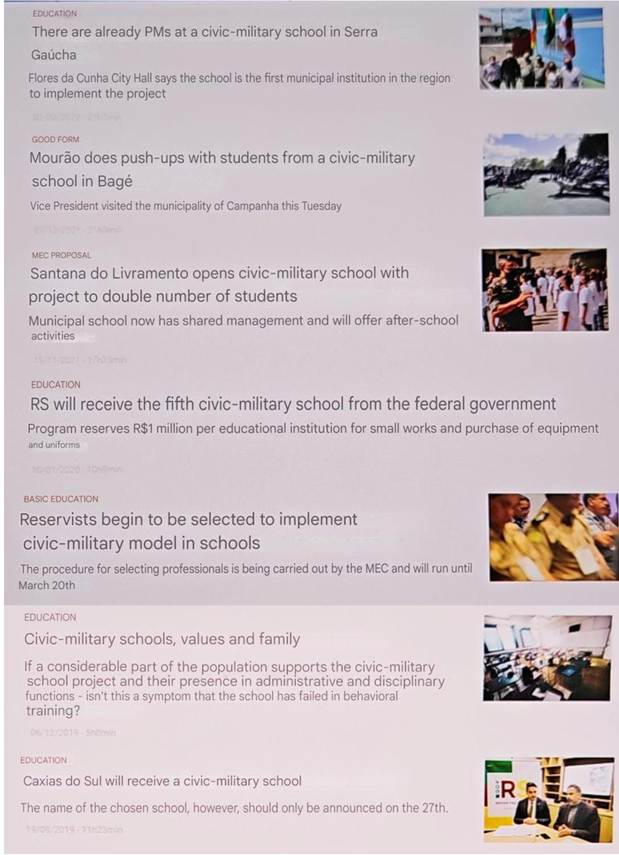
Source: https://gauchazh.clicrbs.com.br/search/?q=c%C3%ADvico-militar.
Figure 1: Civic-military schools in news published on the Gaúcha Zero Hora website (GZH)
This study emerged in the context of the current Brazilian scenario, when the proposal to establish the “National Program of Civic-Military Schools (PECIM)” in public schools was in force (Ordinance number 1,071, of December 24, 2020), based on the discourse that militarism is an educational “reinforcement”. In Figure 1, we show some of the headlines of reports that appear in a search we conducted on the Gaúcha Zero Hora (GZH) website, using the keyword “civic-military”. We noticed that the reports function as discursive operators and proliferators, legitimizing the emergence of the aforementioned program.
The PECIM was established through the voluntary participation of municipalities, based on a public consultation, and the new administration modified the guidelines for the school environment. As a result, we sought to problematize the current educational scenario, making the history of the present, analyzing the past, and problematizing the comings and goings of militarism in the educational context. Through the history of the present, we sought to identify when the coupling between the civic and the military occurred and how history favored the return of the discourse of the militarization of education in the 21st century.
The National Program of Civic-Military Schools, according to the Guidelines for Civic-Military Schools,
[...] is developed by the Ministry of Education in partnership with the Ministry of Defense and with the support of military personnel from auxiliary forces, through the Public Security Secretariats of the states and the Federal District, through the Collaboration Regime with the Education Secretariats, aiming to improve: − school management; − the school environment; − the school's pedagogical practices; and − students' learning and academic performance (Brazil, 2021, p. 7).
According to the Director of Policies for Civic-Military Schools, Gilson Passos de Oliveira, in an interview given in 2021 4, PECIM's goal was to implement 216 civic-military schools by the end of 2023 (Oliveira, 2021). The program's proposal resulted from demonstrations by those responsible for the students, as proven by the public consultations carried out, which demonstrate 98% approval, according to the interviewee.
Thus, this article problematizes the current scenario, questioning the conditions of possibility in which this project is established today. The guiding question was: In what way has history (of the present) offered conditions for militarism to legitimize itself in public education?
To address this issue, we rely on post-structuralist theories, such as Michel Foucault and his archeogenealogy, delving into the knowledge-power issues of each era, and then locating, through discursivities, in which historical conditions, a priori, the discourse of militarizing public education gained strength and achieved a place of power. In his studies, Foucault subverts the notion of linearity and analytical thought, showing discontinuous historicities; he problematizes the “truth” seen as absolute and universal, and investigates the “so-called true”.
In contrast to the ultimate truths, there are the regularities of an era, which make statements possible; however, our historical analysis aims not to investigate events that begin silently but to identify a new type of rationality and its multiple effects on today's society. To problematize the present, we carry out a history of the present, highlighting how the first college with a militaristic slant was established, and then analyze the causes and, subsequently, the effects of such establishment.
The first school with a military slant, according to the Preparatory and Assistance Education Directorate (DEPA, n.d.), was created shortly after Brazil's independence in 1822, when the separation process between Brazil and Portugal took place. Since then, the military has wanted and planned to create an institution that would be committed to the education of its children. The initial idea came from Regent Pedro Araújo Lima, known as the Marquis of Olinda, in 1840; however, his idea was not accepted by his superiors.
According to Carvalho (1989), Luís Alves de Lima e Silva, the Duque de Caxias, a Brazilian military politician and monarchist, was moved by the suffering of his men who had left their families destitute to dedicate themselves to the War of the Triple Alliance. He understood the need for a pension for orphans who had lost their parents in the war and for a quality education that would guide and form individuals dedicated to the defense of the Fatherland. Thus, in 1853, he presented a bill to the Senate through which he would create a Military College at the court. However, it was not approved. Cunha (2006) reports that the proposal was again considered in 1862, this time by the Visconde de Tocantins, Caxias' brother, and by the deputy Sebastião do Rego Barros. However, the proposal was once again rejected.
According to Carvalho (2015), the idea of a military college unintentionally returned to the political scene in 1865, during the greatest conflict in the Rio de Janeiro region, the Paraguayan War. At that time, the Society of the Homeland Invalids' Asylum (SAIP-Sociedade do Asilo de Inválidos da Pátria) was created to take in soldiers who were wounded and mutilated in the war, treat them and support their families and orphans. The function of granting asylum and support was only possible thanks to the collections and donations from the population, which included several contributors to the Commercial Association of Rio de Janeiro. The amount raised was used to purchase facilities belonging to the Catholic Church, such as the former Franciscan convent on the Ilha do Bom Jesus da Coluna, in Guanabara Bay.
With the end of the conflict in 1870, the Asylum was not dismantled, since many soldiers and orphans needed support. Thus, in this context, the idea of a school resurfaced. The Commercial Association of Rio de Janeiro proposed merging with the Asylum Society for the Invalids of the Fatherland, based on the argument of improving the conditions of the Asylum. Still, the merger was contested in the following cabinet.
In 1885, Councilor Thomaz José Coelho de Almeida, former Minister of Agriculture, Commerce, and Industry, took over the War Affairs portfolio. To approve the merger, he proposed that the Association cover the expenses of a school institution based on the boarding school model. The Imperial Military College was then created in Rio de Janeiro through Decree 10,202 of March 9, 1889, which we present below and on which we propose some notes:
Approval of the Regulations for the Imperial Military College.
I hereby approve, for the Imperial Military College, the Regulations hereby issued, signed by Thomaz José Coelho de Almeida, of my Council, Senator of the Empire, Minister and Secretary of State for War Affairs, who has understood it as such and issues the necessary orders. Palácio do Rio de Janeiro on March 9, 1889, the 68th anniversary of Independence and the Empire.
With the signature of His Majesty the Emperor.
Thomaz José Coelho de Almeida.
Regulations referred to in Decree 10,202, of March 9, 1889
CHAPTER I - ORGANIZATION AND PURPOSES OF THE COLLEGE
Art. 1. An institute of military instruction and education is hereby created in this Court, under the name of Imperial Military College, intended to receive, free of charge, the children of active, retired and honorary officers of the Army and Navy; and, upon financial contribution, students from other social classes.
Art. 2. The students will form a body, to which the disciplinary, economic, and administrative regime of the Army corps will be applied, except for what is not practicable, due to the age of the students themselves and the special nature of this institute.
Art. 3. It will be a boarding school, but may admit day students, as long as they only leave the College after the theoretical and practical work of the day has been completed, following the internal regulations.
To initiate students, from a young age, into the noble profession of arms, it will direct their education and instruction so that, upon completion of the course, they will be able to continue higher education at the Military Schools of the Empire.
Art. 4. Students will enlist upon enrollment, but the time they spend attending the course will not be counted for any purpose, except as provided in art. 735.
Art. 5. Free students who complete the course will be required to perform military service, following current laws, except in the case of incapacity or to compensate the College for expenses incurred (Brazil, 1889).
In Article 1 of the Decree, it is stated that the educational institution was designated for the “children of retired, active, or honorary Army officers.” However, it was also accessible to the general public, provided that members contributed financially. It is crucial to highlight that, during this period, Brazil lacked free public education, a fact supported by statistical data from the Development Index. This data reveals that in 1872, the Brazilian population numbered 10,112,662, with a staggering 8,365,997 individuals (83%) classified as illiterate. Furthermore, in 1889, there were approximately 18 students enrolled in the education system for every 1,000 inhabitants.
Article 2 of the Decree specifies that students form a collective body governed by a disciplinary regime. This process involved a transformation where individuals were no longer viewed as micro (individual) entities but rather in a macro (group) context. This group underwent a process of disciplinarization, which entailed the regulation and cultivation of compliance, reminiscent of military practices. According to Article 5, this preparation was essential for their subsequent mandatory military service.
The establishment of the first military school, the Imperial Military College, paved the way for the creation of additional institutions. Consequently, in 1912, two more military schools were founded in Brazil, located in Porto Alegre/RS and Barbacena/MG.
The Paraguayan War and the founding of the first Military School represent a significant historical turning point, marking a period of discontinuity. As Oliveira (2008) notes:
Discontinuity is one of the fundamental axes in Michel Foucault's historical analysis. This is the strategy used in his work to dismantle the essentialisms with which we view the issues of our time, to ironize the supposed sublime nature of the idea of origin and to destabilize the places of truth (and the powers invested in them) that knowledge occupies, camouflaged by the discourse of knowledge. Foucault accused history of clinging to the idea of continuity, subsidized as it was by the belief in an essential origin that subsists over time and that commands the destinies of humanity. He echoed a new tradition of thought that fought the notion of progress, exalted both by philosophical and scientific discourses and by capitalist discourse, for the effect of truth given to the illusion that the current state is the reference for evolution for society (Oliveira, 2008, p. 170).
In his exploration of discontinuities, Foucault demonstrates that the pursuit of continuities in history can obscure its true essence, a point he substantiates through his methods of archaeology and genealogy. Therefore, we can assert that the uniqueness of Foucault's analysis, particularly regarding discourse, begins to crystallize in his work, “The Order of Things” (1966), where he seeks to examine knowledge based on its foundations: the episteme. For Foucault, each era possesses a specific order that shapes knowledge—a network that serves as the condition for the emergence of ideas, dictating what can be thought, how it can be thought, what can be expressed, and how it can be articulated. Consequently, the episteme represents the emergence of a distinct intellectual space in any historical moment. The knowledge that arises within this framework, manifesting in various discourses, is regarded as true due to its substantial influence.
Foucault's initial phase, known as the archaeological phase, explores the relationships among the sciences of life, work, and language in shaping the boundaries of truth and falsehood within modernity. He situates different epistemes that validate statements according to their respective contexts. His work focuses on diagnosing the present, particularly the status of the subject, examining the epistemological conditions that render it an object of self-awareness within the human sciences.
In the genealogy phase, the philosopher connects the assumptions explored in the previous decade to the various forms of power, examining this power as a creator of truths while rejecting the simplistic view of it as merely repressive. He asserts that decentralized power operates only because it exists within all relationships; it is not something that can be acquired, transferred, or defined by contractual agreements. Instead, power reveals itself in the uniqueness of its points of action, functioning as both a mechanism and a strategy. Elusive, inalienable, and non-transferable, it transcends legal boundaries and economic structures.
The author defends the power of two approaches: “While archaeology is the method appropriate for the analysis of local discursivity, genealogy is the tactic that, based on the local discursivity thus described, activates the knowledge freed from subjection that emerges from this discursivity” (Foucault, 2005, p. 172).
Archaeology examines discourse and critiques the rules that shape its emergence, while genealogy serves as a form of resistance and a struggle against the discourses legitimized in a specific era. To conduct a historical analysis in the present, it is essential to highlight the movements of rupture and transformation that have occurred over time. By constructing a timeline, the changes and developments that unfold across the years become evident. Discourses evolve, power relations shift, and the spectrum of knowledge transforms. The truth of one era does not hold the same validity as that of another, and it is only over time that this truth can be fully understood. Foucault challenges us to consider:
[...] the great problem that will be posed - that is posed - to such historical analyses is no longer to know by what paths continuities were able to be established; in what way a single and same project was able to be maintained and constitute, for so many different and successive spirits, a single horizon; what mode of action and what support is implied by the play of transmissions, of resumptions, of forgetting and repetitions; how the origin can extend its reign well beyond itself and reach an outcome that never occurred - the problem is no longer tradition and the trail, but the cut and the limit; it is no longer the foundation that perpetuates itself, but rather the transformations that serve as the foundation and renewal of the foundations. We thus see the spread of a whole field of questions - some already familiar - through which this new form of history attempts to elaborate its theory: how to specify the different concepts that allow us to evaluate discontinuity (threshold, rupture, cut, mutation, transformation)? (Foucault, 2008, p. 6).
However, history, benefiting from fixed structures, seeks to erase the ruptures of events, while the history of thought, knowledge, philosophy, and literature seems to multiply ruptures and problematize all disturbances of continuity. Regarding continuities, Foucault reinforces:
Continuous history is the indispensable correlate of the founding function of the subject: the guarantee that everything that has escaped it can be returned; the certainty that time will not disperse anything without reconstituting it in a recomposed unity; the promise that the subject will one day be able - in the form of historical consciousness - to appropriate once again all these things kept at a distance by difference, to restore its dominion over them and to find what can be called its home. Making historical analysis the discourse of the continuous and making human consciousness the original subject of all becoming and all practice are the two faces of the same system of thought. Time is here conceived in terms of totalization, where revolutions are never more than awareness-raising (Foucault, 2008, p. 14).
All historicity is questioned by discursive networks, and discourse, to be considered as such, needs to be identified as a mode of resistance, a struggle for visibility, a conceptual field in which opponents, on the same level, without escaping power relations, fight for discursive appropriation.
Venerating discourse can often be interpreted as an expression of our fear of it. Foucault (2006) advocates for not merely dismissing this fear but instead delving into it, encouraging us to question our desire for truth. He calls for a reevaluation of discourse, emphasizing its nature as an event and challenging the authority of the signifier. To facilitate this, Foucault introduces the principles of inversion, discontinuity, specificity, and exteriority, enabling us to recognize the negative interplay of division, to treat discourses as discontinuous practices, and to understand discourse as a form of violence, while also exploring its potential concerning external conditions.
Foucault defines a limited space of communication of discourse as positivity, since it does not have the breadth of a discipline taken in all its historical transformations. Thus, positivity plays the role of what is called the “historical a priori.”
Statements are rare, as they are related to positivity, which is a strict field of discursive practices, and few practices tend towards the same place. Statements mark the regularity of discourses, are part of the same field, and are based on the same form of positivity, which gives them conditions of existence. When Foucault speaks of an a priori, he is not giving validity to a judgment or to a truth of a certain time, but to the condition of reality of existing statements. The author does not seek legitimacy, but characterizes the rules of a discursive practice. Relating the a priori to historicity, Foucault highlights:
[...] the a priori does not escape historicity: it does not constitute, above events, and in an unalterable universe, a timeless structure; it is defined as the set of rules that characterize a discursive practice: now, these rules are not imposed from outside on the elements that they correlate; they are inserted in what they connect; and if they do not change with the smallest of them, they modify them, and with them they are transformed into certain decisive thresholds. The a priori of positivities is not only the system of a temporal dispersion; it is itself a transformable set (Foucault, 2008, p. 45).
The historical a priori accounts for statements in their dispersion, considering all the flaws in their simultaneity, which cannot be unified. Therefore, the concept aims to encompass the different perspectives of a discourse, that is, different meanings and truths. We have two types of a priori: formal and historical; in this article, we appropriate the historical to ensure a better foundation, but we highlight the existence of both and make it clear that they are not on the same level, nor of the same nature. By uniting the concepts of discourse, statement, and a priori, we also have what Foucault calls the archive:
We must now deal with a complex volume in which heterogeneous regions are differentiated and in which practices that cannot be superimposed unfold according to specific rules. Instead of seeing words lining up in the great mythical book of history that translate, in visible characters, thoughts constituted before and elsewhere, we have in the density of discursive practices systems that establish statements as events (having their conditions and their domain of appearance) and things (understanding their possibility and their field of use). It is all these systems of statements (events on the one hand, things on the other) that I propose to call the archive (Foucault, 2008, p. 146).
From a Foucaultian perspective, the archive is not merely a collection of texts or a reservoir of memory; rather, it represents the law governing what can be articulated, functioning as the system that dictates the emergence of statements as distinct events. It does not safeguard statements from being forgotten; instead, it organizes them according to the prevailing regularities of their time. Discursive formations are examined within the archive, and discourse analyses are invariably situated within its overarching framework.
In this sense, the main reasons that led to the establishment of militaristic schools arose from the historical context of a certain period, a discontinuity, when there were active struggles for power and territories. We can consider that the war concerning all subsequent events was the Paraguayan War, considered the largest international armed conflict to occur in Latin America. This conflict, which lasted from December 1864 to March 1870, was fought between Paraguay and the Triple Alliance, composed of the Empire of Brazil, Argentina, and Uruguay. Thus, if the first military school emerged from the Paraguayan War, we ask ourselves: what current conflicts/struggles justify the immersion of militarization in education, again?
When we consider historical events, the militarization of education in Brazil is linked to the cultural values of the Brazilian Army, following its disciplinary, economic and administrative regime (according to Decree No. 10,202, of March 9, 1889). In this context, the first educational institutions that adopted the militaristic approach had the function of forming individuals to serve the Fatherland, that is, preparing them for military careers and civil public professions.
The discursive network that challenges the school community, which is the same as the Army, defends “hierarchy and discipline,” as expressly provided for in the 1988 Federal Constitution, in its articles 42 and 142, enabling the docility of bodies, from which there would be better production and performance of the troops (Brazil, 1988). Thus, such a challenge does not escape the power relations that surround the educational environment and emerge as (re)producers of discourses, allowing militarization to be a parameter for quality education. In an interview given in 2021, the Director of Policies for Civic-Military Schools, Gilson Passos de Oliveira, stated: “The program is complementary to other policies to improve the quality of education that already exist, whether at the national, state, municipal, or district level” (Oliveira, 2021).
The lack of quality in education is not a recent debate, since the poor performance in national exams such as ENEM and the low scores in IDEB are part of a web of discussions. There is an argument that the unsatisfactory performance is a consequence of the loss of teacher authority and discipline in the classroom, and, as some believe, the alternative to recover what was lost would be the creation of institutions based on military pedagogies, which “are ahead of the others in large part”, because “they still impose hierarchy and authority on students” (Dolzan, 2018, n.p.).
The justifications for implementing the civic-military program are similar to those for military intervention. According to Santana and Ávila (2021), military intervention is based on the existence of a “serious compromise of public order”, seeking to guarantee the “defense of the homeland” and “constitutional powers”, strengthening law, order, and security. However, replacing some words, we can say that militarism in education is linked to the “serious compromise of educational quality” and that, in seeking to guarantee the “quality of teaching”, it also seeks security.
According to Pinheiro, Pereira and Sabino (2019),
The establishment of the Estado Novo reformulated education plans. From 1937 onwards, with the support of military and Catholic sectors, the government launched an education plan that included the city as a space for learning values of hierarchy and discipline of men. Such values became a reference for the quality that sought to form a useful and disciplined individual for a State that wanted to be industrial and nationalist (Pinheiro; Pereira; Sabino, 2019, p. 671).
Education, at that time, had undergone changes and received an individualistic, economic, and civic focus. So, we ask ourselves: are we, today, under a militaristic focus?
The historical remnants of the proposal to link the Army and education can be seen in the period before the arrival of the royal family in Brazil (1699 to 1808). At that time, knowledge was linked to the Jesuits; that is, science was faithfully Christian.
Historically, it was found that the first official training in military education in Brazil was a course held in 1699, in Rio de Janeiro, entitled “Practical Course in Fortification”, whose objective was to prepare a group of Portuguese to reinforce the coast against foreign attacks (Pirassununga, 1958). A letter written by D. Pedro II, king of Portugal at the time, addressed to the governor and captain of the captaincies, materializes this event:
Artur de Sá e Menezes. Friend. I, the King, send my warmest greetings. As it is convenient for my service, I have decided that in this Captaincy where there is Engineer 26, there should be a classroom where I can teach fortification, and that there should be three disciples in it, people who have the necessary capacity to learn, and to be accepted they must be at least eighteen years old, and if they are soldiers they will be given half a penny per day in addition to their pay; and if they are not soldiers they will only earn half a penny; and every year they will be examined to see if they are advancing in their studies and if they have the talent for them, because if they do not succeed due to inability they will be immediately excluded, and if it is not due to lack of application, they will be given time to see what they can improve; and if they do not succeed in this they will also be dismissed [...]” (Pirassununga, 1958, p. 10).
In this excerpt from the Royal Charter, we can capture the militarism linked to education, without committing anachronisms and relating it to current education, but considering it in the historical context of knowledge at that time.
Thus, militarization in education was already occurring in the 17th century, with characteristics appropriate to the time, as it occurred from the emergence of certain demands. It was, therefore, carried out in discontinuous and non-linear courses, with specific purposes. The first course was proposed in 1738, in Rio de Janeiro, and, from then on, technical education for military personnel became mandatory, lasting 5 years.
Military education underwent some changes when Portugal was weakened by conflicts with Spain and England; therefore, courses were implemented to strengthen the Artillery. In 1774, the Military Engineer Training Course was implemented in Brazil, contained in the Artillery Regiment. In 1792, education was remodeled again, and the new plan included mathematics and practical exercises, which trained officers of all types; in this course, the student, depending on his aptitude, could choose between Infantry, Cavalry, Artillery, or Engineering. Finally, higher education was created at the Royal Military Academy in 1810 to train military officers and engineers.
According to Oliveira (2016), military education was effectively established that year; however, since the mid-18th century, there had been initiatives in the country aimed at training engineers capable of designing fortifications for the defense and control of the colony's territory and creating technologies to extract natural resources. At the time, there were no national Brazilian objectives to guide education, and education was provided according to the needs of the Portuguese Crown (Moreira, 2011).
At that time, the process of creating the Military College in Portugal had already taken place, called the Regimental Artillery College of the Court, also known as the Feitoria College. It later gave rise to the current Military College, with March 3, 1803, being set as the official date of its creation. Its objective was to educate the children of the officers of that regiment, focusing on the occupation and education of children and young people from the garrison's family and civilians in the region, thus configuring a school whose teaching agents would be the regiment's military personnel.
In Brazil, the legacy of military involvement in education is exemplified by the establishment of the Royal Military Academy in 1810, which served a dual purpose as both a military and engineering school. This indicates that military higher education institutions were created before civilian training establishments, shouldering a significant responsibility in preparing the professionals the country required, such as engineers. It is important to note that, beyond pedagogical and didactic considerations, the dual-purpose school was intrinsically linked to the military's participation in addressing national issues. In the absence of an elite concerned with national interests, this role was increasingly assumed by the Army. Furthermore, these schools offered native Brazilians the opportunity to hold command positions, which contributed to their lack of Portuguese support (Luchetti, 2006).
In 1822, with the Proclamation of the Republic, the academy was renamed the Imperial Military Academy; in 1832, as the Military Academy of the Navy, and only in 1838 as the Military School. In March 1858, using Decree 2,116, the Royal Military Academy was replaced by the Central Army School, serving two training courses. In Praia Vermelha (Rio de Janeiro), officers were trained, and in Largo de São Francisco (also in Rio de Janeiro), civil engineers were trained. The training school for officers was called the Army Application School, operating as a boarding school. Later, in 1889, after the end of the War of the Triple Alliance, the first Military College in Brazil was founded in Rio de Janeiro, an institution that is still in operation today, among the 14 in the country. The other Military Colleges are located in Manaus (AM), Fortaleza (CE), Recife (PE), Salvador (BA), Belo Horizonte (MG), Curitiba (PR), Porto Alegre (RS), Brasília (DF), Campo Grande (MS), Juiz de Fora (MG), Santa Maria (RS), Belém (PA) and São Paulo (SP).
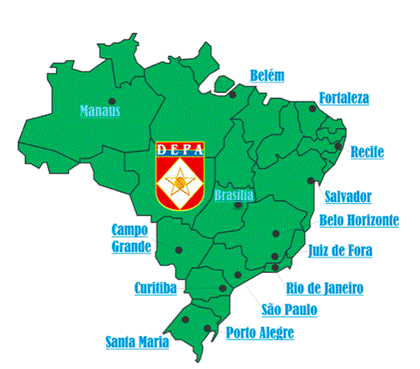
Source: http://www.depa.eb.mil.br/sistema-colegio-militar-do-brasil.
Figure 2: Military College Regions
The Military c Educational System (SCMB), according to the Ministry of Defense (DEPA, n.d.), offers preparatory education for life. The Ministry emphasizes that preparing for life means training all students for the ethical pursuit of happiness and personal fulfillment, understanding this training as open. Preparatory education should enable all students to continue their studies, whether by awakening military vocations, especially for admission to the EsPCEx6, or by preparing them for the selection processes that aim at higher education. Military Colleges, therefore, should prepare students for the society of the future, marked by technological advances and a volatile and competitive job market, for which knowledge alone is not enough.
The Military College Regions also aim to provide educational assistance, which refers to schools that are strongly anchored in ethical and moral values, as well as in customs and traditions cultivated by the Brazilian Army. It is from this combination that the identity of the referred System emerges: the differential capable of generating bonds, attachment, and a feeling of belonging to the schools. As educational institutions affiliated with the codes of the Army, the Military Schools are supported by the same pillars: hierarchy and discipline. This peculiarity, which distinguishes them in the field of national education, reinforces the image that the Military Schools have been polishing over more than 120 years, as their particular brand.
In accordance with its bylaws, the SCMB is dedicated to training young individuals who are active, creative, independent, and self-motivated. These individuals are equipped with essential skills and abilities, as well as the ethical and moral values esteemed by the Brazilian Army. The aim is to cultivate responsible, engaged, and transformative citizens. Military Colleges achieve their mission of delivering foundational education through a seamless integration of preparatory education and values-based education, within an environment that reflects the customs and traditions of the Brazilian Army. This approach is further reinforced by the hierarchy and discipline that underpin the Land Force.
The general goals, listed in art. 4 of the Regulations for Military Colleges (R-69), approved by Order of the Army Commander No. 42, of February 6, 20087, accurately summarize the educational action proposed for Military Colleges:
- to allow students to develop attitudes and incorporate family, social and patriotic values that will ensure their future as patriotic citizens, aware of their duties, rights and responsibilities, regardless of their preferred professional field;
- to provide students with the opportunity to continually seek and research relevant information;
- to develop students' critical view of political, economic, historical, social and scientific-technological phenomena, teaching them to learn for life and not simply to take tests;
- to prepare students to reflect on and understand phenomena and not merely memorize them;
- to enable students to absorb fundamental prerequisites for continuing their academic studies and not superfluous knowledge that is self-contained;
- to encourage students to engage in healthy physical activity, seeking their physical development and encouraging regular sports practice; and
- awaken vocations for a military career (SCHOOL OF HEALTH AND COMPLEMENTARY TRAINING OF THE ARMY, n.d.).
We can identify some differences between Decree 10,202 and Ordinance 42. First, Military Schools are currently not only intended for children of military personnel, since any civilian can participate in the process to join the school; thus, it is clear that the institution intends to be more totalitarian and homogenizing than previously envisioned. In the new system, students are not required to fulfill military obligations, nor do they have this debt. Education, today, builds a critical view on cross-cutting issues, without maintaining a focus on patriotism, and does not have a boarding school system. However, there are also similarities: serving the country, honoring the family, being governed by discipline and following ethical and moral values, according to customs and traditions cultivated by the Brazilian Army.
In reference to Decree 10,202, previously discussed, it is evident that the document aimed to establish a prioritized model for the type of student the institution sought to cultivate. Furthermore, it outlined the standards and profiles that aligned with the College’s mission: to prepare students for a military career. The boarding school regime was designed to provide social support to students impacted by the Triple Alliance War, particularly those who had lost their parents in battle. As such, the College offered various forms of assistance, including food, medical care, clothing, and other resources to orphans. The students adhered to a strict disciplinary framework, which underwent changes in the 19th century and now complies with the provisions of the Child and Adolescent Statute.
Current events are a reflection of discourses and practices that are constantly changing, not escaping power relations, which, in turn, remain in discursive conflicts. When there is a historical rupture in a given era, this means that something has changed, that is, the discourses of the order become different. Previous discourses went through a dispute, in which one of them prevailed and was (re)produced, generating materialities and legitimizing itself in everyday life. We can highlight that the discourses that obtain visibility are in the order because they present conditions of possibility for this. Therefore, currently, the order of educational discourse addresses a supposed reinforcement offered by militarism, and this same discourse was a condition of possibility for the existence and creation of the new Civic-Military Program in Brazilian public schools.
The history we know is not something stratified, fixed, or finished, because it continues infinitely, even with all the ruptures and transformations. When we look at different bibliographies on a given subject, we find different perspectives and positions. In this sense, how would we view history from a single perspective? Generally, books describe history as major events, characters that stood out over time, but what about the other, badly spoken truths? We obtain knowledge about legitimate facts; however, we do not always give them visibility and, often, we do not even capture other discourses, those that have faded over time and provided the conditions for the possibility of so many things to materialize in a past era and that, today, in books, do not even pass by our eyes.
The understanding of the past is layered; historical discourses have undergone conflict and resistance, yet what has been legitimized forms the foundation of what we refer to as history. This history provides us with insight into our present circumstances.
To comprehend the past, we must identify the symptoms of the present and seek explanations through historical analysis. Therefore, we pose the following questions: How has militarization been integrated into education? What factors contributed to this development? What are the conditions and consequences of this alliance? How did the term “civic-military” come to be? What power dynamics facilitated its emergence? What events allowed for the revival of this proposal?
To address these issues, we conducted a history of the present, visualizing current symptoms of Brazilian education, without leaving out the country's current political situation. It is necessary to look at the current scenario to better understand the past, that is, to conduct an archaeological study.
What rupture in Brazilian education provided ammunition for new projects to insert the militaristic strand into education? Given this, in this article, we also undertook research on recent works regarding the term “civic-military” in Brazil, seeking to capture different facets and perspectives of researchers.
From a post-structuralist perspective, contemporary studies of historicity have shifted away from merely chronicling territorial conflicts, shifts in governance, and variations in political alignments. Instead, there is a growing proliferation of diverse analyses that challenge traditional issues, which are often regarded as outdated. New inquiries focus on ruptures, alternative modes of existence, and the evolving nature of social strata. This shift has given rise to a new domain of questioning, wherein the concept of discontinuity emerges as a crucial element of historical analysis.
In the historical context of Brazil during the 1960s, the landscape was characterized by significant changes, transformations, and ruptures that effectively deconstructed established ideologies. Notably, we must consider the coup d'état that led to the military taking power, resulting in an authoritarian regime supported by the bourgeoisie and elite. This government is often referred to as civic-military. According to Santos (2017):
The rupture of the continuity of the political system, which occurred in Brazil in 1964, took place after a brief period of democracy, which occurred with the end of the dictatorial government of Getúlio Vargas in 1945, beginning a period of relative political stability, with the departure of João Goulart from power ending a period of relative democratic stability, with the beginning of more than two decades of civil-military dictatorship, in which there was an alternation in power between generals who became presidents of the republic during this period, starting with Humberto de Alencar Castelo Branco (1964-1967), followed by Arthur da Costa e Silva (1967-1969), Ernesto Garrastazu Médici (1969-1974), Ernesto Geisel (1974-1979) and João Baptista Figueiredo (1979-1985) (Santos, 2017, p. 20).
The dictatorial government not only promoted several changes in the structure of society, but also oppressed any opposition. The main resistance movements against the government came from the National Union of Students (UNE), opposition parties, and activist artists. To repress these movements, the government issued several decrees that strengthened the military's position of power, criminalizing any opposition activity and interfering in citizens' rights, such as freedom of expression, for example.
The discourse of order was the highlight of militarism, allowing the military to carry out any type of action without supervision or intervention from the Judiciary and Legislative Branches. The event that marked the repression occurred with the enactment of Institutional Act No. 5, in 1968, under the government of President Costa e Silva, when a ban on political demonstrations was decreed. The military had permission to repress opposition movements and restrict civil rights. Soon, acts of violence became common, so that fear and oppression solidified in a society that had no right to take a stand. Excesses became routine, while the government argued that, to remain in power, it would use this modus operandi. The civic-military government polarized the politics of the time, believing in the duality of capitalism vs. communism and therefore seeing people who held communist ideals as enemies.
Given this political scenario, the priority was not education, much less the pursuit of citizenship or the intellectual development of the population; however, the demand required some transformations, making the State assume the commitment of an education focused on capital and guiding the educational system to meet the needs of the time.
Education became vocational, with the objective of training students for work, as this would improve the country's development and, in theory, solve the problem of social inequality, since, for the government, the professionalization of education was a way of population control. According to Frigotto (2010),
What is intriguing about the theory of human capital, which postulates a linear link between development and overcoming social inequality, through qualification, because it would lead to increasing productivity, is the fact that it arises when we historically observe a reorganization of imperialism, an exacerbation of the process of concentration and centralization of capital, a growing incorporation of technical progress in production, a weapon of intercapitalist competition, and a consequent disqualification of labor, creation of a collective body of labor and the announcement of the golden age of unemployment and underemployment in the world (Frigotto, 2010, p. 30).
It is worth noting that capital-based education would not form problematic, critical subjects who would participate in political processes, but subjects who would serve only as labor for the financial market. Thus, according to Soares (2007), education, for the State,
began to be seen as an investment: the educational system was given the task of preparing human resources to meet the demands of projects in the economic field. Education began to be thought of as a form of capital appropriation, as an improvement in the qualification of labor, intensely linked to the development that is made based on technology, in the creation and implementation of this technology, and in its relationship with productivity. In this approach, man is not seen as a human being but rather as a workforce, necessary for the various levels and types of technical qualification. The economistic and technocratic ideology places priority on the concept of education linked to economic development, where investment in man should be seen as a factor of economic productivity (Soares, 2007, p. 2).
We can therefore see that educational policy in Brazil was conducted by the dictatorial State based on economic liberalism, whose rules for government policies were dictated by the market. The educational policy of the civic-military regime, according to Germano (1990), developed around the following axes:
. Control at all levels of education, both political and ideological, but this control was not exercised linearly, as the regime was unable to exert complete control over education due to the growing influence of opposition forces in the political arena. Therefore, elements of “restructuring” and “renewal” appear in educational reforms, in addition to the centralization of planning and decision-making, based on technocratic knowledge, in response to the “participationist” appeals of the lower classes;
. Establishment of the “human capital theory”, that is, the immediate and direct existence of the relationship between capitalist production and education, which was even more evident in the reform of secondary education, through supposed professionalization;
. Encouragement of research aimed at capital accumulation;
. Lack of commitment to financing “free public education”, leading to a practice that ran counter to the value discourse of school education, to corroborate the privatization and corruption of education, to transform it into a profitable business subsidized by the State. With this, the regime encouraged the participation of the private sector in education, delegating to it the expansion of the education system and, at the same time, disqualifying, above all, Basic Education in public schools.
In this way, we identified the rationality of that time, which emerged from the historical discontinuity of militarism in education. Thus, we problematized the objectives of the civic-military project created in 2020, based on the current political situation in Brazil, a democratic country: what would lead to the updating of this aspect, 55 years after the military coup?
To better understand the military context in public education, we conducted a search on the CAPES portal to select research that would better guide our problematizations. Although there are countless theses and dissertations found, not all of them are related to education, as there are many more theses and dissertations on Military Institutions, Military Coup and training of military personnel in barracks than, specifically, on civic-military schools.
The research literature on this topic often overlooks the researcher's journey, from the establishment of their research objectives to the conclusions drawn from the analysis. This process can be likened to "mining," as the "categories of analysis rely on the documents that must be located, removed from the shelves, and subjected to a treatment process that, informed by the research problem, facilitates the assembly of pieces akin to a jigsaw puzzle" (Pimentel, 2001, p. 180). Therefore, this article focuses not on the "mining" process itself but rather on presenting results that can enhance the historical analysis conducted previously and, more importantly, to identify the discourses that have gained prominence in academia regarding the topic at hand. With this intention, we hope that the study proves beneficial to other researchers interested in the Civic-Military School Program.
Our initial search filter was the term "civic-military" (in quotation marks), applied to the CAPES Portal. Below, we provide a table detailing the results obtained.
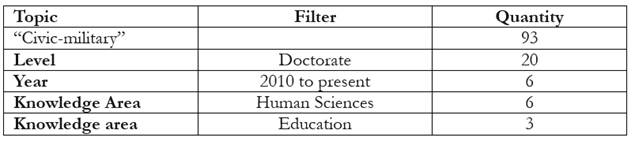
We selected the term “civic-military” to encompass the theses and dissertations that address this topic, filtering for doctoral-level research to facilitate a more in-depth analysis that would enhance our study. We subsequently narrowed our search to the theses published between 2010 and the present year, as we aimed to investigate whether there had been significant academic discussions or analyses related to the evolution of militarism in Basic Education since the Civic-Military School Program was implemented in 2019. The filters about Human Sciences and Education provided a more targeted focus on research within these fields of knowledge.
Below, we outline the three theses identified through our applied filters.
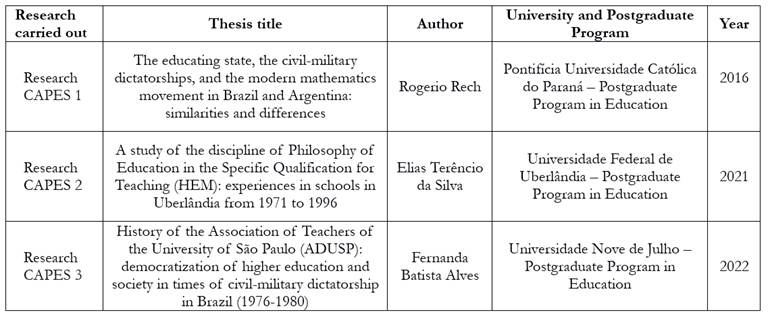
In this paper, we present a literature review based on the findings from the CAPES 2 Research field, focusing on the theme of “civic-military” as it pertains to educational institutions. It is important to mention that CAPES 1 and CAPES 2 Researches were excluded from this review for several reasons: they lack a post-structuralist framework, do not explore civic-military schools, and do not pertain to historically significant periods relevant to our study.
Notably, despite applying this filter, we did not identify any research concerning the new Civic-Military School Program. However, we will still emphasize studies that discuss militarization within the educational context.
The thesis found in CAPES Research 2 is entitled A study of the discipline of Philosophy of Education in the Specific Qualification for Teaching (HEM): experiences in schools in Uberlândia from 1971 to 1996 (Um estudo da disciplina de Filosofia da Educação na Habilitação Específica para o Magistério (HEM): experiências em escolas de Uberlândia no período de 1971 a 1996) and is authored by Elias Terêncio da Silva (2021), defended in the Postgraduate Program in Education at the Federal University of Uberlândia.
Silva's research originated from a study conducted in four educational institutions in Uberlândia-MG, where the Specific Qualification for Teaching (HEM) was offered between 1971 and 1996. This timeframe encompasses the enactment of Law 5,692/1971 during the civic-military regime, which resulted in the removal of Philosophy from the curriculum of Secondary Schools. To analyze the program content of the course “Historical and Philosophical Aspects of Education” (AHFE) in alignment with the educational foundations provided by HEM, the researcher aimed to determine whether the institutions adhered to the legislation in effect at the time, which mandated the offering of only AHFE; investigate the incorporation of independent disciplines in the curricula; and explore the presence of Philosophy.
Silva (2021) examined the philosophical and educational conceptions, as well as the framework for teacher training in the context of AHFE and the discipline of Philosophy of Education, as outlined in the Manual of the Normal Course by the Secretariat of State of Education of Minas Gerais (SEEMG) from 1988. He aimed to determine whether there was a direct and absolute control of education by the civic-military regime. The methodological approach employed was both qualitative and quantitative, encompassing bibliographic and documentary research, with a particular focus on the defunct schools of the Regional Superintendence of Education of Uberlândia/MG. The empirical data was analyzed using an Excel spreadsheet, and a questionnaire facilitated the documentary analysis.
The researcher found that AHFE was omitted from the curricular matrices, but identified the inclusion of the discipline of Philosophy of Education in some educational institutions in Uberlândia, mentioned in the study as I, II, III and IV. Philosophy proved to be not extinct in the initial training of secondary school teachers, and the Philosophy of Education, according to the SEEMG/1988 Manual (apud Silva, 2021), presented a strong inclination towards Marxist philosophy, focused on the analysis of praxis, which indicated a Marxist orientation in teacher training. This discipline appeared in the curricula as an autonomous subject, challenging the guidelines established by Law No. 5,692/1971 and by CFE Opinion No. 349/1972-CESU. Regarding the type of training, the research indicated that it was superficial in HEM, but the Manual described it as more comprehensive.
The results obtained by Silva (2021) indicated that the civic-military regime did not exercise absolute and continuous control over education and that the HEM proved to be ineffective at the national level. The presence of Philosophy in the four educational institutions in Uberlândia was interpreted as an act of demand and resistance, reflecting the effort in favor of the preservation and reintegration of Philosophy in high school education. In Uberlândia, schools emerged as scenarios of confrontation and contradiction between the interests of social classes, that is, between the dominant and dominated groups. However, Philosophy was only reintegrated into the official curriculum 37 years after the enactment of Law No. 5,692/1971.
Based on these considerations about Silva's thesis (2021), we can see that it is a study that investigates teacher training based on legislation established during the civil-military regime and, although it is not a post-structuralist study or a study on the PECIM, it worked with historical discontinuities in teaching. The author carried out a historicization of the facts, involving the Escola Normal (Teaching School), the Philosophy of Education in Brazil and the civic-military regime (after the 1964 coup), to then raise the programmatic content developed in the “Biological, psychological, sociological, historical and philosophical aspects of education”, of the Fundamentals of Education, more specifically, in the “Historical and Philosophical Aspects of Education” (AHFE) of the HEM and/or in the discipline History and Philosophy of Education of the former Escola Normal, since both were aimed at training teachers for the initial grades at the high school level. The study also considered that Law No. 5,692/1971, enacted during the civic-military regime, suppressed High School Philosophy.
To support the analysis, we also searched the CAPES repository of theses and dissertations for the term civic-military without putting it in quotation marks. The search revealed 10,503 results, as described below:
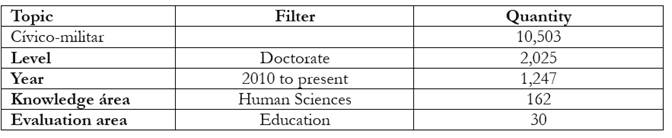
The civic-military filter, utilized without quotation marks, was selected to explore more discussions regarding the intersection of the terms "civic" and "military." We opted for the level of "doctoral thesis" to catalog research that offers greater theoretical and methodological depth. Furthermore, we established a time frame beginning in 2010 to capture contemporary research and discourses that have influenced the present scenario, thereby facilitating the establishment of PECIM. We chose Human Sciences and Education as the focus areas of knowledge and assessment, respectively, given that our research is centered on these domains. This filter yielded a total of 30 theses as a result.
It is clear from the table presented that the civic-military theme is widely addressed in current research; even so, some of them did not contribute to our problem because they relate to other axes and areas of knowledge and have other references. Thus, we chose to select research that had been developed in schools, from a post-structuralist perspective (in order to establish a dialogue with our reference) and/or that related the term “civic-military” to education. It is worth noting that, in these filters, we found only one research that addressed the new Civic-Military Program. Thus, we explored the research and verified some others that also addressed the militarization of education. Based on our discussions, we dialogued with the selected theses, which totaled three, and we present them in the following tables, with the title of each one, the identification of the authors and the University where the research was conducted, as well as the year in which it was defended.
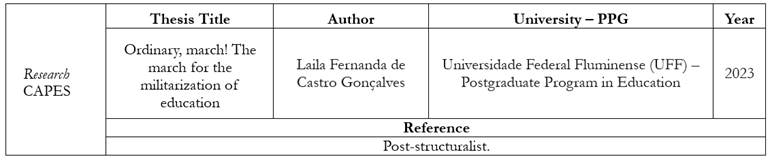
Laila Fernanda de Castro Gonçalves' thesis stands out as the only one identified that delves into the Civic-Military Program, underlining the significance of our discussions. Her research focuses on the rationale behind the adoption of militarism in education, primarily driven by the notable prevalence of violence, which positions security as a key reason for embracing this system. The author notes that at various points in history, the Brazilian State has employed police and military forces to regulate behaviors and reshape urban environments, impacting both social and educational domains. Her research proposal aimed to explore and analyze the historical connection between the criminalization of poverty and the militarization of public schools. Notably, the narrative promoting the social advancement of low-income youth through military education has gained considerable traction within the contemporary Brazilian educational landscape. As a result, the policy for implementing civic-military schools in Basic Education, justified by claims of improved student performance and reduced crime rates, is currently on the rise.
The study by Gonçalves (2023) proposes a discussion based on a genealogical analysis of the institution of public military education, using military discipline as a way and option to prevent crime and promote educational success. The work aimed to understand how military force was used by the Brazilian State to suppress behaviors considered undesirable, which often stigmatizes minorities in various ways, and to evaluate how this punitive segregation was established in public schools. According to the author (2023), the Armed Forces, in their function, are intended to defend the national territory, which is provided for in the Federal Constitution.
According to the thesis in question, auxiliary forces serve to preserve public order, the well-being of people, and property:
Art. 144. Public security, a duty of the State, a right and responsibility of all, is exercised to preserve public order and the safety of people and property, through the following bodies: I - federal police; II - federal highway police; III - federal railway police; IV - civil police; V - military police and military fire departments. VI - federal, state, and district criminal police (Brazil, 1988 apud Gonçalves, 2023, p. 126).
Thus, the author concludes that it is neither a function nor a constitutional attribution of the Military Police, the Fire Department or the Armed Forces to offer Basic Education in their spheres of action and that, therefore, the state legislature, which supports the creation and operation of militarized schools, is contrary to the Federal Constitution (Ximenes; Stuchi; Moreira, 2019 apud Gonçalves, 2023, p. 127).
Gonçalves’ research investigates the role of military forces, both federal and state, as defined by the Federal Constitution, which restricts their functions to national defense, maintaining public order, and safeguarding individuals and property. Despite these limitations, the Armed Forces and state police have expressed an interest in establishing and expanding military schools across the country. The launch of the Civic-Military Schools Program has further fueled this initiative, garnering support from a populace drawn to conservative proposals. However, the author contends that these institutions exacerbate social segregation by being predominantly funded and preferentially selecting students with higher academic performance, effectively excluding the most vulnerable groups, including women, LGBTQI+ individuals, indigenous peoples, and those from economically disadvantaged backgrounds.
Historically, military discipline in public forces dates back to the 19th century, beginning with the Royal Police Guard of Rio de Janeiro, created to monitor and repress demonstrations by the working classes and slaves. Over time, institutions such as the Imperial Military College and the Osório Foundation emerged, designed to discipline orphans and other young people. In the 20th century, militarized state schools, run by the Military Police and the Fire Department, were promoted as solutions to the problems of indiscipline and school violence. However, the author criticizes this approach, arguing that disciplining children should be the responsibility of educators, not police officers.
O histórico descrito, de atuação às vezes inconstitucional das forças militares, culminou com a criação do Programa das Escolas Cívico-Militares, visto como parte de uma tendência conservadora, que visa a regular e controlar as classes populares, cujos direitos sociais foram fortalecidos durante os 14 anos de governo do Partido dos Trabalhadores no Brasil. A autora também destaca que a pobreza e as desigualdades sociais fazem parte de um processo de criminalização que, para o governo, justifica a intervenção disciplinar nas escolas públicas. Ressaltamos, como a autora da tese, que a presença de policiais militares não foi igualmente aplicada nas escolas privadas, transformando a escola pública brasileira em um instrumento de controle social, que pune os mais pobres desde o processo seletivo até a constante fiscalização e cobrança de produtividade, marginalizando os mais vulneráveis sob critérios de mérito.
Still, according to Gonçalves (2023):
The commission of violence outside schools, so emphasized and criticized by the government, now appeared under the guise of legality and social approval within schools. The multiple acts of violence and exclusion that occurred on the streets, with poverty as the main target, gained legitimacy within militarized schools. Under the argument of civility and productivity, designed in the Modern Age, the militarized school was a kind of re-actualization of the Modernity project that silenced, excluded, and subjected the individual, but now to the sound of the Brazilian national anthem and under the command: ordinary, march! (Gonçalves, 2023, p. 128)
Gonçalves' thesis contributes to our research in several aspects, firstly because it is the pioneering research among those we found to give visibility to the Civic-Military Schools Program and, secondly, because it shows one of the reasons for voluntary adherence to the program, namely, the lack of security in society.
The objective of the next thesis discussed here, found through CAPES Research 5, was to study four schools that operated in Curitiba between 1965 and 1986, years that correspond to the founding of the first and the closing of the last of them. These schools are defined, in the educational literature, as “Alternative Schools”, a group of institutions that established different critiques of conventional schools, not only in Brazil but in various parts of the world. Many of the creators and founders of these schools faced the military regime, some of whom were persecuted and arrested, and some schools were subject to investigations and interventions by the police. The following table presents the data from the thesis in question.

According to the author, Maria Rosa Chaves Künzle (2011), schools emerged as spaces of care and education for the children of activists, friends and sympathizers who sought an alternative to doctrinaire and authoritarian education. In addition to their educational role, these schools also functioned as trenches of protection and encounter for those involved in clandestine movements. Influenced by the progressive pedagogies of the time, these institutions adopted, in their practices, elements of Active Pedagogy, Socialist Pedagogy, and Libertarian Pedagogy.
These pedagogical approaches manifested themselves in school practices in various ways, sometimes explicitly and systematically, and other times more intuitively and diffusely. Based on the theories of Michel Foucault and Michel de Certeau on disciplinary institutions and resistance, the study identified movements of contestation against official education, especially about the organization of school spaces and times, discussions on gender, family, and morality, and debates on freedom and limits.
As discussed in the thesis, these educational experiments represented attempts to create an “other education,” promoted by individuals committed to social change. During the turbulent 1960s, these educators risked their lives in the fight against the dictatorship, seeking to break with the paradigms of a disciplinary and authoritarian society. The founders of the Alternative Schools aimed to build an educational institution that would differ from traditional disciplinary schools, both in terms of its functioning and methodology.
Inspired by progressive pedagogical ideas, these educators implemented practices based on currents such as Libertarian Pedagogy, which originated in the anarchist movement of the 19th century and was adapted to the counterculture era; Active Pedagogies, which emphasized child development and New School Psychology; and the principles of Socialist Pedagogy, guided by the theoretical foundations of Marxism and the libertarian socialist ideals of Célestin Freinet, to build a new society and a new human being. These ideas were present in school practices, manifesting themselves in different ways, depending on specific situations and contexts.
Künzle's thesis shows another type of education, different from that implemented by the authoritarian regime. It addresses the lines of escape existing in the processes of militarization and contributes to this article by showing that there may be other ways to innovate in Education and, in addition, by using concepts from Michel Foucault to establish connections with Education. The study also discusses issues such as the organization of school spaces and times; gender, family and morality; and the debates on “freedom and limits”, which serve as a basis for us when we question the paradox between freedom and security. The thesis highlighted above, by Gonçalves (2023), in turn, addresses the lack of security as a reason for adherence to the civic-military program, while that of Künzle (2011) sheds light on another perspective of school, a libertarian one.
Another study, CAPES 6, investigated the process of militarization in public schools in the state of Goiás, specifically in the Military Police Schools of Goiás (CPMG). To contextualize the study, we highlight that, after 2013, the civilian management of these schools was replaced by another, by the Military Police, including the appointment of a military officer as director and the creation of the Parent-Teacher Association to manage resources from voluntary contributions. In addition, an organizational structure was implemented with specific divisions for teaching, administration, discipline and finance, which are not common in the regular education network of Goiás.
The study in question is qualitative and descriptive in nature, using methods such as bibliographic and documentary research, as well as field observation and semi-structured interviews to analyze the implications of the aforementioned militarization in guaranteeing the right to public education. As a result, its author, Vinicius Borges Alves (2021), points out that the CPMGs can compromise this right due to practices such as charging “voluntary contributions”, selective processes for admission and strict performance and discipline criteria for student retention, in addition to the replacement of a school management elected by the community by a military management.
In the Brazilian context, military influence extends from politics to education. Historically, the military has actively participated in the country's political decisions, marked by transitions, ruptures, and continuities. According to Alves (2021), in Goiás, the militarization of schools was motivated by political and social reasons, including the search for local political support, maintaining influence in school management, and promoting these schools as successful models to hide deficiencies in the state network, in a process that also serves the interests of the most privileged classes. Criticisms of this policy include the weakening of democratic school management, the failure to resolve educational inequalities, and the perpetuation of state authoritarianism.
The table below presents data from Alves' thesis (2021).

We also emphasize that the analytical framework employed in this article is grounded in the historicity of past events, which allows us to capture the historical continuities and discontinuities of militarism within education. This framework highlights the conditions that enable the resurgence of militarism, particularly through the implementation of civic-military programs in schools, which are public institutions dedicated to individual development. The theses discussed are scientific outputs that reflect the consequences of these historical events, functioning as legitimizing documents for the emerging effects in the contemporary era.
Out of the 30 theses identified in the CAPES repository, we have highlighted those that most significantly contributed to this article, as mentioned earlier. The selection criterion was based on the fact that these theses were developed within the field of Education, specifically focusing on militarism in education as their central theme. This research presents a variety of perspectives, references, approaches, and stances. The other themes explored in the remaining theses were diverse, including inclusive education, gender and the inclusion of women, historical analyses of institutions, the constitution of schools, evaluations of students and faculty, documentary analyses, and governance strategies in schools, among others.
The plurality of research on militarism in education is notorious. They converge on the same theme, although they have different perspectives on this aspect. We did not find any other research that addressed the discontinuity of militarism in education, which assures us that this is unprecedented.
FINAL CONSIDERATIONS
The creation of the program that establishes civic-military schools in Brazil shows how the discourse of militarism is in the spotlight. We chose not to go into details about the current political context, preferring to diagnose the conditions of possibility that contributed to this scenario. Therefore, in this article, we have undertaken the historical history of militarism in Brazil, giving visibility to the emergence of the term “civic-military” and understanding the historical continuities and discontinuities of this system. We use Michel Foucault’s theorizing and his understanding of the history of the present to analyze the effects of the intersection between militarism and education, which provided the conditions for the establishment of the new Program. The key issue in our article was the emergence of a reinforcement of public education.
First, we address the current scenario of Brazilian education with the establishment of PECIM, explaining the functioning and objectives of the new project. To address the issues that emerged, we conducted an archaeological study, addressing the historical context contained in the creation of the first school with a militaristic slant in Brazil. We used historical discontinuity as an analytical tool, purposefully presenting discontinuous facts from different historical times in the text, since, as in the text, the events are not linear.
In the second part, we presented an analysis of historical ruptures in order to verify the episteme and the conditions of possibility for the updating of militarism in education, capturing the rationality of the time from a history of the present. Then, in order to better understand the military context in public education, we presented the research carried out on the CAPES portal, selecting some theses to guide our problematizations and understand what the current discourses on militarism are in the scientific area. The theses found were of great importance to qualify this study, even though we found few works that addressed the Civic-Military School Program, which, however, contributed to the originality of our research in the area of education. We were able to capture, in the only thesis among those found that most directly addresses our theme, some foundations that theorize the problems proposed so far. The other theses allowed us to identify other discussions and problematizations that are also important, which encompass the term “civic-military” and are part of the rationality of the current era. In the theses found, the approach to the term in question was contained in a specific historical context, in which the discontinuity was visible in each research. We captured, as discourses of the order, inclusive education, gender and inclusion of women, historicization of institutions, constitution of schools, analyses of students and faculty, documentary analyses, governance strategies, among others.
Therefore, we carried out a post-structuralist analysis, inspired by Michel Foucault's archeological phase, reporting important historical facts that led to the militarization of education, such as the Paraguayan War and, with it, the creation of the first military school, in addition to the coup d'état from which the term “civic-military” emerged, among others. It was also relevant to observe other research to analyze the types of research that have been created on this theme, to identify the prevailing episteme in contemporary society.
REFERENCES
ALVES, Fernanda Batista. História da Associação de Docentes da Universidade de São Paulo (Adusp): democratização do ensino superior e da sociedade em tempos e ditadura civil militar no Brasil (1976-1980). 2022. Tese (Doutorado em Educação) - Programa de Pós-Graduação em Educação, Universidade Nove de Julho (UNINOVE), São Paulo 2022 . [ Links ]
ALVES, Vinicius Borges. Militarização de colégios públicos da rede estadual de ensino de Goiás: implicações para o direito à educação pública e gratuita. 2021. Tese (Doutorado em Educação) - Programa de Pós-Graduação em Educação, Universidade Estadual Paulista (Unesp), Instituto de Biociências, Rio Claro, 2021. [ Links ]
BATISTA, Roberto Morais. Colégios militares: ensino educacional de referência. In: ADMINISTRADORES. [S. l.], 12 set. 2016. Disponível em: Disponível em: https://www.administradores.com.br/artigos/colegios-militares-ensino-educacional-de-excelencia . Acesso em: 16 fev. 2025. [ Links ]
BRASIL. Câmara dos Deputados. Decreto n. 10.202, de 9 de março de 1889. Approva o Regulamento para o Imperial Collegio Militar. In: Coleção de Leis do Império do Brasil - 1889. v. 1, pt. II (Publicação Original). Disponível em: Disponível em: https://www2.camara.leg.br/legin/fed/decret/1824-1899/decreto-10202-9-marco-1889-542443-publicacaooriginal-51422-pe.html#:~:text=Approva%20o%20Regulamento%20para%20o%20ImperiaI%20Collegio%20Militar . Acesso em: 12 jun. 2023. [ Links ]
BRASIL. Câmara dos Deputados. Decreto n. 10.202, de 9 de março de 1889. Approva o Regulamento para o Imperial Collegio Militar. In: Coleção de Leis do Império do Brasil - 1889, p. 247, v. 1 pt. II (Publicação Original). Disponível em: Disponível em: https://www2.camara.leg.br/legin/fed/decret/1824-1899/decreto-10202-9-marco-1889-542443-publicacaooriginal-51422-pe.html#:~:text=Approva%20o%20Regulamento%20para%20o%20ImperiaI%20Collegio%20Militar . Acesso em: 12 jun. 2023. [ Links ]
BRASIL. Ministério da Educação. Portaria n. 1.071, de 24 de dezembro de 2020. Regulamenta a implantação do Programa Nacional das Escolas Cívico-Militares - Pecim em 2021, para implementação das Escolas Cívico-Militares - Ecim nos estados, nos municípios e no Distrito Federal. Diário Oficial da União, 28 dez. 2020. Disponível em: Disponível em: https://www.in.gov.br/en/web/dou/-/portaria-n-1.071-de-24-de-dezembro-de-2020-296412451 . Acesso em: 07 mar. 2022. [ Links ]
BRASIL. Ministério da Educação. Secretaria de Educação Básica. Diretrizes das Escolas Cívico-Militares. Brasília: MEC, 2021. [ Links ]
BRASIL. [Constituição (1988)]. Constituição da República Federativa do Brasil de 1988. Brasília, DF: Presidência da República, 1988. Disponível em: Disponível em: https://www.planalto.gov.br/ccivil_03/constituicao/constituicao.htm . Acesso em: 23 jun. 2023. [ Links ]
CARVALHO, Argens José de. Colégio Militar. Cem anos de tradição. Revista do Exército Brasileiro, Rio de Janeiro, v. 126, n. 1, p. 126, jan./mar. 1989. [ Links ]
CARVALHO, Fabrícia A. T. Colégio Militar do Rio de Janeiro. Rio de Janeiro: Biblioteca do Exército, 2015. [ Links ]
CUNHA, Beatriz Rietmann da Costa e. Assistência e profissionalização do Exército: elementos para uma história do Imperial Colégio Militar. Dissertação (Mestrado em Educação) - Faculdade de Educação, Universidade do Estado do Rio de Janeiro, Rio de Janeiro, 2006. [ Links ]
CUNHA, Beatriz Rietmann da Costa e. Ensino secundário militar na primeira república: a construção dos colégios militares (1889-1919). 2012. Tese (Doutorado em Educação) - Faculdade de Educação, Universidade Federal Fluminense, Niterói, 2012. [ Links ]
DIRETORIA DE EDUCAÇÃO PREPARATÓRIA E ASSISTENCIAL (DEPA). Histórico. Disponível em: Disponível em: http://www.depa.eb.mil.br/historico . Acesso em: 23 fev. 2022. [ Links ]
DOLZAN, Marcelo. Bolsonaro inaugura colégio para filhos de PMs e critica ideologia de gênero. Terra, 17 dez. 2018. Disponível em: Disponível em: https://www.terra.com.br/noticias/bolsonaro-inaugura-colegio-para-filhos-de-pms-e-critica-ideologia-de-genero,a0a575f46d6eff1926e3075222fd84a057zke16v.html . Acesso em: 03 ago. 2023. [ Links ]
ESCOLA DE SAÚDE E FORMAÇÃO COMPLEMENTAR DO EXÉRCITO. Bem-vindo à Escola de Saúde e Formação Complementar do Exército. Disponível em: Disponível em: https://www.esfcex.eb.mil.br/images/menu_cms/secretaria_ca/legislacao/1_Regulamento_dos_Colegios_Militares_R_69.pdf . Acesso em: 07 abr. 2022. [ Links ]
ESCOLAS militares se destacam entre as 30 melhores do país no IDEB. G1, 22 ago. 2012. Disponível em: Disponível em: https://g1.globo.com/bom-dia-brasil/noticia/2012/08/escolas-militares-se-destacam-entre-30-melhores-do-pais-no-ideb.html#:~:text=Das%2030%20melhores%20escolas%20p%C3%BAblicas,educa%C3%A7%C3%A3o%20de%20qualidade%20para%20todos . Acesso em: 16 fev. 2025. [ Links ]
FIGUEIRA, Kátia Cristina Nascimento. Forças armadas e educação: o Colégio Militar de Campo Grande - MS (1993-2010). 2011. Tese (Doutorado em Educação) - Universidade Federal de São Carlos, São Carlos, 2011. Disponível em: Disponível em: https://repositorio.ufscar.br/handle/ufscar/7280 . Acesso em: 10 jun. 2022. [ Links ]
FOUCAULT, Michel. A Ordem do Discurso: aula inaugural no Collège de France, pronunciada em 2 de dezembro de 1970. 13. ed. Tradução Laura F. A. Sampaio. São Paulo: Loyola, 2006. [ Links ]
FOUCAULT, Michel. Arqueologia do Saber. 7. ed. Tradução Luiz F. B. Neves. Rio de Janeiro: Forense Universitária, 2008. [ Links ]
FOUCAULT, Michel. As Palavras e as Coisas. 8. ed. Tradução Salma T. Muchail. São Paulo: Martins Fontes, 1966. [ Links ]
FOUCAULT, Michel. Microfísica do Poder. 21. ed. Tradução Roberto Machado. Rio de Janeiro: Graal, 2005. [ Links ]
FRIGOTTO, Gaudêncio. A produtividade da escola improdutiva. São Paulo: Cortez, 2010. [ Links ]
GERMANO, José Wellington. Estado Militar e Educação no Brasil: 1964/1985: um estudo sobre a política Educacional. 1990. Tese (Doutorado em Educação) - Faculdade de Educação, Universidade Estadual de Campinas (Unicamp), Campinas, 1990. [ Links ]
GONÇALVES, Laila Fernanda de Castro. Ordinário, marche! A marcha pela militarização da educação. 2023. Tese (Doutorado) - Programa de Pós-Graduação em Educação, Faculdade de Educação, Universidade Federal Fluminense, Niterói, 2023. [ Links ]
KÜNZLE, Maria Rosa Chaves. Escolas alternativas em Curitiba: trincheiras, utopias e resistências pedagógicas (1965-1986). 2011. Tese (Doutorado em Educação) - Curso de Pós-Graduação em Educação, Universidade Federal do Paraná, 2011. [ Links ]
LUCHETTI, Maria S. R. O ensino no Exército brasileiro: histórico, quadro atual e reforma. 2006. Dissertação (Mestrado) - Universidade Metodista de Piracicaba (UNIMEP), Piracicaba, 2006. [ Links ]
MOREIRA, Heloi J. F. Casa do Trem: berço do ensino militar e da Engenharia brasileira. Revista do Exército Brasileiro, v. 147, Edição especial: 200 anos do ensino militar, 2011. [ Links ]
MOTTA, Jehovah. Formação do oficial do Exército. Rio de Janeiro: Biblioteca do Exército, 2001. [ Links ]
NOGUEIRA, Jefferson Gomes. Educação Militar: uma leitura da educação no sistema dos Colégios Militares do Brasil (SCMB). 2014. Dissertação (Mestrado em Educação) - Programa de Pós-Graduação em Educação, Universidade Federal do Mato Grosso do Sul, Campo Grande, 2014. [ Links ]
OLIVEIRA, Ana Amélia Penido. Profissionalização à Brasileira. In: IX ENCONTRO NACIONAL DA ASSOCIAÇÃO BRASILEIRA DE ESTUDOS DE DEFESA. Florianópolis, 2016. [ Links ]
OLIVEIRA, Cristiane. A vertigem da descontinuidade: sobre os usos da história na arqueologia de Michel Foucault. História, Ciências, Saúde - Manguinhos, Rio de Janeiro, v. 15, n. 1, p. 169-181, jan./mar. 2008. [ Links ]
OLIVEIRA, Gilson Passos de. Programa Escolas Cívico-Militares deverá chegar a mais de 200 colégios até 2023. [Entrevista cedida a] Serviços e informações do Brasil, 28 jun, 2021. Disponível em: Disponível em: https://www.gov.br/pt-br/noticias/educacao-e-pesquisa/2021/06/programa-escolas-civico-militares-devera-chegar-a-mais-de-200-colegios-ate-2023 . Acesso em: 18 fev. 2025. [ Links ]
PIMENTEL, Alessandra. O método da análise documental: seu uso numa pesquisa historiográfica. Cadernos de Pesquisa, n. 114, p. 179-195, nov. 2001. Disponível em: Disponível em: http://www.scielo.br/pdf/cp/n114/a08n114.pdf . Acesso em: 09 jun. 2024. [ Links ]
PINEDA, Silvana Schuler. O Casarão da Várzea visto por dentro: trajetórias escolares de alunos do Colégio Militar de Porto Alegre. 2009. Tese (Doutorado em Educação) - Programa de Pós-Graduação em Educação, Faculdade de Educação, Universidade Federal do Rio Grande do Sul, 2009. [ Links ]
PINHEIRO, Daniel Calbino; PEREIRA, Rafael Diogo; SABINO, Geruza de Fátima Tome. Militarização das escolas e a narrativa da qualidade da educação. Revista Brasileira de Política e Administração da Educação, [S. l.], v. 35, n. 3, p. 667-688, set./dez. 2019. [ Links ]
PIRASSUNUNGA, Adailton. O ensino Militar no Brasil (Colônia). Editora, 1958. [ Links ]
RECH, Rogerio. O estado educador, as ditaduras cívico-militares e o movimento da matemática moderna no Brasil e na Argentina: aproximações e distanciamentos. 2016. Tese (Doutorado) - Programa de Pós-Graduação em Educação, Pontifícia Universidade Católica do Paraná, Curitiba, 2016. [ Links ]
SANTANA, Ygor Santos de; ÁVILA, Flávia de. Um diálogo entre biopolítica e colonialidade a partir da intervenção militar no Rio de Janeiro. Revista Direito, Estado e Sociedade, [S.l.], 2021. Disponível em: Disponível em: https://revistades.jur.puc-rio.br/index.php/revistades/article/view/1656 . Acesso em: 10 jun. 2023. [ Links ]
SANTOS, Leonardo Batista dos. A Escola Estadual Josias Pinto no Projeto Educacional do Governo Civil-Militar (Nova Ponte-Minas Gerais, 1965-1975). 2017. Dissertação (Mestrado em Educação) - Programa de Pós-Graduação em Educação, Universidade Federal de Uberlândia, Uberlândia, 2017. [ Links ]
SILVA, Elias Terêncio da. Um estudo da disciplina de Filosofia da Educação na Habilitação Específica para o Magistério (HEM): experiências em escolas de Uberlândia no período de 1971 a 1996. 2021. Tese (Doutorado em Educação) - Programa de Pós-Graduação em Educação, Universidade Federal de Uberlândia, Uberlândia, 2021. [ Links ]
SOARES, Andréa de Almeida Rosa. As mudanças na Educação Brasileira no Contexto Neoliberal e suas implicações no ensino superior. In: VII CONGRESSO LATINO-AMERICANO DE HUMANIDADES. Campos dos Goitacazes, 2007. [ Links ]
TENENTE COIMBRA. Escolas militares, sinônimo de excelência na educação de São Paulo e do Brasil. In: A TRIBUNA. [S. l.], 03 set. 2019. Disponível em: Disponível em: https://www.atribuna.com.br/opiniao/tenente-coimbra/escolas-militares-sinonimo-de-excelencia-na-educac-o-de-s-o-paulo-e-do-brasil-1.279733 . Acesso em: 16 fev. 2025. [ Links ]
XIMENES, Salomão Barros; STUCHI, Carolina Gabas; MOREIRA, Márcio Alan Menezes. A militarização das escolas públicas sob os enfoques de três direitos: constitucional, educacional e administrativo.Revista Brasileira de Política e Administração da Educação, v. 35, n. 3, p. 612, 2019. Disponível em: Disponível em: https://seer.ufrgs.br/index.php/rbpae/article/view/96483 . Acesso em: 10 jun. 2023. [ Links ]
1Article published with funding from theConselho Nacional de Desenvolvimento Científico e Tecnológico- CNPq/Brazil for editing, layout and XML conversion services.
2ESCOLAS militares se destacam entre as 30 melhores do país no IDEB. G1, 22 ago. 2012. TENENTE COIMBRA. Escolas militares, sinônimo de excelência na educação de São Paulo e do Brasil. In: A TRIBUNA. [S. l.], 03 set. 2019.
3BATISTA, Roberto Morais. Colégios militares: ensino educacional de referência. In: ADMINISTRADORES. [S. l.], 12 set. 2016.
4Available at https://www.gov.br/pt-br/noticias/educacao-e-pesquisa/2021/06/programa-escolas-civico-militares-devera-chegar-a-mais-de-200-colegios-ate-2023. Accessed on: Feb 18 2025.
5“Art. 73. Students who, at the end of the course, obtain the gold medals referred to in § 5 of art. 32, may use them in all acts of civil or military life, and the last two years of the course will count as military service time, for all purposes”.
Received: September 13, 2023; preprint: May 19, 2022; Accepted: February 10, 2025
 Este é um artigo publicado em acesso aberto sob uma licença Creative Commons
