




 texto em
  Inglês (pdf)
 Artigo em XML
 Tradução automática
 Enviar este artigo por email
 Permalink

INTRODUCTION
All over the world, the teaching English to young learners (TEYL) has been discussed from different perspectives (Garton & Copland, 2019; López-Gopar, 2016). In Brazil, even though English is not a compulsory subject in primary education, this is not different (Seccato et al., 2022). Regardless the range of divergent and underlying arguments (Egido et al., 2023), English has become the chosen language to be taught in public schools before 6th grade, when the subject becomes compulsory (Santos, 2009; Rocha, 2006; Lima & Souza, 2019; Tonelli & Avila, 2020, among others).
Global economic factors, technological advancements, and the recognition of English as a global language are some of the reasons why Brazilians have sought opportunities to learn it. Although there is still a lack of public policies regarding additional language education for children up to 11 years old, there have been some initiatives to provide teacher education so that they can teach increasingly younger children (Tonelli et al., 2017; Galvão & Merlo, 2024; Galvão & Kawachi-Furlan, 2023). One topic of particular interest to English teachers for increasingly younger children is student assessment. Some Brazilian studies indicate that English teachers working with this group of students need to develop their assessment literacy (Tonelli & Quevedo-Camargo, 2019; Moraes & Batista, 2020; Quevedo-Camargo & Tonelli, 2024) since this is an area of knowledge that integrates both teaching and learning processes (Scaramucci, 2006, 2016).
Understanding that self-assessment has been cited as a relevant part of both language assessment literacy (Giraldo, 2018) and, more precisely, assessment for1 learning (Butler, 2016), we agree that it helps children develop their autonomy as well as their sense of responsibility over their own learning and engagement in academic activities. Self-assessment in English language learning can also help children explore new learning strategies with the help of the teacher, who acts as a mediator in the process.
Therefore, the aim of this paper2 is to present a practical and theoretical guide3 conceived for English teachers who are interested in developing their literacy in self-assessment for learning with young children. The guide is an interactive e-book comprising five chapters and ten icons representing sections to guide teachers in their self-directed learning. The guide was developed in the context of an online course offered to English teachers, as further described.
The paper is organized into three parts: theoretical framework, methodology and analysis. The theoretical framework section discusses key concepts relevant to the topic of this study and explores how they relate to the objectives of this article. The methodology section describes the steps taken to foster the self-assessment guide for teachers of children learning English, a project developed during the master’s program of the second author under the supervision of the first author. Finally, the analysis focuses on how this educational tool guides teachers through their self-learning process.
THEORETICAL FRAMEWORK
Self-assessment in TEYL: Initial considerations
Assessing increasingly younger children is not an easy task (McKay, 2006). According to Moraes and Batista (2020), the starting point for developing assessments for these students is to establish clear learning objectives based on the language concept adopted by the teacher and/or the school. These authors also emphasize the importance of considering children’s cognitive, emotional, social, and physical development stages. Consequently, they propose the concept of language assessment literacy for teachers of young learners, highlighting the need for teachers to possess knowledge of the language being taught, an understanding of the stages of children’s development, and familiarity with assessment concepts and processes.
Based on the above, we agree that assessment for learning (AfL) is the most appropriate way of assessment for young learners, being “a type of formative assessment that creates and uses feedback to improve students’ learning and performance. A student will take an assessment and use the feedback from the assessment to adjust practice and improve performance” (Coombe, 2018, p. 10). In other words, AfL is a process where both students and teachers will interpret evidence to determine learning objectives, assess students’ current stage of learning, and, finally, develop strategies to meet the identified objectives. This form of assessment, in particular, gives students the role of protagonists of their own learning while the teachers serve as facilitators of the learning process.
Similarly to the concept of AfL, Andrade and Du (2007) describe self-assessment as a process in which students are the protagonists. In self-assessment, students provide feedback on their own performance, by collecting information about their work and identifying how this information aligns with the objectives and the criteria previously established for each activity. This reflective process enables students to analyze the steps that led to their current performance and develop strategies to acquire knowledge, thus becoming better at self-regulation.
It is important to emphasize that a self-regulated learner actively takes control of their learning process by setting goals, monitoring progress, and adjusting strategies to optimize outcomes. From our perspective, and based on Yan and Brown (2017), several advantages associated with being a self-regulated learner include:
Increased motivation and engagement - self-regulated learners are more motivated because they set their own learning goals. This personal investment increases engagement and interest.
Improved academic performance - through careful planning, goal setting, and regular progress assessment, self-regulated learners tend to achieve better academic outcomes.
Better time management - self-regulated learners are more efficient in using their time, as they prioritize tasks, organize their work, and effectively manage distractions.
Enhanced problem-solving skills - self-regulated learners reflect on challenges, adapt strategies, and find solutions when they encounter difficulties in learning.
Greater independence - self-regulated learners rely less on external guidance and develop necessary skills to learn and grow autonomously, making them more adaptable to various learning environments.
Resilience and persistence - self-regulated learners are more likely to persevere through challenges, as they are equipped to handle setbacks and adjust their learning methods accordingly.
Lifelong learning - self-regulation fosters a habit of continuous learning, making individuals more prepared to adapt to new knowledge and skills throughout their lives.
According to Yan e Carless (2022, p. 1118), Yan and Brown (2017) “empirically demonstrated a cyclical process model of self-assessment with three primary actions: (1) determining assessment criteria, (2) self-directed feedback seeking, and (3) self-reflection”.
While self-assessment has been shown as a procedure to help students develop self-regulation and, consequently, achieve learning goals, Butler (2016) points out that there are many different reasons why this type of assessment is not widely used in additional language classes. However, the most important and recurring reason is that teachers frequently do not know how to implement self-assessment or why to do it. Misconceptions and a lack of knowledge about (self)assessment, mainly in the context of teaching children, show the need for developing pre-service teachers’ assessment literacy.
Balbino and Moraes (2023), based on researchers such as Giraldo (2018), Pill and Harding (2013), Stiggins (1991), and Taylor (2013), concluded that teachers, school managers, and large-scale test developers need a multidimensional level of assessment literacy since they are both consumers and producers of assessment. Given their role, they need to be able to understand assessment concepts, such as how to design instruments and establish criteria. Besides, they also must ensure that assessments positively impact the lives of those who depend on them.
Self-assessment with children and its implications on teachers’ education
This section presents some theoretical foundations of self-assessment and its possible impacts on English teachers’ education, particularly in the context of teaching English as an additional language to children.
Before focusing on self-assessment, it is important to reflect on why we have chosen to assess with children and the implications of this change of perspective. Recent Brazilian research on TEYL has emphasized the importance of considering learners’ socio-history, knowledge, emotions, and interests as central to the learning process (Malta, 2019; Tonelli, 2023; Ferreira, 2024). Despite not focusing directly on assessment, Malta (2019) suggests the use of the preposition with instead of to when discussing TEYL. According to the author, placing children at the center of the process and prioritizing their needs increase the likelihood of fostering greater engagement.
This concept resonates with the arguments put forth by Ellis and Rixon (2019) as well as Butler et al. (2021) who advocate for a learner-centered approach to understand the foundational knowledge required for assessing increasingly younger children. Based on Benson’s work (2007), Butler et al. (2021, p. 430) suggest that
Learner-centered approaches have brought learners to the forefront as major stakeholders in language education. In such approaches, learners actively present and share their needs and wants with teachers and other educators. The reflection of these needs in the curriculum and instruction, as well as in assessment, should motivate learners and help them become autonomous and responsible for their own learning.
Therefore, in this paper, we also opted to consider the learners as part of the process. Hence, when addressing assessment in TEYL, we advocate for doing it with them and not just to them.
According to the specialized literature, teachers may also contribute to reducing students’ anxiety caused by fear of exams (Shaaban, 2001). In this context, self-assessment in teaching English to children may help promote a less stressful environment (Butler, 2016) as challenging as it may be (Sukmiarni, 2015). As Jamrus and Razali (2019, p. 66) stated, “The key aspect of self-assessment is that students typically have to reflect upon their work and make their own judgments based on a fixed set of criteria supplied by the teacher”. Using self-assessment as a tool in the English classroom requires teachers to have a good level of language assessment literacy (LAL) (Taylor, 2009; Giraldo, 2018), as it is often misunderstood as a merely process of self-rating overlooking the broader purposes of incorporating this type of assessment.
On this matter, Inbar-Lourie (2017, p. 258) describes “the new concept of LAL as an umbrella term for the knowledge, skills, and background that various participants in language assessment are expected to master”.
As pointed out by Jamrus and Razali (2019), self-assessment plays a crucial role in learning a language, as it motivates English language learners to engage in their learning process and reflect on their process. It fosters critical thinking, reflective practices, and supports the acquisition of English language skills, i.e., reading, writing, listening, speaking, grammar and vocabulary. Furthermore, self-assessment encourages learner autonomy, and fosters commitment to the English learning process among many others. The authors also state that the goals of learning English as an additional language can be achieved through self-assessment, provided that teachers and learners understand its purpose and how to implement it correctly.
It is also important to recognize that giving and receiving feedback is a crucial element of formative assessment (Andrade & Heritage, 2018). However, as discussed by Jamrus and Razali (2019) and Yan et al. (2020), most teachers face difficulty in giving students feedback due to various reasons, such as the large number of students in class, which makes the task time-consuming. Fortunately, students can be excellent sources of feedback through self-assessment, wherein they reflect on the quality of their work, evaluate how well it reflects explicitly stated goals or criteria, and revise it if necessary. Under the right conditions, student self-assessment can provide accurate, useful information to promote learning.
Effective self-assessment often correlates with high grades, a finding that could be compelling to share with students. When students are supported to become effective at conducting self-assessment, teacher workload can be reduced as responsibilities for feedback are shared. In large classes, the teacher cannot feasibly be the sole source of feedback, so students must become learning resources for themselves and others (Yan et al., 2020).
From our perspective and based on the theoretical framework adopted in this paper, all the previously mentioned motives require teachers to possess LAL to ensure that self-assessment in the TEYL is effectively implemented. Given the importance of LAL in promoting self-assessment for learning in English classes with children, in the next section we will provide some definitions and highlight the central role of self-assessment.
What is LAL, and why is it essential for promoting self-assessment in TEYL?
As defined by Fulcher (2012), LAL encompasses multiple levels of under- standing including knowledge, skills, and principles related to language testing and assessment. LAL involves not only the ability to create, administer, and interpret language assessments but also a critical understanding of the ethical, social, and educational implications of assessment practices.
This definition includes being aware of how language assessment impacts learners, the fairness of testing methods, and the need for transparency in scoring and feedback (Fulcher, 2012). LAL also requires that stakeholders - including teachers, test designers, policymakers, and even students - are informed about the technical aspects of testing (e.g., reliability, validity, item design) as well as the broader educational context in which assessments occur. Thus, a comprehensive understanding of LAL means grasping how assessment may function within pedagogical goals, ensuring that it supports learning and is aligned with language learning objectives while minimizing potential biases or negative consequences.
Tonelli and Quevedo-Camargo (2018) argue that teachers are central to LAL since they are often responsible for administering and interpreting language assessments in classroom settings. Therefore, teachers must have a well-rounded understanding of the technical aspects of assessment, such as reliability, validity, and item design, as well as the pedagogical implications of their assessment practices. Consequently, teachers need to be aware of how assessment can influence learning outcomes, student motivation, and the overall classroom environment.
Moreover, Fulcher (2012) emphasizes that teachers should be proficient in creating and scoring assessments and using the results to inform their teaching practices. This idea involves interpreting data in ways that provide meaningful feedback to students, identify areas for improvement, and adjust instructional strategies accordingly. Teachers play a crucial role in ensuring that assessments are fair, transparent, and aligned with the learning objectives, as well as in fostering an ethical approach to testing where student diversity and individual differences are respected.
In short, Fulcher (2012) underscores the critical role of teachers in advancing LAL by equipping them with the necessary skills to understand both the technical and human aspects of language assessment, ensuring that testing supports, rather than hinders, student learning. All those aspects highlight the importance of self-assessment, requiring all those directly and indirectly involved in lan- guage assessment to master how to promote self-assessment with increasingly younger children.
Considering all the aforementioned reasons in this paper, we advocate for the teachers’ need to reach an appropriate level of assessment literacy because self-assessment can be highly meaningful in the TEYL field (McKay, 2006; Tonelli & Bueno, 2020). Nonetheless, mastering the implementation of this tool among increasingly younger children requires specific knowledge that cannot be neglected. Teachers can promote student agency, transparency, and democratic participation in assessment through self-assessment once students become aware of criteria and learning expectations.
METHODOLOGY
Using a qualitative research approach (Lazaraton, 1995; Richards, 2009; Bogdan & Biklen, 1982/2003), we detail the research methodology of the original work, i.e., the guide itself, and next, we present how this paper was conceived.
The guide’s methodology
Concerning the methodology of the guide, it was developed from a bottom-up research approach, in which the target audience, English language teachers of increasingly younger children, was requested to participate in an online extension course. This course took place in 2020 and comprised ten levels divided into six synchronous meetings and asynchronous tasks in the Google Classroom. Although 35 spots were available, only 14 participants completed all the tasks. The course was designed to develop the assessment literacy of teachers of increasingly younger children; focusing on the basic concepts of assessment, types of assessment, misconceptions about assessment, assessment principles, assessment for learning, self-assessment, and self-regulation, self-assessment for learning language abilities, self-assessment rubrics, and self-assessment practices. These topics were selected from two primary sources: the literature review and an open diagnostic form applied via the social network page of the research group Formação de Professores e Ensino de Língua Inglesa com Crianças (Felice).4
All the course meetings were recorded, allowing the researchers to review the discussions. From that, they selected all the information related to the main subject of self-assessment for learning English with children. Afterward, this information was used to create the guide itself so that the content would be based on actual teachers’ needs. One example of how the contents were chosen can be seen in the following speech:
Teacher 1: Something that surprised me when I started to teach in Elementary School from this feedback issue is . . . the necessity of feedback concreteness not only in terms of: “Oh, you got this word wrong” or “Look, you didn’t give the full answer”. They needed the damn teachers’ pedagogical stamps. (Excerpt taken from the recording of the course Going the Extra Mile: Developing Children’s Self-assessment for learning English, emphasis added, own translation).5
When analyzing this teacher’s statements, we realized the need to include a chapter about feedback with young children, as they required different approaches depending on their level of development. In other words, children not only need formative feedback, but this feedback also needs to be playful and comprehensible tailored for each age group. This means that teachers’ pedagogical stamps may be a good strategy to help children understand their learning level or how the teacher evaluates the student’s performance, in terms of learning objectives. However, by using the icon “Doubts” in chapter 4, we show the importance of not only using the stamps but also talking to the student or providing written observations about his/her work. That is, providing meaningful feedback.
Identifying parts of speech related to the lack of assessment literacy was conducted by analyzing recordings from all meetings, and the collected information was then organized into chapters. Table 1 below, outlines the chapter titles and their contents.
TABLE 1 The guide’s chapters and its contents
| CHAPTER | CONTENTS |
|---|---|
| 1. Children English language assessment: main concepts | Presentation of the status of English language teaching for children in Brazil and the effect on teachers’ education; the relevance of teachers’ assessment literacy in teaching children; the concepts and principles of assessment for learning (AfL); the principles of language assessment (practicability, validity, reliability, authenticity and washback effect). |
| 2. Children’s self-assessment for learning English | Presentation of self-assessment concept; description of the effectiveness of self-assessment methodology with children; presentation and connection between self-regulation concept, AfL and self-assessment; the role of stakeholders in self-assessment; an exploration of metacognition concept and strategies. |
| 3. Self-assessment instruments | Differentiation between the assessment processes’ concepts and the assessment instruments; the necessity of using formal recording tools to avoid subjectivity; the creation and use of assessment rubrics in self-assessment. |
| 4. Feedback for children learning English self-assessment | The relevance of feedback in AfL/self-assessment; strategies for providing formative feedback to young learners. |
| 5. From theory to practice | Presentation of ten examples of activities, including possible adaptations, assessment principles considered in each activity, printable materials and content ideas to develop with each example of activity. |
Source: Authors’ elaboration based onBalbino and Tonelli (2022).
ANALYSIS
The guide contains themed icons representing different sections, guiding teachers through their self-learning process. Each icon has a specific relevance in the process of learning the guide’s content. However, this paper focuses on three of them, which are most closely aligned with self-learning practice: “reflection time”, “doubts” and “your turn”. The table below (Table 2) shows the objectives of each icon’s section as well as the topics they bring within.
TABLE 2 The guide’s icons
| ICON | OBJECTIVES |
|---|---|

|
The icon “reflection time” brings real stories and Q&A activities which intends to make the reader think critically about his own context and personal experiences while student or teacher and, by reflecting, also decide what can be done to improve assessment practices in his/her classes. |

|
The icon “doubts” intends to answer questions extracted from the extension course Going the Extra Mile: Developing Children’s Self-assessment for Learning English. The questions rely on the use of pedagogical teachers’ stamps as feedback; the frequency of the use of self-assessment instruments in English classes; and the difference between informal assessment and formative assessment. |

|
The icon “your turn” gives the opportunity for teachers to develop tasks as a way to apply the theory learned in the respective chapter in practical activities. Teachers are requested to create material for their own context as a complete assessment plan; five strategies to develop self-regulation with their own students; and two types of rubrics (self-assessment and recording tool). |
Source: Authors’ elaboration based on Balbino and Tonelli (2022).
Starting with “reflection time”, here is an example of how it is placed in the e-book. In chapter 2, “Children’s self-assessment for learning English”, the reflection icon appears at the end of page 22 (Figure 1). It prompts readers to reflect upon their own experiences with self-assessment as students, their feelings about the use of that self-assessment, their knowledge about self-regulated learning and assess their abilities to do so.
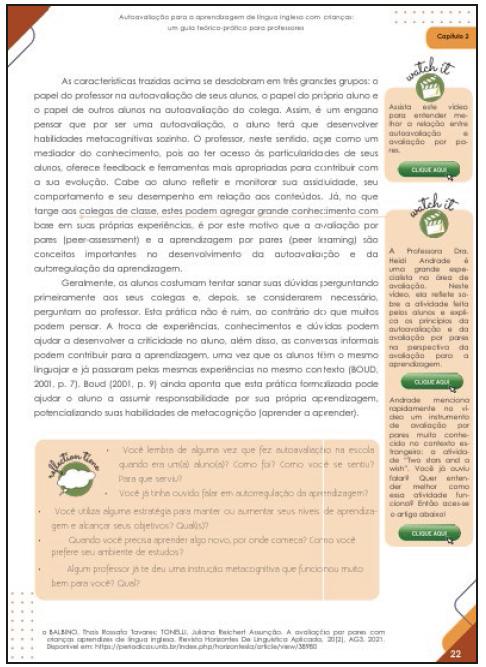
Considering the prevalent lack of teachers’ assessment literacy, it might be a complex task to reflect before explaining the concepts. For this reason, as seen in the image above, the “reflection time” icon appears at the end of the text. This placement reflects the the authors’ intention for readers to reflect on their personal experience with self-assessment, self-regulation, and metacognition from their childhood experiences until now. Nevertheless, readers need a starting point to execute this assignment, and the text serves this purpose, providing “food for thought”.
Regarding the next icon, “doubts”, it has a closer relation to the readers. Hence, the authors incorporate questions posed by course participants and address them within these specific sessions. These sessions align the chapter’s content with issues raised during the course meetings. This also means there is no specific place where the “doubts” icon appears in the text; it depends on the subject discussed in each chapter and paragraph.
In chapter 1, “Children English language assessment: Main concepts”, for example, one participant expressed confusion related to the difference between the concepts of “informal assessment”6 and “formative assessment”. She heard these terms in different contexts and did not know when to use them or whether she was required to implement informal or formative assessment in class. On page 10, the authors address this inquiry in the “doubts” section and explain the concepts of informal and formal assessment. They clarify that, in this context, informal and formative assessments are used as synonyms. Presenting the participants’ questions fosters a meaningful bond between the text and the readers, as they might have the same doubts as other teachers.
Lastly, the “your turn” icon represents the practical component of the guide. It requires teachers to produce genuine material tailored to their own contexts and reflect on the creation process. This section appears at the end of chapter 3, as well as at the end of subsequent chapters. This choice aligns with the objective of encouraging teachers to apply the theoretical content they have previously studied and, while doing so, detect difficulties and adaptations, among other aspects. On page 32, for example, in the chapter titled “Self-assessment instruments”, the teachers are asked to develop assessment rubrics corresponding to the lesson plan they have filled in chapter 1. At the end of the “your turn” section, reflective questions prompt teachers to consider the difficult and easy aspects of creating the rubric and to conclude whether it would be a possible instrument for their contexts.
The next section brings the conclusions from this paper’s findings.
CONCLUSION
In conclusion, this paper presented parts of a practical and theoretical guide designed for English teachers to help them develop their literacy in self-assessment for learning with young children. Specifically, we focused on presenting and detailing the guide’s icons directly related to the teachers’ LAL on language (self)assessment with young learners as well as their self-learning practice. The three icons are “reflection time”, “doubts”, and “your turn”.
The first one, “reflection time”, encourages teachers to critically evaluate their own educational context and personal experiences with assessment. This reflective process aims to generate ideas to improve assessment practices in the classroom. The second icon, “doubts”, intends to address questions extracted from the extension course Going the Extra Mile: Developing Children’s Self-assessment for Learning English that other teachers may have. The final icon, “your turn”, engages teachers to work on accomplishing activities that help them to understand the practical side of the theory.
Based on the recent need for teachers to develop assessment literacy in the context of language learning with children, this study identified three main concepts: assessment for learning, self-assessment, and self-regulation of learning. Assessment for learning focuses on using assessment data to provide feedback for both teachers and learners, allowing for adjustments in teaching and learning activities to meet learning objectives. Self-assessment, as we have argued, is not a simple process. However, when it comes to assessing languages with children, from our perspective and supported by specialized literature, it can be a powerful way of stimulating increasingly younger children, enabling them to recognize their learning process.
We genuinely hope that this research can help TEYL teachers consider self-assessment as a viable and effective strategy within their classrooms.

