




Serviços Personalizados
Journal

Artigo
 texto em
  Inglês (pdf)
 Artigo em XML
 Tradução automática
 Enviar este artigo por email
Compartilhar

 Permalink
Estudos em Avaliação Educacional
versão impressa ISSN 0103-6831versão On-line ISSN 1984-932X
Est. Aval. Educ. vol.36 São Paulo 2025 Epub 18-Jul-2025
https://doi.org/10.18222/eae.v36.10932
ARTICLES
SCHOOL CLIMATE IN A SCHOOL OF THE INTEGRAL EDUCATION PROGRAM OF THE STATE OF SÃO PAULO
, theoretical construction, methodology, data collection, analysis of results, writing of the manuscriptI
 http://orcid.org/0000-0001-9625-3923
, theoretical construction, methodology, data collection, analysis of results, writing of the manuscriptII
http://orcid.org/0000-0001-9395-3166
, theoretical construction, methodology, data collection, analysis of results, writing of the manuscriptIII
http://orcid.org/0000-0001-5807-2064
IFundação Carlos Chagas (FCC), São Paulo-SP, Brazil;
IIUniversidade Federal de São Carlos (UFSCar), São Carlos-SP, Brazil;
IIIUniversidade Federal de São Carlos (UFSCar), São Carlos-SP, Brazil;
IVViamundi Idiomas e Traduções Ltda, Belo Horizonte-MG, Brazil;
This article presents some of the findings from a study carried out in four schools participating in the Programa de Ensino Integral [Integral Education Program] (PEI) of the state of São Paulo. The hypothesis was that by internally regulating the spaces and time structures created by the program, school agents could build a democratically oriented education, a process in which school climate is a relevant factor. Thus, the objective was to analyze the school climate through observations, questionnaires and feedback given to one of the schools. The study fostered collective reflections on the data, revealing different perspectives, encouraging broad dialogue that may contribute to improve the school climate, thus providing a respectful and democratic environment for all members of the school community.
KEYWORDS SCHOOL CLIMATE; DEMOCRATIC EDUCATION; INTEGRAL EDUCATION; ASSESSMENT.
O artigo descreve parte dos resultados de uma pesquisa desenvolvida em quatro escolas do Programa de Ensino Integral (PEI) do estado de São Paulo. A hipótese foi a de que, ao regularem internamente os espaços e tempos criados pelo programa, os agentes escolares poderiam construir uma educação democraticamente orientada, processo no qual o clima escolar é fator de significativa relevância. Assim, o objetivo foi analisar o clima escolar por meio de observações, questionários e devolutiva dada a uma das escolas. O estudo oportunizou reflexões coletivas sobre os dados, explicitando diferentes perspectivas, ensejando amplo diálogo que pode contribuir para o aprimoramento do clima escolar, propiciando, assim, um ambiente respeitoso e democrático para todos que vivem e convivem na escola.
PALAVRAS-CHAVE CLIMA ESCOLAR; EDUCAÇÃO DEMOCRÁTICA; EDUCAÇÃO INTEGRAL; AVALIAÇÃO.
El artículo describe parte de los resultados de una investigación realizada en cuatro escuelas del Programa de Ensino Integral [Programa de Educación Integral] (PEI) del estado de São Paulo. La hipótesis fue que, al regular internamente los espacios y tiempos creados por el programa, los agentes escolares podrían construir una educación democráticamente orientada, proceso en el cual el clima escolar es un factor de significativa relevancia. Así, el objetivo fue analizar el clima escolar a través de observaciones, cuestionarios y retroalimentación dada a una de las escuelas. El estudio dio la oportunidad de reflexiones colectivas sobre los datos, haciendo explicitas diferentes perspectivas, permitiendo un amplio dialogo que puede contribuir para mejorar el clima escolar, proporcionando así un ambiente respetuoso y democrático para todos los que viven y conviven en la escuela.
PALABRAS CLAVE CLIMA ESCOLAR; EDUCACIÓN DEMOCRÁTICA; EDUCACIÓN INTEGRAL; EVALUACIÓN.
INTRODUCTION
The demand for quality, basic education has been growing throughout the entire world. Among other factors associated with this, the physical and emotional security of students stands out, as does meaningful and lasting learning which can underpin the formation of citizens and citizenry from the perspective of democracy and respect for human rights. Thus, the present article deals with the initial results of a study that was developed in a partnership between the Fundação Carlos Chagas and the Universidade Federal de São Carlos within the scope of the Grupo de Estudos e Pesquisas em Organização Escolar: Democracia, Direitos Humanos e a Formação de Gestores, entitled “Aprimoramento do clima escolar e desenvolvimento de lideranças escolares democráticas em quatro escolas do Programa de Ensino Integral do Estado de São Paulo” [“Improving the school climate and developing democratic school leadership in four schools of the Integral Education Program of the state of São Paulo”].
Regarding the research context, four schools of the Programa de Ensino Integral [Integral Education Program] (PEI) of the state of São Paulo were studied, which meet the second stage of elementary and secondary school. Due to the abundance of data collected in these schools, the significant degree of similarity between them and the scope of the present article, we will restrict ourselves to the analysis of a section of the investigation, related to the data gathered in one of the schools, hereafter referred to as School A.
In light of this, the issue to be addressed deals with the identification of the most sensitive dimensions of the school climate at School A, and how the reflections on them could contribute to strengthening collective participation. So, the aim of the present text is to analyze data collected about the school climate through participant observations and the application of school climate measurement instruments (Vinha et al., 2017), as well as the feedback given to the school, which was developed based on the data produced using these two instruments. It should also be clarified that the subjects consented formally to participate in the present study, a process that was conducted according to the criteria established by the Comitê Brasileiro de Ética em Pesquisa Envolvendo Seres Humanos [Brazilian Committee for Ethics in Research Involving Human Beings - Plataforma] - Plataforma Brazil, having been approved under CAAE number: 62846622.5.0000.5504.
Considering this proposal, it is necessary to contextualize the PEI as a public policy and its implementation in the schools of the São Paulo state network. In this sense, Parente and Grund (2019) have outlined the basic characteristics of the program: a) offering components of the Base Nacional Comum Curricular [National Common Curriculum Base] (BNCC) and the varied content in the cultural, artistic and sports areas; b) full-time teaching work in the classroom and in collective activities - 7 hours per day in schools that offer two sessions - from 7 a.m. until 2 p.m and from 2:15 p.m until 9:15 p.m; or, for 9 hours - with activities between 7 a.m. and 4 p.m ; c) a specialized management workload, comprising management and pedagogic activities; d) a life project to be developed with each student, to define goals and deadlines, aiming at their individual development in the fields of education and work; e) youth support, which encourages students to act in a creative, constructive and cooperative way to solve problems in the school, community and society; f) youth clubs, conceived, created and organized by the students, advised by the teachers and the administration; g) tutoring, which is the monitoring by teachers and the management team of a group of students, to support their scholastic development and guide their life project. According to the authors, PEI school management “is articulated as a business management model that includes, among other elements: systematic monitoring, performance evaluation and a specific pedagogic model” (Parente & Grund, 2019, pp. 49-50, own translation). On the other hand, in their view, some managers have “developed differentiated work using participatory management and strengthening relationships with students, families and the community, aspects that are also part of the program guidelines” (Parente & Grund, 2019, p. 50, own translation).
Marques (2017) found that, although one can consider that the extended school time made possible by PEI provides increased opportunities for the students, on the other hand, the preparation of the physical spaces, the provision of the material and financial resources for the execution of the program, and the participation of the school community in its planning and execution, do not correspond to what the program proposes.
Avelino (2019) showed that the increase in the journey in the school environment did not represent a significant improvement in the processes of teaching and learning, or in the proficiency levels measured by external assessments. However, he pointed out that the PEI would help in the construction of the life project of the students and in the student/teacher relationship, due to the time and space provided for activities related to these aspects. From another perspective, Evangelista (2021) showed the pragmatic character attributed to the learnings in the schools in the program, which contributed to the consolidation of a neoliberal societal project in the state education network.
Moreover, Dias (2018), Girotto and Jacomini (2019) and Barbosa (2019) addressed advances, challenges and setbacks that the PEI has generated for the teaching task, showing that despite salary improvements and the existence of more space for the socialization of experiences, a standardization and intensification of teaching work has occurred, in addition to harmful peer surveillance, thus aggravating the precariousness of the profession. These aspects have contributed to a competitive school environment, highly monitored and controlled, with an impact on the subjectivity of the teachers which minimizes the possible gains in the working conditions related to full-time work and exclusive dedication. This reality is particularly dynamized by the so-called “Avaliação 360 graus” [“360 degree Evaluation”], typical of the program which, with a managerial matrix, constantly reminds the teachers that they can lose the labor advantages that they have in the PEI if they do not meet the expectations of the students, the management team and the Secretaria da Educação (Seduc).
Concerning the work of school managers in PEI schools, Barbosa and Placco (2022) present them as builders of links between subjects in the school, links that facilitate the establishment of a participatory and democratic environment. In light of this, managers may be considered articulators between school agents, which can lead to success in learning, mainly when encouraged to lead and be protagonists. Moreover, for the development of human relations and youth protagonism, managers need to rely on the support of the entire team, as well as the students and their families, in collective and collaborative work. From another angle, Mattos (2020) analyzed the work of school principals PEI, pointing out that the program would be deepening the adoption of the managerial logic of the private sector in São Paulo education due to the adoption of new mechanisms to control the work and behavior of professionals, and the explicit valorization of performance and merit.
Fernandes and Baptista (2018) and Quaresma (2015) analyzed the management of PEI schools, indicating that the program created some conditions that can provide dialogue and participation in a democratic perspective. For this to happen, it is essential that the agents in every school not be restricted to implementing the actions proposed by the program, but reconstruct them collectively in the most autonomous way possible.
Therefore, in the present article, we are working with the hypothesis that by regulating internally (Barroso, 2005) the spaces and times created by the PEI, school agents can construct democratically-oriented education (Toro, 2005), a process in which the school climate is a factor with significant relevance. It is worth noting that each school has its own characteristic climate, understood by those who are part of it, referring to the well-being, or not, of all its agents. A positive school climate refers to the way school team, the families and students, see and express themselves about the school in the sense that they like it and want to be there. This is the climate that promotes human development through the learning necessary for a dignified and free life in a democratic society (Cohen et al., 2010). Thus, the way in which students perceive the climate can affect them in various ways, such as: attendance; staying and/or dropping out; motivation to learn; performance in internal and external assessments; behavior; feelings of belonging and fairness; satisfaction with the school, in addition to the value attributed to knowledge and self-concept (Cohen & Pickeral, 2009). In Brazil, the school climate has been defined as the set of perceptions and expectations shared by members of the school community, resulting from their experiences, relating to norms; objectives; values; human relations; organization; and, physical, pedagogical and administrative structures. Thus, climate refers to the psychosocial atmosphere of a school, interfering with the quality of the teaching and learning processes (Moro, 2020).
From the methodological point of view, the approach of the study was mixed, involving “the collection of quantitative and qualitative data, integrating the two types of data and using distinct designs that reflect philosophic assumptions and theoretical structures” (Creswell & Creswell, 2021, p. 4, own translation). The philosophical perspective adopted is transformative, which advocates the political commitment among academic research and human freedom and social transformation (Creswell & Creswell, 2021, p. 7).
Thus, the present article is organized as follows: first, this introduction; next, the research context is explained. Afterward, the methodology for applying and processing the school climate assessment is presented. Following that, the feedback given to School A is analyzed so that the students’ and teachers’ perspectives on the school climate can be understood. Finally, some concluding considerations are proposed.
OBSERVATIONS OF SCHOOL A
The observations at School A were characterized by discretion and balance between participation and observation (Bogdan & Biklen, 2010), and were made between February and December, 2022. First, we sought to know environment and staff of the school; afterward, we began to follow the daily routine of the school, in addition to some events such as meetings and celebrations.
According to PEI guidelines (Diretrizes do Programa Ensino Integral, 2012), the spaces were standardized in the sense that all schools should have exclusive places for certain activities, such as rooms for teachers - one for rest and meals, and another for studies -, as well as separate rooms for area coordinators, general coordinators, principals and vice-principals. In addition, certain teaching spaces would be mandatory, such as different types of laboratories and computer rooms. Students should also have their meals in their own, appropriate cafeteria.
Initially, we understood that School A had been organizing itself, facing difficulties at the beginning of the year to adapt the building to the demands of the PEI, and that the management team had been working to lay the foundations of the program at the school, for both the teachers and the students. We observed a management team that was hard-working and concerned about overall well-being, but that had problems aligning with each other, possibly due to the excessive demands and the school’s own dynamics. The teaching staff proved to be a heterogeneous group, composed of teachers who had worked there for years, since before the adoption of the PEI, and others, newcomers, who apparently had no options other than that school to work at, in the state network, in that year (2022).
As for the students, it is important to consider that they came from families of low socioeconomic status, living in a peripheral neighborhood with problems of infrastructure, violence and drug trafficking. We soon understand that the students brought the social and organizational system of the community in which they lived to school with them, which would make it difficult for them to understand the logic of school education, especially a system of rules imposed from the top down. From this perspective, it was observed that the students had difficulty in complying with the rules of coexistence, which led to numerous situations of disobedience. These circumstances demanded positions and actions from the school staff in an attempt to alleviate/contour/resolve these problems, a task that eventually became excessive and exhausting. On the other hand, some of these situations came to be trivialized by the staff. Having said that, we realized that the teachers had difficulties in dealing with the students - although they still said they enjoyed working with them - so they did their best to “play it cool” in carrying out their duties. In this way, the work of the pedagogical coordinators - who had been at the school for years, but had little experience in management - became more complex, as it required training actions to be developed with the teachers that took into account the complexity of serving the students at that time, and the PEI guidelines. In that context, it was up to the director to deal with all the different demands - from the professionals, the students, the families, the school organization and the infrastructure of the building - which didn’t meet the requirements of the program.
In general, the staff and students of School A were in a process of adapting, training and consolidating the PEI, learning to organize themselves and deal with the demands and opportunities that the program offered in a post-pandemic context, in which many of the students had learning lags/difficulties. We soon understand that, given the conditions, the school environment was organized - although not very orderly -, and there was a feeling of dispersed belonging, particularly among the professionals who had been at the school the longest, and among the students who participated the most in school activities. The management team seemed dedicated and competent, but they needed to be better aligned with each other and with the other segments, so that the actions undertaken could be congruent, rather than scattered and/or sporadic.
Regarding the PEI, we saw that it prescribed various spaces and times that would provide opportunities for the development of autonomy and diverse learning for students, teachers and the management team. These could include youth clubs, class leaders, youth protagonism, tutoring, life project classes, pedagogy of presence, collective study times and windows of time for individual study. In addition, it had instruments and processes for monitoring and building school and disciplinary plans, and for evaluating and developing professionals. All these spaces, times and tools could affect the school climate positively or negatively, depending on how they were built and used. In other words, while youth protagonism spaces could be seen as moments for young people to develop, they could also be understood as unrelated to curricular school learning; and, the various tools and processes for monitoring, planning and evaluating the PEI could be treated as bureaucratic tasks to be carried out, rather than as instruments that really encourage participation, discussion and collective reflection in the school. This would depend on how the management team mobilized students and teachers to build these moments.
Another aspect to be considered was the constant complaint among the professionals at School A about the excessive paperwork to be processed according to the demands of the program, as well as its system of evaluation. In this logic, we understand that the models of work and of professional evaluation had a managerialist content in the sense of performativity (Ball, 2005), with an incentive for micromanagement, based on the monitoring of learning guides and individual agendas added to the production of evidence of actions taken - to be used in the 360º Evaluation -, which could lead to an overvaluation of their own performance by those being evaluated. In this sense, professionals who joined the PEI were subjected to these processes in exchange for a single working day and a financial bonus, among other advantages and disadvantages, so that if they didn’t adapt, they could choose to leave the program or be dismissed. Similarly, students who did not adapt to the full-time workday could choose to change schools, as could those who needed to work to support their families financially. From this angle, the PEI led to the emergence of an alternative school network within the state system that shaped individuals into its model. Thus, we understood that the PEI was proposing a series of practices that could serve the advances in the learning of students and professionals, but that the construction of its spaces and activities should be strongly guided by the management team. This team should also monitor and give due support to the other agents to deal with the bureaucratic and evaluative demands of the program, and to the students to be able to stay in school and learn full time.
Next, we move on to the assessment of the school climate at School A, its methodology, implementation and results.
ASSESSMENT OF THE SCHOOL CLIMATE
We consider a positive school climate to be a relevant factor for human development in its physical, cognitive, affective and sociomoral aspects, as it contributes to educating honest, fair and respectful people. This is in addition to facilitating the learning of knowledge necessary for a responsible and satisfying life in a democratic society. The climate is related to the quality of life in the school and reflects the perception of all the agents about the daily school life, shared values, agreed rules, proposed goals, teaching-learning processes, interpersonal relationships and organizational structures (Cohen, 2006, 2010a, 2010b). Several studies indicate an association between the quality of the climate and the well-being of the agents, specifically the students, showing a relationship between the quality of the climate, academic performance, motivation to learn, behavior, feelings of belonging and of justice, satisfaction with the school, valuing of knowledge and of self-concept (Fan et al., 2011; Cunha & Costa, 2009; Gomes, 2005; Gaziel, 1987; Loukas, 2007; Cohen & Pickeral, 2008; Cohen, 2010a).
From the perspective of studies developed in Brazil, the school climate refers to the perceptions, feelings, sensations, attitudes and values shared among school agents, creating a type of unique “school personality”, demonstrating the importance of school climate in the quality of coexistence in the schools, with effects arising both from the sphere of relationships and in the school performance (Moro, 2020). Furthermore, Vinha et al. (2017, p. 7, own translation) define school climate as a composition of “perceptions in relation to the educational institution that, in general, reveals factors related to the organization, pedagogic and administrative structures, as well as the human relations that occur in the school space”.
Schools that have a positive school climate present a caring, trustworthy, supportive and stimulating student-centered environment, in which the staff feels safe, supported, engaged, belonging, and are challenged respectfully. In addition, this climate can contribute to expanding and strengthening the spaces for participation, the dialogical resolution of conflicts, closeness with family members and the community, good communication and the development of a sense of justice - which refers to the understanding that rules of coexistence are necessary and must be obeyed, and that possible deviations can lead to sanctions (Freiberg, 1998, 2005; Brunet, 2001; Cohen et al., 2009; Debarbieux et al., 2012; Sherblom et al., 2006; Vinha et al., 2017).
Recognizing the relevance of the school climate, we argue that understanding and analyzing it reveal essential elements for identifying important characteristics of school dynamics, as well as aspects that merit further investigation, in addition to proposing possible interventions to improve these environments.
Methodology and instrument for assessing the school climate
Being part of a study developed using a mixed method - qualitative and quantitative (Creswell & Creswell, 2021) -, the main instrument used to diagnose the school climate at School A were questionnaires aimed specifically at students, teachers and managers. They contained eight dimensions, that included aspects of the national school reality, that is: 1) relationship with teaching and learning; 2) social relations and conflicts at school; 3) rules, sanctions and safety at school; 4) situations of bullying among students; 5) family, school and community; 6) infrastructure and physical network of the school; 7) relationship with work; 8) management and participation (Vinha et al., 2017). In Table 1, we explain what is assessed in each dimension and by which groups the respective questions are answered.
TABLE 1 School climate reference matrix
| School climate - Matrix | ||
|---|---|---|
| Dimensions | Concepts | Groups |
| 1. Relationship with teaching and learning | Based on the perception of school as a place of effective work with knowledge, that invests in the success, motivation, participation and well-being of students, promoting the value of schooling and the meaning given to learning. It also assumes the effective performance of a stable teaching staff and the use of differentiated strategies that support learning for all, and continuous monitoring, so that no student is left behind. | Students Teachers Managers |
| 2. Social relationships and conflicts at school | Refers to the relationships, conflicts and perception of the quality of treatment among members of the school. It also covers the identification by adults of situations of bullying and mistreatment experienced in peer relationships, and the co-responsibility of school professionals in problems of coexistence. The good quality of the relational climate is the result of the positive relationships that occur in this space, the opportunities for effective participation, the guarantee of well-being, respect and support among people, promoting continually a sense of belonging. |
Students Teachers Managers |
| 3. Rules, sanctions and safety at school | Concerns the perceptions of managers, teachers and students regarding interventions in interpersonal conflicts at school. It addresses the design, content, legitimacy and fairness of the application of rules and sanctions, as well as identifying the types of punishment generally used. It also includes order, justice, tranquility, coherence and safety in the school environment. | Students Teachers Managers |
| 4. Situations of bullying among students | Deals with the identification of situations of bullying and mistreatment perceived by students in peer relationships, and the places where they occur. | Students |
| 5. Family, school and community | Refers to the perception of the quality of the relationships among school, family and community, including respect, trust and support among these groups. It addresses the actions of the school, taking into account the needs of the community. It involves the feeling of being part of a group that shares common goals. |
Students Teachers Managers |
| 6. The infrastructure and physical network of the school | Refers to the perception of the quality of the infrastructure and physical space of the school, its use, suitability and care. It refers to how the equipment, furniture, books and materials are prepared and organized to encourage welcome, free access, safety, conviviality and well-being in these spaces. | Students Teachers Managers |
| 7. The relationship with work | It is about the feelings of managers and teachers in relation to their work environment and educational institutions. It addresses perceptions of professional training and qualification, practices of studies and reflections on actions, appreciation, satisfaction and motivation for the job they do and the support they receive from managers and other professionals. | Teachers Managers |
| 8. Management and participation | Addresses the perception of the quality of the processes used to identify the needs of the school, intervention, and evaluation of the results. It also includes the organization and articulation between the various sectors and actors that compose the school community, to promote spaces for participation and cooperation in the pursuit of common goals. | Teachers Managers |
Source: Vinha et al. (2017).
To assess the school climate in the different dimensions included in the instruments, first, the mean score obtained in each dimension is calculated using the arithmetic mean of the values obtained for the set of items in the respective dimensions. In addition, climate dimension can be assessed in a general way as more positive, intermediate or negative. Based on the calculation of the mean score obtained in each dimension, it is proposed to organize and code the numerical scores in three levels. To do this, the range of possible values of the means from 1 to 4 is divided into three equal subranges. The first should contain the means with values from 1 to 2.25: negative level; the second should contain values from 2.26 to 2.75: intermediate level; and, the third should contain values from 2.76 to 4.00: positive level.
Application, collection and analysis of the data
As the diagnosis of the school climate (Vinha et al., 2017) is applied individually and online, it was necessary to organize School A so that the students were comfortable and the questionnaires were already on their respective computer screens. The teaching staff, in turn, responded to the questionnaire during the collective time, outside the classroom. 356 students, 22 teachers and 7 managers responded to the questionnaires.
The data analysis was done quantitatively, using the IBM© SPSS© Statistics 22.0 program. With this processing, reports were generated with general, descriptive analyses of the frequencies of responses to the categorical variables - items about the school climate. In addition, based on the calculation of the mean score obtained for each dimension, we proposed coding the numerical scores for categorical data and, using this, we divided the four points of the Likert Scale into three sub-ranges to which levels/nomenclatures were assigned - negative, intermediate and positive. In this way, the evaluation frequencies of the levels for each of the climate dimensions were extracted, which resulted in a diagnosis of the school climate at School A.
Furthermore, the entire processing of analysis and feedback conducted at School A was necessary, because we could involve students, teachers and managers in the discussions about the results of the school climate diagnosis (Vinha et al., 2017). The aim was to verify the receptiveness of school agents to the results measured by the instrument, the coherence of the dimensions with the dynamics of the school and whether the evaluation items were, in fact, capturing what they intended to evaluate.
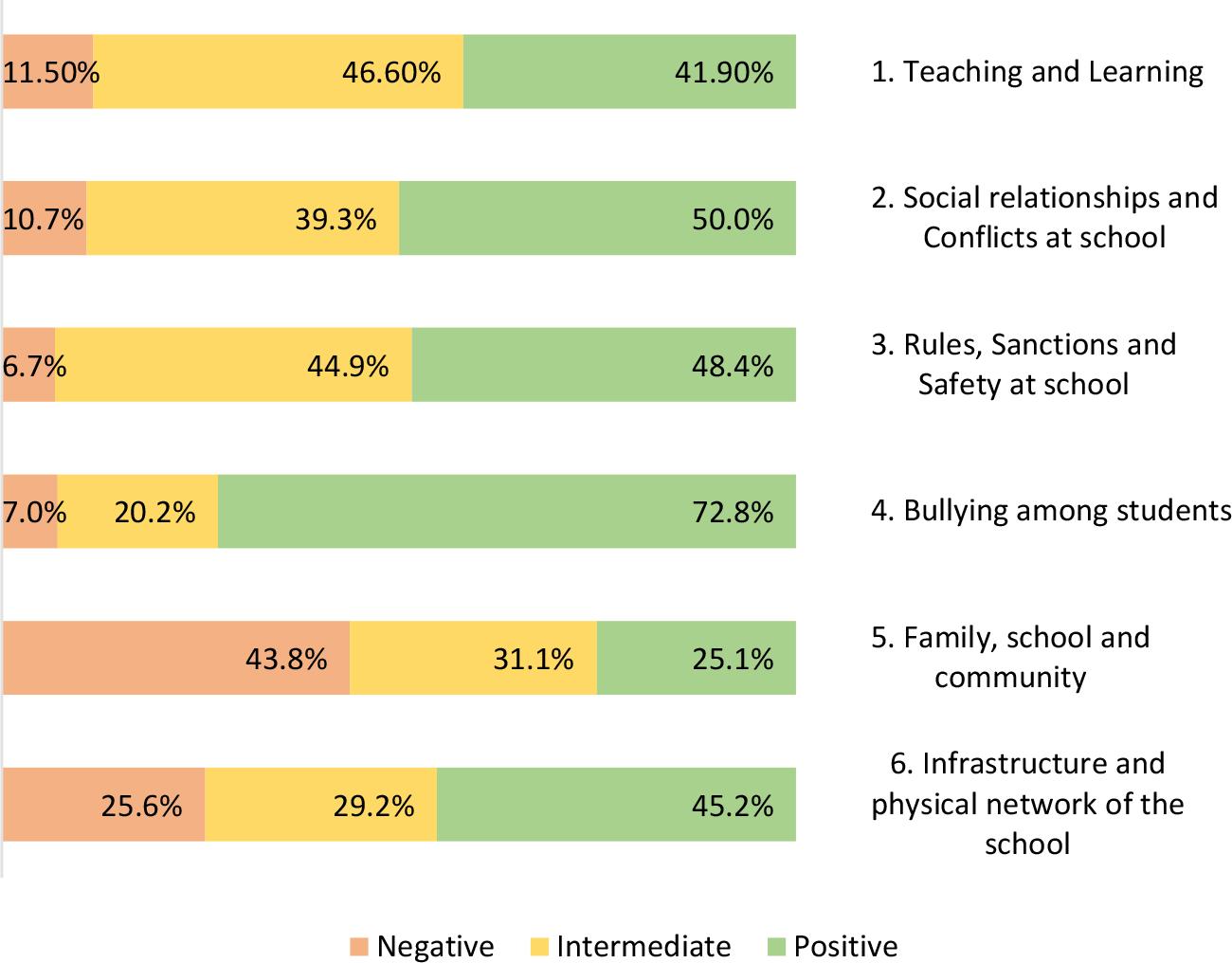
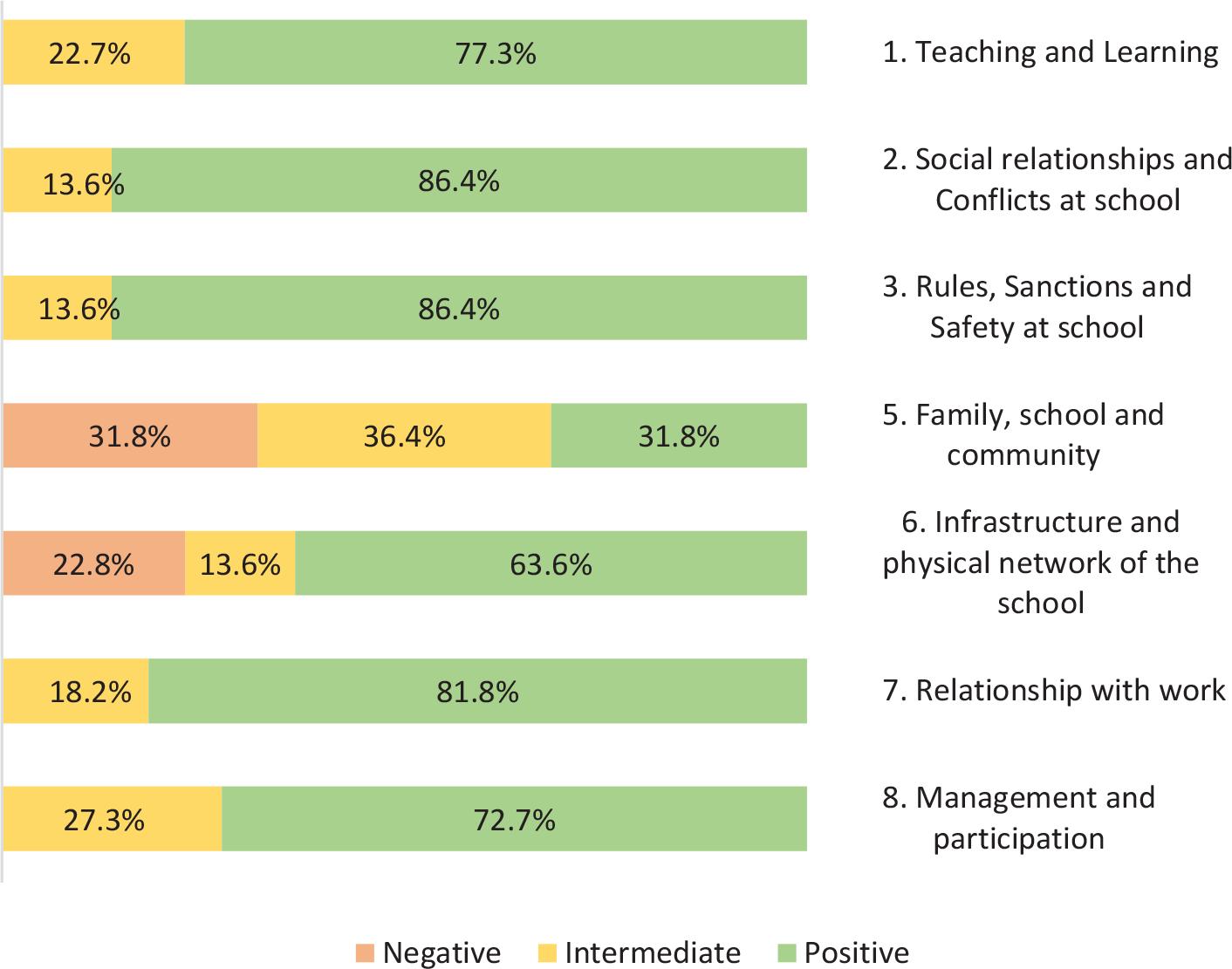
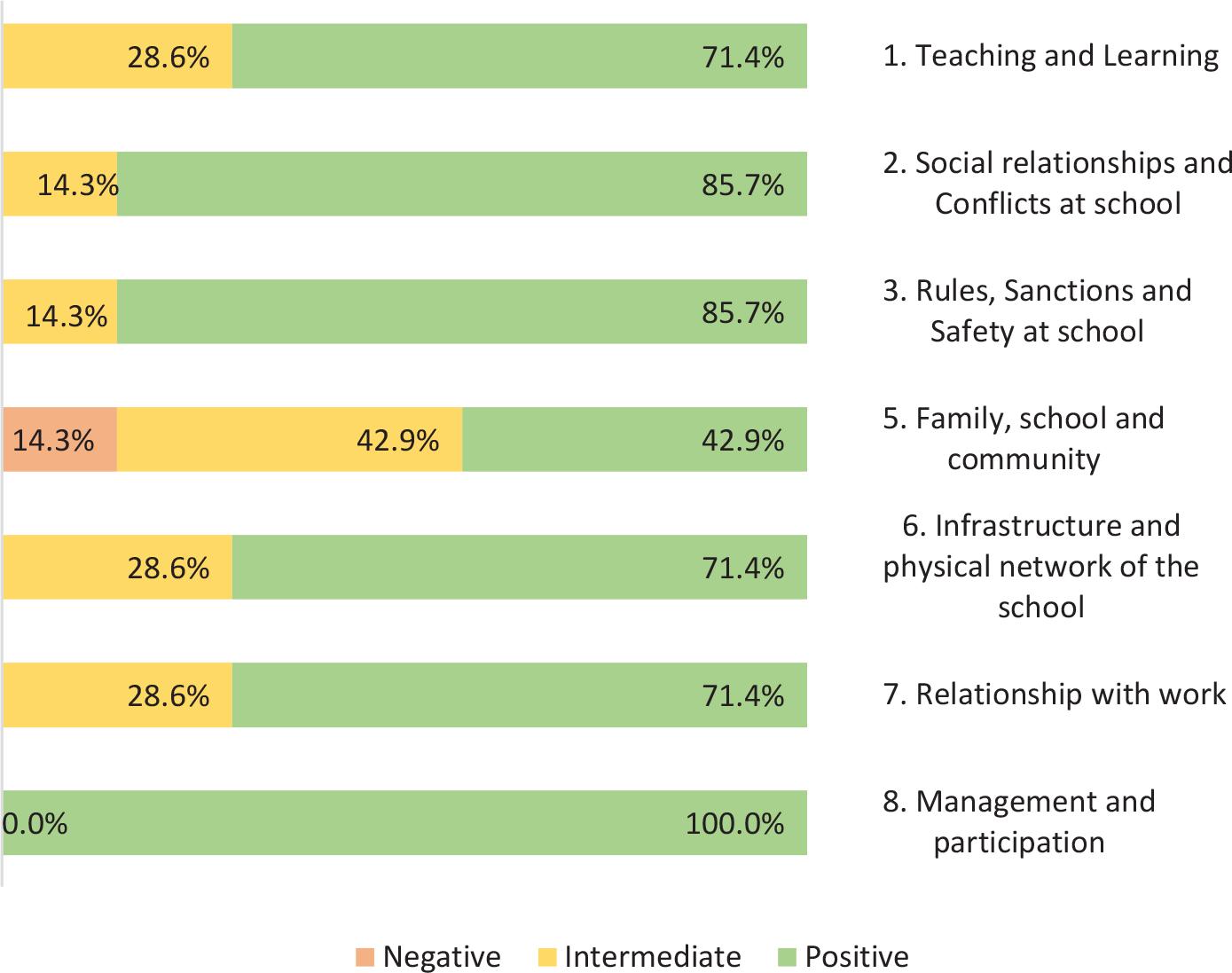
Thus, Figures 1 through 3 show the graphs representing the perceptions of students, teachers and members of the management team regarding the eight assessment dimensions of the school climate. These graphs guided the discussions and reflections, with representation from all the school actors, in the feedback seminars on the school climate diagnosis.
Source: Authors’ elaboration.
FIGURE 1 Frequency distribution of perceptions of each dimension of School Climate at School A, from the perspective of the students
Figure 1 shows an analysis of the school climate perceived by the students at School A, based on the mean of the items for each dimension, which were classified as negative, intermediate or positive levels (according to the distribution of the subranges), in percentages, for each of the dimensions assessed. It is a graphic representation that provides a visual overview of how the students perceive different aspects of the school.
According to the information given in Figure 1, we can verify that the perceptions characterized as negative by the students showed a low percentage, with the exception of dimensions 5 and 6 (Family, school and community, and Infrastructure and physical network of the school), with 43.8% and 25.6% respectively. Dimension 4 (Bullying among students) was the dimension with the greatest percentage of positive perceptions. However, as this is a very sensitive dimension which can involve situations of suffering among students, it is necessary to identify the items in which the negative percentages are indicated.
By gathering the data from the items in each dimension relative to teachers and managers, we will understand their importance in helping them to understand the aspects in which students express dissatisfaction and what the school’s strengths are, emphasizing once again the need for a more micro view, i.e., at the frequency of responses to the evaluation items.
Regarding the data that reveal the perceptions of the teaching staff (Figure 2), we found that most of the dimensions show a high percentage of positive perspective, reaching 86.4% of the responses in dimensions 2 and 3 (Social relations and Conflicts at school, and Rules, Sanctions and Safety at school). The two climate dimensions that showed a negative percentage of responses were Family, school and community, and Infrastructure and the physical network of the school, with 31.8% and 22.8%, respectively.
Source: Authors’ elaboration.
FIGURE 2 Frequency distribution of perceptions of each dimension of School Climate at School A, from the perspective of the teachers
Regarding the data from the management team at School A (Figure 3), we can verify that there is a predominantly positive perspective from the members in all dimensions of the school climate, with the exception of dimension 5: Family, the school and the community, which shows 14.3% negative responses to the evaluation items.
Source: Authors’ elaboration.
FIGURE 3 Frequency distribution of perceptions of each dimension of School Climate at School A, from the perspective of the management team
In view of the general data presented, we can affirm the prevalence at School A of a positive perspective with regard to the general perceptions in most of the evaluative dimensions of the school climate. It’s worth noting that, for an increasingly deeper look at the climate diagnosis, it’s essential that we gradually look at the more detailed results. First, analyzing each of the dimensions by comparing the responses of the three school actors (students, teachers and managers) and, in even greater detail, checking the frequency of responses for each evaluation item that gives rise to the respective dimensions.
ANALYSIS AND DISCUSSION OF RESULTS
By discussing the climate with teachers, managers, students, families and staff at School A during feedback, it was possible to build an overview with them of what they were already doing well and what they could improve. We identified problems that would have repercussions on the perceptions of different groups, making it possible to make decisions based on research data and not simply on common sense and/or experiences perceived as successful.
From the analysis of the results of each dimension of the School Climate, it was possible to identify problems, rank them and study the frequency of responses to the items that compose these dimensions.
Next, we discuss the results from School A regarding the two dimensions that showed the greatest incidence of negative perceptions - Family, school and community and Infrastructure, and the physical network of the school, in conjunction with the data collected in the feedback.
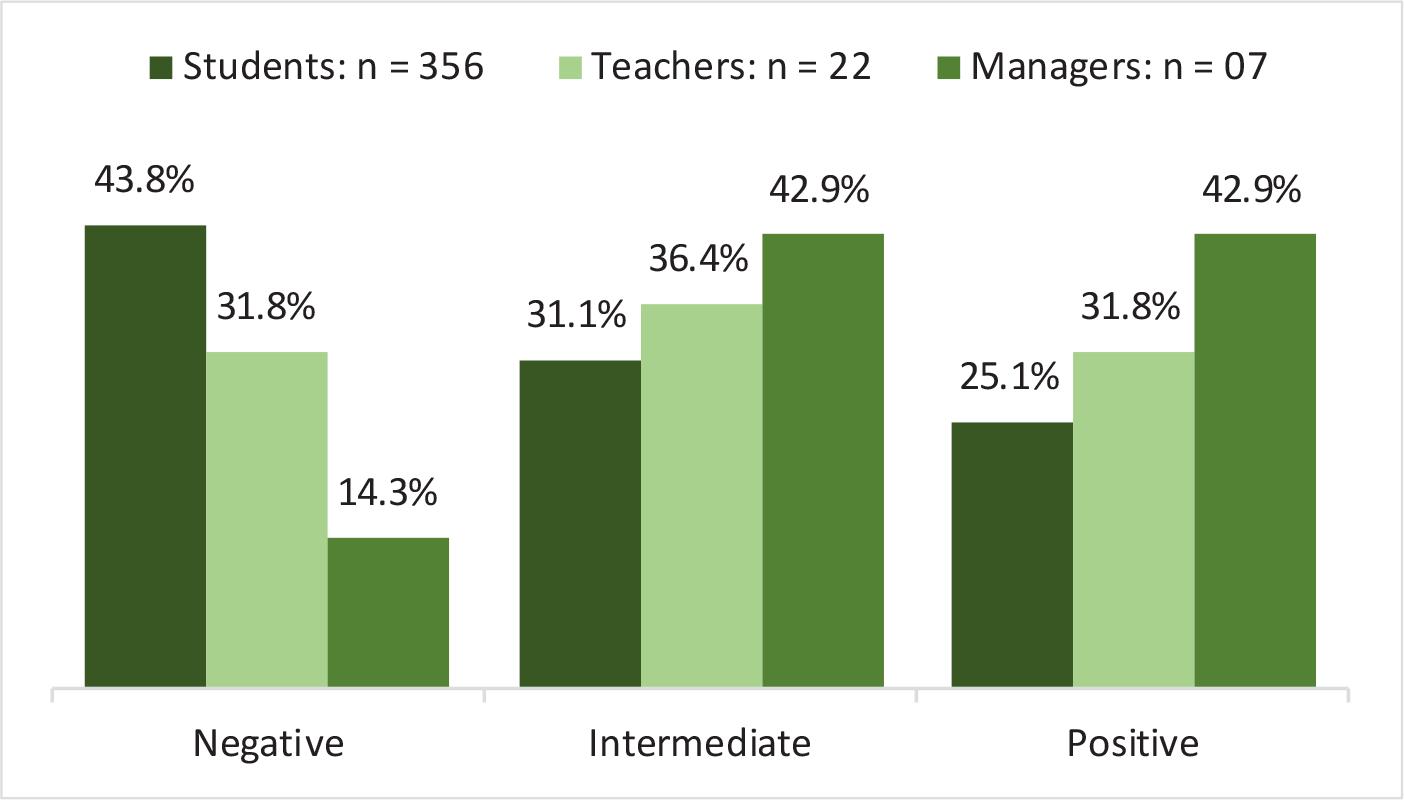
Dimension 5 showed the highest percentage of negative perceptions - 43.8%, by students. With regard to teachers and managers, this percentage was 31.8% and 14.3%, respectively (Figure 4). As there was also a low frequency of responses showing positive perceptions (only 25.1%) from students, we decided to take a more careful look at the evaluation items for this dimension in this group.
Source: Authors’ elaboration.
FIGURE 4 Distribution of the percentages in the negative, intermediate and positive positions perceived by School A’s agents in relation to dimension 5: Family, school and community
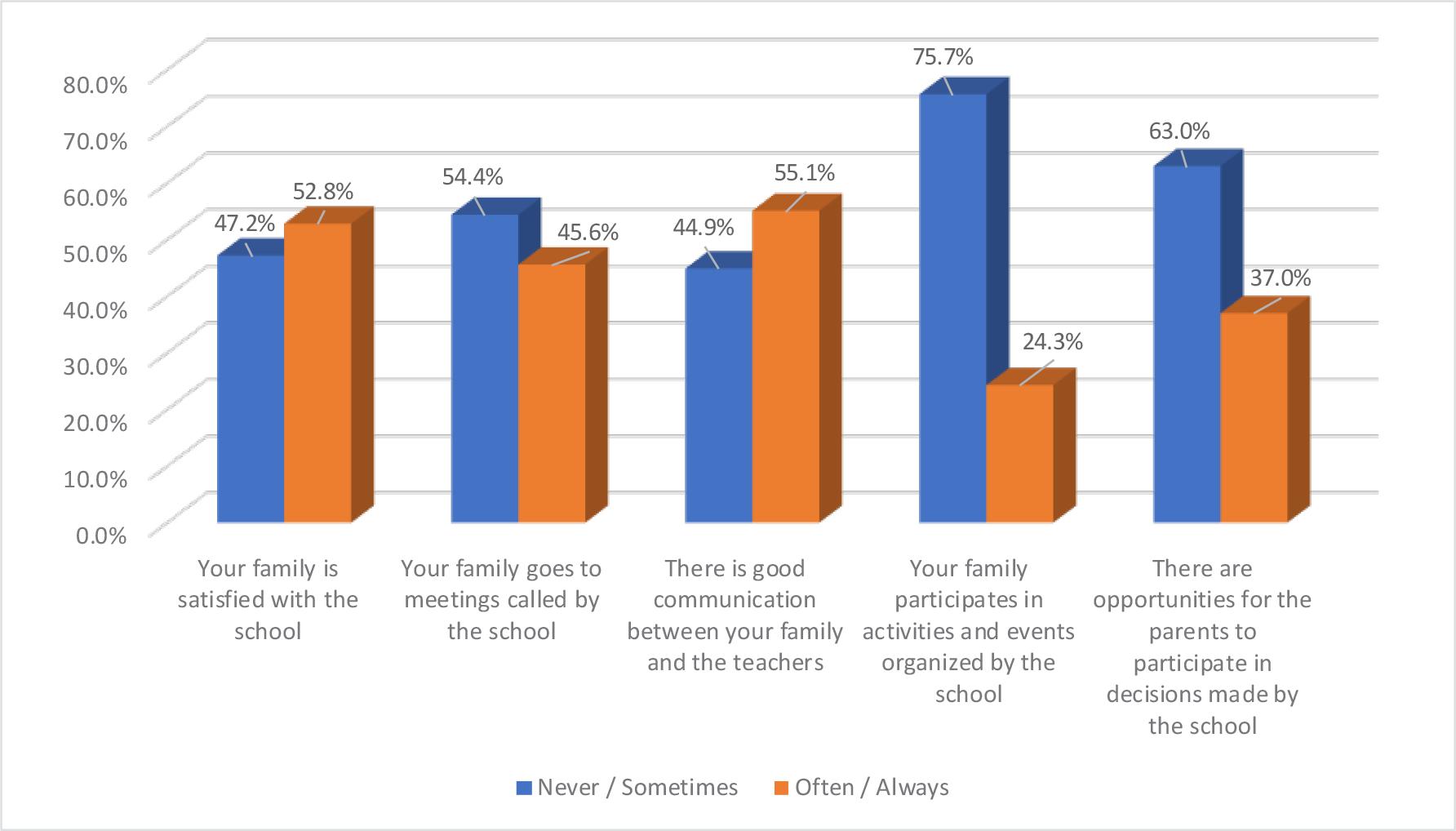
Figure 5 shows some of the items selected from this dimension. In this representation, we worked with the extremes of the alternatives to which the students responded on the Likert scale. That is, we grouped the first two alternatives - “never/sometimes” - as well as the last two - “often/always” - to denote the negative and positive perceptions for each item.
Source: Authors’ elaboration.
FIGURE 5 Distribution of the percentages of student responses to items in dimension 5 of the School Climate at School A
In the set of items shown in Figure 5, we have verified that the perceptions of the students of the five items fluctuate between the negative and positive poles. Although the percentage of negative perceptions was 43.8% for the dimension as a whole, 52.8% said that their families were happy with the school. Another 55.1% stated that there was good communication between their family and the teachers. This result may indicate that, despite the difficulties inherent in school-family relations, School A could be on the right path to overcome them.
On the other hand, it is necessary to reflect, together with the school community, on sensitive points that need a closer look in order to propose improvements. This is the case, for example, with the 75.7% of students who reported that their families did not participate in events organized by the school.
During the feedback meeting, the management team addressed the discrepancies in perceptions between themselves and the students, explaining that they worked closely with families on a daily basis and were unaware of such a significant lack of parental presence at the school. From the management’s perspective, students were not aware of these ongoing efforts, as their understanding was limited to the visible participation of their own parents and peers.
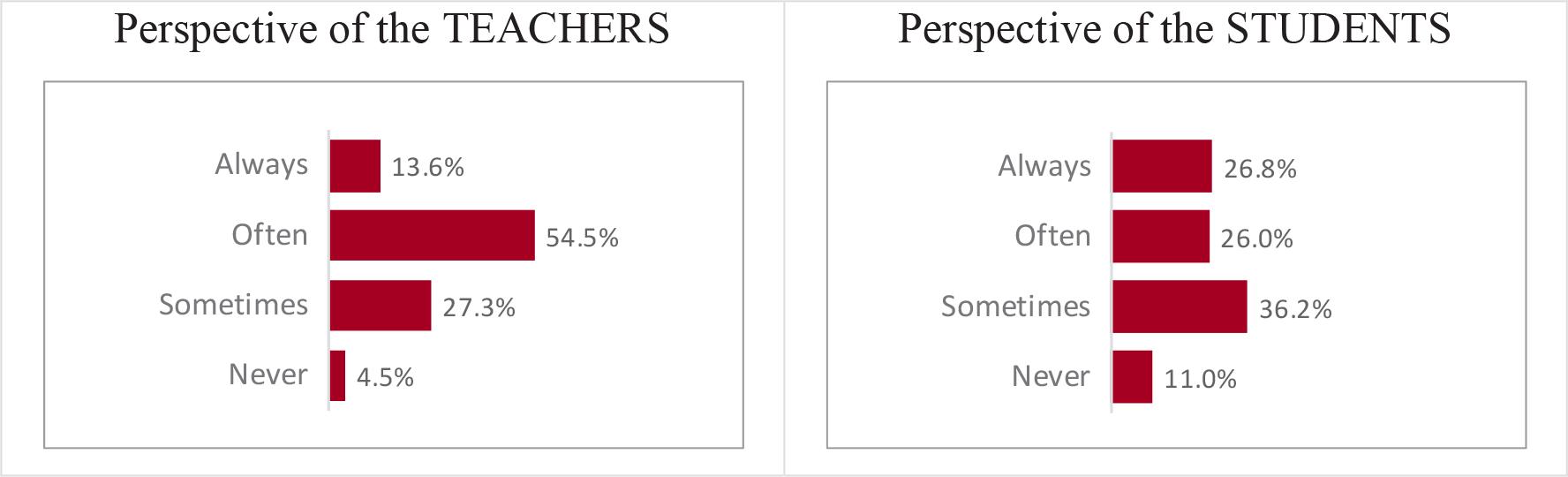
The understanding of the questions by the respondents was also questioned - for example, what it would mean to be close to families, or not; what would be community-oriented work, or not; among others - which could have interfered with the responses given. In addition, the management team commented that since the beginning of the year they had begun to seek out the participation of parents/guardians more, for example by scheduling meetings with them in the evening, which would have increased the levels of family participation a little. Contributing to this discussion is the analysis of two graphs that refer to the item on the degree of family satisfaction with the school (Figure 6).
Source: Authors’ elaboration.
FIGURE 6 Frequency distribution of the response alternatives for the item in dimension 5 of the School Climate, which asked whether the family of the student was happy with the school, from the perspective of the teachers and students at School A.
As we present the distribution of responses for the four alternatives, we can observe more closely how students and teachers perceive the same phenomenon under investigation. According to these graphs, we understand that, overall, the perceptions of the teachers are more positive than those of students. While 68.1% of the teachers believe that families are always or often satisfied with the school, 11% of students indicate that their families are never satisfied with the school.
During the meeting held to provide feedback to representatives from all segments - including staff and parents - at School A, several questions emerged, such as: Why do some students perceive that their families are never satisfied? Are the efforts of the school to involve families proving successful? Is the school communicating effectively with the families? Does the family-student interaction allow for knowledge of the relationship existing between school and family?
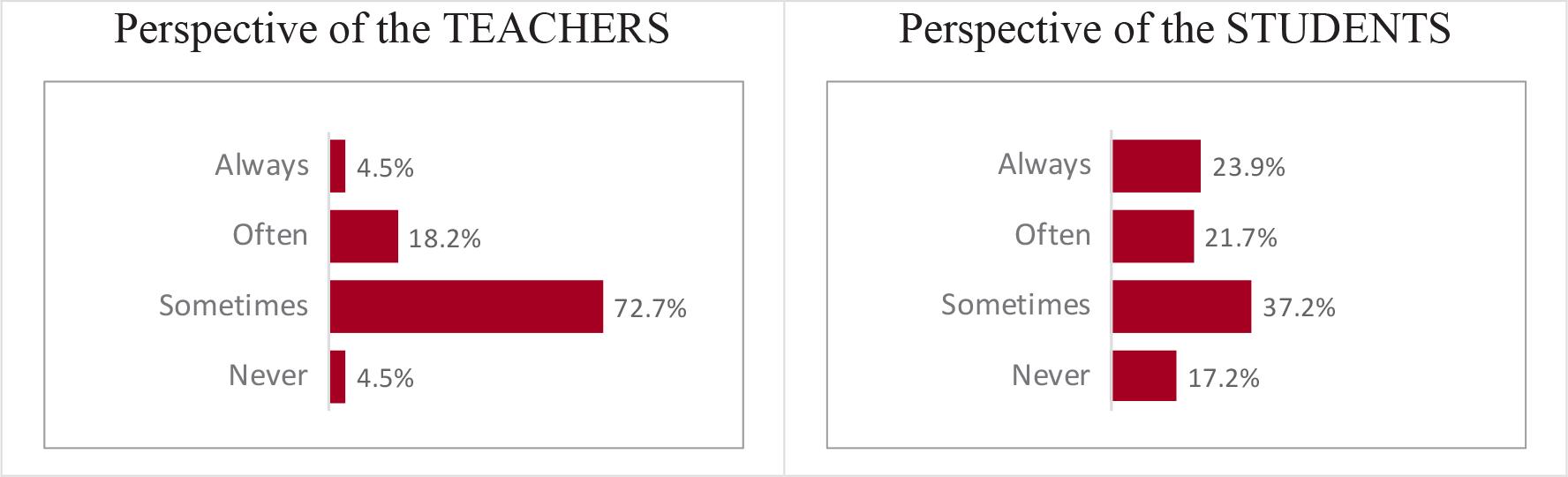
Regarding family participation in meetings, the next item analyzed is shown in Figure 7.
Source: Authors’ elaboration.
FIGURE 7 Frequency distribution of response alternatives for the item in dimension 5 of the School Climate, which asked about family participation in meetings, from the perspective of teachers and students at School A.
Through these findings, we observe a change in the polarity of perceptions, with teachers expressing a predominantly negative perspective. Among them, 72.7% report that families attend school meetings only occasionally. Conversely, 45.6% of students state that such participation occurs always or frequently.
The presentation of these data during the feedback session prompted participants to discuss the interrelationship between statements within the dimensions. For instance, regarding the assertion, “Are there opportunities for parents to participate in decisions made by the school?”, reflections emerged on parental involvement in two ways: They do not contribute to school decisions because they do not participate, or they do not participate because their perspectives may not be considered by other school agents. Additionally, the discussion of these items helped participants gain a clearer understanding of the diagnosis itself (Vinha et al., 2017), as well as its functioning and potential usefulness.
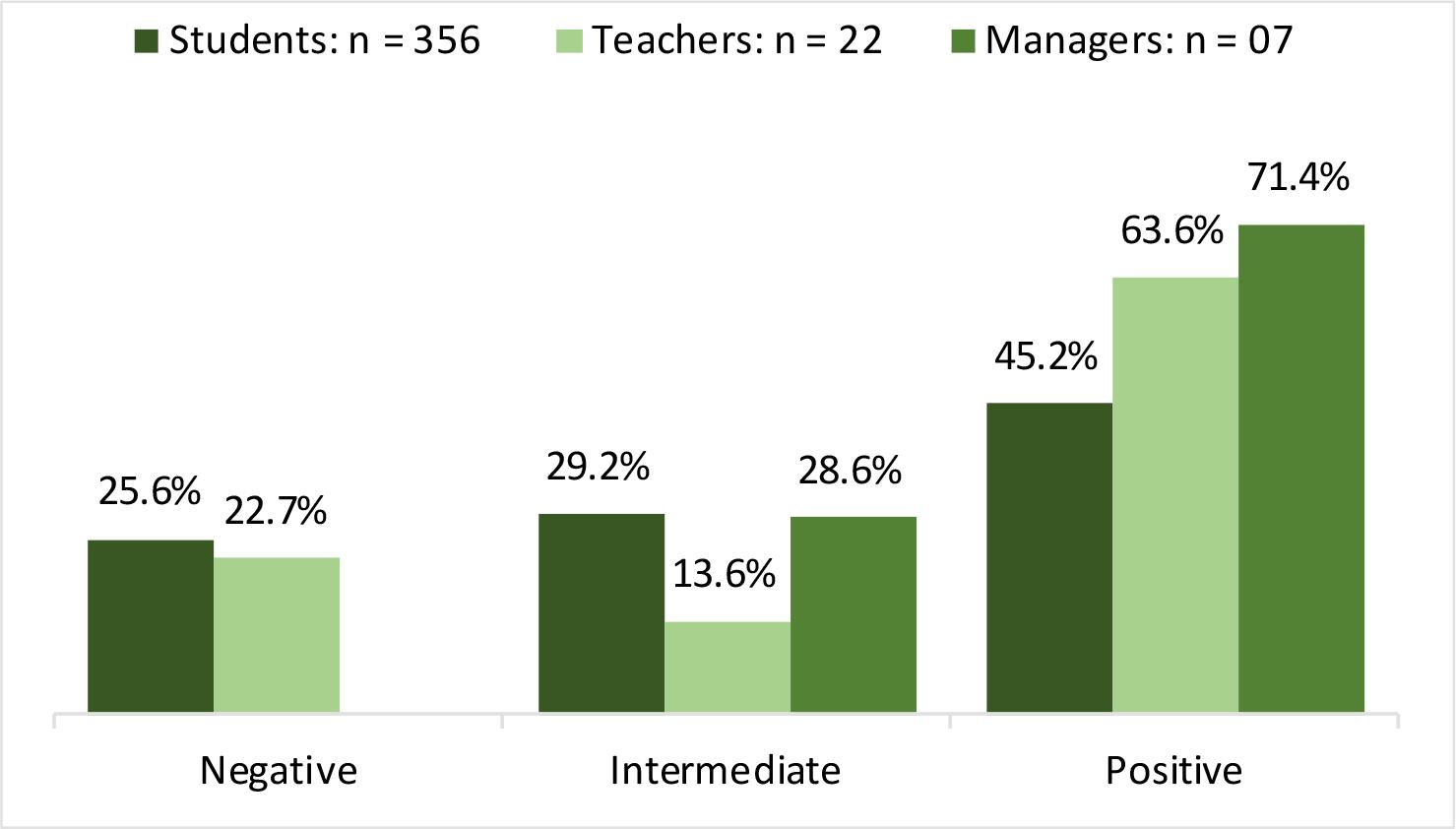
Next, we proceeded to analyze the data related to dimension 6 - Infrastructure and physical network of the school (Figure 8).
Source: Authors’ elaboration.
FIGURE 8 Distribution of the percentages in the negative, intermediate and positive positions perceived by agents at School A, in relation to dimension 6 - Infrastructure and physical network of the school
The presentation of this graph during the feedback session made the discussion among the participants more heated. The agents agreed unanimously that the school had not undergone any renovation since 2008. It was built originally to provide regular schooling in three sessions, so it lacked the necessary classrooms and spaces needed for the PEI. As a result, since its adoption of the program, some specific adjustments had been made - such as dividing a single space to house two small and uncomfortable rooms, one for reading and the other for computer work. In addition, vice-principals had to work in the same room used to provide support for special education students. The teachers’ room did not accommodate them, so many took their meals at tables available in the courtyard. They also complained about the lack of laboratories for hands-on and experimental activities, as well as a recurring problem of flooding, particularly in the courtyard area.
From this point of view, the levels of negative agreement given to the items in this dimension seem somewhat inconsistent with the actual conditions of the school building. This issue can be analyzed based on the discussions during the feedback session, in which several agents stated that while the school had the spaces necessary for the PEI, they were not fully adequate for the implementation of the pedagogical activities proposed by the program.
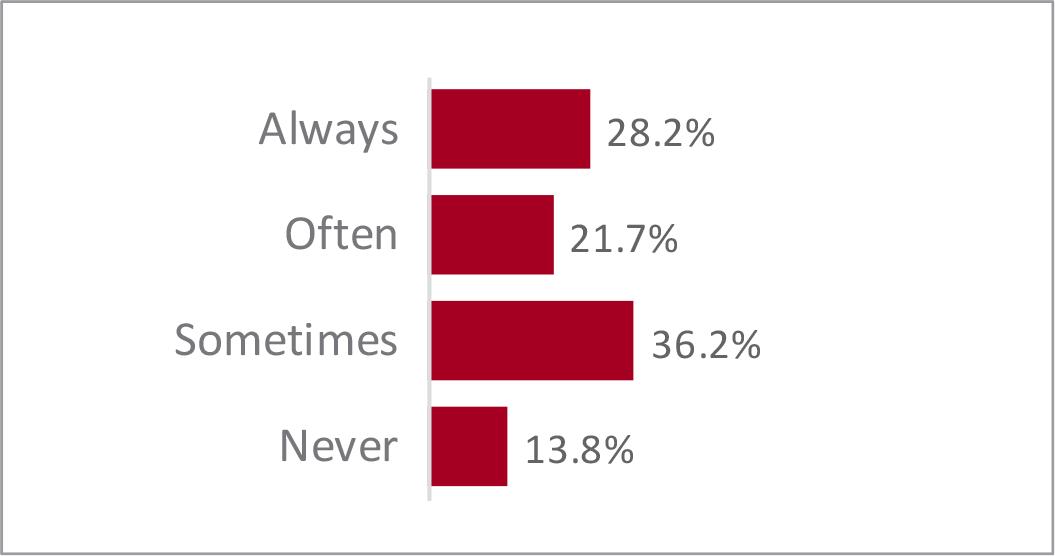
Figure 9 illustrates one of the items in dimension 6.
Source: Authors’ elaboration.
FIGURE 9 Frequency distribution of response alternatives for the item in dimension 6 of the School Climate which asked whether the Students always take care of equipment, furniture, materials and spaces (bathrooms, classrooms...), from the perspective of students at School A.
These responses may be related to the testimony of a staff member during the feedback session. She commented on the maintenance of cleanliness in the spaces of the school, particularly the boys’ restroom, which they regularly littered and vandalized. The strategy implemented to address this issue was to remove the toilet paper from the restroom, as students would often clog the plumbing with it. Instead, the toilet paper was kept in the cleaning supply room, requiring students to request it when needed. However, following negative reactions and discussions among the teachers, the management team, and the students themselves, this measure was abandoned, as it was unanimously deemed humiliating by all agents. Nevertheless, the issue of disorder in the restroom persisted. This discussion highlighted how the situation could impact the school climate, as the boys perceived the experience as both negative and embarrassing.
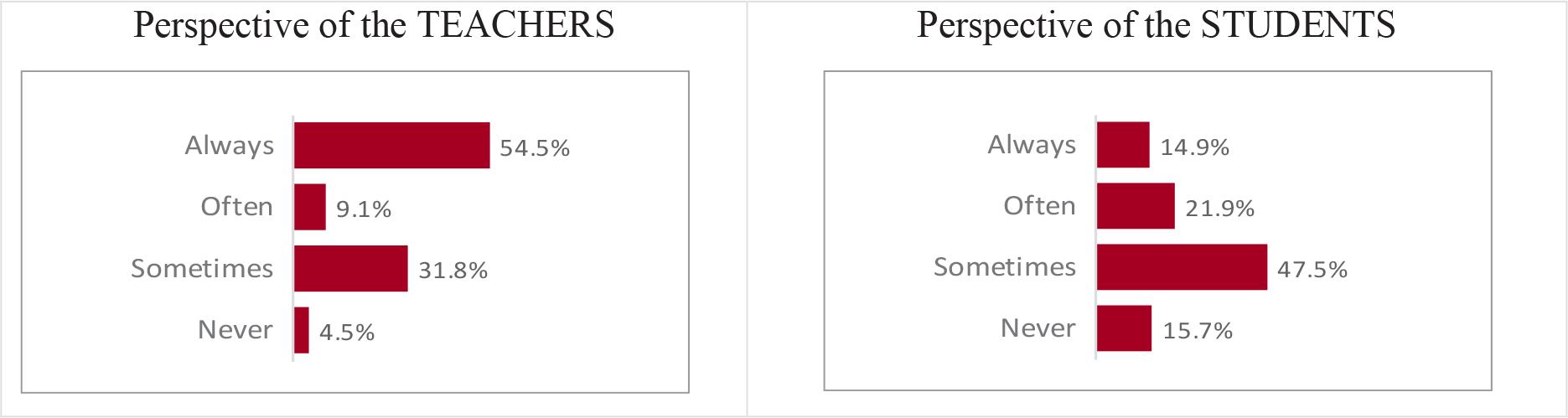
Once again, this calls for a comparison between the perspectives of students and teachers on the same item, which concerns free access of the students to school spaces (Figure 10).
Source: Authors’ elaboration.
FIGURE 10 Frequency distribution of the alternative responses for the item in dimension 6 of the School Climate, which asked about free access of the students to school space, from the perspective of teachers and students at School A
The perspectives of students and teachers are diametrically opposed on this issue: while 63.2% of students stated that they did not have free access to various school spaces, 63.6% of teachers reported that students did have free access. During the feedback session, students explained that they spent a lot of time in the classroom, accessing certain areas - such as the cafeteria, courtyard, and gymnasium - according to a pre-established schedule. As a result, they felt they did not have free access to spaces like the computer room and/or the reading room, because these remained locked during breaks and could only be entered under teacher supervision. On the other hand, representatives of the school staff claimed that these spaces could not be used without teacher supervision due to the presence of equipment and materials. In response, students suggested that a student union representative could oversee the use of these spaces, and a meeting between a student and the school administration was scheduled to discuss this proposal.
Moreover, a remark from a member of the administration drew attention: “Sometimes, we focus on what we need to do, and it’s not us who have to make the decisions. We need to ask them about that, because that is a way for them to participate in the decision-making.” This remark shows the possibility of students taking on leadership roles in organizing school operations. It is important to note that these would not be leadership roles pointed out by the administration, but ones that would emerge from the students themselves (Woods, 2005).
Another aspect to be considered is that the assessment of the school climate (Vinha et al., 2017) sparked a discussion that could lead to a more democratic way to access school spaces. Additionally, teachers noted that this issue had been addressed in some meetings, particularly regarding the lack of spaces for dialogue and the airing of different perspectives. Thus, we observed that the research findings have contributed to raised awareness among the agents, and have already fostered some convergence on this issue.
The discussion regarding free access to school spaces, which was limited at School A, also led teachers to express dissatisfaction with students approaching them during their break periods - 20 minutes per session - and their one-hour lunch break. They stated that they did not want to be disturbed by students during these breaks. The group then shifted the discussion to the importance of a pedagogical effort aimed at fostering civility among students and with other members of the school community, particularly teachers. Once again, student leadership was identified as a key factor in this process, as student leaders could “teach their peers to show greater respect for everyone and, in this way, they could have more freedom within the school.” Peer learning was highlighted by several participants as an important strategy, based on the understanding that this type of learning - mainly in relational matters - can be more effective than instruction by teachers. As one participant noted, “It’s one thing for an adult to enforce a rule with a student; it’s another thing entirely for a peer to do so.”
Regarding the development of the research at School A, the administrative team emphasized its significance since, although stating that they worked in an informed manner, they often relied on “guesswork” due to “the fast-paced nature of the daily operations”. They also expressed appreciation for the research, as it aligned with the needs of the school and provided data that could be used to review rules and develop actions. Additionally, they acknowledged that the feedback session itself could be considered a first step in this process.
Moreover, the participating teachers highlighted the importance of disseminating the research findings so that other school teams could access tools, such as the school climate assessment (Vinha et al., 2017), and implement them in their own contexts.
In this way, they reported having gained an understanding of their own desire to improve, and even transform their school reality, through strengthening participation and more democratic administration. They acknowledged that this is not a simple task, as many school agents may not be prepared for active participation, often preferring merely to follow orders. They also emphasized the importance of considering not only the negative dimensions and perceptions, but also the positive ones, as these provide greater motivation for the ongoing work to be carried out at the school.
Other aspects related to the school climate were addressed in the feedback session. One teacher emphasized the importance of tutoring for understanding the subjective realities of students and their families, as this activity provides an opportunity for greater closeness among teachers, students, and guardians. Additionally, it allows for more accurate monitoring of attendance and the reasons for absences, a possibility created by the PEI program. Another teacher mentioned the collective work aimed at learning related to coexisting, since each teacher, within their own class, can give brief messages or even reinforce the need for respecting the school environment, materials, and each other. These statements support the idea that the work of improving the school climate is not individually, but collectively, built by all members of the school community. A third teacher explained that students are observers, in the sense that they pay attention to the attitudes of the teachers. For instance, a disorganized teacher could not demand organization from the students, since that would be requiring something they themselves do not do. This shows that the group and the whole school were developing an awareness of the importance of coherence between speech and actions in improving school coexistence, and for teaching students the norms of civility itself in democratic coexistence.
Another aspect of the PEI program identified as relevant to the school climate was youth leadership. A student explained that the school system that she had experienced before this program made student leadership difficult due to its hierarchical structure and more rigid regulations. The students, having been trained in that system since they were little, struggled to exercise the level of leadership promoted by the program. In her view, the PEI program would contribute to the development of youth leadership, also fostering closer relationships between students and teachers which, in turn, would enhance the teaching-learning processes.
FINAL CONSIDERATIONS
Based on the hypothesis that PEI school agents can regulate the guidelines of the program internally, using their time and space to build a democratically-oriented education, we understand that school climate constitutes an important aspect in this process - importance evidenced by the research findings at School A. In light of this, the issue examined concerned identifying the most sensitive dimensions of the climate at the school investigated, and how the reflections fostered by feedback could contribute to strengthening collective participation. Thus, the aim of the present study was to analyze data collected on the school climate through participant observations and the administration of school climate questionnaires (Moro, 2020), as well as through feedback provided to School A.
The way that the students perceived two dimensions of school climate - family-school relationships and infrastructure - showed that these were sensitive aspects, that had both physical and emotional impacts on students. Physically, because the infrastructure of the school affected their mobility and overall well-being. Emotionally, because the absence of family could make students feel abandoned or disconnected from their families while at school. Additionally, it could characterize a certain negligence of the families in relation to the school life of their children.
As highlighted in our presentation, the application of the school climate questionnaires (Vinha et al., 2017) allowed each school agent to express their feelings regarding different dimensions, revealing the socio-educational environment based on the set of perceptions of those who interact within it, without individualization. This approach provides recognition of the strengths - what is working well - as well as the difficulties and challenges to achieving a better school environment for everyone. In this sense, diagnosing the school climate, in addition to revealing the agents’ perceptions of the specific characteristics of their school, can be a trigger for plans and actions that support discussion and planning in a coordinated manner, while engaging the entire school community. On the other hand, we understand that perspectives of the researchers on this process can contribute to the progress of the school.
The feedback session at School A, based on the evidence gathered from the questionnaires, fostered collective reflections through discussions on related items. These discussions made different perspectives explicit, fostering a level of dialogue that may contribute to improving the school climate.
Thus, we conclude that it is necessary to investigate and act on the quality of the relationships among all the school agents, and to build relationships of trust, cooperation, and respect, providing spaces for meaningful participation and coexistence is crucial. This is because, for some students, school may represent fear, failure, exclusion, and humiliation. In short, the present findings offer essential insights for the institution, as they reveal both positive and negative perceptions of various aspects from the perspective of those who experience and engage with the school environment.
COMO CITAR:
Moro, A., Nascente, R. M. M., & Yamazato, M. O. (2025). School climate in a school of the Integral Education Program of the state of São Paulo. Estudos em Avaliação Educacional, 36, Article e10932. https://doi.org/10.18222/eae.v36.10932_en
REFERENCES
Avelino, W. F. (2019). Ensino Integral: O cotidiano do/no/sobre uma escola que aderiu ao programa. InterMeio: Revista do Programa de Pós-Graduação em Educação, 25(50), 185-201. https://periodicos.ufms.br/index.php/intm/article/view/9423 [ Links ]
Ball, S. J. (2005). Profissionalismo, gerencialismo e performatividade. Cadernos de pesquisa, 35(126), 539-564. https://doi.org/10.1590/S0100-15742005000300002 [ Links ]
Barbosa, M. L. C. dos S. (2019). A Avaliação 360º: Percepções dos professores do Programa de Ensino Integral [Dissertação de mestrado, Universidade Estadual Paulista “Júlio de Mesquita Filho”]. Repositório Institucional Unesp. https://repositorio.unesp.br/items/9b423e83-6019-4780-842e-5d14b9df499a [ Links ]
Barbosa, R., & Placco, V. M. N. de. S. (2022). O papel do gestor no desenvolvimento de relações no Programa de Ensino Integral (PEI) na cidade de São Paulo. Revista Trama Interdisciplinar, 13(1), 35-55. https://editorarevistas.mackenzie.br/index.php/tint/article/view/14992 [ Links ]
Barroso, J. (2005). O Estado, a educação e a regulação das políticas públicas. Educação e Sociedade, 26(92), 725-751. https://doi.org/10.1590/S0101-73302005000300002 [ Links ]
Bogdan, R., & Biklen, S. (2010). Investigação qualitativa em educação: Uma introdução à teoria e aos métodos. Porto. [ Links ]
Brunet, L. (2001). Climat organisationnel et efficacité scolaire. Universidade de Montréal, Faculté des Sciences de l’Éducation. [ Links ]
Cohen, J. (2006). Social, emotional, ethical, and academic education: Creating a climate for learning, participation in democracy, and well-being. Harvard Educational Review, 76(2), 201-237. https://doi.org/10.17763/haer.76.2.j44854x1524644vn [ Links ]
Cohen, J. (2010a). Jonathan Cohen on school climate: Engaging the whole village, teaching the whole child. The Challenge. A publication of the office of safe and drug-free schools, 16(4), 1-8. https://storage.googleapis.com/edcompass/material/Creating%20a%20Positive%20School%20Climate%20and%20Increasing%20School%20Connectedness%20PDF.pdf [ Links ]
Cohen, J. (2010b). The new standards for learning. Principal leadership, 11(1), 28-32. [ Links ]
Cohen, J., Mccabe, E. M., Michelli, N. M., & Pickeral, T. (2009). School climate: Research, policy, practice and teacher education. Teachers College Record, 111(1), 180-213. https://doi.org/10.1177/016146810911100108 [ Links ]
Cohen, J., & Pickeral, T. (2008). The challenge of assessing school climate. Educational Leadership, 66(4). https://ascd.org/el/articles/the-challenge-of-assessing-school-climate [ Links ]
Cohen, J., & Pickeral, T. (2009). The school climate implementation road map: Promoting democratically informed school communities and the continuous process of school climate improvement. Center for Social and Emotional Education. [ Links ]
Cohen, J., Pickeral, T., & Levine, P. (2010). The foundation for democracy: Promoting social, emotional, ethical, cognitive skills and dispositions in K-12 schools. Inter-American Journal of Education for Democracy, 3(1), 73-94. https://scholarworks.iu.edu/journals/index.php/ried/article/view/618 [ Links ]
Creswell, J. W., & Creswell, J. D. (2021). Projeto de pesquisa: Métodos qualitativo, quantitativo e misto. Penso. [ Links ]
Cunha, M. B., & Costa, M. da. (2009). O clima escolar de escolas de alto e baixo prestígio. In Anais da 32. Reunião Anual da Associação Nacional de Pós-Graduação e Pesquisa em Educação - ANPEd (pp. 1-20). http://32reuniao.anped.org.br/arquivos/trabalhos/GT14-5645--Int.pdf [ Links ]
Debarbieux, É., Anton, N., Astor, R. A., Benbenishty, R., Bisson-Vaivre, C., Cohen, J., Giordan, A., Hugonnier, B., Neulat, N., Ortega Ruiz, R., Saltet, J., Veltcheff, C., Vrand, R. (2012). Le “climat scolaire”: Définition, effets et conditions d’amélioration [Rapport au Comité scientifique de la Direction de l’enseignement scolaire]. Ministère de l’Éducation Nationale (MEN-DGESCO); Observatoire International de la Violence à l’École. http://sti.ac-amiens.fr/IMG/pdf/climat-scolaire2012_1_.pdf [ Links ]
Dias, V. C. (2018). Programa de Ensino Integral Paulista: Problematizações sobre o trabalho docente. Educação e Pesquisa, 44, Artigo e180303. https://doi.org/10.1590/S1678-4634201844180303 [ Links ]
Diretrizes do Programa Ensino Integral. (2012). Secretaria da Educação do Estado de São Paulo. https://www.educacao.sp.gov.br/a2sitebox/arquivos/documentos/342.pdf [ Links ]
Evangelista, S. R. (2021). Programa Ensino Integral na rede pública do Estado de São Paulo: Um projeto societário multifacetado? [Tese de doutorado, Universidade Estadual de Campinas]. Repositório da Produção Científica e Intelectual da Unicamp. https://repositorio.unicamp.br/Acervo/Detalhe/1165991 [ Links ]
Fan, W., Williams, C. M., & Corkin, D. M. (2011). A multilevel analysis of student perceptions of school climate: The effect of social and academic risk factors. Psychology in the Schools, 48(6), 632-647. https://doi.org/10.1002/pits.20579 [ Links ]
Fernandes, R. S., & Baptista, F. F. C. M. E. (2018). A educação integral e a gestão escolar: (Contra)tempos. Revista Contrapontos, 18(3), 240-257. https://periodicos.univali.br/index.php/rc/article/view/11908 [ Links ]
Freiberg, H. J. (1998). Measuring school climate: Let me count the ways. Educacional Leadership: Realizing a Positive School Climate, 56(1), 22-26. [ Links ]
Freiberg, H. J. (2005). Three creative ways to measure school climate and next steps. In H. J. Freiberg (Org.), School climate: Measuring, improving and sustaining healthy learning environments (208-218). Taylor & Francis. [ Links ]
Gaziel, H. H. (1987). O clima psico-social da escola e a satisfação que os docentes do segundo grau encontram no seu trabalho. Le Travail Humain, 50(1), 35-45. [ Links ]
Girotto, E. D., & Jacomini, M. A. (2019). Entre o discurso da excelência e a lógica do controle: Os riscos do Programa Ensino Integral na rede estadual de São Paulo. Revista de Ciências da Educação, 21(45), 87-113. https://www.gepud.com.br/pdf/Entre%20o%20discurso%20da%20excel%C3%AAncia%20e%20a%20l%C3%B3gica%20do%20controle.pdf [ Links ]
Gomes, C. A. (2005). A escola de qualidade para todos: Abrindo as camadas da cebola. Ensaio: Avaliação de Políticas Públicas Educacionais, 13(48), 281-306. https://doi.org/10.1590/S0104-40362005000300002 [ Links ]
Loukas, A. (2007). What is school climate? High-quality school climate is advantageous for all students and may be particularly beneficial for at-risk students. Leadership Compass, 5(1). [ Links ]
Marques, S. (2017). Tempo escolar estendido: Análise do Programa Ensino Integral (PEI) da Secretaria de Estado da Educação de São Paulo (SEE-SP) Gestão Geraldo Alckmin (2011-2017) [Tese de doutorado, Pontifícia Universidade Católica de São Paulo]. Repositório PUCSP. https://tede2.pucsp.br/handle/handle/20918 [ Links ]
Mattos, R. (2020). Análise do trabalho do diretor de escola no Programa de Ensino Integral do Estado de São Paulo (2012-2018). [Tese de doutorado, Universidade Estadual de Campinas]. Repositório da Produção Científica e Intelectual da Unicamp. https://repositorio.unicamp.br/acervo/detalhe/1128979 [ Links ]
Moro, A. (2020). A avaliação do clima escolar no Brasil: Construção, testagem e validação de questionários avaliativos. Appris. [ Links ]
Parente, C. da M. D., & Grund, Z. C. (2019). O Programa Ensino Integral (PEI) do estado de São Paulo: Análise das produções acadêmicas. Comunicações, 26(2), 37-55. [ Links ]
Quaresma, D. G. (2015). Gestão democrática na escola de ensino integral: Limites e possibilidades [Dissertação de mestrado, Pontifícia Universidade Católica de São Paulo]. Repositório PUCSP. https://tede2.pucsp.br/handle/handle/10249 [ Links ]
Sherblom, S. A., Marshall, J. C., Sherblom, J. C. (2006). The relationship between school climate and math and reading achievement. Journal of Research in Character Education, 4(1/2), 19-31. https://psycnet.apa.org/record/2007-04373-002 [ Links ]
Toro, J. B. (2005). A construção do público: Cidadania, democracia e participação. Senac. [ Links ]
Vinha, T. P., Morais, A. de, & Moro, A. (2017). Manual de orientação para a aplicação dos questionários que avaliam o clima escolar. FE/Unicamp. https://www.bibliotecadigital.unicamp.br/bd/index.php/detalhes-material/?code=79559 [ Links ]
Woods, P. (2005). Democratic leadership in education. Sage. [ Links ]
Received: February 09, 2024; Accepted: September 12, 2024
 Este é um artigo publicado em acesso aberto sob uma licença Creative Commons.
