




Serviços Personalizados
Journal

Artigo
 texto em
  Inglês (pdf)
 Artigo em XML
 Tradução automática
 Enviar este artigo por email
Compartilhar

 Permalink
Revista Estudos Feministas
versão impressa ISSN 0104-026Xversão On-line ISSN 1806-9584
Rev. Estud. Fem. vol.33 no.1 Florianópolis 2025 Epub 01-Jan-2025
https://doi.org/10.1590/1806-9584-2025v33n1104256
Seção Temática Tecnopolíticas e capitalismo de dados: Resistências interseccionais (trans)feministas
Non-binarity in Menstruation Apps - Paradoxes Between Queer Visibility and Surveillance
Larissa Pelúcio (larissa.pelucio@unesp.br; larissapelucio@gmail.com) holds a PhD in Gender Studies, Sexuality and Feminist Theories (2019) and is an Associate Professor at UNESP-Bauru (Universidade de São Paulo), where she teaches Anthropology. She is accredited in the Postgraduate Program in Communication at FAAC-UNESP, and completed postdoctoral studies at the Pagu Gender Studies Center and at Université Paris 8. She is the leader of the Transgressions Research Group (CNPq), where she investigates corporalities, gender, sexuality and contemporary media. She is the author of the books Abjeção e Desejo and Amor em Tempos de Aplicativos (Annablume/Fapesp), as well as articles on decolonial theories, feminisms and technopolitics. She is a Productivity Scholar (PQ2).
 http://orcid.org/0000-0001-6212-3629
Eduarda Albrechete Motta (eduarda.motta@unesp.br) is a master's student in the Postgraduate Program in Communication at UNESP-Bauru (Universidade de São Paulo). She is a member of the CNPq research group “Transgressions - Gender, Sexualities, Bodies and Contemporary Media”. She holds a degree in Journalism from UNESP-Bauru. Her research interests explore the representation of dissident sexualities and gender identities in contemporary media.
http://orcid.org/0000-0002-6365-2968
1Universidade Estadual Paulista, Bauru, SP, Brasil. 17033-360 - dchu.faac@unesp.br
2Universidade Estadual Paulista, Bauru, SP, Brasil. 17033-360 - spg.faac@unesp.br
This paper examines how menstruation apps intersect with contemporary gender debates and capitalist pursuits of new products and markets. We focus on the approach of two popular digital menstrual calendars (Clue and Flo) regarding non-binary gender identities. These initiatives are critically analyzed through the lens of queer algorithmization and surveillance. In the era of surveillance capitalism, we contend with new “gender troubles” (Judith BUTLER, 2003) as physical bodies and data bodies become increasingly inseparable. These tensions are explored through immersive digital research.
Keywords: Non-binarity; Flo menstrual calendar; Clue menstrual and ovulation tracker; Queer algorithms; Surveillance capitalism
Discutimos, neste texto, como os menstruapps se colocam na peculiar interseção entre os debates contemporâneos de gênero e a busca capitalista por novos produtos e mercados. Focamos a investida de dois dos mais populares calendários menstruais digitais (Clue e Flo) em torno da não binariedade de gênero. Problematizamos essas investidas inspiradas pela proposta provocativa de algoritmização e vigilância queer. Parece-nos que, em tempos de capitalismo de vigilância, estamos lidando com outros “problemas de gênero” (Judith BUTLER, 2003) em contextos nos quais corpos físicos e corpos de dados são cada vez mais indissociáveis. É sobre estas tensões que nos debruçamos, a partir de pesquisa imersiva em meios digitais.
Palavras-chave: não binariedade; Flo calendário menstrual; Clue Menstrual e de Ovulação; algoritmos queer; capitalismo de vigilância
Este artículo examina cómo las aplicaciones de menstruación se sitúan en la intersección de los debates contemporáneos de género y la búsqueda capitalista de nuevos productos y mercados. Nos centramos en las estrategias de dos de los calendarios menstruales digitales más populares (Clue y Flo) en relación con la no-binariedad de género. Estas estrategias se analizan críticamente desde la propuesta de algoritmización y vigilancia queer. En tiempos de capitalismo de vigilancia, enfrentamos nuevos "gender troubles" (Judith BUTLER, 2003), donde los cuerpos físicos y de datos son cada vez más inseparables, explorando estas tensiones a través de investigación inmersiva en medios digitales.
Palabras clave: no-binariedad; calendario menstrual Flo; Clue Menstrual y de Ovulación; algoritmos queer; capitalismo de vigilancia
Introduction - Click here to get started
“People, what is non-binary? I'm sorry to ask because I really don't know” (user of the menstruapp Flo Menstrual Calendar, in an anonymous post, in 2022)
What is a non-binary person, asks with some embarrassment the user of Flo Menstrual Calendar, one of the most downloaded menstruapps in the digital smartphone app stores24. Menstruapps and non-binary people are terms that have very recently become part of our feminist lexicon and that of people who research gender and sexuality. However, gender non-binarity began to appear as an academic topic at the beginning of this century with Felicity Haynes and Tarquam McKenna in Unseen genders: Beyond the binaries (2001). However, the idea of gender fluidity and the transcendence of binaries had already been circulating in the 1990s in works such as Gender Outlaw: On men, women and the rest of us, written by Kate Bornstein and published in 1994.
Dri Azevedo (2024) points out that in that decade, some terms emerged within the English-speaking movement of transgender people as proposals to tension the binarism implied in the way feminisms had been constructing the concept of gender. For Azevedo, terms such as "genderqueer and its derivatives (genderfluid, genderbender, etc.)"25 were precursors of what we now recognize as gender non-binarity.
From the 2010s onwards, non-binary gender identity began to consolidate itself as a social movement, gaining rapid visibility through social networks. Today, it is present in various profiles and groups, which organize and connect mainly through apps (Hblynda MORAIS, 2024).
Profiles of transsexual people, for example, have started to discuss gender non-binarity in transsexuality as a way of confronting aesthetics and surgical interventions that seek to make transsexuality correspond to the binary established by cisgender norms (MORAIS, 2024). Researchers26 are also expanding this discussion, seeking to "overcome the conventions of the cisgender ruler, which continues to measure trans bodies and define their categories of belonging and inhumanity" (Lucas DANTAS, 2024, p. 173).
In 2010, in parallel with the growth of the debate on non-binarity in online social networks, menstruapps began to be made available for download in the IOS and Android app stores (Camilla RØSTVIK, 2022).
The relationship between mobile apps and gender as a political category is close (Gabriela PALETTA, 2019; Fernando POCAHY; Felipe CARVALHO; Dilton COUTO JR., 2020). When it comes to menstruapps, this link is even more pronounced.
Menstruapps are apps for monitoring the menstrual cycle and fertility, whose algorithmic system is calibrated to warn and/or teach users how to read when their next period and/or ovulation is coming (PALETTA, 2019, p. 124), as well as encouraging them to regularly record physical, physiological, psychological and emotional data, so that the app can help with both conception and contraception.
These apps operate with business models that create revenue by selling users' personal and intimate data. They want to know how you have sex; if you have orgasms and in what position; if you masturbate; what you've eaten; if you have a headache; cramps; are in a good mood or irritable; how much you weigh, measure, walk... so, by knowing you better, predictions will tend to be more accurate. That's one of the promises. There are others, such as promoting self-knowledge, greater control over your cycle and management of your sexual and reproductive life.
Mestruapps datify the menstrual cycle, proposes Nicole Baumgarten (2024). In her digital ethnography, the anthropologist immerses herself in Clue, analyzing the categories the app offers for recording physiological, bodily, psychological and emotional data. In dialogue with Paul Preciado, Baumgarten proposes that "the categorizations present in the app's texts and illustrations are part of the symbolic and material circulation of techno-gender: both through representation and information gathering." (Nicole BAUMGARTEN, 2024, p. 86). Control, regulation and the production of bodies are articulated, and so these technologies also participate in the construction and regulation of gender identities.
Apps aimed at monitoring biological and physiological functions not only mine valuable information about the health, natural cycles and emotional states of users, but also tend to offer magical individual solutions to macro-social issues such as health, poverty and unemployment (Evgeny MOROZOV, 2018).
In this article, organized into three sections and an open-ended conclusion, we discuss how digital technologies, such as menstruapps, have sought to contemplate gender and sexual diversity in order to cater to the growing femtech27 market and the outright queerization of identities, which Western societies and those with a Western matrix, such as Brazil's, have undergone in the last two decades.
Based on immersive research as critical users of these menstruapps, we discuss the architecture of two of the most popular apps for monitoring the menstrual cycle: Clue Menstrual and Ovulation Calendar and Flo Menstrual Calendar. We are particularly interested in what the discourses call "inclusion" and/or "diversity"28. We are also interested in mapping and analyzing the reactions and resistance of users who declare themselves to be non-binary, following their interaction with the menstruapps chatbot. We added to this material, articles written by the teams of these apps and published on their platforms.
Menstruation and everything related to it is still surrounded by misinformation and taboos, so menstruapps end up offering a digital space for learning and exchanges between users. This is a continuation of menstrual education, which throughout the 20th century was primarily promoted by the sanitary products industry and, more recently, by pharmaceutical laboratories (Jeanne Guien, 2023). Big tech adds to this pedagogy which, rather than teaching, "produces bodies that are coupled with a phantasmatic sensitivity (PRECIADO, 2014) to technological devices, blurring the boundaries between the 'natural' and the 'artificial', the 'body' and the 'machine'" (PALETTA, 2019, p. 124).
Interactions between users and digital technologies such as artificial intelligence (AI), chatbots and prediction algorithms generate a large volume of data on sexual dissidence, as in the case of non-binary people, who end up collaborating, even unintentionally, in the codification of queer profiles, based on their normalization. Predictions in menstrual cycle tracking apps are generated using algorithms that analyze data entered by users. From these records, the information is cross-referenced with population databases and physiological patterns. Many of these apps use machine learning to refine their predictions, adjusting to individual variations over time. There is thus a tendency for stereotypes about minority identities to be reiterated (Tarleton GILLESPIE, 2024).
Echoing the concerns of Felipe Rivas San Martín (2025), we ask "How is it possible that something as unclassifiable as queer can be captured and coded in digital networks to the point of being established as an algorithmic pattern?". It seems to us that in times of surveillance capitalism (Shoshana ZUBOFF, 2018), we are dealing with other "gender problems" (Judith BUTLER, 2003) in contexts where physical bodies and data bodies are increasingly inseparable. It is these tensions that we are focusing on.
Menstruapps and non-binarity
Menstruapps act as power plants for generating large volumes of data, especially generified data, collected from menstruating and/or procreative bodies. At the same time, these apps shape and produce these bodies, promoting a kind of techno-pedagogy that teaches how to menstruate in a more self-controlled way and in line with contemporary standards (GUIEN, 2023).
The equation self-monitoring = self-knowledge = empowerment is present in the language of menstruapps. "Understand your cycle and be your best version"; "Know your body. Control your health", "The more you monitor, the more accurate your forecasts will be", are invitations on the Clue and Flo interface.
Surrounded by taboos and stigmas, the menstrual experience in Western societies has been constituted in silence and shame, sustained by biologizing and hygienist discourses (Carolina VÁSQUEZ, 2022). Associated with "becoming" a woman, menstruation and everything that surrounds it is usually experienced through complaints, secrets and even disgust.
Informed by cis-centered perspectives, menstruation, pregnancy and the menopause have been constructed as experiences that only concern cisgender women, so that cis men were neither educated nor involved in these experiences that can occur with their mothers, sisters, friends and partners.
Even in the face of other identities that have found ways of existing and expressing themselves over the last quarter of a century, the menstrual cycle continues to be treated in a highly medicalized and, paradoxically, naturalized way, excluding transgender men, non-binary people and other people who menstruate from the list of interests and concerns related to the reproductive cycle. Given this historical scenario, it is not uncommon for transgender men and non-binary people to see menstruation as an element of discomfort and suffering caused by the alleged incongruity between gender identity and the menstrual cycle.
However, S.E. Frank (2020: 15) notes that dysphoria does not originate from menstrual bleeding itself but from the social norms constructing menstruation as female. A.J. Lowik (2020: 7) adds that not all trans and nonbinary menstruators experience a sense of distress, complicating “the dominant narrative … that menstruation is always triggering of gender dysphoria for trans people” and that menstrual suppression must be the remedy of choice. Thus, there is a need to unpack and critique menstrual discourse to recognize “multiplicities of menstrual realities” (Persdotter, 2020: 367) and to understand how trans and nonbinary perspectives counter menstrunormativity and help degender and depathologize menstruation (Rydstrom, 2020). (Rowena KOSHER; Lauren HOUGHTON; Inga WINKLER, 2023, p. 2)
Menstruapps like Clue and Flo have set out to change this "dysphoric" relationship between menstruation and bodies dissenting from the cisgender norm. Clue, for example, describes itself in the Google Play store as an inclusive app: "we use neutral language. We have people of all ethnicities, genders and sexual orientations in our app" (quoted by BAUMGARTEN, 2024, p. 60)29. Both apps advertise themselves as safe on many levels: data privacy; technical quality; scientific rigor of the information they make available to users.
The article *Talking about periods beyond gender*, written by Jen Bell and published in Clue's "Gender Equality" section in 2017, explains the app's choice to make itself accessible to non-binary people too. The text recognizes that "people who don't fit the common definition of 'women' can easily become isolated, marginalized, stigmatized and discriminated against" when the language about the menstrual cycle is directed exclusively at a female audience. Accessibility and gendered language on Clue, written by Mike LaVigne and Lisa Kennelly, and published in the same section, also in 2017, reiterates the proposal of inclusion. Despite recognizing that, in some languages, gender-neutral language needs to be improved, the app claims to be designed for "all of our millions of users, regardless of gender" (emphasis added).
Although Clue is not exclusively focused on pregnancy and adopts neutral language, Joelle Schantz, Claudia Fernandez and Anne Marie Jukic (2021, p. 14) assess that the app ended up focusing on the preponderantly cis and heterosexual sexual partnership. This ambiguity led to the free update of the app, which in December 2022 announced on its website the "relaunch" of the platform with a new design and the addition of more than 40 monitoring options30. This return of Clue to complaints and notes made by users about inconsistencies in its language reinforces the idea of the app's potential to calibrate a queerized algorithmic system. For example, in the description of the sex life tab in 2024, Clue stated that "sex life monitoring options can be applied to all sexual orientations"31.
Flo also proposes debates on hormones and gender diversity, but it does so through an internal service for anonymous conversations between users called "Private Chat". Among the different thematic keys offered there is the "LGBTQ+ Health" tab, where there are a series of questions prepared by health experts who make up Flo's team and the app's artificial intelligence. The cards (digital cards with text and images) contain questions such as: "What is the effect of gender affirming hormone therapy? Share"; "If you are trans/non-binary and menstruate, how do you feel about it?". The first response to this set of questions comes in the form of an appeal/recommendation.
I wish you could change the pronouns here in the app, you know? choose the pronouns he/him or they/them, it affects my self-esteem and the self-esteem of other trans people. I'm also going to try to evaluate the playstore, if possible like my comment to reach them thanks! (Comment by a user identified with a stylized sheep icon, posted in March 2024).
The 299 people who answered the question reproduced above complain about the way the app behaves towards trans and non-binary people. Lesbian women also intervene in the post (Figure 1). While recognizing the app's qualities, they point out Flo's undisguised cis-heterosexuality.
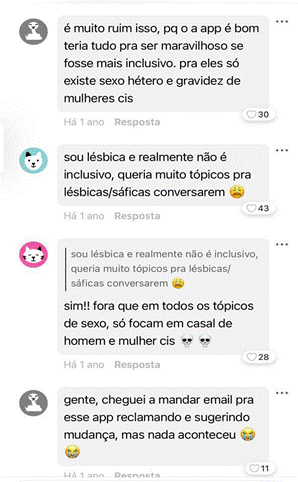
#PraTodoMundoVer The image shows a screenshot of a cell phone conversation consisting of four message balloons on a gray background. To the left of the balloons are circles with the icons of each user: in the first there is a duck with a gray background, in the second a dog with a light blue background, in the third a cat with a pink background and in the fourth the duck is repeated.
Translation of the screenshots: This is really bad, because the app is good and has everything to make it marvelous if it was more inclusive. For them only hetero sex and cis woman pregnancies exist.
I'm lesbian and it really is not inclusive, I would really like topics for lesbian/sapphics to talk about.
yes!! let alone the fact that all the topics on sex, they only focused on cis men and women couples.
people, I ended up sending an email to this app complaining and suggesting changes, but nothing happened.
Figure 1 Screenshot of the "Private Chat" element of Flo Health
The logos of both apps also offer interesting material for gender analysis (Figure 2) in relation to proposals for the inclusion of diverse bodies, genders and sexual orientations. Clue, for example, uses a red-orange mandala as its graphic symbol. Next to it appears the app's name written in a thin sans serif font. Flo uses a feather that seems to float as an image. The logo is pink, written in a serif font and rounded, qualities that refer to the propagated values of femininity.

Source: Clue and Flo official websites.
#PraTodoMundoVer The image shows the logos of the Clue app in red and the Flo app in pink.
Figure 2 Logos
As we know, none of these choices are random. Clue's mandala and Flo's feather are full of meaning. Mandalas, despite being ancient symbols, became popular in the West in the 1960s, mainly due to the influence of Carl Jung in Man and His Symbols. The mandala is a geometric shape that in many cultural traditions represents wholeness. At the same time, the one illustrating Clue's logo refers to an electrosphere, a shape associated with hard sciences such as chemistry and physics, popularly regarded as more precise and reliable.
Flo's floating feather suggests fluidity and lightness. While Flo offers a pink, diaphanous world full of elements commonly associated with the feminine, Clue seems to have opted for more encompassing signs in terms of gender and sexual orientation, visually relating to the scientific and at the same time to blood and delicacy.
In 2023, as part of its effort to be more inclusive of gender diversity, bodies and sexual orientation, Flo started using the term "people who menstruate", but since 2021, it had already included articles aimed at the LGBTQIAPN+ (LGBTQ+, in the app) audience in its library. However, what we found in our research is that, unlike Clue, Flo has kept both its graphic language and writing anchored in ciscentric references. When we analyzed the texts available on Flo's website and app, we found that the references are only to cisgender women, so that "All people who menstruate", as a phrase that would attest to the proposal of inclusion, disappears. In the iconography and illustrations, rounded panties, curvy bodies, voluminous breasts and profiles that refer to women come floating among many shades of pink.
On the other hand, when we read the articles published by both apps, we can see that both Clue and Flo, the former with the most results tabulated by us, have been making an effort to be inclusive and technologically and scientifically reliable. However, these inclusive efforts have not created any real cracks in the binary logic that organizes Flo.
To what extent isn't this effort at inclusion also a form of data capture that updates algorithmic systems on digital platforms? In Graciela Natansohn's opinion, the incitement to self-monitoring contributes to surveillance via digital traces. "Surveillance by default, embedded in technologies, is a commercial and patriarchal strategy to control and restrict rights" (NATANSOHN, 2019, p. 139). So, what happens when this discursive apparatus looks at dissent?
Queer surveillance
The apps available on Google Play or the Apple Store are the new operators of subjectivity. Remember, then, that when you download an app, it is not being installed on your computer or your cell phone, but on your cognitive apparatus (PRECIADO, 2020, p. 79).
Paul Preciado's warning is echoed in Felipe Rivas San Martín's text in this Thematic Session. The author brings up the concerns present in the dossier "Queer Surveillance", published in 2019 in the journal Surveillance & Society32. In the editorial of that issue, Gary Kafer and Daniel Grinberg, organizers of the dossier, defined queer surveillance as a power dynamic that updates queerness as a way of drawing and retracing limits and boundaries between normality and strangeness, capturing what fits within the parameters of normality, abandoning what seems excessive, so that the dichotomy between normal and abnormal continues to be the referent that excludes and classifies what can be considered queer. To put it another way: when Flo distinguishes "women and girls" from "people who menstruate", proposing a separate identity category rather than a comprehensive one, she reiterates queer as another that draws the line between norm and deviation.
On the other hand, what we have observed in this immersive research, inspired by digital ethnography33, is that queerness in the apps investigated is not external to surveillance as a pre-existing identity. It is, in fact, produced within the processes of surveillance as its very condition of possibility. Surveillance and the production of forms of subjectivation that encourage self-control through self-surveillance. Menstruapps are part of a wider scenario of the datification of bodies, where the monitoring of reproductive and menstrual health becomes a biopolitical fact.
Since Foucault (1987), surveillance has been understood as a central element in the processes of subjective constitution, associated with the disciplining of bodies and the normalization of behaviour. In his analysis of biopower and sexuality as historical devices that incite discourse on sex, Foucault shows that power is not only exercised through repression, but also through the production and control of knowledge, norms and social practices.
Central to the workings of surveillance is the presumption of “normative notions of embodiment” that demand transparency from the body for meaning-making and intervention (van der Meulen and Heynen 2016: 19). Queer identities are opaque to such systems insofar as supposedly improper configurations of gender, sex, and sexuality conceal the body and render it a threatening inconsistency. As Kathryn Conrad (2009b:380) wrote in that issue, [referring to issue no.4 from 2009 Surveillance & Society Issue] “Surveillance techniques, themselves so intimately tied to information systems, put normative pressure on non-normative bodies and practices, such as those of queer and genderqueer subjects.” For example, biometric technologies like face scanners are calibrated upon binary assumptions of gender embodiment and compulsory heterosexuality (Keyes 2018). People who do not conform to dominant conventions of gendered grooming and dress are computed as “biometric system failures” (Magnet 2011: 48) that must be corrected by conforming to the discursive constructs in the software. Undoubtedly, surveillance has long been hostile to queer and trans identities in seeking to control deviation.
In the two menstruapps we are dealing with here, there is a clear tension between recognizing these identity experiences and constituting them as "normal". The quotation marks are there to make this ambiguity even more visible. A normality that can only be achieved by capturing "strangeness", which needs to lose its opacity in order to become codifiable.
How can a body that escapes the male/female binary be recognized as a body that menstruates? In one of the many articles that fill Clue's website, an answer can be rehearsed. In “How using the Clue app helped me accept my non-binary identity”, an article published in the Clue library in July 2020, Aubrey Bryan, now working at Clue, tells how they learned to menstruate as a non-binary person using the app.
When I heard about Clue, I was impressed by its inclusivity and how it publicly stated that it was an app for anyone who menstruates. I started tracking my period, and eventually I applied and ended up working at Clue.
The more I logged into the app, the more my mindset evolved. By deviating from the idea that the menstrual cycle had an explicit gender, I was able to free myself from the relationship between my period and my gender (BRYAN, 2020, s/p. Emphasis added).
The more Bryan recorded their data in the app, the more Clue learned how a non-binary person experienced their menstrual cycle. It was thus feeding a "queer algorithm" system. Feeding an algorithm means providing it with data so that it can learn to recognize patterns, make predictions or make decisions. The process involves providing large amounts of examples (data) so that the algorithm can learn how to identify relevant characteristics. In other words, it's not the individual that matters, but a mass of individual behaviors. This is what San Martín (2025) identifies as a "post-individual leap",
because monitoring is no longer focused on the data of each individual separately and in particular, but on the set of data from large groups of users. The data produced by human interaction with the devices is derived from large databases in a depersonalized and disaggregated manner, i.e. the data is decoupled from the subject from which it arises. Algorithms process this data to find correlations and create user profiles that are prototypical models of a standardized character and at the same time flexible nature that take the place of users in the administrative dynamics of computer technology. This definition is decisive because the algorithm does not operate directly on the user, but on the user profile that has also been constructed by the algorithms as a technically manageable material (emphasis added).
When non-binary people are invited to feel free to register their personal, physiological and emotional data in apps, they offer the algorithm unique elements so that a profile can be codified, standardizing identities that have been constituted as non-standard. Paradoxically, there is a digital customization34 that allows the subject to recognize themselves in that profile, in other words, to have an individualized experience, at the same time as their data is being disaggregated. In this way, generalized models of predictable behaviour are created (SAN MARTIN, 2025).
Non-binarity as a "subversive power" (Mariana POMBO, 2024), is queer or cuír (as we have used it in South America)35, not only because it slips beyond gender binarisms, putting the very concept into question, but because cuír/queer, in its political genesis, proposes precisely to "stand against normalization - wherever it comes from" (Guacira LOURO, 2003, p. 546).
Thus the algorithmic capacity to "code the queer" could be understood as the socio-technical correlate of a process of integration of excluded minorities, but also as an expanded intensification of digital surveillance and control dynamics. To understand this point, it is essential to examine the specific technical modalities at play in this "queer algorithm" and the novelties or differences it establishes with other dynamics of queer surveillance (SAN MARTÍN, 2025).
Algorithmic queerization, or the effort of platforms to "queerize" themselves, can be read as a commercial co-optation of disruptive identities. Collaborative filtering algorithms, for example, have the ability to make successful predictions in all fields when compared to content sharing algorithms36.
In this article,
We focus on collaborative filtering algorithms, partly because their ability to make successful predictions across fields is held to be stronger than that of content-based algorithms, but also because they require and exploit ‘participatory’ methods to develop novel classificatory techniques. (Celia LURY, Sophie DAY, 2019, p. 22).
Participatory methods operate on the premise that users have more than a single shared interest in common, which eliminates the need to accumulate the participation of many users to produce personalized recommendations for a specific profile (LURY, DAY, 2019, p. 22). Roughly speaking, a profile that shares content about its enthusiastic interest in Judith Butler's new book probably has more in common with other people who also appreciate the philosopher's ideas, as well as an interest in the theoretical productions of one of the most expressive queer authors. Collaborative filtering algorithms do not pre-allocate users into pre-existing categories, which is why they seem interesting when it comes to identities that have only recently begun to be articulated as a collective.
The collaborative filtering algorithms used by menstruapps to personalize the experience of the people who use them are actors that interact with collective and individual data to recommend content, functionalities and even notifications. These algorithms interpret data entered by users and generate personalized recommendations. In this context, the algorithm ceases to be just a technical mechanism and takes on an active role in shaping identities and self-care practices, by suggesting ways of understanding the menstrual cycle in a way that can reinforce or challenge gender norms.
In a socio-technical network, where algorithms operate as actants, they not only aggregate data to offer recommendations, but also exercise a form of continuous surveillance over bodies and identities. By observing patterns of use, symptoms and user responses, this algorithmic surveillance participates in the normalization and often pathologization of bodily experiences, according to the parameters of normality defined by the algorithms themselves and by the network of developers and health professionals. For non-binary or queer people, this can represent a veiled pressure to adjust their practices and self-understanding to cisnormative standards, compromising the algorithm's ability to generate a truly inclusive subjectivation. In surveillance capitalism, what can "queer surveillance" mean (or are we talking about surveillance of queer)?
Surveillance, paradoxes and captures
The concept of surveillance capitalism was proposed by Shoshana Zuboff in her book The Age of Surveillance Capitalism, originally published in 2018 and in Brazil in 2021. According to the American researcher,
Surveillance capitalism unilaterally claims human experience as free raw material for translation into behavioral data. While some of this data is applied to improve products and services, the rest is declared as the owner's behavioral surplus, feeding advanced manufacturing processes known as "machine intelligence" and manufactured into prediction products that anticipate what a given individual would do now, in a while and later. Finally, these prediction products are marketed in a new type of market for behavioral predictions that I call future behavior markets. Surveillance capitalists have amassed enormous wealth from these commercial operations, since many companies are eager to bet on our future behavior (ZUBOFF, 2021, p. 22).
Surveillance and prediction make up the dyad that guides this model which, according to Zuboff, has the potential to shape individual behavior in the interests of third parties. In surveillance capitalism, power is instrumental, typical of this phase of capitalism, operating with "the instrumentation and instrumentalization of behaviour for the purposes of modification, prediction, monetization and control" (ZUBOFF, 2021, p. 521 emphasis in original), of human behaviour, including residual behaviour such as blood and excretions. Corroborating Zuboff's view, mentruapps are interested in commoditizing our blood, our pain, mood and enjoyment.
Flo, for example, encourages interaction between users with a guarantee of anonymity and expert intervention. At the same time as extracting a behavioral surplus in a space for free dissertation, it is also in that chat that users have found interlocution and mutual listening, in an exchange that we will call here, "between peers".
Since the late Orkut37 communities, which began to be successful in Brazil in 2004, gender and sexuality dissidents have been shaping digital territories where intense exchanges take place (Regina FACCHINI; Carolina DE CASTRO, 2009; Andréa DOS SANTOS; Suely DE AQUINO, 2011; Carolina PARREIRAS, 2008). With the emergence of smartphone apps, portability and perpetual connection, we have seen an increasingly blatant blurring between private and public. The personal has found a political and, paradoxically, intimate space on the so-called internet.
Dissent is expressed, for example, in menstruapps chats or YouTube channels, as research by Rowena Kosher, Lauren C. Houghton and Inga T. Winkler (2023, p.3) tries to show. Based on an analysis of 19 videos about "MENstruation", and more than 12,000 comments, the authors assess, in a celebratory tone, that there is a vast "living archive of trans corporeality and identity" available on commercial platforms such as Youtube. According to the researchers, the platform also gained access to a new vocabulary at the same time as these terms were being formulated and experimented with. Kosher and her collaborators collected a series of euphemisms used by trans men and non-binary people to talk about menstruation, as well as to name body parts and themselves. In "Private Chat", discussions around menstruation, transsexuality and non-binarity, for example, come up with terms such as "MDS lesbians"; "hetero cis"; "transmasc"; "cis sapphic"; "AFAB bodies"; "fluid gender"; "demisexual"; "demigirl"; "asexual"; "bigender". This abundance of new vocabulary reflects the significant changes we have undergone as a society. Changes that apps are assimilating thanks to the interaction that takes place within them and beyond the platforms, making it possible for previously invisible identities to gain codifiable contours.
Thus, the algorithmic capacity to "code the queer" could be understood as the socio-technical correlate of a process of integration of excluded minorities, but also as an expanded intensification of digital surveillance and control dynamics (SAN MARTÍN, 2025).
"Central to the workings of surveillance is the presumption of ‘normative notions of embodiment’ that demand transparency from the body for meaning-making and intervention" (KAFER; GRINBERG, 2023, p. 593), when it comes to bodies and identities that escape these presumptions, the system tends not to identify and/or recognize them. More seriously, it tends to penalize them. As Mariah Silva and Sara York (2025, in this Thematic Section) discuss, surveillance is unequally distributed, as it bears the marks of gender, race, class and territories. Thinking along these lines, we ask whether non-binary people, whether they be called defem lesbian38, non-binary trans39 or queer, have the potential to confuse surveillance systems? This is a rhetorical question, because although we recognize the existence of digital territories where dissidents identify and articulate themselves, the fact is that they are still located in oligopolistic domains, in which global companies feed on trivial behavioral data, while extracting psychic and emotional tones (BRUNO; BENTES; FALTAY, 2019) from those who use these services.
What can this mean when we are faced with emerging identities (AZEVEDO, 2024)? How does the network made up of human and non-human actors weave itself into the tension between resistance and surveillance? Or to what extent are new identities already taking shape in the permanent friction between digital profiles and an analog self? Without pretending to offer exhaustive answers to these questions, we have tried out possibilities for thinking theoretically about the provocations they hold.
Queer identities are being apprehended and learned by AI40 from a network of human and non-human actors. Involved in this learning are certain discomforts: control, surveillance and normativity.
Felipe Rivas San Martín (2025) considers that
one could describe here two possibilities for the existence of what is queer in the face of the algorithmic regime. On the one hand, it could be that the interest in "total" dataification expressed by the Big Data utopia ends up integrating queerness through this dataification, the formation of correlations, the construction of patterns and mobile profiles that are not guided by a normative evaluation. In a certain sense, it could be said that in this operation the queer is integrated and at the same time disappears as another element of algorithmic hypernormalization, because it loses its exceptionality, rarity, extra-ness and disruptiveness that characterized it [...].
On the other hand, queer subjectivation in menstruapps can reveal itself as a field of tension and creation. If these apps try to "teach" users normative forms of self-control and health, we can also consider that non-binary people can reinterpret these practices, turning the apps into tools of expression, resistance and exploration of subversive identities. To assume that people are passive in the face of the uses of technology is not only naive, but empirically unsustainable (Jose VAN DIJCK, 2019).
Apps like Flo and Clue have sought to interact with dissent, presenting themselves as trusted digital territories in which capture and resistance rub shoulders, contributing to non-binary identities being constituted in, through and beyond apps. Visibility occurs within an environment of surveillance and data collection. The question is whether this visibility will in fact provide an authentic amplification of dissident voices or whether it will end up framing them in a controlled and exploitable framework.
Doubtful conclusions
To paraphrase Daniela Alaattinoğlu (2022), in this text we have discussed how menstruapps place themselves at the peculiar intersection between contemporary gender debates and the capitalist search for new products and markets41. We have seen that, although platforms enable the expression of new gender and sexual identities, this does not happen without them benefiting from the visibility of these identities. Visibility that can quickly become hypervisibility in the context of surveillance capitalism. In practice, this means that the presence of non-binary identities on menstruapps is not only to give recognition and welcome, but also to turn these identities into data that can be analyzed, segmented and eventually monetized.
The commercialization of the margins happens when platforms monetize these identities, turning them into commodities (Sarah Roberts, 2019). What gender troubles can arise from this commodification of the subversive?
When dissident identities are transformed into consumable products, their subversive potential tends to be neutralized. Subversion, which initially seeks to question gender norms, can be emptied of its critical character by being shaped to meet their algorithmic requirements. This tends to create the illusion of inclusion, while the normative structures remain unchanged.
What we have seen, in our daily immersion in the architecture of two menstruapps, is that there is an ongoing effort to algorithmize queer from the idea of "diversity inclusion" propagated by Clue and Flo. In these apps, there is a whole incitement to self-scrutiny, careful monitoring of symptoms, moods and attention to sexual health alerts based on the availability of sensitive data, as already discussed here. It is this data, properly perceived and recorded, that is capable of generating the predictability promised by menstruapps. Prediction algorithms learn, but have difficulty dealing with deviation. However, deviation can be established as the boundary that divides "stable" identities (which we know is a contradiction in terms) and those that drift in the deep waters of the digital.
On the other hand, political effects can arise from these attempts at digital capture and algorithmization, such as the publicization of oppressions and exclusions, especially when it comes to taboo subjects like menstruation and reproduction involving bodies that escape the cisgender ruler. We have seen that the apps not only strive to contemplate non-binarity, but end up contributing to it being constituted from the exchanges promoted in a complex network of relationships between human and non-human actors.
Non-binarity as a subversive force, but also as a plural identity42, destabilizes the cis-heteronorm based on its "kaleidoscopic spectrum, in constant movement, which does not allow itself to be seized by a single identity category, nor by corporeal materialities" (Gabrielle WEBER; Silvana NASCIMENTO, 2024, p. 274). But even so, we have seen non-binarity begin to be digitally codified.
However, in the same spaces where surveillance takes place, there is also the possibility of critical aggregation, promoting greater visibility and legitimacy for existences that have historically been made impossible. Between tensions and paradoxes, data capture and algorithmic control remain, leaving open the question of the extent to which it is possible to achieve full autonomy in these environments, given that capitalism has always been successful in domesticating and commodifying dissent. However, it has never been entirely able to prevent the emergence of gender dissidences, let alone their resistance, which continues to create new gender challenges for the cistem.
REFERENCES
ALAATTINOĞLU, Daniela. “Rethinking Explicit Consent and Intimate Data: The Case of Menstruapps”. Feminist Legal Studies, v. 30, n. 2, p. 157-179, 2022. [ Links ]
AZEVEDO, Dri. “Não binariedade: uma identidade emergente no Brasil contemporâneo”. Revista Periódicus, v. 1, n. 20, p. 01-05, 2024. [ Links ]
BAUMGARTEN, Nicole. 2024. Dataficando a menstruação: uma etnografia com um aplicativo de monitoramento do ciclo menstrual. Mestrado (Programa de Pós-Graduação em Antropologia Social) - Faculdade de Filosofia, Letras e Ciências Humanas da Universidade de São Paulo, São Paulo, SP, Brasil. [ Links ]
BELL, Jen. “Falando sobre períodos além do gênero”. Seção Igualdade de Gênero, Clue, 2017. Disponível em: Disponível em: https://helloclue.com/articles/cycle-a-z/talking-about-periods-beyond-gender . Acesso em 25/09/2024. [ Links ]
BORNSTEIN, Kate. Gender outlaw. New York: Vintage Books, 1994. [ Links ]
BRUNO, Fernanda Glória; BENTES, Anna Carolina Franco; FALTAY, Paulo. “Economia psíquica dos algoritmos e laboratório de plataforma: mercado, ciência e modulação do comportamento”. Revista Famecos, v. 26, n. 3, e33095, 2019. [ Links ]
BRYAN, Aubrey. “Como usar o Clue app me ajudou a aceitar minha identidade não-binária - A linguagem neutra de gênero é mais importante do que você imagina”. Seção LGBTQIA+, Clue, 2020. Disponível em Disponível em https://helloclue.com/pt/artigos/lgbt-voices/como-usar-o-clue-app-me-ajudou-a-aceitar-minha-identidade-nao-binaria#:~:text=O%20Clue%20%C3%A9%20inclusivo%2C%20usamos,expectativas%20e%20estere%C3%B3tipos%20da%20sociedade . Acesso em 16/09/2024. [ Links ]
BUTLER, Judith. Problemas de Gênero: feminismo e subversão da identidade. Rio de Janeiro: Civilização Brasileira, 2003. [ Links ]
DANTAS, Lucas Silva. “Transfobia e não binariedade: o regime da diferença sexual e a régua cisgênera”. Revista Periódicus, v. 1, n. 20, p. 173-185, 2024. [ Links ]
DE LA POLA, Rían Lozano. “Visualidades cuír, imaginários sobreviventes”. Revista Lucía - Revista Feminista de Cultura Visual e Tradução, p. 104-121, 2021. [ Links ]
DOS SANTOS, Andréa Pereira; DE AQUINO GOMES, Suely Henrique. “Comunidades Gays do ORKUT: encontros, confrontos e (re) construção de identidades”. Comunicação & Informação, v. 14, n. 2, p. 96-119, 2011. [ Links ]
FACCHINI, Regina; DE CASTRO, Carolina Branco Ferreira. “Medicalização, sexualidade e gênero: sujeitos e agenciamentos (Apresentação)”. Sexualidad, Salud y Sociedad, n. 14, 2009. (Dossier n. 2) [ Links ]
FOUCAULT, Michel. Vigiar e punir: nascimento da prisão. Tradução de Raquel Ramalhete. Petrópolis: Vozes, 1987. [ Links ]
GUIEN, Jeanne. Une histoire des produits menstruels. Quimperlé: Éditions Divergences, 2023. [ Links ]
HAYNES, Felicity; McKENNA, Tarquam. “Unseen genders: Beyond the binaries”. In: HAYNES, Felicity; McKENNA, Tarquam (Eds.). Unseen genders: Beyond the binaries. Bern: Peter Lang Publishing, 2001. [ Links ]
KENNELLY, Lisa; LAVIGNE, Mike. “Acessibilidade e linguagem de gênero na Clue”. Seção Igualdade de Gênero, Clue, 2017. Disponível em Disponível em https://helloclue.com/articles/culture/accessibility-gendered-language-at-clue . Acesso em 25/09/2024. [ Links ]
KOSHER, Rowena B. D.; HOUGHTON, Lauren C.; WINKLER, Inga T. “MANstruation: A cyberethnography of linguistic strategies of trans and nonbinary menstruators”. Social Science & Medicine, v. 328, 115974, 2023. [ Links ]
LOURO, Guacira Lopes. “Teoria queer: uma política pós-identitária para a educação”. Revista Estudos Feministas, v. 9, p. 541-553, 2001. [ Links ]
LURY, Celia; DAY, Sophie. “Algorithmic personalization as a mode of individuation”. Theory, Culture & Society, v. 36, n. 2, p. 17-37, 2019. [ Links ]
MORAIS, HBlynda. “’Pane no cistema’: discutindo a não binariedade e o protagonismo trans nas redes sociais”. Revista Periódicus, v. 1, n. 20, p. 45-71, 2024. [ Links ]
MOROZOV, Evgeny. Big Tech: a ascensão dos dados e a morte da política. São Paulo: Ubu, 2018. [ Links ]
MOTTER, Julianna Paz Japiassu. “Lesbianidades, sapatonices e plataformas digitais no Brasil”. Revista Estudos Feministas, Florianópolis, v. 33, n. 1, e104264, 2025. [ Links ]
NATANSOHN, Graciela. “Para uma internet feminista, descolonizar internet é urgente”. In: GONÇALVES, Christiane; ROCHA, Marcos A. M. (Orgs.). Feminismos Descoloniais e Outros Escritos Feministas. Fortaleza: Expressão Gráfica e Editora, 2019. [ Links ]
PALETTA, Gabriela. Menstruapps na era farmacopornográfica: aplicativos de monitoramento de ciclo menstrual e interseções entre corpos, máquinas e tecnopolíticas de gênero. 2019. Mestrado (Sociologia e Antropologia) - Universidade Federal do Rio de Janeiro, Rio de Janeiro, RJ, Brasil. [ Links ]
PARREIRAS, Carolina. Sexualidade no ponto.com: espaços e homossexualidades a partir de uma comunidade on-line. 2008. Mestrado (Antropologia Social) - Universidade Estadual de Campinas, Campinas, SP, Brasil. [ Links ]
POCAHY, Fernando; CARVALHO, Felipe; COUTO JR., Dilton. “Apresentação - Corpo, Gênero e Sexualidade na Cibercultura: Modos de Conhecer, Práticas de Sociabilidade e Redes Educativas”. Interfaces Científicas-Educação, v. 8, n. 2, p. 8-15, 2020. [ Links ]
POMBO, Mariana Ferreira. “Além dos binarismos: a não binariedade como potência subversiva”. Revista Periódicus, v. 1, n. 20, p. 06-20, 2024. [ Links ]
PRECIADO, Paul B. Um apartamento em Urano: crônicas da travessia. São Paulo: Companhia das Letras, 2020. [ Links ]
ROBERTS, Sarah T. Behind the screen. Yale: Yale University Press, 2019. [ Links ]
RØSTVIK, Camilla M. Cash Flow: The businesses of menstruation. London: UCL Press, 2022. [ Links ]
SAN MARTÍN, Felipe Rivas. “Perfis queer e pós-vigilância”. Revista Estudos Feministas, Florianópolis, v. 33, n. 1, 2025. [ Links ]
SCHANTZ, Joelle S.; FERNANDEZ, Claudia S. P.; JUKIC, Anne Marie Z. “Menstrual cycle tracking applications and the potential for epidemiological research: a comprehensive review of the literature”. Current epidemiology reports, v. 8, p. 9-19, 2021. [ Links ]
VAN DIJCK, José. La cultura de la conectividad: una historia crítica de las redes sociales. Madrid: Siglo XXI Editores, 2019. [ Links ]
VÁSQUEZ, Carolina R. “Educación Menstrual Emancipadora - Una vía para interpelar la misoginia expresada en el tabú menstrual”. Colección Estímulos de la Creación, Medellín, 2022. [ Links ]
WEBER, Gabrielle; NASCIMENTO, Silvana. “Não binariedade emergente ou binariedade projetiva: reflexões exploratórias transdisciplinares”. Revista Periódicus, v. 1, n. 20, p. 273-307, 2024. [ Links ]
ZUBOFF, Shoshana. A era do capitalismo de vigilância. Rio de Janeiro: Intrínseca, 2021. [ Links ]
24According to the Apple and Google Play digital stores, Flo had 380 million downloads worldwide by 2024.
25"Non-binary is not a correlative term to genderqueer. They are not exactly synonymous. But the popularization of the word "genderqueer" in the English-speaking context (especially since the publication GenderQueer. Voices From Beyond the Sexual Binary, edited by Joan Nestle, Clare Howell and Riki Wilchins, in 2022), has made it theoretically and politically possible to popularize a debate about bodies outside the binary and that don't conform to the binary. Gender thugs were given names" (Azevedo, Dri, 2024, p. 4).
26We use neutral language (in Brazilian Portuguese and English) respecting not only our theoretical convictions, but also the way in which colleagues quoted here identify themselves.
27Marina Sarmiento (2021, pp. 4-5) defines femtech as a term applied to a category of software, diagnostics, products and services that use technology to focus on women's health, from reproductive health to diseases that mostly affect women, such as osteoporosis or breast cancer. According to the report Mercado global de tecnología femenina (Femtech): análisis y pronóstico developed by Research and Markets, the Femtech industry is made up of some 200 start-ups around the world, 92% of which are founded and run by women (...) In fact, according to Frost & Sullivan's forecasts, the Femtech market's revenues are expected to reach $1,100 million dollars by 2024, growing at a compound annual growth rate (CAGR) of 12.9%. The very term "Femtech", with the prefix referring to "female", draws gender boundaries, accentuating binarities.
28Dmitry Gurski, a cis man, is one of the founders of FLo and is also the company's CEO. In 2024 Rhiannon White succeeded Audrey Tsang, who was at the helm of Clue for six years, both cis women.
30The redesign of Clue was based on feedback from the app's users. "Our community is the reason we exist: we want to make sure that Clue is helping you in the best possible way and that it is ready to meet the needs of everyone who uses it, regardless of their experience," is explained in the article Clue Menstruation: relaunch with new design, published on the website itself: https://helloclue.com/pt/artigos/como-usar-o-clue/clue-menstruacao-relancamento-com-novo-design.
31The app also includes the "Medication" category among its services, which includes, among other options, testosterone therapy for trans men.
32Surveillance & Society is an independent academic journal that has been working on the subject of surveillance since 2002 (http://www.surveillance-and-society.org/). The dossier referred to is volume 17, number 5 (http://www.surveillance-and-society.org/).
33Digital ethnography applied in a critical way allows us to immerse ourselves in the apps, paying attention to the socio-technical context and the role these platforms play in the construction of identities and the normalization of menstrual experiences.
34Celia Lury and Sophie Day describe customization as algorithmic personalization, which contemplates a contemporary form of economy, the economy of taste, transformed by Facebook into the economy of likes. For the authors, personalization is "the creation of a path, a dynamic series of approximations of similarity and preference that creates people" (2019, p. 24) based on "a massively aggregated decontextualization and recontextualization of likes" (Idem, p. 31). These aggregations are made by recommendation algorithms such as collaborative filtering algorithms and content sharing algorithms.
35See Larissa Pelúcio (2016). The author discusses how the term "queer" in Portuguese loses the semantic weight it carries in English. In order to reproduce the intentional malaise that the first activists and theorists wanted to imprint on queer studies, Pelúcio proposes that "teoria cu" be used in Brazil, justifying this name by the non-binary character of the organ and its relationship to pleasures considered emasculating and forbidden. The same author uses the term “cuir” to graphically reproduce the way the word tends to be pronounced in Portuguese and Spanish. Rían de la Pola (2021) also makes the same use, justifying the Latinized pronunciation as a form of creative appropriation of the proposals of queer theory for the Latin American reality.
36The sharing algorithms start by collecting a large amount of data on user behavior (likes, comments, shares, time spent on posts, previous interactions with profiles or pages, location, etc.), so that the distribution of this content is related to whether it looks like or resembles the digital actions of users. Using the data collected, the algorithms apply machine learning and artificial intelligence techniques to identify patterns of behavior. From this, the algorithm predicts which types of content are likely to attract the most attention from a particular user and distributes it accordingly.
37Orkut was a social network created by Turkish engineer Orkut Büyükkökten and launched in 2004 by Google. Despite being global, Orkut had a disproportionate success in Brazil, where it quickly became the dominant social network until its closure in 2014. In Brazil, Orkut was used intensively to create communities on the most diverse topics, ranging from fandoms, political and social causes, to humorous topics. These communities allowed people to express their identities and opinions in a, shall we say, freer way, as they were created at a time when the internet was not the internet of algorithms, as we are calling it here.
38"Defem lesbians" is used as an abbreviation for "defeminized lesbians" and refers to lesbians who do not perform femininity.
39This term refers to a transexual person - that is, one who does not identify with the gender they were assigned at birth - and their identity is not related to being a man or a woman, but to a fusion, fluidity or denial of femininity and masculinity.
41Daniela Alaattinoğlu writes that menstruapps place themselves in the peculiar intersection between feminist mainstreaming of public debate and the capitalist search for new products and markets [menstruapps place themselves in the peculiar intersection between feminist mainstreaming of public debate and the capitalist search for new products and markets (2022, p.158)].
1 De acordo com as lojas digitais da Apple e Google Play, em 2024, o Flo contava 380 milhões de downloads realizados no mundo.
2“Não binariedade não é um termo correlato a genderqueer. Eles não são exatamente sinônimos. Mas a popularização da palavra ‘genderqueer’ no contexto anglófono (sobretudo a partir da publicação GenderQueer. Voices From Beyond the Sexual Binary, editada por Joan Nestle, Clare Howell e Riki Wilchins, em 2022), tornou possível teoricamente e politicamente a popularização de um debate sobre corpos fora dos binários e que não se adequassem aos binários. Es bandides de gênero ganharam nomes” (AZEVEDO, 2024, p. 4).
3Utilizamos a linguagem neutra respeitando não só nossas convicções teóricas, mas também a forma como colegas aqui citadas, citados e citades, se identificam.
4Marina Sarmiento (2021, p. 4-5) define femtech como sendo um termo aplicado a “una categoría de software, diagnósticos, productos y servicios que utilizan la tecnología para centrarse en la salud de la mujer, desde la salud reproductiva a enfermedades que afectan mayoritariamente a mujeres como la osteoporosis o el cáncer de mama. Según el informe Mercado global de tecnología femenina (Femtech): análisis y pronóstico desarrollado por Research and Markets, la industria Femtech está formada por unas 200 start-ups en todo el mundo, de las cuales el 92% están fundadas y dirigidas por mujeres [...] De hecho, según las proyecciones de la compañía Frost & Sullivan, se espera que los ingresos del mercado de las Femtech alcancen los 1.100 millones de dólares en 2024, creciendo a una tasa de crecimiento anual compuesta (TCAC) del 12,9%. O próprio termo ‘Femtech’, com o prefixo remetendo a ‘feminino’, desenha fronteira de gênero, acentuando binariedade” (SARMIENTO SANTANA, Marina. “Femtech: Start-ups con perspectiva de género”. Universitat Autònoma de Barcelona, Departament de Mitjans, Comunicación, 2021).
5Dmitry Gurski, um homem cis, é um dos fundadores do Flo e é também o CEO da empresa. Em 2024, Rhiannon White sucedeu Audrey Tsang, que ficou por seis anos à frente do Clue, ambas mulheres cis.
6No original: However, S.E. Frank (2020: 15) notes that dysphoria does not originate from menstrual bleeding itself but from the social norms constructing menstruation as female. A.J. Lowik (2020: 7) adds that not all trans and nonbinary menstruators experience a sense of distress, complicating “the dominant narrative … that menstruation is always triggering of gender dysphoria for trans people” and that menstrual suppression must be the remedy of choice. Thus, there is a need to unpack and critique menstrual discourse to recognize “multiplicities of menstrual realities” (Persdotter, 2020: 367) and to understand how trans and nonbinary perspectives counter menstrunormativity and help degender and depathologize menstruation (Rydstrom, 2020).
8O redesenho do Clue foi elaborado a partir de feedbacks dos usuários, usuárias e usuáries do app. “Nossa comunidade é a razão pela qual existimos: queremos ter certeza de que o Clue está ajudando você da melhor forma possível e que está pronto para atender às necessidades de todos que o utilizam, independentemente de sua experiência”, é explicado no artigo Clue Menstruação: relançamento com novo design, publicado no próprio site: https://helloclue.com/pt/artigos/como-usar-o-clue/clue-menstruacao-relancamento-com-novo-design.
9O app também inclui a categoria “Medicação” entre seus serviços, na qual inclui, dentre outras opções, a terapia com testosterona voltada a homens trans.
10Surveillance & Society é uma revista acadêmica independente que se debruça sobre o tema da vigilância desde 2002 (http://www.surveillance-and-society.org/). O dossiê referido é o de volume 17, número 5 (http://www.surveillance-and-society.org/).
11A etnografia digital aplicada de forma crítica permite uma imersão nos aplicativos com atenção ao contexto sociotécnico e ao papel que essas plataformas desempenham na construção de identidades e na normatização de experiências menstruais.
12Tradução nossa. No original: Central to the workings of surveillance is the presumption of “normative notions of embodiment” that demand transparency from the body for meaning-making and intervention (van der Meulen and Heynen 2016: 19). Queer identities are opaque to such systems insofar as supposedly improper configurations of gender, sex, and sexuality conceal the body and render it a threatening inconsistency. As Kathryn Conrad (2009b: 380) wrote in that issue, “Surveillance techniques, themselves so intimately tied to information systems, put normative pressure on non-normative bodies and practices, such as those of queer and genderqueer subjects”. For example, biometric technologies like face scanners are calibrated upon binary assumptions of gender embodiment and compulsory heterosexuality (Keyes 2018). People who do not conform to dominant conventions of gendered grooming and dress are computed as “biometric system failures” (Magnet 2011: 48) that must be corrected by conforming to the discursive constructs in the software. Undoubtedly, surveillance has long been hostile to queer and trans identities in seeking to control deviation.
13Celia Lury e Sophie Day descrevem a customização como personalização algorítmica, que contempla uma forma contemporânea de economia, a economia do gosto, transformada pelo Facebook em economia dos likes. Para as autoras, a personalização é “a criação de um caminho, uma série dinâmica de aproximações de similaridade e preferência que cria pessoas” (2019, p. 24. Tradução nossa) a partir “uma descontextualização e recontextualização maciçamente agregada do gostar” (Idem, p. 31. Tradução nossa). Estas agregações são feitas por algoritmos de recomendação como os algoritmos de filtragem colaborativa e algoritmos de compartilhamento de conteúdo.
14Ver Larissa Pelúcio (2016). A autora discute como o termo “queer” em português perde o peso semântico que carrega no inglês. Para reproduzir o mal-estar intencional que as e os primeiras/os ativistas e teóricas/os quiseram imprimir aos estudos queer, Pelúcio propõe que se use no Brasil “teoria cu”, justificando esta nomeação pelo caráter não binário do órgão e da relação do mesmo com prazeres considerados emasculantes e interditos. A mesma autora usa o termo cuir para reproduzir graficamente a forma como a palavra tende a ser pronunciada em português e espanhol. Rían De La Pola (2021) também faz o mesmo uso, justificando a pronúncia latinizada como uma forma de apropriação criativa das propostas da teoria queer para a realidade latino-americana (DE LA POLA, Rían Lozano. “Visualidades cuír, imaginários sobreviventes.”. Revista Lucía - Revista Feminista de Cultura Visual e Tradução, p. 104-121, 2021; PELÚCIO, Larissa. “O cu (de) Preciado - estratégias cucarachas para não higienizar o queer no Brasil”. Iberic@, v. l, n. 9, p. 123-136, 2016).
15Os algoritmos de compartilhamento partem de coletas de grande quantidade de dados sobre o comportamento das/dos usuárias/os (curtidas, comentários, compartilhamentos, tempo gasto em posts, interações anteriores com perfis ou páginas, localização etc.), de forma que a distribuição desses conteúdos relaciona-se com o que se parece ou se assemelha a ações digitais de usuárias e usuários. Por meio do uso dos dados coletados, os algoritmos aplicam técnicas de machine learning e inteligência artificial para identificar padrões de comportamento. A partir disso, o algoritmo prevê quais tipos de conteúdo provavelmente atrairão mais a atenção de um usuário em particular e assim o distribui.
16No original: We focus on collaborative filtering algorithms, partly because their ability to make successful predictions across fields is held to be stronger than that of content-based algorithms, but also because they require and exploit ‘participatory’ methods to develop novel classificatory techniques.
17Orkut foi uma rede social criada pelo engenheiro turco Orkut Büyükkökten, lançada em 2004 pelo Google. Apesar de ser global, o Orkut teve um sucesso desproporcional no Brasil, onde rapidamente se tornou a rede social dominante até seu encerramento, em 2014. No Brasil, o Orkut era usado de forma intensiva para criar comunidades sobre os mais diversos temas, indo de fandoms, causas políticas e sociais, até tópicos de humor. Essas comunidades permitiam que as pessoas expressassem suas identidades e opiniões de uma maneira, digamos, mais livre, por terem se constituído em um momento em que a internet não era a internet dos algoritmos, como estamos a chamando aqui.
18O trocadilho ortográfico funciona em inglês, uma vez que Men significa homens e o substantivo menstruação, em inglês, diz-se menstruation.
19No original:Central to the workings of surveillance is the presumption of “normative notions of embodiment” that demand transparency from the body for meaning-making and intervention.
20“Lésbicas desfem” é usado como abreviação de “lésbicas desfemilizadas” e se refere a lésbicas que não performam feminilidade.
21Esse termo se refere a uma pessoa transexual - ou seja, que não se identifica com o gênero que lhe foi designado ao nascer - e sua identidade não está relacionada a ser homem ou ser mulher, mas numa fusão, fluidez ou negação da feminilidade e masculinidade.
22Daniela Alaattinoğlu escreve que os menstruapps se colocam na peculiar interseção entre o mainstream feminista do debate público e a busca capitalista por novos produtos e mercados [menstruapps place themselves in the peculiar intersection between feminist mainstreaming of public debate and the capitalist search for new products and markets (2022, p. 158)].
23Vale percorrer os 15 artigos publicados dossiê “Não binariedade”, organizado por Dri Azevedo e Andrey Chagas e Walla Capelobo, para a revista Periodicus, número 20, lançada no primeiro semestre de 2024.
Como citar esse artigo de acordo com as normas da revista: PELÚCIO, Larissa; MOTTA, Eduarda Albrechete. “Não binariedade nos menstruapps - paradoxos entre visibilidade e vigilância queer”. Revista Estudos Feministas, Florianópolis, v. 33, n. 1, e104256, 2025
How to cite this article according with the journal’s norms: PELÚCIO, Larissa; MOTTA, Eduarda Albrechete. “Não binariedade nos menstruapps - paradoxos entre visibilidade e vigilância queer”. Revista Estudos Feministas, Florianópolis, v. 33, n. 1, e104256, 2025.
Received: December 15, 2024; Accepted: December 17, 2024
 Este é um artigo publicado em acesso aberto sob uma licença Creative Commons
