




 Inglês (pdf)
 Artigo em XML
 Tradução automática
 Enviar este artigo por email
 Permalink

1 Introduction
Early Childhood Education or Pendidikan Anak Usia Dini (Paud) are specialized early childhood Education centers in Indonesia. These institutions cater to children aged 0 to 6 years, providing programs that focus on cognitive, emotional, social, and physical development. Paud centers are a cornerstone of the Indonesian educational system, preparing young children for formal schooling through interactive and engaging curricula.
Paud plays a crucial role in children’s developmental stages, but they cannot meet all their students’ developmental requirements alone. Hence, the collaboration between educational institutions, families, and communities becomes essential in supporting the holistic growth of children. This is particularly significant in Indonesia, where the integration of Education, family, and community partnerships can address diverse student needs, especially post-pandemic. Children do better in school with adult teachers, family members, and neighbors who believe in them and help them succeed. This collaborative approach is particularly important in the context of hybrid learning, which combines traditional face-to-face methods with online learning tools to create flexible and inclusive educational environments.
The implementation of the family partnership model with Paud institutions was financed through a combination of government grants provided by the Ministry of Education and institutional budgets from Paud Aryani. This financial support was crucial for the development and execution of the blended learning program and associated activities, including training materials, technology, and participant support.
The post-pandemic Education system has revealed the importance of hybrid early childhood Education, combining online and face-to-face learning approaches to adapt to current conditions (Eriani; Amiliya, 2020). Hybrid learning models can help bridge the gap between home and school environments, ensuring continuity in children’s Education despite disruptions like those caused by Covid-19. Therefore, in the Indonesian context, this approach serves as a valuable tool in early childhood Education, requiring active participation from families and communities to ensure children’s development is maximized. In light of what has been said above, it is clear that the Paud unit, the family, and the community are the “Tri Education Centers” crucial for maximizing children’s early life development.
Parents and community members are encouraged to become involved in their children’s schools because they form partnerships based on the needs of the students (Benavides-Moreno et al., 2019; Ningsih; Farida, 2022). In this partnership, hybrid Education emerges as a vital mechanism, enabling flexible cooperation between schools and families through both physical and virtual platforms. In the following picture, we can see how each participant in the partnership is contributing to the venture (Figure 1).
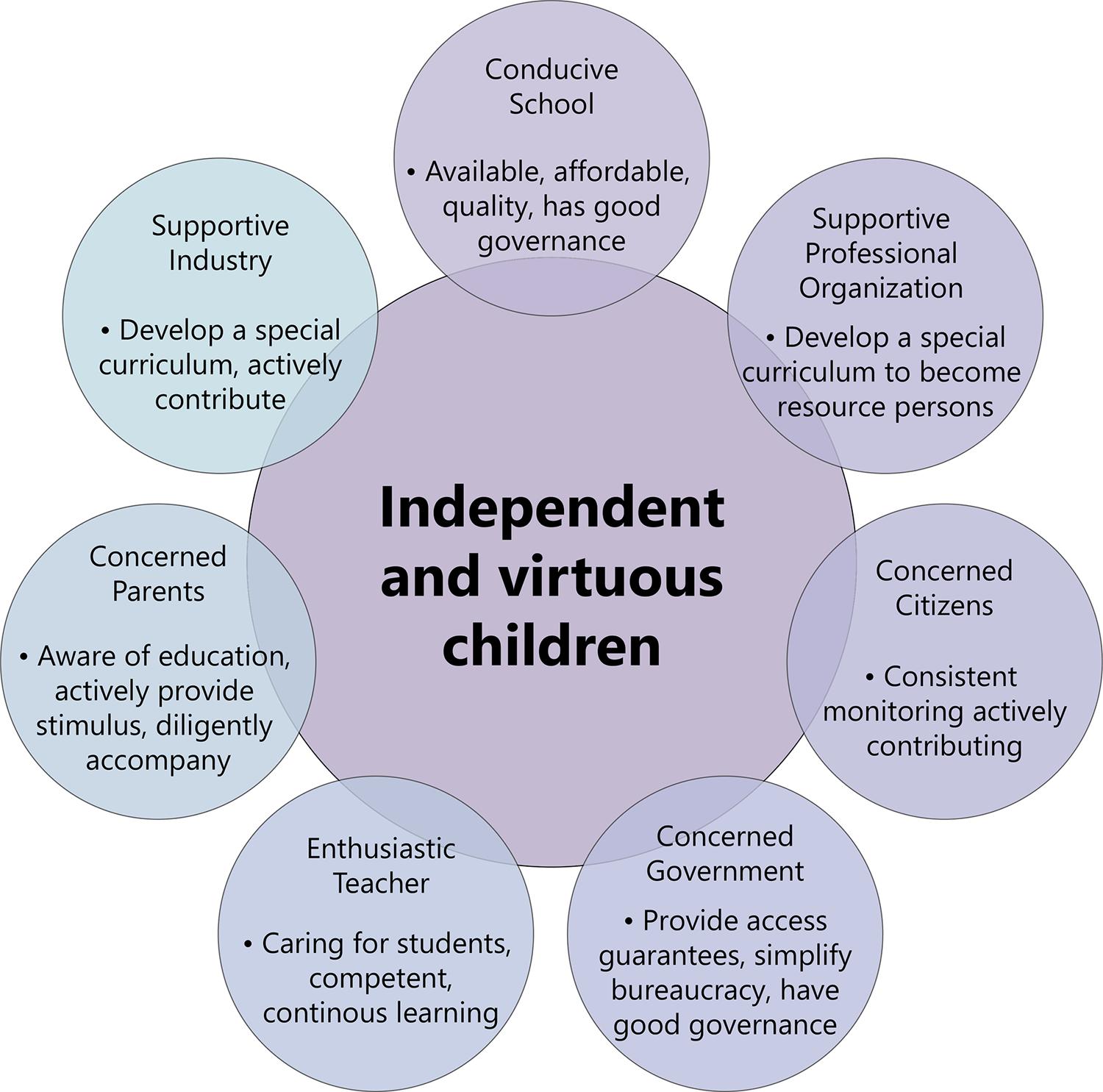
Source: Elaborated by the author (2024)
Figure 1 School, family, and community partnerships operational model
The alliance includes students, parents, teachers, Education staff, the community, companies, and Education sector partners (Medina; Cosby; Grim, 2019). hese partnerships lay the foundation for holistic child development, particularly through the hybrid model, which integrates technology into early childhood Education. The Paud unit, family, and community resources created this partnership operating model. To achieve partnership objectives, all parties may cooperate. PP-Paud and West Java DIKMAS attempted a Partnership Model for Early Childhood Education Units with Parents’ Associations in 2017. Citarip State Kindergarten in Bandung City, Kober Pelangi City of Cirebon Non-Formal Paud Unit, and State Kindergarten Pembina Tanjungsari Kab. Sumedang uses this model. Parent courses, inspiration workshops, and art performances support partnerships. The cooperation between these three Paud institutions found that family Education in Paud units must consider the circumstances of each academic unit to address Education unit and parent issues (Halimah; Margaretha; Mirawati, 2020). This model exemplifies how hybrid learning approaches can facilitate family engagement by offering a range of participation options suited to parents’ needs and preferences.
Parents also recognize that the Education unit, parents, and community share responsibility for a child’s (Gisewhite; Jeanfreau; Holden, 2021). The collaborative activities in health, psychology, parenting, and religion courses distinguish this study (Lansford, 2022). Blended Learning helps institutions and families collaborate in this research (Eriani; Amiliya, 2020). Blended learning, a form of hybrid Education, enhances collaboration by allowing families to engage through online platforms, helping them overcome barriers such as time constraints or physical distance.
A pilot study indicated that families and Paud institutions agreed depending on parents’ situations and the local community or Aryani Paud environment. The Early Childhood Education Institute and Paud Aryani Cianjur have family cooperation. This partnership allowed for the implementation of hybrid learning, where parents could engage through virtual meetings or physical interactions, ensuring flexibility. This family sends their child to Aryani Paud. Parents discuss early childhood development by setting a time, location, and subject. This is done so all parents may engage in and experience the value of sharing and conversation in educating and training children to maximize their potential. Parents and the Aryani Paud institution have shown that activities are adaptable and adapt to parents. As shown above, families and Paud institutions form democratic partnerships based on parents’ needs and conditions without coercion or pressure. The community may educate more democratically through this activity (Aprilia; Riyadi; Uswatiyah, 2021).
Many parents want their children to attend Cianjur’s Aryani Paud. Cianjur’s non-formal Paud unit. Students rise each academic year. Parent’s confidence shows this institution’s effectiveness in educating students and cooperating with parents. The preliminary study that the researcher conducted through an interview with the leadership of the Paud institution found that the institution he leads prioritizes parent agreements and that activities like this have a more significant impact on student potential because activities are focused on needs, interests, and advantages for parents and students at this school. Hybrid models like this are designed to cater to the interests of both the parents and students, ensuring that both face-to-face and online activities align with the community’s needs. Thus, families and institutions working together to educate children may help them grow and develop.
According to the pilot study, Paud Aryani’s partnership with the family or community as the perpetrators of partnership activities is still incompatible with the agreement made with the family and teachers. According to community-based learning principles, family participation in partnership activities was 97%. The collaboration activity was based on a mutual agreement on time, venue, and appropriateness for the parents, so they were excited to participate (Heo; Oh, 2019). However, during the Covid-19 pandemic, these partnership activities transitioned to a hybrid format, allowing families to engage in online and offline activities. During the Covid-19 epidemic at Aryani Paud, parental and family engagement in partnership activities decreased. Parental engagement is down from pre-pandemic levels, and this issue may impair collaborations meant to boost early childhood potential (Wilinski; Morley; Wu, 2023).
Institutional and family relationship issues impact evaluations of early childhood learning outcomes in institutions (Fischer et al., 2020; Miranda; Lins, 2021). Evaluating the effectiveness of hybrid models in these partnerships becomes crucial to ensure that the collaboration between families and schools is contributing to children’s development. Education requires assessment. Paud assesses children’s learning outcomes that affect development (Meyer et al., 2021). Aryani’s monthly reports from Paud teachers showed that children still had to progress in several areas, according to the preliminary study’s interviews and documents. According to the 2014 STTPA, most Aryani Paud students are NYD (Not Yet Developing) or SD (Still Developing). Based on these numbers, student progress remains poor.
Globalization has also eliminated geographic and temporal constraints in the 21st century. Information technology, which is quite advanced, assists people in various economic, social, religious, political, and educational areas. With the increased reliance on digital platforms, the hybrid model has grown in relevance, using networks and technology, a blended learning paradigm was created for family collaborations with Paud institutions (Siti-Syarah; Mayuni; Dhieni, 2020). To address this issue, a collaborative approach that works successfully is needed. Blended learning, which combines face-to-face learning online via video conferencing, social media (WA group), and mentoring, is the current partnership model designed to implement partnerships that meet their goals. standard institutions (Gagnon et al., 2020). Technology is quickly changing schooling. Blended learning is a partnership concept that integrates technology with face-to-face interactions.
Families also struggle with dissimilarities in partnership knowledge, implementation, motivation, attendance, and mastery of partnership instructions, gadgets, and smartphone apps (Fujiawati; Raharja; Iman, 2020). Most parents do not possess or understand cell phones or electronics, which causes this situation (Khadijah; Gusman, 2020). This suggests that the significant partnership issue is a strategy that enables family relationships with Paud institutions to enhance early childhood potential. Based on that, this study developed a conceptual model of family partnerships with Paud institutions for developing blended learning-based early childhood potential in Aryani Paud, Cianjur Regency, West Java. It is hoped that it will enrich policymakers’ and partnership actors’ insights into evaluating family partnerships with Paud institutions so that the results can be used to make policies and develop partnerships in the future.
2 Methods
A conceptual article (Cropanzano et al., 2022) was selected to solve this study issue. To synthesize and integrate previous research, provide an integrated framework, and emphasize prospects for future study, a conceptual approach was chosen. Conceptual articles do not rely on empirical data but aim to establish reasoned explanations for connections between theoretical concepts (Cropanzano et al., 2022; Jaakkola, 2020). Our focus was on constructing a conceptual model of family partnerships with Paud institutions to develop blended learning-based early childhood potential at Paud Aryani, Cianjur Regency, West Java.
To build this model, we reviewed literature specifically on the effectiveness of family partnerships in educational settings. This review was aimed at identifying contributions that offer explanations and solutions to challenges faced in developing blended learning-based early childhood potential. Rather than a comprehensive literature survey, we selected studies based on their relevance to the conceptual model and their ability to address new and practical insights. This selection process allowed us to concentrate on contributions that provide innovative solutions rather than summarizing existing research.
The study employed a case study design to explore the partnership model in its real-life context. Data collection methods included interviews with parents, teachers, and institutional leaders to gather qualitative insights into their experiences with the partnership model. Observations of partnership activities were conducted to assess engagement and implementation practices. Additionally, questionnaires were administered to parents to evaluate changes in their knowledge and involvement before and after the partnership activities. Pre-tests and post-tests were utilized to measure shifts in competencies related to supporting early childhood development and blended learning.
For data analysis, we used descriptive statistics to summarize pre-test and post-test results, focusing on changes in parental competencies and involvement. Qualitative analysis was conducted on interview and observation data to identify key themes related to the partnership model’s effectiveness and challenges. Model validation involved feedback from experts, practitioners, and peers. This feedback was used to analyze the model’s practicality and clarity and to make necessary adjustments based on expert recommendations and small-scale trials.
In the following section, we conceptualize the Family Partnership Model with Paud Institutions in Developing the Potential of Early Childhood Based on Blended Learning at Paud Aryani, Cianjur Regency, West Java, as well as the challenges it presents for adopting institutions and the consequences it has for the internal stakeholders involved in the quality management. Then, we present the solutions to the specific research questions that describe how to combine the conceptual quality framework proposed by Blieck et al. (2020) with an excellent scientific approach for efficient, effective quality management of online and blended learning. In this part, we analyze the conceptual model for adequate quality, breaking down each component and explaining its significance. Early Childhood Education that Harnesses the Power of Blended Learning via Family Partnership with Paud Institutions. In this article, we outline how a problem-focused strategy, as recommended by Jaakkola (2020), might be utilized to connect and integrate work from different areas of study in order to address the research topic at hand. Finally, based on the conceptual model for successful family partnership models with Paud institutions in developing the potential of early childhood based on blended learning, we provide critical proposals for further study.
3 Results and Discussion
The Results and Discussion section presents the results from the implementation of the family partnership conceptual model combined with blended learning to improve early childhood potential in Paud institutions. The discussion attempts to summarize the findings empirically and theoretically from this application model about its positive and negative points.
3.1 A Conceptual Family Partnership Model with Paud Institutions in Developing the Potential of Early Childhood Based on Blended Learning
The leading idea of the family partnership model was to bridge gaps in home-based and institutional early childhood education through blended learning. The empirical results showed that parents, if given appropriate tools and knowledge, may make an immense contribution to their children’s development. Participation was made flexible by a combination of face-to-face and online learning components, which became a mandatory component given diversified family needs, particularly during the pandemic. In this way, parents received more precise information about their role in the early childhood education process, and the model proved very helpful for the deepening of the relationship between the family and Paud institutions.
However, various accounts have described inconsistent participation and some technological barriers to this approach, especially for those families that have had limited access to digital devices or internet connections. This model nevertheless had very promising results in improving the early childhood developmental outcomes, as noted by both parents and teachers, despite these limitations.
3.1.1 Rational Model
Several linguistic and conceptual scientific perspectives shed light on the meaning of collaboration (Cho; Wang; Christ, 2019). Partnership, often known as public relations, is the engagement, participation, or cooperation between community-related organizations or groups. Public relations (PR) is a set of management practices focused on the connection between schools and their surrounding communities (families) in order to improve the quality of Education provided by such schools (Ikhwan, 2019). The quality and amount of Education offered by Paud colleges are two areas that may greatly benefit from more robust relationships. Typically, the institution and the family will meet to discuss how the home and school environments contribute to the children’s academic success in social-emotional, cognitive, psychomotor, religious, linguistic, and other development when one is a young child (Papadopoulos, 2021). What goes on in the home significantly impacts a child’s growth and Education (Bhamani et al., 2020). Parents directly impact their children’s educational outcomes when they participate actively in their Education (Poon, 2020). This underscores the necessity of supporting parents in their role as their children’s primary educators by providing joint educational tasks (Apriyanti, 2020; Leenders et al., 2019).
Blended learning and maximizing a child’s early years are fundamental to the partnership model via sblended learning in increasing the potential of early childhood in the network (López-Fernández; Burgueño; Gil-Espinosa, 2021; Tupas; Linas-Laguda, 2020). The collaboration incorporates online and in-person learning opportunities, making it an example of blended learning. Early Childhood Growth Achievement Level Standards (STPPA) from the 2014 Permendikbud provide a foundation for the potential growth of young children. The integration of blended learning into Paud institution partnerships with families aims to enhance early childhood potential through a combination of digital and face-to-face interactions (Eriani; Amiliya, 2020).
Blended learning is used in implementing Paud institution partnerships with families; this entails a learning process between parents, teachers, and partners in cooperation with Paud institutions. This process takes place over a short period of time, but it is expected to increase family knowledge in developing the potential of early childhood (Eriani; Amiliya, 2020). If improved conduct and expanded knowledge and abilities do not translate to more significant potential in growing youngsters, they are for nothing (Tena; Gutiérrez; Cejudo, 2019). Parental and pedagogical partnerships may facilitate their use in the early years of development (Soltero-González; Gillanders, 2021). As a result, collaborations may also result in shifts in parental practices that help young children reach their full potential. The phases of a partnership activity include setting objectives, putting them into action, and assessing their success. Collaboration models that may be used as a springboard for blended instruction.
Blended learning’s application to partnerships between Paud Aryani institutions in Mande District, Cianjur Regency, is motivated by a desire to foster the growth of young children’s potential via collaborative efforts between schools and their families, in line with the requirements of the SPPA for children aged 5 and 6. However, they confront challenges due to a lack of parental and institutional engagement in the execution of the partnership activities that have been carried out. There has to be a significant collaboration between institutions and families as competence developers in a blended learning setting if early childhood Education is to reach its full potential.
3.2 Blended Learning Partnership Stages
The following stages are used in the blended learning partnership approach between Paud institutions and parents to promote early childhood potential.
3.2.1 Planning
To improve the involvement and activity of parents and Paud institutions in the network, planning is the first step in establishing the phases of partnership-related activities to be carried out (Carvalho; Joana, 2023; Suharyani et al., 2022). This planning process involves creating a comprehensive strategy that includes health facilities, psychologists, religious figures, and other relevant stakeholders. Interactive dialogues were used to carry out the planning process. Planning tasks comprise:
3.2.2 Identification of Needs
First, to get a general idea of the learning needs of institutions and parents, interviews, discussions, and brainstorming are conducted with Paud institutions and families, in this case, the parents of students enrolled at Paud Aryani Kec. Mande, Cianjur Regency. The parents’ learning requirements connected to their competency growth in training identify the learning needs of each mentor using a learning needs identification format, a questionnaire supplemented by interviews. Identifying training sources, including human and non-human resources, that can satisfy training demands is also done to collect data and acquire information (Handayani-Tyas; Naibaho, 2020; Hasbi, 2020; Sa’dullah; Hidayatullah, 2020).
Identification also looks into data and information regarding participants’ initial skills about parent training, the readiness of equipment necessary for training through blended learning, including telecommunications access owned by participants (HP/computer/laptop), network and signal in the area where participants live, readiness time and schedules for distance learning, ICT mastery, and ability to take part in all training activities. Coordination was also carried out with partners, including community health centers, psychologists, and religious leaders. This step also involves assessing participants’ initial skills, readiness for blended learning, and availability of necessary equipment such as smartphones or computers, network and signal quality, and ICT mastery. Coordination with community health centers, psychologists, and religious leaders is also carried out.
3.2.3 Formulate Competency
The skills created for the participants in this partnership program also refer to the STTPA Early Childhood Ages 5–6 Years, which provides the framework for creating early childhood competencies. Participants in this partnership course possess the following competencies (Table 1).
Table 1 Blended learning competency standards
| No | Competency standards |
|---|---|
| 1 | Explain and practice the theory of early childhood development |
| 2 | Implementing online classes |
| 3 | Using technology, information, and communication for the benefit of organizing face-to-face and online partnership activities |
| 4 | Accompanying and reporting online and offline children’s activities |
Source: Elaborated by the author (2024)
Table 1 shows the 2013 Paud Curriculum Child Development Achievement Level Standards (STPPA), the capabilities of early childhood students between the ages of 5 and 6 are consistent with the competencies mentioned in this collaboration activity. Concerning the National Standards for Early Childhood Education, Permendikbud No. 137 of 2014. The signs shown in the Table 1 can be used to determine whether or not early childhood development, which occurs between the ages of 5 and 6, is progressing. The teacher uses four evaluations to determine whether or not early childhood development is being maximized: 1) BB = Not Developed, 2) MB = Still Developing, 3) BSH = Developing According to Expectations, and 4) BSB = Very Good Development (Source: Permendikbud No. 137 of 2014; STPPA Paud Curriculum, 2013).
3.2.4 Formulate Criteria and Recruitment of Prospective Participants
Parents with children between 5 and 6 can participate in this partnership class. Able to utilize a smartphone, the Zoom meeting app, and WA, be ready to participate in partnership lessons all the way through, and have an internet connection. The researchers worked with the institution’s management and professors to schedule the partnership class participants. The researchers collaborated with the institution’s management and faculty to recruit participants who met these criteria.
3.2.5 Developing Partnership Class Devices
Laptops, desktop computers, internet networks, and other online media like mobile phones with specific apps make up learning facilities. Meanwhile, participants can download modules, and display materials (PowerPoint/video/animation), assignment sheets, instrument formats, and evaluation sheets (pretest, process, and posttest) posted to the network. Four components from each partnership class are included in the content of the activity materials. Face-to-face, online tutorials, online independent study, and offline tutorials are the methods used to provide these resources.
3.3 Implementation
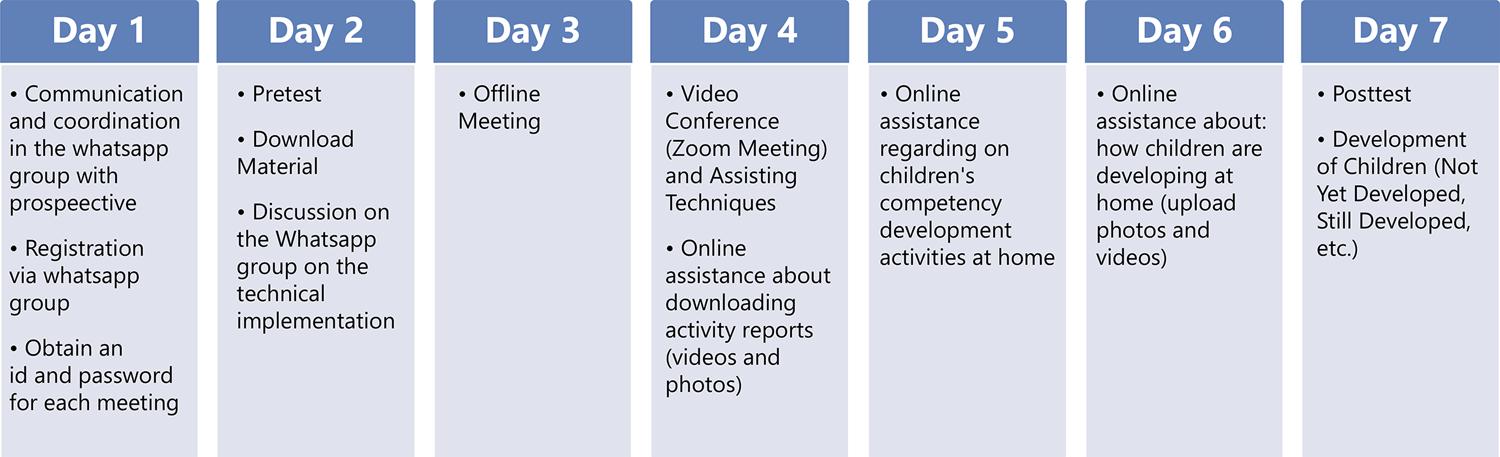
For seven days, the institutional and family partnership class utilized blended learning. The schedule covered various aspects of early childhood development, emphasizing both online and offline interactions (Figure 2).
3.4 Evaluation
The evaluation step is carried out based on the standards and tools that will be applied to determine the efficacy of the partnership model. Through the process of applying the model and assessing the learning outcomes, the model’s efficacy is assessed. By comparing the results of the final test (posttest), which is conducted after the entire activity process has been completed, to the results of the initial test (pretest) to ascertain the initial level of early childhood development, it is possible to assess the effectiveness of the success of the activity.
3.5 Model Testing
The model testing phase involved validating the conceptual family partnership model through small-scale trials and expert feedback. The trials were conducted with parents, educators, and institutional leaders to assess the feasibility and effectiveness of the blended learning approach. Feedback from practitioners and experts highlighted both the strengths and areas for improvement, particularly in terms of participant engagement and the clarity of instructional materials. Adjustments were made based on this input, leading to refinements in the model. The results demonstrated that the blended learning partnership model holds promise for enhancing early childhood education by fostering stronger collaboration between families and Paud institutions.
3.5.1 Validation
Model validation is done by analyzing each step involved in the training to see whether it is feasible. Obtaining thoughts, comments, or feedback from other parties thought to be authorities on the subject of this research is the goal of this validation. Validation can also include recommendations and fixes for issues arising during the trial run (Bartholo et al., 2020; Haddaway et al., 2020). The contents of each stage that will be turned into a model should then be checked and revised for completeness. The results of the study by professionals, peers, and practitioners on the efficiency of blended learning for mentor training in enhancing mentoring skills are as follows.
3.5.1.1 Expert Analysis Results
According to their areas of knowledge and expertise, many experts are used for expert validation (Almanasreh; Moles; Chen, 2019). A description of each topical validation is provided below:
Dr. Cepi Riyana, a lecturer in educational technology at the Indonesian University of Education, was contacted regarding the validity of mentor training materials delivered through blended learning. Blended learning is a combination of face-to-face and online learning. However, even though blended learning combines the two, the guide’s face-to-face section also includes it, making it appear that blended learning is a face-to-face component. Next, provide suggestions on the mentality that is still out of sync. According to him, the illustration generally depicts the flow indicated by the arrow sign, which denotes the existence of three key stages: planning, implementation, and assessment. However, pretest activities should still be in the implementation stage, as well as assignments and activities that should be assessed as the final step.
Dr. Asep Saepudin, M.Pd., a lecturer in public Education at the Indonesian University of Education, validated the study methodology. He suggested that to support the stability of research methods during the model development stages; the preliminary study must be supported by examining the backgrounds of families with children enrolled in the institution. It is also necessary to examine the information from parents about the partnerships that institutions have had with them.
3.5.2.2 Practitioner Analysis Results
Dr. Safuri Musa, S.Pd., a lecturer at UNSIKA who had previously worked as a Paud practitioner at BPPAUD DIKMAS Jayagiri Bandung, validated Paud material. He claims that the information in the competency formulation in the sub-indicator column complies with all relevant laws. However, aligning the competencies set with the course material under a partnership will be possible. The effectiveness of the partnerships is judged by how the participants apply them to children and how well they turn out when early childhood development indicators evaluate children.
3.5.2 Peer Analysis Results
Validation was also done with other Padang State University teachers and Universitas Pendidikan Indonesia (UPI) Public Education doctoral degree holders. Several enhancements and modifications have been made regarding editorial quality and consistency in the flow of collaboration activities.
The intelligibility of the institutional and family partnership model phases of blended learning was tested through several model trials. Five individuals who met the requirements of being parents of children between the ages of 5 and 6 and having access to cell phones and video conferencing tools participated in the experiment. The following are the outcomes of small tests regarding the partnership model’s legibility (Table 2).
Table 2 Table of material trial results
| No | Aspect | Percentage | Category |
|---|---|---|---|
| 1 | Application System | 85% | Very Suitable |
| 2 | Interesting teaching materials | 80% | Very Suitable |
| 3 | Appropriateness of teaching materials | 75% | Suitable |
| 4 | Ease of understanding teaching materials | 80% | Very Suitable |
| 5 | Application of teaching materials | 75% | Suitable |
Source: Result of data analysis (2024)
Even though the pilot participants typically did not comprehend the aim of the activities being carried out at the beginning of the activity, the partnership activities established through blended learning generally went well and were adequate. However, the participants’ engagement as a whole, who were enthused about participating in the activity, showed that they grasped the goal of the partnership exercise. Participants are asked to examine and read instruction manuals, give feedback on modules, and practice utilizing apps under the supervision of teachers and partners. The results of the participant dialogue showed that high motivation is required to be active and participate in each stage of the activity, study the modules carefully, and have managers and partners accompany them both offline and online so that they can be active.
Through brainstorming, participants also expressed the need for support from teachers and specialists in health, religion, and psychology so that families can understand how to play a role and offer services to young children to maximize their potential. Even though they had trouble utilizing the video conferencing tool during online activities, the family looked pleased with the activity. However, parents continued to participate in activities despite this situation. The researchers enhanced and modified the produced model in light of the validation findings carried out by experts, practitioners, and peers. The trial results are used to develop the partnership model by empirical findings and input on the conceptual model, which has already been tested for viability.
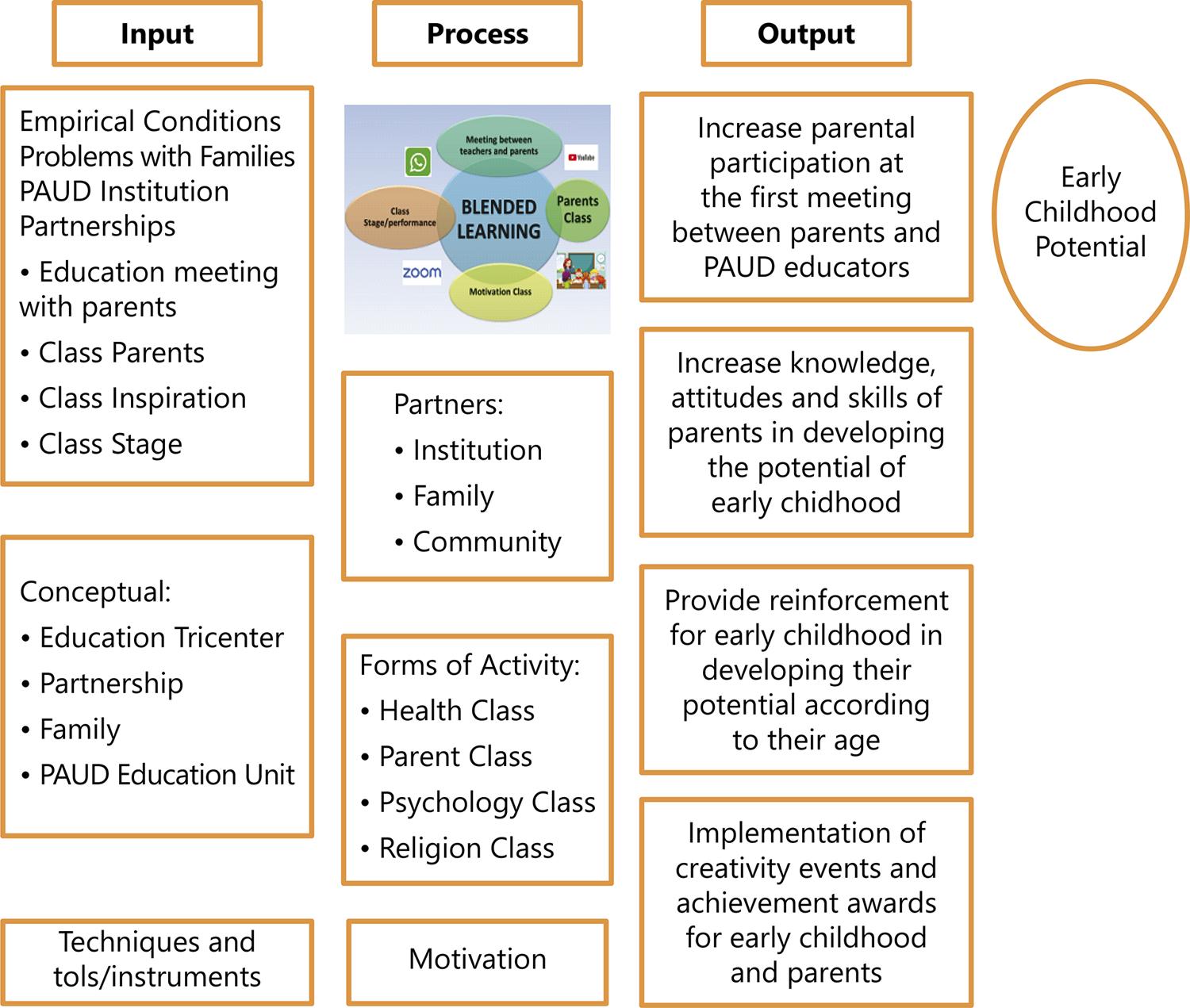
The conceptual model, or first model, was improved based on comments and a small number of experiments, and then specialists were contacted once again (Jaakkola, 2020; Hiltrimartin et al., 2024). The family partnership model through blended learning has been improved, considering experts’ advice, and is now prepared for the execution of field tests. Following is a description of the updated partnership model based on a straightforward explanation (Figure 3).
Source: Elaborated by the author (2024)
Figure 3 Prototype model of Paud institution with family in developing the potential of early childhood (study at Paud Aryani institution, Cianjur district)
The framework of the family partnership model with Paud institutions in implementing the active engagement of parents in institutions in family Education may be articulated based on the above picture, which is produced as follows:
Parent engagement in Paud institutions has four stages of activity, and it was discovered that: (1) The three institutions have had teachers’ meetings with parents on the first day of school. The institution has not entirely implemented its plan to introduce families to the educational environment and the inmates of the Paud unit (Tannoubi et al., 2023; Wilinski; Morley; Wu, 2023); (2) The active involvement of the family in parent class activities revealed issues such as the method used in the meeting still was not varied, the lack of varied supporting media at the meeting caused the meeting process to run less attractively, and the level of parental activity in these activities was not maximized for a variety of reasons (Apriyanti, 2020; Bhamani et al., 2020; Heo; Oh, 2019; Soltero-González; Gillanders, 2021); (3) Because parents do not understand what inspiration class is or how it works, the activities for the three Paud Education modules have not been executed. Institutions are still having trouble locating information on families with a career or who may be imitated to use as examples in inspiration classes, including trouble locating resource people if they are not related (Wardani; Ayriza, 2020); (4) At the end-of-the-year class stage activities, this activity only showcases students’ interests and talents in the arts (dance, singing, drama), and it has not yet shown off their talents, awards, and accomplishments in all other areas of achievement they should be proud of (non-academic). Parents do not actively participate in class performance activities, either. Instead, the institution is responsible for class performance activities’ organization, execution, and evaluation (Imamyartha et al., 2019; Jusoh et al., 2023).
In order to strengthen the family’s ability to educate, care for, and guide their children at home, the family must first strengthen the formal Education process that has been carried out by the family. With good intentions, the school should be the one to start this process. In other words, as a kind of collaboration between families and Paud institutions, institutions can start the execution of family Education programs.
The role of the institution is to mobilize all potential resources within the institution to facilitate and encourage the active involvement of the family in:
Class teacher meeting activities with families (first-day meeting)
Parent class activities, which emphasize sharing parental knowledge and experience in parenting and developing children’s potential at institutions and at home, teach parents to communicate well with children and be wise in using social media.
Inspirational class activities, such as character strengthening and strengthening children’s learning motivation to excel, involve families as inspirations, alums, and other sources from outside the institution.
Class performance activities as a place for happy creations for students and awards for both academic and non-academic achievements, including awards for families who are actively involved in the partnership program.
The four activities above can be carried out together (institutions, committees, and families). The expected outcomes through these activities are as follows:
Increasing family participation on the first day of meetings of teachers with families
Increased knowledge, attitudes, and skills of families in developing the potential of early childhood
Reinforce students’ development of their potential.
Implementation of creativity and appreciation events for students and families as a positive culture in Paud institutions and families
It is anticipated that the implementation of a successful family partnership program with Paud institutions will have an impact on the growth of the character and culture of student achievement through a variety of joint activities between institutional elements, families, and communities (Setiawati; Handrianto, 2023; Suparlan, 2019; Waty et al., 2024).
4 Conclusion
In this article, a conceptual family partnership model with Paud Aryani institutions is presented in order to make the most of the potential that young children have to offer via integrated learning. The strategy is comprised of three steps: first, determining what parents need to know in order to advance their training-related competencies; second, determining what each mentor needs to know in order to perform their job effectively; and third, putting the two together by utilizing a learning needs identification format, a questionnaire, and supplementary interviews. Following this, an analysis of how effectively the model enables the planning and execution of in-person and digitally-facilitated collaborative activities is performed to determine the model’s efficacy. Empirical findings and feedback on the conceptual model, which had previously been evaluated for feasibility, are applied to construct the model per the experiment’s results by experts, practitioners, and practitioners on the effectiveness of blended learning for mentor training. This trial was done to determine whether or not blended learning is effective for mentor training. It is now possible to do testing in the field using the newly developed model.

