




 Inglês (pdf)
 Artigo em XML
 Tradução automática
 Enviar este artigo por email
 Permalink

INTRODUCTION
The literature points to several constraints to the implementation of experimental science teaching as a usual pedagogical practice for teachers.
The results of the study executed by Ramos and Rosa (2008) reveal that primary teachers (1st cycle of basic education — CBE) carry out few experimental activities with their students. The main conditioning factors are: i. lack of encouragement and guidance on the part of school principals and pedagogical coordinators; ii. absence of appropriate planning; iii. shortage of materials; iv. absence of collective work; v. lack of preparation during pre-service and in-service teacher training; vi. encouragement within schools to maintain a traditional teaching stance.
Despite some studies on initial teacher education in Portugal indicating a better quality of the post-Bologna offer (e.g. Sousa-Pereira and Leite, 2016; Galvão et al., 2018), there are few teachers who have benefited from this training by completing their professional master's degree, and who are teaching in schools. According to the General Directorate of Education and Science Statistics (DGEEC, 2023), the percentages of educators/teachers with doctoral or master's degrees teaching in public and private schools in the school year 2020/2021 were as follows: 4.71% preschool educators; 8.03% primary school teachers; 12.04% secondary school teachers; 16.32% secondary school teachers.
In the specific case of the 1st CBE (primary education), Marques et al. (2014) indicate the following weaknesses: the teacher’ pre-service training in science education is insufficient (this aspect is also highlighted by Rodrigues and Martins, 2018); the teachers feel the need to have in-service training in the framework of their mandatory continuous professional training; the offering of such training is scarce. As threats, the authors (Marques et al., 2014) mention: the Portuguese political, economic and social context; the weakening of the contractual relations between teachers and schools or government, which compromises their participation to improve the system (this aspect is highlighted by OECD, 2020); the fact that increasing academic qualifications are not more rewarding for teachers; a fear of interacting and the fact that sharing knowledge and skills, assessing and being assessed by peers is not a habit in Portuguese school culture. Nevertheless, in relation to this last aspect, evaluation culture, there has been progress in Portugal, namely with regard to the evaluation of teaching performance, within which peer observation takes place: if initially there was a phase of resistance to evaluation, there has been progressive acceptance (Jacinto, 2013; Viseu and Barroso, 2020).
However, it is on the urgency of investment in teacher training that the experts most agree. "Systems to ensure recruitment, retention and continuous professional training must be a policy priority in Europe" (Osborne and Dillon, 2008, p. 9). It is recognized that there is a variety of knowledge to effectively implement experimental science teaching, highlighting the subject content knowledge to be taught as "the foundation for the motivation and confidence of teachers to innovate their practices, as well as pedagogical knowledge" (Domingos and Costa, 2018, p. 51).
The Inspectorate-General of Education and Science [Inspeção-Geral da Educação e Ciência] — IGEC (2019, p. 60) recommended schools’ in-service training centres to "promote the continuous training of teachers in practical science teaching, with a view to promoting the more frequent use of this strategy in the classroom/ activity room, laboratory and field for the development of research skills in children and students". Pires, Mafra and Fernandes (2016, p. 424-425) state that the "performance of experimental activities during the initial training process has developed, in the future teachers, socio-affective dispositions favourable to their use in the classroom".
The section of this article entitled Scientific literacy and science education discusses the importance of scientific literacy in the community in general, and formal science education in particular, with an emphasis on pedagogical practices. The section Research methodology describes the procedures adopted in the design and validation of the data collection instrument, in its application and in the treatment of the responses obtained. In the next section, Research results, the study sample is characterized (by recruitment groups, age, academic qualifications and service time), followed by two types of analysis: the teachers’ perceptions (mainly through descriptive analysis) and the results of crossing those teachers’ perceptions (inferential analysis). Finally, the results obtained are discussed in light of the theoretical framework of reference.
SCIENTIFIC LITERACY AND SCIENCE EDUCATION
Within the scope of the PISA 2015 assessment, scientific literacy is defined as (Organisation for Economic Co-operation and Development [OECD], 2017, p. 22): "the ability to engage with science-related issues, and with the ideas of science, as a reflective citizen. A scientifically literate person is willing to engage in reasoned discourse about science and technology, which requires the competencies to: explain phenomena scientifically — recognise, offer and evaluate explanations for a range of natural and technological phenomena; evaluate and design scientific enquiry — describe and appraise scientific investigations and propose ways of addressing questions scientifically; interpret data and evidence scientifically — analyse and evaluate data, claims and arguments in a variety of representations and draw appropriate scientific conclusions."
In this sense, practices that encourage student participation, providing space and structure for discussion and reflection on learning, emerge as those with "most promise for enhancing knowledge and conceptual understanding through practical science" (Cukurova, Hanley and Lewis, 2017, p. 24).
In the past two decades a consensus has emerged that science should be a compulsory school subject (Osborne and Dillon, 2008; Correia, 2014). For this reason, Osborne and Dillon (2008, p. 7) advocate that a "science education for all can only be justified if it offers something of universal value for all rather than the minority who will become future scientists". Therefore, they consider that the goal of science education must be to offer an education that develops students’ understanding both of the canon of scientific knowledge and of how science functions. In this sense, societies need to offer an education in and about science, contributing to the ability to engage critically with science in their future lives.
From the analysis carried out of the curricula of the top countries in PISA 2012, Cukurova, Hanley and Lewis (2017, p. 4) highlight that practical work can have a wider societal impact either by creating more engaged and conscientious citizens (Singapore, Poland, South Korea), or cultivating character traits such as perseverance (Hong Kong) and reduced passivity (Vietnam).
Portugal obtained 492 points in the PISA 2018 scientific literacy assessment, three points above the OECD average — 489 points (Lourenço et al., 2019). There was a decrease in the average score in relation to the 2015 cycle (a significant difference of minus 9 points), a result that accompanies the decreasing trend of the OECD average score in science assessment. However, when analysing the average variation in three year cycles, Portugal is one of the 13 countries that presents a positive and significant variation of more than 4.3 points in science assessment. As for the Trends in International Mathematics and Science Study (TIMSS) 2015, Portugal obtained 508 points in the science assessment, registering a significant drop of 14 points compared to 2011 (Marôco et al., 2016). Considering the evaluation cycles of the most recent international tests, Saraiva (2017) points out some factors that can explain the results obtained, namely the positive performance of Portuguese students (4th grade) evaluated by TIMSS 2011 and by PISA 2015: i. the launch of the Ciência Viva Programme by the Ministry of Science and Technology in 1996 (a national network of interactive science centres dedicated to non-formal science education); ii. the implementation of the new curriculum for basic education, which contemplates the teaching of sciences and which has remained unchanged until now; and iii. the Teacher Education Programme in Experimental Science Teaching (PFEEC) for primary school teachers (1st CBE), focused on the development of research skills and attitudes in teachers and their students (involving thousands of students between 2006 and 2010). The PFEEC evaluation study (Martins et al., 2012) shows that there is evidence of the active role played by teachers who attended the programme, by creating contexts to enhance the importance of science education in the early years. Concerning the students’ learning, 25% of students with the best marks belong to teachers that participated in the PFEEC.
PEDAGOGICAL PRACTICES IN SCIENCE EDUCATION
According to Rocard et al. (2007, p. 2), in a context of declining interest for science among young people, although the science education community mostly agrees that pedagogical practices with inquiry-based methods are more effective, "the reality of classroom practice is that in the majority of European countries, these methods are simply not being implemented".
In the third global report of the activity "Curriculum Management: experimental teaching of sciences" (IGEC, 2019), presents the results of monitoring 32 school clusters that were the subject of an intervention in 2017. In this context, 384 observations of pedagogical practices were carried out (in the scope of 1st and 2nd CBE). In the 1st CBE, the highest incidence of pedagogical practices (33.0%) in the observed classes was in practical activities (activities that are carried out, for example, using paper and pencil and/or electronic means). In the 2nd CBE, the most observed (41%) pedagogical practice was the expository/ demonstrative class. According to the report, in the 1st CBE experimental activities (involving control, manipulation and variables) and field-based work (activities that occur in direct contact with nature and with physical and natural phenomena) are the strategies that show "the need for a more regular and systematic dynamisation, in order to consolidate the appropriation of scientific methodology and that are recommended in the Programme"; and in the 2nd CBE "experimental work and field work are practically residual strategies" (IGEC, 2019, p. 56). It is interesting to note that, in the results of a study that sought to describe the nature of the conceptions and practices of early childhood educators (kindergarten) and teachers of the 1st CBE on science teaching, Bretes and Marisa (2018) highlight that education professionals who give the most importance to science teaching are, mostly, the same ones who revealed a greater openness to the promotion of experimental science teaching.
RESEARCH AIM AND RESEARCH QUESTIONS
Cukurova, Hanley and Lewis (2017, p. 3) state that "there is a clear need for more high-quality studies of practical work that have a tightly-defined focus and a rigorous methodological approach". The study carried out by these authors has highlighted the need for more evaluations of practical science in its various guises, designed to shed light on the usefulness of practical science work.
Based on this framework, this study aims to contribute to the identification of factors that most influence the existence or absence of experimental science teaching practices at different levels of education in Portugal. In this sense, the main research question is: what factors make a difference in experimental science teaching?
The main objectives of this study were i. to identify formal science teaching practices and ii. to relate those practices to several factors (age, in-service training in experimental science teaching and constraints) in the 17 school clusters that belong to a Portuguese region.
It is important to note that the public school network in Portugal is structured in school clusters that integrate schools from different education levels in one organisation. The average size of clusters also varies significantly, including substantial regional variation. The modal school cluster size is five to nine schools, but clusters range from as small as two schools to as many as 30 (Liebowitz et al., 2018). The Portuguese education system is divided into pre-school education/kindergarten (from three years old until entry into basic education), basic education (from six to 15 years old), secondary education (from 15 to 18 years old) and higher education. Basic education is organized into three sequential cycles: the 1st CBE corresponds to the first four years of schooling (from six to ten years old); the 2nd cycle (2nd CBE) corresponds to the 5th and 6th years of schooling (from 11 to 12 years old); the 3rd cycle (3rd CBE) corresponds to the 7th, 8th and 9th years of schooling (from 13 to 15 years old).
RESEARCH METHODOLOGY
In order to answer the formulated research question, a pre-experimental study was implemented with a non-probabilistic sample that aimed to reach the teaching population of a Portuguese region. An online questionnaire was applied to all science teachers of the 17 school clusters of that region. This study is the first phase of an ongoing longitudinal study.
SAMPLE
A total of 483 responses were obtained from the population of 1,063 teachers in the region studied (45% response rate). The sample is characterized by recruitment groups, age, academic qualifications and service time.
In Portugal, recruitment groups are defined for the purposes of selecting and recruiting teaching staff (from pre-school education to basic and secondary education). The recruitment group is associated with the specific qualification to teach at a level of education, discipline or subject area. The distribution of the 483 teachers in the recruitment groups is as follows: 115 (23.8%) are kindergarten educators (group 100); 241 (49.9%) are teachers of the 1st CBE/primary school (group 110); 26 (5.4%) are teachers of mathematics and natural sciences of the 2nd CBE (group 230); 49 (10.1%) are teachers of physics and chemistry of the 3rd CBE and secondary education (group 510); and 52 (10.8%) are teachers of biology and geology from the 3rd CBE and secondary education (group 520).
More than half of the teachers surveyed (61.1%) are over 50 years old. In nine school clusters, none of the teachers who responded to the survey are under 40 years of age. This reflects the Portuguese reality of an aging population in general, and the teaching class in particular (National Council of Education, 2019). There is a great asymmetry between groups, since more than 90% of the teachers are over 40 years old. In order to verify whether the absolute differences reached statistical significance, a χ2 test was performed. The results showed significant differences in the proportion of teachers between the groups "under 40 years old", "between 40 and 50 years old" and "over 50 years": χ2(2)=226.43, p<0.001.
Most teachers (more than 80%) have a degree, almost 10% mentioned having a master's degree and less than 2% reported having a postgraduate or doctorate.
Most teachers (45.6%) have between 21 and 30 years of service, followed by about a third of teachers (33.5%) with 31 to 40 years of service. In total, almost 80% of teachers have over 21 years of service. There are ten school clusters in which no teacher has less than ten years of service.
INSTRUMENT AND PROCEDURES
The process of building the data collection instrument, a questionnaire, took place in different stages. At first, an initial version was prepared and submitted for review and validation by specialists (teachers and researchers with over 30 years of experience in the field of didactics of science). Then, a pilot of the questionnaire was conducted with a group of 19 teachers teaching at the same school cluster. Subsequently, the phase of compliance with the requirements set out in the General Data Protection Regulation (Regulation EU No. 2016/679, of 27 April 2016) took place (e.g., inclusion of a declaration of informed consent). Finally, the questionnaire was applied online through a digital platform of the University of Aveiro. The questionnaire link was sent via e-mail to each director of the 17 school clusters (all from the public school system). Then, each director sent the link to all science teachers in their school cluster. The questionnaire contained 11 questions, with the aim of characterizing teachers in terms of: their academic and professional profile (age level, academic qualifications, years of teaching service, recruitment group); the type and frequency of their science teaching practices (cf. list of 14 practices presented in the Research results section); training in experimental science teaching; the didactic resources they used to support their practices; and the constraints felt in the implementation of experimental science teaching. Although all questions were closed in nature (multiple choice type), there were open response fields to give respondents the opportunity to: specify the training carried out on experimental science teaching; add didactic resources that have not been included in the closed options presented; and add constraints to the implementation of experimental science teaching that have not been contemplated in the closed options presented.
DATA ANALYSIS
The data obtained were analysed based on descriptive and inferential statistics. Given the high number of science teaching practices, they were grouped according to their nature, purely for the purpose of performing inferential statistics, as presented in the model below (Table 1). The system of categories emerged from the analysis itself, but also considering the nature of each practice/ strategy and the inherent role of the student and teacher in them.
Table 1 System of experimental science teaching practice categories.
| Experimental teaching practices (E) | Teacher-focused (ET) | E.T1 – Demonstration of experiences by the teacher |
| Student-focused (ES) | E.S2 – Practical exercises | |
| E.S3 – Sensory or classification experiences | ||
| E.S4 – Verification activities or illustration of phenomena | ||
| E.S5 – Activities with variable control (investigative type) | ||
| Non-experimental teaching practices (NE) | Teacher-focused (NET) | NE.T1 – Oral explanation of the contents |
| NE.T2 – Joint reading of the student textbook | ||
| NE.T3 – Exploration of documents | ||
| NE.T4 – Use of posters, slides | ||
| Student-focused (NES) | NE.S5 – Conducting debates | |
| NE.S6 – Bibliographic research work | ||
| NE.S7 – Project work | ||
| Outside-focused (NEO) | NE.O8 – Field trips / Study visits | |
| NE.O9 – Expert intervention |
Source: authors (2021).
E: Experimental teaching practices; NET: Non-experimental teaching practices: teacher-focused; NES: Non-experimental teaching practices: student-focused; NEO: Non-experimental teaching practices: outside-focused.
Thus the system organizes the type of practices/ strategies that the teacher usually adopts to teach science into two macro-categories, namely: i. experimental science teaching practices (which encompass any type of experiment, trial or experimental practical exercise, whether carried out by students and/or by the teacher); and ii. non-experimental teaching practices (which include activities/strategies that are not experiments, but can be practical and involve students actively).
Category E (experimental teaching practices) above includes five types of science teaching and learning activities/ strategies, within the subcategories: ET (teacher-focused) and ES (student-focused), are summarized below:
Demonstration of experiences by the teacher: the teacher performs the experiments and the students watch.
Practical exercises: students perform techniques and procedures, such as manipulation of the microscope, sensors, filtration, mass measurement.
Sensory or classification experiences: students collect, analyse, organize or classify objects, materials or living beings, based on the senses and/or with the help of more specific observation instruments (e.g. magnifying glasses, microscopes).
Verification activities or illustration of phenomena: students plan and carry out experiments designed to illustrate principles or prove laws.
Activities with variable control (investigative type): students plan and carry out experiments that involve verifying the effect of changing one variable on the value of another.
Category NE (non-experimental teaching practices) includes nine types of activities/strategies, within the subcategories: NET (teacher-focused), NES (student-focused) and NEO (outside-focused).
Within subcategory NET the following strategies/ activities were considered:
Oral explanation of knowledge: the teacher orally exposes the themes to the class.
Joint reading of the student textbook: parts of the discipline's textbook are read together.
Documents exploration: the teacher uses maps, newspaper articles, parts of books or other miscellaneous documents and explores them with the class while addressing science topics.
Use of posters, slides: the teacher uses posters, slides, or other supports of their own elaboration, available on the internet or commercialized, as a support to teaching science themes during classes.
Within subcategory NES the following strategies/ activities were considered:
Conducting debates: groups of students present and discuss ideas, sometimes opposed, about a problem situation or question. From their reasoned confrontation, contributions can be made to clarify the subject under study.
Bibliographic research work: students carry out documentary research on a given theme using different types and sources of information (e.g. books, encyclopaedias, internet, libraries, interviews, newspapers, films).
Project work: groups of students identify a relevant theme/issue, plan a way to study it based on what each one already knows about it, implement their plan for data collection, organize and analyse information, systematise and communicate their work to the class/ school/ educational community.
Within subcategory NEO the following strategies/ activities were considered:
Field trips/ study visits: these are activities that imply leaving school to study issues on site, such as visiting certain ecosystems, science museums.
Expert intervention: these are activities that may or may not occur within the school, but which always involve external contributions from specialists, namely through lectures, workshops, sharing experiences, exhibitions, etc.
It should be noted that this study did not adopt any classification system for practical activities present in the literature, because the intention was to use designations that could be recognized by teachers. Thus, the study adopted the use of designations that exist in the literature (e.g. Dourado, 2001; Leite 2001; Caamaño, 2003; Lunetta, Hofstein and Clough, 2007; Dillon, 2008; Rodrigues, 2011; Ferreira and Morais, 2018; Akuma and Gaigher, 2021), without taking on a particular classification system.
The grouping of Figure 1 was accompanied and validated by factor analysis with the principal component method in order to use the factor loads as weights.
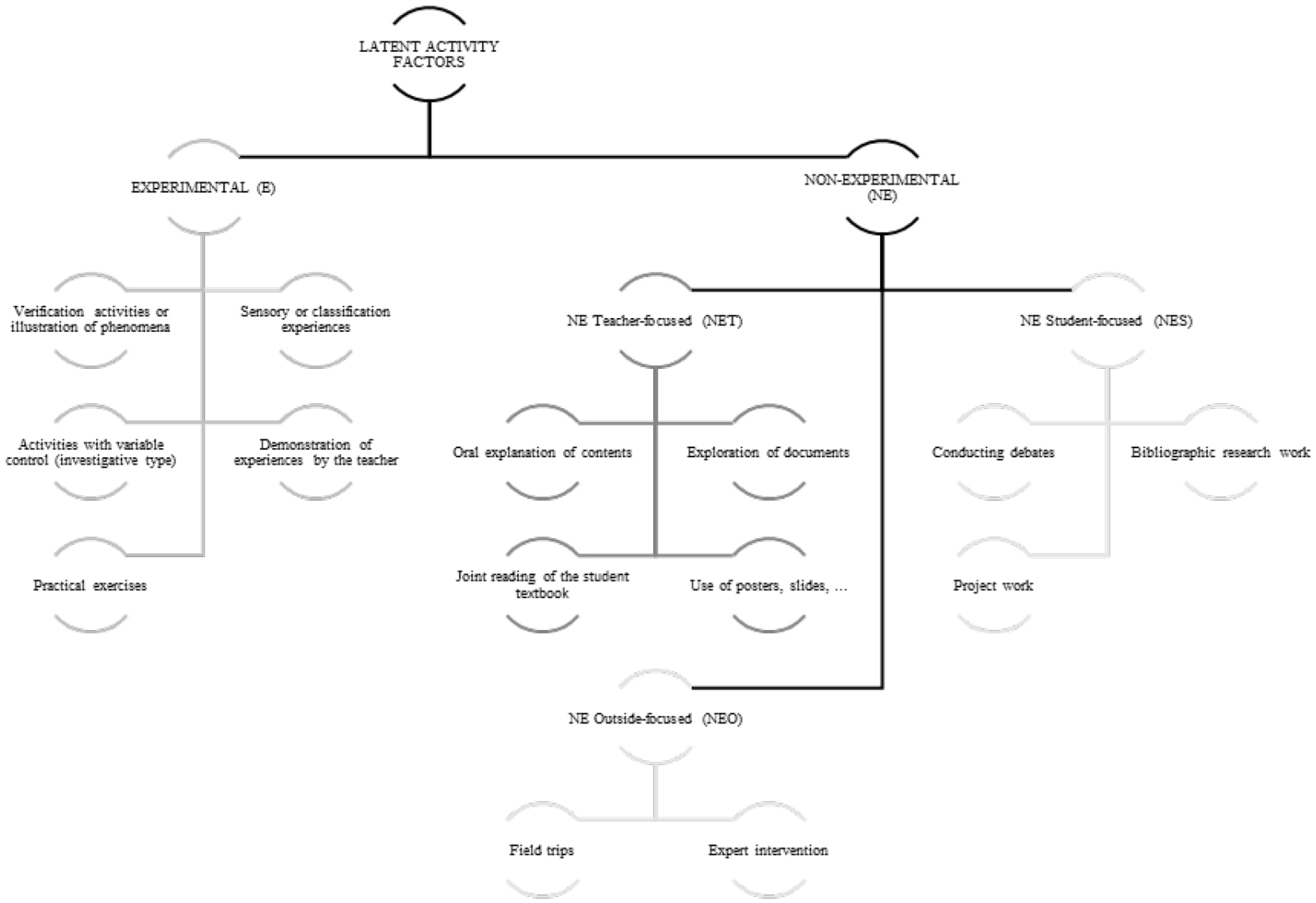
Thus, and taking into account the above, the latent factors are:
E – Experimental teaching practices.
NET – Non-experimental teaching practices: teacher-focused.
NES – Non-experimental teaching practices: student-focused.
NEO – Non-experimental teaching practices: outside-focused.
The formulas for calculating latent factors based on factor loadings are presented below:
The normality study using visual inspection of the Q-Q plots and the Kolmogorov-Smirnov normality test showed that only the latent variable NET has significant deviations from the normal distribution curve. Even so, when the sample size was greater than 30, the central limit theorem made it possible to perform parametric analyses for all latent factors.
RESEARCH RESULTS
The results obtained are organized into each of the following factors: perceptions; in-service training; resources used; constraints. In addition, some factors are crossed, namely: age and practices; age and constraints; age and training; practices and constraints; practices and training; practices and recruitment groups; and practices of the same teacher in different cycles.
THE PERCEPTIONS OF THE TEACHERS SURVEYED
Teachers were asked about the frequency of the following 14 teaching practices:
Phenomenon verification/ illustration activities.
Investigative experimental activities — control of variables.
Demonstration of experiences by the teacher.
Practical exercises.
Sensory experiences.
Oral explanation of the contents.
Document exploration.
Joint reading of the student textbook.
Use of posters, transparencies, slides or diagrams on the board.
Expert intervention.
Field trips.
Bibliographic research work.
Project work.
Conducting debates.
Table 2 shows the distribution of teachers’ experimental science teaching practices according to the frequency scale indicated.
Table 2 Distribution of teachers’ experimental science teaching practices by frequency scale. Values in %.
| Verif./ illustr. | Inv. type | Demo. exp. | Practical exp. | Sensory exp. | Oral expla. | Docs. | Student textbook | Posters, etc. | Expert | Field | Biblio. res. | Project | Debates | |
|---|---|---|---|---|---|---|---|---|---|---|---|---|---|---|
| Never (0%) | 26.1 | 11.4 | 3.9 | 6.2 | 2.7 | 0.0 | 0.6 | 3.5 | 1.9 | 20.9 | 4.8 | 7.5 | 4.1 | 2.7 |
| Rarely (1–5%) | 20.7 | 15.5 | 5.4 | 5.2 | 4.4 | 1.5 | 3.1 | 10.1 | 5.4 | 45.6 | 29.6 | 18.8 | 12.2 | 13.3 |
| Sometimes (6–20%) | 31.3 | 44.1 | 39.8 | 31.5 | 23.8 | 15.1 | 19.3 | 20.1 | 19.3 | 28.2 | 38.7 | 46.6 | 42.7 | 39.3 |
| Often (21–50%) | 13.3 | 20.3 | 36.0 | 38.5 | 38.1 | 35.6 | 38.1 | 29.1 | 36.4 | 4.1 | 17.2 | 21.5 | 28.2 | 29.6 |
| Regularly (more than 51%) | 8.7 | 8.7 | 14.9 | 18.6 | 31.1 | 47.8 | 38.9 | 37.2 | 37.1 | 1.2 | 9.7 | 5.6 | 12.8 | 15.1 |
Source: authors (2021).
It appears that the predominant practices are non-experimental teaching practices — teacher-focused (NET): oral explanation of the contents, exploration of documents, use of posters, slides or diagrams on the board and joint reading of the student textbook — activities that are much more teacher-centric. In general, experimental activities are seldom used in science classes.
IN-SERVICE TRAINING IN EXPERIMENTAL SCIENCE TEACHING
With regard to in-service training, the survey sought to find out if teachers attended training programmes on experimental science teaching. It is notable that almost half of the teachers (226 or 46.8%) report not having had any training in this area. Group 510 stands out positively, with only about 28% of the teachers mentioning that they had never attended any training programme in experimental science.
RESOURCES USED TO SUPPORT EXPERIMENTAL SCIENCE TEACHING
Teachers were asked about the use of the following five resources to support experimental science teaching:
Self-made documents.
Activity sheets, records and proposals available on the internet.
Specific thematic guides.
Student textbook adopted/ other manuals.
Proposals for activities developed in academic and/or research work.
The resources most used by teachers are self-made documents (about 85%) and activity sheets, records and proposals available on the internet (almost 80%). The least used resources are proposals for activities developed in academic and/or research work (less than 10%).
The student textbook and self-made documents are the most used resources by the largest number of recruitment groups (110, 230, 510 and 520), with percentages above 80%. Sheets, records and proposals for activities available on the Internet are most used in group 100 (almost 80%) and in group 110 (more than 85%).
Proposals for activities developed in research work are the least used resource, with group 520 standing out with almost 20% of teachers and group 100 with just over 10%.
CONSTRAINTS TO EXPERIMENTAL SCIENCE TEACHING
Teachers were asked about the following constraints:
Lack of motivation for this work.
Demand for more work from the teacher (class preparation and development).
Lack of training in experimental science teaching.
Lack of resources to carry out experimental activities.
Lack of time to complete the syllabus.
Lack of adequate space.
Greater difficulty in managing student behaviour.
Other (open response field; optional).
According to the survey, most teachers indicated lack of resources (65.4%) and lack of time to complete the syllabus (43.3%) as the major constraints in the implementation of experimental science teaching. A small percentage of the teachers mentioned lack of motivation for this type of work (1.9%). Fewer than a quarter (17.6%) express concerns about the increased workload, with an equal proportion (17.6%) noting heightened challenges in managing student behaviour. In the open response field (optional), 5% (in 6.6%) of the teachers identified the excessive number of students per class as a constraint to the implementation of experimental science teaching. It is important to note that, according to current legislation (Normative Order No. 10-A/2018 [Portugal, 2018]; Normative Order No. 16/2019 [Portugal, 2019]), the maximum number of students per class varies according to the level of education, but, in general, in Portugal, classes have a maximum of between 24 and 30 students.
It was found that more than half of the teachers in all teaching groups indicated lack of resources as a constraint on experimental teaching. Almost half of the teachers in group 100 (46.1%) indicated lack of training in the field of science education as another constraint to the implementation of experimental teaching. More than half of the teachers in groups 110, 230, 510 and 520 indicated lack of time to complete the syllabus and more than half of the teachers in group 230 (53.9%) indicated lack of adequate space as a constraint.
More than half of the teachers from 13 school clusters refer to the lack of resources as a constraint to the implementation of experimental science teaching. One third or more of the teachers in seven school clusters consider lack of training a constraint to the implementation of experimental science teaching. One-third (or more) of the teachers from ten school clusters reported that there was no adequate space as a constraint.
AGE AND PRACTICES
In order to proceed to statistical inference, the age variable was dichotomised, leading to more balanced groups in terms of number of teachers (Table 3).
Table 3 Frequency of teachers in each dichotomised age group.
| Frequency | Percentage | |
|---|---|---|
| Teachers aged 50 or less | 188 | 38.9 |
| Teachers over 50 years old | 295 | 61.1 |
| Total | 483 | 100.0 |
Source: authors (2021).
In order to assess the existence of statistically significant differences in teaching practices between the group of teachers over 50 and the group under 50, independent samples t-tests and Bayesian analyses were performed. The statistical parameters of these analyses are shown in Table 4 and Chart 1.
Table 4 Central trend statistical inference, t-test for independent samples.
| T | df | p | VS-MPR | Cohen's d | |
|---|---|---|---|---|---|
| E | 0.991 | 481.0 | 0.322 | 1.008 | 0.093 |
| NES | 0.336 | 481.0 | 0.737 | 1.000 | 0.031 |
| NEO | -2.197 | 481.0 | 0.029 | 3.625 | -0.205 |
| ZNET | 1.609 | 481.0 | 0.108 | 1.528 | 0.150 |
Source: authors (2021).
VS-MPR: Vovk-Sellke maximum p-ratio: the maximum diagnosticity of a two-sided p-value (Sellke, Bayarri, and Berger, 2001).
E: Experimental teaching practices; NET: Non-experimental teaching practices: teacher-focused; NES: Non-experimental teaching practices: student-focused; NEO: Non-experimental teaching practices: outside-focused.
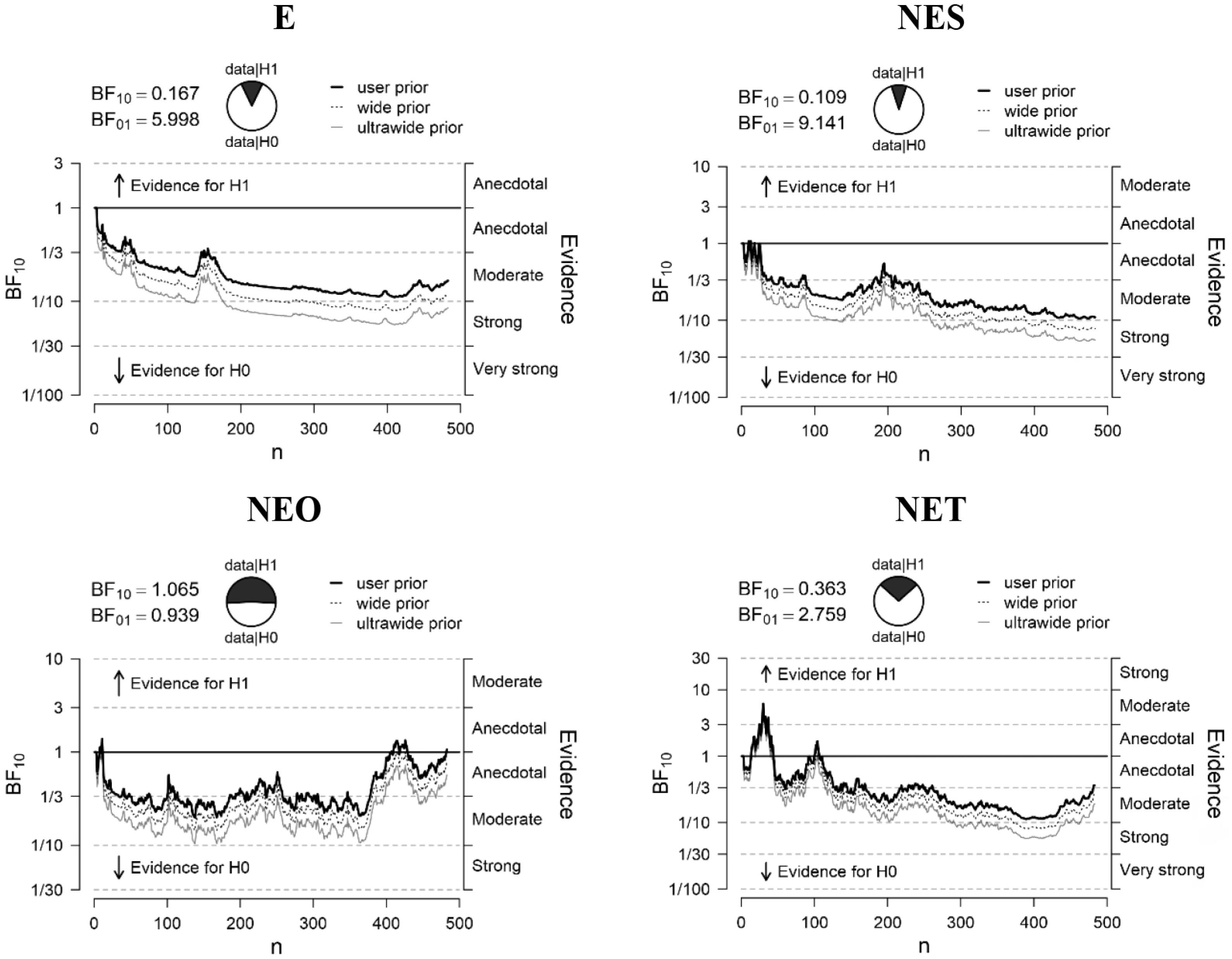
Source: authors (2021).
*Vovk-Sellke Maximum p - Ratio: Based on the two-tailed p, maximum odds at favour of H1 over H0=1/(-e p log(p)) for p≤.37 (Sellke, Bayarri, and Berger, 2001); E: Experimental teaching practices; NES: Non-experimental teaching practices: student-focused; NEO: Non-experimental teaching practices: outside-focused; NET: Non-experimental teaching practices: teacher-focused.
Chart 1 Sequential Bayesian analysis (Bayes Factor).
The results of the inferential analyses showed that there are no statistically significant differences between the two age groups for E, NET and NES. However, there were statistically significant differences for NEO. This result shows that teachers over 50 years old tend to resort to this type of activities more frequently and this difference has proven to be significant.
AGE AND CONSTRAINTS
Regarding the crossing of the variable age with constraints to the use of experimental science teaching activities, the percentages of age groups separated by constraint are shown in Tables 5, 6, 7, 8, 9, 10 and 11.
Table 5 Frequency of teachers who identified or not "absence of motivation for work" as a constraint by age group. Values in %.
| Absence of motivation for work | Total | ||
|---|---|---|---|
| No | Yes | ||
| Teachers aged 50 or less | 96.8 | 3.2 | 100.0 |
| Teachers over 50 years old | 99.0 | 1.0 | 100.0 |
| Total | 98.1 | 1.9 | 100.0 |
Source: authors (2021).
Table 6 Frequency of teachers who identified or not "requires more work to the teacher" as a constraint by age group. Values in %.
| Requires more work from the teacher | Total | ||
|---|---|---|---|
| No | Yes | ||
| Teachers aged 50 or less | 74.5 | 25.5 | 100.0 |
| Teachers over 50 years old | 87.8 | 12.2 | 100.0 |
| Total | 82.6 | 17.4 | 100.0 |
Source: authors (2021).
Table 7 Frequency of teachers who identified or not "lack of training in experimental science teaching" as a constraint by age group. Values in %.
| Lack of training in experimental science teaching | Total | ||
|---|---|---|---|
| No | Yes | ||
| Teachers aged 50 or less | 81.4 | 18.6 | 100.0 |
| Teachers over 50 years old | 68.8 | 31.2 | 100.0 |
| Total | 73.7 | 26.3 | 100.0 |
Source: authors (2021).
Table 8 Frequency of teachers who identified or not "lack of resources" as a constraint by age group. Values in %.
| Lack of resources | Total | ||
|---|---|---|---|
| No | Yes | ||
| Teachers aged 50 or less | 33.0 | 67.0 | 100.0 |
| Teachers over 50 years old | 35.6 | 64.4 | 100.0 |
| Total | 34.6 | 65.4 | 100.0 |
Source: authors (2021).
Table 9 Frequency of teachers who identified or not the constraint "lack of time to complete the syllabus" by age group. Values in %.
| Lack of time to complete the syllabus | Total | ||
|---|---|---|---|
| No | Yes | ||
| Teachers aged 50 or less | 44.1 | 55.9 | 100.0 |
| Teachers over 50 years old | 65.1 | 34.9 | 100.0 |
| Total | 56.9 | 43.1 | 100.0 |
Source: authors (2021).
Table 10 Frequency of teachers who identified or not the constraint "lack of adequate space" by age group. Values in %.
| Lack of adequate space | Total | ||
|---|---|---|---|
| No | Yes | ||
| Teachers aged 50 or less | 64.9 | 35.1 | 100.0 |
| Teachers over 50 years old | 65.8 | 34.9 | 100.0 |
| Total | 65.4 | 34.6 | 100.0 |
Source: authors (2021).
Table 11 Frequency of teachers who identified or not the constraint "management of student behaviour" by age group.
| Management of student behaviour | Total | ||
|---|---|---|---|
| No | Yes | ||
| Teachers aged 50 or less | 80.9 | 19.1 | 100.0 |
| Teachers over 50 years old | 83.4 | 16.6 | 100.0 |
| Total | 82.4 | 17.6 | 100.0 |
Source: authors (2021).
The result of the χ2 test showed that the proportion of teachers in the two age groups is not statistically different at the two levels (yes and no) of the constraint "absence of motivation for work" (χ2(1)=2.969, p<0.086). The χ2 test showed that the proportion of teachers in the two age groups is statistically different at the two levels (yes and no) of the constraint "requires more work from the teacher" (χ2(1)=14,198, p<0.001). This result materializes in a significantly higher proportion of teachers under 50 years old who affirm that "requires more work from the teacher" is a constraint to the use of experimental science teaching practices.
The χ2 test showed that the proportion of teachers in both age groups is statistically different at the two levels (yes and no) of the constraint "lack of training in experimental science teaching" (χ2(1)=9,361, p<0. 01). Thus, there is a significantly higher proportion of teachers over 50 years old who claim that "lack of training in experimental science teaching" is a constraint.
The χ2 test showed that the proportion of teachers in both age groups is not statistically different at the two levels (yes and no) of the constraint "lack of resources "(χ2(1)=0.347, p=.624). Here we highlight the huge proportion of teachers in both age groups reporting lack of resources as a constraint.
The χ2 test showed that the proportion of teachers in the two age groups is statistically different at the two levels (yes and no) of the constraint "lack of time to complete the syllabus" (χ2(1)=20,526, p<0.001). In other words, there was a significantly higher proportion of teachers under the age of 50 who affirm that "lack of time to complete the syllabus" is a constraint to the use of experimental science teaching activities.
The χ2 test showed that the proportion of teachers in the two age groups is not statistically different at the two levels (yes and no) of the constraint "lack of adequate space" (χ2(1)=0.510, p=.540). The χ2 test showed that the proportion of teachers in the two age groups is not statistically different at the two levels (yes and no) of the constraint "management of student behaviour" (χ2(1)=0.510, p=.540).
AGE AND TRAINING
With regard to the crossing of the variable age with the variable "in-service training in experimental science teaching", a χ2 analysis was performed in order to verify whether the proportion of teachers who did or did not undergo training differed between age groups (Table 12).
Table 12 Frequency of teachers with and without training in experimental science teaching by age group. Values in %.
| In-service training in experimental science teaching | Total | ||
|---|---|---|---|
| No | Yes | ||
| Teachers aged 50 or less | 48.4 | 51.6 | 100.0 |
| Teachers over 50 years old | 45.8 | 54.2 | 100.0 |
| Total | 46.8 | 53.2 | 100.0 |
Source: authors (2021).
There were no statistically significant differences between the two age groups with regard to the proportion of teachers trained in experimental science teaching (χ2(1)=0.322, p=.576).
PRACTICES AND CONSTRAINTS
In order to cross the teaching practices and the constraints identified by the teachers, seven t-tests were performed (one for each constraint). The significant results of this analysis are simplified in Table 13.
Table 13 Double entry table with significant t-test results and directionality of effects*.
| E | NES | NEO | NET | |
|---|---|---|---|---|
| Requires more work to the teacher | – | – | – | – |
| Lack of training in experimental science teaching | Less "E" when training is lacking (p<0.001) | – | – | – |
| Lack of resources | – | – | – | – |
| Lack of time to complete the syllabus | – | More NES when lack of time(p<0.01) | Less NEO when lack of time (p<0.01) | – |
| Lack of adequate space | – | – | – | – |
| Management of student behaviour | – | – | Less NEO whenbehaviour management(p<0.01) | – |
Source: authors (2021).
*No analyses were performed for the constraint "absence of motivation for work" due to the small number of teachers who answered yes.
E: Experimental teaching practices; NET: Non-experimental teaching practices: teacher-focused; NES: Non-experimental teaching practices: student-focused; NEO: Non-experimental teaching practices: outside-focused.
The results show that teachers who report lack of time to complete the syllabus as a constraint use significantly less NEO, but use significantly more NES. Teachers who report the management of student behaviour as a constraint use significantly less NEO. Despite the relevance of these results, the most prominent result was the lower use of experimental practices by teachers who report lack of training as a constraint. In a finer analysis, it was shown that teachers who report lack of resources as a constraint have greater differences between NES and E (Z=8,658), than teachers who do not report it (Z=5.51). Another result classified as marginally significant was the fact that teachers who report lack of resources use the student textbook significantly more (p=0.051).
PRACTICES AND TRAINING
Respecting the relationship between "In-service training in experimental science teaching" and the type of practices, a Welch analysis and a Bayesian analysis (Chart 2) were performed for each activity factor where the independent variable was to have undergone or not training. The results of the inference tests are shown in Table 14. The results of the inference analyses show that only for factor E were statistically significant differences registered. That is, teachers who have undergone training use significantly more experimental activities than teachers who have not undergone training. Interestingly, the Bayesian analysis showed that this result is robust and that the probability of this statistically significant difference existing is 3.599 times greater than it not existing.
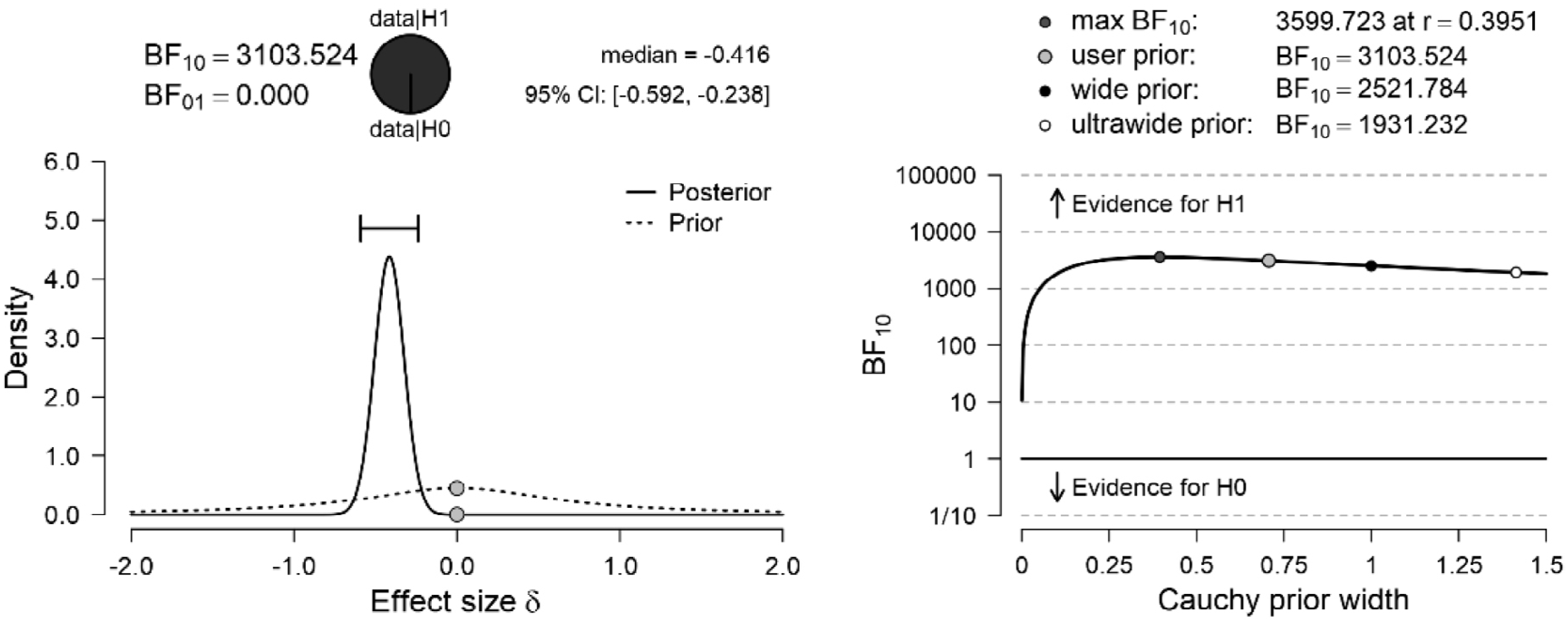
Table 14 Statistical inference of central tendency and Bayesian statistics: parameters of the Welch test for independent samples and Bayes factors for independent samples.
| Factor | Welch statistics | Degrees Freedom | p | VS-MPR | Difference | Cohen's d | 95%CI for Cohen's d | |||
|---|---|---|---|---|---|---|---|---|---|---|
| Inferior | Superior | |||||||||
| E | -4.675 | 479.0 | <0.001 | 7694 | -1.000 | -0.425 | -0.607 | -0.245 | ||
| NES | -0.485 | 480.9 | 0.628 | 1.000 | -0.077 | -0.044 | -0.223 | 0.135 | ||
| NEO | -0.503 | 481.0 | 0.615 | 1.000 | -0.058 | -0.046 | -0.225 | 0.133 | ||
| ZNET | -0.169 | 480.4 | 0.866 | 1.000 | -0.016 | -0.015 | -0.194 | 0.163 | ||
| T-test for Bayesian independent samples | ||||||||||
| BF10 | error % | |||||||||
| E | 3103.524 | 2.877e -10 | ||||||||
| NES | 0.113 | 8.920e -5 | ||||||||
| NEO | 0.114 | 8.834e -5 | ||||||||
| NET | 0.103 | 1.001e -4 | ||||||||
Source: authors (2021).
VS-MPR: Vovk-Sellke maximum p-ratio: the maximum diagnosticity of a two-sided p-value (Sellke, Bayarri, and Berger, 2001); 95%CI: 95% confidence interval.
E: Experimental teaching practices; NET: Non-experimental teaching practices: teacher-focused; NES: Non-experimental teaching practices: student-focused; NEO: Non-experimental teaching practices: outside-focused.
RESOURCES USED TO SUPPORT EXPERIMENTAL SCIENCE TEACHING
In order to cross the teaching practices and the resources used to support experimental science teaching, four t-tests were performed. The significant results of this analysis are simplified in Table 15.
Table 15 Double entry table with p values of significant t-test results and directionality of effects.
| E | NES | NEO | NET | |
|---|---|---|---|---|
| Own elaboration documents | More "E" when using docs (p=0.040) | More "NES" when using docs(p<0.01) | More "NEO" when using docs(p<0.05) | More "NET" when using docs(p<0.01) |
| Internet files | – | More "NES" whenusing Internet sheets(p<0.001) | More "NEO" when using Internet sheets(p<0.001) | More "NET" when using Internet sheets (p<0.001) |
| Specific thematic guides | More "E" whenusing Guides(p<0.001) | More "NES" whenusing Guides(p<0.001) | More "NEO" whenusing Guides(p<0.001) | More "NET" whenusing Guides(p<0.001) |
| Adopted student textbook | More "E" whenusing Manual(p<0.001) | – | More "NEO" whenusing Manual(p<0.001) | More "NET" whenusing Manual (p<0.001) |
Source: authors (2021).
E: Experimental teaching practices; NET: Non-experimental teaching practices: teacher-focused; NES: Non-experimental teaching practices: student-focused; NEO: Non-experimental teaching practices: outside-focused.
Analysis of Table 15 shows that there is a significant effect between the frequency of the practices and the use of the various types of documents. The only exceptions are use of internet with experimental teaching practices and use of textbook with non-experimental teaching practices: student-focused.
PRACTICES AND RECRUITMENT GROUPS
Despite the information presented in Table 3, Table 16 is now used to show the number of teachers per recruitment group, discriminating groups 510 and 520 depending on whether teaching only in 3rd CBE, only in secondary or at both levels of education.
Table 16 Frequency and percentage of teachers by recruitment groups.
| Groups | Frequency | Percentage (%) |
|---|---|---|
| 100 | 115 | 23.8 |
| 110 | 241 | 49.9 |
| 230 | 26 | 5.4 |
| 510 Only 3rd CBE | 19 | 3.9 |
| 510 3rd CBE+Secondary | 18 | 3.7 |
| 510 Only Secondary | 12 | 2.5 |
| 520 Only 3rd CBE | 24 | 5.0 |
| 520 3rd CBE+Secondary | 14 | 2.9 |
| 520 Only Secondary | 14 | 2.9 |
| Total | 483 | 100.0 |
Source: authors (2021).
CBE: Cycle of Basic Education.
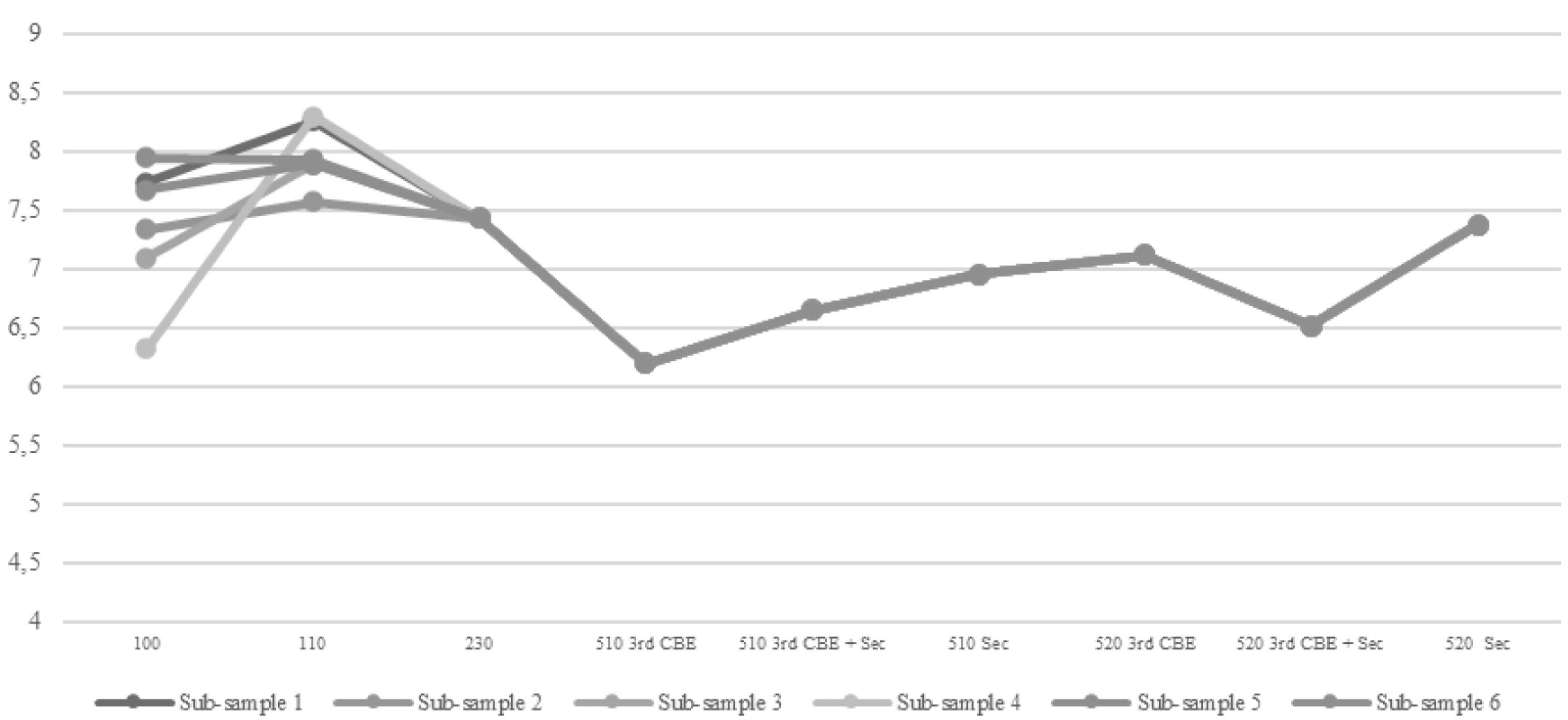
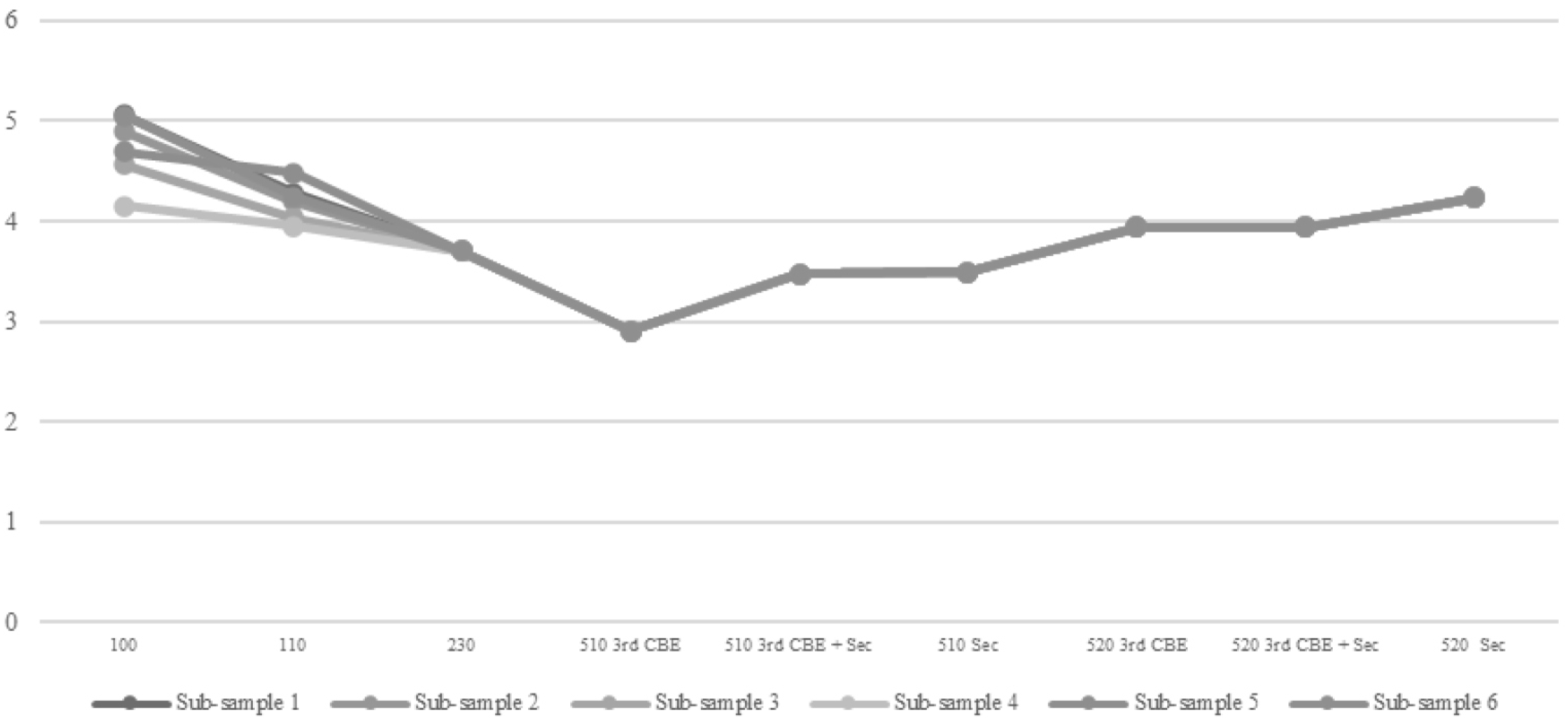
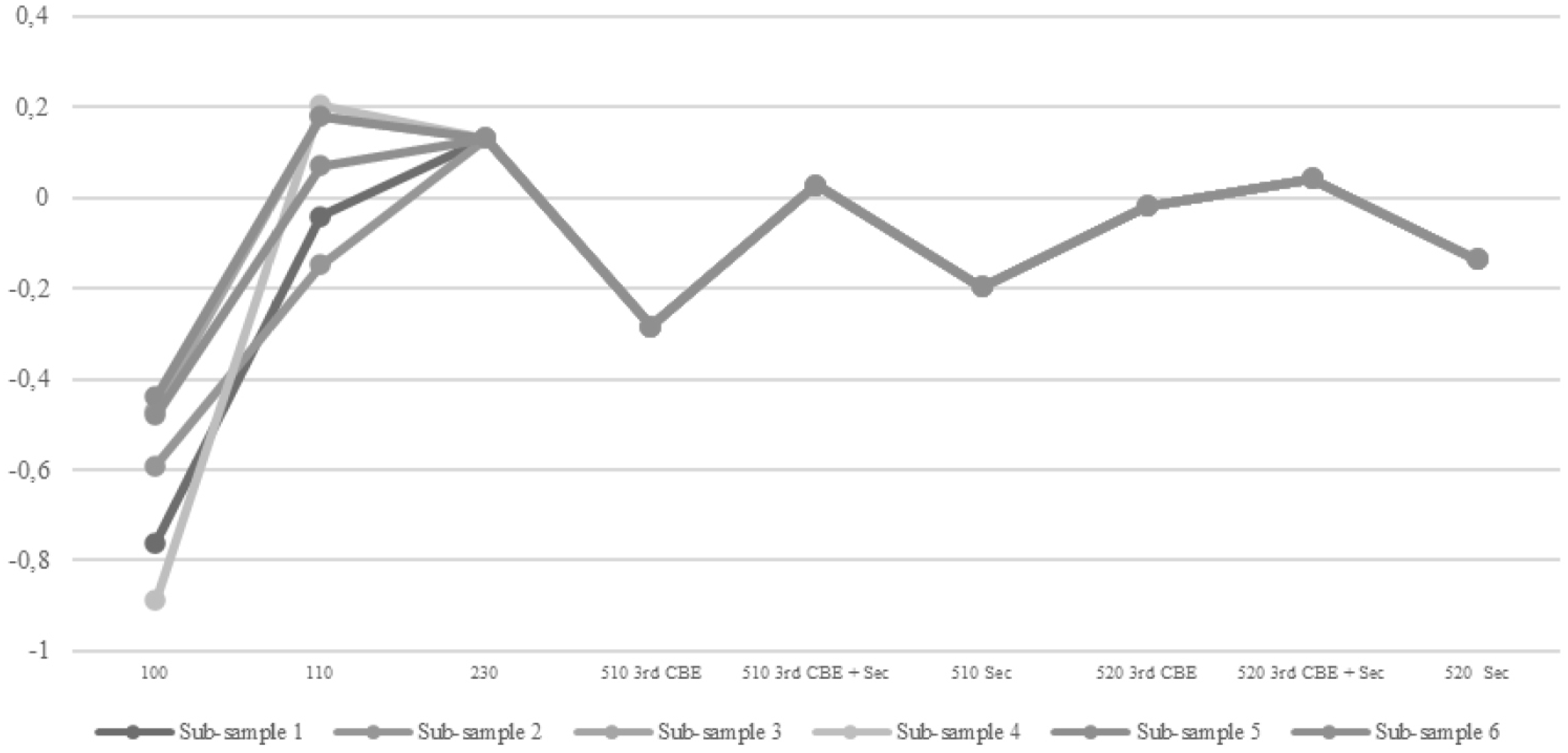
In view of the disparate number of teachers in each group, we chose to do six samples by bootstrapping, removing 15 teachers. Chart 3, 4, 5 and 6 show the descriptive result of this analysis.
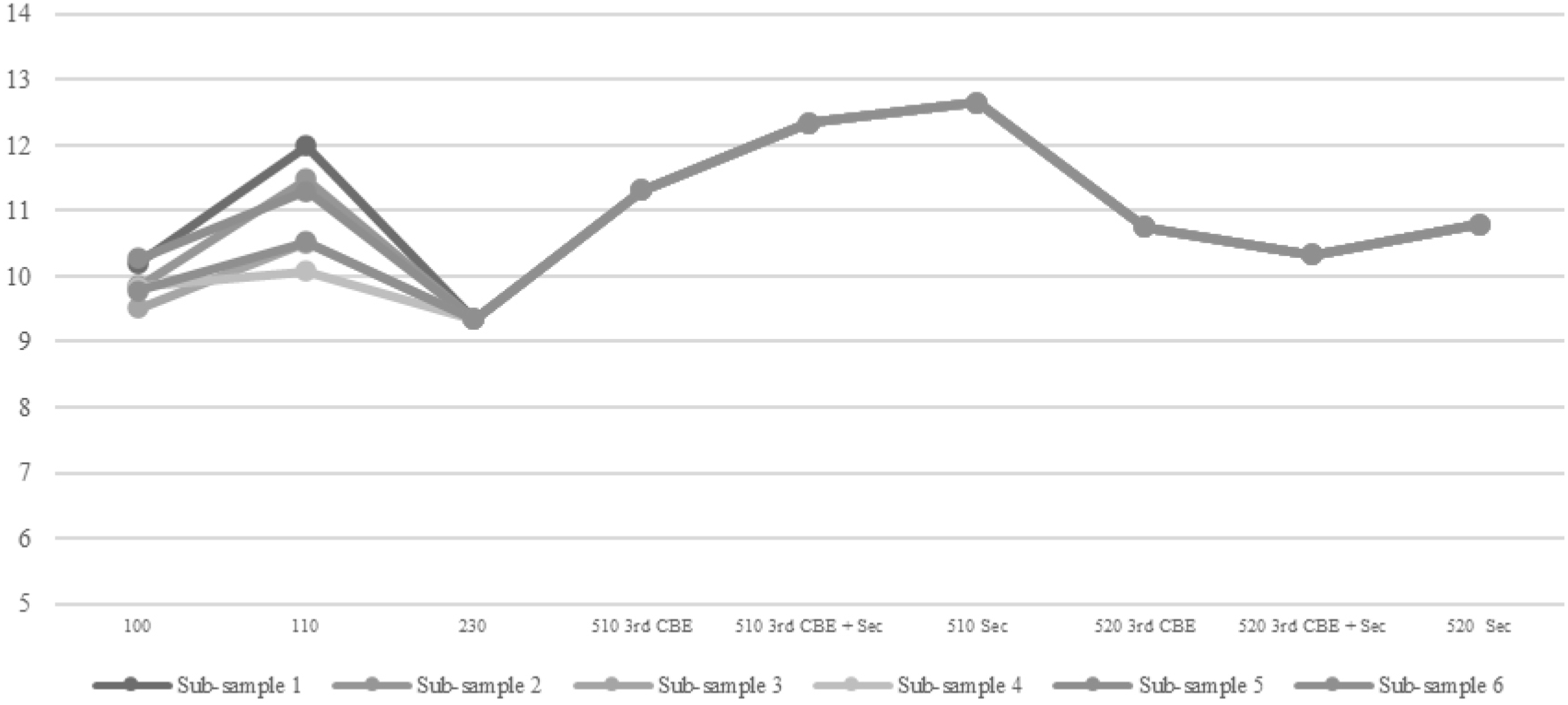
Source: authors (2021).
CBE: Cycle of Basic Education.
Chart 3 Averages of the factor Experimental teaching practices value obtained by each teaching group in the 6 sub-samples.
Source: authors (2021).
CBE: Cycle of Basic Education.
Chart 4 Average values of the student-focused (Non-experimental teaching practices: student-focused) factor obtained by each teaching group in the 6 sub-samples.
Source: authors (2021).
Chart 5 Average outside-focused (Non-experimental teaching practices: outside-focused) factor values obtained by each teaching group in the 6 sub-samples
Source: authors (2021).
Chart 6 Average values of the teacher-focused (Non-experimental teaching practices: teacherfocused) factor obtained by each teaching group in the 6 sub-samples.
The visual analysis of the charts shows some variation in the averages obtained by the six subsamples of 20 teachers from groups 100 and 110.
Analyses of variance with Brown Forsythe correction were made to check if there were differences between subsamples. The results of this analysis showed an absence of statistically significant fluctuations for factor E, NES and NEO (Table 17).
Table 17 Statistics of F and respective p values.
| E | NES | NEO | zNET |
|---|---|---|---|
| F=1.611, p=.158 | F=0.928, p=.461 | F=1.544, p=.177 | F=0.446, p=.816 |
Source: authors (2021).
E: Experimental teaching practices; NET: Non-experimental teaching practices: teacher-focused; NES: Non-experimental teaching practices: student-focused; NEO: Non-experimental teaching practices: outside-focused.
Despite being exposed to potential biases of unbalanced groups, Kruskal-Wallis analyses were performed for each factor. The descriptive results are shown in Charts 7 to 10.
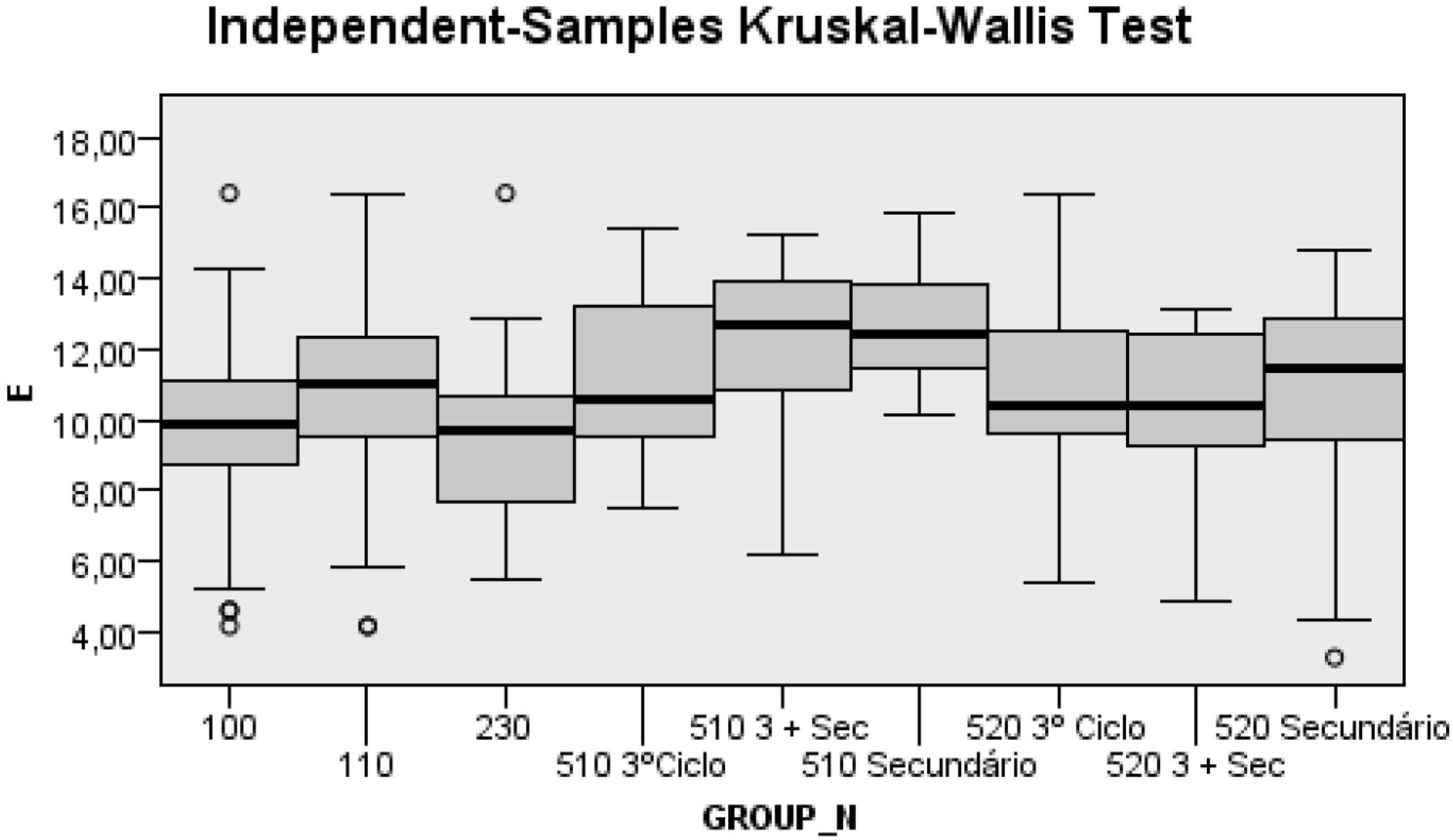
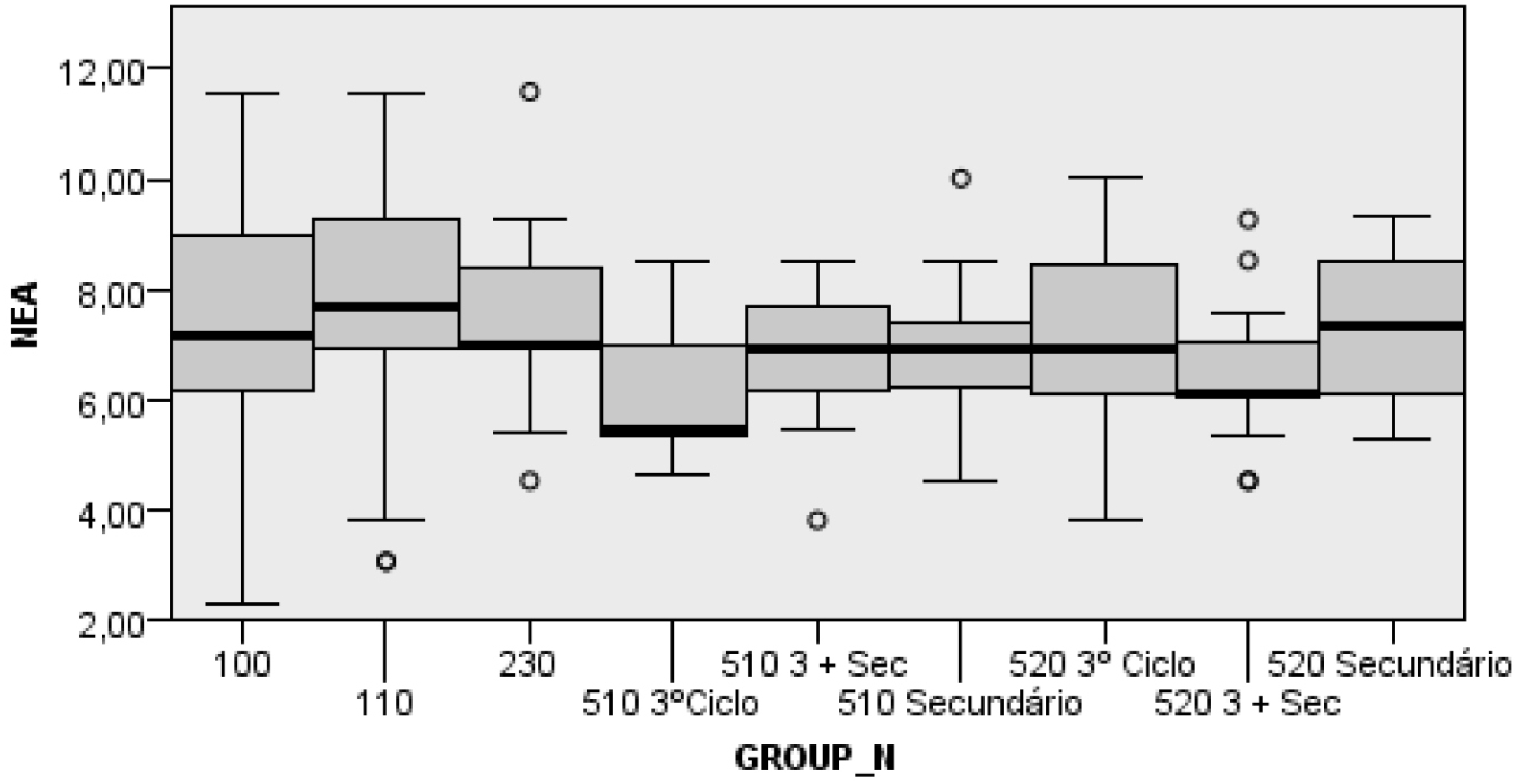
Source: authors (2021).
Chart 8 Kruskal-Wallis analysis for student-focused (Non-experimental teaching practices: student-focused) factor.
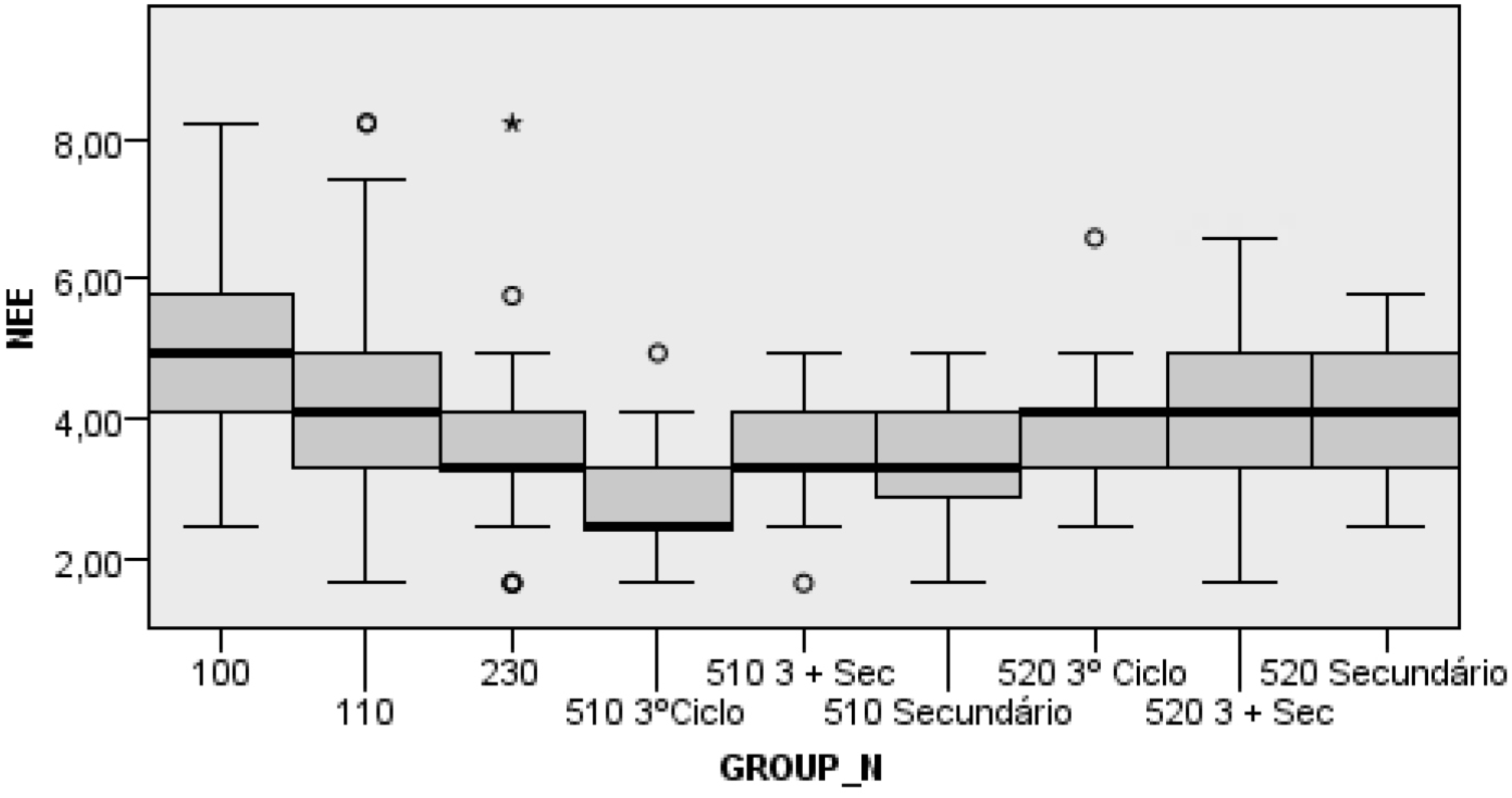
Source: authors (2021).
Chart 9 Kruskal-Wallis analysis for outside-focused (Non-experimental teaching practices: outside-focused) factor.
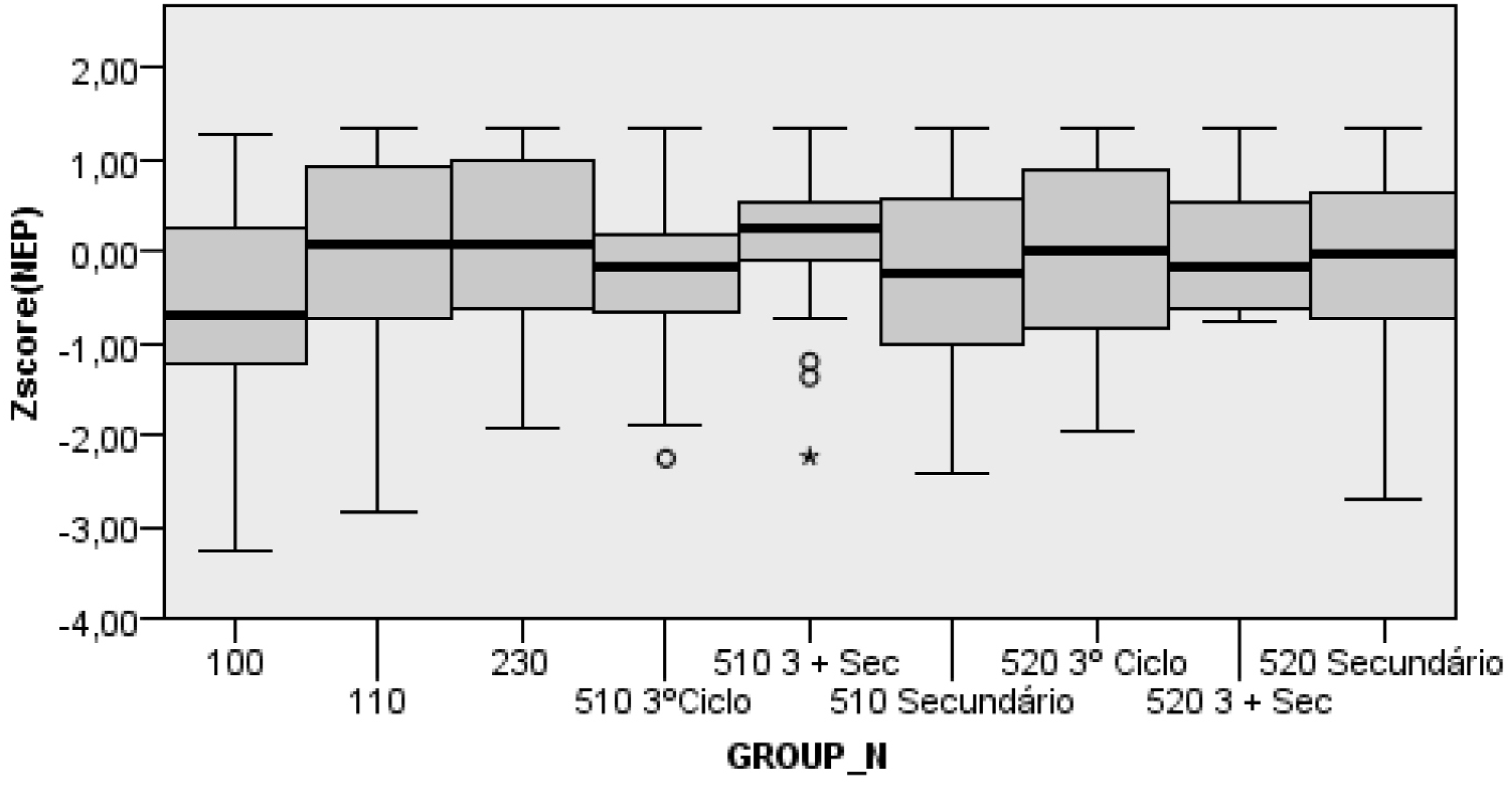
Source: authors (2021).
Chart 10 Kruskal-Wallis analysis for teacher-focused (Non-experimental teaching practices: teacher-focused) factor.
With regard to factor E, the results exposed a statistically significant fluctuation K(8)=45,153, p<0.001. Multiple comparisons highlighted the statistically significant difference between the 510 3rd CBE + secondary group and the 230 group (K=-4.352, p<0.001). Regarding the NES factor, the results also showed a statistically significant fluctuation K (8)=43.505, p<0.001, with emphasis on the comparison between the 510 3rd CEB group and the 110 group (K=-4.501, p<0.001). With regard to the NEO factor, a statistically significant fluctuation was also found between groups (K(8)=59,566, p<0.00), highlighting the difference with statistical significance between the 510 3rd CBE and 100 (K=-5,813 p<0.001). Regarding the NET factor, the result of the inference test also showed a statistically significant fluctuation (K(8)=30,076, p<0.001), with particular emphasis on the significant difference between group 100 and group 110 (K=-5,128 p<0.001).
PRACTICES OF THE SAME TEACHER IN DIFFERENT CYCLES
In order to assess whether teachers who teach both in the 3rd CBE and secondary (who answered specific questions for each level of education) have different patterns of use for the various activities depending on the cycle, sign tests were performed. The results with statistical significance are described in Table 18. The result for experimental activities with variable control showed that, of the 31 teachers who teach both in 3rd CBE and secondary, 15 did not change the frequency of use of these activities between 3rd CBE and secondary, one uses them more often in 3rd CBE than in secondary, and 15 show a higher frequency of use in secondary education than in 3rd CBE. The result obtained for the joint reading of the manuals registered the opposite pattern, with 15 of the 31 teachers using these activities more in 3rd CBE than in secondary. Interestingly, the other significant result recorded was in sensory experiments, with a similar pattern to that obtained for experimental activities with variable control.
Table 18 Descriptive distribution of the categories (+ = -) of the sign-test and respective inference.
| Activities | Teachers who use more in 3rd CBE | Teachers with equal use in 3rd CBE and secondary | Teachers who use more in secondary | p-value |
|---|---|---|---|---|
| Experimental with variable control | 1 | 15 | 15 | p<0.001 |
| Joint reading of the manual, underlining | 15 | 11 | 5 | p=0.041 |
| Sensory experiences | 4 | 13 | 14 | p=0.031 |
Source: authors (2021).
CBE: Cycle of Basic Education.
Bearing in mind that it is the same teachers who respond, thus controlling any group effects for blunt variables, this result seems to show a possible curriculum effect.
DISCUSSION AND CONCLUSIONS
This study allowed us to verify that the predominant practices of teachers in the 17 school clusters are those in the NET category: oral explanation of the contents, exploration of documents, joint reading of the student textbook, use of posters, slides or schemes on the board — activities which are much more teacher-centred. In general, experimental activities with variable control are seldom used in science classes (71% of all teachers say they never, rarely or sometimes carry out this type of activities), results in line with those obtained by Ramos and Rosa (2008) and by the IGEC (2019).
The main constraint on experimental science teaching identified by the surveyed teachers was lack of resources (65.4%). This factor was also identified by Ramos and Rosa (2008) in the study carried out more than ten years ago and also in recent studies developed in other countries (e.g. Namira et al., 2020). This fact can be interpreted as a lack of investment in equipping schools with the necessary resources and equipment for carrying out experimental activities.
However, lack of resources is an easy scapegoat and there are many underused school laboratories and failed equipment projects in different countries. Resource allocation should be coupled with intensive training, lesson materials, coaching and monitoring, so equipment can be allocated to schools/teachers most likely to use it. According to the literature on systemic change and Fullan's New Meaning of Educational Change (Fullan, 2007), it is important to note that training and equipment by themselves are insufficient, coaching support (e.g., by peer coaching) is needed while teachers go through the implementation dip which often occurs when shifting from long used to new teaching methods. This could be peer coaching.
Although, according to the teachers, lack of training was not a factor highlighted by them as a constraint on experimental science teaching (having been identified by only 26.3% of respondents), it is certain that almost half of the teachers reported not having attended in-service training in this area. In fact, cross-analysis has shown that teachers who identified lack of training as a constraint have less experimental science teaching practices; in the opposite direction, we found that teachers who have undergone training use significantly more experimental activities. It is also important to emphasise that the study revealed that teachers themselves are not aware of the importance of training, as they did not identify the lack of it as one of the main constraints to the implementation of experimental science teaching practices (with the exception of kindergarten teachers — recruitment group 100 — who identified it as the second main constraint; the first was the lack of resources, similar to the majority of teachers in the other recruitment groups).
While other studies (Ramos and Rosa, 2008; Marques et al., 2014) have highlighted the lack of preparation during pre-service and in-service teacher training, what is unequivocally innovative about this study is that it demonstrates that training in experimental science teaching predicts the implementation of more experimental science teaching practices. In this sense, Correia (2014) recommended that teachers should have more opportunities throughout their training to rebuild their conceptions, to deepen their knowledge about science and science teaching.
Despite this reality, it is important to note that the performance of experimental activities during pre-service teacher training has allowed future teachers to develop favourable socio-affective dispositions to use of such activities in the classroom (Pires, Mafra and Fernandes, 2016). In addition, the Teaching and Learning International Survey (TALIS) 2018 results revealed that teachers who tended to have higher levels of self-efficacy and job satisfaction were those who participated in training actions that they considered to have had a positive impact on their practices (OECD, 2019).
Answering the question which gives title to this work, the major factor that can make a difference in teachers’ practices is teacher training in experimental science teaching. Based on the above, and as argued by many others (Osborne and Dillon, 2008; Correia, 2014; Pires, Mafra and Fernandes, 2016; Domingos and Costa, 2018; IGEC, 2019), we advocate the urgency for investment in pre-service and in-service teacher training is this area, which implies a coordination between teacher training institutions, educational policy makers and research.
Specifically, we argue that the training offer (initial and continuous) should significantly contemplate the exploration of practical science activities of an experimental nature (with and without control of variables), providing trainees with the opportunity to carry out these activities in context, leading them to be able to select and produce resources to support experimental science teaching, as well as to reflect in a reasoned way on their practices.
This does not mean that we should not invest in equipping schools with resources and equipment suitable for experimental teaching. Otherwise, the pedagogical intervention, the practices adopted, run the risk of being of the demonstrative type (centred on the teacher, that is, activities carried out essentially by the teacher, with the occasional support of one or another student), which would make it difficult to effectively operationalise experimental science teaching.
On the other hand, we also argue that practical activities should preferably be carried out with students organised in groups, which implies the existence of material resources for these various groups and not only for the teacher to demonstrate/exemplify. In addition to the above, and with a view to promoting the adoption of experimental science teaching practices, it is considered necessary to divide classes (for example into two classes; note that in the Portuguese education system many classes have 25 or more students), as well as to advocate co-teaching (collaborative work between peers), in order to ensure that the demands that arise in terms of pedagogical support and guidance to students when carrying out this type of activities in a formal context are met.

