




 texto em
  Inglês (pdf)
 Artigo em XML
 Tradução automática
 Enviar este artigo por email
 Permalink

Introduction
Discussing literacy and education in our country means referencing researcher Magda Soares, professor emeritus at the Federal University of Minas Gerais (UFMG). She passed away on January 1, 2023, leaving behind an important legacy, particularly in the field of literacy. As Sônia Kramer (2023, p. 3) aptly defined, Magda Soares was an “educator, intellectual, and researcher who understood earlier, more deeply, and better than all of us the importance of tracking the state of knowledge about literacy in Brazil.”
One of the most significant acknowledgements of her contributions as a researcher in the field of Education, specifically in literacy, came when she received the Almirante Álvaro Alberto Award for Science and Technology in 2015, in the category of Human and Social Sciences, Literature, and Arts. In her acceptance speech, Magda Soares (2015) emphasized that we, as researchers in Education, “are constantly faced with a call for understanding, followed by a call for action.” For her, our research should seek out questions for the countless answers the world offers, since “the answers are in the world of education, waiting for the researcher’s questions” (Soares, 2015). Among those many answers, one that has grounded the research conducted by this renowned professor since the 1980s is school failure in reading and writing, which continues to affect children in public schools across our country.
Until the mid-1980s, discussions of literacy in Brazil focused mainly on different methods for teaching reading and writing – either synthetic or analytical – which framed literacy instruction as the process of learning to decode and encode written language. In her article “As muitas facetas da alfabetização,” published in the journal Cadernos de Pesquisa in February 1985, Magda Soares emerged as a pioneer in Brazil by proposing a broader and more interdisciplinary understanding of literacy: one that incorporates not only linguistic, but also social and cultural dimensions. As Kramer (2023, p. 3) notes, this article marked “a clear boundary between what had been produced before and what was produced later in Brazil in terms of literacy.”
In the 1980s, while seeking to understand the underlying causes of persistent school failure in reading and writing – evident at the time by the fact that more than 50% of students were failing first grade – Magda Soares highlighted the complex nature of literacy. She underscored its psychological, psycholinguistic, sociolinguistic, and linguistic dimensions, all of which are further shaped by social, economic, cultural, and political factors. Although she had not yet explicitly used the term letramento (literacy in its broader sociocultural sense), which would appear in her later work and that of other scholars, in this text she introduces a concept of literacy that was already closely aligned with it.
Kramer (2023, p. 5) highlights that, since its founding in 1979, Magda Soares brought to the Associação Nacional de Pós-Graduação e Pesquisa em Educação (Anped – National Association of Graduate Studies and Research in Education), a “quiet restlessness and a demand for rigorous research, expressed in various forms of engagement.” The Working Group (Grupo de Trabalho – GT) on Language and Education was established after her initiative in 1983, at a time when only eight groups were part of Anped. In 1986, a proposal was introduced to create the Literacy Working Group (GT de Alfabetização), with the aim of “catalyzing experiences, research, and literacy implementation policies to assess the state of the field” (ANPED, 1986). The 10th Annual Meeting of the Association, held in Salvador in 1987, marked the inclusion of the Literacy Working Group (GT 10). In 1994, the group’s researchers decided to rename it Literacy, Reading, and Writing to reflect not only an expanded conceptualization of literacy but also the broader range of topics being addressed (Goulart; Schwartz; Maciel, 2015). According to Kramer (2023), the GT – now Literacy, Reading, and Writing – was profoundly transformed by the contributions of Professor Magda Soares.
This article aims to reflect on the contributions of the discussions proposed by Magda Soares in the field of literacy, reading, and writing. We examine how her work has influenced, over time, studies focused on the analysis of reading and writing teaching practices in Brazil. To this end, we analyze her contributions to research presented and/ or published within GT 10 – Literacy, Reading, and Writing – of Anped, a working group established with the help of Professor Magda Soares to foster dialogue on research in this field conducted within Graduate Programs across the country.
“Initial reading instruction” and “literacy”: what does Magda Soares claim?
The term letramento (literacy in its sociocultural dimension) was formally introduced into the Brazilian educational scenario in the second half of the 1980s, first appearing in Mary Kato’s 1986 work No mundo da escrita: uma perspectiva psicolinguística.Ribeiro (2023) explains that Kato associated the term with the ability to use written language in its formal, cultivated form, highlighting the school’s role in developing this competence. Not long after that, in 1988, the term appeared in Tfouni’s book Adultos não alfabetizados: o avesso do avesso. In it, the author differentiated alfabetização – which in English also means literacy, but understood as initial reading instruction, that is, the mechanical acquisition of reading and writing skills – from letramento, which can also be translated as literacy but encompassing the sociohistorical dimensions of written language acquisition, intrinsically linked to both literate and illiterate individuals.
In the paper titled “Língua escrita, Sociedade e Cultura: relações, dimensões e perspectivas”, presented at the 17th Anped Annual Meeting in October 1995 and published that same year in the inaugural issue (No. 0) of the Association’s journal, Revista Brasileira de Educação, Magda Soares introduces the concept of alfabetismo (which she considered the most faithful translation of the English word literacy), referring to the state or condition achieved by those who learn to read and write. From that moment forward, the author began advocating for the need to understand, incorporate, and materialize this concept in our country and schools, as a way to address a rapidly changing social reality and widening social inequalities. Simply knowing how to read and write in the sense of mastering writing technology was not enough; it was equally necessary to know how to use this technology, “incorporating it into one’s life, thereby transforming one’s ‘state’ or ‘condition’ as a consequence of mastering this technology” (Soares, 1995, p. 7).
When discussing the concept of literacy (“alfabetismo”), Magda Soares breaks it down into two dimensions, individual and social, while exploring its relation to society and culture. In doing so, she engages in dialogue with international scholars such as Street (1984) and Heath (1983, 1991) in the article. Soares argues that when viewed from the individual dimension, literacy is understood as a personal attribute, referring to an individual’s possession of reading and writing skills. From this perspective, conceptualizing it proves challenging due to the multiplicity of skills and knowledge involved in such skills, the heterogeneous nature of these competencies, and the wide variety of text genres and media through which they must be applied. From a social perspective, literacy goes beyond individual skill acquisition and involves “a set of social practices associated with reading and writing, effectively exercised by people within specific social contexts” (Soares, 1995, p. 10).
When it comes to the social dimension of literacy, Magda Soares (1995) identifies two distinct orientations: a progressive “liberal” tendency and a radical “revolutionary” tendency. The former, aligned with the concept of functional literacy, asserts that literacy holds the potential to promote both individual and social advancement. It conceives of being literate as the ability to use reading and writing skills to function effectively in society, participate actively in civic life, and pursue personal fulfillment. From this perspective, literacy is seen as “responsible for cognitive and economic development, social mobility, professional advancement, and the promotion of citizenship” (Soares, 1995, p. 11). The revolutionary orientation, represented by scholars such as Street (1984), who characterizes it as an “ideological model”, defines literacy in terms of the specific forms that reading and writing practices assume within particular social contexts. According to Street, these forms are inherently shaped by the social institutions they are embedded in.
We emphasize that in that article Magda Soares uses a single term (“alfabetismo”) to encompass both the individual (primarily psycholinguistic) and social dimensions of reading and writing acquisition. Three years later, in 1998, she published the book Letramento: um tema em três gêneros with Editora Autêntica, where she proposed a distinction between “alfabetização” (initial reading instruction) and “letramento” (literacy as sociocultural practice), considering them as distinct yet inseparable phenomena. The book brings three texts on literacy (“letramento”), each written under different production conditions, with distinct objectives and target audiences. The first text, originally published as an entry in the “Dicionário crítico da Educação” (“Critical Dictionary of Education”) section of Revista Presença Pedagógica, explains the meaning of literacy to teacher-readers. The second, didactic in nature, was designed for use in teacher training courses, seminars, and workshops, addressing educators and specialists working in literacy and reading/writing instruction. The third text, initially prepared as a monograph for UNESCO (United Nations Educational, Scientific and Cultural Organization), is an essay aimed at professionals responsible for assessing and measuring literacy through the lens of literacy. This text also represents an expanded version of her 1995 article referenced earlier.
In the opening chapter of the book, Magda Soares defines letramento as the Portuguese equivalent of the English word literacy, which derives from the Latin littera (letter) combined with the suffix -cy, which means the quality, condition, or state of being.
Literacy (in English), then, refers to the condition of being literate: “educated, particularly capable of reading and writing.” On the other hand, letramento combines letra (from Latin littera) with the suffix -mento, which denotes the result of an action. It is therefore understood as “the result of the action of teaching or learning to read and write: the state or condition that a social group or individual acquires as a consequence of becoming literate” (Soares, 1998, p. 18).
At the end of the chapter, Soares highlights that an individual may not know how to read and write (i.e., be illiterate), yet still be literate in a sociocultural sense by participating in social practices that involve the use of written language. In this way, initial reading instruction (literacy as skill acquisition) and literacy (in a sociocultural sense) emerge as distinct phenomena: the former refers to the technical mastery of writing systems, while the latter pertains to the social uses and practices of reading and writing in which individuals, even those who are formally illiterate, may be engaged.
In the second text, the author highlights both the distinction and the inseparability of these two processes, emphasizing that, in schools, the goal should be to “teach reading and writing in a way that also develops students’ engagement with the social uses of written language.” In other words, to combine literacy acquisition with literacy:
We would need a verb equivalent to “literacying” in order to name the act of guiding individuals toward sociocultural literacy. In this way, we could distinguish between “teaching the technical skills of reading and writing” and “using written language in social contexts” as two distinct, albeit not separable, actions. It would be ideal to teach reading and writing within the context of social practices, so that individuals become not only able to read and write but also literate in a broader, sociocultural sense (Soares, 1998, p. 47).
Some researchers, such as Emília Ferreiro (2003), advocate for the use of a single term to encompass both the learning and the use of reading and writing. In a 2003 interview with Nova Escola magazine, Ferreiro argued that the widespread adoption of the term letramento in Brazil to refer to exposure to different text types and reading comprehension had led to the reduction of initial reading and writing instruction to mere decoding. This separation between initial reading instruction and literacy, she stated, represents a conceptual setback, prompting her to defend the use of a single, more comprehensive term. Ferreiro concluded the interview with the following remark: “If there were a vote and it was decided we prefer to use literacy instead of initial reading instruction, that would be fine. What does not work is the coexistence of both terms.”
In a 2004 article published in Revista Pátio, Magda Soares acknowledges that, at a conceptual level, distinguishing between initial reading instruction (literacy acquisition) and literacy (literacy as sociocultural practice) may be unnecessary, since a redefinition of literacy could, in theory, encompass both dimensions. However, as a researcher deeply concerned with the recurrent failures in teaching literacy to children and adults in Brazil, she argues that from a pedagogical perspective, this distinction remains essential. While she recognizes them as distinct processes, Soares stresses that they must be addressed as inseparable and interdependent within educational practice.
In a more recent interview, published in Cadernos de Pesquisa by the Federal University of Pelotas (UFPel), Magda Soares (2022, p. 12) addressed her disagreement with Emília Ferreiro regarding the concurrent use of the terms literacy and initial reading instruction. She argued that, in Brazil, the latter has historically been understood as the process of learning the alphabetic writing system. Soares maintained that “once words acquire and consolidate a meaning, they do not easily allow their meaning to be changed or modified.” She further emphasized that her main argument in favor of distinguishing (though not separating) the two terms is fundamentally pedagogical in nature:
[...] Mastering the alphabetic writing system requires specific linguistic and cognitive learning, focused on the system itself, and therefore needs instruction grounded in linguistic science. In contrast, using that system to produce texts involves fundamentally different learning processes, based on distinct foundations. [...] Naturally, literacy educators cannot be satisfied with merely teaching the mechanics of the writing system; they must also support students in becoming readers and producers of meaning through text. To accomplish this, instruction must move beyond basic literacy (learning to decode and encode) and simultaneously foster broader literacy competencies, including the ability to read, interpret, and compose diverse types of texts (Soares, 2022, p. 12).
In 2003, Magda Soares was invited to present a commissioned paper for Working Group 10 (Literacy, Reading, and Writing) at the Anped conference. The result was the article “Letramento e Alfabetização: as múltiplas facetas,” published in 2004 in the Revista Brasileira de Educação. In this work, Soares dialogues with her earlier 1985 article, “Alfabetização: as muitas facetas,” revisiting two central themes: first, the discussion on literacy acquisition, a discussion that had already hinted at the connection between initial reading instruction and literacy; and second, the persistent problems of school failure in teaching literacy that, nearly two decades later, remained unresolved. In the 2004 article, Soares sought to trace the conceptual evolution of literacy acquisition over the previous twenty years, describing this trajectory as “the progressive invention of the word and concept of literacy, and the concurrent de-invention of literacy acquisition, resulting in the current controversial situation that I dare call the reinvention of literacy acquisition” (Soares, 2004, p. 5).
Engaging in dialogue with other researchers from Anped’s Working Group 10, Magda Soares (2004, p. 5) explains that the aim of her paper is “to defend, through a proposal that is only apparently contradictory, the specificity and, at the same time, the inseparability of these two processes: initial reading instruction and literacy, both from a theoretical perspective and in terms of pedagogical practice.” According to Soares, the challenges faced in addressing school failure related to literacy acquisition of children in public schools may be linked, among other factors, to a loss of specificity in literacy, a phenomenon she refers to as the “de-invention of literacy acquisition.”
For Soares, this process was caused primarily by the conceptual shift in understandings of how written language is learned, a shift that gained ground in Brazil in the mid-1980s with the dissemination of research on the psychogenesis of writing. She highlights several misunderstandings and false inferences that arose from the application of this approach to teaching reading and writing. These include favoring the psychological dimension of the process, which obscured its linguistic, phonetic, and phonological dimensions; the widely publicized notion of an incompatibility between the psychogenetic conceptual paradigm and structured methods of literacy instruction; and, finally, the broadly held assumption that children could learn to read and write solely through immersive exposure to written materials circulating in everyday social practices.
From this perspective, Soares (2004, p. 9) argues that the acquisition of the alphabetic writing system was overshadowed by the broader sense of literacy, as “the latter often ended up prevailing over the former, which consequently lost its specificity.” Rather than advocating a return to traditional methods that prioritized decoding and encoding before introducing diverse reading and writing activities, Soares proposes a reinvention of literacy acquisition: one that integrates systematic instruction in the writing system within authentic literacy practices. This approach, which she terms “practicing literacy while becoming literate” aims to develop both technical proficiency and meaningful engagement with reading and writing simultaneously.
In 2007, after retiring from UFMG but still deeply concerned with the persistent failure of Brazil’s public schools to effectively teach literacy and foster proficient readers and writers, Magda Soares began volunteering in the municipal school system of Lagoa Santa, Minas Gerais. There, she developed the Alfaletrar Project, a professional development initiative for in-service literacy teachers, carried out in collaboration with local educators. Soares (2014) described the project as a “micro-practice”, both because it was implemented in a single municipality among Brazil’s 5,500+ cities, and because it focused specifically on the initial stages of writing acquisition. The project’s name encapsulates its central philosophy: that learning written language involves an inseparable combination of technical mastery of the writing system and engagement in sociocultural literacy practices, reflecting the theoretical framework Soares had developed throughout her academic career.
Her 12-year experience was published in 2020 in her book Alfaletrar: toda criança pode aprender a ler e escrever. Through her deep immersion in municipal schools, which she describes in the book’s introduction as an “intense and permanent interaction with all district schools, with teachers, with children, with classrooms” (Soares, 2020, p. 12), Soares demonstrated that children in Brazil’s public schools can indeed learn to read and write effectively. Her approach emphasizes playful, reflective learning within rich literacy environments, fundamentally different from traditional methods like phonics-based instruction proposed in the now-revoked Política Nacional de Alfabetização (National Literacy Policy) (Brasil, 2019). Central to her argument is the principle that teaching must be designed by first focusing on understanding how learning occurs.
What proved essential to reversing this pattern of failure was a shift in the focus of teaching practice, implemented through a sustained process of daily professional development for teachers. This included: the collective formulation of learning goals to be achieved each school year (initially developed in 2007, well before the introduction of the Common National Curriculum Base – BNCC); systematic analysis and refinement of instructional practices; targeted support for children’s conceptual understanding of written language and their progressive appropriation of the alphabetic principle; the development of fluent reading, reading comprehension, and written production skills – from early childhood education through the early years of elementary school. These efforts were supported by the presence of a dedicated children’s library in every school, filled with high-quality books that served as the foundation for learning activities (Soares, 2020, p. 13).
During the development of the Alfaletrar Project, driven, as previously emphasized, by her dissatisfaction with the persistent failure of literacy instruction in Brazil’s public schools, Magda Soares (2016) undertook an exhaustive and in-depth review of literacy studies, seeking theoretical frameworks that could shed light on her experiences with teachers and students in Lagoa Santa.
As a result of this inquiry, in 2016 she published Alfabetização: a questão dos métodos, in which she revisits literacy as a multifaceted phenomenon encompassing three principal dimensions of written language: the linguistic aspect, concerning the learning of the alphabetic writing system and its conventions; the interactive aspect, which views written language as a medium for interpersonal interaction, enabling the expression and comprehension of messages; and the sociocultural aspect, focused on the uses, functions, and values attributed to writing within sociocultural contexts. Building on the distinction she had long advocated between initial reading instruction and literacy, Soares explicitly associates initial reading instruction with the linguistic dimension of written language acquisition, while literacy pertains to the interactive and sociocultural dimensions. As the title suggests, the book primarily centers on the linguistic dimension and the theoretical and pedagogical discussions surrounding initial reading instruction.
In a recent interview, Magda Soares (2022, p. 13) described the two books – Alfabetização: a questão dos métodos and Alfaletrar – as complementary works, with the former emphasizing theoretical foundations and the latter focusing on practical application. Consequently, the intended audiences for the two books differ accordingly:
Alfabetização can serve as a resource for undergraduate and graduate students, for teacher trainers preparing literacy instructors, and for researchers seeking theoretical foundations to clarify the problem they intend to investigate. On the other hand – and here I no longer suppose but affirm – Alfaletrar has been serving as support and even a pedagogical proposal for literacy teachers, schools, and public education networks, which brings me great satisfaction: it was written with this purpose.
The publication of these two books consolidates Professor Magda Soares’s approach to the relationship between acquiring reading and writing skills and using them socially – an approach that considers the specificities of our country and the urgent need to ensure that all children learn to read and write.
The importance of Professor Magda Soares’s work regarding the debate on literacy in Brazil is raised and discussed by Street (2013) in the article “Políticas e práticas de letramento na Inglaterra: uma perspectiva de letramentos sociais como base para uma comparação com o Brasil”, in which he analyzes the situations in England and Brazil concerning national policies focused on the work done on literacy in schools. The work carried out in Lagoa Santa is seen by Street (2013) as a key site for discussing school literacy within both contexts.
Street examines cultural and political differences through an ethnographic lens of these realities. In the proposal developed collectively under Professor Magda Soares’ leadership, he emphasizes their deliberate effort to bridge rather than separate initial reading instruction and literacy. This stems from the observation that children become literate within contexts of actual reading and writing use, through dialogic language practices in educational situations that involve textual variety in interactive and creative tasks. The researcher emphasizes the importance of the Alfaletrar project and states that it is “work that can be carried out in educational circles where the understanding of literacy and learning is broader than what the phonics approach suggests” (Street, 2013, p. 62), an approach adopted in schools in England.
Street (2012) reaffirms the importance of Magda Soares’ theoretical work, research, and practical research for fostering meaningful public engagement with reading and writing practices across the country. In a tribute published in Jornal Letra A celebrating the professor’s 80th birthday, Street (2012, p. 6) stated:
“I owe much of my reflection on the concept of ‘literacy’ to Magda, as I use this term to focus more on the processes involving reading and writing practices in social situations rather than the limited skills implied by the traditional concept of ‘initial reading instruction’.”
This leads us to our central research question: How have Magda Soares’ conceptual discussions about initial reading instruction and sociocultural literacy practices, as materialized in her various books, articles, book chapters, and pedagogical materials, contributed to research development in the fields of literacy, reading, and writing?
To answer this question, we conducted a study aiming to examine the influence of Soares’ work by analyzing publications from Anped’s Working Group 10 (Literacy, Reading and Writing), available on the association’s website.
In the following section, we outline the methodological approach of our investigation, followed by the presentation of the results. At the end, we offer some concluding remarks.
Methodological approach
This qualitative study (Bogdan; Biklen, 1994) focuses on identifying and analyzing works that reference Magda Soares’ publications about literacy acquisition and sociocultural literacy practices. We employed documentary analysis combined with Bardin’s (1977) content analysis methodology.
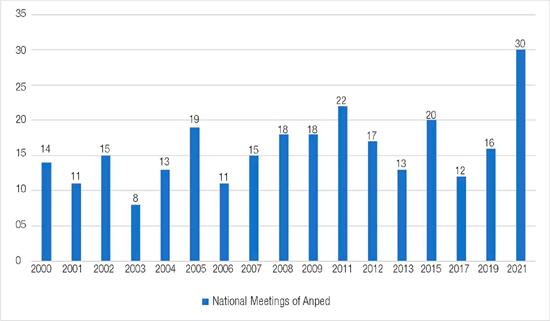
To examine Soares’ influence on research presented in Anped’s Working Group 10, we first established our analysis timeframe. Our empirical data comprised a sample of conference papers published on Anped’s website from 2000 to 2021. Proceedings from the 2010 meeting were unavailable, as were those from the 23rd annual meeting in 2023. In the end, our analysis encompassed 17 annual meetings.
We should clarify that not all published papers were actually presented at the conferences due to presentation limits. Some were published as “supplementary” submissions. Our research corpus included all published papers within the specified timeframe.
Graph 1 shows the number of papers published for each annual meeting:
Source: the authors.
Graph 1 Number of papers from Working Group 10 published in the National Meetings of Anped (2000-2021)
A total of 242 papers were reviewed to identify whether they included references to works by Magda Soares, as previously mentioned. Following this review, we conducted a mapping of these papers and an analysis of the references they contained. The results are presented in the following section.
Magda Soares’s Works Cited in Papers Presented in Anped’s GT 10
The mapping of papers presented in GT 10 (Literacy, Reading, and Writing) revealed that texts written by Magda Soares (including books, articles, book chapters, and educational materials) were cited in all the Anped meetings analyzed in this study. This underscores the importance of her contributions to the development of research in the fields of literacy, reading, and writing. Table 1 provides an overview of how different works by the author were cited in papers published in the meetings considered in this analysis.
Table 1 Works by Magda Soares Cited in Papers Published in GT 10 at Anped (2000-2021)
| Productions cited | Number per Meeting |
|---|---|
| LETRAMENTO: um tema em três gêneros. Belo Horizonte: Autêntica, 1998. | 17 |
| Letramento e alfabetização: as muitas facetas. Revista Brasileira de Educação, Rio de Janeiro, n. 25, p. 5-17, 2004 | 8 |
| A escolarização da literatura infantil e juvenil. In: EVANGELISTA, Aracy A. Martins et al. (org.). A escolarização da leitura literária: o jogo do livro infantil e juvenil. Belo Horizonte: Autêntica, 1999. | 9 |
| LINGUAGEM E ESCOLA: uma perspectiva social. São Paulo: Ática, 1986. | 7 |
| Letramento e escolarização. In: RIBEIRO, Vera Masagão (org.). Letramento no Brasil: reflexões a partir do INAF 2001. São Paulo: Global, 2003. p. 89-113. | 4 |
| A reinvenção da alfabetização. Presença Pedagógica, [S. l.], v. 9, n. 52, p. 1-21, jul./ago. 2003. | 4 |
| ALFABETIZAÇÃO E LETRAMENTO. São Paulo: Contexto, 2003. | 3 |
| ALFABETIZAÇÃO: a questão dos métodos. São Paulo: Contexto, 2016. | 3 |
| ALFALETRAR: toda criança pode aprender a ler e a escrever. São Paulo: Contexto, 2020. | 2 |
| Língua escrita, sociedade e cultura: Relações, dimensões e perspectivas. Revista Brasileira de Educação, Rio de Janeiro, n. 0, p. 5-16, set./dez. 1995. | 2 |
| Concepções de linguagem e o ensino da Língua Portuguesa. In: BASTOS, Neusa Barbosa (org.). Língua portuguesa: história, perspectivas, ensino. São Paulo: EDUC, 1998. p. 53-60. | 2 |
| Apresentação. In: FRADE, Isabel Cristina Alves da Silva; MACIEL, Francisca Izabel Pereira (org.). História da alfabetização: produção, difusão e circulação de livros (MG/RS/MT – Séculos XIX e XX). Belo Horizonte: UFMG/FaE, 2006. p. 7-8. | 2 |
| Alfabetização: a (des)aprendizagem das funções da escrita. In: SOARES, Magda. Alfabetização e letramento. São Paulo: Contexto, 2003. p. 63-84. | 2 |
| Alfabetização: em busca de um método. in. SOARES, Magda. Alfabetização e letramento. São Paulo: Contexto, 2003. p. 85-97. | 1 |
| Alfabetização e cidadania. In: SOARES, Magda. Alfabetização e letramento. São Paulo: Contexto, 2003. p. 55-62. | 1 |
| As condições sociais da leitura: uma reflexão em contraponto. In: ZILBERMAN, R.; SILVA, Ezequiel T. (org.) Leitura: perspectivas interdisciplinares. São Paulo: Ática, 1988. p. 18-29. | 1 |
| ALFABETIZAÇÃO NO BRASIL: o estado do conhecimento. Brasília, DF: INEP, 1991. | 1 |
| Letramento/Alfabetismo. Presença Pedagógica, [S. l.], v. 2, n. 10, p. 83-89, ago.1996. | 1 |
| Alfabetização e literatura. Revista Educação: Guia da Alfabetização, São Paulo, n. 2, p. 12-29, 2010. | 1 |
| Alfabetização e letramento: caminhos e descaminhos. Revista Pátio, Porto Alegre, n. 29, p. 96-100, fev. 2004. | 1 |
| SOARES, Magda; BATISTA, Antônio Augusto Gomes. Alfabetização e letramento: Caderno do Formador. Belo Horizonte: Ceale/Fae/UFMG, 2005. | 1 |
| Ler, verbo transitivo. In: PAIVA, Aparecida et al. (org.) Literaturas /iterarias: discursos transitivos. Belo Horizonte: Ceale: Autêntica, 2005. p. 29-36. | 1 |
| Novas práticas de leitura e escrita: letramento na cibercultura. Educação & Sociedade, Campinas, v. 23, n. 81, p. 143-162, dez. 2002. | 1 |
| Práticas de letramento e implicações para a pesquisa e para políticas de alfabetização e letramento. In: MARINHO, Marildes; CARVALHO, Gilcinei Teodoro (org.). Cultura escrita e letramento. Belo Horizonte: UFMG, 2010. p. 54-67. | 1 |
Source: the authors.
As shown in Table 1, twenty-four works by Professor Magda Soares – including books (7), book chapters (10), and articles published in journals and periodicals (7) – were cited as references in papers published in GT 10 at Anped during the period our study covered. Moreover, the most frequently referenced texts in the papers presented at the National Meetings of Anped were the book Letramento: um tema em três gêneros and the article “Letramento e alfabetização: as muitas facetas.” The book was referenced in papers from all 17 meetings included in our analysis, while the article was cited in 8 meetings.
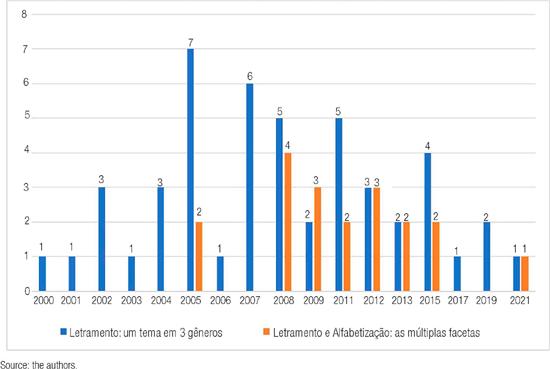
Graph 2 presents the number of papers, by meeting, that referenced these two works.
Source: the authors.
Graph 2 Number of papers referencing the book Letramento: um tema em três gêneros and the article “Letramento e alfabetização: as muitas facetas” at each National Meeting (2000–2021)
As we can see, the book Letramento: um tema em três gêneros was cited in 48 papers across the 17 meetings, which marks it as key reference work in discussions about literacy and literacy acquisition in Brazil. In several of the meetings, this book was cited in multiple papers, reaching as many as seven citations in 2005, six in 2007, and five in 2008 and 2011. Most of the papers (35) rely on this work by Magda Soares to discuss the concept of literacy. Among these, eleven refer to Magda Soares (1998) and Ângela Kleiman (1995) as the researchers who, in the 1990s, introduced the concept of literacy based on Brian Street’s studies. Nine papers present Magda Soares’s (1998, p. 18) definition of literacy as “the state or condition acquired by a social group or individual as a consequence of learning how to write.” It was also noted that fourteen papers refer to the distinction – but not dissociation – that Magda Soares makes between acquisition and social practice, indicating agreement with the author. Finally, one paper presented at the 2012 meeting challenges the use of the term “letramento” as a translation of the English word “literacy.” The author of that paper argues that the term “written culture,” adopted by researchers in Spain and Latin American countries, would be more appropriate, as it encompasses the social practices and uses of written language.
Regarding the different ways of approaching the phenomenon of literacy as a social practice, Frade, Heinig, and Ferreira (2024), in a documentary study analyzing the use of the term “literacy” in papers presented at three editions of the Colóquio Internacional de Letramento e Cultura Escrita (International Colloquium on Literacy and Written Culture), highlight the diverse processes through which the term has been appropriated in academic research and draw attention to the warning issued by Magda Soares (2010, p. 56):
[...] Literacy is a semantically saturated term – a word that means different things to different people, depending on their cultural and academic contexts, to different researchers, and to different teachers.
Still about the book Letramento: um tema em três gêneros, the diversity of researchers referencing the work called our attention, since it had been been cited by researchers from different institutions in different parts of the country: Pontifícia Universidade Católica do Rio de Janeiro (PUC-Rio), Universidade do Estado do Rio de Janeiro (UERJ), Faculdade de Filosofia e Letras de Diamantina (FAFIDIA), Universidade Federal de Minas Gerais (UFMG), Universidade Federal do Rio Grande do Sul (UFRGS), Universidade Federal do Espírito Santo (Ufes), Universidade Federal de São Carlos (UFSCar), Universidade Federal Fluminense (UFF), Universidade Federal de Santa Catarina (UFSC), Universidade Regional de Blumenau (FURB), Universidade Federal de São João del-Rei (UFSJ), Universidade Federal de Juiz de Fora (UFJF), Universidade Federal de Pernambuco (UFPE), Universidade Federal de Pelotas (UFPel), Universidade Federal Rural de Pernambuco (UFRPE), Universidade Federal de Matogrosso do Sul (UFMS), Universidade Federal do Rio de Janeiro (UFRJ), Universidade de Brasília (UnB), PUC-Campinas, Centro Federal de Educação Tecnológica de Minas Gerais (Cefet-MG), Universidade Federal do Estado do Rio de Janeiro (Unirio), Universidade Federal do Rio Grande (UFRG).
Our findings point that the themes of the studies that referenced the book Letramento: um tema em três gêneros investigate, among other topics, the teaching of reading and writing in literacy classes in elementary education and Youth and Adult Education (EJA) (15) and in other grade levels (4); literacy practices (reading and writing) in non-school contexts (8); approaches to teaching reading and writing in textbooks (8) and in literacy programs (2); literary reading practices in schools and other settings (5); reading and writing practices in higher education (4); teachers’ reading and writing practices (3); digital literacy (2); and the assessment of reading and writing (1). Thus, the book is a key reference in studies on literacy, reading, and writing, in schools and other contexts.
The article “Letramento e Alfabetização: as muitas facetas”, originally commissioned by GT 10 for presentation at the 26th Annual Meeting of Anped (2003), was cited in 19 studies after its publication in the Revista Brasileira de Alfabetização in 2004, eight of which also referenced the book Letramento: um tema em três gêneros. When citing the article, the studies generally address Magda Soares’ argument that, although they are distinct processes, initial reading instruction and literacy are interdependent, simultaneous, and therefore inseparable. In this proposition, the texts emphasized the perspective of teaching reading and writing beyond the technical dimension, showing that the concept of becoming literate involves multiple facets, going beyond the boundaries of encoding and decoding.
The themes of the studies that used this article as a bibliographic reference primarily concerned conceptions and/or practices of literacy instruction (14), reading and writing in schools (3), digital literacy (1), and literature and literacy (1). This result demonstrates the importance of Magda Soares’ work in research on literacy practices. Regarding the researchers, we also found that they were affiliated with institutions across various Brazilian states: UFSCar, UFMG, PUC-RIO, UFSC, UFPE, Universidade do Extremo Sul Catarinense (Unesc), UFF, UFPel, Universidade Federal do Pampa (Unipampa), Furb, UFMT, and UFJF.
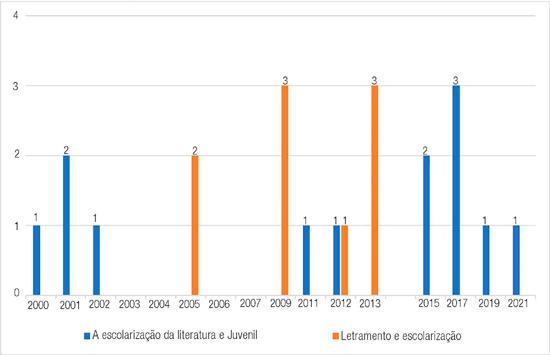
The data presented in Table 1 shows that two texts addressing the relationship between literacy and schooling were also frequently cited in the studies analyzed. One of these is the chapter titled “A escolarização da literatura infantil e juvenil”, published in the book A escolarização da leitura literária: o jogo do livro infantil e juvenil (Belo Horizonte: Autêntica, 1999), organized by Aracy Evangelista and other scholars. This chapter was referenced in studies presented at nine Anped Meetings, totaling 13 citations. All these studies focused on research related to literary reading in schools and/or other educational spaces. Although Magda Soares does not explicitly use the term literacy in this chapter, she reflects on the inevitable process literary texts undergo when introduced into schools and formal educational settings. She calls for a critical examination of what might constitute effective or meaningful use of literary texts – not only for literature but also for other genres.
The second text is a book chapter titled “Letramento e escolarização,” published in the volume Letramento no Brasil: reflexões a partir do INAF 2001, organized by Vera Masagão Ribeiro (São Paulo: Global, 2003). It was mentioned in four Anped Meetings, in a total of nine studies, four of which focused on research involving reading and/or writing practices carried out by adults, either in school settings or in other contexts.
Graph 3 presents us with an overview of these data:
Source: the authors.
Gráfico 3 Number of papers referencing the book chapters “A escolarização da literatura infantil” and “Letramento e escolarização” at each Anped Meeting (2000-2021)
Table 1 also highlights the significance of the book Linguagem e Escola: uma perspectiva social, first published in 1986 and reissued numerous times, which was cited in seven Anped Meetings, totaling ten studies. Although it does not explicitly address the concepts of acquisition and social practice, Magda Soares presents an important discussion on school failure in literacy education from a sociolinguistic perspective. Drawing on the work of Bernstein, Labov, and Bourdieu, she analyzes the relationships between language, school, and society, focusing particularly on the linguistic interactions within the school context. These interactions, she argues, can contribute to the marginalization of working-class students by erasing their cultures, knowledge, and, most notably, their speech.
The last two books published by Magda Soares – Alfabetização: a questão dos métodos and Alfaletrar – have been cited in research conducted in recent years. The former, aimed primarily at researchers and pre-service teachers, was referenced in four papers presented at the 2019 and 2021 meetings. The latter, more recent (published in 2020), was cited in one paper presented in 2021. Without a doubt, these two works, alongside other publications by Magda Soares, will remain key references in the development of literacy research and practice.
Final considerations
The analysis of Professor Magda Soares’s contributions to the development of research presented and published in GT 10 (Literacy, Reading, and Writing) reveals a body of work built over the course of her career as a teacher and researcher committed to quality public education and to ensuring that all children in Brazil learn to read and write. Her concerns were gradually transformed, over the years, into studies and research that significantly shaped theoretical and pedagogical discussions on the teaching of reading and writing in schools, as well as on the uses of literacy both inside and outside the classroom. Her work inspired many researchers to engage deeply with her ideas in order to better understand the social and political role of schooling and of the everyday practices that take place within it.
Beyond academic discourse, her extensive legacy has also influenced public policies in Brazil, particularly those aimed at in-service training programs for literacy teachers, which drew on the discussions presented in her works as key references for rethinking the daily practices of the literacy classroom. Her books, studies, research, articles, and numerous other publications consistently reflect her enduring concern that not only do all individuals learn to read and write, but they also use reading and writing in meaningful ways in their everyday lives.
Initial reading instruction, literacy, written culture, schooling, literacy acquisition, social practice, literacy teaching – regardless of the terms employed or the different perspectives adopted by different scholars in the academic field, the discussions on initial reading instruction and literacy found throughout Magda Soares’s work remain vital references. They continue to inform research in Education – particularly in the areas of reading and writing – as well as shape literacy policies and the training of both teachers and researchers in Brazil. Her contributions to the field of education and literacy are unquestionable.
Her theoretical and pedagogical legacy was, is, and will continue to be present yesterday, today, and always.

