




 texto em
  Inglês (pdf)
 Artigo em XML
 Tradução automática
 Enviar este artigo por email
 Permalink

Introduction
In the last two decades, the development of affirmative university policies has contributed to expanding actions around the fundamental rights of everyone to education. Thus, participation and learning must be mediated by responses to the educational demands of all, especially those who identify with specific educational needs and experience academic processes, with or without the experience of disability, presenting important challenges to university management.
In this regard, the role of movements strengthening programs and actions surrounding guarantees of access for groups in situations of economic, social, and cultural vulnerability to higher education has been a recurring theme in the current academic political landscape.
Furthermore, specialized educational programs and infrastructure services, such as human resources training and adaptation of physical spaces, among other adaptations aimed at facilitating the access and permanence of these students, are essential for ensuring an equitable completion of studies at the university.
In this direction, the writing of this article focuses on the institutional commitment to offering programs and/or services of pedagogical support to the mentioned audience, characterized by academic mentoring. This measure is in line with the Inclusive Education Policies (Brasil, 2008), partially guided by Decree No. 7,611 (Brasil, 2011), which provides measures for specialized educational services at all levels of education, as outlined in the provisions of Ordinance No. 69, which establishes the General Guidelines for Accessibility and Inclusion Policy at the university locus of the study (UNESP, 2020). Therefore, the importance of intersectionality is emphasized as a crucial tool to strengthen studies on this topic, particularly those aimed at establishing an intersection of disability with other markers of difference, based on shared literature and institutional policies investigated in the study.
The questions aimed at delimiting and describing the strategies, supports, and/or academic services provided to a specific group in a vulnerable situation, as well as addressing how the understanding of disability has been revisited by institutional census protocols through the interpretive lens of rights and the understanding of social markers of difference in the configuration of affirmative actions, were confirmed in the investigated scenario.
Inclusive educational policies in higher education
The movement for inclusive education, as a political, social, and pedagogical action, has always been present and necessary in various contexts, and higher education is no exception. In alignment with international agendas such as the Jomtien Declaration (UN, 1990), the Salamanca Statement (UN, 1994), and the principles outlined in the Convention on the Rights of Persons with Disabilities (CRPD) and its Optional Protocol, from the United Nations (UN, 2007), the Brazilian government reaffirms its commitment to providing education for all as a strategy to fight and combat social inequalities, with particular emphasis on higher education (Brasil, 2009)4.
Thus, through affirmative policies implemented by the Quotas Law No. 13,409, of December 28, 2016 (Brasil, 2016a), among other measures, Brazilian public universities began reserving “50% (fifty percent) of spots for students from families with income equal to or less than 1.5 minimum wages per capita,” including students who identify as having a disability, as part of the group for quotas for self-declared Black, Brown, and Indigenous individuals, in both technical and higher education programs at Federal Higher Education Institutions (IFES), as stated in Article 3 of the aforementioned Quotas Law (Brasil, 2016a).
In this context, inclusive education is considered an evolving concept, as is disability (Pagni, 2020). Addressing inclusion in higher education means acting in a democratic and equitable manner in the production and access to academically produced knowledge. Therefore, the formation of human capital must be inclusive, marked by democratic and solidaristic values, principles, and convictions. Challenging the academic formation of certain vulnerable groups means recognizing that everyone has the right to education.
The establishment of an inclusion policy, understood as an educational principle advocating for the coexistence of all in educational spaces, presupposes that differences be recognized as constitutive of humanity and as the greatest wealth of life in society. In this way, thinking about disability as an event is to experience the “reasoning of the learning of the new, the unprecedented, the strange,” as Carvalho et al. (2006, p. 18) point out. It means considering the experience of “the eruption of the unforeseen and extraordinary,” a situation that
[...] gives way to the recognition of the new; not what we think about or around, but what gives us the opportunity to think under the demand for new thinking, with new categories and a new language.” Therefore, the event is what allows us to understand it as an experience (Carvalho et al., 2006, p. 18).
In other words, “the event is not about what we experience, but precisely this other that makes an experience in us, because it is something that happens to us and does not leave us the same” (Carvalho et al., 2006, p. 8)5. Conceiving it as an event implies, above all, adopting perspectives from those who define it as “a sum of lost opportunities,” as stated by Isabel Maior6. From this point of view, it is crucial to be willing to confront epistemological conceptions that seek to distance themselves from the categorization and typification of the demands declared by the university student, “centered on normalizing and corrective views of disability,” in order to justify the type of specific educational responses that must be considered in the learning and academic development processes of all (Martins; Louzada, 2022; Martins et al., 2022; Oliveira et al., 2021). In this process, intersectionality is characterized as an important tool, as it is understood that
[...] Intersectional power relations influence social relations in societies marked by diversity, as well a individual experiences in daily life. As an analytical tool, intersectionality recognizes that categories of race, class, gender, sexual orientation, nationality, disability, ethnicity, and age - among others - are interrelated and shape one another. Intersectionality is a way of understanding and explaining the complexity of the world, people, and human experiences. (Collins; Bilge, 2020, p. 16, translation ours).
Intersectionality has served as a lens for understanding discriminatory processes not conceived in isolation, nor as a mere addition of discriminations, but indeed allows for raising explanatory aspects of the complexity of intersections, based on the specific conditions that arise from them (Kyrillos, 2020), and in reflections on inclusive educational policies, it has been no different. Despite its widespread dissemination in the educational context, the author warns about the erasure of history and the theoretical debates that existed before the concept of intersectionality (Kyrillos, 2020), especially in Brasil. For her, this erasure becomes particularly serious when we observe that the origin of intersectionality is related to social struggles and the theoretical developments of various stigmatized and marginalized groups. For this reason, it is necessary to discuss the topic in light of a critical analysis of the origin of intersectionality as foundational to the concerns of social movements and theoretical texts long before the emergence of the concept of intersectionality and its appropriation by the academic world.
As Brah (2006) points out, we must not forget the pitfalls of essentializing differences, without realizing that real lives “are forged through complex articulations” of race, class, and gender dimensions, and that these conditions “do not assert themselves as individual categories that are internally homogeneous” (2006, p. 341). Therefore, addressing the specific educational needs of students in situations of disability, considering the intersection of social markers of difference as categories of analysis for the potential situations of discrimination they face, calls on us to remain vigilant about forms of rights violations, signaling measures that ensure their full social participation and learning, as an ongoing process to be pursued in the University.
Specific Educational Needs: what university policies say
Identifying “Specific Educational Needs (SEN)” has not always been an easy task for education professionals, who, for many decades, have conceptualized them as resulting from learning problems caused by intrinsic factors related to the development and individual behaviors of students. These were considered explanatory causes of school failure at various levels of education.
This discourse was widely challenged and disseminated by the Warnock Report in the 1970s, produced in England, as well as by the Education for All movement (UN, 1990, 1994, 2007), both of which were key drivers in the revision of Special Education Policies in Brazil. These revisions emphasized that educational institutions should accommodate all students, regardless of their physical, intellectual, social, emotional, linguistic, or other conditions (Warnock, 1978). This collective included street-working students, those from remote origins or nomadic populations, students from linguistic and ethnic-cultural minorities, students with disabilities, and gifted students who were in conditions unfavorable to learning at any level of education7.
Among the measures outlined, the report warned about the causes of school failure related to the inefficiency of education systems and/or integrationist educational policies that restricted the enrollment of students in special classes and/or schools, particularly in the early years of schooling. These policies had a strong influence on special education in Brazil, in the newly designated transversal modality of education, through the National Guidelines for Special Education in Basic Education, with the CNE/CEB Resolution No. 2, of September 11, 2001 (Brasil, 2001), aimed at students with special educational needs:
Article 5- Considered as students with specific educational needs are those who, during the educational process, present:
I - Significant learning difficulties or developmental limitations that hinder their ability to follow the curricular activities, categorized into two groups:
Those not linked to a specific organic cause;
Those related to conditions, dysfunctions, limitations, or disabilities;
II - Communication difficulties and signaling that differ from those of other students, requiring the use of applicable languages and codes;
III - Giftedness/talent, showing great ease in learning, enabling them to quickly master concepts, procedures, and attitudes.
Ratified by Law No. 9,694, of December 20, 1996, concerning the Guidelines and Bases of National Education (LDBEN), in its Chapter V, Article 58, the process determined that “students with special needs” would have access to special education services, an area responsible for specialized educational support, primarily in multifunctional resource rooms, through Specialized Educational Assistance (AEE). This assistance would be offered complementarily and/or supplementary to regular education and not as a substitute for schooling, in accordance with the educational policies produced at the time (Brasil, 2008, 2009)8.
However, only twelve years later, with the drafting of Law No. 12,796, of April 4, 2013 (Brasil, 2013), the LDBEN (Guidelines and Bases of National Education) came to define that its provision would be limited to “students with disabilities, global developmental disorder (GDD)9 and giftedness/superior intellectual ability,” the clientele considered the target audience of Special Education (PAEE).
Thus, the decision to limit the beneficiaries of the aforementioned services did little to overcome the existing dichotomy between special education and/or regular education, a dichotomy that was once challenged by the Salamanca Statement (UNESCO, 1994) globally, as well illustrated by the Warnock Report. While, on the one hand, it is fair to consider that these policies helped mitigate the historical debt of exclusion faced by this group in the Brazilian educational context, on the other hand, they fail to focus on protective measures for fundamental rights for all, regardless of individual limitations and/or abilities, as they are directed solely to the PAEE.
Recognizing the impact of these decisions on the production of affirmative university policies, it is important to highlight in this text the adoption of the term “Specific Educational Needs” (NEE) as a strategy to position it within university policies in the Brazilian context, avoiding its conception as synonymous with disability, the PAAE (Special Educational Assistance Program), or the characterization of learning disorders centered on the individual. Recognizing NEE as part of the educational process, within teaching environments and not as something inherent to the person, means acknowledging that we must be capable of providing differentiated responses to the learning needs of all students, and not the opposite.
Moreover, it is essential for universities to treat disability and NEE as strategies in the fight against various forms of oppression, vulnerability, and exclusion experienced by some individuals due to gender, race/ethnicity, language, religion, sexual orientation, and other social markers, aiming to eradicate these barriers. In other words, NEE can be understood as
[...] resulting from the interactions of students with or without disabilities that may restrict and/or prevent their participation in academic life. These needs, whether permanent or temporary, generally require specific institutional support through the provision of assistive technology resources and/or differentiated services to offer equal conditions that enable the full expression of educational development and societal integration (Martins et al., 2022a, p. 68).
Therefore, the following pages address aspects of the complexity involved in the didactic-pedagogical relations present in institutional regulations, as well as in their educational practices in response to changes committed to transforming education to and for diversity, at the university under investigation.
Context of the research
This research is characterized as a Case Study and aims to describe and analyze the challenges of the mentoring work provided to university students who have expressed Specific Educational Needs (SEN), with special attention to those identified as having disabilities (physical, intellectual, auditory, visual, multiple), deaf blindness, and deafness; autism spectrum disorder (ASD); high abilities/giftedness; and those with specific learning demands involving reasonable communication adaptations, assistive technology, and other resources, strategies, and services, in order to attend and/or carry out their academic activities. These students are enrolled in the Pedagogical Support and Inclusion Program (NAPI) at a university located in the interior of São Paulo state.
Of a qualitative nature, the study focused on understanding the written statements from the Field Diaries recorded by participants from the investigated contexts, which could not be incorporated into a sample survey or evaluated solely through a quantitative approach (Llewellyn; Northcott, 2007, p. 195). Furthermore, to broaden the understanding of the concept of Specific Educational Needs (SEN), reflections on excerpts from institutional documents were included in the results section, namely: Ordinance No. 69, which establishes the General Guidelines for Accessibility and Inclusion Policy (UNESP, 2020), and the University’s Statistical Yearbook [base year - 2021] (UNESP, 2022), from conceptual aspects regarding the assessment of disability, in accordance with the descriptions outlined in the Brasilian Inclusion Law (Brasil, 2015).
Seven scholarship mentors participated in the study, carrying out their activities in accordance with the specialized service standards for accessibility and inclusion, as outlined in Circular Letter No. 12/2023. These guidelines align with those established in Decree No. 7,611 (Brasil, 2011), which provides guidelines for Specialized Educational Assistance at all levels of education, and with Ordinance No. 69, which establishes the General Guidelines for Accessibility and Inclusion Policy at the university under investigation. In the following table, we will present the profile of the mentors, using the initial acronym T1, T2 to represent them and E1, E2 to identify the students with SEN, and so on, in accordance with the participant protection standards for research.
Under the supervision of faculty members from the courses of Speech Therapy, Occupational Therapy, Archival Science, and Social Sciences, as described in the table above (Table 1), the sessions were conducted weekly, lasting up to 1 hour and 30 minutes each, primarily in a remote format. It is worth noting that the responsibilities of the monitors in the program included: a) supporting the educational inclusion process of students enrolled in CAUM (Alternative Pre-University Program), undergraduate, and postgraduate courses; b) outlining the academic/pedagogical profile of students with Specific Educational Needs (SEN); c) preparing and monitoring the schedule of in-person and/or remote activities to support study, such as assisting with text reading and academic tasks; d) developing strategies to help meet deadlines for the submission of course completion assignments; e) promoting continuous training for the academic community; f) assisting professors in developing teaching activities and curricular adjustments; g) aiding in the production of accessible teaching and learning materials; h) reviewing the literature related to the study topic; i) evaluating the developed program.
Table 1 Profile of NAPI Tutors
| Profile of NAPI tutors in 2021 | ||||
|---|---|---|---|---|
| Tutor | Gender | Degree Program at the Institution | Supervisor | Student with SEN |
| T1 | female | Occupational Therapy | Faculty member in the Speech-Language therapy program | E1 and E2 |
| T2 | female | Physical Therapy | Faculty member in the Speech-Language therapy program | E1 and E3 |
| T3 | female | Occupational Therapy | Faculty member in the Occupational Therapy program | E4 |
| T4 | female | Occupational Therapy | Faculty member in the Occupational Therapy program | E4 |
| T5 | female | Social Sciences | Faculty member in the Archival Science program | E 5 and E6 |
| T6 | female | Occupational Therapy | Faculty member in the Social Sciences program | E7 |
| T7 | female | Occupational Therapy | Faculty member in the Social Sciences program | E7 |
Source: Developed by the authors.
The data included in the scope of the study were collected from the monitors’ field notes recorded in a Google Drive platform diary, covering the period from June 2021 to July 2022.
The table shows that five students with Specific Educational Needs (SEN) identified as male and two as female; three were studying Archival Science, two Pedagogy, one Speech Therapy, and one was enrolled in the CAUM program. The situations declared in the university’s enrollment system (SISGRAD) included three cases of deafness, two of hearing impairment, one of cerebral palsy, and one of Prader-Willi Syndrome. It was indicated that their specific needs were linked to the use of assistive technology resources (alternative communication software, Tobi eye mouse), sign language interpreter services, and academic mentoring.
Table 2 aimed to depict the educational demands based on the statements made by the participants at the time of filling out the undergraduate enrollment protocol. It is known that different forms of oppression do not simply add up; they multiply and create new, unique situations, reinforcing those that already exist. Since education is identified as a privileged space in human formation and socialization, it can be decisive in the construction of critical consciousness or serve as support for the alienation of human consciousness and the reproduction of the dominant ideology. However, it is necessary to clarify that, based on the collected material from the profiles of university students with SEN, it was not possible to capture the manifestations of social markers such as race and ethnicity, among others, that could have been incorporated into the study material.
Table 2 Profile of Students with Special Educational Needs (SEN) in NAPI Service
| Profile of students with SEN receiving support from NAPI in 2021/22 | |||||
|---|---|---|---|---|---|
| Student | Gender | Degree Program at the Institution | Declared Status (Sisgrad) | Declared SEN | monitor |
| E1 | male | Pedagogy | Deafness | Brazilian Sign Language Interpreter; tutor | T1 and T2 |
| E2 | male | Pedagogy | Hearing Impairment | Brazilian Sign Language Interpreter; tutor | T1 |
| E3 | male | Speech-Language therapy | Hearing Impairment | tutor | T2 |
| E4 | male | CAUM | Cerebral Palsy | Augmentative and alternative communication (AAC) software (Tobii, eye-tracking mouse); tutor | T3 and T4 |
| E5 | female | Archival Science | Deafness | Brazilian Sign Language Interpreter; tutor | T5 |
| E6 | female | Archival Science | Deafness | Brazilian Sign Language Interpreter; tutor | T5 |
| E7 | male | Archival Science | Prader-Willi Syndrome | tutor | T6 and T7 |
Source: Developed by the authors.
Therefore, the treatment and analysis followed the recommendations proposed by Aguiar and Ozella (2013), known as the Signification Framework. This approach allowed for the identification and understanding of the essential elements of the selected statements to address the research objectives. In other words, the analysis undertaken considered unique aspects of language as constitutive of knowledge production in the human sciences, viewing the word as a close amalgamation between thought and language, due to its relationship
[...] between meaning and sense. The first constitutes the starting point: it is understood that they contain more than they appear, and through a process of analysis and interpretation, one can move toward the more unstable, fluid, and profound zones, that is, the zones of sense. It is thus stated that sense is much broader than meaning, as the former constitutes the articulation of psychological events produced by the subject in response to reality (Aguiar; Ozella, 2013, p. 304).
In discussing the production of meaning as the starting point for analysis, these authors (2013) highlight the need for the researcher to distance themselves from naturalizing and ahistorical processes of subjects, acknowledging that the word, in discourse, is not neutral. In turn, the apprehension of meaning will occur through the mobilization of the multiple determinations of the context in which the subjects are constituted in their interactions with others, involving the process of knowledge construction in research through the establishment of meaning frameworks.
The analysis, therefore, resulted from a process of floating reading of the field diary records, outlining the pre-indicators that best captured the meanings of the statements produced by the mentors. Subsequently, the pre-indicators were organized into tables and grouped according to their similarities, complementarities, or oppositions, becoming indicators, which were renamed and incorporated into the Signification Framework. In Table 3, a description of the process followed is highlighted, followed by an analysis of the data produced in the study, which will be detailed in the next section titled Results and Discussion of the Data.
Table 3 Elaboration of the Signification Framework Based on the Data Produced in the Study
| PRE-INDICATOR | INDICATOR | SIGNIFICATION FRAMEWORK |
|---|---|---|
| SEN (Specific Educational Needs), indicators, census data, registration, enrollment, institutional policies | Census data bank; specific educational needs; university enrollment system | Review of the term SEN (Specific Educational Needs) in the university’s institutional policies |
| Assisted students, mentor, educational support, pedagogical strategies, academic performance | Interview, activities proposed by the teacher; mentors’ perception of students’ performance in the proposed activities; organizational activities of the student’s academic routine | Didactic-pedagogical strategies used in the classroom setting |
| Human resources, educational programs, specialized professionals, resources, information and communication technologies | Infrastructure for internet access and participation in support services; training activities for using ICT tools | Challenges portrayed by the mentors in performing their duties in the program |
Sources: Research data.
Results and discussion
Nucleus 1. Review of the term SEN (Specific Educational Needs) in the university’s institutional policies
By ratifying national legislation on the subject (Brasil, 1988, 1996, 2011, 2015, among others), it is known that the university under investigation, through the General Guidelines for the Accessibility and Inclusion Policy (UNESP, 2020), has ensured the rights of
Article 1 - Persons with disabilities and other specific educational needs within the university’s multi-campus facilities and establishes the General Guidelines for the Accessibility and Inclusion Policy at the University, based on four guiding action axes, as follows: I - Institutional policy and culture II - Access and permanence (physical) in different environments of the institution; III - Promotion of reasonable adjustments (assistive technologies) for accessibility to services and materials produced at the university (accessible materials and equipment); IV - Structural accessibility of materials and equipment (services and pedagogical support and for work).
It is observed in the legislation, from the highlighted excerpt in bold, that it is unclear what the specific needs are and whether they are related to a particular population group to which they are intended. In other words, it seems as though a student in a situation of disability is not considered to have Specific Educational Needs (SEN), limiting their characterization to another group, not described in the document. This reinforces a distinction between two different groups - people in situations of disability and those with SEN, as referenced earlier in this manuscript.
Under the same perspectives, the term “Specific Educational Needs” appears in the University’s Statistical Yearbook, as described in Figure 1, under the title “Table 2.1.6 Students Enrolled in Undergraduate Programs (New and Continuing Students) with Special Needs - 2021.” The term “Specific Educational Needs” is used to provide more details about the profile of this group, introducing aspects of disability typification to address educational demands. For instance, the term “Areas of needs” is used, such as high needs, hearing, typical behaviors, physical, mental, multiple, visual, and other needs, without providing further descriptions.
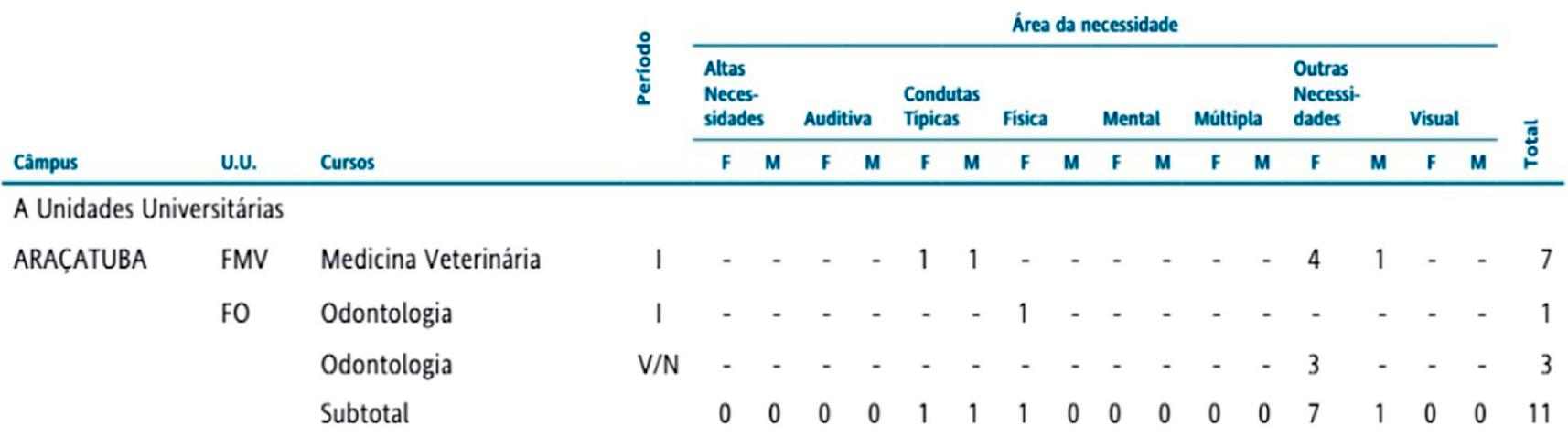
Source: Institutional Yearbook [base year - 2021] (UNESP, 2022).
UNESP. São Paulo State University “Júlio de Mesquita Filho.” Statistical Yearbook 2022: base year 2021. São Paulo: UNESP, 2022. Available at: https://www2.unesp.br/portal#!/anuario. Accessed on: August 10, 2024.
Translation note about figure 1: Alunos matriculados na graduação (ingressantes e veteranos) com necessidades especiais: Undergraduate students enrolled (new and returning) with special needs; Area de necessidade: Area of need Cursos; medicina veterinaria, odontologia:Programs: Veterinary Medicine, Dentistry Altas necessidades; High support needs Auditiva, condutas tipicas, fisica, mental, multipla, outras necessiadades, visual: Hearing Behavioral Physical Intellectual Multiple disabilities Other needs Visual
Figure 1 Statistical data of students enrolled in the university’s undergraduate programs.
The institutional choice to define SEN (Specific Educational Needs), described as “special needs” in Figure 1, does little to contribute to understanding the needs of students enrolled in undergraduate programs, as noted by Martins and Louzada (2022) in their discussion of the topic10. Even acknowledging that the protocol is not the only one adopted by the institution to refer to this group’s delineation, they observe that the lack of clarity in the use of the term SEN only accentuates the maintenance of the dichotomythat SEN continues to be conceived as synonymous with the typification of disability (Martins; Louzada, 2022). In line with the aforementioned considerations, it seems reasonable that the census protocols describe in the enrollment indices of incoming students which resources would be most urgent to ensure their full participation in academic activities. Moreover, for graduates, it is essential to indicate which supports were provided by the institution throughout their academic journey these include the use of specialized resources/services, the use of Brazilian Sign Language (Libras), adapted transportation for physical mobility, screen reader software, extended time for exams, differentiated methodologies, among others.
Martins and Louzada (2022), in depicting typification/categorization as an implicit conceptual element in the census instruments directed at the target audience of the analyzed policies, warn of the risk that universal practices “around normality/abnormality, based on an abstract and ahistorical conception of the subject, guided by closed concepts and premises structured in a deterministic logic,” merely reinforce “[...] affirmations of the same: the disabled is; the disability is; education of the disabled is; the disabled world is” (Berberian; Martins, 2015, p. 35).
Reflections of this nature have led universities to reassess their institutional policies for evaluating disability in the confirmation protocols of the declared condition, in accordance with the Quota Law (Brasil, 2016a).
In light of the social model of disability, as described in the Brazilian Inclusion Law - Statute of the Convention on the Rights of Persons with Disabilities (Brasil, 2015), these protocols now consider individuals in situations of disability as those “who have long-term impairments of a physical, mental, intellectual, or sensory nature, which in interaction with various barriers may limit their full and effective participation in the university and society” (Brasil, 2015).
Article 2, § 1 of this law directs that the person should be “evaluated based on the biopsychosocial model by a multidisciplinary and interdisciplinary team, considering:
I - the impairments in body functions and structures;
II - the socio-environmental, psychological, and personal factors;
III - the limitation in activity performance; and
IV - the restriction of participation.
Since then, civil society representative organizations, specialists in various fields, public managers, and people with disabilities, all committed to ensuring that the State recognizes, reforms, and adapts disability assessment models and instruments through a biopsychosocial approach, hope that this will bring about significant changes to the understanding of disability. This shift is reflected in institutional management practices and in the census data from the National Institute for Educational Studies and Research Anísio Teixeira (INEP) in Higher Education.
More recently, these and other measures have been mobilizing coordinated action by the Secretariat for People with Disabilities of the Ministry of Human Rights and Citizenship in Brasil under the Lula government (2023-2026). Through Decree No. 11,487/2023, a working group (GT) was established, responsible for initiating the process of implementing a unified disability assessment system. This system aims to support the development of the Unified Biopsychosocial Disability Assessment Proposal, based on the International Classification of Functioning, Disability, and Health (ICF). The group’s tasks also include proposing the processes for the implementation of the Unified Biopsychosocial Disability Assessment at the federal, state, and municipal levels, and evaluating and finalizing the Modified Brasilian Functionality Index (IFBrM). This index will be systematized through the management of Brasilian policies across all social sectors, including social security, education, work, health, leisure, and others, as demonstrated in the study by Vilela et al. (2023).
In order to determine who is or is not considered a person with a disability, especially for the purpose of accessing public policies materialized through guidelines inspired by the principles of the social model, the IFBrM (Modified Brasilian Functionality Index) was developed as a reference that better reflects the principles and values of functionality levels. It sees functionality as a dynamic interaction between health conditions and contextual factors, both personal and environmental, of individuals, unlike the ICF (International Classification of Functioning, Disability, and Health), which has traditionally guided the practices of assessing the functional capabilities of people with disabilities from a biopsychosocial perspective in fields such as health, employment, and others.
Beyond these considerations, it is important to determine whether the ongoing evaluation form (IFBrM) will be able to interact with markers of exclusion related to race, ethnicity, differentiated linguistic conditions, gender identity, etc. These markers, depending on the situation experienced, may obstruct individuals’ participation in different spheres of social circulation. This situation is expected to emerge once the IFBrM is implemented in official public services within the Brasilian federation.
Influenced by the references described here, the Coordinating Body for Affirmative Actions, Diversity, and Equity (CAADI) at the university under investigation published reports on the census profile of the university community students, staff, and professors referencing different social markers of difference. The report was produced by this coordinating body at the request of the vice-rectors, with the objective of creating an institutional plan that embraces differences and focuses on the inclusion of various ethnic-racial segments (Black, Brown, and Indigenous people), people with disabilities, and promotes gender equity and respect for sexual diversity. The material was created based on the recommendations of the Higher Education Census, coordinated by INEP (National Institute for Educational Studies and Research), and completed by all Higher Education Institutions in Brazil. The data gathered refers to the following categories: gender, social name, course, marital status, age group, network in which the student completed high school, quota-based admissions (racial quotas), race (color), disability, students from other states (outside São Paulo), and scholarship holders.
Despite observing progress in the way the issues addressed in this study are portrayed, there are still doubts about the procedures adopted to define the profile of students stratified in the CAADI report - specifically regarding those in situations of disability. This is due to the fact that their designation is recorded differently in institutional protocols (SISGRAD) when compared to the same group referenced in the Institutional Statistical Yearbook, where they are referred to as students with “Specific Educational Needs”. As a result, uncertainties remain about the conceptual references of disability that prevail in institutional policies, as previously referenced in a study by Martins et al. (2022). Promoting protocols that recognize these aspects constitutes a challenge for those involved in this process. No less important, the following data will highlight other aspects of the institutional management’s work regarding the challenges of providing mentoring services to students with SEN at the university.
Nucleus 2: didactic-pedagogical strategies used in the classroom context
In the field diary records analyzed, the predominant themes were linked to the didactic-pedagogical strategies for supporting students with SEN (Specific Educational Needs). After confirming the students’ interest in the program, the mentor would schedule an interview to discuss the students’ complaints and/or educational needs. During these meetings, the mentor would also provide information about the NAPI (Pedagogical Attention and Inclusion Program) operations within the unit. If the student’s enrollment in the program was confirmed, a follow-up meeting would be scheduled to develop an academic work plan together (mentor - assisted student). Examples of statements that illustrate the start of activities include: “Introduction, Initial Interview. Introduction, identification of difficulties, student expectations” (T1, T4 e T2-E1).
In this regard, Fernandes and Costa (2015) emphasize the importance of establishing a connection during the first sessions of mentoring and learning support in university contexts. This statement aligns with the personal experiences of the participants, in that positive engagement from the beginning of the mentoring process is essential for the success of peer mentoring programs.
Regarding the activities developed and the strategies adopted to support these academic demands, such as reflective reading activities, the participants report:
We opened the classroom together, encouraged the student to choose the text that caught their attention the most, and explained reflective reading. Due to the format of the text, with many metaphors, it was necessary to break them down one by one. It was not possible, as the professor desired, for the student to independently formulate critical questions about the topic presented. In this regard, the mentors were the ones asking the questions in an attempt to guide the student toward their own reflection (T1 e T2-E1).
The goal of this meeting was to train a good synthesis, reading, and greater mastery of the content through the creation of slides about the student’s thesis topic, while also preparing for the upcoming presentation. He created a PowerPoint file with 25 slides for this meeting, incorporating our suggestions/changes from the previous meeting. We discussed presenting the proposal more formally, working on posture and speaking, with the understanding that the audience may not always be familiar with the topic. We suggested making a brief introduction to each section of the thesis before addressing it. We also discussed aligning images, adding captions, citing sources, font formatting (color, emphasis, alignment, size), grammar, and agreement throughout the presentation (T6 e T7 -E7).
It was possible to observe, from the highlighted excerpts, that the students faced difficulties in completing tasks such as reflective reading, synthesizing, and presenting assignments, among others. In response to the demands mentioned by the students, the mentors played a collaborative role in guiding the study planning and monitoring these tasks, recording their perceptions about the students’ performance in the activities carried out.
In the pedagogical planning actions, the mentor sought to establish, in partnership with the student, a study routine that addressed the ongoing demands. As an example, they prioritized certain strategies:
Alignment of routine and activities. The assignments and tasks that the student had were reviewed, and we aligned them in the schedule, ensuring that there were no pending tasks and that the routine was well organized. (T2-E3).
The organization of all the hours for a complete week was planned, including class times, study periods, and college assignments. In the end, he was advised to print his schedule, try using it, and note any suggestions for improvements, schedule conflicts, and other issues that he deemed necessary throughout the week. The goal was for him to be able to create his own weekly schedule independently the following week and make it a habit (T6 e T7-E7).
Creation of the schedule, identifying overdue tasks (T1 e T2-E1).
Regarding the offer of peer mentoring programs in Higher Education, Almeida (2012) highlights the importance of the following aspects: 1) identifying the desired life experiences, 2) setting goals to be achieved, 3) determining the intensity of support needed to reach these goals, with the development of an individualized support plan, and 4) systematic monitoring of progress, followed by 5) evaluation. The incorporation of these elements into the design of academic support is considered by the author as essential for the work of personalizing and adapting interventions according to each student’s specific needs.
In the same vein, Rocha and Miranda (2009) emphasize the necessity of investments directed towards the entire university community, which address the creation of accessibility and inclusion centers aimed at supporting students with SEN, with particular attention to those living with disabilities. They also highlight the importance of interdisciplinary work among professionals from areas such as Pedagogy, Psychology, Psychopedagogy, Speech Therapy, and Information Science, who are responsible for ensuring Specialized Educational Support (AEE) for students at all educational levels, as recommended by the inclusive educational policies referenced in this text (Brasil, 2008, 2011, 2015).
Nucleus 3: challenges faced by mentors in their duties during the pandemic
During the pandemic, university classes were offered remotely. The challenges faced by the mentors throughout this period were related to the lack of technological infrastructure, due to poor connectivity for carrying out academic activities from home. They also mentioned that the students’ limited mastery and knowledge of technological tools, combined with the poor technological infrastructure in their homes, worsened the challenges they faced. These factors became barriers to learning and required creativity to accomplish certain tasks. Below are excerpts from the diaries that describe the situation experienced:
Justified Absence: Lack of Internet Access (T1 and T2 - E1). The reason was that their computer caused some delays, as it took too long to open the files (T6 and T7 - E7). The student E5 had very poor internet access (T5 - E5 and E6).
The student shared their screen, and we accessed the classroom together, guiding and showing how to navigate on the platform. Still sharing the screen, the student uploaded texts and asynchronous activities to the drive folder (T1 and T2 - E1), as well as spreadsheets and presentations (T2 - E3; T5 - E5 and E6), though with difficulty.
Among the tools available for remote guidance, Classroom was used for peer mentoring. Considered a content management platform in the educational field, commonly known and employed by university students, it was used in such a way that students could complete extracurricular activities for their courses with autonomy and independence. This situation was not always easy for both the mentors and students, as it required adequate technological knowledge and support to carry out the tasks, which were linked to studies and mastery of the available Information and Communication Technologies (ICTs) used in academic contexts.
Fernandes and Costa (2015) emphasize the importance of ongoing training for the team working in peer mentoring programs, both in remote and/or face-to-face formats. These programs can be characterized in different ways: 1) Peer Mentoring for the Entire Class; 2) Peer Mentoring Across Ages; 3) Peer-Assisted Learning Strategies; 4) Reciprocal Peer Mentoring; 5) Peer Mentoring for the Same Age Group. They also highlight that the success of the mentor-mentee relationship requires appropriate training for the mentors in order to collaboratively support the learning of the mentee. The sessions should be planned based on an interaction script that guides mentors in their responsibilities. This makes prior training, especially for mentors, a crucial requirement to transform the collaborative interaction into a genuine mentoring relationship, where each member of the pair fulfills their role effectively. The mentor’s duties encompass a range of responsibilities, from academic aspects to motivational ones. Therefore, it is imperative to create an environment of trust and empathy, providing mentees with authentic support through both synchronous and asynchronous interactions.
In the same direction, Oliveira, Nozu, and Rebelo (2023) argue that flexible communication environments contributed to overcoming the challenges related to connectivity during the pandemic and can limit the use of distance learning platforms and teaching strategies, which were not always available to those involved. Thus, creativity and partnership in carrying out tasks were highlighted by the authors as key factors in developing strategies that could enhance learning experiences in a creative way within the students’ routines.
In the study in question, it was observed that low attendance and participation in scheduled mentoring sessions became a challenge in motivating the students’ presence in the program:
The contact was made to schedule the meeting, but the student refused to participate (T3 and T4 - E4). The students have not been consistent in the NAPI program, making it difficult to finish an activity. When A5 attends, A6 is absent, and when A6 attends, A5 is absent (T5 - E5 and E6). Unjustified absence (the student reported already having another commitment) (T1 e T2-E1).
Similar circumstances to those previously exemplified occurred at specific moments, being emphasized by the mentors as challenging, as mental health issues and time management problems for the mentees worsened.
It is well-known that effective time management has become a recurring challenge in today’s world, especially when balancing academic demands with personal life responsibilities. The university context requires careful organization to manage readings, deadlines, assignments, and to establish a study routine. The transition to remote learning, according to Losekann and Mourão (2020), triggered the need to adapt to a new way of sharing the same space for various activities, and this was no different in the context of studies.
Final considerations
Regarding the documentary and census data presented in the study, it is observed that the intersectional perspective on the topic has become an evolving element in the analyzed policies and literature. The manuscript highlights the need to promote more in-depth studies on how affirmative and inclusive education policies reflect conceptual aspects of understanding disability in their institutional political-administrative guidelines and in eliminating barriers to access and retention of students with disabilities in Higher Education.
Above all, it emphasizes the need to establish protocols and/or census procedures capable of demonstrating how the prejudices, stigmas, stereotypes, and discrimination suffered by these individuals interact with their specific demands, allowing for an understanding of
[...] who their students are in their various dimensions, organizing and preparing to meet their distinct educational needs; creating inclusive and clear institutional policies for student retention, grounded in an intersectional perspective of disability alongside other social markers, and providing spaces and the creation of collectives, promoting greater visibility and awareness for all who circulate in the university (Martins et al., 2022, p. 14).
Through the provision of tutoring, it was noted that the NAPI has played an important role in providing pedagogical support for the retention of university students who identify with specific educational needs (NEE) at the university. The tutoring program, aimed at academic guidance supervised by course instructors, has become a fundamental didactic-pedagogical action in the students’ formative process. The connection between theoretical and practical knowledge provided an opportunity for both the university students and the professionals involved to recognize themselves as active participants in the consolidation of inclusive policies within the university.
The challenges faced by the team went beyond the lack of technological resources inherent to remote and/or post-pandemic in-person learning, as previously mentioned. Creativity in planning, linked to time management actions to balance the execution of the study plan, represented crucial moments in establishing the daily routine carried out in the students’ formative experience both the tutor and the mentee.
Pletsch, Souza, and Orleans (2017) highlight the importance of diversified measures and more flexible curricula, considered a key point to expand participation in classroom practice. From the Universal Design for Learning in Basic Education, they refer to pedagogical-curricular proposals that consider differentiated strategies, pathways, and modes of organizing teaching and learning work, not just for those who identify with disability. They point out that this approach may be a necessary path to address the specificities (or specific demands) of students, whether cultural and/or stemming from the elimination of barriers to their participation in different contexts (Pletsch, 2017, p. 270), constituting an essential element for the educational success of all, at all levels of education.
Thus, it is essential to strengthen and consolidate qualified teams to work in an intersectoral and collaborative manner, with emphasis on hiring and/or maintaining specialized professionals, preferably in the field of Special Education studies. This configuration, indicated in the “Living Without Limits” Plan for Federal Technological and Higher Education Institutions (Cabral; Melo, 2017), although threatened by cuts in government resources allocated to its implementation in higher education institutions, remains urgent and necessary. Such measures must prioritize the planning of flexible curricular practices, the production of academic materials in accessible formats, the management of support and/or specialized services that enable innovation in pedagogical practices for all in university education (Furtado, 2016).
Differentiated methodological programs for services and/or resources in removing barriers to learning and access to the curriculum, such as those highlighted by NAPI, have made (and continue to make) a difference in the goals of the mentioned programs. Affirmative political-administrative actions from an intersectional and inclusive perspective can provide a promising environment in the fight against ableism in university life.

