




 texto em
  Inglês (pdf)
 Artigo em XML
 Tradução automática
 Enviar este artigo por email
 Permalink

Introduction
Commonly, in the Brazilian context, public education is recurrently characterized as to the physical and material precariousness of public education networks, in addition to teacher training and working conditions. In this situation, built school representations tend to reduce educational projects in their power to promote the development of new ways of understanding the world and positioning oneself in it (Freitas, 2007; Libâneo, 2012; Sampaio, 1998).
Accordingly, it is also necessary to consider that school conditions are diverse in the multiple contexts coexisting in Brazilian society and that there have been advances in public education in basic education, especially after the promulgation of the 1988 Constitution. These changes and advances, the different social, political and economic forces that contribute toward or against them, and the built representations on the operating conditions of basic schools have different impacts on the design of curricular propositions and the decisions of teachers about their pedagogical practices.
Moreover, the history of each education network provides elements that produce significant marks on the choices of education departments and schools and their subjects. In the case presented here, the history of the São Paulo municipal education network (RME-SP) should be noted; during Paulo Freire’s term as Secretary of Education of the Luíza Erundina administration (1989-1992), the network saw experiments of active participation of education professionals in the design and development of proposals oriented toward improving the quality of education.
Another aspect to be considered in analyzing the education provided in the education networks is what is socially expected from schools. This article affirms a conception consistent with the positions of other authors who understand schools as places for the development of knowledge and ways of thinking that enable students to obtain a comprehension of the world that adds new perspectives to those that already allow them immediate experience (Young, 2007; Libâneo; Silva, 2020; Hoadley, 2018).
Thus, decision-making about what should be taught in schools - and how - constitutes the object of reflection in the present work, with a view to discussing the curricular and pedagogical choices expressed in a reference curricular document produced by a municipal department of education, in response to the National Common Curricular Base (BNCC), a normative-based centralizing document. Hence the research question: how are the teacher and student models expressed and the interaction between these subjects and between them and the knowledge valued in a document of this nature?
In Brazil, the curricular proposals designed by the federative entities are related to federal prescriptions. This relation was not mandatory until recently; however, this changed with the publication of the National Common Curricular Base (BNCC) (Brasil, 2018), establishing that this document must mandatorily be the reference for all curricular proposals.
Analyzing trends assumed in proposals from the 1980s and 1990s, Barretto (2000) recognizes that, even with the autonomy that states and municipalities had, in the period there were more similarities between these documents than differences. According to her, these proposals “reflect an ideology that permeates society more widely through its institutions and the social forces that animate them, an ideology that goes beyond the particular interpretation, made by the segments in power, of certain educational principles and assumptions” (Barretto, 2000, p. 7, free translation).
The author says that the principles and values disseminated widely in society have significant force on the curricular choices made in different dimensions. This even goes beyond the national scope; in a context of globalization, there is a tendency to the dissemination of discourses that foster certain ways of living, certain behaviors and values that also tend to make curricular reforms more and more similar in different countries.
In this regard, Hoadley (2018) identifies similarities between reforms in developing countries, while considering the specificities of each context. The characteristics of these reforms have also been observed here since the late 1990s, notably the emphasis on student-centered pedagogies and constructivism.
These similarities between reforms tend to configure a pedagogy to be taken as an object of study. It is related to what Nóvoa and Alvim (2022, p. 13, free translation) recognize as the three coexisting trends currently: “the reduction of education to learning; [...] a hyperpersonalized view of learning; and the defense of a consumerist perspective of education,” with all their implications to the work conducted by teachers and students.
The understanding of pedagogy is not limited to technical and/or psychological discussions. On the contrary, it is considered that it is not a matter of “questioning the ‘thematic or methodological content,’ but describing and explaining the logic of its modalities of intervention in knowledge and in the production of specific orders and forms of relationship and identity” (Diaz Villa, 2019, p. 21, free translation).
This implies examining the grammar of the school, condensed in the pedagogical device (Bernstein, 2000). This device gathers three sets of rules - distributive, recontextualizing and evaluative - that enable identifying how knowledges of different natures are transformed into school knowledge and transmitted through pedagogy. Very briefly, we can understand that
To explore cultural transmission is to explore pedagogy, to explore the positioning of individuals and social groups in dominant discourses and practices and in modes of control; it is to explore how, through these practices and their intrinsic forms and languages, life models are transmitted [...] (Díaz Villa, 2019, p. 16, free translation).
With this perspective of pedagogy, this article addresses the discourses that transmit models of teachers and students, as well as the types of relationships between these subjects that are legitimized and valued in the current context. As done by Galian et al. (2021), focusing on federal documents, this study seeks to know how these models are identified in a municipal curricular proposal, the City Curriculum, developed in response to the standardization of a single national curricular base. The authors point out that, in the National Curriculum Parameters (PCNs), education and teaching work are not disassociated, differently from what the BNCC does. In it, education is characterized as a process that is independent from the subject who produces it, in the same way that learning is characterized as a process that is independent from those who learn.
It could be expected that this disassociation would also be expressed in the City Curriculum, given the force of law with which the BNCC is invested. However, the curricular process involves several transformations (Gimeno Sacristán, 2000) and, among these, we must consider those fostered by the history of the network, which brings marks to the models of teachers and students promoted in it. In other words, we are dealing with the understanding that
[...] the curriculum, always elusive, is marked simultaneously by tradition and resignification, and the curriculum policy is an expression of the struggle for fixing meaning, subjectivation and addressing of identities, including the very identity of what the curriculum is (Santos et al., 2019, p. 240, free translation).
Hence the relevance of document analysis not taking the prescribed curriculum as the only defining aspect of what is developed in the curricular process, although it is a representative element of the ways in which public policies for education are designed.
In this sense, the field of research on educational policies has relevant contribution to analyses of this nature. That is the policy cycle approach, conceived by Stephen Ball and Richard Bowe and used in several studies developed in Brazil (Lopes; Macedo, 2011; Mainardes, 2018; Moreira, 2017; Stremel; Mainardes, 2018). In this approach, according to Carrijo (2021, p. 1220, free translation), “the analysis must ‘[...] focus on the formation of the discourse of the policy and on the active interpretation that professionals working in the context of practice do to relate the texts of the policy to practice” (Mainardes, 2006, p. 50). Also according to the author, in the policy cycle, the contexts in which the policies are developed - of the influence, of the production of texts and practice4 - are interconnected and are not organized according to a temporal or linear sequence. The research dealt with in this article focuses on the context of the production of texts, which, according to Carrijo (2021, p. 1221, free translation), can be understood as “representatives of the policy showing, with certainty, the obscurities and controversies” present in the context of the influence, where interest groups compete with a view to “influencing the destination of education, that is, its social objectives.” Furthermore, in line with what is assumed in this article, Carrijo (2021) refers to the context of practice as a domain marked by instability and ambiguity, where “changes in policies can happen and interpretations can create other policies, [...], through the active role of the subjects involved” (p. 1221, free translation).
Following this Introduction, we address the curriculum conceptions that support the theoretical and methodological choices of the research on which this article is based, giving special relevance to its understanding from the perspective of Basil Bernstein’s theory. Subsequently, we present the methodological path and the results, together with their discussion, and then the final considerations.
Curricular proposals and the projection of teacher and student models
It is reinforced that the prescribed curriculum, despite lacking absolute correspondence with what is effectively developed as a curricular process, has material and symbolic effects on it (Gimeno Sacristán, 2000). From a material point of view, its choices guide the distribution of resources, the production of teaching materials, the distribution of the workload of the different school subjects, the selection of themes for the initial and continuing teacher training, etc. From a symbolic point of view, they outline expectations about the teachers’ role in the education process, as well as about the students’ role in the learning process. They also legitimize forms of interaction between these subjects and between them and the knowledge mobilized to fulfill the educational objectives assumed.
These texts express clashes between distinct positions in the field of education - in addition to others, linked to diverse social, economic and/or political interests5. Hoadley and Muller (2023, p. 97, free translation) are also in line with this viewpoint, when they state that “what is to be taught, how it is organized, who it is intended for - in other words, the curriculum, is of crucial concern when thinking about human development and the role of education in shaping people.”
The analysis of the agreements expressed in curricular documents aims to foster the recognition and criticism of choices that are inconsistent with the promotion of conditions for the development of quality public education for all. It is not ignored, however, that the reflections presented herein are restricted to one dimension of the curricular process; it is also not stated that the prescribed curriculum has - or should have - direct correspondence with what materializes in the real curriculum.
Shifting the focus to these agreements and the choices arising from them, Hoadley and Muller (2023) see similarities between recent curricular reforms in developing countries. They note global changes in curricular policies, which have been informing specific conceptions of human development and the identities of students - and, undoubtedly, of teachers, as well. Referring to these global changes over time, Hoadley and Muller recognize three major movements: the first, which they call “progressive,” the second, aimed at consolidating outcome-based curricula; and the third, developed in response to the detection of a “learning crisis.” In this regard, they state that
[...] the 2019 Human Development Report [published by the United Nations Development Programme (UNDP)] [...] confirmed a “learning crisis”: the ‘great expansion of education’ did not turn into significant gains in learning where great inequalities existed (Hoadley; Muller, 2023, p. 105, free translation).
The discourses on this “crisis” were followed by a shift towards the establishment of generic skills to be developed by students, with an emphasis on “the measurement of learning, with the purpose of quantifying the crisis accurately” (p. 105, free translation). From the point of view of the teacher’s work, this emphasis on learning outcomes would have led to inattention in relation to teaching. In other words, attention shifted from pedagogical issues and teacher competence to student outcome in large exams, with all the consequences this represents for the assignment of roles for them and their teachers, as well as for the relation between curriculum and pedagogy.
In Brazil, Santos et al. (2019, p. 241-242) also identify consequences of this nature when dealing with the uses that have been made of student outcomes in large exams, in order to define responsibilities for teachers:
The outcomes obtained, the insufficient scores, in general, more than contextualizing intervention paths, indicate the training deficit of those who should teach, disregarding other important variables of the educational process, such as infrastructure, socioeconomic level, mismatch or difficulty in defining what should be evaluated and how it should be evaluated, (mis)understandings about what is meant by curriculum, evaluation, knowledge, among other elements of the educational context.
Having noted the complex nature of the processes of design of curricular proposals, the agreements that these texts express and the trends that they reinforce as to he formation of teacher and student identities, we then address Bernstein’s contribution to a sociological understanding of school education.
The curriculum from the perspective of Bernstein’s sociology of education
Bernstein (2000) already noted that curriculum reforms arise from clashes between groups that aim to advocate their perspectives and concerns in educational policies and practices. Thus, the expectation in relation to a curricular reform is that the perspectives and concerns consolidated in the official documents materialize in moral dispositions, motivations and aspirations of students and teachers, and/or that they are incorporated into their performances and practices. Different ways of managing the expected changes will operate in order to make these perspectives mark the experience lived by teachers and students, establishing contours for their pedagogical identities.
One of these ways concerns the selection of knowledge to be taught in schools; for the author, this process involves movements of decontextualization and subsequent recontextualization of this knowledge, composing objects of study whose study aims at fulfilling the purposes for which this institution is intended in specific socio-historical contexts (Bernstein, 2000). In this process, the pedagogical discourse is built, which consists in the introduction of an instructional discourse (ID), related to the knowledge selected in its fields of production, on a basis constituted by the regulatory discourse (RD), associated with values, rules of order, relationship and identity, rules of conduct and behaviors legitimized for school education. It is precisely through the strength of the RD that the models of teachers and students and the forms of interaction between these subjects and the knowledge mobilized in the school are disseminated. According to Bernstein (2000, p. 34-35, emphasis added, free translation):
The recontextualizing principle not only recontextualizes the “what” of pedagogical discourse, which discourse will be the subject and content of pedagogical practice. It also recontextualizes the “how”; that is, the theory of instruction. [...] The theory of instruction also belongs to the regulatory discourse and contains in itself a model of learner and teacher and of the relationship between them.
As an example of analysis of pedagogical text from this perspective, Neves and Morais (2010) emphasize the elements of pedagogical discourse in official documents, with regard to science teaching, in two Portuguese curricular reforms in the 1990s. The authors sought to identify the extent to which changes would have occurred with regard to the relationships underlying the teaching-learning process in science programs. Highlighting excerpts from the documents, they focus on the instructional discourse and on the regulatory discourse. The analysis showed that the 1995 reform introduced changes compared to that of 1991, especially at the level of the general intentions of the curriculum; at the level of science teaching contents, that was less significant. In the general intentions, there was a prevalence of the aim to show how teachers should act to make teaching more efficient, without proposing significant changes in the content considered relevant. It was also observed that what is reinforced at the level of general intentions is close to the principles established in legal texts, such as the country’s Constitution and the Portuguese education guidelines law, which constitute a general regulatory discourse.
In Brazil, in 2017, Coelho conducted a survey of academic production that deals with the design of curricular documents oriented toward the teaching of Sciences (2010-2014), in the country and in Portugal, and which have Bernstein’s theory as the main element of theoretical foundation. In the study, the author observed the importance of the researches carried out by the Classroom Sociological Studies Group (ESSA), of the University of Lisbon, which, in the period, carried out the largest number of researches that adopted this theoretical reference and supported studies developed in Brazil, as well. According to the author:
It was observed [in the surveyed production] that the concept of recontextualization presented by Bernstein is the most present in the analyzed researches, followed by the ideas of the OPD [Official Pedagogical Discourse], RPD [Reproduction Pedagogical Discourse], vertical discourse and horizontal discourse (Coelho, 2017, p. 805, free translation).
The Portuguese articles used by Coelho (2017) focused primarily on the analysis of the official pedagogical discourse6 (OPD), materialized in curricular documents produced within the scope of a curricular reform that occurred in 2001. Based on the analysis of these productions, the author notes
[...] the need to foster continuing teacher training, due to the observation of decreased complexity of scientific knowledge and research skills in the recontextualization of the OPD for practices conducted in the classroom. The same was found in researches developed in our country (Coelho, 2017, p. 806).
In another article, Silveira et al. (2022) focus on the potential of a Bernsteinian approach to analyze the implementation of curriculum policies. The authors suggest a path to be followed in the process of analyzing the curricular texts produced in the official scope:
After identifying and selecting the texts that compose the official discourse, in accordance with the research issues and objectives, a careful reading is necessary to identify in these documents the main statements and meanings that seek to regulate pedagogical practice and introduce certain changes in the field of practice. While reading, it is important to be attentive to the key words or expressions that support the official discourse. They are usually those on which the meanings and purposes of education are based or aim to produce consensus, which express the changes or reforms instituted in the policy in question (Silveira et al., 2022, p. 9).
Another important suggestion of the authors is to take into account the coherences or inconsistencies within the same text and in the set of texts that compose a curricular policy at a given historical moment: “It is these reference universes expressed in the official grammar of the policy that need to be apprehended by the researcher to later understand what, in the field of practice, will be recontextualized” (Silveira et al., 2022, p. 9, free translation). The authors continue, stating that
[...] a discourse or text is subject to various possibilities of recontextualization, depending on the many fields and contexts in which they are situated. Like a discourse or text produced by a State Department of Education (SDE), these can be recontextualized in specific school contexts, suffering interference from the power relations of the recontextualizing field between the SDE and the cultural context of teachers7 (Silveira et al., 2022, p. 10, free translation).
In this article, as will be explained below, a path was traced that is similar to what is proposed by Silveira et al. (2022, p. 9, free translation), extracting excerpts from a document produced by a municipal department of education, seeking to “identify [...] the main statements and meanings that seek to regulate pedagogical practice and introduce certain changes in the field of practice,” notably in the definition of teacher and student models. These statements were then classified according to the emphases they assume, either in the ID or in RD, configuring a specific pedagogical discourse.
For Hoadley (2018), it is especially the RD that expresses these general intentions, that is, the curriculum is influenced in degree and direction by sociological messages stemming from the socio-political context. However, this should not be understood in a deterministic manner: formal education has substantial relative autonomy from diverse economic or political demands. Even so, there are always ideological elements that inform the student and teacher model, the perspective of instruction and the moral purposes of education that will be expressed in the different dimensions of the curriculum throughout the recontextualization process.
The research whose results are presented in this article sheds light on the general intentions expressed in the curriculum prescribed for the RME-SP, notably the teacher and student models projected therein, as well as the legitimized type of interaction between them, maintaining the clarity that the effectively developed curriculum is not being explored in the investigation.
A path for the analysis of curriculum texts
In this work, we observed the principles assumed by the department of education to guide the RME-SP, expressed in the City Curriculum (São Paulo, 2019). It is interesting to nopte that, in any curricular reform, the official pedagogical discourse (materialized in official documents) reflects a recontextualization of the general regulatory discourse. In this sense, changes in the dominant principles of society give rise to changes in the sociological messages conveyed by the pedagogical discourse of curricular projects.
The choice of Part 1 - Introduction to the City Curriculum: Elementary Education for analysis is justified by the fact that its positions define conditions for the conduct of teaching work and for the education of students in the municipality. In all sections, intended for each curricular component, the same introductory text analyzed here is repeated. This article refers to the Mathematics section only to be able to indicate the numbering of the pages, when making citations; no specificity was dealt with in relation to such curricular component.
With the qualitative approach adopted, we sought to identify excerpts representing two categories: one, referring to the student model, the theories of instruction and the principles of moral order (which defines the regulatory discourse - RD); and the other, related to the knowledge considered relevant for education (which defines the instructional discourse - ID). The excerpts were thus classified according to the references made in them to elements of ID and RD - using, to this end, the NVivo software - followed by the objective of identifying the balance achieved, in the analyzed document, in relation to these two discourses - which characterizes the pedagogical discourse.
Far from intending to separate these dimensions in a static manner, which would be contradictory to the relational character they establish in the design of the pedagogical discourse, the approach adopted aimed to discuss the specific balance between aspects of the instructional discourse and the regulatory discourse assumed in the document under analysis - in this sense, it is also worth noting that the way of establishing relationships between these two discourses is, for Bernstein (2000), what builds ideology - and the teacher and student models that are thus valued in the text. Furthermore, it is believed that the treatment in the analysis of data related to a particular document has the potential to contribute to the field of education, notably in the line of sociology of education, by representing a possible way to analyze other texts8, whether curricular proposals, textbooks, lesson plans, etc.
Emphasis on the constitution of the pedagogical discourse and the valorization of certain teacher and student models
A first approach aimed to characterize the specific balance between excerpts in which the ID is emphasized and excerpts in which the RD is emphasized, in order to recognize what is central in the Introduction: the affirmation of values/principles, the regulation of teachers’ and students’ behaviors and/or the establishment of principles that will guide school practices (RD); or references to the knowledge to be taught (ID). It is worth mentioning that the same excerpt can bring together aspects related to ID and RD; therefore, we sought to recognize which element is emphasized in each excerpt. Then, the work of grouping the excerpts by similarities led to the categories used being unfolded into three subcategories, defined according to the emphasis assumed in them (see Figure 1): the issues related to the teacher’s work (Teacher-Teaching), the students’ work (Student-Learning) or the interactions between teachers, students and knowledge (Interactions).
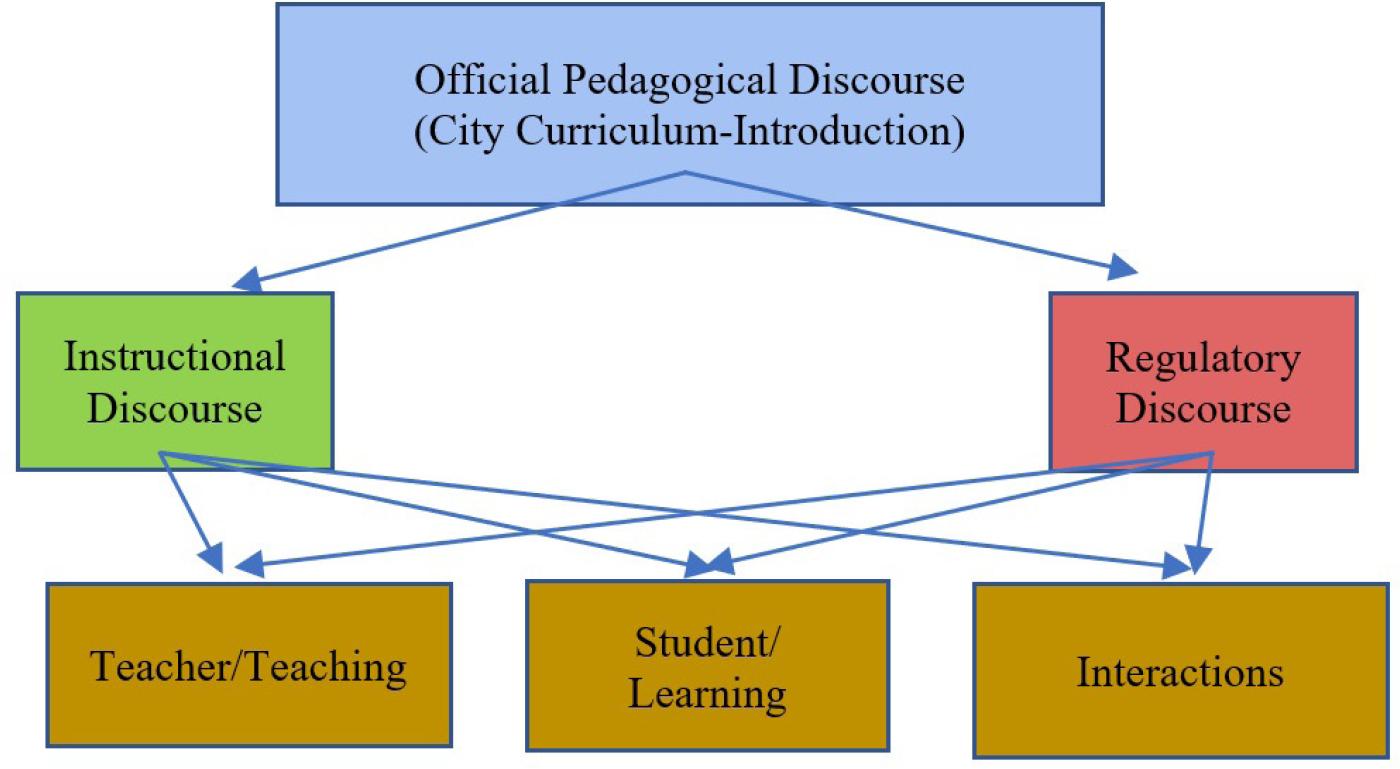
In the analysis, in line with Neves and Morais (2010, p. 227, free translation), the identification of “sociological messages present in a given pedagogical text (program, textbook, teaching practice) was carried out, with respect to the multiple relationships that characterize the teaching-learning process.” As the authors point out: “the messages expressed by the analyzed texts should be considered only as representatives of intentions and not as indicators of what is effectively transmitted or practiced, much less required” (p. 243, free translation).
The methodological treatment of the Introduction document of the City Curriculum highlights the emphasis given to RD in the design of the pedagogical discourse: having classified 102 excerpts, 42 were linked to ID; 58, to RD.
Chart 1 presents some examples of the type of classification operated. They show that those in which ID is prevalent explore the definition of knowledge to be addressed at schools and the justifications for these choices. There is affirmation of the character of cultural construction of knowledge, the role attributed to school contents in school education, and the diversity of types of knowledge valued for teaching. Those that emphasize the RD emphasize the centrality given to students in the development of the curriculum, the choices aimed at their support and participation, as well as the relationship established between the expected learning and the change in understanding and quality of life, individual and collective.
Chart 1 Excerpts in which aspects related to ID and RD are prevalent9
| Prevalence of Instructional Discourse (ID-RD) | Prevalence of Regulatory Discourse (RD-ID) |
|---|---|
| “The curriculum involves the different wisdoms, cultures, knowledges and relationships that exist in the universe of an education network. Therefore, it is the result of a cultural construction that gathers diverse perspectives and several meanings produced according to the contexts, interests and intentions that permeate the diversity of actors and actions that occur inside and outside the school and the classroom” (São Paulo, 2019, p. 17, free translation). | “The fundamental purpose of a curriculum is to provide conditions and ensure the full learning and development of each student, as determined by Brazilian legal frameworks. Curricula also need to dialog with the reality of children and adolescents, in order to connect with their interests, needs and expectations” (São Paulo, 2019, p. 19, free translation). |
| “curricular contents are means for the achievement of full autonomy and for the resignification of the individual by themself and in their relationship with others” (São Paulo, 2019, p. 20, free translation). | “The City Curriculum, as well as the pedagogical spaces, times and materials made available by the educational units, need to support them [the students] in their entirety and promote their participation. To this end, it is necessary to know their aspirations, interests and needs, as well as to pay attention to the changes that occur throughout their development” (São Paulo, 2019, p. 16, free translation). |
| “To be overcome, these challenges require that children, adolescents and young people have the opportunity to identify, develop, incorporate and use knowledge, skills, conducts and values. The learning of curricular contents, although important, is not enough for the new generations to be able to promote the necessary social, economic, political and environmental advances in their communities, in Brazil and in the world” (São Paulo, 2019, p. 22, free translation). | “The curriculum can be considered as the core of a pedagogical proposal, as it has the function of delimiting the learning to be carried out and being the reference for the activities to be carried out in the classroom, always having the understanding and improvement of the quality of life as the basis of society, of the school itself, of the teacher’s work and of the meaning of the student’s life” (São Paulo, 2019, p. 17, free translation). |
Source: Prepared by the author.
In this approach, beyond recognizing that there is an emphasis on RD, it is possible to identify which aspects are prominent, based on the subcodes with which we worked. Thus, Table 1 shows how the 58 excerpts in which RD predominates are distributed by subcategories, in addition to providing examples of excerpts gathered in each of them.
Table 1 Recurrence of excerpts in RD-related subcategories
| Category/ Subcategories | Number of excerpts | Examples |
|---|---|---|
| Category: Regulatory Discourse | 58 | |
| Subcategory: Student-Learning |
16 |
“The childhoods are diverse. Children are social actors with their own identities and actions, who go through different physical, cognitive and emotional processes, come from different contexts, have specific needs and individual characteristics, such as sex, age, ethnicity, race and social class” (São Paulo, 2019, p. 41, free translation). |
| Subcategory: Teacher-Teaching |
18 |
“The set of teachers and educators in the network is fundamental to recognize the critical and creative capacities and enhance the cultural resources of all its students, without distinction, by considering and valuing the elements that constitute them as humans and as citizens of the world” (São Paulo, 2019, p. 24, free translation). |
| Subcategory: Interactions |
24 |
“Educational practice cannot be limited to homogeneous or standardized school tasks, which are not consistent with the inclusive perspective, since respect for the way and characteristic of learning of all is recommended” (São Paulo, 2019, p. 25, free translation). |
Source: Prepared by the author.
As for RD, it can also be recognized, in the excerpt analyzed, the preferential interlocution, especially marked by the guidelines on the organization of teaching and the role of the teacher in this process.
Table 2 shows how the 42 excerpts in which ID predominates are distributed by subcategories, with the presentation of excerpts that exemplify what was gathered in each of them.
Table 2 Recurrence of excerpts in ID-related subcategories.
| Category and subcategories | Number of excerpts | Examples |
|---|---|---|
| Category: Instructional Discourse | 42 | |
| Subcategory: Student-Learning |
7 |
“The subject is the knowing human being, the one who wants to know, in this case, the students of Elementary Education” (São Paulo, 2019, p. 46, free translation). |
| Subcategory: Teacher-Teaching |
14 |
“The teacher is the main subject for the preparation and implementation of a curriculum, since they have the function of contextualizing and giving meaning to learning, both through their knowledge and practices, and through the relationship they establish with their students” (São Paulo, 2019, p. 18, free translation). |
| Subcategory: Interactions |
21 |
“Although the function of the curriculum is not to close itself to creativity and innovation, its most fundamental characteristic is the clarity with which it enunciates principles and creates a condition and plan that foster dialog, learning and the exchange of experiences mediated by broad and significant knowledge of history” (São Paulo, 2019, p. 18, free translation). |
Source: Prepared by the author.
When seeking to explain its premises related to the knowledge to be addressed at school, or to ID, the text predominantly addresses the teacher, notably their role in the implementation of the prescribed curriculum, including indications on how they should organize the class. For example, it is said that they should think about
[...] the instruments and strategies to be used to lead all students - without exception - to knowledge and, therefore, to the development of their mental actions, enabling them to access new spheres of thought and language, attention and memory, perception and discrimination, emotion and reasoning, desire and meaning (São Paulo, 2019, p. 25, emphasis added, free translation).
It also underscores their role in the search for diversified activities for teaching: “to teach everyone, it is necessary to think about diversified activities, differentiated proposals, multiple paths that can lead to the same educational objective” (São Paulo, 2019, p. 25, free translation). Regarding this emphasis on the search for diversification and differentiation of teaching paths, it is worth noting what Neves and Morais (2010) underline, based mainly on Bernstein’s theory, on the degree of autonomy given to teachers and other professionals within the educational system. The authors note the need to consider the potential and limits of the interventions of these professionals, in terms of innovation; they depend on the recontextualizations that occur at all levels of the educational system. In other words, according to the authors, although it is clear that teachers are not only reproducers of official prescriptions, having an important role in the construction of the curriculum, “if they want to innovate, they must recognize the context and the possible influences to be taken into account in their activity, reflecting critically on the multiple paths open to them” (Neves; Morais, 2010, p. 223, free translation), which presupposes an initial and continuing training that is well based on the so-called education sciences and the promotion of dialog and decision-making, collectively by school professionals and individually by teachers. It is worth questioning whether the City Curriculum, considering the curricular process in all its complexity, maintains attention to this potential and these limits of teaching intervention when it emphasizes the innovative character to be adopted in teaching practices in order to teach everyone, leading them “to the same educational objective” (São Paulo, 2019, p. 25, free translation).
However, there seems to be greater attention to the student in the design of the RD when compared to the ID. Essentially, it is expressed in an effort to characterize them - “all students are integral, potent, autonomous subjects, and, therefore, capable of learning and developing” (São Paulo, 2019, p. 12, free translation) - or to detail the education that is desired for them - for example, when it is stated that the City Curriculum must help prepare them “for the realization of their life project and to contribute to the construction of a better world” (São Paulo, 2019, p. 20, free translation).
Both when outlining the ID and when outlining the RD, the text prioritizes the characterization of the role that the teacher must play in the preparation of the curriculum. It is noted, however, that students receive even less attention when it comes to ID; that is, with regard to the knowledges that will be mobilized in classes, the document emphasizes those that compose the cultural selection valued in it, saying little about the knowledge that students bring to school, their reading of the world. Even in the excerpts associated with the RD, the school’s work is limited to the education that is projected for students, strictly in accordance with what is defined in the City Curriculum. It is worth mentioning that even with regard to the teachers’ professional knowledge base, there is also a relative silence - the focus seems to be on defining how they should work with the prescriptions already defined, which institute the teaching work valued in the document.
Thus, in the City Curriculum (São Paulo, 2019, p. 13-14), although the curriculum is presented as “a field open to diversity,” when seeking developments of this statement throughout the text, it is recognized that the idea of diversity is restricted to “learning content in different ways,” that is, to the diversity of the students’ ways of learning (São Paulo, 2019, p. 12, free translation). These contents would already be established and in relation to this selection there would be no diversification. What is pointed out as an expectation for the teacher’s work, to respond to diversity, is that they make “didactic and methodological adjustments that take into account their [students’] peculiarities” (p. 14, free translation).
On the other hand, it is stated that the teacher “has the function of contextualizing and giving meaning to learning, both through their knowledge and practices, and through the relationship they establish with their students” (São Paulo, 2019, p. 20, free translation). It is not surprising that the teacher is attributed a central role in the contextualization of the contents, but the question is: how could the teacher give meaning to what is learned by the students?
This is an idea that can be related to the position of Charlot (2013, p. 107, free translation), which emphasizes the importance of the work done by the student at school: “Only those who develop an intellectual activity for that can learn [...], no one can learn instead of the other. [...] the one who learns is the student. If they do not want to, refusing to enter into intellectual activity, they will not learn, whatever the teacher’s pedagogical method may be.”
Consistently with the author, it is stated that what the teacher can do is make choices of content and form that promote conditions for the mobilization of students for intellectual activity. This professional could never be required to guarantee learning defined as essential in a curriculum document - whatever it may be. This author also helps to reflect on the mandatory relationship between the teacher’s work and the student’s work; it is precisely this articulation to which Charlot refers that seems fragile in the face of the confusion of roles for these agents, assumed in the excerpt analyzed: “the student’s personal mobilization and the teacher’s action (or any incentive to learn) are always essential, at the same time; the outcome of the teaching-learning process stems from these two closely articulated activities” (Charlot, 2013, p. 178, free translation).
It is also important to note the issue of the meaning that students find for what they do and learn at school. What drives them to school activity? This sense depends on whether or not the student enters the intellectual activity and the reason that leads to this movement. Here lies what Charlot (2013) calls the “pedagogical equation” to which a curriculum document may or may not contribute (and never as the only factor capable of doing so), with a view to promoting learning: “Activity, meaning, pleasure: these are the terms of the pedagogical equation to be solved” (Charlot, 2013, p. 146, free translation).
It is evident, as already pointed out, that, according to the document, what is central in the teaching work is the choice of strategies/methodologies. Thus, “to teach everyone, it is necessary for [the teacher] to think about diversified activities, differentiated proposals and multiple paths that can lead to the same educational objective” (São Paulo, 2019, p. 27, free translation). On what the educational objectives in question are, apparently, they would have no choice, from the perspective assumed in the Introduction: their role is clearly defined in the field of didactics; on the teacher as an actor who makes crucial choices for the development of the real curriculum (Gimeno Sacristán, 2000), there is silence. Similarly, the analyzed excerpt has no information on how to adopt the knowledge that students already have, although it is stated that their different ways of learning should be respected. In the presentation of what is being valued as a curricular project, for both subjects, teacher and student, the way - of teaching and learning - prevails over the content of teaching and learning.
In the Introduction, the teacher is referred to as a creative thinker, “who combines theory and practice as inseparable aspects of their pedagogical practice and work, thinking about the instruments and strategies to be used to lead all students [...] to knowledge and, therefore, to the development of their mental actions” (São Paulo, 2019, p. 27-28, free translation). Again, although it is emphasized that, as a creative thinker, they must find support to make adequate choices to seek the learning of all students, the valorization of the articulation between theory and practice seems to be restricted to its potential to identify “instruments and strategies”; nothing refers to reflection on the contents to be taught.
In this sense, when examining pedagogical planning as a fundamental dimension of teaching practices, Silva (2018, p. 187-188, free translation) expresses a concern similar to that which the present analysis has been emphasizing, by stating that in the current context “of centrality of learning and decline of the public senses of schooling, it is pertinent to reestablish the debate about the intellectual (and political) tasks that constitute the action of teachers.”
In an excerpt that refers to the teachers’ choices regarding the knowledge to be taught, it is said that this professional:
[...] adapts what is necessary that students learn according to the curriculum. There is a planning of what needs to be taught (based on the curriculum document), but there is also a real class of students with different built knowledge who need to advance in their education (São Paulo, 2019, p. 55, emphasis added, free translation).
These teacher choices - which are restricted to how to teach, since what to teach is previously defined - are also related to the evaluation process, understood as that which “indicates the distance between” the teaching plan and what the real class knows, without explaining whether the reference to what the students know is restricted to what the school itself has already addressed in previous stages or whether it can also include everyday experiences out of school. Considering the results of the student performance evaluation, the teacher would be responsible for “ensuring the learning of all” (São Paulo, 2019, p. 55, free translation), which seems to refer to the first case, that is, to the learning developed in school, for which the teaching function seems in fact to be restricted to choices about ways of teaching.
For students, an “inclusive, plural and democratic education” is advocated, capable of adequately meeting their biopsychosocial characteristics. Here too, diversity is valued based on the “way of being, thinking and learning of each student” (São Paulo, 2019, p. 12, free translation). Again, diversity seems to be restricted to the ways of learning; it does not refer to the different knowledges in dialog in the interaction between teachers and students.
It is also stated that the students’ modes of participation are valued, being important to “know their aspirations, interests and needs, as well as to consider the changes that occur throughout their development” (São Paulo, 2019, p. 18, free translation). From this perspective, placing students at the center of the process seems to mean only maintaining attention to their ways of learning, so that the teacher is projected as the one whose function is to find the means for them to access the knowledge prescribed in the document.
Accordingly, even if the text proposes the “creative dialogical socialization of the student with themself, with others, with the community and with society” (São Paulo, 2019, p. 20, free translation), there is the question on about what dialog would be held and what is intended to be emphasized with the adjective “creative” associated with dialogical socialization. It does not seem to refer to the production of knowledge that occurs in the interaction between teacher and students, and/or between students; rather, based on the analysis presented here, it seems to suppose that the creativity is of the teacher and is restricted to the search for methodologies that would be able to foster access to the contents defined in the document. Even so, the teacher is not seen as an agent that produces, in the dialog with students, school knowledge.
In Part 1 - Introduction, it is also stated that, if “creative dialogic socialization” - an expression that could be characterized as a pleonasm, if it is observed that dialogy is the constitutive principle of language as a social fact - is effected, the curricular contents will lead to the “full autonomy” of students and the “resignification of the individual.” Such contents are gathered in what was previously defined as what “needs to be taught (‘based on the curriculum document’)” (São Paulo, 2019, p. 55, emphasis added, free translation). The dialog that, in the excerpt analyzed, is claimed to be necessary to value, does not seem to be that which can be established between knowledges of different natures - those brought by teachers, selected among the knowledges of the different disciplines, and those that are based on the students’ school and non-school experiences -, but that which is carried out for specific purposes of reproducing the knowledge prescribed in the document.
It is the path to be followed between what students know and what is defined by the prescribed curriculum that needs to be built by teachers and students, in a process that involves backs and forths, advances and resumptions to create conditions for giving meaning to what is learned. In this path, there is production of knowledge that, although based on the curricular document, goes beyond the rigid lists of teaching contents. Thus, it is questioned what potential the pedagogical discourse assumed in the Introduction to the document would have to impact the work with knowledge at school, since it is oriented towards reducing the teacher’s work to the strict reproduction of the selected teaching contents established in the document - albeit creative in the method of approach -, as well as the student’s role, recognized in their peculiarities and interests, but also in their knowledge gaps, which need to be filled.
Final considerations
The analysis conducted in this article aimed to characterize the pedagogical discourse in Part 1 - Introduction of the City Curriculum. In the excerpt, which explores the general intentions of the curriculum to be adopted in RME-SP, we recognized an emphasis on aspects related to RD, which contribute to outlining a teacher model: one that essentially seeks diversified ways of teaching in order to ensure the learning of all students. In relation to students, they are presented as those that must have their characteristics, interests and possibilities respected and supported in the schooling process. Such support seems to refer to the search for creative and innovative ways to promote access to the knowledges selected in the document itself as relevant for education and, in the interaction between teachers and students, this is the objective: the fulfillment of what is established by the prescribed curriculum, with reduced consideration of the essential dialog between the knowledges listed therein and those that these subjects bring to the school setting.
Considering these findings, it is interesting to revisit what Bernstein (2000) states about the pedagogical discourse. Resulting from a process of inserting an instructional discourse (ID) in a regulatory basis (RD), it is built by the shift of other discourses, from the fields of knowledge production, to the educational context. In this process, which the author called recontextualization, it is the RD that “sets the tone” for the pedagogical discourse. That is, in this shift of the discourses from their fields of production for the purpose of school transmission, a new discourse is developed, different from the original, especially due to the character defined by RD. In this process, a space is opened for the ideological action that is expressed in the RD: “No discourse ever moves without ideology at play. As this discourse moves, it is ideologically transformed; it is not the same discourse any longer” (Bernstein, 2000, p. 32).
Although it is understood that the introductory part of a curricular proposal usually focuses on the more general principles on which the specific curricular choices of each school subject are based - being, therefore, strongly associated with RD -, it is worth reflecting on how the tone assumed by the RD potentially produces effects on the pedagogical discourse conveyed in the document as a whole - that is, also in the excerpts that present the selection and ordering of the knowledges to be taught in each subject - and on its developments in the work of schools and their agents. Thus, what kind of relation with the specific knowledge of the subjects, or with ID, is favored when the officially legitimized teacher model, at least in the general intentions stated in the Introduction, focuses on their didactic knowledge and ignores or devalues their relation with the knowledge to be taught? What can be said about the role of this professional in the design of the curriculum, according to their choices of content and form - and not only of form, or of the methodologies for approaching the predefined content, always filtered by the real conditions in which this process develops (Gimeno Sacristán, 2000)? Accordingly, what to expect from the students’ relation with knowledge, when the model assumed in the RD, despite seeking to support their different ways of learning, does not emphasize, in the exposition of curricular intentions, what they already know about the world and the dialog between knowledges of different natures that is developed in school?
The results of the analysis also allow suggesting that the type of interaction between teachers and students valued in the document refers to the prevalence of the figure of the teacher in pedagogical communication, since they are responsible for tracing differences, identifying interests, planning creative and innovative teaching actions and ensuring the learning of what is defined as legitimate knowledge in the prescribed curriculum. To the student, there seems to remain a passive and equally obedient role with regard to the contents of learning.
The prioritization of the content of the curricular proposal over those from other non-school sources shows that the valorization falls on what students have already learned at school, so that dialogic socialization would actually operate for the control of the senses and the rigid definition of what and how should be known.
On these bases, teaching and learning would assume the objective of focusing on identities in formation, in a process in which it is intended that the “resignification of the individual by themself and in their relationship with others” (São Paulo, 2019, p. 22) be carried out according to the prescriptions established by the document. Teachers and students, and the knowledge they produce in the interaction between them, are made secondary in the part of the document that presents the general intentions of the curriculum as to the cultural selection defined in the curricular proposal - being necessary to examine whether other configurations are expressed in the excerpts dealing with each school subject - and this is not a promising choice in a document of this nature.
In short, the regulatory discourse, in the analyzed excerpt, is recurrently employed to legitimize the selection of knowledges that compose the instructional discourse, in order to build models of teachers and students that deal with thse knowledges as an unquestionable and sovereign cultural selection. Although it is not understood that these perspectives supported by the regulatory discourse will be mechanically reproduced in schools, in the always creative interaction between students and teachers, it is relevant to identify these elements in the general intentions of a document that gathers curricular prescriptions, recognize inconsistencies and face their potential to promote the dissociation between these subjects and theirs in relation to teaching, learning and knowledge.
Thus, in the Brazilian context, the common movement observed by Hoadley and Muller (2003) as to making the student the measurable unit of the learning process on a constructivist basis seems to have shifted toward making the teacher responsible for the outcomes achieved: by prescribing a fixed school knowledge set to be learned and characterizing students as “integral, potent, autonomous subjects, and therefore capable of learning and developing” (São Paulo, 2019, p. 12, free translation), the teacher becomes responsible for the outcomes of learning, as these depend on the teacher’s didactic skills and abilities to build the hyperpersonalized ways of learning that ensure that all students with their singularities learn everything that was defined in the curricular proposal.
Although it is recognized that the analysis of a curricular document cannot be taken as the only - not even the most important - way of understanding the curriculum under development in schools, the analysis conducted in this article intended to emphasize that already in this dimension of the curriculum a certain balance is delineated between instructional discourse and regulatory discourse, with emphases that tend to promote certain forms of approach to knowledge and certain teacher and student models. Certainly, this trend will be confronted by the subjects at school, who resist such models, or refuse them in their entirety, which enables them to recognize the limits and affirm the necessary expansion of the analyses outlined here to other dimensions of the curriculum, considering the complex relationships that are established around it.
The interdiction to the circulation of knowledge in school resulting from the rigid relationship with a prescribed set of knowledge to be learned, associated with the natural assumption of human development, hypertrophies the role attributed to the teacher in the curricular propositions under analysis. This excessive responsibility assigned to the teacher, emphasized in the way the Regulatory Discourse was constituted, is delineating a subject position in line with the recent movement of curriculum reform in Brazil and constitutes an issue that requires the continuity of reflections in the field of education.

