




 texto em
  Inglês (pdf)
 Artigo em XML
 Tradução automática
 Enviar este artigo por email
 Permalink

Introduction
In the eyes of adults, the young children’s games - especially when they are not based on verbal language - appear as a chaotic and disorganized scene. This aspect of incomprehensibility to “adulthood” (Pinto, 1997) gives games, in the traditional school context, little space in the curriculum and underutilization of their strength as a cultural element, distancing adults from the production of meanings carried out by children. Among the elements that contribute to this disconnection, we highlight the pedagogy rooting in the modern conception of childhood, which associates children with the idea of deficit, seen them as unfinished, dependent, immature, and inept beings (Sarmento, 2004). According to Jobim and Souza (1994), this conception is closely linked to the concern of modern theories in equating developmental issues with rational or logical experiences, neglecting aesthetic experiences, sensitivity, and imagination.
However, this scenario has been changing based on research that uses the Sociology of Childhood as a reference and propositional field, when children are no longer understood from the point of view of deficit and begin to be seen as social actors who assign meanings to the world and activate symbolic systems, reaching the position of producers of culture (Corsaro, 2005; Delgado and Müller, 2005; Friedman, 2016; Pinto, 1997; Sarmento, 2002, 2004). In this context, knowledge of the grammar of children’s cultures has been expanding, which, in turn, provides support for children’s games to gain importance and legitimacy in school planning.
This article aims to contribute to this scenario by presenting a master’s degree research (Rezende, 2022),1 in which we sought to identify how young children create images of themselves and the world when inhabiting and making use of the educational environment (Forneiro, 1998), in playful contexts and peer interaction. The dissertation followed the methodological approach of narrative research (Clandinin; Connelly, 2015) and was developed through a field study in an Early Childhood Education school affiliated with the government of the city of São Paulo, with a group of children aged 4 and 5 as participants. The investigative path was discussed and carried out WITH the children, maintaining the intention of learning WITH the children, thinking and producing meaning WITH them. The premise of children as social actors and producers of culture guided our reading of what was experienced during the field research process at the school, allowing the games they created to be understood as clues to their formulation of knowledge of themselves and the world.
The research process focused on a specific approach that was even closer to young children, so that attention could be paid not only to their voices and words but also to their gestures and playful narratives, and our priority was to understand how materiality - when incorporated by children into their productions - affects the act of playing. From this perspective, the concept of an educational environment became crucial in the research process, since it was in and from it that the children played, interacting with natural elements, spaces, and opportunities for interaction between peers. When we refer to environment, we are employing the categorization used by Forneiro (1998), which distinguishes environment from space, taking into account mainly interpersonal relationships.
Discussing the concept of play - in light of the Winnicottian approach (Winnicott, 1975) - and referencing the idea of material imagination - in the context of scientific productions anchored in the work of Bachelard (1988, 1993, 1997, 2008) -, we seek to strengthen the understanding that children’s imagination is not an incapacity, but rather a factor of knowledge, whose understanding is evident in the recognition of the intersection between poetry, typical of human artistic and cultural creation, and the ways in which children understand the world and speak about it (Machado, 2007). In this way, we were able to find organizing meanings, which, although referring to specificities of children’s experiences, also concern dimensions of human life beyond childhood.
Reflections about play, material imagination and educational environment
Sarmento (2002) states that symbolic play corresponds to a core element of children’s sense of the world and that imagination is essential in their ways of understanding and interpreting what they experience. The author highlights the intertwining of reality and imagination that are typical when playing, emphasizing the possibility that formal logical organization and illogical, non-linear, image-based thinking coexist in children’s discursive organization. Extrapolating the circumstances of play, Sarmento (2002) questions the concept of reality, suggesting that the intertwining of reality and fantasy would be the basis of all human interpretation.
Understanding play in light of the theory of Winnicott (1975) also leads to this intertwining as an anchor for the human way of understanding the world and acting in it. According to the author, the possibility of understanding reality objectively is an achievement and, ultimately, it is not radically achieved, since each person preserves within themselves a subjective, singular perception, which opens up the possibility of creation and authorship.
To better understand this perspective, Winnicott (1975) describes the path taken by babies until adulthood, a path that begins with maternal care - or with other people who perform the “maternal function.” In this sense, a mother who introduces the world to her babies little by little, according to their needs, is called “good enough” by Winnicott (1988). The emblematic image used by the author is the offering of the breast when babies are hungry and cry, which favors the illusion that babies created the breast (food), based on their own gesture and need. Mothers do not always get it right when it comes to offering babies what they need - warmth, affection, hygiene, cuddles, food -, but they get it right enough so that they can gradually build the notion that their movement, their search, their gesture (crying) generate something important for themselves and, gradually, they can learn to trust the caring environment and themselves.
According to Winnicott (1988), as babies grow, the mother - or other people - enable the opposite process, disillusionment. To do this, they allow babies to deal with life adversities on their own. Certainly, babies try to keep the world immediately aligned with their desires and, if this is not possible, they attack the mother-world - they bite, scream, hit, do not eat, do not sleep. The babies’ positive aggressiveness is extremely important, because, when they realize that, despite their attacks, the universe survives around them, they realize that there is a world beyond their will and control - their mother, their father, their siblings, their home -, and thus the ground for objective perception is formed.
“If things go well, in this gradual disillusionment process” (Winnicott, 1975, p. 28), objective perception develops throughout life, which allows life in society and the production of shared knowledge. Nevertheless, although it is important to achieve objective perception, preserving some degree of subjectivity is essential so as not to lose hope that one’s own actions can transform the world. The author relates the maintenance of this degree of subjectivity to the feeling that life is worthwhile (Winnicott, 1975). In this regard, playing is emblematic in relation to the human possibility of acting in reality, considering collectively shared limits and meanings, without completely losing the illusion and the singular way of understanding and transforming reality.
Thus, from a Winnicottian perspective, on the path taken by each human being to achieve objective observation and shared reality, playing and its relations with the childlike way of interpreting the world are understood as a stage of development.
When referring to Winnicottian thought, Sarmento (2002) highlights its derivations, which go beyond the developmental perspective and its difference in relation to what is common among modern theories. In other words, although Winnicott (1975) reinforces the path that babies - and, later, children and adolescents - need to take to become adults, when delving into the theme of playing, the author brings to the center of the discussion the childlike way of perceiving the world and acting in it. In this way, the reflection that Winnicott (1975) presents on his own studies that relate play and cultural experience seems to corroborate Sarmento’s analysis: “[...] There is a direct development from transitional phenomena to playing, and from playing to shared playing, and from this to cultural experiences” (Winnicott, 1975, p. 76).
Although, ultimately, all human knowledge production derives from a cultural experience - which has a direct connection with play -, there are spheres of human action that further demonstrate this relationship. From this perspective, Sarmento (2002, p. 17) recalls the visual productions of Joan Miró, Paul Klee and Paula Rego, who, according to the author, in an “epistemological effort, enlightened the eyes of adults with the rediscovery of children’s features”. Machado (2007) also refers to the field of Arts when indicating the presence of resources specific to the aesthetics of the children’s universe in cinema, such as nonsense and the non-linear and non-chronological time of the scripts.
The children’s features present in cultural manifestations help bring the adult’s gaze closer to the childhood cultures, reinforcing the understanding of their potential as holders and producers of knowledge specific to the children’s universe - and beyond it -, to the human universe. Machado (2007) articulates this perspective with the work of Bachelard (1988) and identifies poetry as a crucial point of intersection between the adult and children’s universes. The words of Bachelard (1988, p. 21) help us understand this intersection: “Poets will help us find this living childhood within us, this permanent, durable immobile world.” Sarmento (2002) and Machado (2007) cite aspects that are not restricted to verbal language, such as the specificity of temporality, graphic forms, semantics, and the presence of the poetic gaze. In other words, the “epistemological effort” (Sarmento, 2002) to transform the adult gaze through knowledge of the grammars of childhood is favored when we pay attention to aspects beyond the formal logic of discourse, venturing into the “rescue of the sensitive” (Sarmento, 2002). It was from this perspective that we sought references that would help us fine-tune our listening and our gaze regarding the playful narratives created by children, reaching aspects beyond the word, such as image, gesture, temporality, and plasticity. In this context, the idea of “material imagination” proposed by Bachelard (1997, 2008) was crucial for the development of the research.
In his studies, whose theme of investigation is material imagination in its relationship with the four elements of nature - fire, air, water and earth -, Bachelard (1997, 2008) emphasizes that imagination operates in the realm of tactile images, that is, density, roughness, hardness, weight, malleability. He uses the expression “poetics of touch” when he states: “[...] we need to understand that the hand, like the gaze, has its reveries and its poetry. We must, therefore, discover the poetics of touch, the poetics of the kneading hand” (Bachelard, 2008, p. 66). According to the author, when we act in the world, matter touches us, just as we touch it, and “the intimacies of subject and object touch each other” (p. 22).
We can say that coming into contact with the materiality of the world and acting upon it gives the human being the possibility of reaching their intimacy in its dreamlike and imaginative dimensions. The hand that penetrates matter gets to know it and transforms it, in such a way as to glimpse and feel what was hidden within it - and, in this intimacy with matter, human intimacy itself lives: “A reverie of intimacy - of an intimacy which is always human - opens up for the man who enters into the mysteries of matter” (Bachelard, 1998, p. 68).
Richter, Silva and Faria (2017, p. 239), based on Bachelard, emphasize that children experience a process of metamorphosis and become what the world becomes for them: “Here, the action of learning is not a synthesis, much less a cumulative process of what is perceived, but a metamorphosis of the body in openness to the temporal experience of becoming in simultaneity what the world becomes for oneself and for others.” According to the authors, children animate things, accessing multiple dimensions of reality and producing a specific type of knowledge marked by its anchoring in “bodily roots”: “Such an approach occurs within the scope of sensitive knowledge that emerges from bodily roots: a primal, founding, direct knowledge, prior to the processes of reasoning and reflection, which requires encountering the qualities of the world. Sounds, colors, flavors, textures and odors place us in the world and are embodied by us” (p. 241). This specificity of the children’s way of understanding themselves and the world helps us understand the passage from the text of Bachelard (2008, p. 67) that says: “[...] immersing the hand in the right matter is to immerse one’s entire being in it.”
Children get to know the world by immersing themselves in it, inhabiting it and, above all, by playing. Thus, immersed in the world, they gradually recognize - through play - the presence of themselves and of humanity that resides in each object, in each little piece of it. From the school point of view, understanding this immersion in the material reinforces the concern about the school environment.
Today, the importance of the environment - thought of from a relational point of view and as an educational element associated with the entire curriculum - is reasonably widespread, mainly through research developed in Italian schools using the Reggio Emilia approach (Gandini, 2016; Vecchi, 2013, 2017). Research related to this approach emphasizes the need for the environment to operate in two opposite directions that complement each other: being marked by the past - allowing girls and boys to have access to tradition - and, at the same time, being flexible so that they can perceive and leave their mark. There is a game of peers, of opposites, between tradition and innovation, order and transgression. According to Vecchi (2013, p. 18), “the environment is seen not as a monologic space structured according to a formal pattern and a functional order, but as a space in which multiple dimensions coexist, even opposing ones.”
Brazilian research involving environment and play also points to the coexistence of these two aspects. Lima (1995) reflects on traditional games, indicating that they merge the forces of conservation and transgression. Guimarães (2009), when discussing environments suitable for Early Childhood Education, uses the expression “invitation to action and narrative,” highlighting malleability as the main characteristic for supporting children’s action. Klisys (2015) talks about “wide-ranging” objects, and Roveri and Santos (2016) warn about the inflexibility that standardized toys can promote by offering little support for children’s creations. Redin and Fochi (2014) also compare industrialized toys to what they call “toy materials,” highlighting their characteristics as being more open to imagination and creation. As an example, they list natural materials, such as stones, branches, seeds, shells, wood, cotton, and earth.
In light of these perspectives, we understand that educational environments need to be flexible and malleable in terms of the ways they are used or occupied and, at the same time, point to a dimension beyond the child, from the point of view of collectivity, permanence, and cultural and affective values of a community. Furthermore, they need to provoke strangeness and instigate in children the desire to know and master them, which becomes possible if they are regularly within their reach, in a way that inspires enough familiarity and intimacy for children to feel safe and autonomous to transform them.
Understanding the children’s actions as essential in the construction of knowledge, Vecchi (2017, p. 326) states that the educational environment must be built based on listening to those who “lived in the children’s places, today and in the past.” In line with this understanding, Gandini (2016, p. 145) suggests that “careful notes should then be made about how children acted with these objects and, eventually, reinvented them.” In this regard, we consider it essential to investigate the ways in which children are affected by the environment and how they affect it through play, because “child is almost synonymous with play; through play, they discover themselves, discover others, discover the world around them and its multiple languages” (Ayoub, 2001, p. 57).
Getting into the game: field research at school
According to Clandinin and Connelly (2015), narrative research involves the researcher in contact with their history and memories, which are reinterpreted in light of the experiences lived in the research field. Following this approach, we dedicated ourselves to field records, using different languages to facilitate contact with the different layers of what was experienced. We adopted a logbook for the researchers to record, through notes, comments and writing of short narratives; we filmed, photographed, and recorded interviews with the class teacher and conversations between the children.
The authors emphasize that, in a research text, making the different voices present is not an easy task, because if researchers appears too much in the text, the field and the participants’ voices are placed in the background; on the other hand, if researchers are not visible, they can let the participants speak entirely for them. Thus, narrative research focuses on retelling and reliving experiences through what the researcher observes and interprets based on the relationships established with the participants in the context under investigation, given that “Narrative research takes us on a journey within ourselves and our memories, which will be touched and reinterpreted in light of the experiences lived in the research field” (Clandinin; Connelly, 2015, p. 9).
Our study was conducted in 2019, at a school located in the West Zone of the city of São Paulo. At this school, there were three Early Childhood Education grades, each consisting of only one class. In conjunction with the institution’s coordinators, we decided that we would accompany a group of children during specific moments focused on play, which would be proposed by us with the support from the class teacher. Thus, the proposal was organized as follows: 1) the group would be composed of 4-5-year old children, who belonged to teacher Francisco’s and his assistant Fernanda’s class (fictitious names); 2) the meetings, called “compositions,” would take place on Wednesday mornings, when we would arrive early to organize and set up the environment; 3) before playtime, we would hold a conversation circle with the children, to show them images of the previous compositions and record their comments, opinions, and reflections; 4) in total, eight compositions would be organized.
Teacher Francisco was very receptive to the research proposal. In the interview, he said that, as a boy, he had lived in a shantytown and that, unfortunately, he noticed that a problem he faced had only gotten worse: children no longer have space to play. He explained that the houses are getting close together, with no space; the streets are dangerous, and the loud sound of electronic devices drowns out the children’s voices. Finally, teacher Francisco commented that, given this context, he understood the theme of the environment as fundamental for Early Childhood Education - especially regarding play - and suggested that our compositions be performed in a space in the school that was close to the central court. This space had dirt floor and there was a tap nearby. Francisco thought it was important for the children to have access to water and we agreed.
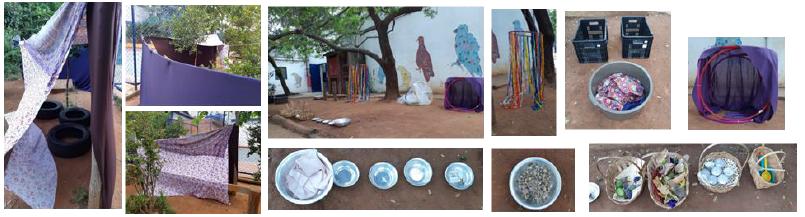
To compose the environment, we chose objects and elements that preserved the characteristic of being flexible and malleable in terms of the ways in which they were used or occupied, such as wooden spoons, fabrics, elements of nature, large aluminum basins, crates, tires, baskets, and shovels.
Regarding the encounters with the children, although the permanence - of the objects, their organization, etc. - was an important aspect to be considered, none of the eight compositions was identical to any other. Each new week, we added, transformed, or removed elements, as the objects became worn out and according to the teacher’s and assistant’s suggestions, the children’s comments, and the weather (rain, sun, wind). In Figure 1, we present images of the first composition.
Source: personal collection (2019).
Figure 1 Backyard prepared by the researchers to set up the play environment, using basins, fabrics, huts, baskets with natural elements, pebbles, crates, and tires
For the aforementioned conversation circles, the first few times we selected some photos that we had taken of the compositions and led the conversation, mediating the speaking turns so that all the children had the opportunity to communicate their impressions. Nonetheless, we realized that they often did not want to report their experiences to the whole group, but rather wanted to take the photos and see themselves in them, making comments to their closest friends: “Look, I’m here!”; “José! José! Come and see!”. So, we decided to distribute the material in small groups, encouraging all the children to see the photos and to a variety of speeches. Then, we stopped asking questions and started to simply write down the comments, which multiplied as they saw themselves in the photos and relived the games: “Luísa, remember that?”; “I didn’t like that day!”; “Today it’s going to be my turn to get that shovel!”; “What was that, Adriano? What were you doing?”
The conversation circle changed and listening situations became an opportunity for children to remember what they had experienced, renegotiate roles and objects, and learn more about their classmates’ games. We wrote down and recorded what they said, occasionally losing some bits, given that we ended up participating in the dialogue, which became increasingly rich according as became less controlled. During the games, when the children called upon us, we interacted and participated in the activity. At other times, we remained observers, taking advantage of opportunities to record what happened through videos, photos, and notes in the logbook. We collected records, as well as observations made by the children when they recalled their games as memories.
To refer to the poetic image, Bachelard (1993) makes an analogy to a stone falling into a lake, generating waves, stating that the image is the stone, while the waves are the repercussions of the being in this explosion of meanings from the encounter of the stone strength and weight with the water. Following this line, Bachelard (1993, p. 184) addresses the theme of the trans-subjectivity of an image, asking how the poetic image, even though it is a singular and ephemeral event, resonates with the being and, in view of this, “‒ with no preparation ‒ can [...] react on other minds and in on other hearts [...]”. Discussing the power of “reacting on other hearts,” the author cites, as an example, the feeling of pride, a “touch of pride,” which arises from the reader’s approval to an image that they appreciate, as if they also felt themselves, even if secretly, the author of the image read: “In any case, every reader who re-reads a work that he likes knows that its pages concern him” (Bachelard, 1993, p. 189). The emphasis on trans-subjectivity indicates his interest in the aspect of novelty and repercussion of the poetic image, rather than an interest in the search for its causes or its constituents. Bachelard does not propose to explain images by the past, or by the life history of the people who created them, nor by the material conditions from which they originated.
The way in which we seek to approach children’s games is in line with the approach reflected here. Therefore, we did not seek information about the life stories of the participating girls and boys as explanatory facts for their playful choices. Instead, we analyzed how their creations impacted the other children, recorded the narratives that the children themselves created during the games and how they retold them later. We observed their expressions, gestures and movements and how they related to the objectives and material elements that made up play. We noted how long the games lasted, how and when they were interrupted or reconfigured, and considered the value that the girls and boys gave to their creations, when, at times, they asked us and their classmates to take care of an object or protected their scenarios, seeking distance from others or building walls with fabrics and other materials.
During the field research, we organized - in the digital logbook that we wrote - the notes, the children's statements, the videos, and the photos of the compositions. The digital logbook made it possible for the written texts and visual elements to complement and interact with each other. We observed the children’s expressions as they played, where they focused their gaze, what sounds made them turn their faces, who they shared their discoveries with, who they invited to play with, and what space they chose. These were some of the clues that guided our gaze and listening when we re-watched the videos, helping us maintain the confidence that there, in that tangle of sounds, colors, and movements, there would be threads of meaning that were worth pulling and discovering where they would lead us. Then, having collected some “threads,” we analyzed the similarities and differences between them and the way they connected with literature, organizing them into four axes: concavity, mass, weight, and rhythm.
In “concavity,” we presented narratives of inhabiting, hiding, staying, and fitting in. In “mass,” we addressed narratives of play linked to the mixtures of water and earth and the experiences of joining, separating, shaping, and transfiguring. In “weight,” narratives of overcoming, joint effort, displacements, movement, and speed. In “rhythm,” narratives of center and expansion. Due to the length of this article, we chose to discuss the first axis: concavity.
Hammocks, huts and little beds: an invitation to concavity
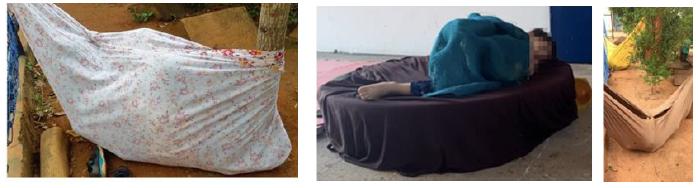
During the meetings, the children, on several occasions, used the fabrics to build places for themselves, such as hammocks, huts, and little beds. In some of these games, they covered themselves, to the point that it was impossible to see their eyes. On other occasions, it was possible to see them, but their gaze seemed distant, absorbed, oblivious to contact with the environment and people.
Trindade (2016) reports that, many times, when they are confined to small and tight spaces, children curl up their bodies like a baby and, in this position, they often close their eyes and turn their attention to their heartbeat or breathing. Relating this to the act of meditation, Trindade (2016) states that curling up like a baby invites to “self-concentration”.
Bachelard (1993) also uses the image of the shell and - based on the sea and snail shell - highlights its condition of being created by the very animal that inhabits it, which makes it simultaneously a home for the being and the being itself, which moves with it. The author alludes to nests, indicating that many of them are made from the inside. Since birds have no arms, hands or feet, they compress the nest walls with their entire bodies, using their chests that expand and contract, as when breathing. Quoting Michellet, Bachelard (1993, p. 263) states: “The form of the nest is commanded by the inside. ‘On the inside’ [...] ‘the instrument that prescribes a circular form for the nest is nothing else but the body of the bird. It is by constantly turning round and round and pressing back the walls on every side, that it succeeds in forming this circle.’” The nest, built from the inside, and the shell, which moves along with its inhabitant, condense the images of the habitation adjusted to the body, since they are protections, that which surrounds and embraces, “just right.” For Bachelard (1993, p. 276), “[...] a snail’s shell, this house that grows with its inmate, is one of the marvels of the universe.” Equipped with fabrics, the children created many houses for themselves that grew as large as their guest. They were not necessarily individual houses. Sometimes, the hammocks and cocoons were inhabited by more than one person - and, in these cases, the malleability of the fabrics allowed the habitation to be continually readjusted to its inhabitants, giving shape to their bodies, or set of bodies. In Figure 2, we show images of the use that the children made of the fabrics.
Source: personal collection (2019).
Figure 2 In the first image, four children built a hut that wrapped their bodies, closed in such a way that there are no doors or windows. In the second image, the fabric is used as a blanket by a child, who curls up like a baby. In the third image, the fabrics are used as “garment-houses,” but it is possible to see an opening to enter and exit
Observing the children wrapped in fabrics, we are reminded of the story “Goldilocks and the three bears” (Tatar, 2004), whose main character is a girl who one day breaks into the home of a family of bears. There, she finds signs of the house being inhabited, such as freshly prepared food and made beds. The girl experiences what it would be like to live in that house: she eats the porridge that was in bowls on the table, sits in the armchairs, and even sleeps in one of the beds. In the house of the bears, Goldilocks finds three versions of each element: one of the father, one of the mother, and one of the little son. The character tries out all three, always preferring the one of the son, who was “just right.” Like the character, some children found in the hammocks, nests, cocoons, and beds a place “just right” for themselves, adjusted to their bodies, size and weight. A place where they could momentarily withdraw from the world and relax or sleep until the rooster crowed.
Once, a group of girls and boys pretended that the hammock was a house and a family lived in it. The members of this family would wake up in the morning and go out to do their chores: go to school, work, and go to the market. Then, when night fell, they would all return to the hammock-house and go to sleep. At that moment, one of the children would close the hammock and they would remain silent for a few seconds, until the same child imitated a rooster, saying: “Cock-a-doodle-doo! It’s already dawn.” Then, everyone would leave the house, and the day would begin once again. In this game, the hammock was the family’s meeting point, a place of residence, intimacy, retreat, and rest.
Bachelard (1993, p. 263), using the term “garment-house,” relates the adjustment of the feeling of protection to the body: “From the depths of what daydreams do such images arise? They might come, of course, from the dream of the protection that is closest to us, a protection adapted to our bodies. Dreams of a garment-house are not unfamiliar to those who indulge in the imaginary exercise of the function of inhabiting.” The author alludes to animal refuges - such as burrows - as places where the being huddles up to itself: “Physically, the creature endowed with a sense of refuge huddles up to itself, takes to cover, hides away, lies snug, concealed” (Bachelard, 1993, p. 257). The shelters built and inhabited by children, which were mainly experienced as refuge and protection, were also small and cramped, providing physical isolation and hiding places.
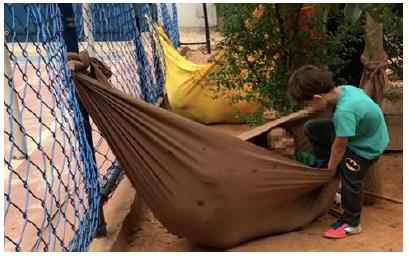
Piorski (2016, p. 29) indicates that the images and worlds that children create for themselves as homes, alluding to fitting in and living, are related to intimacy: “The child creates many universes in their images of wholeness and completeness. Universes of inhabiting, of fitting in, of resigning oneself to living. [...] All these virtues of play have their embryo in the imagination of intimacy”. Figure 3 shows a moment of playing with fabrics.
Source: personal collection (2019).
Figure 3 A boy moves the edges of a fabric to enter the garment-house created by two other children who are inside and allow him to enter
However, not all the places that the children chose for themselves had seclusion as their main characteristic. We noticed that, especially when they were made from materials other than fabric, such as crates and cardboard boxes, for example, the “just right” dimension was less evident and, in some way, the girls and boys were more connected to the environment. In these situations, they did not hide their faces or keep their gaze absorbed - instead, they remained attentive, interacting with their peers through speech and gestures.
During composition 1, a group of children played at family, using one of the huts as a house. According to the narrative told by the girls and boys, the people in this family fought a lot with each other and with their neighbors. At several times, they called the police to intervene, and the game was quite lively and agitated. The children laughed a lot, touched each other, pulled and pushed each other. One of the boys, however - who we later learned was, in the pretend play, the “son” - did not leave the house, but stayed inside a crate, just watching. When we analyzed his expression, it was clear that he was following every step of the game, smiling from time to time when he saw that confusion of bodies and screams. He was not, therefore, absorbed or isolated. He was not essentially distant or detached, nor did he take part in all the movements and agitation.
On another occasion, a boy made a place for himself on top of a table, inside a crate. He wore a piece of fabric over his shoulder like a cape. He remained stuck in the crate for a long time and, from up high, smiling from time to time, watched his classmates playing. Sometimes, he would reproach a friend or get off the table, “flew to the floor,” walked around and returned to his base.
Even inside the crates, these children were not isolated from the group that was playing. According to Trindade (2016, p. 28), the skin is the body’s interface with the external environment, becoming emblematic in the delimitation of the notion of inside and outside, allowing exchanges with the environment, as in perspiration - and, “due to its extension and continuity, it allows the individual to perceive themselves as an integrated whole.”
In the two ways of using the crates mentioned above, we believe that, by allowing the children to feel contained as a whole, they intensified the perception of being an “integrated whole” and not feeling as being apart or dissociated. In this way, even when close to their peers’ movement, speech and agitation, within their “bases,” these children could differentiate themselves and give visibility to their - and the group’s - contours, while simultaneously remaining inside and outside the plots.
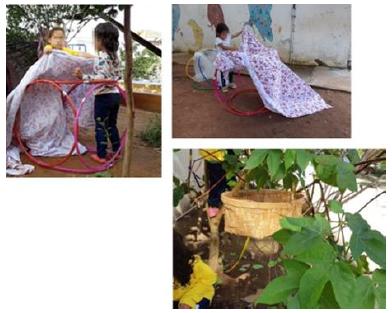
Bachelard (1993, p. 225), when referring to the images of the house and its protective quality, states that “House and space are not merely two juxtaposed elements of space. In the reign of the imagination, they awaken daydreams in each other, that are opposed.” The apparent calm found by the children, when inhabiting the crates, is not only due to the act of getting stuck in their concavity, but also because they find themselves inside them while some agitation happens outside. And, therefore, it seems to be pleasurable to contemplate the other peers’ “buzz,” since it is this that evidences and validates its opposite, that is, stillness and tranquility. The “buzz” contrasts with the immobility of those inside the box. The crate, being made up of corners and walls, favors the experience of immobility, which Bachelard (1993, p. 287) attributes to the “corners”: “Consciousness of being at peace in one’s corner produces a sense of immobility, and this, in turn, radiates immobility.” Giving visibility to what is “inside” and what is “outside” was one of the main functions that the children assigned to the available materials. According to the narratives created between peers, boxes, fabrics, hula hoops, and rubber bands were used to define the places of the houses, schools, kitchen, cars, and trains. Figure 4 shows other moments of the children’s games.
Source: personal collection (2019).
Figure 4 Two images of girls pulling a flowery fabric over a frame made of hula hoops to build a little house. An image of a basket hanging from a bush, which was used by the children as a wardrobe, where they stored shovels, fabric ribbons, and elements from nature
Contrary to when they formed cocoons, when building houses, schools, supermarkets, and means of transport, the children maintained constant contact with their peers, shared stories, and assumed and distributed roles. Even when positioning themselves inside the huts, they looked at each other and communicated through the “windows.”
Sometimes, as soon as they had defined the places, they would get into action, developing the narratives together, speaking and acting as their characters. On other occasions, they spent almost all of their time decorating and compartmentalizing their “constructions” while they worked, telling each other what each compartment was for and redefining their roles and functions in the story. Depending on an object they held or a space they organized, they gave themselves a new function. For example, when organizing a big party for one of their peers, a girl, in possession of the large aluminum basin, exclaimed: “I was the one who was going to make the cake.” Or, in the context of a game of cabin in the woods, when a girl managed to tie a basket to the tree, she said to the other children: “This was the place where we kept everything we need.”
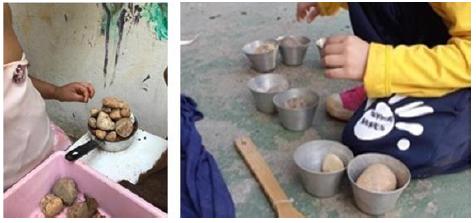
Organizing, decorating, and designating were practices that girls and boys set out to carry out, dedicating time and effort. Small pots, baskets, seeds, leaves, pebbles, and fabrics were organized and reorganized by them. During the games, they played, varying the content and container, by distributing and transposing small elements. In these situations, they tested sizes and fit, made one-to-one correspondences of terms, experimented with excess, sought new configurations, or returned to the initial one. The elements were moved, transposed, grouped, selected, and separated.
Bachelard (1993) addresses the theme of organization, which can be experienced as a “center of order” against “uncurbed disorder” and attributes the unfolding of the function of living to the act of carefully choosing where to store our belongings. For the author, “Only an indigent soul would put just anything in a wardrobe. To put just anything, just any way, in just any piece of furniture, is the mark of unusual weakness in the function of inhabiting. In the wardrobe there exists a center of order that protects the entire house against uncurbed disorder” (Bachelard, 1993, p. 91-92). When they dedicated themselves to organizing small elements, making different combinations between content and container, the children were building small habitations for their belongings and for themselves. Figure 5 shows two examples of this organization.
Source: personal collection (2019).
Figure 5 Two images of small pots that the children filled with pebbles
On several occasions we witnessed the children’s anger when a classmate “messed with” their things or “stole” them. It was not uncommon for them to designate a guardian classmate when they needed to move away from the scene and materials they had selected and organized for their games. In these situations, the guardian classmate took it upon themselves to take care of the classmate’s game with determination: “Don’t touch it, it’s Helena’s!” A game that has already begun, that already has an owner, is sacred to children.
Intimacy, home, protection, refuge and “self-centeredness” are dimensions and qualities linked to the function of inhabiting. Throughout the compositions, the children built different places for themselves and their belongings. Some characteristics of the material and the environment - simplicity among them - favored these games. As Bachelard (1993, p. 287) says, “At times, the simpler the image, the vaster the dreams.” We believe that inside the pots and basins there was room for many worlds dreamed of by children.
Final considerations
During the investigation process, we gathered memories, notes, records of the children’s speeches, photographs and recordings, and gradually imagined, felt, and visualized the narratives. We found common points between the children’s experiments, associated their speech with gestures, created and identified logic between the sequences of images, so that we were able to organize part of the experience into four themes - concavity, mass, weight and rhythm - which give coherent meanings to the children’s games. Nonetheless, this selection and organization do not claim to exhaust all interpretative possibilities and do not represent unique or main meanings of the experience lived. There are other possibilities for concreting meanings that could illuminate the multiple dimensions of the children’s productions in contact with the environment. The experience was and always is greater than what can be narrated and interpreted within an investigation. Even so, the selection made is valuable, as it gives visibility to the educational environment and its ability to enhance children’s creations, anchored in playfulness and physical experience.
Returning to the guiding question of the research - how does the environment affect and qualify play in childhood? -, we emphasize that elements of the material universe enhance play in its poetic and creative dimensions, supporting children in formulating understandings about themselves and the world in interactions with each other, especially regarding the processes of creation and investigation that are often not restricted to the verbal universe.
We expect that this work can inspire educators in planning play situations at school and in other contexts. Life is always persistent and resilient. In the same way that nature finds its means to grow and reproduce, children can also play in different contexts. We know that there are games played by children in classrooms full of tables and chairs, with no space to sit on the floor or even to interact in pairs with their classmates. Even so, play happens, children find their own way, find alternatives, subvert, transform the environment and transform themselves.
In this study, we seek to give greater visibility to the poetic dimensions of younger children’s games, which can be opaque to adults, since they are not woven only by words, but essentially from the physical experience of contact with the malleability of the material world. In this way, our expectation is to have contributed to awakening a different perspective on children’s cultural production, considering the relationships between the educational environment and the material imagination that are woven in play.

