




 texto em
  Inglês (pdf)
 Artigo em XML
 Tradução automática
 Enviar este artigo por email
 Permalink

Introduction
Early Childhood Education has undergone considerable transformations since the last decades of the 20th century. There is, alongside the expansion in the number of enrollments, an increase in the level of training of its educators, changes in the understanding of the social and political function of this stage of education, and new conceptions of children and their learning and development processes (Brasil, 2013, 2017).
Despite advances, curricular practices that guarantee children's right to participate, by considering them as competent subjects to construct narratives and practices about themselves in children's institutions, removing them from the condition of invisibility and social subordination to which they have historically been subjected, are still incipient in this first stage of Primary Education (Mello; Barbosa; Martins, 2023; Oliveira, 2010).
To contemplate the right to participate, it is necessary to establish curricular arrangements that overcome fragmented views of knowledge and embrace the social and cultural practices of children and the communities in which they are inserted, in addition to their different languages, going beyond the knowledge systematized by culture and science. Therefore, it is necessary to “[…] bring together elements to reorganize times, spaces, and situations that guarantee the learning rights of all children [...]” (Brasil, 2017, p. 39, our translation).
Reiterating consensus on the specificities of Early Childhood Education expressed in the Brazilian National Curricular Guidelines for Early Childhood Education (Brasil, 2009) and BNCC (Brasil, 2017), the curriculum for this stage of education is defined as the “[…] articulation of children's knowledge and experiences with the set of knowledge already systematized by humanity, that is, cultural, artistic, environmental, scientific and technological heritage” (Brasil, 2017, p. 59, our translation).
According to the curriculum concept presented in these documents, the appropriation and construction of knowledge in Early Childhood Education institutions must be conducted through the participation of children in different cultural practices, intentionally organized by the teacher, in which they interact with their peers and adults.
The curricular documents (DCNEI and BNCC) adopt interactions and play as structuring axes of pedagogical work in Early Childhood Education. They point to the importance of considering children's experiences mediated by playful activities and play in constructing knowledge and the meaning of the world by children, because a world is born to be given meaning when a child is born (Barbosa; Richter; Delgado, 2015). Underlying this perspective is the understanding that culture is not something we possess but something we permanently make and remake.
In the relationships they establish with each other and adults, children produce their peer cultures1 (Corsaro, 2009) and, in conjunction with other contextual conditions, they construct knowledge and actively participate in their socialization and learning processes. In this way, curricular practices are not limited to content selected by adults, but also constitute different learning experiences of/with children, woven into the daily routines of children's institutions.
For Esteban (2012), the vitality of everyday school life, with its different subjects, cultures, knowledge, projects, specificities, and expectations, creates countless lines of escape and spaces of displacement in the curriculum. These multiple possibilities of composition, permanently tensioned by pedagogical practices also incorporated by social relations, give different contours to the lived curriculum that expand the restricted possibilities of the official curriculum: “[...] it seems that the complexity of the daily reality of a school of Early Childhood Education ‘does not fit’ into the reductionist forms of materialization of the prescribed curriculum” (Barbosa, 2010, p. 2, our translation).
Given the above, this study aims to analyze children's participation through playful activities and interactions established between and with them, in the curricular production of Early Childhood Education. To this end, this text focuses on a pedagogical experience developed in the revitalization of a playroom, in which children give new meaning to curricular practices in the daily life of a Municipal School of Early Childhood Education (CMEI) in Vitória, in the state of Espírito Santo, Brazil.
Theoretical-methodological paths
This research is a Collaborative Action Research (CAR) (Ibiapina, 2008), in which the discussion process and data analysis come from experiences with Physical Education in the daily life of a CMEI in Vitória/ES. CAR has two inseparable dimensions: knowledge production and teacher training.
[...] It is not investigating about [something], but investigating with, in the sense of deepening the understanding and interpretation of teaching practice to strengthen the activity of transforming practices, the school, the curriculum, and society, contributing to teachers recognizing themselves as producers of knowledge [...] (Ibiapina, 2008, p. 12-13, our translation).
Collaborative Action Research presupposes joint and coordinated work between researchers and teachers, aiming to “[...] implement changes and analyze problems, share responsibility for decision-making, and conduct research tasks” (Ibiapina, 2008, p. 23, our translation). Ibiapina (2008) argues that the reflective process, which requires immersion in both theoretical knowledge and the world of experience, helps to develop this professional consciousness responsible for remembering and examining reality to transform it.
All Action Research, regardless of the theoretical-methodological perspective adopted, presupposes the transformation of a given reality. In this study, the reality to be transformed is the curricular practices of a CMEI, which, following national and municipal guiding documents and also with its political-pedagogical project, aimed to give visibility and centrality to the participation of children in its pedagogical practices, that is, it sought to bring to the field of actions what the field of intentions advocated.
The study, which originated from a master's thesis developed between 2016 and 2018, was approved by the Human Research Ethics Committee of the Federal University of Espírito Santo (CAAE number: 70932217.0.0000.5542) and involved the participation of 50 children (aged three to five) and five adults (four teachers and one principal). The procedures used in data production were a field diary (with emphasis on children's statements), narrative interviews with adults, and photographs. In the research development process, we followed the spiral proposed by Ibiapina (2008): action, observation, reflection, and new action, which permanently fed into each other.
The data produced were analyzed in dialogue with the assumptions of the Sociology of Childhood (Sarmento, 2013; Corsaro, 2011), a field of knowledge that demarcates the conception of childhood underlying this research, and with the study of everyday life (Certeau, 2014), a perspective originating from cultural history that, based on its theoretical-methodological premises, allowed to see the participation of children through their daily cultural productions.
By conceiving children as ontologically full social beings, complete in their skills and dispositions, capable of thinking and acting on themselves in their life worlds, the Sociology of Childhood seeks to overcome views that see them only through their absences and incompleteness and keep them in a condition of invisibility and social subordination (Sarmento, 2013).
Based on studies of Everyday Life (Certeau, 2014), we consider that children do not passively assimilate the cultural artifacts offered to them, as there is always an aesthetics of reception, in which they imprint their subjective and identity marks, configuring themselves as producers and not just as reproducers of culture. In this sense, the relationships they establish with adults are not of incompleteness, but of otherness. As Cohn (2005) states, children do not know less than adults; they know other things, and it is precisely these things that need to be made visible and recognized by adults to value their participation in the curriculum production with Early Childhood Education.
Active participation of children in the revitalization of the playroom
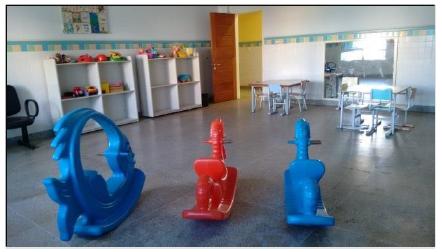
The research field was CMEI Girassol2, a large-structure school of Early Childhood Education with two floors. Among the different learning spaces was a room on the second floor, practically empty, with very few toys, some of which were broken. The space was called the playroom and was rarely visited. Figure 1 illustrates the environment.
In the first collective planning meetings of the year in which the research was conducted, with all the teachers, there was a meeting that caught our attention due to the following statement from the principal:
When this building was opened, we made new toys purchased by CMEI available to children in the playroom. After only two months of using this room, most toys were broken, missing, or destroyed. So, I collected the few toys still in good condition, put them away, and locked the room (the playroom). I will reopen the room only after talking to you all about reviewing its usage (Field Diary: Statement by the principal of CMEI Girassol, on March 06, 2016).
This statement gains more evidence when the Physical Education team at CMEI Girassol, composed of three teachers (one working in the morning shift, one working in the afternoon shift, and the researcher of this study), sets out to better understand the situation described by the principal.
According to the principal’s statement, the uses of the playroom gave clues that the practices developed in that space did not have prior planning, with defined pedagogical intentionality, as the occupation was mainly spontaneous. The use of the playroom seemed to be marked by a lack of care, the absence of preservation and sustainability of materials and toys, and precarious relationships established with children and adults in that environment. Therefore, we identified that practices like these diverge from the guidelines prescribed in the guiding documents. BNCC (Brasil, 2017, p. 36, our translation and emphasis) states that
The conception of a child as a being who observes, questions, raises hypotheses, concludes, makes judgments, and assimilates values and who builds knowledge and appropriates systematized knowledge through action and interactions with the physical and social world should not result in the confinement of this learning to a natural or spontaneous development process. On the contrary, it imposes the need to imprint educational intentionality on pedagogical practices in Early Childhood Education.
In the daily context experienced, we noticed a practice that deviated from the children's production capacity, which the curricular documents (national, municipal, and local) recommended. This bothered not only the Physical Education team at the institution, but also other subjects in daily life, causing demonstrations as observed in the following narrative:
This room is run down! The children come in here and get more agitated. There are no toys for everyone. There are broken toys... What a shame! And this happened due to misuse (Field Diary: statement by teacher Dayse, on March 01, 2016).
In the experience with the playroom, we found evidence that denotes the relationships that the subjects established with that space and with each other: relationships of little affection and lacking care; interactions and playful activities in that environment were exhausted; the place seemed little or not at all interactive, without inviting production or creation. It was a scenario of non-belonging. People, especially children, did not feel happy or encouraged to play in that environment, as it was not very inviting for meaningful, playful experiences.
Given this situation, we ask: how can we revitalize the playroom to transform it into a pedagogical environment conducive to children's playful experiences? How will children participate in this process? In this context of collective reflection, we realized the need for change and focused our lenses on the reality of CMEI that needed to be transformed. The proposal to transform the playroom, led by the Physical Education team, brought together different subjects and areas of knowledge present in the daily life of the CMEI.
Anchored in the concept of children as subjects of rights and producers of culture, we knew that the answers to these questions should come from children themselves. This is what we did. In the first meetings, we observed elements that we considered important about their body culture. We noticed, for example, that the children's interaction with the toys was quite short; it took very little time. This signaled that the toys they played with most could be very structured or electronic, such as cell phones, tablets, virtual games, or objects that turn on colored lights, make sounds, and play by themselves, implying little or no creativity and expressiveness in interactions. Children are in the position of spectators and not of social actors when interacting with these toys.
In this context, the Physical Education team held a mini-forum, an activity of listening and dialoging with the children about their interests, needs, and expectations, through which the indicators of territory occupation emerged, that is, the clues to practice/explore that space (the playroom). Anchored in the Sociology of Childhood, to promote children's political participation based on the idea of confluent social interaction in the creation of collective spaces, we were not interested in replicating adult forms of listening and dialogue (by appointing parliaments or committees), but “[...] discover, through the use of intervening imagination, forms of participation compatible with children's cultures, forms of communication attentive to children's modes of expression [...]” (Sarmento; Fernandes; Tomás, 2007, p. 196, our translation), because they “[...] are competent political social actors [...]” (p. 204, our translation). In this sense, we pursued the following route: children aged two to six were taken to the playroom as the room was, at that time, practically empty and with very few toys, most of them broken. The children were able to play in the space with what it offered. Interacting with the children, we asked what they thought of the room. We informed them that we were interested in going to a store and asked for suggestions on which toys to buy for that room.
In the same dialogue, we also informed them that we would go to nature to look for some materials so that together we could build our own toys and playful activities. We asked the children for suggestions on what to look for in nature. We recorded and analyzed their statements, recognizing them as clues that supported planning meetings with Physical Education. Subsequently, a survey was conducted on the materials and toys needed to organize the proposal.
Through their statements, we perceive the children's desire to be part of the process, simply because they were members of a specific group. Based on Alves (2012), we sought to draw from all sources. Thus, we observed the importance of another indicator for our practices when we asked children: What do you like doing most in Physical Education? The following expressions appeared in their interactions with this question: basketball, soccer, volleyball, jumping rope, play area, artistic gymnastics ribbons, games, skating, sandpit, playing with family, rock and roll, sports, bicycle, riding on benches. In addition to the presence of sports, we identified the desire for games and various adventurous body practices, when they talked about bicycles, scooters, jumping rope, flying kites, playing ball, and playing hopscotch. Attentive to children's manifestations, Physical Education envisions bodily practices, sports, games, and play as languages to compose its proposal, that is, as teaching objects potentially contextualized in/with sustainability.
From this same investigative perspective, another source that influenced the construction of the proposal was the documentary Território do Brincar3 (Play’s territory). Impacted by how the children, in the film, create their toys and playful activities with natural and unstructured materials4, we acknowledge that the close relationship with nature brings an exploratory atmosphere to play when we problematize: How do I play in water, on land, in air, and fire?
Based on this reflection and the interface with the central theme (sustainability) of the institutional project "You do, the planet feels," it was possible to see air, water, earth, and fire as a playful and interactive invitation for children to play. In addition to guiding the contextualization of meetings with Physical Education, this theme aimed to instigate subjectivity, giving an idea of a place to be practiced (Certeau, 2014). Through research and dialogue as guiding threads of pedagogical work, the four elements of nature were listed as thematic axes to organize the Physical Education proposal and expand the possibilities of symbolic representation using different languages. An example was the production and use of a banner for each element.
The four banners will serve as triggers for classroom contexts and will live inside the empty playroom throughout the year, moving around the CMEI during Physical Education classes, carried by the children to the sound of the battle cry: Explore, explore, the adventure is about to begin! (Field Diary: Physical Education planning, on July 07, 2016).
To mark the beginning of the composition process in the playroom, the Physical Education team conducted an action representing the marking of the children's territory in the playroom based on the understanding of territory as space (Certeau, 2014), that is, a practiced place. Called Fincada dos estanartes (Setting of the banners), this action aimed to socialize with the entire school community the idea and meaning of the thematic axes, and the circulation of banners triggers the contexts of practices.
All the children and teachers at CMEI participated in the action. It took place as follows: we read a letter sent by nature to the children, inviting them to use the four elements to produce toys and playful activities. To the sound of the song Os Quatro Elementos (The Four Elements), the children stuck the four banners they had decorated in the four corners of the playroom. We invited the teachers and children to choose a symbol of an element that was or was not close to each class's project, then take it, and together create playful activities with the element they chose.
This action triggered and spread the invitation for children to produce their toys and playful activities. Afterward, the banners representing the four elements began to live in the empty playroom. From there, each one was taken to each Physical Education class, enhancing the dynamics of toy production and playful activities with the children.
In the movement to systematize the Physical Education proposal, it was necessary to articulate all the elements considered in this process: physical practices, sports, games, and children's favorite activities; the invitation for children to create toys and gam playful activities es from unstructured materials to compose the playroom; and the use of the four elements as thematic axes to contextualize curricular experiences in sustainability. A brainstorming session was held with the Physical Education teachers to organize the practices based on each axis. The Air axis contextualization was the base for the organization of pedagogical practices for April and May in Physical Education classes:
In the Air [axis] are games of contemplation: blowing, flying with wings, feathers, jumps, kites, shuttlecocks, stilts. A sensory dialogue with heights. By blowing, children come into concrete contact with the air inside themselves. We can also build and play with paper airplanes, parachutes, pinwheels, rattan, trinkets, merry-go-rounds, run with moving superhero capes, spaceships, in short, the experiences produced in movement and that can be off the ground, such as volleyball, false baiana, pendulum, rappelling, climbing, shuttlecocks, trampolines, aerial soccer, rhythmic gymnastics, dance, slackline, baseball, basketball, throwing, boomerangs, bilboquet, tennis, handball, treehouses, fairies, fans, clouds, birds, butterflies, balloons, among others (Field Diary: brainstorming of the Physical Education proposal, on April 15, 2016).
From these elements, the context was created by exploring different languages, such as the image of Doki, a cartoon character broadcast on a children's television channel, known by children and characterized by always exploring an adventure with his friends. In one of our first meetings, when we showed the image of the character Doki, a conversation started with the question:
Who is this? What does he do? A child answered: It's Doki, he flies in a plane. Me: When he flies in a plane, where does he go? Child: He flies really high up, really high up! Me: That's right, he flies really high, because he likes adventure. And today we're also going on an adventure up high. We're going to cross a really high bridge. Are we going to fall? Child: We hold on to the rope you are going to put up (Field Diary: dialogue with the children, on April 19, 2016).
Using this dialogue, we find clues that denote the relationship of trust established between the adult and the child, essential to materialize a practice whose perspective focused on adventure. This teacher-child relationship presupposes an ethical symmetry, as Christensen and Prout (2002) refer to as strategic guidance given in the consideration of children's rights, feelings and interests, in the same way as it is given to adults. So, in another intervention with this element (Air), after watching a video about birds and singing a song about flying, a child approached the teacher, sitting on her lap, and said: Auntie, I want to go to the sky, I want to fly like the birds. This child's expression sounded like a suggestion to the teacher and was considered when returning to planning. In the following meetings, it was possible to experience interactions and games with the children focused on the possibilities of flying with their arms, with the superhero cape, with the paper airplane and the airplanes made with popsicle sticks and clothes pegs, produced by them.
Despite this, children do not passively consume what we propose. The teacher's records on the pedagogical practice, based on the element Air, serve as an example. The activity was planned to play basketball, throwing paper airplanes into hula hoops hanging vertically by a rope.
[...] the hula hoops had blue ribbons tied to them. After we built (folded) and painted our paper airplanes with the children, I told a story to explain what those blue hula hoops could be. The story spoke of a sky full of clouds, then a giant bird appeared and made a hole in them with a very strong breath. At that moment, we blew really hard, imitating this giant bird. And so the story went, which this time suggested that the hanging blue hula hoops could be clouds with holes in the middle, so that our planes could be launched into them, like in basketball, where we throw the ball into the basket. One child said: I thought this was a monster cave (suggesting that the hanging hula hoops were the monsters). Another child: I liked that my plane flew over the clouds (avoiding the possibility of hitting planes inside the clouds). Another child: I prefer to fly with the plane, I don't like to launch it because sometimes it gets lost (suggesting that she fly holding the plane herself). That's what we did, we played with the planes, the clouds, and the monster cave in various suggested ways (Field Diary: records of the Physical Education meetings, on April 19, 2016).
These records demonstrate a teaching attitude of attention to a crucial element to Physical Education at CMEI Girassol: the concept of children. Based on this point of view, the report above represents a pedagogical practice that recognizes the child's voice as something that matters in the curriculum production processes. We find explanations about these childhood manifestations in Corsaro (2009). Based on this author, we understand that children are not passive in the face of the content they are exposed, as they interpret and reconstruct actions in their playful moments, as an interpretive reproduction of what they see and experience. Thus, children creatively appropriate information from the adult world to produce their unique peer cultures. Such appropriation is creative as information from the adult world is transformed to meet the interests of their peer cultures (Corsaro, 2009).
In June and July, it was the turn of the Fire element, whose work possibilities were also mapped out during the brainstorming of the Physical Education proposal. Here is the record:
In Fire, there is the hidden, the covered, the subtext, the adrenaline, the challenge. In some cultures, Fire is identified with the Sun, the energy that radiates light and heat. Children are curious, wanting to see the transformations that Fire produces, observing what melts under the action of heat, or experimenting with what would happen if we prepared a volcano to erupt. Attention and care become redoubled attitudes in these activities. Likewise, we highlight the playfulness found in expressions of different languages, such as stories, videos, images, music, shadow theater, among others, as possibilities for dialoguing with the child's imagination and providing rich contexts - fireballs (red in color) that burn and melt the ice (blue sheet for everyone to hold), caves (explore lights and shadows with overhead projector or flashlights), different rockets that fly around the school, burning whip, meteor shower, red lights from a spinning globe, fire pit, hot potato, tag using hot and cold tools, red wigs to represent the fire catcher, blowing out cake candles, campfire, etc. (Field Diary: brainstorming of the Physical Education proposal, recorded on April 15, 2016).
In one of the experiments contextualized with the theme Fire, the planning pointed to the production of a toy, a fast rocket called gira-gira (spinner), made with string and strips of fabric or crepe paper. After making the rocket and trying different ways of handling it (to the side, upwards, spinning fast or slow, walking, running, launching), the teacher asked the children where they would go with it. They answered:
To Outer Space! Following the children's suggestion, we spun our rocket around the CMEI until we reached Outer Space (internal courtyard), where another game would take place, which was explained: It will be a game of tag: a crazy fiery meteor that is in Outer Space, passing from one side to the other, wanting to catch us. Who will be the meteor? A child answered: Me! I put a red mohawk wig on this child and asked the others: If this meteor hits us, what will happen to us? The children's answers were: We'll get hot, we’ll melt, we'll burn. Then I asked the children: So, show us how we melt, how we burn, and how we heat up. And each child expressed themselves in their own way (some falling to the ground slowly, others turning into a statue). So, I said: This is what we're going to do if the meteor hits us or floats us, okay? And so, the tag went on. After most of the kids had melted, one of them asked me: But if everyone gets melted or burned, tag is no fun. Who will save us? Then I asked the children: Who can save us from this melted or burned form? And the children answered: Water! At that moment, I grabbed a spray bottle with water, expanding the pike to three roles: the catcher (the fire), the savior (the water) and those who would be floated (the other children) (Field diary: records of Physical Education meetings, on July 27, 2016).
Dialogues like this, established with children during meetings, are, above all, an act of respect, as they demonstrate recognition of their right to participate. According to Sarmento (2006, p. 22), participation is a right, not a pedagogy, as it implies changes in the school's political organization, interactive dynamics, relationship between teacher and child, and communication processes. In this sense, in the interaction with the child, the teacher leaves aside a verticalized power relationship and bets on a more horizontal relationship.
Therefore, participation is presented as an absolute condition for making the discourse that promotes children's rights effective and, consequently, the promotion of participation rights in its various dimensions - political, economic, and symbolic - is assumed as an imperative for childhood citizenship (Sarmento; Fernandes; Tomás, 2006, p. 141, our translation).
Teachers' use and appropriation of listening and dialogue in their relationship with children draws attention to the movements that enhance learning experiences, which are made effective through children's participation.
Through the children's expressions and how they related to this element (theme Fire), we were surprised by the meanings produced by them. A theme that initially sounded to adults as dangerous, limited, risky, or even unfeasible to work with this age group turned out to be a context of fascination, mystery, adrenaline, challenge, and desire for children. We observed that the bet we made on symbols, representative figures, and different forms of language expression was assertive, as we made the production of meanings by children effective, such as the figure of the fiery meteor and the water that saves the melted. The children taught us other ways of interacting to count on their participation.
Based on Sarmento (2013), we understand that transforming the concealment and silencing of children into a consented right to the assertion of opinion depends on the degree of their involvement in the production processes. That was when we returned to planning and redefined it based on these clues, making the Fire axis the theme worked on for the longest time, enabling opportunities for participation beyond being part of and taking part, as children also took part when they took possession of their rights and became their holders (Bordenave, 1987).
Given the possibilities we have found for practices with Physical Education, we can state that, as with Air and Fire, the other thematic axes awakened subjectivity in the imagination of children and adults, encouraging the use of different languages to produce learning experiences. This bet corroborates the DCNEI, which states in its article 8 that the pedagogical practice that comprises the curricular proposal of schools of Early Childhood Education “[...] must aim to guarantee the child access to processes of appropriation, renewal, and articulation of knowledge and learning of different languages [...]” (Brasil, 2009, p. 2, our translation).
In lived experiences, such as those we presented, we understand through the meaning-experience pair, proposed by Bondía (2002), that interactions and games affect the practices of active participation of children in their socialization processes. In this logic, to consider children's authorial practices in the curriculum, to guarantee their participation, we choose not only an attitude of listening and dialoguing with them, but we also make ourselves available to learn, offering flexibility in planning and exercising research and theoretical deepening to interpret the clues and authorize children to give new meanings to curricular practices.
The revitalization of the playroom had an educational nature for adults and children, and was configured in a movement with two major actions: the process and the product. Regarding the process, we highlight the children’s learning. By betting on their involvement, the children themselves act effectively in their interactions, as they participate with their ways of producing meaning in the context of Physical Education meetings.
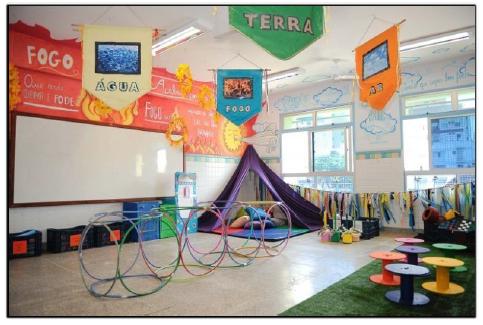
Regarding the product, this action was the delivery of the CMEI Girassol's playroom, which was organized as a place to play with toys and playful activities produced with and by children. Receiving the name A place to play, the playroom (previously just a place, when it indicated the idea of control, order, power, organization by strategies) was transformed into a space, as an effect produced by the operations that guide it, the tactics (Certeau, 2014).
Illustrated in Figure 2, A place to play is both a process and a product, because it does not indicate stability, but rather an inviting legacy for the different daily movements of CMEI Girassol, in attention to children's statements.
This delivery represents a legacy for CMEI Girassol, as it materializes into a common good, a set of meanings produced with children's participation. Implementing this type of action can trigger other training processes and help to implement emancipatory practices, strengthening teaching practice.
Operations for children's protagonism: a teacher training experience
Investigating everyday life allowed us to practice spaces as a production experience with childhood, as a social and cultural construction. It teaches us the choices and bets we make when occupying this place of power (teaching). We note that it is not about giving children a voice, as they already have one. In their most diverse forms of expression, children's utterances pulsate and emerge from/in everyday life at every moment.
However, as teachers, we still ask ourselves: when we listen to children's statements, does this make them active subjects in the curricular processes of Early Childhood Education? We observed from listening that there is still an inevitable flow of interactions that should not be interrupted.
Listening is often part of teaching activities, but teachers ask themselves: What to do with children's statements? What can be done to ensure that these statements return to pedagogical practice? This Collaborative Action Research showed that, after the dialogue with the listener has begun, continuity is still necessary to ensure their active participation. The experience revealed the political positioning of sharing teaching for the occurrence of protagonism, of the child's active participation in pedagogical practice.
Knowing that this requires teaching methods that allow for this protagonism, we turn to the teachers’ narratives:
I like to think of the curriculum as an inspiration when it helps me move forward in the work I need to do with the children. It inspires in the sense of showing me. It is a map, it is inspiration. A map, because it is punctual, it is something that serves as a guide for the path. But it is also an inspiration when it opens up possibilities. The relationship I have with the curriculum is that, sometimes, it places some requirements on me in the work that I need to do; when you say something like: I can't forget this. There are times when I feel like it forces me to, and there are times when it allows me to. But that's it, inspiration and map (Dani - Physical Education Teacher, on March 13, 2018, our emphasis).
Establishing a dialogue with this narrative, we recall a Canadian army rule: When the map doesn't match the terrain, follow the terrain5. We can state that, when conceiving the curriculum as a map and inspiration, Dani, a Physical Education teacher, revisits in her narrative a function of the prescribed curriculum by declaring that it serves as guidance. The terrain, mentioned in the rule above, can be understood as the ground on which reality occurs, the daily life in which people live, that is, as a lived/practiced curriculum.
When faced with maps and terrain, we establish an approximation with the concepts of tours and maps by Certeau (1984, p. 119), which are forms of "how to enter each room.” This author presents maps as knowledge of the order of places or as descriptive drawings created to display the products of knowledge, and tours, in turn, as discursive reports or spatializing actions, or even as the organization of movements in each room. For better understanding, there is a metaphor: when we refer to maps, the idea is of a prescribed curriculum, as a place of guidance, of strategies; on the other hand, when we refer to routes, the idea is of a lived curriculum, as a space, terrain, territory of play.
Thus, the rule “when the map does not match the terrain, follow the terrain” takes us back to the focus of our study, which is on practices, when they emerge from the lived experience, so that, in effect, they can dialogue with the prescribed and inevitably return to the lived experience. This movement, in which practice is the starting and the end point, explains our commitment to staying on the ground, with the practices, where the children and their cultural productions are. This does not mean abandoning the map, but rather consulting it, using it, and giving it new meaning safely and meaningfully, based on the ground.
When it comes to tours, Certeau (1984, p. 119) states that “[...] a circuit or ‘tour’ is a speech-act (an act of enunciation) that ‘furnishes a minimal series of paths by which to go into each room’ [...]”, which are the operations.
In this study, we propose a path with four operations based on these concepts, called Path to value children's participation and protagonism6, to guide teachers to practice the teaching place and make it a dialogical and participatory space in the different contexts of Early Childhood Education.
Operation Intention: considering the understanding of children as producers of culture and who play an active role in socialization processes (Sarmento, 2013), the teacher presents to children, in practice, their pedagogical intentionality based on their planning. This positionality presupposes preparing a welcoming environment conducive to the upbringing of children, using different languages and didactic-methodological tools, in a context that awakens their investigative paths, discoveries, and statements.
Listening Operation: refers to teachers' sensitivity and commitment in being willing to listen to what the child is saying in its most diverse forms: talking, playing, crying, fighting, shouting, smiling, running, observing, singing, drawing, dancing, among many others. Operation Listening encourages teachers to pay attention and offer their perspective to the child. It is more than just turning to the other person; it is about understanding and accepting them in their entirety, intending to interpret their statements.
Dialogue Operation: based on listening/reading children's statements in a responsive-responsible act7, dialogues with them. In this operation, there is an encounter between the planned pedagogical intentionality and what the children express in their capacity to be, exist, and act in that context. It is an interaction in which the teacher focuses on authorizing the child as an interlocutor, acting as a mediator in this learning process, expanding and enhancing the possibilities of children's observation, exploration, investigation, experimentation, and creation. An interaction that produces curricular learning experiences.
With this way of operating their teaching activity, teachers do not remain reserved, but offer their availability by making their planning flexible and changing the route if necessary. It is a choice to make the educational context a dialogical and participatory space, sharing with the child the place of power in making decisions inherent to pedagogical practice.
Often, teachers begin a path towards protagonism and bring significant planning to meet with the children or even listen attentively to their statements, but interrupt this process based on their choices. The teaching attitude of not making planning flexible, making it rigid, and not taking an open and willing position to dialogue with children about what emerges from/in their daily lives, from/in their experiences, compromises the curricular movements that guarantee active and critical citizenship to them as essential and participatory social agents in society. There is a responsibility in the choices regarding how to operate teaching that implies not only the recognition of children's rights, but also the conditions for their exercise in pedagogical practice, through full participation and real protagonism.
Operation Resignification of Practice: the experiences and knowledge produced with children in dialogue with them are prioritized as clues that awaken reflexivity, calling the teacher to research and theoretical deepening. In the effect of critical resumption, the teacher reviews planning and selects other knowledge, other ways of doing things, other materials or spaces, designing the next intention so that subsequent practices are re-signified.
In a spiral or cyclical movement of the Practice Resignification Operation, we continuously return to the Intention Operation. Thus, we see practice as a starting and finishing point when proposing this four-operation path. Therefore, we affirm that recognizing the child's leading role in curriculum production processes is an attitude that permeates teacher activity and training, without seeing them as self-taught, but knowing that it requires much more elaborate processes. Esteban and Zaccur (2002, p. 21) point out that teachers must equip themselves to observe, question, and resize their daily practice:
Practice is the starting point. From it emerge questions, needs, and possibilities, that is, practice outlines the paths to be followed. This investigative look at everyday life is constructed by the knowledge one has. Thus, acquiring new concepts reshapes the possible interpretation of everyday life. (our translation)
To guarantee the child's right to active participation and autonomy as a subject of the curriculum, it is not enough for their statements to be produced. It is essential to see them as expressions loaded with meaning, history, knowledge, and experience, because they are produced within the context of action. According to Certeau (2014), to understand the meanings of the statement, we cannot distance ourselves from its context of production: a daily life full of life.
As subjects immersed in the everyday school context, the teacher training experience brings the understanding that children want a different interaction, that their learning requires experiences and games that have meaning for them and with them. This recognition is inherent to a set of attitudes and postures of the teacher in relationship with the child, which are not limited to listening, but extend to interactions with dialogue and sharing.
Final considerations
The pedagogical practices with Physical Education constituted, in the explicit scenario, evidence about the dialectical relationship established between the curriculum experienced in everyday practices, the theoretical-methodological assumptions, and the prescribed curriculum, as well as the reflexivity about the interactions and games that give visibility to the children's participation, enabling, in turn, the resignification of practices.
When we create a metaphor, it is not about configuring map and terrain or lived and prescribed as opposites, but about understanding the task and challenge of deconstructing the curriculum as simplistic and reductionist practices, which tend to individualize, polarize, dichotomize, fix, and mainly hierarchize the contexts of curriculum production. Based on the experience of children's active participation in interactions and games, this study takes the curricular discussion to another place: the lived curriculum. For children to participate, it is necessary to look at the terrain.
In this sense, we agree with Certeau (2014), as this author helped us understand that if we want to practice everyday school life as a space where subjects leave their mark with their art of practice, we have to recognize them and give visibility to their productions, especially children, who do not act with the same tools as adults, since they have other means, other languages, since they enunciate with their bodies. In this way, they act subtly, covertly (tactics), as they feel constrained by strategies.
These children's manifestations, productions, statements, and participations would hardly be visible here without intending to go against the grain to investigate everyday life. Diving into the daily life of CMEI Girassol, in its curricular dynamics, allowed us to see the details, the particulars, and see what was not visible or even hear what was not audible.
By moving the child from a subordinate position and bringing them to the center of curriculum production processes, we argue that it is not a matter of placing them as the central figure or personified in isolation. On the contrary, we want to place it in the collective, as we understand Early Childhood Education from the perspective of educational experience as an intersubjective, generational, and intergenerational encounter, involved with the common world. The effects of interactions and games on children in socialization processes show that they challenge adults to subvert the school logic of predictability (strategies) and argue for another form of learning, based on their active participation (tactics).
Practicing the place as space (Certeau, 2014), which is not fixed like a map, but fluid like a route, allowed us to occupy a political position as narrator of the ordinary, authorizing the voice of the weakest, and to present the four operations, Intention, Listening, Dialogue, and Resignification of Practice, as substantial elements to operate the curriculum in the exercise of teaching that dialogues with children.
Therefore, the fragment “follow the terrain” invites us to direct our gaze to the lived curriculum, to practice, and from there establish approximations and distances in relation to the curricular prescriptions, with theory, and then return to pedagogical practices, giving them new meanings.

