




 texto em
  Inglês (pdf)
 Artigo em XML
 Tradução automática
 Enviar este artigo por email
 Permalink

Introduction
This study aims to analyze a continuing education experience designed for basic education teachers, carried out within a Municipal Education Network (RME) between 2017 and 2020. The enhancement and development of Basic Education are intrinsically linked to partnerships with universities, which play a key role in teacher education-both in initial training and throughout their professional careers. In this context, the initial discussions that led to the training proposal, entitled Knowledge in Dialogue Project, stemmed from the understanding that addressing educational challenges would require a process involving both the diagnosis, planning of actions, and the evaluation of real and concrete possibilities-yet necessarily conceived from the perspective of the school.
The initiative to conduct a diagnostic study within the schools-through visits and listening to the teachers’ demands1,- revealed the impression of a network with strong professional and academic qualifications among educators, where the growing number of teachers holding master’s and doctoral degrees was beginning to influence the work carried out in schools. Official data from the Administrative Directorate of the Municipal Department of Education (SME) (May 2027) indicated that 51% of teachers hold postgraduate qualifications. Among these, 45% are specialists, 5% hold master’s degrees, and 1% hold doctoral degrees. On the other hand, both the National Education Plan (PNE) 2014-2024 (Brasil, 2014) and the National Graduate Education Plan (PNPG) 2011-2020 (CAPES, 2010) point to the relevance of educational policies that promote closer ties between universities and basic education. The Canoas Municipal Education Plan (PME) 2015-2025 (Canoas, 2015), in line with the national document, also addresses this issue more specifically in Goal 7, which relates to the IDEB (Basic Education Development Index), by proposing to strengthen the articulation between graduate programs, research centers, and training courses for education professionals in order to enhance the quality of education in the municipality.
These elements led the Pedagogical Advisory Board of SME, in the first semester of 2017, to propose a partnership between the Pedagogical Directorate (DP) of the SME and a Graduate Program in Education affiliated with a partner higher education institution. This dialogue, grounded in mutual engagement and commitment, materialized through the organization of the 1st Municipal Seminar Knowledge in Dialogue: Basic Education, University, and Research (Silva; Machado, 2018) and the publication of the papers presented in an e-book (Machado; Ledur; Silva, 2018). In the following years, from 2018 a 20202, the project was reorganized to incorporate research arising from the daily experiences of the schools themselves, aiming to enhance basic education through formative processes centered on educators as subjects-via research-thereby strengthening the relationship between basic education and the university.
Throughout the years of the project’s development, two dimensions of evaluation were present. Internally, the increased (and sustained) engagement-both in terms of the number of research proposals submitted for participation in the process and in attendance at the Municipal Seminars, as shown in Graph 1-allowed us to infer the potential of the initiative from the teachers’ perspective.
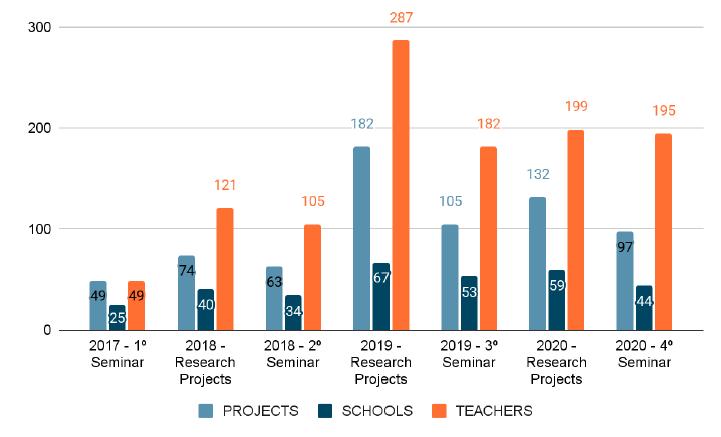
In the external context, the recognition of researchers in the field of teacher education was a relevant element in the evaluation of the Project, which led to an understanding of the potential of what was being developed. In the book “Professores do Brasil: novos cenários de formação” (Teachers of Brazil: New Scenarios of Teacher Education), Gatti et al. (2019) revisit the teacher education process for Basic Education in Brazil. In Chapter 7, they discuss some innovative experiences in initial and continuing teacher education, among which the Saberes em Diálogo Project is mentioned. In the collection “Formação permanente de professores: experiências Iberoamericanas” (Permanent Teacher Education: Ibero-American Experiences) (Imbernón, 2019), the text by André and Passos (2019), titled “Experiências Brasileiras de Formação de Professores da Educação Básica” (Brazilian Experiences in Basic Education Teacher Education), analyzes some innovative teacher education experiences in Brazil and highlights the Saberes em Diálogo experience. Additionally, in a publication titled “Perspectivas da formação de professores para o magistério na educação básica: a relação teoria e prática e o lugar das práticas” (Perspectives on Teacher Education for the Teaching Profession in Basic Education: The Theory-Practice Relationship and the Role of Practices), Gatti (2020) highlights the Canoas experience as an initiative signaling new practices in the educational scenario.
In order to organize a more comprehensive and rigorous evaluative study of the Saberes em Diálogo project, expanding the focus beyond the two dimensions mentioned, the present study is proposed, as detailed in the following sections.
Regarding methodological aspects: the researcher’s stances
The synthesis that explores evaluative aspects of the intended project is linked to lived experiences and implications, making use of data collection instruments generated within the scope of the Project-an endeavor that is not detached from a sense of belonging to a particular group. For Ocaña, López, and Conedo (2018), when developing a practice, it is essential to be part of the “investigated” group, immersed in its reality, reflections, relationships, actions, feelings, traditions, customs, and values, not constituting “a voice of/in/for the community” (p. 179).
In this process, a different way of knowing, thinking, being, and living is proposed, seeking ways to produce knowledge. Inspired by Ocaña and López (2019a) and Suárez and Bustelo (2021), researching stances are proposed: a) Access, b) Sensitize, c) Contemplate/Listen, d) Converse/Dialog, e) Reflect/Ponder, f) Record/Document.
Access refers to the search, the act of gaining access to data, files, reports, what has been memorized, opening a path, obtaining permission, entering, and accessing a territory or area. Sensitizing refers to the perception or receptivity towards something, someone, a fact, an experience, knowledge, or lived experience. It reveals the possibility of expressing emotion, feeling, compassion, sympathy, empathy, tenderness; of being moved. It relates to touching and allowing oneself to be touched, with sensitive observation and listening. Contemplating/listening is grounded in the idea of seeking a sensitive listening posture as a researcher, supported by listening/seeing with empathy, which proposes to exercise feeling the emotional universe of the other to understand their system of functioning from within. Conversing/dialoguing is expressed in a conversation for living, for decolonial living, which includes the other, cares for, protects, welcomes, and loves. It is an allocentric perception, not intending to “extract” information, but to produce it. It constitutes a spontaneous, fluid conversation that solidifies, not as a discussion group, but as a collective learning space. Reflecting/pondering involves closing the eyes and opening the hands to abandon beliefs that paralyze us (Ocaña; López, 2019a). In configurative reflection, the most important element is not the product, but the process, and as a result, other life practices, other ways of feeling, doing, knowing, and loving, emerge. Recording/documenting/systematizing refers to a process that involves recording the lived experience so that one can later reflect upon in an orderly manner based on practice. As Oscar Jara (2013, p. 75) states: “Systematization is an intentional exercise aimed at penetrating the ‘near complex’ fabric of experience and recreating its knowledge through an interpretative exercise of theorization and conscious appropriation of the lived.”. In other words, it is a critical interpretation arising from the ordering and reconstruction of the lived logic.
These stances, intertwined, are in a constant movement of back-and-forth, breaking with the objectivity and rigidity present in conventional methodologies, as they permeate daily different forms of knowledge: we listen, we are listened to; we feel, we make others feel; we touch, we are touched; we move, we move others; we see and are seen.
Beyond the support of the researcher stances, for the systematization of this study, and beyond the articles and materials produced and published about the teacher education project experience, the portfolios of the Saberes em Diálogo Project from 2017 to 2020 were considered, along with two specific records: the record of the closing session of the 4th Saberes em Diálogo Municipal Seminar (Saberes em Diálogo, 2020) and the record of the meeting of the Coordinating Committee, held at the end of the 2020 school year via Google Meet. This meeting aimed to evaluate the activities of the year and mobilize the discussion of an evaluation of the project over the four-year period.
For the purposes of systematization in this study, the recordings of the two moments were carefully reviewed, with transcriptions of the spoken words and chat comments, allowing the analysis of these data to engage with both the other produced data and the meanings provoked by the formative experience. Finally, through a rigorous analysis of this material, eight categories of analysis were outlined, which will be detailed in the next section. Both the process of their construction and the way they contributed to the elaboration of the data analysis process will be addressed.
Evaluating: From the Dialogue with National/International Literature to the Data of the Experienced Project
At the outset of the work, the project sought to organize common features of the literature on continuing teacher education, aiming to produce syntheses that would point out advances and gaps, and from there build a training proposal. This starting point is well highlighted by Imbernón (2010), who states: “To know them implies analyzing successes and failures and being aware of everything we still need to learn and advance” (p. 10). In other words, to access in order to identify and recognize the gaps and, based on them, to seek to fill them through proactive actions.
From this perspective, six studies were selected based on criteria that, in our view, meet the research objectives. The criteria adopted were: a literature review in the field of continuing teacher education; complementary temporal scopes, aiming to cover a broader time span; territorial coverage; and, finally, studies focused on the reality of public education. Based on these criteria, the following works were selected: Avalos (2007); Moriconi et al. (2017); Gatti et al. (2019); André and Passos (2019); Vezub (2019); Almeida et al. (2021). Table 1 systematizes the findings that the syntheses on continuing teacher education have identified in the analyzed.
Table 1 Points of Convergence and Divergence in the Teacher Education Literature
| Ávalos (2007) | Moriconi et al. (2017) | Gatti et al. (2019) | André e Passos (2019) | Vezub (2019) | Almeida et al. (2021) | |
|---|---|---|---|---|---|---|
| Active, collaborative, and peer learning | X | X | X | X | X | X |
| Situated learning / Connection with contexts | X | X | X | X | X | |
| Focus on pedagogical content knowledge and skills | X | X | X | |||
| Collective participation | X | X | X | |||
| Extended duration | X | X | X | |||
| Coherence | X | X | ||||
| Concern for teacher educators | X | X | ||||
| Development of an investigative stance | X | |||||
| Articulation between university and school | X |
Source: Prepared by the authors (2022).
Complementarily, the project portfolios were reviewed to extract the objectives defined over the four years, which are presented in Table 2. These objectives were established at the beginning of each year, informed by the collective experiences of the previous year(s). The objectives were organized into three axes: “Relation between Basic Education and the University,” “Production, Reflection, Systematization, and Visibility of Pedagogical Knowledge,” and “Research with Everyday Practice”.
Table 2 Objectives of the Saberes em Diálogo Project
| Axis 1 - Relationship between Basic Education and the University | ||||
|---|---|---|---|---|
| 1. Objectives | 2017 | 2018 | 2019 | 2020 |
| • To bring teacher-researchers from the municipal network and the university into dialogue, fostering an exchange of knowledges. | X | |||
| • To connect universities with the municipal school network, thereby expanding partnerships related to initial and continuing teacher education. | X | |||
| Axis 2 - Production, Reflection, Systematization, and Visibility of Pedagogical Knowledge | ||||
| 2. Objectives | 2017 | 2018 | 2019 | 2020 |
| • To learn about and give visibility to research conducted by teacher-researchers in the network at the postgraduate level. | X | |||
| To engage the teacher-researcher in enhancing their practice through reflective and systematized analysis, in order to generate knowledge about the school, taking into account teaching knowledges (academic, curricular, experiential). | X | X | X | |
| To enable “experience reports” to be refined and established as pedagogical knowledge. | X | X | X | |
| To produce systematized pedagogical knowledge that serves both the context in which the research was conducted and other contexts. | X | X | X | |
| Axis 3 - Research with Everyday Practice | ||||
| 3. Objectives | 2017 | 2018 | 2019 | 2020 |
| • To propose strategies or incentive programs for research within the network. | X | |||
| To direct the school’s gaze inward, seeking the specific knowledges of its context and community in a reflective, grounded, and systematized manner, shifting the perspective from research “about” the school to research “with” the school. | X | X | X | |
| To enable greater collaboration among teacher-researchers within the network, creating a network that thinks, executes, and lives research and training in an interconnected and collaborative way. | X | X | X | |
Source: Prepared by the author (DP/SME, 2017; DP/SME, 2018; DFPP/SME, 2019; DFPP/SME, 2020).
Considering both the elements pointed out by the literature review syntheses and the objectives outlined by the project, guided by the researcher stances, criteria were established to conduct this evaluative study, allowing for the prioritization of focal points for analysis. These criteria were divided into 8 (eight) categories: I. Active, collaborative, peer learning in context; II. Collective participation and in collegiate spaces; III. Extended duration or (dis)continuities; IV. (In)epistemic and operational inconsistencies; V. Shared production and reflection on practices; VI. Articulation between University and School; VII. Development of a research-oriented stance; VIII. Focus on pedagogical content knowledge and skills.
I. Active, Collaborative, Peer Learning in Context: Starting in 2018, with the expansion of scope and redirection of the proposal, which began to include projects designed and carried out based on the specific issues and challenges of each school context, there was a shift toward self-reflection, seeking the unique knowledge of their own context(s) in a reflective, grounded, and systematized manner. This allowed for a shift in perspective, from research "about" the school to research "with" the school. Research WITH prioritizes “doing together,” where the sharing of knowledge, practices, and learning develops collaboratively (Silva; Machado, 2021). One of the participating teachers in the project stated: "It was from my practice that I thought about the theme to be researched for the writing of the article, [...] enhancing my perspective on the children, as well as further qualifying my pedagogical practice” (DFPP/SME, 2019, p. 40). Another account expresses the research movement from the school, shared within the network: "The studies, texts, and the sharing of experiences in the Saberes em Diálogo study groups constantly make me rethink my practice. (...) It pushes me out of the certain comfort zone we fall into in the school routine and challenges me to qualify my teaching practice (...) (DFPP/SME, 2019, p. 40).
These aspects, present in the narratives, were also found in the literature on teacher education and are recurrent in the discourse of the teachers: “We had a mobilization to invest in a stance of educator and researcher, (...) as knowledge producers seeking to enhance educational practice” (Silveira, 2021, p. 135).
The experience in the project allowed participants to engage in another interesting movement, characterized by the alternation of roles experienced throughout the project, that is, “Trajectories that alternated in the project: researchers, committee members, listeners, spectators - connection with flexibility - belonging” (Saberes em Diálogo, 2020). This movement, although legitimate, raises questions about the institutional role of the maintaining body in developing training strategies that encompass such roles. While small advances were made in this regard, such as advocating for “some” hours to be dedicated to the project for teachers on the coordinating committee3, it is understood that such progress was not institutionalized but was sensitively welcomed by the managers at the time. However, a public policy requires more than sensitivity.
It is important to highlight that this formative principle was incorporated into the training dynamics of the maintaining body in 2017, driven more by the scarcity of human resources in the SME technical staff than by a pedagogical conception. As a strategic option, active, collaborative, and peer learning, beyond what is suggested in the literature on the subject, has proven to be a powerful alternative in practice, which places teachers at the center of formative processes, thereby also fostering situated learning.
II. Collective Participation and in Collegial Spaces: Thinking about spaces characterized by dialogue, synthesis, perspectives, and impressions, “in the collective and shared construction of a project that is made every day ‘in network, through the network, with the network, and... beyond the!” (DP/SME, 2018, p. 34), materialized through various strategies, including expanded meetings, round tables, working groups, study groups, coordinating committee meetings, “knitting” meetings”4 and ultimately resonated in the strategies implemented by the pedagogical teams and teaching staff in the schools.
Technological tools played an important role in promoting conditions for the development of collective, participatory, and collaborative work. Together with the teachers, we experienced the writing of collective texts, the use of collaborative spreadsheets, the creation of shared presentations, and the joint development of research forms through Google for Education5 tools and other platforms. These elements were highlighted in a study conducted by Machado et al. (2021), which demonstrated “the potential of continuing education as a self-formative and collaborative process mediated by technological resources” (p. 13), stimulating the training work, both in the individual aspects of professional development and in the knowledge generated through social interactions and peer sharing.
Another important issue to be discussed at this point refers to participation in collegial spaces for discussion and decision-making. The experience in/with the coordinating committee represented one of the greatest challenges experienced, which, while proving to be powerful, also brought challenges never before encountered in mediating workgroups. From the process of thinking, creating, and planning to the moment of replanning, evaluating, and questioning, it simultaneously uncovered the fragilities within the network, exposing the wounds of insufficient working conditions and the need to approach training from the perspective of professional development, inherent to teaching work.
III. Prolonged Duration or (Dis)continuities: One of the biggest challenges in Public Administration is the discontinuity of projects and programs with each municipal, state, or federal election. This issue involves everything from the interruption of works, actions, and projects to the alteration of priorities, goals, and the suspension of future plans, impacting activities, generating demotivation, and creating tension among the teams involved. According to Collares, Moysés, and Geraldi (1999), there are several indicators of discontinuity, including the constant interruption of projects without listening to or evaluating the participants; changes in the formatting of programs and projects, and the organizational structures of public bodies responsible for implementing the plans; the trivialization of scientific models, turned into “trends” and passed off as “recipes” for all problems. Unfortunately, this program does not differ in this regard from other programs tried in different educational networks. Thus, the possibility of continuity faced obstacles due to the change in management at the end of the fourth year of the project, leading to its discontinuation. This issue is also explicitly highlighted in the synthesis proposed by Ávalos (2007), who points out that potentially successful experiences that do not receive continued support end up being replaced by others that are either not institutionalized or fail to sufficiently recognize contextual factors, thus limiting or reducing their impact.
In the words of one of the teachers in the chat of the 4th Municipal Seminar Roundtable (DFPP/SME, 2020): "Without a doubt, a project that came to become a program, because it gives visibility to teaching work, which is always reinventing itself" (teacher 3). Excerpts from teachers who participated in the project in 2020 also highlighted: "Turn the project into a program! A construction of this caliber cannot be lost" (teacher 7); "The Saberes em Diálogo project is an important tool that should be consolidated as a public policy for continued education in the municipal network" (teacher 13). Such a movement would allow, on one hand, actions to address the identified gaps and, on the other hand, to maintain and improve the productive actions and strategies in development.
IV. (In)coherencies in Epistemic and Operational Aspects: The bond and belonging mobilized by epistemic coherence were expressed in many ways over the four years. This is pointed out by Professor Priscila Bier da Silveira, when reporting the work done in the construction of the Political Pedagogical Project (PPP) of the school: "The partnerships for projects and actions are flowing in the daily life of teaching. (...) The relevance of this process is the commitment among peers, the construction of knowledge, and the increased motivation of teachers with collective identity" (Silveira, 2021, p. 133)
During the development of the project, we had clashes that highlighted that, although most teachers shared pedagogical and formative concepts and were open to sharing, there were some opposing movements, experienced both by colleagues from the university, by the pedagogical advisory team at the SME, by school leadership teams, and by teachers working in classrooms. There were frequent moments when the strategies thought out tended to look for already known solutions, those usually used. The epistemic coherence that connected, in some way, ensured that when some faltered, others strengthened, reminding of the commitment collectively assumed.
This issue is also highlighted by Professor Evelise Pereira during the same activity, pointing out that "It is very laborious to do research alongside our practice, but at the same time, it is rewarding when we see the result in the classroom” (Saberes em Diálogo, 2020). Even though the strategies undertaken helped overcome challenges inherent to the teaching profession, the issue of including formative times and spaces within the weekly work schedule of teachers, as pointed out by excerpts from participants of the project in 2019 and 2020 (DFPP/SME): “We cannot forget that it is still necessary to have space in the school routine for the more systematic development of this project" remained a challenge to management" (teacher 8).
The Round Table of the 4th Municipal Seminar (Saberes em Diálogo, 2020) revisited the discussion of time(s), mobilized by Professor Giorgia Santos' provocation when presenting the concepts of Chronos and Kairós, i.e., the sequential, chronological time, the one that can be measured, and the lived moment, the significant one, of an event.
V. Shared Production and Reflection on Practices: The record, understood as a strategy for the production and systematization of pedagogical knowledge, was incorporated into the project's context as a logic, in which, while producing elements, indications about what is lived, the ideas are organized through recording, giving meaning to what has been lived and making it possible for others to also access it, in a movement characterized by sharing (Silva; Machado, 2018; Machado, Ledur, And Silva, 2018; Ledur, Silva, And Machado, 2019; Silva And Machado, 2020; Silva And Machado, 2021; Silva et al., 2021). That is, beyond the rhetoric of those who believe and want to act, there is a trajectory that follows the practice, signaling the exercise of at least three of the researcher's postures: dialoguing/conversing, reflecting, and recording/documenting/systematizing.
Teachers spoke during the closing session of the 4th Municipal Seminar in 2020, where it was heard: “When you start writing about what you do, it makes a lot of sense; we are able to revisit our practice more often” (Saberes em Diálogo, 2020). Another teacher pointed out: “In 2018, we had our research project under the 'School' modality and five more accounts of teaching practices. We dedicated a training session so that teachers could share their presentations, if they wished to do so” (Silveira, 2021, p. 132). The teacher has a commitment to their own self-education, and this cannot come from the outside; it must initially come from the subject looking at their own practice” (DPFF/SME, 2019, p. 40). These highlights echo Ribetto (2016), who states that experience, always subjective, becomes unique when lived by a subject who is open and exposed to the transformation of what is emerging. In another way, creating appropriate conditions so that the production, reflection, systematization, and visibility of pedagogical knowledge make sense and can be communicated in the language of teachers is a fundamental condition of this process.
VI. Articulation between University and School: According to Ledur, Silva, and Machado (2019), the partnership with the university for the qualification of teachers in the municipal network at the postgraduate level, during the period between 2012 and 2015, supported a Master's Degree in Education for 20 (twenty) teachers and Specialization courses in School Supervision and Educational Guidance, as well as Inclusive Education, for 80 (eighty) teachers. The scholarship program proposed that the research projects should address issues specific to the Municipal Education Network (RME), and therefore could contribute to continuing education within the RME itself.
The relationship6 established between the University and Basic Education represented a two-way movement, bringing benefits to both. While the RME was strengthened by the discussions undertaken through this dialogue with the University-reflected in the training strategies developed in partnership-the University also benefited from the knowledge produced by and with the school, through the initiatives of teachers conducting their research, since the focus of any educational program at the university level should not be disconnected from the real challenges experienced in schools.
The relationship between university and school, within the Saberes em Diálogo project, manifested in two main aspects. The first one was the shared use of physical space, with project activities being developed at the university, including study groups, expanded meetings, seminars, launches, and other events. The second aspect was marked by tensions. One of the university professors, who was part of the commission, expressed fatigue and struggled to understand a proposal that aimed to decentralize decisions, knowledge, and the recognition of an epistemology that claimed the right to be built outside the academic environment, with the school as a privileged locus. This difficulty led to his withdrawal from the project by the end of the second year. According to Suárez (2019), teachers in basic education must actively participate in collaborative research-training-action processes with university researchers, thereby expanding the scope and expectations of teaching - both in higher education and in basic education. One project participant stated: “These exchanges are very important, to be able to share our knowledge. I am a teacher trainer in the private network and I believe that being part of the municipal network's training sessions as an observer is very enriching” (DFPP/SME, 2020, p. 29). The teacher’s comment reinforces how essential and urgent the relationship between teacher educators and basic education truly is, as a way to nourish and be nourished by initial and continuing teacher education, reimagined from another perspective that epistemologically repositions both the role of the university and the role of the school.
VII. Development of a Research-Oriented Stance: Research grounded in everyday life becomes a meaningful learning experience in terms of teacher education and self-education. This lived experience of teachers, expressed through their pedagogical practice with students, became quite evident, as seen in the words of one teacher: “To make sense, connect with practical life, with daily, everyday life, bringing accumulated knowledge closer to the student’s life-where the student becomes the protagonist of this knowledge, of this daily construction” (Saberes em Diálogo, 2020). Students began to perceive a sense of authorship within the school and started to engage in projects and actions in a more proactive manner.
Research thus becomes a catalyst for actions in the classroom, reflecting the educator's own experience, as expressed by one member of the coordinating committee, who mentioned that he had the “Need [...] to ask more questions-to want to know more about the research being presented, about the interlocutors (Final Coordinating Committee Meeting 2021). Although more present in Elementary Education-both from a curricular perspective and in pedagogical practices-it was also possible to observe this movement in Early Childhood Education: “with a simple garden bug, they built hypotheses, formulated questions, (...) trying to acquire knowledge that perhaps was no longer empirical but rather based on a more solid foundation” (DFPP/SME, 2019, p. 41). A research-oriented stance is expressed through constant curiosity and openness to knowledge produced by and with others.
VIII. Focus on Pedagogical Content Knowledge and Skills: How can we measure student learning gains or improvements in educational quality resulting from a project like Saberes em Diálogo? For now, we have realized that none of the current indicators are capable of measuring or even inferring such outcomes, as beyond dealing with subjective aspects, these results are tied to long-term work, i.e., the actions proposed and developed within a formative project focused on teacher development do not lead to immediate or easily quantifiable outcomes. On the other hand, even though literature reviews point in this direction, questions arise about the “focus on pedagogical content knowledge”-what kind of knowledge is being referred to? Defined by whom? Considered important for whom? Suárez and Bustelo (2021) help advance this discussion by suggesting that we must make knowledge and the emancipatory ideal of science less indolent, arrogant, and self-referential - not necessarily abandon them.
Rufino (2021) aligns with this position by questioning how curricular issues in education are shaped by a colonial legacy that continues to persist and is reinforced by traditional means of teaching and schooling. This legacy often disregard-or push to the margins-diversity, dialogue, and the unfinished nature of human beings, since colonization is embedded in a curriculum that institutes “the learning of being colonized through violence and self-erasure, transforming them into something perpetually deviant and submissive” (Rufino, 2021, p. 16-17).
Thus, although there is a need to think about indicators and ways to measure educational quality and the actions undertaken to improve it-understanding teacher education as one of the core elements of this process-it is crucial to be clear about the inherent tensions, which demand conscious choices in conducting a formative process. These choices must align with epistemic and operational coherence. Aware of this requirement, it is fundamental to engage with genuine commitment, recognizing that every choice also entails limitations. The literature reviewed and the systematization of this experience demonstrate that one of the essential elements to consider in continuing teacher education is an integrative perspective as a foundational pillar. This approach links academic, didactic-pedagogical, and professional experiential knowledge, in dialogue with general education and ethical-moral principles. In other words, it aims to reclaim the human dimension, beyond mere technical and theoretical professionalization.
By Way of Conclusion: Nurturing Hope in Teacher Education - Let the Dance Begin
To “hope” (“esperançar”, in Portuguese) is an expression that defines an invested movement. It means recognizing fragilities and committing, viscerally, to transforming what no longer meets the aspirations of those involved. More than waiting for external solutions, 'esperançar' is expressed through engagement and participation in a process in which one is personally involved. By way of conclusion, we present a few syntheses made possible by this evaluative and reflective process, grounded to a large extent in the abundant records and data generated throughout the unfolding of the action.
One of the first issues observed and pointed out as a limitation during the experience of Saberes em Diálogo, refers to the absence of specific financial resources for the project's development. Despite this limitation, the initiative benefited from the autonomy granted in its implementation and the support of the Municipal Department of Education. It is worth noting that, aside from a few specific investments-such as covering travel expenses for external guests and releasing two weekly class periods for teachers on the coordinating committee to dedicate to the project - there was no formal budget allocation for its implementation.
The second point to highlight concerns how the day-to-day work evolved within the spaces of Saberes em Diálogo. The exercise of attentive and committed listening among educators, along with the effort to operationalize collective discussions into concrete actions, became established in the municipal network as a methodology that expanded to other spaces-becoming part of the network’s culture and enabling an ongoing self-formative process. A conversation in motion.
The third point emphasizes intellectual protagonism as an epistemic claim for the knowledge produced in the daily practice of teaching. A network that learns to recognize itself as author and producer of knowledge and ideas-through peer collaboration and encounters that strengthen understanding and activate new learning paths in teaching.
The fourth point highlights the sense of belonging to a collective work project-one that has no single owner, but is realized precisely through collectivity, made possible by creating formative spaces where we learn how to learn, and learn how to teach. It is an exercise in affection viabilizado por criar espaços formativos onde se aprende a aprender e se aprende a ensinar. Affection is put into practice.
The fifth point concerns the value of research and the learning of how to use the knowledge science offers as a legacy. In this regard, two institutions have experimented with occupying that role from different: the university was displaced from its traditional role as the central, primary producer of knowledge through academic research; and the school stepped away from being merely a field of application for externally produced knowledge. Considering what the literature on continuous teacher education indicated as advancements and gaps during discussions within the group of basic education educators served as a guiding light to move forward and experiment with greater radicality in certain aspects, even if accompanied by reluctance. It also mobilized an unconditional commitment to other areas where the literature suggested a higher likelihood of success. In this last aspect, the following can be highlighted: peer exchange, training rooted in the context, and the creation of multiple spaces for professional development.
This was something that exceeded expectations - something fulfilling, pulsating, and existentially significant. “Saberes pulsed so strongly in me!” (Profa. Juliana Silva/ Saberes em Diálogo, 2020). One could say that the collective surpassed each individual, asserting itself. Amidst limitations and possibilities, Saberes em Diálogo proved to be a powerful project-especially in terms of teacher education centered on teachers themselves.

