




 texto em
  Inglês (pdf)
 Artigo em XML
 Tradução automática
 Enviar este artigo por email
 Permalink

Introduction
At the end of the 2024 school year, 71,324 cases of students with special educational needs were registered in the municipal education network in the city of São Paulo, according to the database provided by the Municipal Department of Education (São Paulo, 2025); of these total cases, 54.195, around 76%, are children (from one to 12 years old). At a national level, in 2023, 1.771.430 students with Special Educational Needs (Necessidades Educacionais Especiais - NEE) were enrolled in basic education in Brazil, according to the School Census carried out by the Anísio Teixeira National Institute for Education Studies and Research (Inep, 2024).
This context allows for various perspectives, logics and research configurations: from the sociometric status of students with NEE (Dyonisio; Gimenez, 2020), such as the development of public policies for Inclusive Education (Damasceno; Assumpção, 2020), the conditions of pedagogical processes and characteristics of the work activity of teachers working in Multifunctional Resource Rooms (Sala de Recursos Multifuncionais - SRM) in Special Education (Silva; Miranda; Bordas, 2019), the role of curricular adaptations for the inclusion of students with NEE (Zanato; Gimenez, 2017), or the transition of these students from early childhood education to primary education (Dyonisio; Martins; Gimenez, 2016). Aiming for a new perspective in this context, this article is based on the aegis of the inclusive education-family relationship, reflecting its mishaps.
The importance of discussing this aspect, in particular, involves a series of nuances such as the initial, continuing and specialized training of active educators, involving on public policies, conceptions and inclusive and excluding ideologies; but without reflecting on the central dyad that makes up the child-family-inclusive education pyramid, the constructions representing the so-called atypical parenting in education will appear as a shadow to be avoided in everyday school life. Cunha (2017) argues that teaching for social inclusion, using the school’s pedagogical tools and also including the family, is to strengthen it as the basic nucleus of inclusive and citizenship action, thus emphasizing the inclusion of the atypical family in the spaces of pedagogical attention and action.
Terms such as atypicality, neurodiversity, or the judicially accepted nomenclature Person with a Disability, reveal the ambivalent content of their conceptions, evoking in the figure of family members conditions that deviate from the standard constituted in the socio-historical sphere. They also evoke a space impregnated with ambivalence and ambiguity, fused with prejudices and stereotypes, once denounced by Lígia Assumpção Amaral (1998). At the same time, despite these basic concepts, it is necessary to use these terms not as an adjective, but as an identification of the guarantee of rights, especially in the educational sphere.
At the same time, the inclusion of a student in the mainstream education system, previously diagnosed with an “atypical condition”, or just under the shadow of the diagnostic hypothesis, reverberates the consideration of the symbolic nature (Merleau-Ponty apudCarmo, 2011) of the young student and their family in the face of neurodiversity. The imagination of their peers, educators and, above all, their parents, can turn to the media-baseddominant current of thought. From Rain Man (USA, 1988); to the soap opera Amor à Vida (Rede Globo, 2013), with the iconic character Linda; to current stream services, with series such as Atypical (Netflix, 2017) and The Good Doctor (ABC, 2017); what we see in common is the stereotyped portrayal of neurodivergent people (Lacerda, 2017; Alves, 2018; Tavoni; Silva; Corrêa, 2019). Such productions cover not only the difficult aspects, but also treat the characters in a caricatured way, portray aspects that are not always true and not clarify the diversity of the spectrum, for example, in The Good Doctor it seems that the condition was given to the young doctor and not constituted in the process of his development. (Nunes; Azevedo; Schmidt, 2013).
In the context of hegemonic media - which is not synonymous with mass culture (Vergueiro, 2017) - and counter-hegemonic media (or alternative media) (Tavoni; Silva; Corrêa, 2019), and of school multiple scenarios, media productions and educational experiences are not without the possibility of attributing new meanings, in a hermeneutic circle, creating conditions for an experiential understanding of the parenting of students in an inclusive process. The Ninth Art (Ballmann, 2009; Gomes; Silva; Barbosa, 2020) has been used as an instrument for reflection, and comics and graphic novels (Vergueiro, 2020) continue to bring up issues of social analysis, such as the so-called atypical family. Thus, three specific examples were the empirical objects (Gomes, 2015) of the research proposed: Não era você que eu esperava (2019) by Fabien Toulmé, Nori e eu (2019) by Masanori Ninomiya and Sonia Ninomiya, and Fala, Maria: um romance gráfico sobre o autismo (2020) by Bernardo Fernández (Bef). These are (auto)biographies (Passeggi, 2016), which have in common the unveiling of the meaning of the atypical family.
Thus, what is proposed in this research is the following question: why is the participation of a common meaning necessary? In other words, why is it necessary to understand the student’s parenting in the inclusive process in terms of the family-school relationship? This problem complements how facilitating the hermeneutic phenomenological view can be in understanding the relationship between the school community and the family; in this way: could comics be a mediating language in the mutual understanding of meaning? In other words, could they be a mediating language for understanding the parenting of the student in the inclusive process in the family-school relationship? The aim of this research is not to exhaust the subject, but to open up new perspectives, with the aim of strengthening inclusive action with these families.
In order to contextualize the problem, a literature review was done, searching for research that referred to the process of inclusive education and the family-school relationship, from 2012 to 2022. The following descriptors were used in education databases: family; inclusive education; parenting; comics; and their combinations. The platforms used to search and refine papers were: Brazilian Digital Library of Theses and Dissertations (BDTD), Scientific Electronic Library (SciELO), CAPES Catalog of Theses and Dissertations, and Education Resources Information Center (ERIC); and the Publish or Perish software, using the Scholar Google platform as a search base. Prioritizing works that were directly related to the family-inclusive education dyad, a total of 57 productions were found, including book chapters, articles, master’s dissertations, doctoral theses, and an expanded abstract; 48 of these were national productions. The next step was to list the productions in significant units (Holanda, 2006; Bicudo, 2020), after re-reading the abstracts of the works, arriving at a total of 10 categories of these units, as shown in Table 1.
Table 1 Relationship: Units of Meaning X Type of Production
| Units of Meaning | Article | Book Chapter | Dissertation | Thesis | TOTAL |
|---|---|---|---|---|---|
| INVOLVEMENT | 4 | 7 | 11 | ||
| STRESS AND SELF-ESTEEM | 1 | 1 | |||
| LEGISLATION | 2 | 2 | |||
| PERCEPTION | 5 | 2 | 12 | 1 | 20 |
| PEDAGOGICAL PRACTICE | 2 | 1 | 3 | ||
| PREJUDICE | 2 | 1 | 1 | 4 | |
| COMICS | 2 | 2 | |||
| RECSOURCES | 1 | 1 | |||
| MARITAL RELATIONSHIP | 1 | 1 | |||
| REVIEW | 3 | 3 | |||
| TOTAL | 17 | 5 | 23 | 3 | 48 |
Source: Authors (2023).
The deadlocks found in research into the lack of communication and the failure to integrate parents into their children’s school process are converging points of view, both in the perception of parents and educators (Cruz, 2013; Pinto, 2013; Cotarelli, 2014; Souza, 2016; Silva; Cabral; Martins, 2016; Felicio, 2017; Bassotto, 2018). The school’s need to understand the student’s parenting experience in the inclusive process was inferred, not by protocol or formalisms listed in legislation and/or systematic guidelines, but with the intention of reducing the distance in the family-school relationship, procedurally improving communication between the parties, encouraging family integration, and not least, experiencing a new reference model for understanding the family’s role in the inclusive process (Jones, 2013; Maturana, 2016; Silva; Cabral; Martins, 2018; Torrens, 2018; Oliveira, 2020; Lopes, 2021).
Finally, this article is not intended to conclude the subject or to provide a deductive explanation, but rather to appear as a synthesis, through phenomenological reduction, of a state of empirical knowledge. Adapting Silva Filho’s (2003) question, any research problem whose answer is initially unknown, but whose essence is the to generate knowledge, we will need to investigate again the practices of the family-school relationship in inclusive education, to find the unique meaning, the proper meaning, of a possibility of mediation between the polarities involved.
Methodological design
As an epistemological/methodological proposal, this research was based on a methodological inspiration in which a priori premises are renounced. It was based on a change of posture in the subject-object relationship, grounded in phenomenology. Its methodological approach allows us to get to grips with the systemic complexity of the research. Phenomenology, as a scientific research method, is an alternative to the positivist way of generating knowledge. Its application proposes breaking down the dichotomy between subject and object, understanding that every conscious act of investigation is intentional, focused on the world, and is not separate from it (Bello, 2006; Holanda, 2006). That said, knowledge is generated by and in the subject’s relationship with the world, in an empirical way, which is crossed in its perceptive field (Merleau-Ponty, 2006b); the idea that an external world is perceived outside the cognizing subject is revoked, an intuition is appealed to as immediate knowledge of the object, as a phenomenon as an immanent relationship between experience and knowledge.
The epistemological dialog was based on the narrative material of comics and the knowledge that the narrative-autobiographical paradigm evokes, conjuring up comics as a typology of secondary biographical materials (Passeggi, 2010), which, by expressing an individual act, can provide a hermeneutic of social interaction. In short, the inclination of research into autobiographical narratives is directed as an educational action par excellence, legitimizing a social reading of a single biography, considering the narrative as an anthropological phenomenon (Passeggi, 2010). Assuming that the comics to be analyzed in this work are autobiographies, as personal narratives (Vergueiro, 2017), they allow us to identify examples of complex and integrative learning experiences, understanding that experiences with others are fundamental to the task of constructing one’s own experiences (Lira; Passeggi, 2021), so that access to autobiographical comics, with the theme under discussion, is the opening for assigning meaning and significance to the phenomenon studied.
Driven by this epistemological prism, we turned to the thinkers of the phenomenology as a methodological movement, with Edmund Husserl (1859-1938) as its precursor; and this research navigated through the writings of Maurice Merleau-Ponty (1908-1961), who dedicated himself to the subsequent structuring of the method in question, as well as engaging in dialogues with other applied sciences, such as psychology, education and art. In parallel, the analysis was instrumentalized a posteriori by the theory of Thierry Groensteen (2015), with his structuralist and semiotic influence, in reading the complex system of comics.
The aim was to identify the mediating potential the ninth art, as a language system (Groensteen, 2015), has in the process of joint apprehension of meaning, of understanding, and of parenting in inclusive education, given the current socio-political scenario. The intention was to carry out this exercise under the influence of hermeneutic phenomenological methodology, in a qualitative way (Bicudo, 1994; Holanda, 2006; Andrade; Holanda, 2010), describing the reconstruction of the object/phenomenon, in search of its understanding (Gomes, 2015). The aim was to unveil the possible significant elements of the authors’ experience, in a comprehensive and non-interpretative way, of the experience of parenting students in an inclusive process, through the Ninth Art, allowing a phenomenon-structural reading, which can provide comprehensive intermediation of the family-inclusive school relationship.
The proposed phenomenological analysis investigated the reading of comics from Merleau-Ponty’s perspective, using concepts from Gestalt and Saussure’s structuralism. We identified two main pillars: the structure of comics and the logic of open categories in the “research of the lived” (Bicudo, 1994; Holanda, 2006; Andrade; Holanda, 2010). Groensteen and Merleau-Ponty provided the epistemological basis, emphasizing that perception is a bodily activity that apprehends objects in their entirety, and that the meaning of comics lies in the relationship between the panels. Merleau-Ponty’s notion of “perceptual faith” and the articulation between the panels in the comics show how we perceive the world without questioning its reality. In addition, the constituent structures of consciousness - corporeality, spatiality, temporality, and intersubjectivity - are essential to understanding our experience of the world, reflected in the comics as a language system that connects the reader and the cartoonist, overcoming the form-content dichotomy and promoting a deeper understanding of lived experience.
Thus, we came up with a proposal for a phenomenon-structural reading of autobiographical comics, following the established steps: a) repeated reading of the works so that we could identify the units of meaning (Bicudo, 1994; Holanda, 2006), evoked by the narrative in images (Groensteen, 2015); b) systemic description of the iconic contents that gave rise to the units of meaning; and c) hermeneutic reading of these as a possibility in the act of mediating the family-school relationship in inclusive education.
Under methodical rigor, the comprehensive reading of the three comics did not stick to a single paradigm. Perception was focused on the complex whole that makes up the narrative system of the comics. Thus, the units of meaning revealed are not isolated parts of the narrative or the work as a whole, but only sustain their meaning in the diegetic network of meaning of each story. The reading carried out, described below, is configured as the dialectical synthesis of experiencing each of the three stories, looking at the converging meanings in their panels.
Next in the methodological exercise, the systemic structure of the moment of origin of the significant unit was analyzed from the theoretical perspective of Groensteen (2015). In the third and final moment, we aimed for a synthetic movement to open up the possibilities of this reading. The dissertation consists of one more significant unit, but this article will only present the first unit: the diagnosis.
Discussion
Aiming good comprehension, the following is a short summary of the three works previously chosen:
Não era você que eu esperava (Toulmé, 2019): the 245 pages delve into the author’s personal journey upon discovering that his newborn daughter, Julia, has trisomy 21, popularly known as Down’s syndrome. The narrative begins with Toulmé’s initial reactions, which are permeated by anguish, shock, and uncertainty in the face of the unknown. As the story unfolds, the author shares his initial fears and prejudices, but at the same time, illustrates the development of unconditional love and a special bond that forms between him and his young daughter. Through the pages of the comic, Toulmé challenges stereotypes and confronts social prejudices, highlighting Julia’s uniqueness and the richness she brings to their lives.
Nori e eu (Ninomiya; Ninomiya, 2019): unlike the homogeneous proposal of comics, Nori and I is an autobiographical work of two visions of the same experience. As a mother, Sonia Ninomiya stars in and narrates the first part of the graphic novel, narrating her journey with the events and outcomes of accompanying her eldest son Masanori, diagnosed with autism, who was non-verbal until the age of 12; and the mishaps in the daily balance of attention between him and his two younger brothers. In the second part of the comic, Masanori himself describes his historical mode of making sense of his own biography.
Fala, Maria: um romance gráfico sobre o autismo (Fernández, 2020): Bernardo Fernández, known as Bef, envisions entering the world of Maria, his autistic daughter, facing a complex journey in search of the child’s identity and voice. The narrative offers an intimate insight into the parenting experience, exploring the challenges Bef and his wife face as they try to communicate in a predominantly neurotypical world. The story is told with sensitivity, touching on themes such as the importance of language, the search for acceptance, and the parents’ concern that Maria is able to establish an emotional connection with others. The more cartoonish illustrations amplify the emotional narrative, highlighting Maria’s parents’ journey towards self-discovery and understanding, offering a unique perspective on the complexities of Maria’s parenting. And one of the most interesting things about the narrative is that the comics are a point of contact between the father and the daughter, who, despite enjoying drawing, lives in a world that is hers alone and that he can only imagine the contours and colors (Vargas, 2020).
With this in mind, the first part of the analysis exercise will list and describe one of the units of meaning evoked in the readings and re-readings of the aforementioned works. It is in the set of balloons, panels, and strips that we can intuit the production of meaning, made possible by the phenomenological method.
The diagnosis
The first unit that crosses the reader’s mind in the three stories is the representation of the lived experience (Merleau-Ponty, 2004) of the moment of diagnosis. From the Greek, diagnōstikós, from dia, “through”, and gignósko, “to know”; the name of a disease is discovered “through knowledge” (Universidade de São Paulo, 2023). Embedded in medical science, diagnosis is a process of investigation in which the health professional looks at the symptoms, signs, and traits, known as dysfunctions, in order to arrive at a name that will direct their therapeutic conduct. This moment is portrayed in different ways in the comics chosen, but they evoke the same meaning in their experiences.
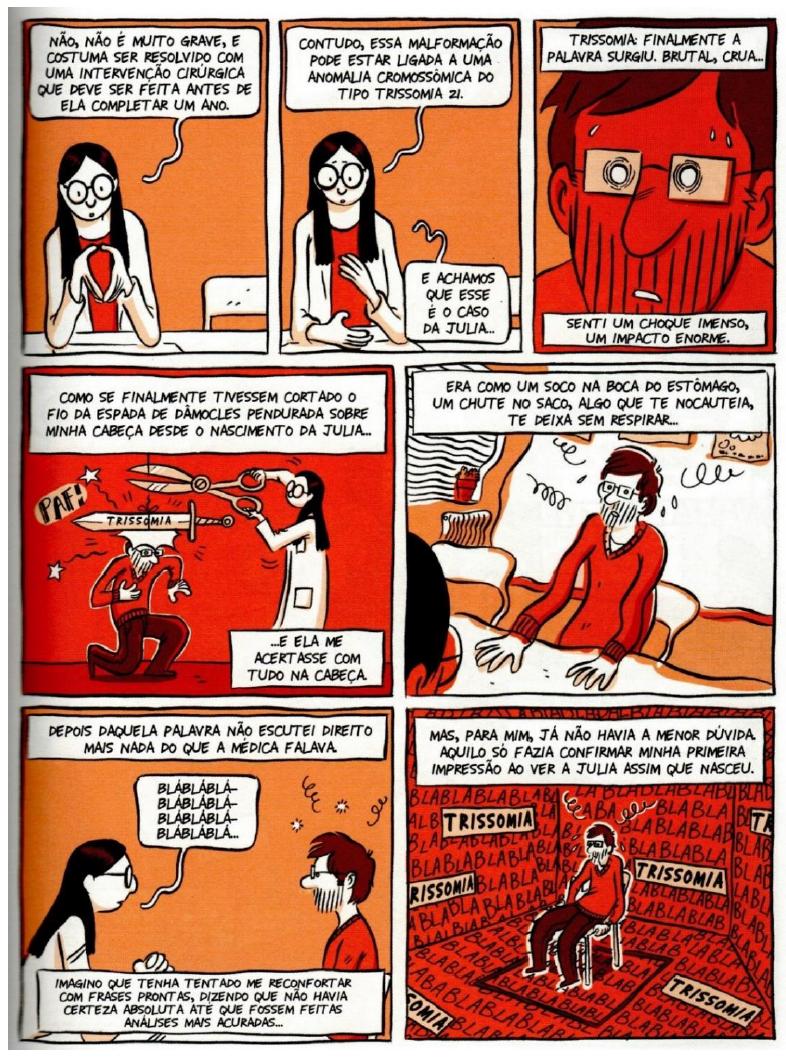
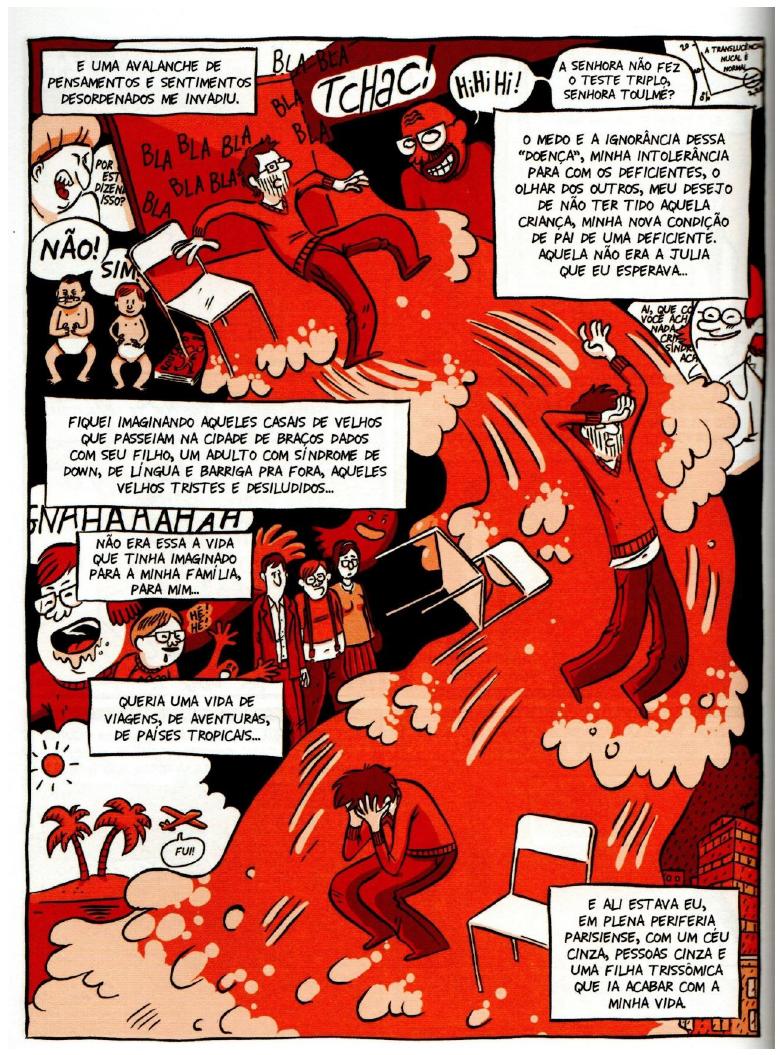
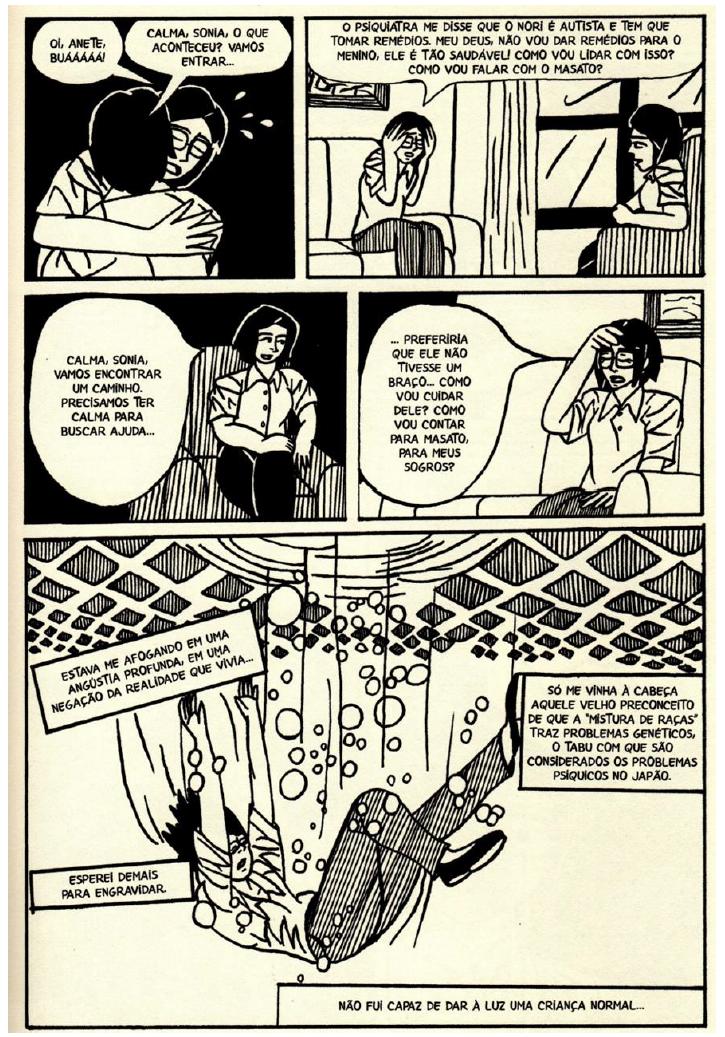
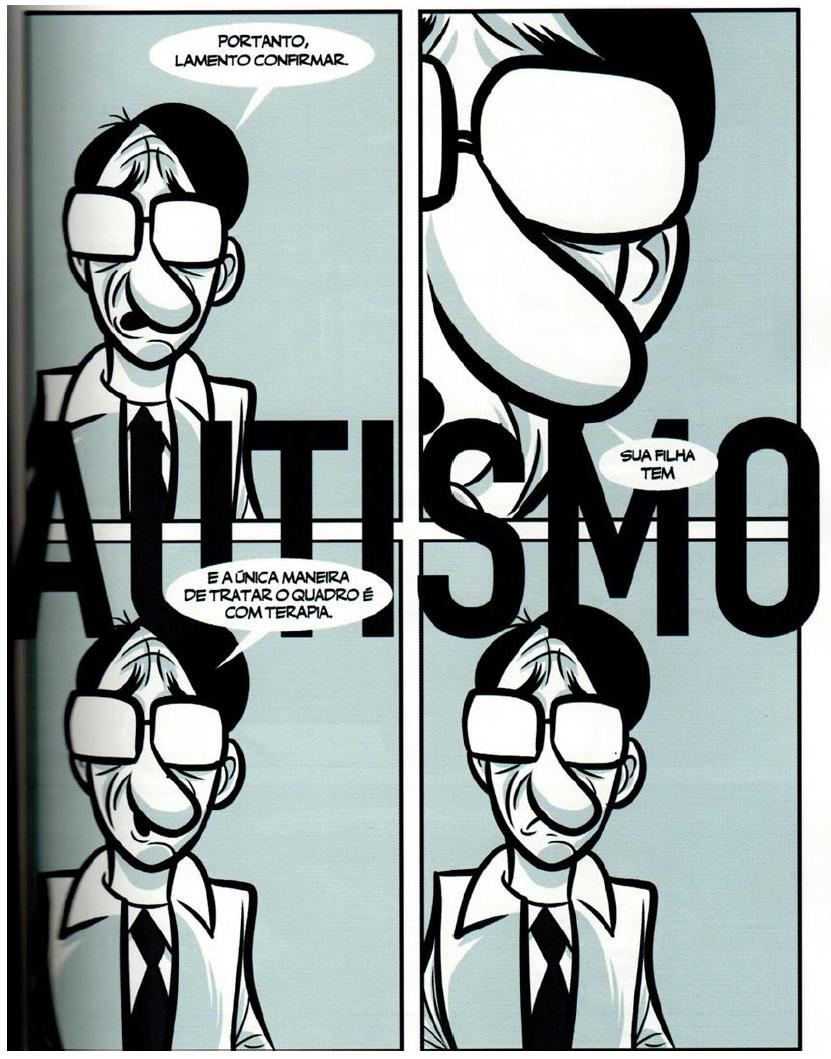
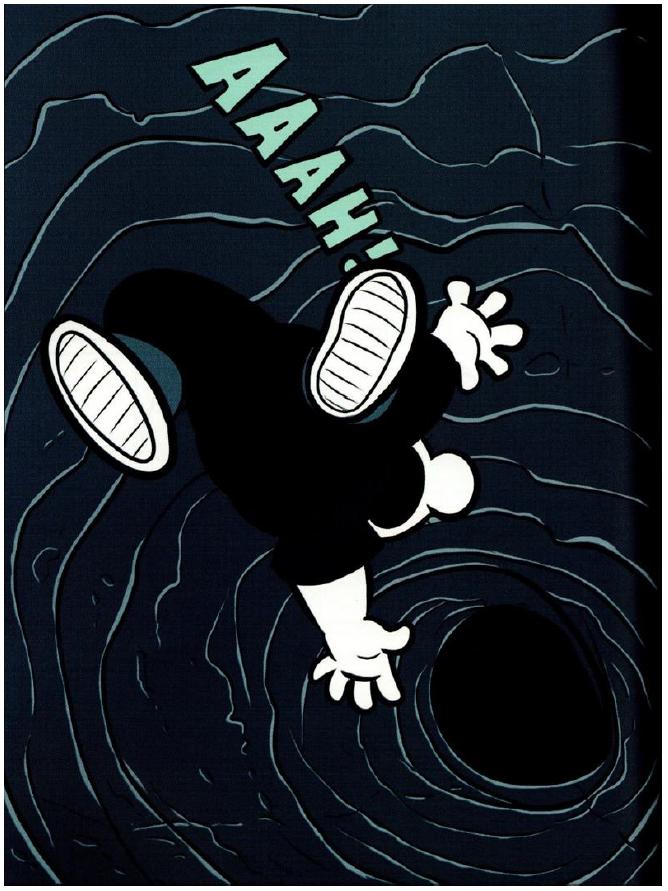
In an exercise of eidetic reduction, one is faced with a moment of falling, of a free fall without a guardrail, without the prospect of stopping falling. In all three works, there is a representation of lived experience (Merleau-Ponty, 2004) in the characters’ own bodies, and the expression of the fall also reveals a temporal detachment, of an instant that is eternalized in the fall itself; it is not symbolism, but the experiential expression of the moment of diagnosis for the children’s parental figures at the time.
From a pre-reflective act one, the following is possible to analyze in these pages (Groensteen, 2015), both Toulmé, and Bef use splash pages: they use an entire page (panel) to express their falls in the face of the diagnosis. However, it is possible to notice the difference in the use of balloons in three: Toulmé loads the pages with balloons, like a flood of information, feelings and emotions, to express his experience; while for Ninomiya, in the last strip of figure 3, the distribution of the balloons also suffers the weight of Sonia’s fall; and Bef makes the second balloon of the page expand beyond the panels and frames, making the word autism have an almost three-dimensional spatial expansion, such is its intensity for the author.
As seen in the works of Pinto (2013), Oliveira (2020), Bassotto (2018) and Silva, Cabral and Martins (2016), the distancing of the school and its lack of visualization of the parents’ subjectivities was noted; a finding that after this unit of meaning, becomes denser, because if the school does not take into account the subjectivity of parents of inclusive education students, at what point will it understand the experience of falling? How will it know if it is part of the free fall, or if it can be used as a parachute for these parents? Getting in touch with a mediator, such as comics, allows for the possibility of getting in touch with this information, facilitating some steps in the family-school relationship.
Also, in the literature, parents’ expectations of inclusion were found to be carried out in an affective context, content only with the socialization of their children (Pinto, 2013; Oliveira, 2020; Bassotto, 2018); also, in research in Indian schools, 80% of parents perceive that the more time their children spend in a regular classroom, the more likely they are to be treated kindly by the students without disabilities (Mathur; Koradia, 2018); the same is in Uganda, where parents stated that their children ‘had a chance’ when they were included in regular classrooms (Bannink; Nalugya; van Hove, 2019). But what we can understand in the authors’ autobiographical narrative goes beyond a concern with the paradox of tolerance and acceptance of these students; these guardians are concerned about the future, about the development of these students in the process of inclusion, and the consequences of their evolution as students. For these parents, being at school involves policies, logistics and curriculum; for the family, being at school is experienced even before the schooling process begins, in its duration, and in the expectations of the students’ next steps. Once again, the family’s lived experience needs to reach the educational agents, not just to guarantee the students’ access to the inclusive schooling process, but so that their singularities can be understood, along with the family’s wishes, so that the school can be an environment that facilitates development and gives the family a leading role in it.
Like the dive of the seagull, an analogy used by Merleau-Ponty (2006) on the methodology of perceptive experience, without distancing or categorizing it, the school can use this dive into the world of the family with the student in the inclusive process, without distancing itself from analysis, but participating together in the common meaning. In other words: the school moves on from inferring the family’s experience to comprehensively experiencing their lived experience, with the possibility of grasping the family’s network of senses and meanings, in view of the student’s development and learning in inclusive education. The support for this sharing, this companionship, this sharing of etymological bread, takes place through the mediation of the comics system, not just through the expression of the lived experience of the “fall” of guardians. Research such as that by Oliveira (2014), Fernandes and Costa (2019), and Cardoso (2022) has empirically shown the possibility of using comics as training material for basic education teachers, not as a didactic resource, but as a form of language accessible to teachers in their improvement in inclusive education.
Final considerations
In summary, the significant unit studied emerged from a reading mode based on the research proposal, the contextualized theme, and the production reviewed. Other units have emerged, but they are not in line with the proposal made in this research. In this way, the value of the school weaving this significant unit is justified by its leading role in the inclusive process of schooling students with NEE and integrating them with their families.
The language system of comics acts as a mediating field for and in the family-school relationship, by providing an exchange of lived experiences at both ends of this relationship, since both parents and guardians can sometimes be unable to express their experiences to school agents, in the same way that school agents can only interpret their actions. Our object of study is a propellant for the school to be able to understand these experiences, in possession of the meaning of the experiences as well as the moment of diagnosis, endorsing the breaking down of attitudinal barriers, and the strengthening of its practices for and in favor of the development of students with NEE. In this condition of possibility (Merleau-Ponty, 2006), the school becomes a constituent in the family’s experience in the inclusive process, and not an experiential barrier to it. There is pedagogical and didactic potential in comics, not only because of the cultural meaning that the language system contains in itself, but also because of its multifaceted structuring, with potential for training, teaching and learning methodology, on the different fronts of training the actors of inclusive education. Comics can be used as material for paradigmatic rearrangement in the training and updating of teachers and other inclusive education agents. An example of this is some of the material made available in continuing education processes for managers and educators, as seen in Oliveira (2014).
In view of this, we understand that the school’s access to these narrative experiences deliberates not only family-school integration in the field of inclusive education, but endorses joint participation in the construction of meaning of both polarities, aiming for a better objective and intersubjective apprehension of the experience of diversity at school, considering that the student is the heir of their family’s culture (Merleau-Ponty, 2006). In short, the autobiographical narratives in the comics analyzed are revealed as a mediating language system in the family-school relationship in inclusive education, as they enable the family experience of students in the inclusive process to be appropriated by school agents, in a vision of totality and not just in parts. The great meaning unveiled in our research is: the school participates in the common meaning of students’ parenting in the inclusive process, becoming a support for sustaining the meaning of this, together with the student and the family, in a way of ontologically being a world of conditions of possibilities for learning and development.
Far from being an end, our research ends as a departure, as an opening to new questions about the potential of the comics language system in the inclusive educational process as a fertile field in the dialectic learning and development. What other audiences in the school community can comics reach? What other processes in school life can comics express? What other senses and meanings can comics become in education? These are questions that other studies will be able to answer, with the technical-scientific rigor that our science and method demand.

