




Serviços Personalizados
Journal

Artigo
 texto em
  Inglês (pdf)
 Artigo em XML
 Tradução automática
 Enviar este artigo por email
Compartilhar

 Permalink
Cadernos de História da Educação
versão On-line ISSN 1982-7806
Cad. Hist. Educ. vol.23 Uberlândia 2024 Epub 17-Mar-2025
https://doi.org/10.14393/che-v23-e2024-13
Papers
Family environment and the decision to opt for a teaching career: A case study of three generations of the Ceccato family1
1
 http://orcid.org/0000-0003-0659-6485; lattes: 2819316107193915
2
http://orcid.org/0000-0001-5440-974X; lattes: 8422843658282107
3
http://orcid.org/0000-0003-3759-0377; lattes: 0198429449537597
1Pontifícia Universidade Católica do Paraná (Brasil). freitas.joyce@pucpr.edu.br
2Pontifícia Universidade Católica do Paraná (Brasil). acl.giovannaamaral@gmail.com
3Pontifícia Universidade Católica do Paraná (Brasil). alboni.vieira@pucpr.br
The study that gave rise to this article investigated the relationship between the family environment and the professional choice of teaching. The study was carried out with the support of cultural history to investigate the role of the family environment in one’s choice of the teaching profession. The general objective was to analyze the dynamics of this relationship. The study had a bibliographic, documentary, and field character, from a qualitative approach. The key scholars considered were Nóvoa (2000), Moita (2000), Faht (2011), Bohoslavsky (2015), and Bourdieu (1983). The field research involved the life history of three teachers from the Ceccato family, covering the period between 1959 and 2015. The analysis of the data revealed that the choice of profession is influenced by both the family and the social context, which vary according to the period in which one lives.
Keywords: Family relationship; Professional choice; Ceccato Family
A pesquisa que deu origem a este artigo investigou a relação entre o ambiente familiar e a escolha profissional do magistério. O estudo foi realizado com apoio na história cultural, buscando investigar o lugar ocupado pelo ambiente familiar na escolha da profissão docente. O objetivo geral é analisar a dinâmica da relação entre o ambiente familiar e a escolha profissional do magistério. A pesquisa tem caráter bibliográfico, documental e de campo, com abordagem qualitativa. Os principais autores são: Nóvoa (2000), Moita (2000), Faht (2011), Bohoslavsky (2015) e Bourdieu (1983). A pesquisa de campo envolveu a história de vida de três professoras da família Ceccato, abrangendo o período compreendido entre 1959 e 2015. Com a análise dos dados, compreende-se que a escolha da profissão sofre influência tanto familiar quanto do contexto social e, ambos variando, em maior ou menor grau, de acordo com a época que se vive.
Palavras-chave: Relação familiar; Escolha profissional; Família Ceccato
La investigación que dio origen a este artículo investigó la relación entre el entorno familiar y la elección profesional de la docencia. El estudio se realizó con apoyo en la historia cultural, buscando indagar el lugar ocupado por el entorno familiar en la elección de la profesión docente. El objetivo general es analizar la dinámica de la relación entre el entorno familiar y la elección profesional de la docencia. La investigación tiene un carácter bibliográfico, documental y de campo, con un enfoque cualitativo. Los principales autores son: Nóvoa (2000), Moita (2000), Faht (2011), Bohoslavsky (2015) y Bourdieu (1983). La investigación de campo involucró la historia de vida de tres docentes de la familia Ceccato, abarcando el período comprendido entre 1959 y 2015. Con el análisis de los datos, se comprende que la elección de la profesión es influenciada tanto por el contexto familiar como social, y ambos varían, en mayor o menor medida, según la época en que se viva.
Palabras clave: Relación familiar; Elección profesional; Familia Cecato
Introduction
This study aimed to explore the role that the family environment plays in the decision to pursue a teaching career. To this end, the study focused on three teachers from the same family-the Ceccato grandmother, aunt, and granddaughter-examining their life stories to gain insight into their choice of the teaching profession. On the one hand, the study aimed to explore how the choice of a teaching career was passed down from generation to generation; on the other, it aimed to determine whether any external factors contributed to this decision and, just as crucially, to document the teachers' professional lives, ensuring that their lived experiences are not lost to time. The participating teachers were Roseni (born in 1940), Izabela (born in 1963), and Giovanna (born in 1990). They signed an informed consent form, thus authorizing the release of the interview content, their identities, and their photographs. The study was part of the "History, Memory, and Teacher Education" research project, which was approved by the PUCPR Research Ethics Committee (CEP). For further information, contact nep@pucpr.br.
To guide this reflection, the following question was explored: What is the relationship between one's family environment and their decision to pursue a teaching career? The study's primary goal was to examine the dynamics of the relationship between the family environment and the choice of a teaching career. Therefore, three specific objectives were set: to explore the contributions to the study of teachers' life histories and influences on career choice; to describe the professional journeys of the Ceccato family's female teachers; and to discuss the impact of family on the decision to pursue a teaching career.
To address the research question, this study drew upon the life histories of teachers from the viewpoint of Nóvoa (2000), Burnier et al. (2007), and Moita (2000) as its theoretical framework, aiming to understand the significance of constructing teacher identity from the context and life experiences of the teacher. It relied on the authors Faht (2011), Filomeno (1997), Bohoslavsky (2015), and Santos (2005) to contextualize the factors that can influence an individual's career choice. Ultimately, the study drew upon Bourdieu (1983, 2001a, and 2001b) to understand the blend of various factors that influence an individual’s life choices.
Cultural history is concerned with the individuals who produce and consume culture, aiming to "identify the ways in which a certain cultural reality is constructed in different places and times," (Chartier, 1990, p. 17). From a cultural history perspective, individuals become aware of their place in the world and express themselves within it, creating their own cultural practices and fostering cultural representations, which in turn allow these representations to be depicted through what has been previously established. In this way, cultural history endorses the undertaking of studies such as this one, where participants have the chance to see themselves as subjects who create history. The qualitative field research incorporated Bardin's (2011) content analysis methodology.
History of Teachers
Over time, the life stories of teachers have become material for education research and study. According to Burnier et al. (2007), starting from the 1990s, with the beginning of discussions on teacher knowledge and practice, there was a period of growth concerning the study of teachers' biographies. These studies aimed to "reposition teachers at the heart of educational debates and research issues" (Nóvoa, 2000, p. 15).
In the teacher training process, personal and professional dimensions are closely intertwined, enabling the shaping of the teacher's being as well as being connected in the construction of their identity, since the teacher as an individual and the person themselves are composed of the same essence, and each has an influence on the other. Therefore, it is essential to consider the teacher's life history in any teacher training process. Nias (1991, cited in NÓVOA, 2000, p. 15) reinforces this premise by stating that "the teacher is the person; and an important part of the person is the teacher." Therefore, one cannot separate the essence of being a teacher from an individual's personal dimension, just as one cannot detach the social dimension of a person from the essence of being a teacher.
The construction of teacher identity is a complex process, as it does not occur detached from the teacher's life history. Given that a teacher, throughout their life, builds and develops values, ideals, beliefs, and conceptions that guide their way of thinking and acting in life, it follows that these life premises have a direct impact on how the teacher behaves in their professional life. Therefore, it is "impossible to separate the professional self from the personal self" (NÓVOA, 2000, p. 17).
In the face of the impossible task of separating the professional self from the personal self, it is essential to rethink the professional development of the teacher, taking into account their personal life history. Moita (2000) emphasizes that education requires the exchange of experiences, knowledge, and social interactions, as no one can be educated in a vacuum. The life stories of teachers, therefore, encompass the narratives of their family, misunderstandings, personal relationships, studies, everything that constitutes the whole being, and "having insight into how each individual is shaped means acknowledging the uniqueness of their story and, above all, the distinctive way they act, react, and interact with their environments" (Moita, 2000, p. 115). It is through family experiences that rights, autonomy, participation, mutual respect, and individual freedom are internalized, thus shaping the values that govern social interaction. The family is the first social laboratory where people's systems of representations and beliefs are shaped. It is within this network of interrelationships that the teacher's formative processes are constructed.
Research Paths
Aiming to explore the connection between the family environment and the choice of teaching as a profession, this study involved qualitative research, including a literature review, document analysis, and fieldwork using oral history techniques. According to Minayo (1994, p. 53), research is "the delineation made by the researcher in terms of space, representing an empirical reality to be studied based on the theoretical conceptions that underpin the subject of investigation"; it is the selection of a setting for conducting the research. The time frame examined in this research encompassed the educational background of the three teachers, starting with the first one in 1959 and concluding with the last one in 2015.
The theoretical support for the study, which encompassed the significance of a teacher's life history, the factors influencing career choice, and the concept of habitus, were of great relevance to the literature review. According to Lakatos and Marconi (2001, p. 183), a literature review "encompasses all the bibliography that has been made public concerning the studied subject [...] and its purpose is to put the researcher in direct contact with everything that has been written, spoken, or filmed about a specific topic." Therefore, this study drew on the theoretical frameworks of Nóvoa (2000), Burnier et al. (2007), and Moita (2000) to understand the significance of constructing teacher identity; Faht (2011), Filomeno (1997), Bohoslavsky (2015), and Santos (2005) to contextualize the influencing factors in an individual's career choice; and Bourdieu (1983, 2001a, and 2001b) to grasp the blend of various influences that lead an individual to make their life choices.
From the perspective of documentary research, the relevant documents that the researchers had access to included photos, meeting minutes books, and attendance registers. These documents were also helpful in allowing the researched teachers to share their life stories. Gil (2008, p. 10) explains that documentary research is similar to bibliographic research; however, it "relies on materials that have not yet undergone analytical treatment, or that can still be reworked according to the research objectives."
In this study, the gathered data were qualitative, “which denotes being rich in descriptive details about people, places, and conversations, and involving complex statistical processing" (Bogdan & Biklen, 1994, p. 16). The qualitative approach is also referred to as naturalistic "because the researcher visits the places where the phenomena of interest naturally occur, focusing on the collected data on people's natural behaviors" (Bogdan & Biklen, 1994, p. 17).
In turn, the oral history technique, a research method often embraced by scholars from various knowledge domains, particularly in the field of Education, enables a deeper understanding of the subject matter. According to Thompson (1998, pp. 44-45), "It infuses life into history itself, expanding its scope of influence [...], it brings history into the community and draws history out from within the community." In this research format, it is feasible to grasp the core of educational phenomena with greater depth and clarity, as this technique allows for an empirical and detailed interpretation of the phenomenon under study.
Interviews were chosen as the method for data collection. Portelli (1997, pp. 9-10) highlights it as "an exchange between two subjects: essentially a mutual gaze." One side cannot see the other unless the other can see it in return, and its main purpose is to record a person's experiences. In this study, three teachers were interviewed, each from a different generation of the Ceccato family. Roseni Ceccato, born in 1940, dedicated 27 years (1960 - 1987) to teaching at the Barão do Rio Branco School Group as a public servant and is now retired. Izabela Ceccato de Lima Baggio, born in 1963, has also been a public servant for 37 years, spending the last 20 years as an educational advisor and currently working at the CEEBJA Paulo Freire. Giovanna do Amaral Ceccato Gabinio, born in 1990, has been in the field of education for five years and has served as an assistant teacher in Early Childhood Education at a confessional school in Curitiba for two years. They are grandmother, aunt, and granddaughter/niece, respectively.
Therefore, the Ceccato family was chosen for this study precisely because it has three generations of women who are teachers. The period under study spanned the 1970s, beginning with Teacher Roseni's career, moving on to Teacher Izabela's journey, and concluding with Teacher Giovanna's path until 2015.
The Ceccato family was headed by patriarch Domingos Ceccato (who passed away at 36 from typhoid fever, although the interviewees could not specify his birth and death years) and matriarch Othália Stocco Ceccato (1889-1945). Both came to the city of Curitiba from Italy as children and married there. Domingos was a tailor and Othália was a midwife. The couple settled in the Água Verde neighborhood of Curitiba and had six children: Luiz, Glaci, Nancy, Ari, Osvaldo, and João. Teacher Roseni is the daughter of Luiz Ceccato (1910-2000), the first child of the couple, and Maria Follador Ceccato (1913-1993). The father worked as a bookkeeper, a role equivalent to today's accountant, while the mother, as was customary at the time, served as a homemaker.
Initially, the researchers invited the teachers to participate in the study through interviews about their choice of the teaching profession. Once the participants' consent was obtained, the researchers proceeded with the interviews, which had been scheduled for different days and lasted approximately an hour and a half each. Each interview was segmented into three parts: childhood and adolescence; entry into teaching; and teaching journey. The interviews were conducted individually and recorded at the interviewees' homes.
At the start of the interview, the researchers asked the teachers to share their childhood and adolescence experiences, allowing them to talk freely on the topic. Minor interventions were occasionally needed to steer the conversation back to the topic. Similar strategies were adopted for the other two segments of the interview.
The researchers requested permission to record the teachers' statements and, after the interview was concluded, proceeded with the transcription. After the transcription was completed, the researchers went back to each interviewee's home and read through the interview, made any necessary adjustments, and ultimately validated the document. It is important to note that the teachers gave permission for their names and personal information to be used in the study, as per the Informed Consent Form held by the researchers. Table 1 presents the demographic information of each participant.
Table 1: Characteristics of research participants
| NAME | AGE | EDUCATIONAL INSTITUTION WHERE TEACHING CREDENTIAL AND/OR DEGREE WAS OBTAINED | YEAR OF TRAINING | TEACHING TIME |
|---|---|---|---|---|
| Roseni (R) | 80 | Colégio Sagrado Coração de Jesus | 1959 (Teaching) | 27 years old, retired |
| Izabela (I) | 57 | Colégio Sagrado Coração de Jesus / Universidade Tuiuti do Paraná | 1981 (Teaching degree) 1986 (Education) | 39 years, still working |
| Giovanna (G) | 30 | Pontifícia Universidade Católica do Paraná (PUC-PR) | 2018 (Education) | 5 years, still working |
Source: Developed by the authors based on data obtained from interviews (2020).
To analyze the interview data, the study utilized the content analysis method proposed by Bardin (2011, p. 15), which is described as "a collection of methodological tools in continuous refinement, applicable to a wide array of discourses (both content and containers)." Bardin (2011) highlights three essential phases for conducting this analysis, namely: pre-analysis, material exploration, and results processing. Table 2 presents the stages of the interview analysis.
Table 2: Stages of content analysis from the interviews
| Phase 1 - Pre-analysis | The interviews were recorded, transcribed, and saved in a Word document to be validated by the interviewees. A skimming of the obtained content was performed. |
| Phase 2 - Exploring the Material | After validation, the three interviews were read and highlighted in the sections that showed similarities. From these highlights, categories and subcategories for speech analysis were created. |
| Phase 3 - Processing the results (CA) | The established analysis categories were: childhood games; adolescence; educational background; and active parental involvement in the individual's development. Following the researchers' analysis, the responses (R1-R3) were categorized as shown in Table 3, with their frequencies identified. |
Source: The authors (2020).
The interview responses were analyzed and categorized as shown in Tables 3 to 6. This analysis yielded four categories and four subcategories, which helped understand the relationship between the family environment and the choice of a teaching career. It is important to note that the interviewees' statements were transcribed verbatim.
Table 3: Analysis categories
| Category | Subcategory | Incidence |
|---|---|---|
| Childhood games | Types of play | Doll (2) School (3) Cycling (1) |
| Adolescence | Typical activities | Walking (3) Being with friends (3) Playing with siblings (1) |
| Educational background | Teacher training | Teaching profession (2) Pedagogy (2) |
| Active parental involvement in individual development | Ongoing involvement of parents |
Commitment to studies (3) Parents included in the daughters' circle of friends (2) Motivating parents (3) Loving parents (3) |
Source: The authors, 2020.
After reviewing the data, it was possible to determine that the category with the highest occurrence in the teachers' discourse was the active involvement of parents in the individual's development, with eleven mentions, followed by the category of adolescence, which was noted seven times. Next, childhood games featured six times, and finally, the educational background category was featured four times.
Influence of family environment on career choice and the construction of a professional trajectory
From the three interviews, twenty-eight pieces of evidence were gathered regarding the teachers' early life trajectories up to their educational formation: the teaching qualification and the university. Their life paths were found to be close, even during different periods.
To understand the choice of becoming a professional, we chose Bourdieu's (1983) theory of habitus, which posits that individuals' initial, fundamental experiences serve as a foundation when facing new situations, allowing them to compare, evaluate, reject, or select actions relevant to their logic. These initial experiences are thus situated at the beginning of the structuring of all subsequent experiences.
At the core of the habitus theory, Bourdieu (1983) specifically discusses studies, teacher education, and teacher identity as conditioning interpretations of culture and society. The establishment of school practices that evolve into practical sense and reflect on the particularities of the socialization process also contributes to the construction of an individual's identity. In other words, habitus is the result of all actions carried out in the teaching field, which are simultaneously a constant product of restructuring and are based on dispositions that have been previously internalized. Therefore, they are partly permanent, yet at the same time, changeable. According to Bourdieu (1983, p. 65), habitus is "a system of enduring and transferable dispositions that, incorporating all past experiences, operates at any given moment as a framework for perceptions, appreciations, and actions." The social trajectory, shaped by various socializing agents that may or may not complement each other, also plays a role in the formation of habitus.
In the formation of habitus, the family is at the core, as it is the first entity to interact with the individual. Through this interaction, imbued with values, beliefs, and customs, the individual will become the protagonist of their own socialization (Bourdieu, 2001a). The family is tasked with imparting to the individual, consciously or unconsciously, cultural capital; that is, deeply internalized and implicit values that will shape how the protagonist interacts with their own cultural capital and the educational institution. Bourdieu (2001b) also emphasizes that, while families have unique characteristics stemming from their own socialization, there is a tendency for them to have aspirations typical of the class fraction to which they belong.
Regarding the first category-types of play-it was noted that, among other childhood memories of the teachers, school was a recurring theme. When the three interviewees reminisced about their childhood, they mentioned playing games that involve pretend schools and students. Excited, Teacher Roseni shared:
When I was a child, in our home, which is this very house here, though it's been renovated now, back then, we had a really big backyard full of stuff, and there was a shed where I used to play with my cousin, Luiza. The two of us were always together. We used to play with dolls a lot, but what we did the most was set up a little school in that shed. It was really nice, a lot of fun (R, 2020).
Teacher Izabela also invoked her memories:
In my childhood, I was really fond of playing school, and there was this little counter down here in the shed. So, I'd go in there, and there was a blackboard. I'd set up the chairs, grab a notebook, take a pencil, oh... I loved playing teacher, writing with chalk and giving lessons (I, 2020).
During the interview with the third teacher, she had fun recalling that she once taught during vacation at her grandmother's farm:
My grandparents own a farm, and there my grandma set aside a space for me to play school; she even put up a chalkboard and little tables. The idea was to play teacher with the kids who lived there. Before the holidays started, I remember preparing activities with my mom and printing them out so we'd arrive with everything ready. At the end of the vacation, I would hand out the report cards to the children's parents and discuss how they had performed in the classes. I would still put an encouraging message at the forefront. I really enjoyed it, and I had fun doing that (G, 2020).
It was noticed that, in their own way, as children, they played freely with their chosen pastime. However, their favorite pastime was playing "school," complete with students, a chalkboard, and lessons. Playing with dolls and riding bikes were also part of their childhood. It is interesting to note that, despite the different eras, the kinds of games played were quite similar, with grandmother, aunt, and granddaughter essentially playing the same things.
Adolescence is a significant and pivotal time in people's lives, characterized as "a phase of the life cycle, transitioning from childhood (a stage of bodily development and socialization) to adulthood (the peak of development and citizenship)" (FAHT, 2011, p. 22). This period brings about various changes, one of which is career choice. Filomeno (1997) suggests that when choosing a profession, not only the job itself is considered but also the lifestyle, environment, and daily routine that come with it. When making a career choice, a teenager considers what they want to become, not just what they will do in their profession.
From Bohoslavsky's perspective (2015), career choice is directly connected with close interpersonal relationships, especially the relationship with one's parents, as they are often regarded as points of reference. According to the author, parents play a significant role in their children's career choices by investing in their education, engaging in informal discussions about their future professions over the years, setting expectations and demands, and conversing about the principles of the job market as well as its rules and guidelines. As Colín (2008) adds, the family is a dynamic, evolving, contextual, and malleable set of relationships and processes that affect each of its members in various ways.
Regarding the second category-typical activities-it was observed that adolescence was a significant phase for the interviewees to practice the freedom of choice, even though these choices were still supervised by their parents. Just as in their childhood, the teachers, in their youth, also engaged in typical age-related activities such as going out, spending time with friends, or playing with siblings. The significance of friends and family was evident in the teachers' speeches, as they fondly reflected on the cherished moments they experienced.
Expanding on Bohoslavsky's (2015) understanding, Santos (2005) asserts that the choice of a profession is embedded in a broader sphere of influence that encompasses the entire family of the adolescent (not just parents and siblings), their friends, and others. Within this broad network of direct and indirect influences, the adolescent must engage in self-reflection and personal growth to forge their own identity-one that is closely connected with their reality-while simultaneously seeking support from those influencers. Moreover, they should strive to ensure that this journey harmonizes with their family life, rather than becoming tumultuous, which would only complicate this already challenging quest.
The recollections of the Ceccato family members about their teenage years sparked emotional moments, as evidenced by the joyful expressions the teachers showed. Teacher Roseni, now eighty years old, reminisced about her life as a young girl:
As a teenager, I would stroll down XV Street with Luizinha and my other cousin Marilia. There were some handsome guys we'd just go to check out. We also hit the matinees, which are movie theaters; there was one called Cine Avenida where we'd munch on popcorn. I loved those walks, wandering back and forth, always with Luizinha. My parents allowed me to roam freely (R, 2020).
With each account, the researchers became more engaged with the life story of each individual, such as Teacher Izabela, who had fun sharing tales of the parties she used to throw at her home:
When I was young, we used to have dinner parties at our place. I'd wait for my grandma to go on her trips, then I'd invite my friends over for dinner. We used to have costume dinners and pajama parties; it was just us girls. We had so much fun. It was like that; it was delightful. (I, 2020).
Teacher Giovanna concluded this phase of the interview by stating:
When I was a teenager, I was a calm one, so I enjoyed hanging out with my friends. I started dating quite young, at 14, and today he's my husband. So, I enjoyed going out with my boyfriend. He would come over to my place... I've always liked being close to my family, my siblings. I always enjoyed playing with them. I used to go to my friends' houses and travel; I was a normal teenager (G, 2020).
The above statements show that the opportunities provided by families allowed the interviewees to experience an adolescence filled with sociability. Families and their surroundings, interconnected through different temporalities (historical time, family time, personal time), have influenced the lives of each of their members in various ways, contributing to the shaping of individuals.
During the career selection process, the adolescent makes decisions about their future profession, largely based on the influences they experience throughout their adolescence and the reality they are part of. Therefore, it is essential that parents, as primary influencers, strive for ongoing and open dialogue with their children to broaden the adolescent's perspective to the myriad of existing possibilities, allowing them to make their own decisions in the most authentic way possible.
Regarding the third category-teacher training-it was observed that gradually, even before becoming teachers, a certain teacher identity was taking shape, embedded in the life history of each of the teachers. Nóvoa (2000) emphasizes that the teacher education process is closely connected with the construction of identity, as the teacher as a subject and the individual as a person are composed of the same figure, and each has an influence on the other. When examining the teachers' discourse, it was observed that their life stories were not disconnected from their educational training, as all of them were influenced by pedagogical traits, given that their families included numerous teachers. Teacher Roseni reported:
Back in my day, all the young women pursued teaching. It was my father who enrolled me; my mother insisted that I had to become a teacher, just like my aunts. She would say she'd "die" if I didn't become one. It was common to go into teaching, and let me tell you, I was an excellent teacher. I thought being a teacher was beautiful; my aunts were always well-dressed for class, they were meticulous, and they were excellent teachers (R, 2020).
Continuing the discussion on the topic, Izabela (2020) remarked, "Everyone in my family was a teacher: Miriam, Aunt Glaci, Luizinha, Marília, everyone went into teaching, most of these aunts completed teacher training and were teachers."
Regarding their educational background, both Roseni and Izabela completed their teacher training at the Colégio Sagrado Coração de Jesus (Sacred Heart of Jesus College; CSCJ), a private Catholic Confessional Institution led by nuns and highly significant for the training of secondary-level teachers in the city of Curitiba-PR. When discussing this training, the teachers looked for photos to share with the researchers, capturing memories of that significant time.
Izabela shared a photo (Figure 1) featuring her and her fellow graduates at the school chapel, celebrating the completion of their course. In the photo, she is the fourth graduate from the left to the right at the top. It is clear that the graduates seem to be happy with the occasion, all of them smiling. The soon-to-be teachers are in uniform and well-arranged, which shows their attention to this significant moment.
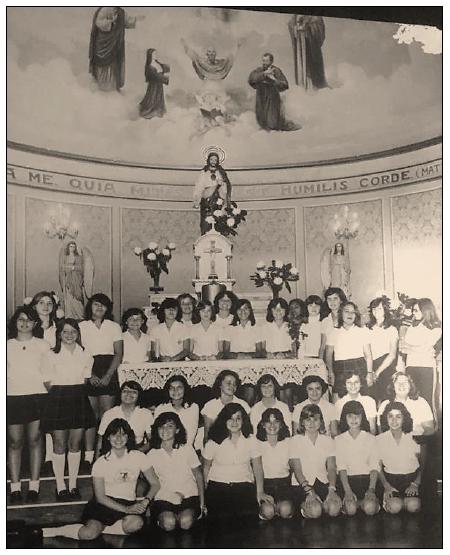
Source: Personal Collection of Teacher Izabela (2020).
Figure 1 Teacher Training Graduates, Colégio Sagrado Coração de Jesus, Class of 1982
The teacher mentioned that choosing the chapel as the location for the photo was a tradition for those graduating in education. The school sisters arranged the graduates for the photo. Izabela mentioned that the students were dressed in the so-called gala uniform, which was reserved for parties and consisted of a navy-blue skirt, a short-sleeved white shirt, white three-quarter socks, and black moccasin shoes. Until the day this photo was taken, the future teachers organized bingos and raffles to raise money for their graduation dinner at the school itself, following the commencement ceremony. Reflecting on that day, the teacher recalled how she and her friends were ecstatic and joyful, as they were just months away from graduating and becoming teachers. However, for Izabela, it was also a bittersweet moment, knowing that the group had been together since the fifth grade and that after graduation, they would go their separate ways.
During the photo presentation, Teacher Roseni focused on the portrait below from her graduation collection, which took place in the same chapel as her daughter's, albeit 23 years earlier. In the photo, the teacher is dressed in a gown and wearing a mortarboard, her expression serene and gentle. Roseni mentioned that before the formal graduation ceremony, a mass was held in honor of the female graduates. Since she studied at a convent school, the nuns did not allow graduation dances, a decision that somewhat displeased the teacher, given that her family was known for being "party-loving." Despite this, her parents hosted a dinner for relatives after the graduation ceremony to celebrate their daughter's achievement. Another aspect the teacher reminisced about concerning that day was how her mother was extremely happy and proud of her because she truly was now a teacher, just like her aunts.
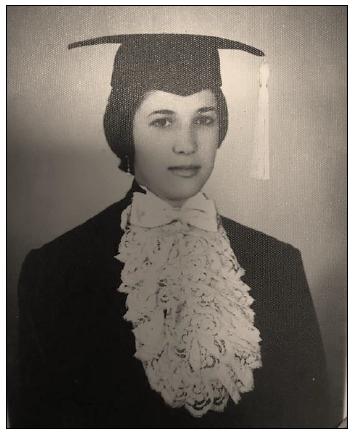
Source: Personal Collection of Teacher Roseni (2020).
Figure 2 Colégio Sagrado Coração de Jesus Class of 1959 Collection.
One thing that Teacher Izabela and her niece Giovanna had in common was that neither of them had chosen Education as their first choice for their undergraduate degree. Teacher Izabela studied International Trade for a year, but eventually gave up, and it was her mother who signed her up for the Education entrance exam. Giovanna studied Business Administration and worked in the field for five years before enrolling in a teacher training program. When interviewed, she recounted finding her calling during the course, shared her graduation photo, and expressed certainty in her decision to become a teacher. Giovanna shared that her graduation was a milestone in her life, as it was during the ceremony of degree conferral that her dream of becoming a teacher was realized. In the photo, it is clear that she is dressed in a graduation gown and holding a mortarboard. She shows joy in the moments leading up to the graduation ceremony.
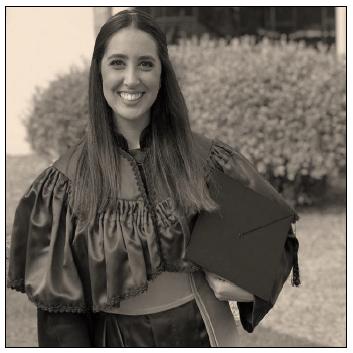
Source: Personal Collection of Teacher Giovanna (2020).
Figure 3 Teacher Giovanna's Graduation Ceremony, 2019.
Regarding the third category-the ongoing involvement of parents-the influence of parents was highlighted through conversations, social partnerships, and the educational investments they make in their children, fostering significant decisions in career choice. Bohoslavsky (2015) emphasizes that career choice and the relationship with parents are closely connected, as they are the initial role models for their children. It is the parents who set the initial expectations for their children's future careers and demand their involvement in the profession. It was evident that the parents played an active role in the interviewees' upbringing, from their academic journey to moments of relaxation with the family.
An analysis of the interviews clearly shows that their parents placed high value on education: all three teachers attended excellent schools and received family support and encouragement to pursue their studies. The teachers' parents expected them to achieve good grades and maintain ethical conduct within the school. Another significant and common point among the teachers was that their parents were included in their circle of friends. Teacher Izabela mentioned that her mother often joined her and her friends to go to gatherings or parties.
It can be inferred that the interviewees' parents were loving and kind, yet they also held high expectations for academic performance and the principles and values upheld in their homes. The closeness they shared with their parents was also evident. Teacher Izabela fondly recounted that to secure her first job in 1983, she went hand in hand with her mother to the State Department of Education, where there was a department that guided newly graduated teachers to positions in schools. Teacher Giovanna also made it clear that there was a partnership with her parents, mentioning that when it came to choosing a second degree, her parents encouraged her and said that becoming a teacher was a perfect fit for her.
Each interviewee was asked what it means, from their perspective, to be a teacher. Each responded in their own way. For Roseni, being a teacher means
contributing to the lives of others. She has had several famous students, such as Murilo, who became a doctor. When I go to see him, wow, he just adores me, saying that I was the one who taught him how to read and write. I was a great, excellent teacher; I was demanding. My students knew their multiplication tables by heart, but what about their notebooks? Wow, such a treat (R,2020).
Izabela remarked that being a teacher is
something you're born for; it's about having patience, showing care, and knowing how to share. I can't imagine myself not being a teacher; I really enjoy it. I remember when I was a preschool teacher, I loved teaching kids to read and write. Oh, how much fun we had. I learned through play; I would tell a really cute little story to introduce the letters. It was so cool, I absolutely loved it (I, 2020).
Finally, Giovanna shared that being a teacher means
contributing to the development of a well-rounded individual. Working with children, I am fully aware of my influence and significance in their development. That's why I study so hard and dedicate myself so much; my goal is for them to make a positive impact on the lives of others and the world as they grow up. I love my students, and I want them to be very happy (G, 2020).
This inquiry led the teachers to share numerous classroom stories, and the joy with which they recounted each segment was evident. The statements of the three teachers indicate their understanding of the impact they have on their students' lives, which is a reflection of the responsibility that comes with "being a teacher." Together, the teachers had a combined 69 years of contribution to education.
The use of oral history techniques in researching life trajectories allowed the teachers to relive significant moments in their lives, considering that there were fifty years between the first and the last teacher. This study provided an opportunity to access the intrinsic and personal moments of the teachers, which only happens when there is a specific interest in understanding why this family had three generations of teachers.
Final Thoughts
This study and the reflections made after analyzing the data revealed that although the family environment plays a role in the choice of a teaching career, there are other equally significant factors.
Bourdieu (2001b) emphasizes that the family plays a key role in transmitting values to individuals, either directly or indirectly, as it is their first point of reference. In agreement with the scholar, it was evident from the teachers' discourse that initially, the choice of the teaching profession was determined and influenced by the family, as values and principles were strongly oriented toward the field of education.
Bourdieu (1983) also cautions that choices are made based on a blend of influences stemming from an individual's experiences and the various social fields in which they are embedded. Thus, in this study, the participants' choice of the teaching profession was the result of a wide range of influences. In the case of Teacher Roseni, her path was shaped by the social context of the time and the image she had of her aunts-always well-dressed, respected by the community, and autonomous in their profession. Moreover, she knew that teaching was her destiny, especially since her father had enrolled her in the traditional teacher training program, the Curso Normal, only informing her of the decision afterwards. Despite the father's stance seeming imposing, Teacher Roseni claimed to be satisfied with her career path and had no regrets about the years that were dedicated to teaching.
In the case of Teacher Izabela, during her high school years, she also pursued teacher training, as it was customary in society for young women to be educated for teaching roles. With the goal of earning an income after completing her teaching degree, she decided to teach at a school and, at the same time, began studying International Trade with friends. Izabela eventually gave up on her first major and graduated in Education.
Teacher Giovanna initially chose to study Business Administration, inspired by her father's professional career, then, after four years of working in the field, she freely decided to pursue a degree in Education. Following this brief recap of the history behind choosing a teaching career, it can be deduced that in the case of Teacher Roseni, the most decisive factor was her father's decision regarding the teaching profession, that is, influenced by the social context of the time, which legitimized such behavior. On the other hand, Izabela's choice was more autonomous; after all, she had the freedom to opt for a different degree even though she was enrolled in Education. She could have withdrawn if she had not felt a connection with the program. Thus, the impact of the family environment was not dominant, and what mattered most to her was the professional experience she had prior to the Pedagogy program, as a lead teacher, which sparked her interest in continuing with the course to become a teacher. Finally, Giovanna, who had no direct family influence, chose her profession after years of working in another field, as a result of a personal process of maturation and discovery.
Therefore, by allowing an individual the freedom to choose, even though every choice is, to some extent, shaped by the social and historical context of each person, the factor that becomes predominant in the decision-making process for one's professional future is the personal aspect. In other words, it is the maturation process of the individual within their social context (friends, the generation they live in, cultural influence) that grants them greater freedom to choose their career. The study spanned the selection of a teacher in the 1950s, through the 1970s, and concluded in 2015. In this context, the decision to become a teacher was influenced by various factors for each interviewee. In the 1950s, family influence was significant in shaping an individual's professional future, but by the 1970s, there was a noticeable increase in freedom regarding this matter, and by 2015, individuals had complete freedom of choice. It is important to note that while the family environment contributes to decision-making, it should not be considered the sole determining factor in career choice. With each passing decade, the social context of an individual has become increasingly complex due to the growing array of professional options available, as well as the surge in information, which has lessened the decisive influence of the family on career-related decisions.
REFERENCES
BARDIN, Laurence. Análise de conteúdo. São Paulo: Edições 70, 2011. [ Links ]
BOGDAN, Roberto C.; BIKLEN, Sari Knopp. Investigação qualitativa em educação. Tradução Maria João Alvarez, Sara Bahia dos Santos e Telmo Mourinho Baptista. Porto: Porto Editora, 1994. [ Links ]
BOHOSLAVSKY, Rodolfo. Orientação vocacional: a estratégia clínica. 13ª ed. São Paulo: Martins Fontes, 2015. [ Links ]
BOURDIEU, Pierre. Esboço de uma teoria da prática. In: ORTIZ, Renato. (org).; Sociologia. Trad. Paulo Montero e Alicia Auzmendi. São Paulo: Ática, 1983. p. 46-81. [ Links ]
BOURDIEU, Pierre. Futuro de classe e causalidade do provável. In: NOGUEIRA, Maria Alice. e CATANI, Afrânio. (orgs.). Escritos de Educação. 3ª ed. Petrópolis: Vozes, 2001a. p. 81-126. [ Links ]
BOURDIEU, Pierre. Classificação, desclassificação, reclassificação. In: NOGUEIRA, Maria Alice e CATANI, Afrânio. (org.). Escritos de Educação. 3ª ed. Petrópolis: Vozes, 2001b. p. 145-183. [ Links ]
BURNIER, Suzana; CRUZ, Regina Mara Ribeiro; DURÃES, Marina Nunes; PAZ, Mônica Lana; SILVA, Adriana Netto; SILVA, Ivone Maria Mendes. Histórias de vida de professores: o caso da educação profissional. Revista Brasileira de Educação v.12 n.35 maio/ago. 2007. DOI: https://doi.org/10.1590/S1413-24782007000200013 [ Links ]
CHARTIER, Roger. A história cultural: entre práticas e representações. Rio de Janeiro: Bertrand Brasil, 1990. [ Links ]
COLÍN, Luis Álvarez. Familia, desarrollo y cambio social. Claves para un estudio interdisciplinario. En-clav. pen v.2, n.4, México, dic. 2008. Disponível em: http://www.scielo.org.mx/scielo.php?script=sci_arttext&pid=S1870-879X2008000200001. Acesso em 20 nov. 2020. [ Links ]
FAHT, Beatriz Hering. Fatores que influenciam a escolha profissional do jovem universitário e sua visão a respeito da orientação profissional. (122f.) 2011. Dissertação (Mestrado em Educação) - UNIVALI, Universidade do Vale do Itajaí, Itajaí, 2011. Disponível em: https://siaiap39.univali.br/repositorio/bitstream/repositorio/1854/1/Beatriz%20Hering%20Faht.pdf. Acesso em 20 nov. 2020. [ Links ]
FILOMENO, Karina. Mitos familiares e a escolha profissional: uma visão sistêmica. São Paulo: Vetor, 1997. [ Links ]
GIL, Antonio Carlos. Como elaborar projetos de pesquisa.6. ed. São Paulo: Atlas, 2008. [ Links ]
LAKATOS, Eva Maria.; MARCONI, Marina Andrade. Fundamentos de metodologia científica. 4.ed. São Paulo: Atlas, 2001. [ Links ]
MINAYO, Maria Cecília de Souza. (Org.). Pesquisa social: teoria método e criatividade.17ª ed. Petrópolis, RJ: Vozes, 1994. 80 p. [ Links ]
MOITA, Maria da Conceição. Percursos de formação e de trans-formação. In: NÓVOA, A. (Org.). Vidas de professores. 2. ed. Porto: Porto Editora, 2000. p. 111-140. [ Links ]
NÓVOA, Antonio (Org.). Vidas de professores. 2. ed. Porto: Porto Editora, 2000. [ Links ]
PORTELLI, Alessandro. Forma e significado na história oral: a pesquisa como um experimento em igualdade. Tradução de Maria Therezinha Janine Ribeiro. Projeto história, São Paulo, n.14, p. 7-39, fev. 1997. [ Links ]
SANTOS, Larissa Medeiros Marinho dos. O papel da família e dos pares na escolha profissional. Revista Psicologia em Estudo, Maringá, v. 10, n. 1, p. 57-66, jan./abr. 2005. DOI: https://doi.org/10.1590/S1413-73722005000100008 [ Links ]
THOMPSON, Paul. A voz do passado. Tradução de Lólio Lourenço de Oliveira. 2. ed. São Paulo: Paz e Terra, 1998. [ Links ]
Received: August 17, 2023; Accepted: November 28, 2023
 Este é um artigo publicado em acesso aberto sob uma licença Creative Commons
