




Serviços Personalizados
Journal

Artigo
 texto em
  Inglês (pdf)
 Artigo em XML
 Tradução automática
 Enviar este artigo por email
Compartilhar

 Permalink
Ensino em Re-Vista
versão On-line ISSN 1983-1730
Ensino em Re-Vista vol.30 Uberlândia 2023 Epub 22-Dez-2023
https://doi.org/10.14393/er-v30a2023-33
Articles
Conceptions and Reinterpretations shared by teachers who teach Mathematics in the Early Years about Statistics in continuing education meetings1
Mestre em Educação e Docência. Universidade Federal de Minas Gerais, Belo Horizonte, MG, Brasil.
marceloperizzi@gmail.com http://orcid.org/0000-0001-9542-9966
Doutora em Educação. Universidade Estadual de Campinas, Campinas, SP, Brasil.
keli.conti@gmail.comhttp://orcid.org/0000-0001-5662-2923
2Universidade Federal de Minas Gerais, Belo Horizonte, MG, Brasil. E-mail: marceloperizzi@gmail.com.
3Universidade Estadual de Campinas, Campinas, SP, Brasil. E-mail: keli.conti@gmail.com.
In this article, we seek to describe the conceptions that teachers who teach Mathematics in the Early Years have about the teaching of Statistics, promoting a re-signification of shared conceptions. We aim to bring these elements to (re)think the formation of teachers who teach Mathematics, contributing to the resolution of challenges faced by these professionals, in addition to bringing proposals for the construction of skills related to Statistics by students. The methodology is based on a qualitative approach from a perspective of collaborative work, valuing the experience and knowledge that the professors bring, giving voice to these professionals. The results demonstrate a probable absence of teaching Statistics in initial training courses, in addition to bringing the perspective of collaborative work as an element that favors the sharing of knowledge in continuing education. We conclude that there is a need for continuing education on Statistics with these professionals, as well as a reformulation of the curricula content taught in the initial training.
KEYWORDS: Statistics Teaching; Teacher training; Shared Meetings; Early Years of Elementary School; Mathematics Education
Neste artigo, buscamos descrever as concepções que os professores os quais ensinam Matemática nos Anos Iniciais apresentam sobre o ensino de Estatística, promovendo uma ressignificação às concepções compartilhadas. Objetivamos trazer esses elementos para (re)pensar a formação dos professores que ensinam Matemática, contribuindo para a resolução dos desafios encontrados pelos profissionais, além de trazer propostas para a construção de habilidades ligadas à Estatística pelos estudantes. A metodologia baseia-se em uma abordagem qualitativa sob uma perspectiva de trabalho colaborativo, valorizando a experiência e o saber que os docentes trazem, concedendo voz a esses profissionais. Os resultados demonstram uma provável ausência do ensino de Estatística nos cursos de formação inicial, além de trazer a perspectiva de trabalho colaborativo como elemento que favorece o compartilhamento de saberes em uma formação continuada. Concluímos que há necessidade de uma formação continuada sobre Estatística com esses profissionais, além de uma reformulação das ementas dos currículos trabalhados na formação inicial.
PALAVRAS-CHAVE: Ensino de Estatística; Formação de Professores; Encontros Compartilhados; Anos Iniciais do Ensino Fundamental; Educação Matemática
En este artículo, buscamos describir las concepciones que los docentes que enseñan Matemática en los Primeros Años tienen sobre la enseñanza de la Estadística, promoviendo una resignificación de las concepciones compartidas. Pretendemos traer esos elementos para (re)pensar la formación de profesores que enseñan Matemática, contribuyendo a la resolución de los desafíos que enfrentan esos profesionales, además de traer propuestas para la construcción de competencias relacionadas con la Estadística por parte de los estudiantes. La metodología se basa en un enfoque cualitativo desde una perspectiva de trabajo colaborativo, valorando la experiencia y los conocimientos que los professores aportan, dando voz a esos profesionales. Los resultados demuestran una probable ausencia de la enseñanza de la Estadística en los cursos de formación inicial, además de traer la perspectiva del trabajo colaborativo como elemento que favorece la compartición de conocimientos en la formación continua. Concluimos que existe la necesidad de una educación permanente en Estadística con estos profesionales, así como una reformulación de los menús curriculares trabajados en la formación inicial.
PALABRAS CLAVE: Enseñanza de la Estadística; Formación de profesores; Encuentros compartidos; Primeros Años de la Escuela Primaria; Educación Matemática
The reform of thought that facilitates a change in behavior and openness to new ideas incorporates an undeniable social necessity: to educate citizens capable of addressing the issues of their time, aware of their complexity and aware of the inevitable presence of uncertainties, alongside possible certainties that are always provisional.
Cleide Almeida and Izabel Petraglia
Introduction
This article presents excerpts from a research titled "Who said Statistics cannot be taught in the Early Years of Elementary School? Contributions from teachers who teach Mathematics in shared training meetings", and conducted within the scope of the Professional Master's Degree Program in Education (PROMESTRE) at the Federal University of Minas Gerais (UFMG). In the research, we aim to describe the conceptions held by teachers who teach Mathematics in the Early Years of Elementary School regarding the teaching of Statistics, as well as to provide contributions for the ongoing professional development of these educators, promoting a reevaluation of the shared conceptions within the group. Our aim is to bring these elements to (re)think the training of teachers who teach Mathematics, contributing to the resolution of challenges faced by these professionals, and also proposing strategies for developing statistical skills in students.
In this article, we brought excerpts concerning two themes that have contributed to the analysis of the results obtained in our study: the Teaching of Statistics in the Early Years, offering insights from authors and documents that influence curriculum development; and Teacher Training, introducing authors who describe the relevance of collaborative work and the importance of analyzing the conceptions that teachers bring from their education and field of work regarding a particular topic - in our case, the teaching of Statistics in the Early Years of Elementary School. The goal was to present the analysis of narratives shared by the teachers during the training sessions, highlighting their conceptions and reevaluations, which will be our focus in this article.
Finally, we draw some conclusions regarding the narratives shared by the group of teachers and included in this study. The emphasis was placed on collaborative work, conducted during the training meetings, as an interesting methodology to be considered in the context of continuing education. Furthermore, there was a reflection on the syllabi of initial teacher training programs for those who teach Mathematics, aiming to (re)think these training programs.
The Teaching of Statistics in the Early Years of Elementary School
Many argue that Statistics is relevant for interpreting data that surrounds us from various sources of acquisition. However, conceiving it as important for the formation of citizenship in the context of school education, starting in early childhood education, through the integration of its teaching into Mathematics classes, has still been a true "Achilles' heel"4. If we consider the context of teacher training, the situation can be even more concerning, as we might delegate, to future generations, teachers who know the relevance of this study in the classroom, but, due to formative obstacles, Statistics has not been fully addressed with a focus on the school environment.
In this section, we will highlight some authors who have studied Statistics as content that should be taught in the Early Years of Elementary School with the aim of developing specific skills in students. We will also provide contributions from normative documents that influence the curriculum related to this subject
We will begin by presenting the contributions of Lopes (2008, 2010). According to the author's reflections on our current times, "the constant presence of Statistics in the modern world has become a reality in the lives of citizens, leading to the need to teach Statistics to an ever-increasing number of people" (LOPES, 2010, p. 47, our emphasis). We emphasize the term "necessity" because we understand that Statistics, more than just being relevant - as we dare to assert - is necessary from the perspective of living in society. This is because in our current world, we are surrounded by statistical information, which requires citizens to have the skills to interpret it.
We share the author's idea, which reaffirms the need for the study of this subject in Mathematics classes:
The study of these topics becomes indispensable for citizens in the present day and in the future, assigning to the Teaching of Mathematics the responsibility of not only imparting numerical proficiency but also data organization, graph reading, and statistical analysis (LOPES, 2008, p. 58).
In addition to the contributions that the author makes regarding the necessity of teaching Statistics in the context of school education, there are documents that influence the curriculum and reinforce this thesis, which is prior to the observations described here. Among these documents, we can highlight the National Curriculum Parameters (NCP), an instrument that systematizes and provides guidelines for the teaching of Statistics in Elementary School, which states:
Understanding and making decisions in the face of political and social issues also depend on the reading and interpretation of complex, often contradictory information, including statistical data and indices disseminated by the media. In other words, to exercise citizenship, it is necessary to know how to calculate, measure, reason, argue, and handle information statistically, etc. (BRAZIL, 1997, p. 25, our emphasis).
However, considering the documents that influence the curriculum, the teaching of Statistics as a skill to be developed in the Early Years of Elementary School is relatively recent. In addition to the NCP, indicators of the need for work involving Statistics for citizenship, the National Common Curriculum Base (NCCB), through the thematic unit "Statistics and Probability", presents the skills and competencies to be developed by students during the Early Years of Elementary School. Regarding this unit, the BNCC describes:
Uncertainty and data handling are studied in the thematic unit Probability and Statistics. It proposes the exploration of concepts, facts, and procedures present in many problem situations in everyday life, science, and technology. Thus, all citizens need to develop skills to collect, organize, represent, interpret, and analyze data in a variety of contexts to make well-founded judgments and take appropriate decisions. This includes reasoning and using statistical concepts, representations, and indices to describe, explain, and predict phenomena (BRAZIL, 2017, p. 274).
In relation to the development of skills for interpreting different contexts in order to make more assertive decisions, we introduce the concept of statistical literacy proposed by Gal (2002), aligning with what the NCCB emphasizes:
(i) the ability to interpret and critically evaluate statistical information, arguments based on data, or stochastic phenomena that people may encounter in various contexts, including the media, but not limited to it, and (ii) the ability to discuss or communicate their opinions regarding such statistical information when it is relevant (GAL, 2002, p. 2 - 3).
Based on the author, we understand statistical literacy as the citizen's ability not only to interpret the information that surrounds the citizen from various contexts but also to assess the available choices for making assertive decisions. Therefore, we understand it as a skill that the student should possess. In order to achieve this, the teacher should work in the classroom, creating and providing materials that help the student develop this skill.
Continuing with the concept of statistical literacy proposed by Gal (2002), Cazorla and Utsumi (2010, p. 12) detail a model that divides this literacy into two components: cognitive and affective. Figure 1 outlines this division and presents elements that characterize each one.
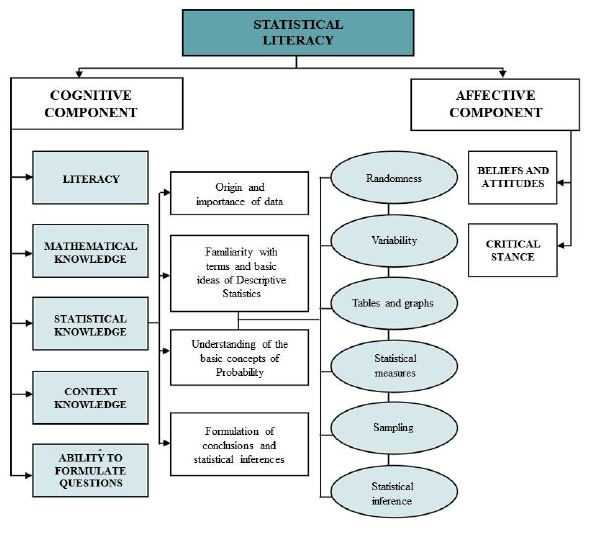
Source: Cazorla and Utsumi (2010, p. 12), with visual adaptations, our translation.
FIGURE 1: Statistical Literacy Model based on Gal (2002).
According to the proposed model, in the cognitive component, there are five elements that, according to Cazorla and Utsumi (2010, p. 12), are responsible for people's competence to "understand, interpret, and critically evaluate statistical information". In the affective component, there are two elements: beliefs and attitudes, which "shape their worldviews"; and the critical stance, which involves adopting a "questioning behavior in the face of statistical information" (CAZORLA; UTSUMI, 2010, p. 12).
As we mentioned beliefs and attitudes, characteristics found in the affective component of statistical literacy, we will discuss, in the next section, the importance of considering teachers' conceptions about the subject. Consequently, we will discuss the training of these professionals in order to provide elements that support the analysis of our shared meetings.
Teacher training: gaps, conceptions and collaboration
We will begin this section by posing the following questions to the reader: What memories do you have regarding Statistics during your initial training? The Statistics in question, if it was present, was it focused on teaching and learning? For this section, we aim to present authors who have studied the presence of Statistics education in teacher training programs, the importance of understanding and giving voice to conceptions that education professionals have about this topic. Furthermore, we aspire to provide a contribution to shared training based on collaboration, a perspective used in our meetings with teachers participating in this research.
Regarding the word “Statistics”, Cazorla et al. (2017, p. 14) bring the following concept:
[...] it refers to the set of tools for obtaining, summarizing, and extracting relevant information from data; identifying and evaluating patterns shown by data; planning data surveys or designing experiments; and communicating the results of quantitative research (CAZORLA et al., 2017, p. 14).
Based on this definition, it is possible to have courses in initial teacher training programs that include Statistics in their curricula; however, they may not necessarily consider aspects related to teaching and learning in the classroom. In other words, we have Statistics as a tool for organizing and calculating scientific data, often used in research. In order to differentiate Statistics as a science from that focused on teaching and learning, these authors define the term Statistical Education:
Statistical Education is centered on studying how people learn Statistics, involving cognitive and affective aspects, and the development of didactic approaches and teaching materials. Aiming at achieving this, Statistical Education requires contributions from Mathematics Education, Psychology, Pedagogy, Philosophy, Mathematics, and Statistics itself (CAZORLA et al., 2017, p. 15).
As we can see, in accordance with Gal (2022), Statistical Education takes into account cognitive and affective aspects with a focus on the processes inherent to teaching and learning, that is, those related to the context of school education. However, despite having justified the need for teaching Statistics in the Early Years of Elementary School, as expressed in the previous section, in which we described some documents influencing the curriculum, such as the NCP and the NCCB, as well as authors like Lopes (2008, 2010), this does not guarantee that Statistics, as a process to be taught in schools, is included in the curricula of undergraduate programs. According to Batanero (2002), "[...] the fact that Statistics is officially included in the curriculum does not necessarily mean it is taught [...]. Alongside the curricular changes, there is a need for teacher training [...]" (BATANERO, 2002, p. 6).
As if the probable absence of a Statistics curriculum in teacher training programs were not enough, some recent research, such as that by Conti, Nunes, Estevam and Goulart (2019), shows that there is a "misalignment regarding the demands indicated by the prescribed curricula for the Early Years of Elementary School and the syllabi of the analyzed Pedagogy courses" (CONTI, et. al, 2019, p. 13). Concerning this last point, Nacarato, Mengali and Passos (2021) assert that, as a consequence of this "misalignment", future teachers of the Early Years of Elementary School hold beliefs about what Mathematics is and about its teaching and learning - including Statistics, which falls within the realm of Mathematics.
Since we mentioned teachers' beliefs, we have introduced Tardif (2000), who provides insights into the beliefs that teachers carry from their training into their professional field:
Students go through teacher training programs without altering their previous beliefs about teaching. And when they start working as teachers, it is primarily these beliefs that they rekindle to solve their professional problems (TARDIF, 2000, p. 13).
By relating Tardif's contributions (2000) to the analysis by Nacarato, Mengali and Passos (2021), we infer that teachers carry the same beliefs acquired during their time as students in Basic Education, given that teacher training programs have not kept pace with the need to update their curricula to the same extent as Basic Education has evolved. As a result, teachers carry within themselves teaching experiences that were lived during their journey as students in Basic Education, which can lead to the repetition of these same experiences with their students when they work as teachers in schools.
For the purposes of this study, concerning the belief system that a teacher brings from previous experiences to the classroom, we rely on the concept of conception, as shared by Thompson (1992, p. 132):
A teacher's conception of the nature of Mathematics can be seen as the conscious or subconscious beliefs of that teacher, the concepts, meanings, rules, mental images, and preferences related to the subject. These beliefs, concepts, opinions, and preferences constitute the rudiments of a philosophy of Mathematics, although for some teachers, they may not be fully developed and articulated into a coherent philosophy (THOMPSON, 1992, p.132).
We understand the term "conception" as the way of understanding a theory or its practice, or a point of view. Regarding theories about the teaching of Statistics, teachers' conception can be their understanding of it, often without even having a deep knowledge of it. Because the belief system is included in Thompson's (1992) concept of conception, in conducting this study, we chose to work with the term "conception" instead of "beliefs".
By emphasizing the importance of understanding the conceptions that teachers bring and, consequently, carry into the classrooms, we reflected on a model of continuing education that could give voice to these conceptions while also reinterpreting them based on the contributions that the group itself has regarding the teaching of Statistics in the Early Years of Elementary School. Following this line of thought, we sought to establish a group based on collaboration, as proposed by Fiorentini (2019), who defines it as follows:
In collaboration, everyone works together ("co-laborates") and supports each other, aiming to achieve common goals negotiated by the group as a whole. In collaboration, relationships tend to be non-hierarchical, with shared leadership and "co-responsibility" for guiding actions (FIORENTINI, 2019, p. 56, author's emphasis).
The author adds that for this collaborative context to exist, there are three constitutive aspects that need to be present in this work: 1. Voluntariness, identity, and spontaneity; 2. Shared leadership and co-responsibility; 3. Support, mutual respect, and reciprocal learning (FIORENTINI, 2019, p. 58-63).
In the first aspect, we highlight the teacher's initiative to be part of a study group voluntarily; in the second aspect, we have the participation of all group members as teachers of these meetings, that is, as participants who also have something to contribute; and in the third aspect, there is respect for the memories and conceptions that teachers bring from their education and current experience.
We understand that creating a collaborative context fosters an environment that encourages the sharing of conceptions that teachers have about a particular topic - in our case, Statistics in the Early Years of Elementary School. Simultaneously, from this perspective, we aim to reframe these conceptions as a group that participates not only as a learner but also as a teacher who teaches and has something to share, contributing to the resignification of these conceptions.
Next, we describe the methodology used in this study, along with the key information related to the collaborative context created.
Methodology: constituting a collaborative context
For this study, we conducted research using a qualitative approach (BOGDAN & BIKLEN, 1994). We chose this approach because we agree with the authors on the following data to be valued: detailed descriptions of situations, contexts, people, interactions, behaviors, teachers' speech, attitudes, conceptions, among others; relevant aspects that ensure a commitment to knowledge production.
In the fieldwork, during the meetings with the teachers, we intend, in a collaborative work perspective, to especially value the third aspect proposed by Fiorentini (2019), called support, mutual respect, and reciprocity of learning, aspects that align with the data to be valued in the qualitative approach according to Bogdan and Biklen (1994).
In order to achieve this, we carried out an extension activity called "Shared Training Meetings: Statistics in the Early Years," which was widely promoted, especially on social media. We conducted this activity remotely to enable teachers from different locations to contribute and reframe their conceptions about the topic. It also provided an opportunity for teachers to attend the meetings without the need for physical travel.
We reiterate the term “meetings”, inserted in our training moments, from the perspective of work that was carried out based on collaboration, which grounds on the idea that all group members have something to contribute regarding the topic. In this perspective, we aimed to counterbalance the expositional work, as it is employed in most courses, in which one person takes on a leadership role in disseminating knowledge.
In total, we conducted eight synchronous meetings with the teachers. All of them were recorded with the professionals' consent5 - use of audiovisual resources - and, subsequently, they were transcribed. From the transcriptions, we analyzed the conceptions that the teachers shared during the moments of continuing education (which will be the highlight of the article). Additionally, as materials, experiences, and knowledge were exchanged, we observed the reframing that the meetings stimulated within the group of teachers.
We provide, in Table 1, the number of participants who attended each synchronous moment and the respective date of each meeting. The virtual meetings were conducted by using Google Meet platform, with a duration of approximately 1 hour and 30 minutes, held bi-weekly on Tuesdays, from 7:30 PM to 9:00 PM, in 2022.
TABLE 1: Number of participants in each synchronous meeting and its respective date of occurrence.
| Synchronous Meetings | Date of Meetings | Number of Participants |
|---|---|---|
| Meeting 1 | March, 15 | 13 |
| Meeting the Teacher | ||
| Meeting 2 | March, 29 | 5 |
| Working on Statistics in the classroom | ||
| Meeting 3 | April, 12 | 4 |
| Memories and Challenges up to the 3rd grade | ||
| Meeting 4 | April, 26 | 5 |
| Working Graphics and Activities | ||
| Meeting 5 | May, 10 | 3 |
| Statistical Research | ||
| Meeting 6 | May, 31 | 3 |
| A Children's Story | ||
| Meeting 7 | June, 28 | 1 |
| Presenting Projects | ||
| Meeting 8 | July, 12 | 3 |
| The Last Meeting |
Source: Created by the authors (2023).
For each meeting, as shown in Table 1, we provided a title summarizing the central axis addressed during that synchronous moment. Some people attended from the very first meeting. Among these attendees, we identified four teachers who had a genuine, spontaneous, and voluntary interest in sharing knowledge about the proposed topic. More than the number of people present, we agree that the research made significant contributions in relation to the conceptions that the professionals bring from their experiences, in addition to the new meanings inserted, as we will detail in the next section. The asynchronous moments were dedicated to previously agreed-upon readings and the preparation of materials that would be shared during the synchronous meetings.
Results: teachers’ conceptions and resignifications
In this section, we will present two points identified in some of the narratives of the teachers who participated in the shared training meetings related to the teaching of Statistics in the Early Years of Elementary School: conceptions and reframings regarding the topic.
For our analysis regarding conceptions, we used Thompson's definition (1992, p. 132), who states that a conception "can be seen as the conscious or subconscious beliefs of that teacher, concepts, meanings, rules". This makes it possible to relate these elements to the teaching of Statistics in the Early Years of Elementary School. The author emphasizes the importance of understanding the conceptions that teachers bring, associating them with characteristic patterns of behavior. Furthermore, the researcher states that understanding these conceptions results in an improvement in the quality of Mathematics teaching in schools - consequently, in the teaching of Statistics in the Early Years of Elementary School. During the shared training, we identified two conceptions that guided our moments: the difficulty in teaching and learning Statistics up to the 3rd grade of Elementary School, as well as the difficulty in teaching and learning Statistics for students who cannot read, write, or perform the four basic operations. Below, we present three statements from teachers André, Maria, and Karina.
Teacher André: I like to think about teaching Mathematics. When I received an invitation to participate in one of the groups I am in, I found it interesting to discuss Statistics in the Early Years, how to work with it, as it is often something that remains, thinking like "Statistics is not for the Early Years; it is more for later on". Personally, when I am in the classroom, I work with my students on this part of Statistics (Researcher's video file, range 0:13:42 to 0:14:12, Meeting I, our emphasis).
In this first statement, we brought teacher André's contribution, in which he reports the conception by other professionals regarding the fact that Statistics is not addressed in the Early Years of Elementary School. A justification for this conception may be the lack of teaching and learning of Statistics during the initial training of teachers for those grade levels.
Continuing with the concepts, we brought the contribution of teacher Maria:
Teacher Maria: I find it a bit challenging to work with 1st graders because the children are still very immature in their mathematical knowledge. And if you work with pure Statistics, it is difficult; however, since we are teachers, we have a great facility to adapt the students' reality to the content's reality, and then I think that if I get hands-on, I can handle it; of course, I will not apply pure Statistics, scientific Statistics, but I will introduce them to a method close to pure Statistics; which I also do not know because I am a pedagogue (Researcher's video file, range 1:11:21 to 1:12:18, Meeting III, our emphasis).
In teacher Maria's speech, we identified a difficulty in distinguishing Statistics as a science from Statistics Education, with the latter being taught in the Early Years of Elementary School. We can also justify this conception due to the absence of Statistics in the curricula of undergraduate courses, in which sometimes a subject related to the theme is introduced in a scientific manner, with a focus on research rather than practical classroom applications.
We also brought the conception of teacher Karina, which aligns with the conceptions mentioned above by other teachers regarding Statistics education being addressed later:
Teacher Karina: And indeed, in the Early Years, 1st, 2nd, and 3rd grade, it is more challenging, especially in this moment we are living, due to the pandemic, with all the students being late. But in the 5th grade, it is possible to work well with them, of course, within their reality. We cannot go too deep; it is all step by step, very slowly, within their reality. I believe it can be done (Researcher's video file, range 0:12:37 to 0:13:04, Meeting III, our emphasis).
Reinforcing the previous narratives and bringing reports about the influence of the coronavirus pandemic on teachers' conceptions, we observe, in this statement, the conception that Statistics education should be conducted from the 5th grade of Elementary School, in opposition to the NCCB, which introduces the thematic unit "Probability and Statistics" from the 1st grade of Elementary School. Moreover, through the expression "all the students being late", we can see that there are conceptions of priorities regarding what should be taught before teaching Statistics. Complementing our analyses and relating them to teacher Karina's narrative, we present below the conceptions regarding "prerequisites" for teaching Statistics in the Early Years of Elementary School, starting with teacher Edna's report:
Teacher Edna: I believe that now, after the pandemic, there has been a significant difficulty and a substantial gap in students. So, we have to start from the beginning, sometimes as early as the 3rd grade [she teaches 5th grade], working with natural numbers and gradually building a path from there (Researcher's video file, range 0:19:38 to 0:20:02, Meeting II, our emphasis).
Regarding the conception shared by teacher Edna, we observe a tendency among teachers to prioritize, in relation to the NCCB, working on the thematic unit of Numbers, as opposed to other thematic units and, consequently, other skills. We believe that the pressure on teachers to ensure that students know how to perform the four basic operations is greater, sidelining the teaching of Statistics. This view is also in line with the narrative of teacher Fabrícia:
Teacher Fabrícia: [...] Statistics, probability, which are in the NCCB, are Math contents, but if I do not teach first, if the student does not recognize what numbers are, if they do not know the basics, like addition, subtraction, the four basic operations, how can I talk to them about Statistics? Analysis, Information Treatment, how am I going to get to that? So, I say we have to give the basics, we have to give the rice and beans (Researcher's video file, range 0:36:49 to 0:37:20, Meeting III, our emphasis).
In teacher Fabrícia's statement, we justify our analysis regarding the priority of teaching Numbers in contrast to Statistics in the Early Years of Elementary School. Indeed, among the authors studied and mentioned in this article, and in the NCCB, we did not find that there is a prerequisite for Statistics to be taught. In fact, they have placed this theme as necessary in this stage of basic education, which is in line with other studies.
We believe that the separation into thematic units proposed by the NCCB may lead teachers to overlook the fact that these themes can be taught in conjunction. In Statistics teaching, for example, we can add up the number of people interviewed from data on a graph. It is teaching Numbers alongside Statistics!
From these narratives, we sought to share some texts that could reframe the presented conceptions, including the article entitled "Celebrating birthdays and working with Statistics in the 3rd grade of Elementary School" (PEREIRA, CONTI and CARVALHO, 2013); the master thesis entitled "Interfaces between investigation and statistical competences: a study with 1st-grade elementary school children" (MENDES, 2020); the article entitled “First experience with graph construction: the pets of 1st grade Elementary School students” (YOKOMIZO, CONTI and CARVALHO, 2012); and the children's book entitled “Escaping from the cat's claws”, written by Jeong and Yeong.
Clearly, just sharing texts with teachers without listening to them would make this a task that initial and continuing training programs are accustomed to, without taking into account the teachers' conceptions and challenges they bring from their professional practice. Therefore, we conducted shared training meetings with the premise that everyone in the group has something to teach and learn, while also presenting our difficulties and solutions.
When it comes to the resignifications, we identified some statements in which teachers bring a new perspective on the conceptions that had been shared at the beginning of the meetings. Some of them are shared here.
After the presentation of the master thesis entitled "Interfaces between investigation and statistical competences: a study with 1st-grade elementary school children" (MENDES, 2020), we asked the teachers about the possibility of conducting the activities proposed by the research, and we received the following feedback from teacher Karina:
Teacher/Researcher Marcelo: Is it a possible or impossible thing to do?
Teacher Karina: I think it is possible to do it, however, it does take a little bit of work...
Teacher/Researcher Marcelo: It does take a little bit of work...
Teacher Karina: And it is also a really fun thing, I was here watching, the kids are going to have a lot of fun, the person who encourages doing this research, they are going to really enjoy it... suddenly, I cheer them up.
Teacher/Researcher Marcelo: Hopefully, that is the goal [...] (Researcher's video file, range 1:20:48 to 1:21:20, Meeting IV, our emphasis).
By presenting Mendes' master thesis (2020), we aimed to guide our readings towards the practical part of the research, providing examples of how to teach Statistics in the Early Years of Elementary School. In particular, in this research, the author works with 1st-grade Elementary School classes. Therefore, we emphasize that teaching Statistics in this grade, despite the initial conceptions of the teachers, is indeed possible!
Continuing in our meeting moments, we presented the children's book entitled "Escaping from the cat's claws", written by Jeong and Yeong, in order to provide insights into teaching Statistics in the Early Years of Elementary School through children's literature. The use of children's stories in Mathematics classes is not new. On the contrary, it is a tool used even with students in Early Childhood Education, as mentioned by Passos et al. (2018):
[...] children's stories can be a tool in the processes of teaching and learning Mathematics, especially during the literacy phase, a period when students aged 6 to 8 begin to have more systematic contact with their native language and with mathematical knowledge (PASSOS, et al., 2018, p. 73).
Understanding that teachers who teach Mathematics in the Early Years of Elementary School are multi-subject teachers, as they have other subjects to teach besides Mathematics, this is an important point to mention because working with children's stories in Mathematics classes goes beyond that subject. This can be supported by the fact that it helps students develop skills that are part of the Portuguese curriculum, for example. When revisiting the children's story presented during the collaborative training meetings, we brought the contribution of teacher Karina:
Teacher Karina: I found it very interesting; I did not know this story. I was going to behave like Fabrícia [the name of another teacher participating in the meetings], reading this text but only thinking about Portuguese, not considering several other subjects that can be worked on within this story. Very nice, I think I am going to use it in my classroom. I will read it to my students and create activities, especially in Mathematics (Researcher's video file, range 1:08:02 to 1:09:01, Meeting VI, our emphasis).
As we can see in the statement above, working with children's stories is an interesting tool for teachers to teach certain content in Mathematics classes, including Statistics. In this article, we leave our recommendation that initial and continuing training courses propose the use of children's stories in Mathematics classes, and, more specifically, when it comes to teaching Statistics, we bring the recommendation of the children's book “Escaping from the cat's claws”, written by Jeong and Yeong.
Concluding the narratives described here, we move on to the final considerations of our study, understanding the importance of sharing perceptions among teachers and the essentiality of developing continuing education activities in a collaborative perspective for the resignification of the conceptions presented by the group.
Final Considerations
With the presentation of excerpts regarding documents that influence curriculum development and teacher training, by bringing authors who describe the relevance of collaborative work, our aim was to provide an analysis of the narratives shared by teachers during training moments, highlighting their conceptions and resignifications.
Based on the analysis of the narratives shared by the teachers who participated in the training meetings, we infer that Batanero's statement (2002) is present regarding the teaching of Statistics: even with the publication of documents that influence curriculum development, these are not sufficient for a change in teacher training programs to occur.
Furthermore, we understand, based on the narratives presented here, that continuing education from a collaborative perspective allows studies to be directed toward discussing and proposing solutions to challenges and conceptions reported by teachers, unlike the perspective of a course, in which there is usually a pre-defined curriculum on what will be taught. In summary, collaborative training provides the group with a greater sense of contribution, as, in this perspective, leadership is shared, and all participants commit to sharing what they know and their experiences as well.
We advocate for more studies on the teaching of Statistics in the Early Years of Elementary School, particularly with a focus on initial and continuous teacher training. We also advocate for collaborative training to be more prevalent, giving voice to education professionals who have much to share, not just to learn.
We believe and hope that this study will be taken into account by governments for the adoption of public measures regarding teacher training, as well as by universities aiming to reformulate their curricula in initial teacher training programs and to develop extension projects for continuous education with a collaborative perspective.
REFERENCES
BATANERO, C. Los retos de la cultura estadística. In: JORNADAS INTERAMERICANAS DE ENSEÑANZA DE LA ESTADÍSTICA, 2002, Buenos Aires. Conferência inaugural. Buenos Aires, 2002, p. 1-11. [ Links ]
BOGDAN, R.; BIKLEN, S. A Investigação Qualitativa em Educação. Porto: Porto Editora, 1994. [ Links ]
BRASIL. Ministério da Educação e do Desporto. Secretaria de Educação Fundamental. Parâmetros Curriculares Nacionais: Matemática. Brasília: MEC/SEF, 1997. [ Links ]
BRASIL. Ministério da Educação. Base Nacional Comum Curricular (BNCC). Educação é a Base. Brasília, MEC/CONSED/UNDIME, 2017. [ Links ]
CAZORLA, I.; UTSUMI, M. C. Reflexões sobre o Ensino de estatística na educação básica. In: CAZORLA, I; SANTANA, E. (Org.). Do tratamento da informação ao letramento estatístico. Itabuna: Via Litterarum, 2010. [ Links ]
CAZORLA, I. M.; MAGINA, S. M. P.; FERREIRA, V. G. G.; GUIMARÃES, G. L. (org.). Estatística para os Anos Iniciais do Ensino Fundamental. Brasília: Sociedade Brasileira de Educação Matemática - SBEM, 2017. (Biblioteca do Educador, Coleção SBEM, 9, E-book.). [ Links ]
CONTI, K. C.; NUNES, L. N.; GOULART, A.; ESTEVAM, E. J. G. Um cenário da Educação Estatística em cursos de Pedagogia. Revista Eletrônica de Educação Matemática, v. 14, p. 1-15, 2019. [ Links ]
FIORENTINI, D. Pesquisar práticas colaborativas ou pesquisar colaborativamente? In: BORBA, M. C.; ARAÚJO, J. L. (Org.). Pesquisa qualitativa em educação Matemática. 6. ed. Belo Horizonte: Autêntica editora, 2019. [ Links ]
GAL, I. Adult’s statistical literacy: meanings, components, responsabilities. International Statistical Review, n. 70, 2002. [ Links ]
LOPES, C. A. E. O Ensino da estatística e da probabilidade na educação básica e a formação dos professores. Cad. CEDES, Campinas (SP), v. 28, n. 74, p. 57-73, jan. 2008. Disponível em: http://www.scielo.br/pdf/ccedes/v28n74/v28n74a05.pdf. Acesso em: 18 jun. 2023. [ Links ]
LOPES, C. A. E. Os desafios para Educação Estatística no currículo de Matemática. In: LOPES, C. E.; COUTINHO, C. Q. S.; ALMOULOUD, S. A. Estudos e reflexões em Educação Estatística. Campinas: Mercado de Letras, 2010. [ Links ]
MENDES, V. C. Interfaces entre investigação e competências estatísticas: um estudo com crianças do 1º ano do Ensino Fundamental. 2020. 171 f. Dissertação (Mestrado) - Programa de Pós-Graduação Mestrado Profissional em Educação: Formação Docente para a Educação Básica, Universidade de Uberaba, Uberlândia, 2020. [ Links ]
NACARATO, A. M.; MENGALI, B. L. S.; PASSOS, C. L. B. A Matemática nos Anos Iniciais do Ensino Fundamental: tecendo fios do ensinar e do aprender. 3. ed. Belo Horizonte: Autêntica, 2021. 143 p. [ Links ]
PASSOS, C. L. B.; et al. A MATEMÁTICA DAS HISTÓRIAS INFANTIS: UM OLHAR PARA PRODUÇÃO DAS PROFESSORAS DOS ANOS INICIAIS. Revista Educação e Linguagens, Campo Mourão, v. 7, n. 13, jul./dez, p. 69-89, 2018. [ Links ]
PEREIRA, E. L.; CONTI K. C.; CARVALHO, D. L. Comemorando aniversários e trabalhando com Estatística no 3º ano do Ensino Fundamental. In: COUTINHO, C. Q. S. (Org.). Discussões sobre o Ensino e a aprendizagem da Probabilidade e da Estatística na escola básica. Campinas: Mercado de Letras, p. 61-73, 2013. [ Links ]
TARDIF, M. Saberes profissionais dos professores e conhecimentos universitários: elementos para uma epistemologia da prática profissional dos professores e suas consequências em relação à formação para o magistério. Rev. Bras. Educ., Rio de Janeiro, n. 13, p. 05-24, 2000. [ Links ]
THOMPSON, A. G. Teachers' beliefs and conceptions: a synthesis of the research. In: GROUWS, D.A. (ed.). Handbook of research on mathematics teaching and learning. Nova York: Macmillan, 1992. p. 127-146. [ Links ]
YOKOMIZO, M. K.; CONTI, K. C.; CARVALHO, D. L. de. Primeira experiência com a construção de gráfico: os animais de estimação dos alunos do 1º ano do ensino fundamental. Revista Eletrônica de Educação. São Carlos, SP: UFSCar, v. 6, no. 1, p. 312-321, mai. 2012. [ Links ]
YUN-JEONG, C.; SUN-YEONG, K. Fugindo das garras do gato. Coleção: Tan Tan. Editora: Callis. [ Links ]
4"Achilles’ heel" is a popular expression that means the weak point of someone or something, and conveys the idea of weakness and vulnerability. In other terms, it designates the vulnerable point of an organization, a project, or a task to be carried out.
Received: July 01, 2023; Accepted: October 01, 2023
 Este é um artigo publicado em acesso aberto sob uma licença Creative Commons
