




Serviços Personalizados
Journal

Artigo
 texto em
  Inglês (pdf)
 Artigo em XML
 Tradução automática
 Enviar este artigo por email
Compartilhar

 Permalink
Ensino em Re-Vista
versão On-line ISSN 1983-1730
Ensino em Re-Vista vol.31 Uberlândia 2024 Epub 28-Jan-2026
https://doi.org/10.14393/er-v31e2024-26
Articles
The perception of adolescents about school learning during the COVID-19 social isolation1

2PhD in Education, Feevale University. Novo Hamburgo, RS, Brazil. E-mail: elianapgmoura@gmail.com
3PhD in Psychology. Polytechnic Institute of Leiria, Portugal. E-mail: m.joao.santos@ipleiria.pt.
4Master in Psychology. Feevale University, Novo Hamburgo, RS, Brazil. E-mail: psimari50@gmail.com.
It presents a study that investigated teenagers' perception of their school learning before the pandemic, during social isolation, and currently. Following an exploratory-descriptive and cross-sectional methodological design, with a quantitative approach, the sample consisted of sixty-four (n=64) teenagers, aged between 14 and 17 years old, from three schools in the Porto Alegre/RS metropolitan region. Data collection was conducted in the first semester of 2022, using a self-administered questionnaire. A descriptive analysis of the frequency distribution of variables and the Friedman Test were performed to compare data and verify the existence of significant differences. The adopted significance level was 5%. The results indicate that teenagers negatively evaluated online classes, understanding that during the period of social isolation, online classes had low technical and pedagogical quality and did not contribute to their learning, resulting in weak assimilation of the taught content.
KEYWORDS: COVID-19; Teenagers; School learning
Apresenta uma pesquisa que investigou a percepção de adolescentes sobre sua aprendizagem escolar antes da pandemia, durante o isolamento social e, atualmente. Seguindo um delineamento metodológico exploratório-descritivo e transversal, de abordagem quantitativa, a amostra foi composta por sessenta e quatro (n=64) adolescentes, entre 14 e 17 anos, de três escolas da região metropolitana de Porto Alegre/RS. A coleta de dados foi realizada no primeiro semestre de 2022, utilizando-se um questionário autoaplicável. Foi realizada uma análise descritiva da distribuição de frequência das variáveis e o Teste de Friedman para comparar dados e verificar a existência de diferenças significativas. O nível de significância adotado foi de 5%. Os resultados indicam que os adolescentes avaliaram negativamente as aulas online entendendo que durante o período de isolamento social, as aulas online foram de baixa qualidade técnica e pedagógica e que não contribuíram para o seu aprendizado, acarretando fraca assimilação dos conteúdos ministrados.
PALAVRAS-CHAVE: COVID-19; Adolescentes; Aprendizagem escolar
Presenta una investigación que investigó la percepción de los adolescentes sobre su aprendizaje escolar antes de la pandemia, durante el aislamiento social y actualmente. De diseño metodológico exploratoriodescriptivo y transversal, de enfoque cuantitativo, la muestra estuvo compuesta por sesenta y cuatro (n=64) adolescentes, entre 14 y 17 años, de tres escuelas de la región metropolitana de Porto Alegre/RS. La recolección de datos se realizó en el primer semestre de 2022, utilizando un cuestionario autoaplicable. Se realizó un análisis descriptivo de la distribución de frecuencia de las variables y la Prueba de Friedman para comparar datos y verificar la existencia de diferencias significativas. El nivel de significancia adoptado fue del 5%. Los resultados indican que los adolescentes evaluaron negativamente las clases en línea, tuvieron baja calidad técnica y pedagógica y no contribuyeron a su aprendizaje, lo que resultó en una débil asimilación de los contenidos impartidos
PALABRAS CLAVE: COVID-19; Adolescentes; Aprendizaje escolar
Introduction
In March 2020, when the Covid-19 pandemic broke out, according to the second edition of the survey "Educational response to the covid-19 pandemic in Brazil", carried out by the National Institute for Educational Studies and Research Anísio Teixeira (INEP, 2021), 99.3% of Brazilian schools suspended their face-to-face activities, abruptly interrupting the teaching and learning process. A process of migration to non-face-to-face interaction modalities has begun. Private schools, most of which already had the technology and technical support, quickly adopted non-face-to-face teaching through synchronous classes almost instantaneously. In public schools (municipal, state and federal), however, the transition took place at a slower pace due to the need to acquire new equipment, technical adaptation and also teacher training in the use of non-face-to-face teaching programs.
In effect, the Covid-19 pandemic has impacted the Brazilian educational reality in various ways due to the countless disruptions caused by the health crisis. Several studies have been published (Silva; Machado, 2020; Lima; Souza, 2021; Senhoras, 2020; Silva; Santos; Soares, 2020; Santos et al., 2020), the social and educational crisis caused by the pandemic, such as the exclusion of students due to the low power to acquire the technologies necessary for remote classes, the expansion of latent inequality. But perhaps the most striking has been the human distance impacting the relationship between students and teachers with the adoption of remote or non-face-to-face teaching. To the extent that students and teachers began to interact only through emails, video calls, social media and/or messaging apps, the abrupt change in the act of teaching made it difficult for students to obtain and understand the content, implying damage to learning.
In the case of teenage students, who are considered digital natives, we could assume that they adapt easily to the new model. According to Lemos (2009, p 39), "digital natives live immersed in different learning communities, opening several windows at the same time", spending most of their day exchanging messages online, surfing the internet, downloading music, watching series and playing streaming games.
However, we cannot ignore the consequences of the indiscriminate use of digital technologies by adolescents (Silva, 2016). In fact, long before the COVID-19 pandemic broke out, numerous authors were already pointing out the impacts of the excessive use of digital technologies by teenagers, raising questions about their benefits and harms for social, cognitive and affective development.
Throughout 2020 and part of 2021, countless decisions were taken with the aim of "minimizing the damage to learning curriculum content" (Pereira, Narduchi, Miranda, 2020, p.232). Nevertheless, at the same time, numerous studies have been published demonstrating the damage that social isolation does "to the teaching, socialization and educational development of children and adolescents." (Silva, 2022, p. 02).
At the same time, the offices of psychologists and/or psychopedagogues also received cases of students with numerous complaints about school learning difficulties. This sparked a debate involving families and educators, concerned about the increase in cases of school learning difficulties under the conditions of non-face-to-face teaching, delivered through synchronous online classes.
In this context, we started to ask: how did the school learning experience of adolescents aged 14 to 17 occur during the social isolation imposed by the Covid-19 pandemic? Was the increase in complaints of learning difficulties that reached the offices of psychologists and/or psychopedagogues a result of social isolation? Did the students who came to the offices already have school learning problems before the social isolation? Or did their complaints arise from the decree of social isolation? And what about the students who, long before social isolation, were already experiencing school learning difficulties; did their difficulties increase?
This article is the result of a master's thesis in Psychology defended in the second half of 2022, at a Higher Education Institution (HEI) located in the metropolitan region of Porto Alegre/RS, whose general objective was to analyze, from a psycho-pedagogical perspective, the consequences on school learning and socio-emotional skills of adolescents between 14 and 17 years old, resulting from the social isolation imposed by the Covid-19 pandemic.
This article is an excerpt from the aforementioned dissertation research; it presents the results of the analysis carried out on the perception of adolescents between 14 and 17 years of age, on school learning before the pandemic, during the social isolation resulting from the Covid-19 pandemic and, currently.
Method
The research was characterized as an exploratory-descriptive, crosssectional study with a quantitative approach. It followed the ethical principles described in Resolution 510/2016 of the National Health Council (CNS), which provides for ethical care in research with human beings. The research project was submitted and approved, under protocol number CAAE 59419822.5.0000.5348, by the Research Ethics Committee (CEP) of the I.E.S. to which the master's research was linked.
Empirical context of the research
The research took as its empirical reference three schools located in two municipalities in the metropolitan region of Porto Alegre/RS: a public high school, a public technical high school and a private primary and secondary school. The schools were intentionally chosen because they met the main criterion: adolescent students between the ages of 14 and 17.
Research participants
Sixty-four (n=64) adolescents between the ages of 14 and 17 took part in the study, distributed as follows: twenty-two students enrolled at the technical high school; twenty-one students enrolled at the private primary and secondary school and another twenty-one students enrolled at the public high school. The participants were selected for convenience according to the following inclusion criteria: being a student regularly enrolled in one of the schools that was the empirical reference for the research; having remained in social isolation, attending classes online; having returned the Free and Informed Consent Form - TCLE signed by their legal guardians; having signed the Free and Informed Assent Form - TALE. The exclusion criteria were that the participants could not have a physical or cognitive disability, based on the need to guarantee the homogeneity of the group studied and minimize possible variables that could influence the results of the research. We understand that physical or cognitive disabilities can have a significant impact on how students deal with the educational environment, especially in a context of social isolation and online teaching.
Data collection instruments
A self-administered Likert scale questionnaire was drawn up, structured in two parts. The first part is made up of socio-demographic questions aimed at gathering general information such as: age, level of education, gender, with whom and in which city they live and the number of schools they have attended. The second part of the questionnaire contains questions relating to the school experience with a focus on learning difficulties, attendance, remote online classes and assimilation of content, considering three different moments: how they occurred before the pandemic, during and how they are currently occurring.
Data collection procedures
Data collection took place in the first semester of 2022. Prior contact was made with the pedagogical coordinators of each school by telephone, followed by email, and we also held an online meeting with one of them. The objectives of the research were presented and the school was invited to take part in the research as a co-participant. Once the schools had given their consent, we proceeded to schedule dates to send the TCLEs to the parents/guardians of the students who had expressed an interest in taking part in the research. On the scheduled day, before the instrument was applied, the students who consented to take part signed the TALE.
Presentation and discussion of results
A descriptive analysis of the frequency distribution of the variables was carried out. The Friedman test was used to compare linked sample data and check for significant differences. The significance level adopted was 5%.
The data was entered into a Microsoft Excel spreadsheet and processed in the Statistical Package for the Social Sciences (SPSS version 26.0).
Sample profile
The research sample, made up of sixty-four students (n=64) aged between 14 and 17, had the following sociodemographic characteristics. The average age of the participants was 15 years and 7 months (SD=1.04). With regard to gender identity, 50% of the sample surveyed declared themselves to be female (n=32); 45.3% male (n=29); 1.6% of the sample declared themselves to be agender (n=1); 1.6% of the sample declared themselves to be intersex (n=1) and, finally, 1.6% of the sample declared themselves to be non-binary (n=1).
With regard to level of education, the majority (85.9%) of the participants in the sample (n=55) are studying at secondary school level and only 14.1% of the participants in the sample (n=9) are studying at elementary school level. The 85.9% of the sample (n=55) attending secondary school are distributed as follows: the majority (40.6%) are attending (n=26) the first year of secondary school.Another equivalent proportion is distributed as follows: 23.4% of the students in the sample reported (n=15) that they were in the 2nd year; and 20.3% (n=13) were in the 3rd year of secondary school.There was one (n=1) student in the sample (1.6%) who reported being in the 4th year of secondary school, which allows us to deduce that this was technical secondary school.
As for the students in the sample (14.1%) who are studying at elementary school level, the majority (12.5%) of them (n=8) are studying at 9th grade level, with only one (n=1) student in the sample (1.6%) reporting that they are studying at 8th grade level.
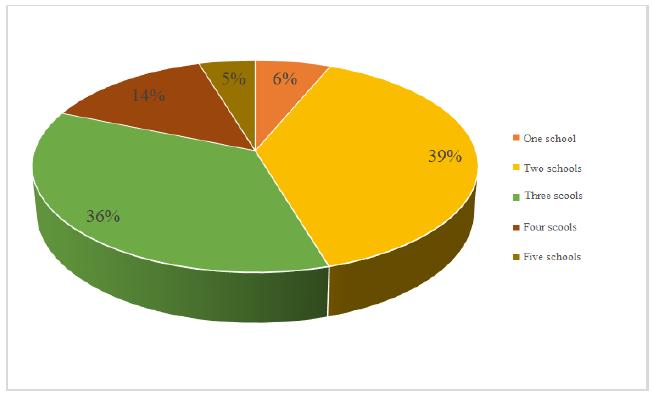
Finally, we asked the survey participants: how many schools have you attended? The results show that twenty-five participants (n=25) in the sample (39.1%) have studied at two schools. A similar number (n=23) of the students in the sample (35.9%) reported that they had studied at three different schools. Adding the two scores together, we have forty-eight students (n=48) in the sample (75%) who have already changed schools. This data is noteworthy because, considering the average age (15.7 years) of the sample, we can infer that 75% of the research participants change schools every six years. Motivated by this suspicion and looking at the data from another perspective, we came across an even more surprising fact: only four students (n=4) in the sample (6.3%) had attended a single school at the time of the survey. Even though only three (n=3) students in the sample (4.7%) have studied in five different schools, if we add the nine students (n=9) in the sample (14.1%) who have studied in four different schools, and add the 75% who have studied in two or three schools, we are forced to recognize that the overwhelming majority (93.8%) of the students in the sample (n=60) live a dynamic of constant changes of schools, suggesting a pattern of relationship with the school marked by inconstancy. Figure 1 illustrates these results.
On the other hand, it is widely recognized that switching schools is frequent during the move from primary to secondary school, due to factors such as the offer of different educational options, geographical changes, family preferences and other socio-economic aspects. We recognize that this aspect can influence the survey results in several ways. Firstly, it could lead to an underestimation of participants' previous school experiences before the period covered by the survey. In addition, the frequency of school changes may be correlated with socio-economic, cultural and regional variables that may also influence the participants' responses.
In any case, this data deserves to be analyzed more closely, as it may be expressing how adolescents perceive their school learning difficulties, regardless of social isolation. In this sense, studies carried out by Faermann and Rufato (2016) with adolescents reveal that their learning difficulties are multi-causal, involving a series of factors linked to biological, social, cultural, cognitive and emotional aspects. Antunes and Falcke (2015) also highlight the need for a comprehensive understanding of the phenomenon of learning difficulties. According to these authors, in general, learning difficulties in adolescents "are related to emotional and behavioral problems, depression, inattention, cognitive blockage, worries, fear and anxiety, substance abuse and involvement in situations of conflict with the law." (Antunes; Falcke, 2010, p. 54)
From another perspective, Simões (2020) points to social inequality as an important factor that appears to be strongly related to the learning difficulties of children and adolescents.
Adolescents' perception of school learning
In order to get to know the adolescents' perception of the experience of social isolation, the questions in the questionnaire were designed considering three different moments: before the pandemic, during social isolation and currently. The alternative answers offered frequency options: (1) never, (2) once a week, (3) twice a week, (4) three to four times a week and (5) every day. Question number one was formulated as follows: "Do you have/had any difficulties learning? The results are shown in Table 1.
Table 1: Perception of learning difficulties
| N | Average | Standard deviation | Minimum | Maximum | |
|---|---|---|---|---|---|
| Before | 64 | 1,80 | ,995 | 1 | 5 |
| During | 64 | 3,13 | 1,241 | 1 | 5 |
| After | 64 | 2,28 | 1,147 | 1 | 5 |
Source: Survey data
The analysis of the data shows that there is a significant difference between the three moments considered (before the pandemic, during social isolation, currently) in terms of adolescents' perception of learning difficulties. In other words, there is a significant difference (χ2 = 58.503; p < 0.01) in the adolescents' perception of the learning difficulties they face when comparing the three different moments.
In other words, the participants in the sample perceived that they faced more learning difficulties during social isolation (2.66%) than they used to face before the pandemic, just as they are currently facing. In addition, the result also indicates that currently (1.85%) the adolescents participating in the survey are facing more difficulty learning than they did (1.49%) before the pandemic, suggesting that social isolation has left negative marks on the adolescents in the sample. These data are corroborated by Bittencourt et al (2010) who describe a permanent deficit in learning as a negative result of the pandemic's impact on children and adolescents' learning.
Along the same lines, the second point investigated was adolescents' absence from school. The question was phrased like this: "Do you miss/have you missed classes?" The results are shown in Table 2.
Table 2: Perception of class absence
| N | Average | Standard deviation | Minimum | Maximum | |
|---|---|---|---|---|---|
| Before | 64 | 1,14 | ,432 | 1 | 3 |
| During | 64 | 2,11 | 1,335 | 1 | 5 |
| After | 64 | 1,17 | ,456 | 1 | 3 |
Source: Survey data
The result of the multiple comparisons test indicated a significant difference (χ2 = 47.153; p < 0.01) in the survey participants' perception of absences from classes during social isolation (2.46%), compared to the perception of absences before the pandemic (1.75%) and compared to the perception of absences today (1.79%). In addition, although not significant, the slight difference in adolescents' perception of absences today (1.79%) and before the pandemic (1.75%), when compared to adolescents' perception of learning difficulties, indicates that adolescents are currently facing more learning difficulties and are more absent from classes than they were before the pandemic. These results are corroborated by Antunes and Falcke (2010) who, when investigating the characteristics of the family and school context of adolescents with learning difficulties, showed that adolescents tend to understand their learning difficulties as related only to their personal characteristics and/or their relationships with teachers in the classroom. In this context, adolescents start to absent themselves from classes as a way of avoiding their problems.
Teenagers' perception of online classes
Finally, the survey sought to find out about teenagers' perceptions of the non-face-to-face teaching strategy, synchronous online classes, adopted by their schools during the period of social isolation imposed by the COVID19 pandemic. At this point, teenagers were asked about three aspects: (i) the quality of online classes (ii) the contribution/s of online classes to student learning and (iii) the assimilation of content taught through online classes. For each aspect listed above, the response alternatives were: (i) very bad, (ii) bad, (iii) regular, (iv) good, (v) very good. Table 3 shows all the data relating to the three aspects investigated about online classes:
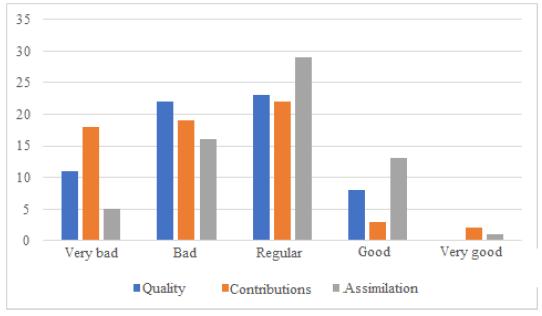
As for the quality of the synchronous online classes attended by the teenagers during social isolation, the answers were almost symmetrically distributed between the alternatives very bad (17.2%) and bad (34.4%). If we add the two percentages together (51.6%), we see that half of the teenagers considered the online classes offered during social isolation to be of poor quality, which raises important questions about the impact of remote learning on students' educational experiences. The perception of low quality can derive from a variety of factors, including a lack of personal interaction with teachers and classmates, technical difficulties in accessing the internet and suitable equipment, as well as challenges in adapting to the virtual learning environment.
When compared with the group of answers with a positive connotation: the good alternative (12.5%) and the very good alternative (0%), the results converge with the findings of Silva and Machado (2020), who pointed to the poor quality of teaching and the insufficient support provided by schools as one of the negative impacts of the pandemic on the teaching and learning process in the non-face-to-face modality.
When we look at the scores obtained in the question that asked the adolescents in the sample about the possible contributions of online classes to their learning, we see that the respondents were evenly distributed between the alternatives very bad (28.1%), bad (29.7%), and when added together, the group of answers with a negative connotation reached 57.8% of the sample. The joint analysis of the perception of low quality and the evaluation of the contributions of online classes to learning confirms a negative trend in relation to remote learning. These results are corroborated by Cardoso, Fuhr and Dias (2020) whose study concluded that the adoption of imperfect methods resulted in poor learning during the pandemic.
Finally, the results relating to the third aspect investigated (assimilation) about online classes are compatible with the line of reasoning followed here. In other words, the teenagers' responses regarding the assimilation of content in online classes reinforce the negative trend observed in the analysis of the two previous aspects: the quality of online classes and the contributions (of online classes) to student learning.
In this sense, 32.8% of the sample answered that they had a very bad or bad assimilation of the content taught in online classes, followed by 25.0% of the sample who considered their assimilation to be good (20.3%) and those who answered that their assimilation of the content was very good (1.6%), we have that the majority of adolescents presented answers with a negative connotation (very bad = 7.8% + bad = 25%) their assimilation of the content in online classes. In this sense, Santos et al. (2020) corroborate our data by pointing out that children and adolescents suffer significant losses in obtaining and understanding content during remote classes.
When we analyze the three aspects of online classes in isolation, it becomes clear that the regular answer is predominant in the sample. The neutrality of the answers can be interpreted in several ways. Firstly, it could indicate a lack of strong emotional engagement or extreme opinions towards online teaching. This may be a result of the ambivalent nature of the educational experiences lived during the period of social isolation, with students recognizing both the challenges and benefits of remote classes.
In addition, the prevalence of regular responses may reflect a certain conformity to the online teaching situation, with teenagers accepting it as a temporary and unavoidable part of their lives during the pandemic. This attitude may be influenced by the perception that remote learning is a temporary solution in the face of exceptional circumstances, and that it was necessary to adapt to it as best as possible.
On the other hand, neutrality in responses can also indicate a lack of enthusiasm or satisfaction with online teaching, without students feeling motivated to express meaningful criticism or enthusiastic praise. This may reflect a resignation or disinterest in the educational process during social isolation, especially if students were experiencing difficulties adapting to the virtual learning environment.
Nonetheless, the results grouped around the positive or negative connotations of the answers show the unequivocally negative tendency of the survey participants' responses in relation to online classes. Table 4 illustrates the tendency for teenagers to perceive online classes negatively in relation to the three aspects investigated.
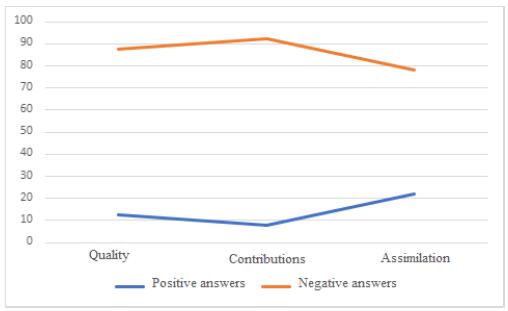
This is a worrying result, as it indicates that during the long period of social isolation, the main non-face-to-face teaching strategy adopted by the majority of schools was perceived as negative, of low quality, producing poor assimilation of content by the adolescents in the sample. These results are in line with the data obtained in the question that investigated the perception of difficulties in learning during social isolation, whose data reveal that it was during social isolation that the adolescents consider they faced significantly more difficulties in learning. These arguments are corroborated by Cardoso, Ferreira and Barbosa (2020), who concluded that "emergency distance learning does not have the capacity to provide the same results as face-to-face learning". (p. 42).
In this sense, a systematic review study on the impacts of the pandemic, Silva (2022), analyzed twenty-five (25) studies that address the learning of children and adolescents. Of this total, the author found that twenty-three (23) studies pointed to negative impacts, and only two (02) studies were able to point to positive impacts of the pandemic on school learning.
In a categorical way, Silva (2022) concluded that the vulnerabilities brought about by social isolation weakened the learning of children and adolescents, making it difficult for them to retain the content and compromising the continuity of their educational and curricular training, corroborating the data from this research Based on all these results, we should expect many future challenges in the educational field; challenges that were generated during social isolation, the consequences of which did not only translate into increased difficulties in learning, but will have different effects according to the different forms of teaching implemented during social isolation. A study by Cardoso, Ferreira and Barbosa (2020) analyzed the adaptations made in education to ensure teaching during the pandemic, showing that the greatest losses were suffered by students in the worst socioeconomic conditions. According to these authors,
The impacts of the pandemic on education will be felt in the short and long term, and will manifest themselves in various ways, such as school dropouts, performance gaps, failure rates, etc. [...] it is likely that levels of educational quality will fall back and that the disparity between the averages verified in external assessments will increase in relation to certain regions and social strata. It is also possible that the targets set in the PNE will be impacted, making it difficult for them to be achieved within the predetermined timeframe (Cardoso; Ferreira; Barbosa, 2020, p. 42).
It should be remembered that learning is an extremely complex and multi-causal process, which begins at birth and which, according to Antunes and Falcke (2010), may be a symptom of a bigger crisis that the adolescent may be experiencing. However, we mustn't lose sight of what Antunes and Falcke (2010) teach us when they state that "adolescent learning difficulties are not an individual phenomenon, but may reflect issues specific to the stage of adolescence and to family, school and social relationships". (p. 54)
In this case, taking into account the long period in which the students remained isolated, without contact with their peers, friends, etc. and considering that, according to Nardon (2006), it is during adolescence that social interaction expands, with participation in the different groups to which adolescents belong, such as: school, sports, courses, leisure, among others, we can estimate the future damage of the pandemic. In this sense, several authors (Silva; Machado, 2020; Lima; Souza, 2021; Senhoras, 2020; Silva et al., 2020; Santos et al., 2020), when studying the main negative impacts of the socio-sanitary crisis on the teaching and learning process, in addition to the disruptions in the educational process, point to the exclusion of students as an aspect that contributes to the expansion of educational inequalities in our country
In this scenario, numerous measures and reconfigurations of the educational process will be necessary. However, according to Gatti (2022), it will be impossible to abandon the methodologies and technological resources that were developed and used during the period of remote classes. That would be a step backwards. However, it must also be recognized that the simple acquisition of data during the pandemic is not the same as learning. During the period of social isolation, teenagers did not achieve the necessary understanding, the information was not processed or associated with others to generate a deeper understanding. The use of technology in the way that occurred during the pandemic may have contributed to a greater cognitive and affective imbalance in adolescents.
According to Moreira, Martins-Reis, Santos (2016), poor school performance should be seen as a symptom related to multiple etiologies. With the advent of the pandemic, in addition to pedagogical difficulties, pathologies and associated disorders, it is necessary to consider the impacts of the pandemic as causes related to poor school performance.
Closing considerations
This article presents the results of a study aimed at understanding the perception of adolescents aged between 14 and 17 about school learning before the pandemic, during the social isolation resulting from the Covid-19 pandemic and currently. The results indicate that the period of social isolation has led to more difficulties in learning than they used to face before the pandemic. The results also indicate that, although lower than during isolation, adolescents continue to face more difficulties in learning than they did before the pandemic.
Or to put it another way: the adolescents consider that the period during social isolation was significantly different from what they had faced before in terms of difficulties in learning. However, they perceive that they continue to face difficulties in learning, which are milder compared to the period of social isolation, but far from the difficulties they faced before the Covid-19 pandemic.
The results of the study also point out that the participants in the survey rated the online classes negatively, understanding that during the period of social isolation, the online classes were of poor technical and pedagogical quality and therefore did not contribute to their learning, resulting in poor assimilation of the content taught.
Finally, since most of the adolescents investigated reported having already changed schools, we must consider the possibility of bias in the interpretation of the results presented. In order to mitigate this possible bias, in future studies we intend to include additional questions to capture the participants' previous educational experiences, including the elementary school period. In addition, we will carry out more detailed analyses, considering factors such as the reason for changing schools, the perceived impact of these changes on students' learning and socio-emotional development, as well as comparing those who changed schools with those who remained at the same institution over time.
We believe that a more detailed analysis is needed in the future, as it may be somehow related to how adolescents perceive school learning beyond what they experienced during the period of social isolation imposed by the pandemic.
REFERENCES
ANTUNES, M. E. da S.; FALCKE, D. F. Contexto familiar e escolar de adolescentes com dificuldades de aprendizagem. Cadernos de Psicopedagogia. v. 8, n. 14, 2010, p. 53-69. [ Links ]
BITTENCOURT, M. S.; BITTENCOURT, D. P.; GENEROSO, G.; M., J.; MOURA, C.; COSSI, J. COVID-19 e a reabertura das escolas: uma revisão sistemática dos riscos de saúde e uma análise dos custos educacionais e econômicos. BID -Banco Internacional do Desenvolvimento, 16(4), 56 2010. [ Links ]
CARDOSO, M. D. O.; FUHR, H. P. P.; DIAS, K. G. COVID 19 and education: Reflections and possible ways. Revista Observatório. 6(2), 1-17, 2020 [ Links ]
CARDOSO, C. A.; FERREIRA, V. A.; BARBOSA, F. C. G. (Des)igualdade de acesso à educação em tempos de pandemia: uma análise do acesso às tecnologias e das alternativas de ensino remoto. Revista Com Censo #22. volume 7, número 3, agosto 2020 [ Links ]
FAERMANN, L. A.; RUFATO, V. F. Interfaces Científicas - Educação. Aracaju. V.4. N.3.p. 91 - 104, Jun. 2016. INEP (2021) Disponível em: Divulgados dados sobre impacto da pandemia na educação - Inep (www.gov.br) [ Links ]
GATTI, B. A. Contemporaneidade: educação, modernidade e pós-modernidade. Práxis Educacional, Vitória da Conquista, v. 19, n. 50, p. e11995, 2022. DOI: 10.22481/praxisedu.v19i50.11995. Disponível em: https://periodicos2.uesb.br/index.php/praxis/article/view/11995. [ Links ]
INSTITUTO NACIONAL DE ESTUDOS E PESQUISAS EDUCACIONAIS ANÍSIO TEIXEIRA (INEP). Resposta educacional à pandemia de covid-19 no Brasil. INEP; Brasília, julho de 2021. [ Links ]
LEMOS, S. Nativos digitais x aprendizagens: um desafio para a escola. Boletim Técnico do Senac. Rio de Janeiro, v. 35, n.3, set./dez. 2009. [ Links ]
LIMA, L. C.; SOUSA, L. B. Pandemia do Covid-19 e o Processo de Aprendizagem: Um Olhar Psicopedagógico. Id on Line Revista Multidisciplinar Psicologia.15(54), 813-835, 2021. [ Links ]
NARDON, F. A relação interpessoal dos adolescentes no mundo virtual e no mundo concreto. Trabalho de Conclusão de Curso. Criciúma: Curso de graduação em Psicologia, Universidade do Extremo Sul Catarinense, 2006. [ Links ]
MOREIRA, B. B. G.; MARTINS-REIS, V. de O.; SANTOS, J. N. Autopercepção das dificuldades de aprendizagem de estudantes do ensino fundamental. Audiology - Communication Research (ACR). 2016 ;21: p.p. 01-06. [ Links ]
PEREIRA, A. de J.; NARDUCHI, F.; MIRANDA, M. G. de. Biopolítica e Educação: os impactos da pandemia de covid-19 nas escolas públicas. Revista Augustus. v.25, n. 51, p. 219-236, jul./out. 2020. [ Links ]
SANTOS, E. T., CHÁVEZ, E. S., SILVA, A. A. M., LORDANO, G. A., AYACH, L. R., ANUNCIAÇÃO, V. S., BATISTA, R. L. Covid-19 e os impactos na educação percepções sobre Brasil e Cuba. Hygeia, Edição Especial: Covid-19, 16, 450 - 460, 2020. [ Links ]
SENHORAS, E. M. Coronavírus e educação: análise dos impactos assimétricos. Boletim de Conjuntura, Boa Vista, Ano II, 2(5), 2020. [ Links ]
SILVA, T. O. Os impactos sociais, cognitivos e afetivos sobre a geração de adolescentes conectados às tecnologias digitais. Trabalho de conclusão de curso (Graduação) - Universidade Federal da Paraíba. João Pessoa. 2016. [ Links ]
SILVA, M. C. da. Impactos da pandemia de COVID-19 na aprendizagem de crianças e adolescentes. Research, Society and Development, v. 11, n. 5, e47611527837, 2022. [ Links ]
SILVA, S. R. T. F.; MACHADO, E. Reflexões sobre a educação em época de crise, o impacto da pandemia: a partir da visão de professores da educação básica. Simposio: Formación integral de niños, adolescentes y jóvenes. la prevención y mitigación de multirriesgos de desastres naturales, tecnológicos y sanitarios. 3(5), 22, 2020. [ Links ]
SILVA, D. S. C.; SANTOS, M. B.; SOARES, M. J. N. Impactos causados pela covid19: um estudo preliminar. Revista Brasileira de Educação Ambiental - Revbea, 15(4), 128-147, 2020. [ Links ]
SIMÕES, E. D. F. As dificuldades de aprendizagem e a vulnerabilidade social. Brazilian Journal of Development (BJD). Curitiba, v. 6, n. 1, p.3037-3046 jan. 2020. [ Links ]
Received: September 01, 2023; Accepted: January 01, 2024
 Este é um artigo publicado em acesso aberto sob uma licença Creative Commons
