


measuring the quality of philosophical dialogue: a high-inference rating instrument for research and teacher education
Philosophical dialogue with children and adolescents has found its way into schools all over the world. The diverse teaching methods and approaches that have become established due to different authors and educational contexts are often subsumed under the term Philosophy with Children (PwC). The roots of this form of classroom discourse lie in the work of Matthew Lipman, who started the Philosophy for Children (P4C) program in the 1970s (Lipman, 1988, 2009). Since then, the effects of philosophical praxis in the classroom have been examined in numerous empirical studies. These studies show that the regular implementation of PwC has a positive effect on the cognitive development of students (García-Moriyón et al., 2005; Yan et al., 2018). Various studies further suggest that this method contributes to significant improvements in reasoning and argumentation skills (Collins, 2007; Säre et al., 2016; Walker et al., 2013), language ability (Alt, 2018; Schleifer & Courtemanche, 1996), social skills (Daniel, 2012, 2021) and critical thinking skills (Colom et al., 2014; Siddiqui et al., 2019, 2022; Worley & Worley, 2019). Previous research, however, has not included consideration of whether and to what extent the quality of collaborative philosophical inquiry had an impact on participants’ progress in the aforementioned areas. To facilitate such consideration, this article presents a high-inference rating instrument that measures the quality of philosophical dialogue. The instrument was developed as part of an intervention study and tested in 21 secondary-school classes in Switzerland. The paper first addresses the characteristics of philosophical dialogue and then describes the development and indicators of the high-inference rating scale using excerpts from classroom discussion. It then presents the results of the validation of the instrument carried out as part of the study. Finally, it addresses the limitations of the instrument, possible further developments and practical applications in research and teacher training.
characteristics of philosophical dialogue
This article bases its understanding of philosophical dialogue primarily on Matthew Lipman’s ideas (Lipman, 1988, 2003) but also on the publications of important German-speaking authors such as Ekkehard Martens (2003), Barbara Brüning (2003) and Kerstin Michalik (2013), thus connecting to the tradition of the Socratic Method. Children and young people explore philosophical questions collaboratively and expand their insights in a co-constructive process using specific philosophical methods. Philosophical dialogue thus differs from everyday conversations and discussions because certain philosophical methods are used to promote philosophical reflection. Reviewing the philosophical practice of Socrates and Aristotle, Ekkehard Martens defined five core philosophical methods that support successful philosophising: Phenomenology, Hermeneutics, Analysis, Dialectics and Speculation. Children participating in philosophical inquiry perceive and describe facts and phenomena in a differentiated way (phenomenological method). They try to understand the statements of their peers and to grasp their perspectives (hermeneutic method). Concepts and terms are scrutinised, and arguments are examined and questioned (analytical method). This happens in a collaborative, co-constructive exchange (dialectical method). Furthermore, participants in philosophical inquiry formulate hypotheses, consider possible consequences and discuss creative ideas (speculative method) (Marsal, 2009, 2014; Martens, 2003; Meerwaldt et al., 2018).
The teacher’s task is to promote critical and independent thinking in students using specific questions and statements. In the Socratic tradition, this can be called the maieutic method since the teacher helps ‘give birth’ to ideas and thoughts. The aim of such questions is to deepen the students’ philosophical reflection (Fisher, 2007; Haynes, 2008; Michalik, 2016). With increasing philosophical practice, children become able to use such questions and prompts for themselves (Kennedy, 2013). Table 1 presents different types of questions that can support philosophical reflection (Helbling, 2018).
Table 1: Types of questions in philosophical dialogue
| Describe facts and clarify terms | Can you explain that? What do you mean by that? What do you understand by this term? In what situations do you use it? Can you give an example? |
| Identify differences and similarities | What are the features of x and y? What is the difference between x and y? |
| Justify opinions and reflect on evaluations | Can you give a reason? How would you justify that? How do you know that? Can you give an example? |
| Creating hypotheses and considering consequences (thought experiments) | What would happen if…? What could be done so that...? Does anyone have another idea? |
In addition to the depth of philosophical reflection, the type of discourse is crucial for the quality of philosophical dialogue. In a community of inquiry (Sharp, 2009), students should collaboratively and co-constructively share thoughts and ideas so that the content of the dialogue evolves. Participants refer to each other and repeat statements, rephrase them, add to them, question them, contradict them, or ask questions if they are not understood (Daniel, 2008; Fisher, 2007; Kennedy, 2013; Michalik, 2016). Progress becomes visible since views are not simply expressed additively (Daniel et al., 2005; Jackson, 2013). The teacher can encourage co-construction through moderation questions, as exemplified in Table 2 (Fisher, 2007).
Table 2: Questions and statements to promote co-construction
| Moderation questions and statements to promote co-construction | Can you agree with x? Why/why not? Did everyone understand what x said? Can you repeat what you meant? Would anyone like to add something to this question/statement? Has anyone thought of something similar? Does anyone disagree? What do others think about this? So you agree that... Some of you think that … and others think it is rather … What have we found out together? |
Another feature of quality is that a previously defined question becomes focused and clarified. It is easy, instead, for students to digress and get lost in detail. To counteract this, the teacher can regularly summarise the status of the dialogue with regard to the question and explicitly revisit the underlying philosophical question (Brüning, 2003; Jackson, 2013). In order to be able to focus on the question, the participants must also comply with the rules of discourse so that no disturbances or interruptions occur (Haynes, 2008; Jackson, 2013).
Therefore, facilitating a philosophical dialogue requires great skill and sensitivity. This becomes clear in Haynes’ description of the teacher’s role:
The teacher’s role is to prompt children into giving reasons for their ideas, making distinctions and connections, constructing arguments and developing hypotheses and analogies. A balance has to be struck between a sense of adventure and exploration and a sense of direction and progress. The teacher helps the group to clarify and build on ideas whilst allowing the discussion to follow its own course. (Haynes, 2008, pp. 30-31)
Despite being expected to promote philosophical reflection and co-construction, teachers must also moderate with restraint (Krüger & Schick, 2012; Sharp, 2018). As a result, they should not express any opinions or attitudes of their own and should try to limit their share of the speaking: “In a community of enquiry teachers are facilitators, holding back on their own views, tactfully supporting children’s thought and talk and encouraging the dialogue to flow between participants” (Haynes, 2008, p. 35). In addition, teachers should not steer the dialogue in a direction that they have set but should follow the students’ train of thought (Jackson, 2013). The teacher’s tasks in a philosophical dialogue can be summarised as follows (Brüning, 2003; de Boer, 2015; Kennedy, 2004):
Promoting philosophical reflection and co-construction with questions and prompts
Summarising different contributions and positions; sharpening opinions
Keeping the focus on the topic/question
Monitoring the dialogue for inclusion of all participants and compliance with rules
Summarising results (at the end)
Providing prompts to reflect on the dialogue
Philosophical dialogue can therefore be regarded as successful if a deeper philosophical reflection takes place through the application of philosophical methods and if the students gain new insights in a co-constructive and collaborative way while maintaining the focus. Teachers support these processes and act as facilitators, holding back their own views and limiting their share of the speaking.
the development of a high-inference rating instrument
As already mentioned, until now there has been no instrument for measuring the overall quality of philosophical dialogue. Studies dealing with quality have exclusively addressed individual factors. For example, Cassidy and Christie (2013) used categories to examine what types of contributions participants made to philosophical inquiry. This made it possible to determine how often children used (philosophical) talk moves such as formulating examples or hypotheses, defining or differentiating words or phrases or introducing new ideas. A Canadian research team led by Marie-France Daniel described the development of complexity and critical thinking in dialogues (Daniel, 2008, 2021). Helzel and Michalik (2015) addressed, among other things, the multiple perspectives and references of students. Santi (1993) analyzed and described philosophical dialogues based on the criteria of spontaneous philosophical content, argumentative structure, epistemic categories, and the roles of teachers and peers. However, assessing the impact of philosophical dialogue requires a more comprehensive measurement tool. Therefore, we developed a high-inference rating instrument based on the rating system of Hugener et al. (2006) as well as Kunter (2005) to capture the overall quality of a philosophical dialogue. The first step consisted of a literature analysis, from which central quality characteristics emerged via a deductive procedure. These were then condensed into dimensions and operationalised with indicators. The preliminary instrument was adapted and supplemented in dialogue and based on an example class discussion, in accordance with an inductive procedure.
For this study, we used a high-inference procedure, which requires a high degree of inference and interpretation. Such procedures are used to assess the quality of instructional sequences - or, in our case, conversational sequences (Clausen et al., 2003; Seidel, 2005). In contrast, low-inference methods yield statements about easily observable behaviour.
Due to the need for intensive interpretation, the conversational features to be assessed must be presented precisely. Therefore, the content of each dimension is described in the rating instrument. This basic idea is then further elaborated using detailed indicators that are as close to the behaviour level as possible. The description and the indicators reflect a typical ideal philosophical inquiry. The rater (or, in our case, the two raters) must then rate the extent to which the dialogue corresponds to this specification on a four-point scale, assessing how often a certain behaviour occurs and how pronounced it is. Usually, the rater also examines the extent to which different students are involved in the class discussion. In our case, this third feature could not be measured or rated since only audio recordings were involved. The aim is for the judgments to reflect the overall impression in every dimension (Hugener et al., 2006).
Each category was supplemented by various remarks to clarify any ambiguities that arose. A complete philosophical dialogue forms the unit of analysis. The use of a highly inferential method requires intensive study of the instrument and many joint discussions for assessment (Rakoczy & Pauli, 2006).
Based on the literature, we defined four dimensions of the quality of philosophical dialogue: Philosophical Richness, Co-construction, Focus and Restrained Facilitation. Table 3 provides an overview of the dimensions and indicators. The complete instrument with the corresponding literature can be found in the Appendix (Supplementary File 1: High-Inference Rating Instrument).
Table 3: Dimensions and indicators of the high-inference rating instrument
| Dimension | Indicators |
| Philosophical Richness The criterion captures the extent to which different questions and contributions are illuminated in a differentiated manner using philosophical methods. | Terms, phenomena and situations are described and clarified. Similarities, differences and connections are formulated. Justifications or examples supporting opinions are expressed and evaluations reflected upon. Hypotheses are formulated, consequences assessed and speculations expressed. Diverse and substantial thoughts are expressed. |
| Co-construction The criterion captures the extent to which the teacher’s and students’ statements and questions relate to each other and build on each other. | Statements refer to previous statements by repeating, rephrasing, supplementing or differentiating them. Statements relate to previous statements by questioning or contrasting with them. Unclear statements are taken up and clarified by (follow-up) questions. Progress becomes evident in successive statements. Statements are not primarily made in an additive manner. |
| Focus The criterion captures the extent to which the statements and questions from the teacher and students focus on answering the philosophical question. | Questions and statements contribute to answering the underlying question. The conversation does not digress in content. Summaries, transitions and questions that focus on the underlying issue create a common thread in the conversation. The underlying philosophical question is explicitly taken up again during or at the end of the dialogue. Basic dialogue rules are followed so that the dialogue is not disturbed or interrupted. The teacher recognises statements with potential for the topic and deepens them with specific questions. |
| Restrained facilitation The criterion captures the extent to which the teacher succeeds in promoting co-constructive dialogue and philosophical richness without assuming too dominant a role in the dialogue. | The teacher refrains from expressing personal opinions or evaluations and does not provide any answers. The teacher follows the students’ trains of thought and deepens them by adapting questions flexibly, rather than leading the dialogue towards a specific goal. The teacher creates space so that the students can talk to each other and limits her or his share of the speaking. The teacher creates space so that the students can develop their own trains of thought without being too quickly restricted by the focus of the topic. |
In the next section, we will take a closer look at the dimensions using examples from philosophical dialogues.
presentation of the instrument using excerpts from philosophical dialogue
In order to make the instrument more comprehensible, two academic excerpts from philosophical dialogues taken from the Swiss study mentioned above are presented in this section and linked to the dimensions.
The intervention study aimed to examine the influence of philosophical dialogue about the nature of science on the acceptance and understanding of evolution. In the teaching unit, philosophical dialogue was thus linked to the content of the subject of biology. The teaching approach of using philosophical reasoning in school subjects goes back to Kerstin Michalik (2009, 2013) and holds great potential for the students’ (interdisciplinary) learning. The focus of these dialogues was not on the development of questions by the students but rather on the conversation itself and its progression. Accordingly, the instrument is exclusively centred on the discussion phase.
The teaching unit on evolution was carried out in 21 secondary-school classes, with students mainly aged between 13 and 15. The classes were divided on three occasions, during which half took part in a philosophical dialogue while the other half delved further into the subject for about 25 minutes. In the philosophical dialogues, the students dealt with the following three questions: Does the theory of evolution make belief in God and religion superfluous? Can we rely on science? What distinguishes humans and animals? The first two dialogues thus focused on epistemological questions and in particular on the relationship between religion and science. These topics are part of the concept of the nature of science (Hofheinz, 2010; Lederman et al., 2002; McComas & Olson, 1998) and have proven to be important factors influencing the acceptance and understanding of evolution. The third dialogue focused on anthropological and ethical questions, and its discussion required recourse to the first two dialogues. The students in the classes had generally known each other for one or two years, but this was their first time participating in a philosophical dialogue in this group or at all. Research findings indicate that experience in philosophical praxis and the duration of the group's existence have a significant impact on the quality of the dialogues (Daniel, 2008).
All class discussions were assessed using the instrument described. This allowed the pursuit of the question whether the quality of the philosophical dialogue influences the acceptance or understanding of evolution. Further information on and results of the study can be found in Bernhard (2022).
In the following simplified excerpt, students consider the question of whether one can believe in God and hold the theory of evolution to be true at the same time. Due to the audio recording, the students speaking cannot be identified. The statements are thus simply numbered and assigned either to the teacher (identified as ‘T’ for ‘teacher’) or to the students.
S1: So, I think yes, that is possible. Believing in God does not only mean that he created the world and everything. It could also just help if you have a problem or something. You can still count on God. S2: So, I think you can. So, you can do everything, but you must try to separate it. You can’t just, so you must separate it. So, these are two different issues, because I think that belief is believing it is so. And the other is simply a fact, so it’s about facts. Facts that can be proven, so to speak. With God, it’s just believing. S3: I don’t know if that’s true, either. Those giraffes used to look like this.1 There’s no proof of it, it’s just a guess. S4: You can prove that. S5: If you find dead animals, you can use the genes to look up what kind of animal it was; then you have proof that it had a short neck. S6: But we don’t know exactly how it came about. S7: You can do experiments. It’s definitely different now. It’s always changing. You can see this in all animals. S8: They also only learned about the dinosaurs from the bones they found. S9: Well, there are enough facts, I think, or evidence. S10: Yes, I think it is possible that one can be a believer and a scientist. Because if you find out something in science, for example, and believe in God and read it somewhere in the Bible and it is confirmed again, then you are actually even safer. T1: So, they can confirm each other. S11: Yes, exactly. T2: That would be great. Are there also subject areas where this is not possible?
philosophical richness
Here, students name two important reasons that one can be a scientist and religious at the same time. First, belief in God involves more than just the question of whether God created the world; it can, for example, fulfil the need for help or protection (S1). It is also emphasised that science and faith are two things that must be clearly distinguished. The important distinction between knowledge and belief is mentioned (S2). A brief discussion develops from this point, clarifying in part how science can find evidence. During the discussion, the students seek to support their views with concrete examples and thus provide justifications (S5/S7/S8). However, there is no conclusive clarification or statement of the extent to which faith and science are two different domains or of what distinguishes knowledge from faith. Here, the teacher fails to follow up specifically or summarise. She does not elaborate, merely asking about the last point mentioned (T1).
co-construction
In the excerpt, it becomes clear that the students’ statements relate to each other and are not uttered additively. The second statement is even questioned by a student so that a longer exchange develops (S3). Various participants complement each other in explaining why the idea of the development of the giraffe is based on evidence (S5/S7/S8/S9). The teacher also refers in her statements to statements made by the students. She paraphrases and sharpens the students’ statements (T1) and adapts her question to them (T2).
focus
The statements by the students and the teacher all focus on the underlying question. There are no distractions, and the rules of conversation are observed. No summaries or transitions are visible in this section. A summary would have been helpful, especially regarding the important distinction between knowledge/facts and belief. The teacher does not recognise the importance of this issue for the underlying question; consequently, no deepening takes place.
restrained facilitation
The teacher gives the students plenty of space to talk to each other and keeps her share of the speaking to a minimum. Her questions are adaptive and refer to statements made by the students (T1/T2). However, deepening the central point of the students’ discussion falls short. Furthermore, the teacher - presumably unconsciously - expresses an evaluation by positively assessing a possible mutual confirmation of religion and science (T2).
In another excerpt, the class discusses similarities and differences between humans and animals. The philosophical dialogue deals with the relationship between humans and animals and the consequences that follow from this relationship.
T1: Let’s go to the basic question, what do animals and humans have in common? Or maybe also what are the differences - both. S2: So, animals and humans have feelings; both eat, both drink. T2: And what are the differences? S3: No idea. S4: We are smarter. T3: How do you know? S5: We build houses, and we build roads, and we have cars, and they still live in the wild, and we build things, and they are, yes. T4: We develop things, for example, tools and such. Don’t animals do that? S6: No. S7: Monkeys do. I’ve seen a video of a monkey using a rock to crack a coconut. That’s also a tool that it built. S8: Or the ants also build their houses. S9: Yes, that’s right. T5: Hmm, could an animal now also build a complex vehicle like a car? S10: Maybe. T6: So, they both need tools, and animals build houses too, but we might agree that humans can build or make more complex things, develop tools to use them. T7: Do you see any other differences between humans and animals? Something we do and can do and animals don’t do? S11: So, I think we can also plan for the future, and animals don’t even know that they are dying. T8: Plan the future. Give me an example. For example, what are your plans now for the future, maybe the next few weeks or something? S12: Yes, actually nothing. But I don’t know if the animal knows if it’s going to die anyway or something. T9: So, you think animals don’t even realise that life eventually comes to an end? S13: Yeah, I don’t know what they are thinking. S14: I have the feeling that they don’t study around at all. Well, they don’t ask themselves that, they just live it and take it as it is. They don’t even think about how it could be otherwise. I have a feeling they can’t even think that far. T10: Hmm, think so far. You said something important. Thinking about the future, planning vacations, thinking about what it would be like to live in America. Do you think animals can do that too? S15: I do not think so. T11: So, is that actually something that distinguishes us from animals? S16: Yes.
philosophical richness
In response to the teacher’s question (T1), a student formulates various similarities between humans and animals (S1). However, the topic of similarities is abandoned rather abruptly and not further differentiated. Various, substantial factors are proposed on the question of differences: intelligence (S4), building things (S5), using tools (T4/S7), planning one’s own future (S11), being aware of one’s own death or life (S11/S14). In this dimension, it is irrelevant whether the teacher or the students introduce or elaborate on these points. Although these key areas are mentioned, they are not further described or clarified. It remains unclear how the use of tools differs between animals and humans. It remains just as open to what extent human and animal intelligence, thinking, consciousness and planning can be differentiated. The areas are therefore only treated superficially. At various points, views are supported with examples (S5/S7/S8). Elsewhere, students find it difficult to further justify suggestions (S12/S13).
co-construction
The teacher often behaves in a co-constructive manner. She paraphrases statements made by the students (T4/T9/T10) and asks specific questions (T4/T8/T11). Sometimes, however, it seems as if the teacher is putting statements into the students’ mouths that go beyond anything they have expressed (T4/T6). Two students contradict a statement by a colleague who attributes the use of tools exclusively to humans (S7/S8). Otherwise, the students do not behave in a co-constructive manner without the support of the teacher. The conversation is like a teacher-student ping-pong. Some progress is visible, but the topics change too quickly and are therefore not ultimately clarified. In terms of content, there is hardly any progress in relation to the question of using tools or planning for the future.
focus
Most of the statements contribute to answering the underlying question. However, the question about one’s own plans for the future in the next few weeks serves no purpose and tends to lead away from the topic (T8). The teacher tries to differentiate or summarise statements (T6, T10). It would make sense to relate or contrast statements more often and to let the students react to them. The philosophical potential of individual comments is only partially recognised. The characteristics of planning for one’s own future and being aware of one’s own existence should have been deepened, given their importance for the difference between humans and animals. Discussion rules are followed, and there are no distractions.
restrained facilitation
As already mentioned, the teacher puts certain statements in the students’ mouths that go beyond anything they actually expressed (T6). It sometimes seems as if she had been waiting for the opportunity to introduce certain keywords, such as ‘tools’ (T4). Thus, she pursues a certain goal (T5) instead of following the students’ trains of thought. At various points, however, the teacher asks specific questions and adapts them to the statements made by the students (T3/T8/T9). The teacher is rather dominant in terms of content and takes up a large part of the discussion. It would be more effective to ask more moderate questions and to invite the opinions of other students.
evidence of the high-inference rating instrument’s validity
According to the American Educational Research Association et al. (2014), validity describes “the degree to which evidence and theory support the interpretations of test scores for proposed uses of tests” (p. 11). There are various sources of evidence: evidence based on test content, evidence based on response processes, evidence based on internal structure, evidence based on relations to other variables and evidence for the validity and consequences of testing (American Educational Research Association et al., 2014). Since the development of the instrument and its validation were not the focus of the Swiss research project, only individual sources of evidence are addressed in this chapter.
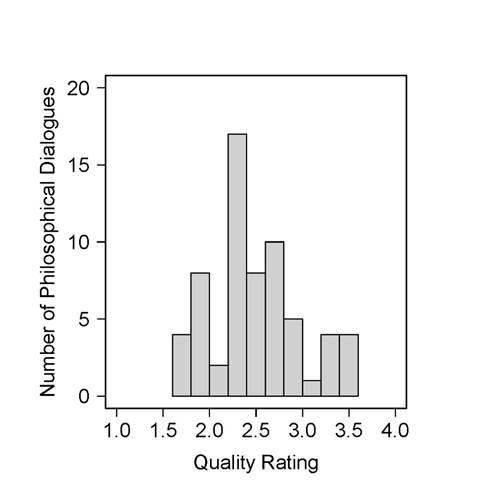
The results of the rating of the 63 philosophical dialogues in the study in Figure 1 show that the instrument is able to record different levels of quality.
The crucial question now is whether these differences can be validly measured. In the following sections, we therefore briefly discuss evidence based on test content, evidence based on internal structure and evidence based on relations to other variables. In addition, we address interrater reliability in the assessment of the dialogues as an aspect of objectivity.
evidence based on test content
To ensure the fit of content and construct, the instrument was developed based on existing literature on philosophical dialogue and improved in discussions with experts. The references to literature on the dimensions and indicators are listed in the Appendix (Supplementary File 1: High-Inference Rating Instrument).
evidence based on internal structure
The dimensionality of the instrument was tested with the help of an exploratory factor analysis (maximum likelihood) with oblique rotation (oblimin) (Bühner, 2011; Preacher & MacCallum, 2003). A factor with an eigenvalue > 1 could be detected, which explains 43% of the variance. Cronbach’s alpha, i.e. internal consistency, was 0.72. This value is acceptable. The values in the factor analysis indicate how strongly a particular dimension correlates with the underlying construct, the quality of philosophical dialogue. A high value shows a high correlation and indicates that the variable is strongly connected to the dimension. This means that the variable makes a significant contribution to explaining this construct. Table 4 shows that each dimension makes a relevant contribution to the construct of quality, though to varying degrees.
Table 4 Results of the maximum likelihood factor analysis with oblimin rotation to capture the dimensionality of the quality of philosophical dialogue, N = 63
| Dimension | Factor |
| 1 | |
| Philosophical Richness | .86 |
| Co-construction | .74 |
| Focus | .46 |
| Restrained Facilitation | .45 |
| Eigenvalue | 1.7 |
| Explained variance | 0.43 |
evidence based on relations to other variables
If theoretically based connections with other constructs can also be determined empirically, this can provide a source of evidence for validity. In our research project, based on numerous theoretical and empirical works, we assumed that the quality of philosophical dialogue has a positive influence on acceptance of evolution. Figure 2 presents a latent change score model (Kievit et al., 2018; McArdle & Grimm, 2010) of the impact of the quality of philosophical dialogue on the change in acceptance of evolution. A higher quality of dialogue leads to a greater increase in acceptance of evolution (β = .214, p = .009). The model explains 19.9% of the variance in the change in acceptance of evolution. The theoretically assumed connection was thus empirically confirmed, providing evidence of the instrument’s validity. The acceptance of evolution was measured using a questionnaire before and after the intervention (Bernhard, 2022)
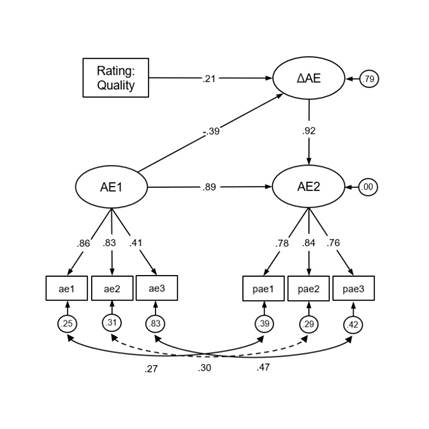
Figure 2 Latent change score model for the philosophy group2 (N = 180) with the dependent variable acceptance of evolution and the independent variable quality of philosophical dialogue. Solid lines indicate significant relationships, dashed lines non-significant relationships. AE1 = pre-test acceptance, ae1/ae2/ae3 = pre-test acceptance items, AE2 = post-test acceptance, pae1/pae2/pae3 = post-test acceptance items, ΔAE = change in acceptance, Rating: Quality = quality of the philosophical dialogue.
interrater reliability
Two evaluators, the author and a master student, rated the philosophical dialogues from the study. The master student familiarised herself with the introductory materials for the teachers of the first dialogue as well as the rating instrument and discussed these with the author. Subsequently, various discussions on the first philosophical question were jointly evaluated, allowing the resulting judgments to be discussed and clarified. The intraclass correlation (ICC) was calculated to determine interrater reliability. Since 27 of the 63 philosophical dialogues were assessed independently by both raters, values were evaluated using a two-factor analysis of variance. The rating aimed to achieve the greatest possible agreement, so an unadjusted ICC was calculated (Koo & Li, 2016; Wirtz & Caspar, 2002). The results may be seen in Table 5.
Table 5: Intraclass correlation (ICC) for overall quality and each dimension, N = 27
| Overall quality | 0.903 (Confidence interval: 0.800 < ICC < 0.954) |
| Philosophical richness | 0.705 (Confidence interval: 0.455 < ICC < 0.853) |
| Co-construction | 0.849 (Confidence interval: 0.697 < ICC < 0.928) |
| Focus | 0.662 (Confidence interval: 0.379 < ICC < 0.831) |
| Restrained facilitation | 0.851 (Confidence interval: 0.701 < ICC < 0.929) |
There is no precise definition of when the ICC is considered sufficient. According to Koo and Li (2016), values above 0.5 can be interpreted as moderate reliability, values above 0.75 as good reliability and values above 0.90 as excellent reliability. It can be stated that overall agreement on assessments for this instrument is very high. However, reliability is lower for the focus dimension.
conclusion
In this section, we critically discuss the potential of the developed high-inference rating instrument. We consider the limitations of our study, possible further developments and the opportunities for application in research and teacher training.
The instrument presented offers an innovative approach to holistically assessing philosophical dialogues and reflects many key features of quality. The analyses of the 63 class discussions show that the instrument enables reliable measurement. In addition, the use of the instrument is practical and comparatively simple, even if training is necessary.
Because the instrument was developed during the study, no cross-validation could take place. Consequently, it would be important to have dialogues evaluated both by different groups and by additional raters in order to obtain reliable results. Another limitation of both the instrument and the study is the omission of the distribution of student statements. Since the study analysed audio recordings, it was not possible to track which students, or how many, participated. However, with video recordings and an additional indicator in the dimension of co-construction, this factor could be taken into account in the future.
Furthermore, a sharpening and (further) differentiation of the individual dimensions, especially philosophical richness, is necessary. As can be seen in the exploratory factor analysis, this dimension is a kind of ‘super factor’ that seems to contain a lot of information from the other dimensions. Differentiation could be supported, for example, by formulating the levels of the individual indicators.
Another challenge is the distinction between statements made by the teacher and those made by the students. With the present instrument, this distinction is only partially taken into account in the dimensions of co-construction and restrained facilitation. Nevertheless, it is only partially possible to make statements about the contribution of the teacher to the quality of the dialogue. To examine this area more closely, low-inference methods could be helpful. Lotz et al. (2013) advocate a combination of the two procedures, which would allow for mutual validation and provide a more comprehensive picture of a dialogue. Thus, a possible further development would be the addition of a low-inference instrument in which, for example, the types of talk moves (introducing new content perspectives, formulating hypotheses, etc.) by teachers and students are recorded. This type of classroom discourse analysis is already widespread, as can be seen in the contributions of Cassidy and Christie (2013) or Moser et al. (2022).
The potential of a high-inference rating instrument such as the one introduced here is evident both in teacher training and in research. When pre-service teachers engage in the method of PwC, they need criteria for what constitutes a dialogue of good philosophical quality. The instrument can be used to analyse and reflect on conversations and can serve as a basis for discussion. In this way, the pre-service teachers’ ideas about philosophical dialogue can be sharpened. This is especially important because learning the competencies required to apply PwC has proven challenging (Akkocaoğlu Çayır, 2019; Mathis & Conrad, 2015).
An effective means of measuring the quality of philosophical dialogue is a key contribution to the research. As with all teaching methods, the quality of implementation is decisive in determining success. The instrument offered here can be used to examine the effects of PwC in a more differentiated way. In addition, it opens up an opportunity to check the effectiveness of teacher training in the field of philosophising.
