




 Inglês (pdf)
 Artigo em XML
 Tradução automática
 Enviar este artigo por email
 Permalink

thinking with perceptual skills in philosophy for and with children (p4wc)
“A thinker is very much like a draughtsman whose aim it is to represent all the interrelations between things” LudwigWittgenstein (1980)
introduction
Initially developed as a practice aiming to encourage the development of critical thinking and a democratic ethos that could, in the long run, transform education, Philosophy for children (P4C) has generated inquiries into the nature of thinking, adult-child relationships, and the structure of the curriculum that diversified and extended its initial framework. Lipman’s multidimensional thinking model proposed a balanced and non-hierarchical representation of the three modes of thinking - critical, creative, and caring - which stimulated research into the role of emotions, imagination, and artistic expression, as forms of embodied participation in philosophical dialogue.
Starting from the premise of multidimensionality, we would like to explore new ways of thinking beyond what seems to be institutionalized in P4C practices around verbal and conceptual language. In this article we attempt to retrace some of the developments that indicate a shift in the paradigm of the Philosophy for children approach, from a conceptual inquiry to methodologically diverse, yet not less rigorous, practices that consider the embodied dimensions of thinking and learning. We begin by exploring Lipman’s and Sharp’s views of multidimensional thinking, focusing on the collaborative and transactional nature of all dimensions of thinking. We continue by investigating how an embodied and situated approach to cognition has opened new possibilities to consider the development of multidimensional thinking in a broader sense, which takes into account mind-body collaboration in philosophizing with children. From integrating art into philosophical discussions, to acting on the environment in order to stimulate experiential learning by using gestures, drama, and drawing, the framework of embodied learning is gradually transferred to embodied philosophizing in the CPI, where both the initial P4C and the more recent P4wC approaches are concerned. Finally, we suggest a proposal inspired by B. Edwards's drawing method which, to our knowledge, has not yet been explored in the field of P4wC. Developing perceptual skills through drawing can change not only the way we think of creativity, but also our understanding of how drawing can contribute to philosophizing.
a multidimensional approach to thinking
Thinking in education, which is also the title Lipman chose for his best-known work, refers to educational practices based on the reflective model of the community of philosophical inquiry. This is consistent, in his view, with an inquiry-driven society and its values: democracy and reasonableness (Lipman, 2003, p. 204). To enable children to learn in practice, educators must recognize their ability to think for themselves and create educational circumstances for the growth of their intelligence and the enhancement of their thinking. For Lipman (2003), philosophizing in a community of inquiry in the classroom is the best way for educators to respect children's right to develop their rationality, judgment, imagination and appreciation (p. 203) and thus teach different ways of thinking.
In education, as in life and society, thought is never pure and ahistorical, simply fixed in perennial abstract concepts and categories; nor does the thinking process follow a linear path which might be more in line with a one-dimensional conception of cognition (Elicor, 2016). On the contrary, “for Lipman, the critical, creative and ethical aspects intertwined with it are mental acts that take shape historically in the development of the human species and tradition” (Juuso, 2007, p. 78). Cognition is related to different modes of thinking and Lipman (2003, p. 198) recalls the classical distinction between analytical thinking, “which is linear and explicit”, and intuitive thinking, which is “inventive and expansive”. Kahneman (2011), for example, takes up this dichotomy used in psychology to distinguish modes of reasoning, to highlight two-speed thinking: one is instinctive and emotional - “thinking fast”, and the other deliberate and logical - “thinking slow”. Whereas in the first edition of Thinking in Education, Lipman (1991) emphasized only critical and creative dimensions of thinking, in the second edition, under the influence of A. M. Sharp, he regulates the three dimensions, each with its own specificity, but all three interconnected and of equal importance (Lipman, 2003, p. 201). Critical thinking emphasizes reasoning, relies on criteria, is sensitive to context and self-corrective. Creative thinking is guided by context, and is based on creativity and imagination; it is therefore holistic, inventive and generative. For Lipman and Sharp, who recognize the role our passions and emotions play in thinking, caring thinking is just as much a form of research as the other two: based on ethical and emotional values, it leads to an appreciative, active, affective and empathic thinking. Caring thinking makes sense in education (Sharp, 2018) because it liberates and restructures feelings, values and meanings (Lipman, 2003, p. 202) in the context of shared reflection.
However, the description of the three modes of thinking still does not explain the notion of “trinity” that constitutes multidimensional thinking. For one, Lipman advocated permanent collaboration between the three dimensions of thought in the sense that one dimension should not be privileged at the expense of the other two. For example, even if deliberations in the form of “logically disciplined dialogue” (Lipman, 2003, p. 256) of a democratic nature remain central to P4C practice, the “reflective paradigm of critical practice” (p. 18) focusing on collaborative construction of problems is not limited to logical expression as a pedagogical method. The personal thinking that emerges from the situation experienced in dialogue is, for Lipman (2003), the most appropriate paradigm for creative thinking. It makes research imaginative, holistic, inventive and generative (p. 259). Subsequently, appreciation and attention in collective deliberation bring greater precision to individual reasoning and perception.
Furthermore, as these different dimensions of thinking take place in the context of dialogue, they are necessarily in transaction. Lipman (2003) illustrates the collaboration between forms of thought with the image of mind-body union:
When we work, our hands enter into dialogue with one another. Each does what it has to do: one holds while the other shapes or cuts. These behavioral differences are readily observable and describable but not so readily explainable. Similarly with instances of multidimensional thinking. (p. 198)
With her complementary point of view, Sharp specifies that dialogue is first and foremost what happens and is experienced by children in the particular environment of the classroom community of inquiry. In a CPI, children can “discover themselves as cooperative inquirers, persons who are feeling, intuiting, wondering, speculating, loving and willing, as well as thinking and writing, encountering the whole vast range of human experience with their classmates and teacher” (Sharp, 2018, p. 214). It is in this environment that the multidimensionality of thought can be cultivated.
Overall, Lipman and Sharp promote a conception of multidimensional thinking as a form of “significantly improved thinking”, aiming “at a balance between the cognitive and the affective, between the perceptual and the conceptual, between the physical and the mental, the rule-governed and the non-rule-governed” (Lipman, 2003, pp. 199-200). Lipman finally suggests that a balance in thinking goes hand in hand with balance in teaching methods (pp. 201-202). To this end, he and his colleagues have produced teaching material consisting of philosophical novels accompanied by practical manuals designed to help teachers facilitate students’ inquiries serving as a model for the thought process, group discussion and multidimensional thinking (De Marzio, 2007). However, Lipman and Sharp did not seem to object to teachers using materials outside the P4C curriculum (Oyler, 2016). This leaves room for other possibilities for maintaining mind-body balance and promoting multidimensional thinking.
p4c founders make room for body attributes
Acknowledging the body as a participant in experiential learning has shaped new directions of research in education. In Democracy and Education, John Dewey (2004) noted that “the pupil has a body, and brings it to school along with his mind” (p. 153), and defended a form of experiential, integrative learning that would not dissociate intellectual freedom from freedom of movement, thus restoring the rightful place of the body as a “wellspring of energy” (Dewey, 2004, p. 153).
Dewey (2004), highly critical of traditional education, observed that traditional teaching discouraged students’ freedom of movement by imposing strict rules of conduct and rigid classroom organization involving risks such as fatigue or ignorance of bodily capacities. With this in mind, Dewey (1997) focused on identifying freer, more collaborative learning environments, inside or outside the school, such as the workshop and laboratory (p. 63). Moreover, an education focused exclusively on the mind would neglect the practical activities that facilitate contextualized and personal understanding.
Following in his predecessor's footsteps, Lipman also criticizes the traditional approach to education, placing at its center not the acquisition of knowledge but the child's personal understanding and active participation in the search for and discovery of meaning. This commitment stems from an original philosophical experience which is both individual - “an emergent, multivocal, and interactive story about the world and about persons thinking about the world”, as described later by Kennedy (1999, p. 339), - and collective “an immersion into a democratic and aesthetic experience that can serve as funded experience of the group in envisioning new possibilities and making judgments” (Sharp, 2018, p. 210).
However, we might ask how Lipman’s (2003) “significantly improved thinking” concretely makes room, as he stated (p. 198), for the attributes of the body, and not just those of the mind?
As we have already noted in a previous study (Dascălu & Fournel, 2024), the body and emotions play an important role in Lipman and Sharp’s philosophical novels as concepts to be questioned, and insofar as the characters participate in an embodied way in the unfolding of stories. Teachers can invite children “to look beneath the more superficial levels of discourse to discover what these levels conceal” (Lipman, 2003, pp. 201-202), for example, “what instances of creative thinking in the chapter under discussion they can point out, or what sorts of caring do the characters in this episode manifest” (Lipman, 2003, pp. 201-202). Lipman thus seems to place more emphasis on interpreting the behavior of the novel's characters than on the lived experience of the children who read and are interested in what happens in the novels. Indeed, the authors of philosophical novels rely on the fact that the presentation of children engaged in an embodied search for meaning offers a model that can lead to an increasingly embodied involvement of children in the dialogue. As we have seen, Sharp places multidimensional thinking more at the level of involvement in CPI and the quality of children’s immersion in the research process. By focusing on caring thinking, Sharp (2018) unveils a deeper dimension of meaning that goes beyond what is said in the CPI and lies “in the aesthetic and intersubjective form of the dialogue - as they [children] experience it” (p. 214). The CPI gains cohesion through sharing moral values and emotions just as much as ideas. It is primarily a relational environment which should develop “care for the procedures of inquiry, care for one another as persons, care for the tradition that one has inherited, care for the creations of one another” (Sharp, 1987, p. 43). She thus seems to open the way to going beyond the exclusive use of material developed in the original P4C curriculum.
In this regard, it is worth recalling the evolution of the Philosophy for Children program, since its founders (Lipman et al., 1980; Lipman, 1988) promoted a method to improve children’s thinking, to a broader, global educational movement made up of several practices, approaches and methods that take account of the current challenges facing our societies - a Philosophy above all with Children (Vansieleghem & Kennedy, 2011). Combined, they make up Philosophy for and with Children (P4wC). Changes in aim and design, but also in the way in which we think children use their perceptions, imagination, feelings etc., are not without consequences for the way in which multidimensional thinking can be addressed and applied in practice.
embodied learning and embodied philosophizing
The theory of embodied cognition (Varela et al., 2017) provides a relational and situated approach to cognition, based on a continuous interaction of the mind, body and environment. Numerous studies in cognitive linguistics, neuroscience, philosophical phenomenology, etc. have fostered the emergence of a consensus around the idea that thought is shaped and limited by the body: processes of thinking and decision making are at least partly based on emotions (Damasio, 1994); the sensory-motor systems limit our abstract reasoning which is, according to Lakoff & Johnson (1999), largely metaphorical. More generally, the notion of embodiment underpins fundamental changes in the way we understand natural but also artificial intelligence (Pfeifer & Bongard, 2006).
The framework of embodied cognition made it possible for researchers to experiment modalities of embodied learning, ranging from awareness of how we spontaneously find support in the body to learn (we sometimes use our fingers to count) to interventions on the learning environment (immersive technologies).
The body is a semiotic tool for speakers. According to the multimodal discourse thesis, gestures are a resource available to speakers in the same way as verbal and vocal messages, making it possible to express emotions, to interpret and understand the intentions of others and interact with them, to represent concrete and abstract references. For example, metaphorical gestures contribute to abstract thinking and reasoning through their spatial and analogical properties (Calbris, 2011). During collective reasoning, like in P4wC practices, metaphorical gestures also help to generate and elaborate on new abstract concepts (Lagrange-Lanaspre & Colletta, 2020)1. A similar observation on the role of gestures in educational interaction has been made in mathematics lessons, where teachers react differently, taking account of their pupils’ gestures to provide teaching in line with their needs (Goldin-Meadow & Singer, 2003). Pupils’ gestures can reflect the state of their knowledge or of a transitional state and thus predict future learning. Gestures also play a role in the development of knowledge, indirectly through their effects on the learning environment or directly through its effects on the learner (Goldin-Meadow, 2011).
For example, the use of semantically related gestures performed by learners themselves helps memorize vocabulary better, and the same holds for mathematical concepts, even if gestures are performed by an avatar instead of the teacher (Cook et al. 2016; Macedonia 2019). Furthermore, “full-body immersion” in a “mixed reality” environment was shown to improve understanding of scientific notions, such as speeds and trajectories of spatial objects (Gallagher, 2018). Be they purposefully or spontaneously performed, gestures are part of the intersubjective experience, the stronger, the more embedded in an affective context. For example, “playacting, as a practice of imagination” (Gallagher, 2018, p. 629) can generally extend our representational environment, and, more specifically, be used to train caring thinking, by being able to represent the situation or predicament of another person.
Along with the potential for increased effectiveness in learning, embodied philosophizing in the CPI strengthens the transactions between the three dimensions of thinking with lived experiences, enhanced perception, movements and emotions more present in the classroom. Both Lipman (1995) and Sharp (2007) believed that the practice of philosophical dialogue should be connected with reflection on and expression of emotions, especially as part of caring thinking. Lipman emphasized their role in enabling judgments about causality, identification of what is appropriate and often repressed according to cultural contexts, as well as of what is reasonable in the CPI. For Sharp (2007), emotions are important aspects in affective, valuation and normative thinking, and the intensity with which children express them may be indicative of a “great depth of commitment, clarity of thought, willingness to articulate the case in terms of right and wrong, and strong determination to see justice done” (p. 50). Sometimes children identify with the character who suffers, and give expression to an emotional content which is only suggested; other times the process can be more intellectual, as the meaning and intensity of emotions speak of both the stimulus and the child’s sensitivity or experiences. Not all emotions have an equally embodied expression, although it can be argued that emotions are never only judgments, that is, they are never disembodied (Prinz, 2004).
In addition to examples from the literature or case study, art can have a powerful impact on children’s and teenagers’ need for a unified (emotional and intellectual) expression, which may trigger philosophical thinking and allow them to participate imaginatively in the artistic process. A group of junior high school Australian students were exposed to Picasso’s Guernica, which was projected on their classroom’s wall, and, after the facilitator presented a brief context of the painting, they each received an A4 copy to encourage reflection. During the discussions, their perception of sadness and horror translated into metaphors such as “sad circus”, and “cage”, as well as attention to the weight and size of body parts represented in the paintings. The facilitator inferred their initial answers reflected “perplexity”, being “at a loss for what to say”; at the same time, the “heightened intensity” of the sessions created the experiential basis for discussions about “war, rights and responsibility”, as well as about the vulnerability of “all living things”. In order to bring about the transaction between the perceived intensity of the painting and conceptual reflection, the facilitator built on Lipman’s insights on “the criterion dependency of all judgments and the judgment dependency of all inquiry” (Lipman, 2003, p. 48, as cited in Leckey, 2017, p. 141) Thus, an experience that stimulated students visually and emotionally revealed that “The transformative power of the philosophical community of inquiry … was made all the more powerful by the consummation of art as experience” (Leckey, 2017, p. 144). The embodied dimension of the experience was manifested in verbal expression (“sad” - emphasis of a student; Think about foot for a moment, what does it do in the painting? - emphasis of the teacher), gestures of a student (using the laser point and drawing imaginary lines to show she understood that the bodies in the painting were like caged), as well as the teacher’s perception that the “interaction was at times overly loud” and “passionate” (Leckey, 2017, p. 143).
Art in conjunction with P4C practices is not limited to the domain of the stimulus. Integrating the category of the aesthetic in the habit of philosophizing can lead to transforming the classroom into a space where participants share an aesthetic experience. This can be promoted by using artworks, but, essentially, what matters most is to create novelty, so that teacher and students become “co-artists in the performance” (García Moriyón, 2017, p. 10). A related proposal focused on cultivating an “art of living” in the P4C class not only by reflecting on how to lead a beautiful life, but by taking responsibility for it and expressing it as part of one’s identity. Thus, the connection between our daily routines (habits conditioned by the environment or unconscious expressions) and reflexivity is made possible: do we overuse gestures, colors and words which are not coherent with what we aspire to be? Do we overlook possibilities of expression that we can borrow from art? The philosopher-child who is encouraged to cultivate an art of living will express this through “personal daily habits”, many of which are embodied (D’Olimpio & Teschers, 2016, p. 122).
Other suggestions include acting out stories to be read in the community of inquiry, role-playing characters, using improvisation and mime. In the example described by D’Olimpio & Teschers (2017), boys and girls aged 3 to 9 were “asked to act as if they were princesses.” In order to represent their notions of royalty, they “chose coloured material and moved around the room” (D’Olimpio & Teschers, 2017, p. 7). As the authors conclude, having a direct, embodied experience of the concept sets the stage for a discussion about the criteria for royalty and, subsequently, about its descriptive and normative meanings.
Such examples from the literature support a view of human intelligence that is not “mentalistic”, i.e. not “something that takes place in the “mind.” Rather, intelligence can be displayed in any form of human behavior, in one's acts, in one's artistic creations, and in one's reflections or verbalizations as well” (Lipman et al., 1980, p. 162).
drawing as embodied philosophizing
An accessible practice, which does not require spatial arrangements or fancy materials, drawing can be used to empower children, as the creators of the P4C program recommended when talking about de-professionalizing imagination: “that children be encouraged to think and create for themselves, rather than that the adult world continue always to think and create for children” (Lipman et al., 1980, p. 36). Although Lipman’s philosophical novels are not illustrated, and he did not advise the use of picture books in the P4C curriculum, other practitioners thought of ways in which children’s drawings can respond to adults’ drawings and tell a very different story.
Murris and Thompson (2016) offer an insightful reflection on how drawing enriches the philosophical engagement in a P4C community of inquiry. They describe and analyze an experiment carried out by Thompson, who used the artist’s Chris Wormell picture book The Big Ugly Monster and the Little Stone Rabbit with a group of children aged 7 to 9. The illustrated story is emotionally engaging, as the monster is somebody used to complete rejection and loneliness, until, out of some stone animals he carved for himself, a stone rabbit does not crack and becomes his loyal friend. One day, however, the monster no longer comes out of his cave-dwelling despite the rabbit continuing to wait for him. As the story does not describe the monster’s death, children were asked to draw the inside of the cave as part of the questioning session. More specifically, they were instructed not to copy images from the book, to express their thoughts and feelings about the story hitherto unknown to them, and not to be concerned with drawing artistically. The experiment showed, first of all, the willingness of all children to philosophize by drawing, as they engaged with the notions of death and heaven, as well as with the distinctions that arose in the process: how to represent death as compared to sleep or the different beings present in heaven (God, angels and souls of the dead). Differences which were manifest in oral discourse between children who expressed themselves easily and others, some of whom were on medication for attention disorders, dissolved. There was a greater diversity of visual answers, and more creativity in the individual work that carried children beyond the given text and images, generating new reflections.
More recently, Papandreou and Kalouda (2023) confirm that integrating drawing into the practice of P4C allows children to engage with their imagination and emotions in abstract topics, such as the process of thinking, reflecting on what happens in our head, the difference between thinking and thinking well about something, what gestures people do when they think in order for others to understand this.
The researchers describe a study which involved 35 Greek children aged 4 to 6 and explored drawing-telling as a means of expressing their views on what happens when we think. Children were introduced to the topic by a short story in which a little bear had to make some decisions, and after the discussion they were asked to draw a person who was thinking. The embodied dimension was obvious not only in drawing and using gestures to explain one’s drawing, but also in the need to visually represent gestures, movement, and logical connections, such as placing one’s hand on one’s chin, drawing balloons, “a small circle or other small signs inside or outside the head of their thinking figures that represented their mind or their thoughts” or using lines “to connect the mind to the head of the human or animal figure or to the objects of thinking” (Papandreou & Kalouda, 2023, p. 7). Wishes and emotions also found their place naturally in the drawing through the choice of colors, representing movement, such as hugging a puppy, a little girl jumping with joy because she could draw, or being sad for having received an unwanted present. The bodily expressions of thoughts and emotions thus open the door to understanding children’s experiences in reflecting individually or collectively (deciding to go and play together), sociocultural conventions about representing thinking (“when children think in a picture, they think like this”), as well as their ideas about how the mind rules the body (“it tells your hands what to do”). As the researchers noted, the use of drawing allowed children to provide rich insights into the thinking process, which “went beyond a simple association of thinking with objects, events, and the mind”, seeing it more as dynamic and connected to desires, like a “broker for taking action in different circumstances, always in relation to their own experiences” (Papandreou & Kalouda, 2023, p. 12).
Another example shows how drawing stimulates cooperation, attention and helps overcome linguistic barriers. In the bilingual Shanghai-based Fortune Kindergarten International, children of various nationalities, aged 4 to 6, develop collaborative picture questions which they present to the class for voting. Drawing their own group’s questions entails negotiation and embodied participation. As each visual representation is different, questions are easier to remember, similarities between them may appear, and, since questions are displayed on a board along with copies of the stimuli for discussion, further reflection is encouraged (Walshe & Wilson, 2015).
seeing better, thinking better: training perceptual skills with b. edwards’s method
An artist and art teacher, Betty Edwards developed a method of training perceptual skills, inspired by her work with high school and university students over decades. First published in 1979, Drawing on the Right Side of the Brain challenged common misconceptions about talent, creativity, and thinking. The core of Edwards’s teaching and research, which became a doctoral dissertation on art, education and psychology, invites a shift of perspective on how we relate to the artistic process. Basically, the assumption that someone draws well or not ignores the fact that realistic drawing requires observation skills. These need to be trained and safeguarded against habits of thinking which prevent correct perception. Thus, drawing well means having trained oneself to perceive well. To this end, the Edwards (2012) method approaches drawing as a “global skill” (p. xv) divided into specific components, each of which requires practice. The method focuses on perceiving the edges, negative spaces, lights/shadows, relationships and, in the end, the whole picture (the Gestalt). Together, these perceptual skills enable people to draw in ways their rational mind would have obstructed. The Edwards method is not, however, only about cultivating a relationship with one’s creativity - rather, it balances a lopsided approach of the world, which privileges conceptual and symbolic understanding to the detriment of perception. The benefits are manifold: making drawing accessible where prejudice reigns, bringing back the arts into the public curriculum, developing creativity, and, not least, learning to solve problems better.
Since Edwards (2012) was deeply inspired in her work by neuropsychologist Roger Wolcott Sperry’s research on the functions of the two brain hemispheres, her method starts from an awareness that we first need to get into the right mindset for drawing, which is an “individual, silent, timeless task” (p. xxiv). Why doesn’t this come naturally, or why is not an effort of will enough? The answer lies in our deeply ingrained habits. Most of the usual tasks we carry out to be successful according to social standards are the province of the left-brain hemisphere. We conceptualize, make distinctions, reason with schemas of a complex reality, which we separate into categories, and use symbols, because the left-brain mode likes what is “sequential, symbolic, linear, objective, and provably true” (Edwards, 2012, p. 36). Over time, from a participant in the process of making sense of the world, the left brain has become the dominant and respected one, whereas the right half was relegated to a subordinated position. To borrow Lipman’s metaphors, the left hemisphere became “the monarch”, while the right one a “minister” or “commoner[s]whose overweening aspirations were destined to be repressed by the sovereignty of reason” (Lipman, 2003, p. 201).
Since restoring the balance between the brain hemispheres meets the resistance of habit, Edwards (2012) believes it needs to be done by “easing the left brain out of the task” (p. 114). In other words, we need to consciously invite the right-brain hemisphere to work. It expresses itself in ways we have been educated to consider unproductive or marginal, but it provides valuable qualities which add depth to our life. Unlike the rational, symbolic, analytic left half, which does not deal well with complexity and ambiguity, the right one “tends to confront what is <<really out there>>”: it is the “intuitive, subjective, relational, holistic, time-free, reality-seeing mode” ( Edwards, 2012, p. 36).
In fact, even for common tasks that do not seem to present any complexity or challenges, the approach makes a big difference. Edwards gives the example of drawing a chair: an object with a simple shape that we are all familiar with and which we may have drawn many times in childhood. However, if we attempt to draw a chair, and we are left somewhat unsatisfied with the result, it may be that we unconsciously tried to represent accurately the object according to its definition. While conceptual knowledge is abundant, the visual one is impoverished:
A beginner in drawing knows too much, in an L-mode sense, about chairs. For example, seats have to be deep enough and wide enough to sit on; all four chair legs are about the same length; chair legs sit on a flat surface; the back of the chair is as wide as the seat, and so forth. This language-based information does not help, and in fact can greatly hinder drawing a chair. The reason: when a chair is seen from different angles, the visual information does not conform to what we know. Visually-that is, as seen flattened on the plane-a chair seat may appear as a narrow strip, not nearly wide enough to sit on … . The curve of the chair’s back may appear to be entirely different from what we know it must be. Moreover, the legs may appear to be all of different lengths, and if there are rungs below the chair seat, they form angles-sometimes triangles! -when we know the rungs to be parallel to the chair’s seat. (Edwards, 2012, p. 119)
Therefore, in order to restore the R-mode to its natural functioning, we first need to make sure the L-mode does not occupy more room than it is entitled to. As we shall see in the next section, this is precisely what the method does, by focusing on each separate skill so that, in the end, we should be able to draw naturally. Just as learning to read and write “makes a qualitative difference in terms of thinking” (Edwards, 2008, p. 40), training perceptual skills improves the way we see. Our own experience showed us that, presented with an image which we had to copy by drawing, focusing on the details in the attempt to get everything right yielded poorer results than focusing on the edges of the figure or object, which provides significant information on the proportions and relationships between parts. The most surprising results were, however, when we drew by copying an image turned upside-down. The picture of a horse we had to reproduce was simply turned upside-down, in order to make the figure unrecognizable for the conceptual mind. We covered the bulk of the picture with white paper in order to focus on very small segments that we copied one by one. We saw straight lines or curves and used a ruler to measure the segments, which decreased anxiety over not representing proportions correctly. The end result was more accurate than a drawing done the usual way.
In addition to its benefits for learning to draw, understanding the artistic process and cultivating a distinct kind of focus, the Edwards method has the potential to enrich our thinking about daily problems. Brainstorming, a common technique used for generating spontaneous ideas in a group, can be updated to “visual brainstorming by means of gesture drawing” (Edwards, 2008, p. 142). For example, we begin by drawing a representation of the problem, then look for empty areas in the drawing and reflect on whether we could add something, observe which edges are clearer, where lines are missing and whether some forms should be different. Then, Edwards suggests we draw repeated representations of the same problem, trying to avoid standard symbols unless they are absolutely necessary, and observe how our drawings change. The method thus becomes a complement to and stimulus for decision-making, as she illustrates later with the case of a designer who needs to harmonize her work with the needs of a client. In the visual representation of the project the designer needs to carry out, there are some shared edges, where the designer’s and client’s objectives conflict or harmonize, for example, the designer’s objective to secure financial resources to work well, and the client’s objective of cost efficiency (Edwards, 2012, p. 249). Thus, the components of the decision and the challenges are rendered explicit.
Although the scientific foundations of the Edwards method came in for criticism, in particular the oversimplification of brain functions and the correlation between activating the right-brain hemisphere and better drawing skills (Chambliss & Hartl, 1987; Schiferl, 2008), the practice was credited with considering “psychosocial dimensions of self-esteem” by approaching drawing as a set of skills (Moody, 1992, p. 43), as well as with stimulating drawing in perspective, hindered by “object knowledge and especially object labels” (Lange-Küttner & Vinueza Chavez, 2022, p. 4).
Putting aside both the scientific validity of the method and its adequacy for children - Edwards (2012) herself believed it could be applied “in elementary school, starting around the fourth or fifth grade” (p. xxiv) - we focus on its opportunities for providing an extended framework by which P4wC practices can be enriched. That does not exclude using drawing as an embodied way to construct and nuance philosophical problems along the five perceptual skills. Rather, we propose to see it as a complement to Lipman’s (2003) set of components of improved thinking, such as “inquiry skills”, “affective states” and “dispositions” like “to wonder”, “to be inventive”, “to seek alternatives”, “to be inquisitive” (p. 164).
an application of perceptual skills in a philosophy workshop
We would now like to illustrate how the development of a philosophical problem, in a philosophy workshop, can be worked on in the light of the five perceptual skills learned through drawing. If for Edwards (2012), these perceptual skills “can add insight to verbal and analytical problem-solving” by following the stages of creativity (p. 292), in our hypothesis, they can also contribute to “problem-seeking”, which is the focus, according to Lipman (2003, p. 64) in thinking education. This is challenging because we may be tempted to think in terms of “thinking skills”, as proposed by Lipman, Sharp and other scholars. Thinking skills (at least the cognitive ones) seem designed to become habits, even automatisms, from which fine, “witty” perceptions could escape. Successful transposition therefore requires a shift from an analytical, symbolic and linear thinking, to more visual, spatial, synthetic and global thinking. We consider perceptual skills to be part of the second type of thinking, which Edwards attributes to the right hemisphere of the brain.
For our illustration, we were inspired by an example of a Philosophical Discussion Plan taken from Lipman’s Elfie Support Manual, around the question: “Can we stop thinking about something?”. Here's the sequence of questions it consists of.
Are there times when you want to stop thinking, seeing or feeling something, and you can’t?
Are there times when you want to keep thinking, seeing or feeling something, but it goes away?
Is there anything you can do to stop thinking or feeling something?
Is there anything you can do to stop a thought or a feeling from going away?
Most of the time, do your thoughts and feelings remain the same for a while or do they change a lot? Can you tell us a little bit about this?
Lipman (2006), Getting Our Thoughts Together. Instruction Manual to Accompany Elfie, Chapter 6, episode 2.
According to Lipman (1996), discussion plans and exercises, like dialogue and discussion, are ways of doing philosophy. He defines a philosophical discussion plan as “a group of questions that generally deal with a single concept, relationship (such as a distinction or connection) or problem” (Lipman, 1996, p. 65). Here the problem to be dealt with is whether it is possible to stop thinking (or whether we think all the time)?
The 5 perceptual skills derived from Edwards’s drawing method are illustrated below, one after another, in the context of a philosophy workshop around the problems to be discussed.
perceiving the edges
The first perceptual skill, if we follow the Edwards method, is to perceive the edges of a problem. In other words, we are led to ask: Where does one thing end and another begin? What are the limits of the problem? (the edges that separate the problem from its surroundings)? (Edwards, 2008). Our philosophical discussion plan already provides material to explore the contours of the problem in question in different ways. Being able to stop thinking can be understood as wanting to stop (question 1) or, on the contrary, continue thinking (question 2), but also the ability to do something (an action) aimed at stopping the act of thinking (questions 3 and 4). Finally, as the Discussion plan suggests with question n°5, stopping thinking about something may not be our doing, but it happens because thoughts themselves change, modify or end. Consequently, in order to perceive the edges of a problem, we may explore different interpretations of what “can we” in “Can we stop thinking about something?”, means. The focus is on how we see/perceive/interpret the boundaries of our power to think (we will, we do something, we can’t be the cause). As Lipman would have argued, the discussion plan can be seen as a model for working on this perceptual skill, even if, let's be careful, it is not the only way to achieve this task. For example, according to Sasseville and Gagnon (2007), “it is up to the participants to formulate the problem they are trying to tackle” (pp. 151-153). Problem-seeking is not just a matter of choosing a question and discussing, but also of questioning the way in which each person sees the problem and how it should be dealt with, and continuing to do so throughout the research process.
As an example of how the perception of contours can be worked on in a more embodied way, we can suggest inviting students to use their bodies to express what they can, what shows that they have the power to… Participants are asked to consider their peers’ suggestions, adding to them or proposing new ones, while maintaining a visual and spatial perception (like contemplating a work of art in a museum). At the end, the suggestions can be summarized in words.
perceiving negative spaces
Perceiving the negative spaces of the problem is the second perceptual skill to be trained according to Edwards’s method. It invites us to ask these questions: what is in the space (spaces) around or behind the object of the problem? Since the edges of the spaces are shared with the objects, can the spaces help define the objects? (Edwards, 2008). To explore the negative spaces of our problem regarding the possibility of stopping thinking, we can think of the way Edwards suggests drawing a chair. She invites us to bypass the object (the chair) and focus on the shapes that this object creates in space. Then we can ask the following question: what other forms (or problems) become visible to us when we work on the main form (or problem)? This reminds us of Lipman’ (1991) creative questioner, who looks for questions in the form of answers that will lead to the perpetuation of inquiry (p. 162). As a creative questioner, we may perceive other problems that share common boundaries with the current problem. For example: If I stop thinking about something, do I still exist/ do I still remain me? This raises the question of how to maintain the existence, and the identity of the thinker when he or she stops thinking. Therefore, the second perceptual skill focuses on problem surroundings and aims to perpetuate the questioning.
Yergeau (2024) suggests a tool that can help improve questioning in a CPI: “the question network”. Starting with the initial question (in our example: Can we stop thinking about something?) participants can identify the elements that are important for answering the question (in our example: can we; stop; thinking; about something). They can use different colours for each element by defining branches of questioning (Figure 1). In this way, participants can work in a more organic way, rather than systematically, and discover questions that they hadn't anticipated.
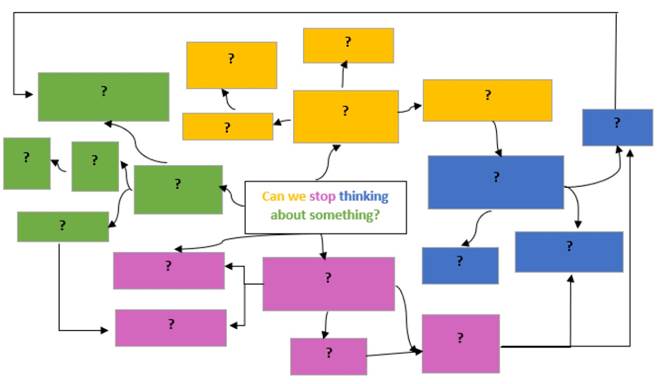
Figure 1 Outline for “the question network”. Source: Directly inspired by the questioning tool presented by Yergeau (2024, in the video: 1:00:10 - 1:01:23) and adapted to our question.
perceiving relationships and proportions
To perceive the relationships and proportions of the problem, the third perceptual skill, Edwards suggests evaluating, from our point of view, the state of the problem in relation to what is constant in the situation (things that don't change or can't be changed). What are the relationships of the parts to each other, and to the whole? (Edwards, 2008).
In order to illustrate the perception of the perspectives and relationships, we have chosen to analyze a short excerpt from the dialogue recorded in France on “Where do thoughts come from?” (see note 1), in which participants discuss the relationship between thinking and forgetting.
Excerpt: “Where Do Thoughts Come From?”, CPI with students aged 12-14, recorded in France, 2015.
400 Facilitator: Forgetting it would be thinking for you? 401 Maria: Yeah 402 Facilitator: Do you agree with this or should we take it another way? You don’t agree with this? 403 Peter: No, I don’t agree. For me forget it would be rather not to think about something and, precisely, not to think about something and to think about something else 404 Facilitator: Ah 405 Peter: And how to say, don’t say forget but to say, uh it would be to leave something unintentionally, to drop something 406 Facilitator: To drop something. And what about remember? 407 Peter: Uh, remember, uh. That is to say? 408 Facilitator: Remember what you ate this morning, but you don’t tell us, okay? Did you, when you remembered, think? 409 Peter: Uh I thought about what I ate this morning and I asked myself what I ate this morning. I thought about it and I saw it in my thoughts 410 Facilitator: You went so far as to reflect as well
From 400 to 403 turn speech, we understand that Peter doesn’t agree with the idea that forgetting would imply thinking. Peter put it paradoxically, saying that forgetting no longer consists in thinking about one thing, but in thinking about something else (403). Which is, in fact, still thinking. So, he contradicts himself. The facilitator expresses his surprise (404). Then Peter pulls himself together and tries to say it differently: forgetting can mean unintentionally dropping something (405). We see here the student's efforts to clarify his point of view, which was initially confused, by adapting the proportions and perspectives of the problem to his position. Which enables him to go further and consider what happens in the opposite situation, when he remembers. The role of the facilitator is important here in helping the student to closely examine his point of view carefully and to adapt the proportions and perspectives of the problem to it.
A possible application of the Edwards method would focus on identifying the elements that give meaning to the problem (child-thought-another thought-environment); for example, the second thought that takes over the first could be symbolized as bigger, closer to the child or “out there”. Representing size and distance reveals patterns and proportions, as well as relationships between parts which the child expressed verbally, for example, one thought remains in the back of one’s mind, to be accessed later (it is not deleted, thus not forgotten), while the new one takes center stage.
perceiving lights and shadows
What is visible, or in the light, and what is in shadow? What parts can’t be “seen into” at this moment? asks Edwards (2008) to draw attention to the characteristics of the fourth perceptual skill. As with visual perception, paying attention to contrast helps us to better identify the problem. Our initial problem we dealt with - whether it is possible to stop thinking - has a question in the spotlight: “Can we stop thinking about something?” which serves to examine the problem. But other questions remain in the dark, as implied by the first, for example: “What happens if you think all the time?”, or “What would happen if we never thought about anything?”. “If” questions bring a fresh look to ongoing research by taking into account other perspectives and avoiding a one-sided view of the problem.
This brings us to two references already existing in P4wC literature. The first is “examining the other side of a position”, a thinking skill that Sasseville & Gagnon (2007) considers to be halfway between critical thinking and divergent thinking, which is creative thinking. It would involve both assessing a position and providing a fresh perspective by evoking other positions. The second is Peter Worley’s (2011) book, The if machine, which provides facilitators with imaginary situations or thought experiments to encourage students an “open questioning mindset”.
Edwards highlighted a paradox: our ability to extrapolate into unknown domains depends on our ability to see known domains accurately, i.e. without distortion (2008). We can imagine a question-based exercise in which participants are challenged to identify, from their point of view on the question Can we stop thinking about everything?, three types of information: (1) what is in the light (what is known, clear, recognizable, unambiguous) : When you perceive the problem, on which part does the light fall?; (2) what is in a soft shadow (what is not obscure and can be extrapolated from what is known): Can you begin to “see” into these areas, to extrapolate from what is known to discover what is unknown?; (3) what is in a dark shadow (no information is visible): Using your imagination, can you find clues that would allow you to start visualizing the idea?
perceiving the Gestalt
The last perceptual skill concerns the perception of the Gestalt: What is the unique set of qualities, the “thingness of the thing” - that makes the problem what is and none other? (Edwards, 2008). This seems difficult to achieve, as in the drawing, but, at this final point, having explored the many aspects covered by each of the four previous perceptual skills, we need to examine the problem as a whole. This may be the case when participants in a CPI, individually or collectively draw up a mind map summarizing the problem developed (including in the form of drawing).
At the end of the CPI, the facilitator suggests that participants try to see, individually, the “complete picture”, made up of the various complex parts explored during the session. As Edwards (2008) suggests, the words and concepts that come to mind will be linked to perceptions and visualizations (edges, negative spaces, relationships and proportions, light and shadows). It is as if everyone is taking a snapshot of the situation, paying attention to all the details that appear, without missing any, and accepting that it is possible not to see everything clearly, then reproducing it graphically. The drawings can then be used as the basis for a collective analysis of the perception of the problem, before moving on to find solutions.
As we haven't yet tried this out in practice, we can imagine a drawing (Figure 2) in which the questions raised are included as such, or a completely figurative one.
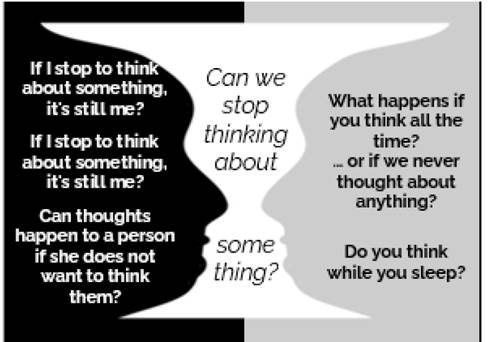
Through this transposition of the five perceptual skills into P4wC, we highlight its epistemological interest: structuring the stages of problematization (defining a problem, pursuing the questioning, clarifying one's point of view, questioning by contrasts, examining the problem as a whole) as well as the existing tools and techniques that can be mobilized in philosophy workshops (discussion plan, mind map, network of questions, facilitation methods, etc.).
conclusion
Lipman’s description of thinking skills leaves room for the integration of embodied philosophizing as a complement to conceptual rigor in constructing philosophical problems. As both Lipman and Sharp noted, personal interest in the discussion topic and the affirmation of moral attitudes should not be dissociated from the formation of analytic skills. Correct thinking never takes place in a cultural void, and Lipman (2003) drew attention to the need for “enormous vigilance on the teacher’s part not to overlook the floodplain of emotion in which the writing in question stands or the flow of care that is an essential part of our experience” (p. 202). Our working hypothesis in this article was that this premise of multidimensionality needs to be addressed in ways true to an understanding of education and philosophy as “reconstruction of experience” as Dewey (1997, p. 87), a fundamental source of inspiration for the founders of P4C believed.
In our view, looking at embodied learning and embodied philosophizing as promising directions of research presented us with rich opportunities for extending the traditional framework of constructing philosophical problems in the CPI. We started by correlating insights from the theory of embodied cognition with practical ways in which the body can be seen as a semiotic tool in the classroom. Inviting the body to express itself by metaphors, gestures, drama, and drawing was shown not only to increase effectiveness of learning, but also to reconstruct the transactional nature of the three dimensions of thinking. With reference to Edwards’s method, visual representation as a means of problem-solving has various benefits, which, in the future, could be tested in a CPI: gauging emotional reactions (eagerness, difficulties) with regard to the aspect represented, taking more time to reflect on how one child’s or literary character’s needs overlap or conflict with another’s, seeing that we can add imaginatively more aspects to the problem than those present in the question selected for discussion; care for the topic discussed and the participants (representing it with care for the quality of the drawing, collaborating with children to make a beautiful and clear drawing by their shared standards), etc. An embodied approach to learning and philosophizing does away with the cognitive dualism that subordinates creative and caring thinking to critical one, and emphasizes the natural balance of all dimensions of thinking in making sense of the world.
This is also the core motivation for integrating Betty Edwards’s training perceptual skills method in contemporary P4wC practice. According to Edwards, training visual perception skills enables one not only to see more, thus draw better, but also to think better, i.e. more comprehensively and creatively, an asset which can be transferred to problem solving and problem seeking in groups. For Lipman (2003) too, education as inquiry needs to focus on meaningful relationships, such as those between part and whole, means and ends, cause and effect (p. 22). We suggested that Edwards’s method shows how to do this in an embodied way. Moreover, it may prove naturally akin to the practice of multidimensional thinking, which sees the interdependence of problematization, creativity and affective involvement (Lipman, 2003, pp. 253-254).
The analogy between Edwards’s method and Lipman’s view of multidimensional thinking is, however, limited. One limitation has to do with the controversial scientific basis of Edwards’s description of the ways the two brain hemispheres function, deemed an oversimplification of human cognition. Furthermore, it is important to distinguish between two major uses of the method in P4wC practice: one focuses on embodied participation, with drawing as a medium for constructing philosophical problems. To us, this means that P4wC practitioners might consider integrating training perceptual skills exercises in the classroom, and thus stimulate an embodied engagement in the discussion of philosophical problems. The second, more interesting way of applying Edwards’s method to the P4wC practice approaches it as a conceptual reservoir for extending the framework of philosophical discussion. Problem analogs, first insight problematizations, attention to the context of a question by means of criteria such as: edges, relationships, proportions, lights/shadows may enrich problem-seeking in the CPI. Finally, a fundamental challenge that applies to embodied philosophizing in general is how to integrate these new possibilities into a coherent experiential learning framework. As with all methods that present themselves as stand-alone tools, the risk is to focus more on the novelty of the tool and overlook the systematic framework in which it needs to be integrated, an observation that takes us back to Dewey’s (1997) view that experiential learning should not be downgraded to piecemeal entertainment, but rather constantly meet the two criteria of educative experiences, continuity and interaction.

