




 texto em
  Inglês (pdf)
 Artigo em XML
 Tradução automática
 Enviar este artigo por email
 Permalink

Introduction
Wednesday, July 20, 2021. The Minister of Education, Presbyterian pastor, theologian, lawyer, and ProfessorMilton Ribeiro makes a statement on the national network, calling for the return to classroom instruction, which, according to him, is an urgent need that can no longer be postponed. To call is an insistent call, a summons. There is no mention of the pandemic situation in Brazil or of the Statistical Synopsis of the Questionnaire Educational Response to the Pandemic of COVID-19 in Brazil, Basic Education, done by the School Census between February and May 2021, which used the Questionnaire Educational Response to the Pandemic of COVID-19 in Brazil, Basic Education as an instrument.
To show what the minister omitted, distorted, or misrepresented in his speech, we bring data and information accessed online in official media, government institutions, and newspapers. The data show that the lack of structure offered by the managing bodies prevented many children from benefiting from emergency remote education. Thus, this work understands that calling for the reopening of schools is a strategy to ignore the situation of abandonment during the pandemic. Instead of providing the necessary conditions for remote education, the government chooses to reopen the schools as if there were no COVID-19, just to see what happens. Let it die. Side effect.
The analyses presented here have looked separately at urban and rural municipal schools and show how the latter are more affected by the lack of public policies during remote teaching. It is in the municipal network where most children in the states of Paraná and Amazonas study, giving us a sample of the situation of remote teaching and the conditions in which it is being offered, as well as the use of sanitary measures and the contamination of the school community. The municipal network concentrates 82% of the school enrollments offered in Brazil (Kindergarten and Early Years) (INEP, 2020).
This paper proposes to problematize the minister's speech, presenting data that were omitted, distorted or misinterpreted, creating a situation of pandemic crossing that does not reflect what we find in schools, which, together with the discursive strategies used in the pronouncement, produce the context that characterizes the post-truth, used to make what is said true. The Oxford dictionary incorporated this expression in 2016, defining it as an adjective. "Relating to or denoting circumstances in which objective facts are less influential in shaping public opinion than appeals to emotion and personal belief" (OXFORD, n.d)1 . Hanna Arendt already warned us about the way modern politics uses this strategy to create parallel realities that would give veracity to discourses:
(...) if modern political lies are so great that they require a complete rearrangement of the whole factual plot, the creation of another reality, so to speak, into which they fit without patches, flaws, or cracks, just as the facts fit into their own original context, what prevents these new stories, images, and pseudo-facts from becoming an adequate substitute for reality and factuality? (Arendt, 2014, p. 313).
To gain this effect, forms of power that make up these new realities are activated, and act from the device. We will discuss here the practices used by pastoral power, biopower, and necro power, relying on the theoretical keys of Michel Foucault and Achille Mbembe, which help us understand the production of this discourse and the type of rationality of government in which it operates.
The text is divided into three parts. The first one problematizes the discourse of the minister of education, in an attempt to map the tactics that produce the blurring of reality and the production of an invented scenario of political actions that would offer the right to education for children during the pandemic and the guarantee of their future. The second part discusses the concept of biopolitics, the activation of pastoral power as a powerful tactic in the production of the minister's discourse, which calls and shows the way to cross the pandemic, which overlaps and potentiates the biopower. Finally, the text uses the concept of necro power to analyze what the government insists on hiding: the deaths, the effects of the deaths on the lives of those who remain and those who are more susceptible to die.
The convocation
In the words of the minister: "Brazil cannot continue with closed schools, generating negative impacts on these and future generations. We must not deprive our children of the learning necessary for their academic and professional formation" (RIBEIRO, 2021). First mistake: the schools were not closed and education, even with all the difficulties imposed by the lack of structure, does take place.
The SynopsesStatistic shows that, among the strategies and tools adopted in the development of teaching activities, the one with the greatest reach was the provision of printed activities, which shows that the schools were open, preparing, photocopying or printing them, delivering them to schools or homes, collecting them, producing individualized study plans, attending to the school community. All this added up to a remote workload. The following table shows these specific tasks:
Chart 1 Strategies and tools adopted in the development of teaching-learning activities (can mark more than one category) (can mark more than one category
| Delivery of material press at school and/or at home (%) | Availability of materials on the Internet (%) | Live classes (%) | Transmission of live (synchronous) classes by TV or radio (%) | Transmission of live (synchronous) classes over the internet (%) | Transmission of previously recorded lessons by TV or radio (%) | Availability of recorded lessons via internet (%) | Remote evaluations or with shipping/return activities (%) | Support students or guardians - study plans (%) | Staggered virtual or in-person attendance (%) | ||||||||||||||||||||
| BR | PR | AM | BR | PR | AM | BR | PR | AM | BR | PR | AM | BR | PR | AM | BR | PR | AM | BR | PR | AM | BR | PR | AM | BR | PR | AM | BR | PR | AM |
| 93 | 95 | 92 | 85 | 86 | 30 | 31 | 14 | 5,9 | 4 | 4 | 15 | 20 | 10 | 6,3 | 12 | 19 | 2,7 | 56 | 56 | 3,4 | 57 | 61 | 47 | 54 | 56 | 9,3 | 60 | 60 | 36 |
Source: INEP, 2021 (Authors' organization).
Many difficulties were imposed on the development of the teaching work. The research shows the working conditions to which the category was submitted: predominance of meetings and control mechanisms, little technical training, non-availability of equipment and internet, and demands for planning adequacy.
Chart 2 Strategies adopted by the school/education department with the teachers (schools could mark more than one category):
| Virtual meetings for planning, coordination and monitoring of activities (%) | Training for use of non-face-to-face teaching program methods/materials (%) | Availability of equipment for teachers - computer, notebook, tablets, smartphones, etc. (%) | Free or subsidized Internet access at home (%) | Reorganization/adaptation of planning with prioritization of specific skills and content | ||||||||||
| BR | PR | AM | BR | PR | AM | BR | PR | AM | BR | PR | AM | BR | PR | AM |
| 85 | 86 | 50 | 53 | 47 | 51 | 19 | 36 | 7,1 | 2,2 | 1,9 | 2,7 | 89 | 93 | 84 |
Source:INEP, 2021 (Authors' organization).
To give credibility to his claim, the Minister of Education cites reports by UNESCO, UNICEF and OECD, for which the closing of schools would bring devastating consequences: loss of learning, of progress, of knowledge, of qualification for work, increase in school dropouts, emotional implications. Triggering the ruin of a future has been a very present argument in the policies and actions implemented by the current government, betting on a multiplicity of risks that would prevent the fulfillment of the dream of formal employment and financial stability.
This argument carries the false premise that education is the sure passport to a good economic condition and to social security, keeping the risk of unemployment away. In this logic, unqualified people are out of the labor market, not the labor surplus produced by contemporary labor relations. Robert Castel (2005) alerts us to the phenomenon of mass disqualification, the unemployable, populations that have had their jobs eliminated or do not have the necessary qualifications imposed by the market, among which are young people. It is necessary to move forward, even if there is no guarantee of getting somewhere.
The minister mentions that Portugal, Chile, France, Spain, Austria and Russia have returned to face-to-face classes in 2020 and that they have adopted as health measures the use of alcohol gel, masks and social distancing. According to him, in this period, the schools in these countries reopened without even a vaccination forecast, which is not true. The Parliamentary Inquiry Commission (CPI) established in May of this year found that the pharmaceutical company Pfizer contacted the Brazilian government in August 2020 to offer vaccines that would be delivered in December of the same year (AGÊNCIA SENADO, 2021). Therefore, there was a vaccination plan. At that time, there were no Alpha and Delta variants, which are more transmissible and cause more deaths (VALENTE, 2021).
Johns Hopkins University analyzed lethality and mortality caused by COVID-19. The data is from July 20, 2021. Of the countries cited by the minister, the lethality rate in Portugal, which is 290 on this list is 1.8%, with 167 deaths/100,000 inhabitants. Chile is 240, with 2.2% lethality and 182 deaths per 100,000 people. France is at 300, with 1.9% lethality and 166 deaths per 100,000 French people. Spain is at 270, with 1.9% lethality and 173 deaths per 100,000 inhabitants. Austria, also mentioned by the minister, is at 450, with 1.6% of infected deaths, and 120 deaths per 100,000 Austrian people. Finally, Russia is 540 on this list, with a high lethality of 2.5%, but with a mortality rate of 102/100,000 inhabitants, which is less than half of ours. Brazil is the 90th country with the highest mortality rate: 2.8%, and for every group of one hundred thousand Brazilians, 257 people died. Among all the countries mentioned by the minister, we have the highest lethality and mortality rate (UNIVERSITY JOHNS HOPKINS, 2021). In Brazil, the Coronavirus Panel, linked to the Ministry of Health, reported on July 21 544,180 deaths, with a lethality rate of 2.8%, with 259 deaths per 100,000 inhabitants (BRASIL, 2021a).
The Statistical Synopsis of the Questionnaire Educational Response to the Pandemic of COVID-19 in Brazil, Basic Education analyzed the percentage of workers and students at municipal schools removed for being contaminated with the coronavirus after returning from school activities, and the results are worrying: in Brazil, there were 57.4%. In Amazonas, we have 54.8% and in Paraná, 68.2% of professionals and students, which shows that even with the recommended biosecurity protocols, there was no protection against infection (INEP, 2021). With the arrival of the Delta variant, more contagious and with potential for transmission before symptoms appear, returning to school in the harsh winter in Paraná, for example, composes a favorable condition for contamination.
Milton Ribeiro mentions that Basic Education professionals are being vaccinated, but states that the vaccination of the school community cannot be a condition for reopening schools. In the Vacinometer website, consulted on 07/21, the graph Doses Applied of Vaccine against AIDS, According to Priority Groups shows that 843,119 Basic Education workers were vaccinated with the first dose and 110,462 with the second or single dose (BRASIL, 2021b). The news published on the Ministry of Education's website in January of this year reports 2.2 million teachers and 161,183 principals working in 179,553 Basic Education schools in Brazil (BRASIL, 2021c). That is, not even half of these professionals have been vaccinated yet. If the vaccine, together with sanitary measures, is the way to contain contamination, none of these conditions are guaranteed. The government thus exposes the school community to the risk of being contaminated, of getting sick, and, for not being completely immunized, of developing more aggressive forms of manifestation of the virus.
In the statement, the minister informs us that we have an Interactive Emergency Committee, whose name on the Ministry of Education's website is COE/MEC (Comitê Operativo de Emergência, or Emergency Operating Committee), created by decree no. 329/2020, and which aims to "manage issues inherent to sensitive issues of national repercussion" (BRASIL, 2020, s. p.). In the second paragraph, it is foreseen that this committee must analyze events that cause significant changes in the activities and that require studies of measures to return to normality. The third article describes the committee's components, which includes a representative from each of these bodies and institutions: Office of the Minister of State of Education; Executive Secretariat of the MEC; Secretariat of Basic Education of the MEC; Secretariat of Higher Education of the MEC; Secretariat of Vocational and Technological Education of the MEC; Undersecretariat of Planning and Budget of the MEC; National Fund for Education Development - FNDE; Brazilian Company of Hospital Services - EBSERH; National Institute of Educational Studies and Research Anísio Teixeira - INEP; National Council of Secretaries of Education - CONSED; two seats for the National Union of Municipal Directors of Education - UNDIME; two seats for the National Council of Institutions of the Federal Network of Vocational and Technological Education - CONIF; two seats for the National Association of Directors of Federal Institutions of Higher Education - ANDIFES. Of the 16 representations, 7 are directly linked to the MEC.
The competencies of COE/MEC are listed in Article 5:
I - gather information for the diagnosis of the emergency operation, allowing goals and focus of action to be established. II - summon efforts and knowledge of professionals that may integrate, by invitation, the COE/MEC. III - analyze the history of the situation and the unfolding of similar occurrences, in order to subsidize decision making IV - planning actions, defining actors, and determining the adoption of measures to mitigate threats and reestablish the normality of the situation; and V - monitor the implementation of proposed measures and assess the need for revision and planning (BRASIL, 2020, s. p.)
On the MEC homepage available at https://www.gov.br/mec/pt-br, consulted on July 21, 2021, there is no link to access the COE. There is a space called KORONAVIRUS - MEC Actions in Response to the Pandemic from COVID 19. By clicking on this space, there is the Activity Report on MEC's Actions in Response to the COVID 19 Pandemic - Mark 2020/March 2021, divided into Axis 1: Basic Education, which presents the actions taken by the Secretariat of Basic Education (SEB), Literacy (SEALF), Education Modalities (SEMESP), and the National Fund for Education Development (FNDE); and Axis 2, which deals with Higher Education, Post-graduation, and Professional and Technological Education (BRASIL, 2021d).
On the MEC page there is also a news item informing about the Guide for the Implementation of Protocols for the Return of Presential Activities in Basic Education Schools. Clicking on it, there is a text published on 07/20/21, the same date as the minister's statement, which explains that the material aims to "guide systems and basic education teaching networks on the operation and development of administrative and educational activities in schools, with a view to the return of classroom activities" (BRASIL, 2021e). When we click on the link Check the Guide, we are redirected to a page that says: "Sorry, but this page does not exist...". The attempt was made on 20 and 21/07/2021. We found this document by doing a search with his name in the Google search engine.
Milton Ribeiro makes it clear in his statement that the decision to reopen the schools or close them was delegated to the states and municipalities, but that the MEC is in favor of the immediate return of classroom classes throughout Brazil, regardless of the situation of contamination, hospitalizations, deaths, or the conditions of the schools to adapt to the protocols presented by the Implementation Guide of the protocols for the Return of Classroom Activities in Basic Education Schools.
In Amazonas, on August 23, the State determined the return of classes 100% face-to-face. The website of the State Department of Education (SEDUC/AM) reinforces safety protocols such as "the use of masks, not sharing personal items, and keeping hands always sanitized" (AMAZONAS, 2021a, s. p.), not mentioning the social distancing recommended by the General Protocol for the Prevention of COVID-19, prepared by the Health Surveillance Foundation of Amazonas, and which is mentioned by SEDUC itself (AMAZONAS, 2021b) as a reference document for health measures.
In the beginning, the General Protocol already informs in its recommendations
the social distancing, correct use of masks and PPE, hygiene and disinfection of surfaces and objects, personal hygiene (especially frequent hand washing with water and soap or 70% alcohol gel) and respiratory etiquette and should be implemented together and according to the characteristics of each place or environment (AMAZONAS, 2021, p. 3).
In the specific recommendations for public institutions, item 7 of the Protocol states that: "The work and public service stations must be with a minimum spacing of 1.5m (one and a half meters) between their positions" (AMAZONAS, 2021, p 16).
In the photo published on the SEDUC website, the absence of social distance as a sanitary measure is materialized and normalized:
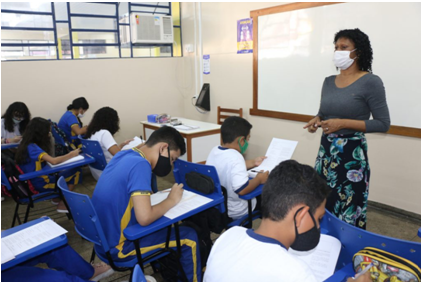
Source: SEDUC/AM (Photo without authorship
Figure 1 Fully face-to-face activities were resumed throughout the public network of Manaus
Opening schools is a strategy to erase the failure that was remote education in Brazil. In the State of Paraná, statements from the State Secretary of Education Renato Feder announced investments in Open TV, smartphone applications, partnerships with telephone operators with access via 3G and 4G, which total 15 million. Feder emphasized the classes given by the Meet platform, reaching 150 thousand classes a day: "Every day the students have classes where they can see the teachers, the teachers see the students, and the students see themselves in their classes. Classes take place in Paraná" (PARANÁ, 2021a). It should be noted that this access was offered for the Final Years of Elementary School and High School, without extending the service to the municipalities that serve the Early Years and Kindergarten.
The condition presented by the Secretary of Education is not the same as that reported by SEED itself:
Currently, Paraná serves a large percentage of students through printed material in schools that do not have adequate internet connection to offer synchronous classes, a situation that contributes to the increase of learning difficulties and social inequality among the population and causes damages to the mental health of children and teenagers (PARANÁ, 2021c, s. p.).
The document states the need for parents to justify in writing the reason for not sending their children to school. The consequences of this letter are elected principals removed for not being able to return in person, being replaced by professionals designated by SEED (PIRES, 2021).
This condition is presented in the Synopsis already mentioned. Regarding the communication strategies and technological support made available to the students of the municipal network in Brazil, 98% did not have free or subsidized access to the Internet. In Amazonas, the index of those who had access is 0.6% and in Paraná 0.8%. The percentage of equipment made available was also low: 4.3% nationally, 0.8% in Amazonas and 4.3% in Paraná (INEP, 2021).
The most used channel of direct communication between children and their teachers was e-mail, telephone, social networks and messaging applications. This means working beyond virtual classrooms, since sending these messages is not regulated by working hours, but by the availability of the sender.
The use of digital platforms/tools in internet activities was also questioned by the survey. The question where the use of WhatsApp appears is the one with the highest frequency of answers.
Chart 3 Digital platforms/tools used by the school in the internet activities
| Platform developed specifically for the municipal or state education department or the school (%) | Google Classroom (%) | Microsoft Teams for Education (%) | Applications or tools for videoconferencing (WhatsApp, Zoom, YouTube etc.) (%) | ||||||||
| BRA | PR | AM | BRA | PR | AM | BRA | PR | AM | BRA | PR | AM |
| 23,9 | 19 | 17 | 24 | 27 | 9,4 | 5,4 | 1,4 | 1,0 | 84,3 | 84 | 62,8 |
Source: INEP, 2021. (Authors' organization)
The monitoring of students' participation and attendance was also evaluated in Axis II of the research. The modality that had the greatest reach was the collection of printed pedagogical activities, which shows that, contrary to what the minister said, the schools were open and working. In the municipal network, the electronic call was 25% in urban schools and 19% in rural ones, which indicates that remote teaching was not using the Internet as a resource for classes.
These data were collected until April 2021, at the beginning of the second wave of COVID-19 produced by the Gamma variant, which appeared in Amazonas, and is more lethal in younger populations; and the Delta variant, which now is having community broadcasting in Paraná. On July 21st, the government of Paraná determined the return of the classes in the hybrid model, under the sanitary conditions presented here. On July 28, we had 29 cases and 12 deaths from this variant (PARANÁ, 2021b). The Brazilian Agency of Communication (EBC) reports that the Ministry of Health received in August a letter from governors requesting actions to support the fight against the Delta variant, informing that it is 100% more transmissible than the first CEPA, and 30% more transmissible than the GAMA variant (VALENTE, 2021). The government continues to deny the effects of the pandemic and insists on forcing us to live as if it does not exist or is not lethal.
Milton Ribeiro said that the Ministry of Education provides all the health biosecurity protocols to all schools of Basic Education and Higher Education. Researching what these protocols would be and investments made to make them effective, I found the document MEC Actions in Response to the Pandemic of COVID-19 (BRASIL, 2021f), which was available on the MEC website on 07/21, but already unavailable the next day (07/22). Its Action 8 concerns the Emergency Direct Money in School Program, informing that around 672 million reais were allocated in 2020 to schools in the state, municipal and district networks to prepare for the return to school. This amount is divided to 116,899 schools and more than 36 million students, that is, R$ 5,748.55 per school or R$ 18.66 per student for the whole year. The minister speaks of a value of 1.7 billion reais to tackle COVID in public schools but does not explain how this money was made available and what it can be spent on. If it exists and if it is forwarded, it totals R$47.22 per student and R$14,542.00 per institution per year, varying, depending on the number of students in each school.
The money can be applied as follows:
I. in the purchase of consumable items for sanitizing the environment, the hands, as well as in the purchase of Personal Protection Equipment (PPE), with the objective of preventing the contagion of the school's professionals, as well as of the students in this moment of pandemic. II. in hiring specialized services in environment disinfection. III. in the performance of small repairs, adaptations and services necessary for the maintenance of safety procedures for the passage inside the school premises. IV. in the investment with access and/or improvement of internet access for students and teachers; and V. in the acquisition of permanent material (BRASIL, 2021, p. 13).
The Implementation Guide for the Return to School Attendance Protocols in Basic Education Schools recommends the following sanitary measures: PPE for students: "Triple layer mask (must be changed every 4 hours or as soon as it is wet) - observing the contraindication for children under 2 years of age; individual bottle of alcohol gel/ 70% alcohol" (BRASIL, 2021e; p. 14). Cooks need the same type of mask, face shield, 70% alcohol gel, disposable protective gloves, and a disposable cap (BRASIL, 2021e). Cleaners, in addition to all these items, need a long-sleeved waterproof apron and waterproof boots or shoes, and the face shield can be replaced by eye protection. Other school personnel need a triple-layer mask, face shield, and an individual bottle of 70% alcohol gel (BRASIL, 2021e). Money is not enough.
The Statistical Synopsis also investigated the sanitary measures adopted by schools for the return of classroom activities. The first aspect evaluated was the adequacy/enlargement of the physical infrastructure: installation of sinks for hand washing, construction of classrooms to reduce the number of students per class, increase of natural ventilation. The data show that there are still no adaptations. The second item evaluated the training of education professionals to recognize and evaluate the compliance with sanitary measures such as the identification of the symptoms of COVID-19, and to monitor the reasons for the students' absence, with results that also place Paraná below the Brazilian average. Note the increase in the teaching workload with these new tasks.
Chart 4 Health measures adopted by the school for the return of classroom activities
| Adequacy/enlargement of schools' physical infrastructure (%) | Training of professionals (%) | Communication and dissemination of information and guidance to the school community (%) | Increase in routine cleaning frequency (%) | Temperature monitoring (%) | Constant use of PPE (%) | Reduction of people in the school environment (%) | ||||||||||||||
| BR | PR | AM | BR | PR | AM | BR | PR | AM | BR | PR | AM | BR | PR | AM | BR | PR | AM | BR | PR | AM |
| 37 | 27 | 34 | 70 | 50 | 41 | 92 | 95 | 64 | 90 | 95 | 93 | 78 | 90 | 41 | 93 | 95 | 99 | 82 | 95 | 48 |
Source: INEP, 2021. (Authors' organization).
Even with insufficient resources, the minister assumes the commitment to guarantee the necessary conditions for the return to classes "for the good of the children and for the future of the country," without saying how he will do this or with what budget. Finally, the statement ends with "God bless our Brazil. My wish and my prayer," meeting one of the defining aspects of post-truth: "objective facts are less influential in shaping public opinion than appeals to emotion and personal beliefs.
Making live - understanding biopolitics to understand necro politics
In his speech, the Minister of Education exercises his function as a shepherd who leads his flock, mixed with that of a sovereign, who governs. We will discuss here this overlapping of figures who exercise power, and whose function is to guarantee the conditions for the population to live. To do so, we will rely on Foucauldian theoretical keys.
Michel Foucault problematizes the moment in which the technologies used by pastoral power become part of the art of governing operated by the Modern State, superimposed on two other forms of power: the disciplinary and the biopower. Understanding the composition of the strategies of government of the population allows us to identify the biopolitics that produce childhood and adolescence from the pedagogical device, and that places the school as a privileged space for protection, training, and production of subjectivities aligned to the demands of economic models.
The concept of pedagogical device is initially used by the French philosopher René Schérer, based on readings by Michel Foucault, and that we use here problematized by Silvio Gallo and Alexandre Carvalho (2017). This device is composed of "(...) discourses and thoughts, but also institutions and architectures, laws and administration actions, philosophical propositions and scientific truths, moral and religious maxims" (CARVALHO; GALLO, 2017, p. 627), where "(...) someone only learns when another (the master) teaches, generating a hierarchization in the acquisition and relationship with knowledge that makes an effective intellectual emancipation impossible" (CARVALHO; GALLO, 2017, p. 624).
This device acts, for example, through television newspapers, internet news, speeches by representatives of the State and public figures (artists, celebrities, youtubers), pronouncements and documents of institutions for the protection of childhood and adolescence, which make up a narrative that highlights and repeats in various ways the risks of being out of school. Beyond the right to Education, the instances of power know that schools are a privileged space for regulating subjectivities, disciplining bodies, and producing human capital (FOUCAULT, 2008b).
The activation of pastoral power in our current government is one more of the tactics of an ultra-conservative model. The pastor is the figure who connects the people to God, and because of this direct connection, to question him is to question God. His function is to lead the flock to the salvation of their souls, protecting them from the deviations and temptations of the devil, which metamorphoses into imaginary enemies. He has a vigilant function, attentive to each person, preventing them from straying.
Pastoral power arises in the pre-Christian East and gains strength in Christianity. For Foucault, it is only after the 18th century that pastoral power begins to be used as a tactic to govern the population. If before there were networks of influence between the sovereign and the church, they remained distinct: one was responsible for leading souls to salvation, and the other had the power of life and death of each one (FOUCAULT, 2008a).
The techniques and tactics of pastoral power are moving to the rationality of government of the Modern State, which was born "(...) from the combination between - or perhaps better: the invasion of - pastoral power and / over the power of sovereignty" (VEIGA-NETO, 2011, p. 69). If before the sovereign's problem was to increase his territory, now the ruler's problem becomes conducting the population to extract from it the maximum work with the minimum cost. For this, it is necessary to take care of it, to let it live.
For this leadership, another form used to regulate these subjectivities is disciplinary power. It operates through the practices of institutions that arise with the purpose of molding the bodies and making them docile, such as the school, the barracks, the family, preparing them for work in the industries. It acts based on tactics such as the squaring of time and space, through which bodies must follow the flow. This arrangement is also produced from the examination and the watchful eye (FOUCAULT, 2009). Each person in his or her place. A time for each thing. The place and time of childhood is in school, for it is in the child that the adult person dwells.
The State does not promise the salvation of souls, but social welfare: minimum conditions of housing, employment, some social security, health, salary, food. What Michel Foucault could not have imagined is that these tactics would be operated by the pastor himself, our minister, exploding with the secularity of the State and the care of the population.
Superimposed on these forms of power, Foucault will identify another form that will act on what each one of us has in common: life. He called it biopower, where "the set of mechanisms through which what, in the human species, constitutes its fundamental biological characteristics will be able to enter into a policy, a political strategy, a general strategy of power" (FOUCAULT, 2008a, p. 3).
The biopower acts from the biopolitics, that: "(...) which makes life, and its mechanisms enter the domain of explicit calculations" (FOUCAULT, 1988, p. 134), that is, policies of conduction and control of the population's life. This new rationality of government will use the knowledge produced about life by several areas: Biology, Social Medicine, Economics, and Pedagogy, thus constituting an area of knowledge about the things of the State, Statistics: "Etymologically, statistics is the knowledge of the State, the knowledge of the forces and resources that characterize a State at a given moment" (FOUCAULT, 2008a, p. 364). In this new rationality, different from the sovereign who had the power to kill or let live, the State manages the life of the population based on calculations that indicate who should live and who should be allowed to die. Statistics, allied to economics, guarantees the strengthening of the State based on the maximum extraction of the population's strengths. Therefore, we are not surprised that the discourse of saving the economy was so active during the pandemic period.
Foucault has problematized how biopolitics is produced and why tactics and technologies act based on an event that has similarities with the health crisis we are experiencing: the practice of smallpox inoculation. The philosopher shows us how Social Medicine and Statistics produced knowledge about the risks of contamination from the observation of lifestyles, and how this observation produced ways to manage and control diseases, such as the vaccine. The knowledge about the risks of contagion were the basis for health policies imposed on the population, whose ways of living started to be watched by the State. For this surveillance, a state apparatus is created - the police, who had a very different function from the one it has today: to monitor whether the recommendations and determinations made to populations at greater risk of contracting the disease were being followed and incorporated into everyday life, conducting behaviors and producing new ways of living (FOUCAULT, 2008a).
Biopolitics aimed to conduct behaviors, to convince people to change their habits, to leave the countryside for the cities working in extensive and unhealthy regimes, ensuring that capital and power remained or circulated among certain groups, organizing life in cities, erecting institutions that ensured the minimum of social welfare and security, but that regulated subjectivities. All these tactics operate a new and much more complex rationality of government: governmentality:
By governmentality I mean the set constituted by the institutions, the procedures, the analyses and reflections, the calculations and the tactics that allow the exercise of this very specific, though very complex, form of power that has the population as its main target, the political economy as its main form of knowledge, and the security devices as its essential technical instrument (FOUCAULT, 2008a, p. 143).
In this new rationality, the return to school should be conditioned to the calculations of the contamination risks of COVID-19, the application and supervision of sanitary measures, analysis of the lethality and mortality rates, specific actions to protect the most vulnerable populations, guaranteeing the creation of priority groups for vaccination, immunization by vaccine, guaranteeing alternatives for remote teaching to restrict the transmission of the virus. These calculations would produce biopolitics that would allow the control and management of the pandemic, until going back to school would not offer great risks of contagion and death.
The data presented above about the pandemic situation in Brazil, produced by health agencies and INEP should serve as a source of information for the elaboration of the Ministry of Education's actions during the pandemic, but they were neither cited by the Minister nor by the documents published by the MEC. The government's actions ignore this knowledge, which leads us to conclude that its policies come from another logic: to expose to death.
Letting die - the Brazilian traversal of the pandemic and necro politics
Achille Mbembe (2018) warns us that the notion of biopower is insufficient to understand how contemporary forms of sovereignty establish the conditions that result in the guarantee of life. Therefore, he proposes the concepts of necro politics and necro power to understand the various ways of provoking "(...) the maximum destruction of people and creating 'worlds of death,' unique and new forms of social existence, in which vast populations are subjected to living conditions that give them the status of the 'living dead' " (MBEMBE, 2018, p. 71). As effects of this form of power, he cites civilian victims in wars and refugees in concentration camps. Aligned with the author's problematizations, we consider the Brazilian government's actions during the COVID-19 pandemic as strategies of necro politics.
For Mbembe (2018), the highest expression of sovereignty materializes in the power to dictate who can live and who must die. By calling for education professionals to immediately return to classroom instruction without ensuring the sanitary measures that the MEC itself recommends, the Minister of Education is activating necro power. If teachers, employees, children get infected, develop the severe form of the disease, get sequelae, die, infect their families, these are side effects of a larger project, where the Economy cannot stop. The actions of our government interweave techniques of pastoral power, biopower, and necro power, which use post-truth to produce a reality of false security, where the power to expose to death is exercised. Pastor Milton leads his flock. There is no guarantee of salvation. Only the one of the crossing.
The discourse of the need for a future for this generation of children coexists with its withdrawal, in practice. We have a legion of children orphaned by COVID-19, which may increase with the return of school without full immunization of the population. The research recently published by The Lanced magazine, conducted by Susan D. Hillis and collaborators analyzes the orphanhood produced by the pandemic, with data collected between March 2020 and April 2021: 1,134,000 children lost at least one of the people who were their caregivers (father, mother, grandmother or grandfather) as a result of complications caused by the virus. In Brazil, there were 113,150 children, with 87,529 losing their father, 25,608 their mother, and 13 both (HILLIS et al, 2021).
Mbembe points out that biopower divides people into those who should live and those who can die, distributing populations into subgroups, establishing a biological cut-off. The data from COVID in Brazil show racism at work. The lethality of COVID-19 varies by population. The 20 Socioepidemiological Bulletin of COVID-19 in the Favelas worked with data from the communities of Rio de Janeiro, collected between 06/22/20 and 09/28/20, and shows that the lethality rates were between 10% and 16%. The mortality rate for black people was twice as high as in neighborhoods not called favelas. This population also had a higher mortality rate than non-black people (FIOCRUZ, 2020).
Another population that suffers most intensely from the effects of necro politics is the indigenous population. Data from the Amazon Environmental Research Institute (IPAM) from the same period show that the mortality rate in this population is 150% higher than the Brazilian average, with 6.8% of those infected (IPAM, 2020). It is worth noting that the first infection of an indigenous person was in contact with a doctor from the Special Indigenous Health Secretariat (SESAI), and that the need to seek emergency help in the cities increased the number of cases. The cut in the basic food baskets sent by FUNAI, the presence of non-indigenous people in the territories, the lack of large-scale testing, the increase in mining, and the non-recognition of the rights of indigenous people are tactics of necropolitical politics that have collaborated to these rates. On July 28 of this year, there were 57,415 confirmed cases, with 1144 deaths and 163 infected people (COVID PLATFORM AND THE INDIGENOUS PEOPLE, 2021). This situation is the result of "a long process of ferocity against lives, directed to the destruction of forests, rivers, animals, and, consequently, people who lived there, resist and take their livelihood even today in the Amazon" (RATUSNIAK; MAFRA; SILVA, 2020, p. 1365).
In Curitiba, data from the Cadastro Geral de Empregados e Desempregados (CAGEB) (General Registry of Employed and Unemployed) for the first quarter of 2021 informs that the total number of dismissals due to death of cleaning professionals, janitors, collectors and security guards increased by more than 500% in the first quarter of 2021 (KOWALSKI, 2021). These are jobs composed by workers that are mostly outsourced, with "low income, indefinite working hours, job rotation, social and rights discrimination and, finally, class invisibility for the employee, who is relegated to the role of an inferior being (RODRIGUES, SANTOS, SILVA; 2020). Disposables. A subgroup that does not need to live.
This rationality selects, classifies, hierarchizes populations, defining who can follow the flow:
(...) biopolitics is a technology of government that "makes live" those population groups that best adapt to the production profile required by the capitalist state and, on the contrary, "lets die" those who do not serve to foster productive work, economic development and modernization (CASTRO-GÓMEZ, 2007, p. 157).
In this rationality, the school is tutored and strengthens this function over childhood and adolescence, whose goal should no longer be human training, but the production of human capital, which is defined as the "(...) set of all physical and psychological facts that make a person able to earn this or that salary" (FOUCAULT, 2008b, p. 308), and that composes competencies, skills and characteristics required by the labor market. It allies itself with institutions and instances that appropriate discourses and knowledge, and that produce a narrative anchored in statistical and economic data analyzed in a distorted and biased way (the post-truth), and that produce a reality that aims to make believe that everything is fine, and if it is not, it is because of the enemies of the Brazilian people.
We can identify these tactics in the minister's speech: his body performance, tone of voice, use of words like call, threat to the future of an entire generation, protection against hunger and violence, use of the names of institutions that monitor and regulate childhoods in the world, comparison with countries, distortion of data, invention of truths, alliance with the Christian religions, invocation of divine protection. These are governing strategies that, in this pronouncement, have the clear objective of making the population demand an immediate return from the schools, thus guaranteeing the will of the government, which is not worried about letting those who get infected and develop the most aggressive form of the disease die.
The bet on the school as the space that produces a future is a biopolitical strategy, where the aim is to produce a subject that is somewhat docilized, somewhat self-made, somewhat alienated, and somewhat converted. Military schools, high school reform, the New Common Curricular Base, the freezing of civil service salaries, the criminalization of teaching practices, the presence of evangelists in public administration, the cutting of budgets in agencies that promote research and teacher training, and the absence of public competitions are orchestrated actions that meet this project of producing subjects according to the aspirations of the government that is in place.
Necro power is present in the attitudes of this government: in the denial of the effectiveness of sanitary measures such as the use of masks and social distancing, in the encouragement of the use of ineffective drugs in the treatment of COVID, in the delay in purchasing vaccines and in the delay of immunization of the entire population, in the propagation of a false scenario favorable to the return of classes that expose children to death. The chances of dying follow specific groups that are more exposed to the virus and whose lives matter less. Those are left to die. Side effect.
Final considerations
This text is an exercise in indignation. To live with a scenario of post-truths, with the absurd bombarding us daily, until the absences, omissions and counter-productions of our governments are naturalized is desolating. And that is one of the desired effects: that we lose our strength to resist.
The attempts to erase the data, successive in this government, appear in the absence of the Statistical Synopsis of the Educational Response to the Pandemic of COVID-19 in Brazil made by the School Census as an element for decision making by the Ministry of Education on the conduct of Basic Education in the pandemic period.
Surveillance actions that only watch over children, families and teachers do not address social control. Forcing education professionals to return to work in person without being immunized, taking away any possibility of participating in the organization of this return, creating a parallel reality completely different from what they are experiencing in the classroom, monitoring classes, requiring them to work with activities planned and prepared by other people, watching the work in the classroom on a weekly basis, shifting the role of pedagogy to the control of practices, all this scenario aims to destroy autonomy and any attempt at resistance or revolt. Training takes the place of formation. This, together with the return to face-to-face teaching with a high risk of contamination of oneself and of those around, exposes to death in several ways: to the person who inhabits the education professional, to the practices that configure the teaching function and that configure the act of teaching, to the childhood of a child that is not being thought of in the present, and that is also going through the pandemic.
The actions orchestrated by the State, besides exposing to the virus, take advantage of this moment of social insecurity brought by the pandemic to destroy, along with life, an education for the human formation of children, for autonomy and citizenship. A trained flock is easier to lead.

