




 texto em
  Inglês (pdf)
 Artigo em XML
 Tradução automática
 Enviar este artigo por email
 Permalink

Introduction
The term identity has been posed as an object of analysis, re-deconstructions, and semantic and conceptual re-discussions that integrate into various disciplines, establishing itself as a multifaceted object of study through which a series of issues unfold, encompassing different theoretical perspectives and disciplinary fields that allow for its conception from a multidisciplinary interpretation. Initially, the conception was assumed that identity was fixed within each individual, without the possibility of reinvention or transformation; according to various scholars, it was destined (Hegel), focusing on a fixed point (Kant) and presenting a relationship with the reasons for production (Marx) (cf. Navarrete, 2015). With the changes experienced in society, related to Freudian postulations of the unconscious, the decentering of individuals, the emergence of postmodernity, and the onset of globalization, the concept of identity began to be linked with other meanings, indicating that its sense can transform, establishing itself as a term related to mobility, change, and a process in which the individual is not born, nor is determined by a final identity, but rather situated in a constant and never-ending process of construction and reconstruction.
Identity has been approached from various perspectives; one of them is sociology, which proposes the concepts of social identity and personal identity. According to Bourdieu (1982), the individual presents social practices through mental representations, which are in constant power struggle, where subjects construct and reconstruct themselves. On the other hand, Dubet (1987) points out that the notion of identity is polysemic, where a differentiation is made between two entities of the subject: the social and the personal, emphasizing that both are not given or unidimensional. Thus, identity functions to understand everything and its opposite, being an impossible but necessary entity (cf. Navarrete, 2018).
From an anthropological point of view, Hall (2000) presents a deconstructive approach to constructed identities, based on discourses, practices, and positions that are intertwined and antagonistic. In contrast, Bhabha (2012) presents multiculturalism from difference as a means of expressing diversity, where a multiplicity of identities can be conceived; Gossberg (2012) proposes difference, individuality, and temporality as constitutive elements of identity. Through psychoanalysis, Freud (2011) perceives the process of identity formation in individuals as an affective connection with another being. Lacan (1990) proposes that this concept can be analyzed as an image reflected from the environment to the subject, and finally, Žižek (2003) suggests that identity is constructed and reconstructed through multiple signifiers in an ideological space in which individuals are involved. Laclau and Mouffe (2004) propose from political theory that identity is constructed within and outside of discourse; based on this, subjects constitute a temporary identity that can transform. On the other hand, Foucault (1992) mentions that individuals are political beings who have the power to decide and act not only collectively but also individually.
Thus, it can be highlighted that the concept of identity has been and continues to be addressed in various researches and from various disciplines such as philosophy, sociology, pedagogy, anthropology, psychology, etc., based on different theoretical, analytical, and methodological positions that have allowed us to understand its development over time.
Regarding the term "formation," this is the result of a configuration or structure achieved (Brugger, 2019) that is formed in a common space shared among individuals, their cultural, professional, social environment, and the institutions in which they work (Bolívar, 2005). In this way, formation is often contingent, as it is a construction that takes place in various spaces continuously and permanently, in which each individual is constituted according to their context, their potentialities, their ways of learning, and their objectives. Formation can be understood as a permanent construction of something or someone; in the case of individuals, they are formed throughout their lives in different stages and spaces (Navarrete, 2021), sharing knowledge with their peers that allows the configuration of a range of transforming knowledge.
Professional formation then implies the preparation of individuals to carry out particular activities that are specific to their profession, linking with vocational training where institutions serve as guides in the development of individuals' knowledge and skills. In the case of the university, it is seen as a space for formation that contributes to addressing global and local needs, occupying a prominent place in the educational scheme of each nation (Navarrete, 2015), allowing individuals to be intentionally constructed permanently with specific learning objectives for each of the professional aspects.
The main objective of this article is to account for some of the research conducted in Mexico during the decade between 2012 and 2022, which has addressed the topic of formation and identity at the higher education level, focusing on the identity of students. To achieve this, this work was constructed based on the following elements: a) The research question, "What have been some of the works published in the decade of 2012-2022 related to the theme of formation and identity of university students in Mexico?" b) The theoretical framework, which takes up some of the postulates of Bourdieu 1982, Dubar 2002, Dubet 1987, Hall 2000, Lacan 1990, Laclau and Mouffe 2004, & Žižek 2003, and where the epistemological principle of identity as a multifaceted concept, in constant construction, deconstruction, and reconstruction, is made compatible, depending on the transformations presented in the subject where a series of social elements impact, with identity being aporetic, that is, impossible but necessary (cf. Navarrete, 2015). c) The empirical reference, which consists of the analysis and exposition of the research conducted on the theme of formation and identity in Mexico during the decade of 2012-2022 (see Table 1).
The present text is structured into five sections. Firstly, there is the introduction, providing a general overview of the article. Secondly, the methodology used to carry out the research that led to this article is described. The third section, "Identity and formation at the university level," acknowledges the importance of higher education as a formative space for professional subjects. The fourth section, "Identity and Formation in the Psychology Degree," presents the result of the documentary review carried out within the framework of the research process. This review allowed for the observation of a broad relationship between the studies conducted during the decade between 2012 and 2022 and the construction of professional identity in the field of psychology. In the fifth and final section, "Identity and formation in different professional fields," the research addressing identity and formation in various professional fields, such as advertising, Community Educational Leaders of the National Council for Educational Development, and educational intervention, is presented. Finally, the final reflections derived from the research developed are presented.
Methodology
To carry out this study, a qualitative documentary methodology was employed, through a bibliographic search, a total of 100 research papers were collected; retrieved from exploration in various databases including Mexican scientific journals, production from educational research centers, institutes, and departments, as well as university repositories, conference proceedings, meetings, and colloquia. Subsequently, the collected information was reviewed, systematized, and analyzed through two phases.
The heuristic phase of this research focused on the search and systematization of information, developing exploration protocols delimiting the period, concepts, as well as data acquisition strategies. A review protocol was developed where a series of inclusion and exclusion criteria were established using technological resources such as Mendeley and a database where aspects related to the type of literature, authors, research abstracts, and keywords that guided the formation of analysis categories (formation and identity) were retrieved.
In the hermeneutic phase, the information obtained from various authors, keywords, titles, and abstracts was manipulated, as well as the visualization of bibliometric networks, using the VOSviewer manager, which contributed to the descriptive analysis of the research papers retrieved regarding the theme of identity formation in the university (see images 1 and 2).
Considering the results of the bibliometric analysis obtained through the data manager, the most studied topics in the selected documents that are part of the research conducted between 2012 and 2022 were identified. It was found that a considerable fraction focuses on the study of the formation of professional identity in the university, with professions related to psychology standing out (see Image 1).
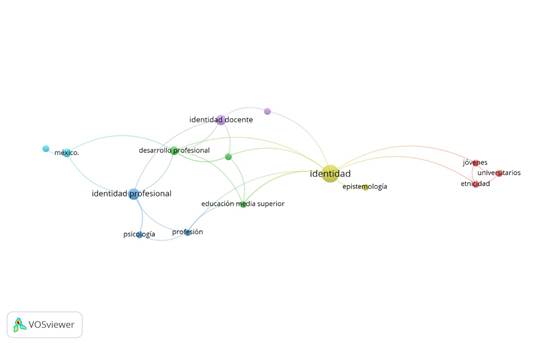
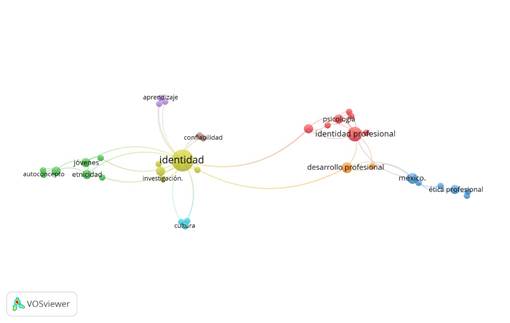
On the other hand, it is important to highlight that initially, 100 documents were located around the term "identity." Subsequently, a thorough selection process was carried out by conducting a detailed analysis of the extensive productions, considering that the objective of this article is to account for some of the researches that have focused on the subject of formation and identity in Mexico during the decade between 2012-2022. As a result, only eleven materials were selected that specifically addressed the mentioned topic (See Table 1).
Table 1 Analyzed Sources
| Grey literature | Thesis | Rodríguez (2014) |
| Presentations | Ramírez y Gallur (2017) Paredes y Saucedo (2017) Williams (2015) | |
| Literatura especializada | Journal articles | Navarrete (2015) Rodríguez y Seda, (2013) Ramírez y Saucedo (2016) Covarrubias (2013) Herrera y Mijangos (2019) Roacho y Herrera (2016) |
| Books | Navarrete (2018) Navarrete (2021) |
Source: Own elaboration.
The following three sections of this article will present the findings obtained during the research conducted. In the first section, the research conducted on university identity and formation in the country will be presented, based on those works that emphasize the importance of this level for professional formation. As the second point, the research related to the field of psychology will be discussed, as it emerged as the most extensively studied subject by researchers in Mexico during the decade. Finally, the third section will account for the research conducted on identity and formation in different professional fields.
Identity and Formation at the University Level
Mexico has a long history related to the establishment of higher education. The first educational institution was founded in 1551, known as the Royal University of Mexico, built by order of Charles V, which allowed the development of a series of disciplines that positively impacted the population. Thus, the chairs of Medicine, Civil Law, Ecclesiastical Law, and Arts provided university education that enabled access to ecclesiastical positions, to the bureaucracy of the viceroyalty, or to the university structure itself (Rodríguez, 2008).
Currently, in the Mexican Educational System, the university plays an extremely important role, as Article 3 states it as a duty and a right that the State must grant in order to meet the educational needs of the country. Thus, in Section VII, the following is stated:
Universities and other institutions of higher education granted autonomy by law shall have the authority and responsibility to govern themselves; they shall pursue their goals of educating, researching, and disseminating culture in accordance with the principles of this article, respecting academic freedom and freedom of research and the free examination and discussion of ideas; they shall determine their plans and programs; establish the terms of entry, promotion, and tenure of their academic staff; and manage their assets (Constitución Política de los Estados Unidos Mexicanos, Art. 3, Section VII, 2019).
Building upon the previous paragraph, in Mexico, the university is presented as the institution responsible for innovation and cultural dissemination, directing its functions towards the improvement of Mexican society. Therefore, its role as a professional educator is essential to the nation's progress.
Based on the above, one of the works regarding this institution is by Navarrete (2015), who conducts research aimed at understanding the role of the university as a fundamental part of shaping professional identities, analyzing the existing link between higher education institutions, formation, and identity. Thus, the study begins by conceptualizing these three elements in interaction, which form the basis for understanding the object of study.
The author suggests that the university ensures recognition and certifies professionals who will occupy positions in society, playing a significant role within the educational frameworks of each nation. Meanwhile, formation refers to a permanent and continuous construction of something or someone, and identity is the point of convergence of theoretical reflections and various reconstructions.
It is important to mention that throughout the work, there is a review of the concept of identity starting from classical philosophy, noting that it is placed in an aporetic position, being something unrepresentable. It is only possible to speak about it but not represent it in tangible or definitive terms. Thus, the concept is not only polysemic but can also transition from one linguistic domain to another, exploring all its directions: social, psychological, cultural.
Based on the review of studies conducted on university identity and formation in various professional fields during the decade from 2002 to 2012, the author concludes that the majority of these studies recognize the plural nature of identities, accounting for the particular processes present in identity constructions within higher education institutions. Within these configurations, the institutional professional reference of each university is present, which in turn combines with the history and personal trajectory of the professional subject.
Continuing along this line of research, Navarrete (2018), using Political Discourse Analysis, examines how the identity of university students is configured, focusing on the formation of pedagogues at the National Autonomous University of Mexico and the University of Veracruz. The central category expressed is the professional identity of the pedagogue, which is understood as a dynamic and complex process involving multiple appropriations of the identity model proposed by the institutional sphere. This identity is constructed on a relational basis in three moments of the formative trajectory: pre-university, university, and post-university. The analysis allows for the visualization of a re-signification of professional identity through reactivation. Analytically, common traits among the study's interviewees are identified, relating to a) institutional conceptions of pedagogy and being a pedagogue, b) graduates' conceptions of the pedagogical discipline, and c) professional practice as an element shaping identity. Thus, it is evident how professional identity has been formed through the transition before, during, and after the undergraduate degree, as a relational construction made possible through the interaction of various elements within the same discursive chain. The work concludes that the pedagogue's identity is constructed and reconstructed based on experiential relationships and a series of symbolic references recognizing historical genealogy, as evidenced by the analysis of study plans and the narratives of interviewed pedagogues.
It is important to highlight that the works included in this section allow us to recognize the importance of higher education as a shaper of professional subjects, who are formed through the interaction of various elements where identity plays a central role in creating professional identity in different contexts. Thus, professional identity is a product of personal experience and the role the individual plays in society.
Identity and Formation in Psychology Bachelor's Degree
The documentary review conducted within the research process revealed that the studies carried out in the decade from 2012 to 2022 had a close relationship with the formation of professional identity in the field of psychology. Its dual nature as both a science and a practice (Rodríguez & Seda, 2013) makes the investigation of the constitution of professionals in the field interesting, considering for identity formation the knowledge that psychologists acquire during their training and the meaning students give to the knowledge they construct at the university level, along with their exposure to real working conditions, which enables them to integrate into workplaces where they apply their knowledge.
Based on the above, a total of 5 studies related to identity and formation in the psychology bachelor's degree were found, corresponding to Rodríguez & Seda (2013), Rodríguez (2014), Ramírez & Saucedo (2016), Ramírez & Gallur (2017), Covarrubias (2013), Paredes & Saucedo (2017), which are presented below.
Rodríguez & Seda (2013) present the results obtained in the "Formative Scenarios" program applied at the Faculty of Psychology of UNAM, recovering the meanings that a total of 34 students attribute to the career once they have participated in professional contexts. The authors argue that professional identity is related to a set of cultural repertoires that individuals internalize, constructing meanings that they put into action to apply in the future. The premise of this study is to understand what psychology students appropriate from all the information they receive, finding that professional practices are a way to identify important attitudes, allowing them to access a series of ideologies, languages, traits, and disciplinary meanings that enable them to energize and consolidate formative experiences.
Continuing with their line of work, Rodríguez (2014) analyzes the phenomena related to the configuration of the professional identity of psychology students. The theoretical tools are based on the work done by Dubar (2002), which addresses the constructs of identity and profession. With a case study and based on the analysis of trajectories, the importance of constructing meanings in psychology is proposed, defined as desirable relational-attitudinal traits. After analyzing the information gathered from interviews with five students, the author concludes that identity can be seen as a distinguishable unit with historical, dynamic, intersubjective, and relational characteristics, which incorporates family values, formal experiences, interaction with professors, symbolic references from the institution, the curriculum, and the specific educational context. A relevant finding highlighted in the study is that student participation in different communities of practice allows for greater capacity for action, appropriation of meanings, and consolidation of identity around their profession.
Continuing with the studies carried out at FES Iztacala, Ramírez & Saucedo (2016) analyze the meanings and identity transitions of 16 psychology students, based on the applied psychology course. The authors conduct their research from a sociocultural perspective (Dubar, 2002), recognizing that the classroom is a space for learning in which identity formation processes can be fostered through fluid peer exchanges. In addition, identity in practice depends on a cultural construction that guides students' motivations and forms of interaction, allowing them to apply the content addressed within HEIs. Following the qualitative method and based on the students' responses in interviews, it is concluded that the formation of professionals in psychology involves a series of dilemmas regarding transitions between theory and practice, generating a complex process of identity formation where the impact of interaction in various contexts on professional formation can be analyzed.
Following the research line, Ramírez & Gallur (2017) analyze the impact of future psychologists' participation in professional practice scenarios. In this study, identity is approached as a construct related to a network of images and meanings that students attribute to both the community and themselves. It stems from a professional trajectory that takes into account mediation and self-regulation, the integration of knowledge and know-how as well as a sensitization between working with users and their development as therapists. It is concluded that identity formation presupposes a long-term and active construction where practices significantly influence individuals becoming active participants.
In her research, Covarrubias (2013) analyzes the social representations (Bourdieu, 1982) that psychology students belonging to FES Iztacala have constructed about their professional identity. Through a qualitative study, the author gathers the opinions of 22 students, finding that they perceive their professional development within the faculty positively, which is related to their object of study, scientific work, and interdisciplinarity. They recognize that the processes and spaces where they carry out their learning process are fundamental to build a professional identity linked to the social reality and the specific needs of Mexican society. Therefore, they consider it essential to keep the study plans updated to train competent professionals capable of coping with the problems presented in their workplace.
Paredes & Saucedo (2017) analyze the narratives of a group of students belonging to FES Iztacala, focusing on the formation of their professional identity at the end of their academic trajectory, based on the experiences that shape their initial training such as: choosing the degree, student life, psychology in action, and their future projections. Based on this, their ethos is configured with the areas of action of psychology, desirable traits of the career, and training mechanisms, paying attention to the formative scenarios in which they operate: research laboratories, psychological care centers, and educational and health institutions. Using a sociocultural approach, the authors account for the students' experiences, finding that the professional identity of psychologists is built upon multiple knowledges, imaginaries, collective interventions, and their participation in real work contexts. Thus, a process of co-construction develops between what the official curriculum dictates and what lies outside of it, recognizing that practices are a relevant means to consolidate psychologists' sense of professionalism in their field.
With reference to the aforementioned research, it can be observed that the construction of a psychologist's identity relies on the linkages generated from students' perceptions when choosing the degree, the experiences lived through each subject, working with peers, and their integration into the community. These elements contribute to a process of construction, deconstruction, and reconstruction that allows them to give meaning to their actions as professionals in the field, recognizing that identity formation is both an individual and social matter.
Additionally, professional practices are spaces where university students can have an approach to formative experiences closely aligned with reality, whose cultural repertoires are internalized, leading to a construction of meanings that will be applied by future professionals, serving as a way to access the ideology of the environment.
Identity and training in different professional fields
As mentioned in the first section, the university has been the institution whose role is fundamental in forming professionals, allowing for certification that accredits individuals as professionals or technicians, developing in them a series of knowledge, skills, and aptitudes specific to their field. In this sense, this section presents research that accounts for identity and training in different professional fields, such as advertising, Community Educational Leaders of the National Council for Educational Development (CONAFE), and educational intervention.
Williams (2015) conducts a case study to understand how the professional identity of advertisers is constituted at the Universidad Popular Autónoma del Estado de Puebla, noting that it unfolds in a process of transformation and change involving both the individual and the society around them, as well as the institutional context where they undergo their initial training. The author concludes that the professional identity of advertisers occurs in a dual environment where teachers teach students to recognize themselves, and students renew the knowledge acquired, generating dynamism between theoretical and pragmatic evolution.
In their research, Herrera & Mijangos (2019) present preliminary results of the study related to identity processes built with young people participating as Community Educational Leaders of the National Council for Educational Development (CONAFE). The authors highlight the importance of addressing this issue since identity is a central element in carrying out pedagogical work as it guides the actions of the teacher both inside and outside the classrooms. Through a qualitative study that incorporates a social perspective (Berger & Luckmann, 2019), it is evident that the Community Educational Leaders shape their identity based on their initial training where they develop basic skills to teach in practical settings that bring them closer to real working contexts in remote communities in the country. Therefore, identity is constituted as a construct between the knowledge generated in the courses and the exchange they have with community members.
On the other hand, Quiroz (2014) analyzes the professional identity of educational intervenors who completed their bachelor's degree at the Universidad Pedagógica Nacional, with an approach involving a total of 12 graduates from three generations. The author examines the formation of identity by drawing on the theoretical contributions of Political Discourse Analysis (Hall, 2000; Laclau & Mouffe, 2004) and organization theory. The study starts from the configuration of identity from initial training in higher education institutions, where a dynamic process takes place involving socialization among peers and professors, adaptation to institutional norms, and the tacit assumptions that underpin transmission, preservation, and change. The research results show that educational intervenors appropriate formal discourse and competencies, which initially caused conflicts when entering the workplace, indicating that theoretical discourses have been insufficient for them to perform effectively in their professional roles.
Following the same thematic line, Roacho & Herrera (2016) present a study aimed at analyzing how the subjectivity and identity of professionals dedicated to educational intervention have been constructed, as well as how they are reinterpreted. The results suggest that the bachelor's degree is functionally disconnected from the study interests and the requirements of a complete graduate profile to ensure that these professionals enter the job market, which devalues and misaligns the graduates. As a result, identity remains static and becomes complex, becoming confusing due to the distortion of meanings regarding oneself, presenting a problem that must be addressed.
Based on the research presented in this section, it can be observed that the construction of identity within the university is seen as a dynamic and dual process involving both theoretical and practical aspects, resulting in a series of exchanges with the community and individuals where knowledge is constructed that significantly impacts the performance of professionals, enabling them to perform more effectively within the professional environment.
Conclusions
Considering the documentary review of the research conducted on the topic of formation and identity published between 2012 and 2022, it becomes evident that university students construct, deconstruct, and reconstruct their professional identity through a series of interconnected elements, which are related to initial training, peer work, individual perceptions of the chosen professional field, and professional practices, where a set of knowledge and skills are developed that impact the way of being a professional.
The methodology proposed in this research guided a search that allowed the retrieval of the most relevant works published in the repositories of the Mexican nation, finding that during the studied decade, works were related to the theme of identity formed in the field of psychology, presenting itself as an object of study of utmost relevance.
Thus, the concept of identity related to professional formation has been approached from different perspectives and positions through which authors have accounted for the process of identity construction, recognizing that it possesses a plural character, being a stable and provisional, individual and collective result, subjective and objective of various processes of socialization where the socio-cultural context is of utmost relevance, rescuing the common and shared space that individuals have, taking as reference the professional, social, and institutional environment in which they operate.
It is essential to highlight that the authors have emphasized the impossibility of discussing identity as a static phenomenon, establishing it as a concept that implies mobility, transformation, and change. Identity is conceived as a process in which both individuals and institutions responsible for professional formation are constantly constructing, deconstructing, and reconstructing themselves. Thus, the research presented in this work focuses on understanding the formation of professional identity, taking into account the interrelationships established among the individual, the university, and the community where professional practice occurs, which together shape a professional identity.
Finally, concerning the formation of university identity, it is crucial to underscore the importance of its examination. This allows us to recognize the needs of professionals operating in today's knowledge societies, which can either positively or negatively influence their formation and professional practice. Therefore, it is essential to continue researching this topic, paying attention to the processes and logics of transformation through which such identities are formed, to understand how, why, and from where these identities are configured

