


Introduction1
Teaching is an unattractive profession in different regions of the world (Johnson & Kardos, 2008; United Nations Educational, Scientific and Cultural Organization [Unesco], 2016; Heinz et al., 2017; Madero, 2019) due to low wages, high workload, precarious working conditions, and social devaluation. In 34 nations studied by Price and Weatherby (2018), only 28% of teachers on average agreed that teaching was a valued profession in their societies. The teacher’s job has never been more complicated and it is considered one of the most stressful of this century (Kyriacou, 2001; Johnson & Kardos, 2008; Doney, 2013; Newberry & Allsop, 2017; Rinke & Mawhinney, 2017).
Poor social perception steer young people away from teacher education programs, cause high turnover rates, and make teachers leave both elementary and secondary levels, especially in the fields of Science, Chemistry, Physics and Maths (Hoyle, 2001; Guarino et al., 2006; Ronfeldt et al., 2013). Teacher attrition and turnover result in increased expenses with training, hiring and integration of new teachers, as well as pose difficulties for the continuous and adequate development of the school curriculum (Johnson & Kardos, 2008).
Countries such as England and the US have struggled in attracting and retaining qualified teachers, especially in science fields (Ingersoll & Perda, 2009; Sibieta, 2018). In Brazil, there is a shortage of more than 200,000 science teachers to serve eight million high school students (Ruiz et al., 2007). This is related to the low interest in teaching as a career, the high dropout rates in teacher education courses and the high rates of job abandonment (Gatti et al., 2019), which peaks at 40% in the first five years of work (Fanfani, 2005; Madero, 2019). This figure is not different in other countries, in which this rate ranges between 25 and 40% (Madero, 2019; Organization for Economic Co-operation and Development [OECD], 2005; Price et al., 2012; Sibieta, 2018). As a reflection of all this lack of interest, just as Ronfeldt et al. (2013) and Wong and Luft (2015) point out, in Brazil it is common for science teaching to be carried out by professionals with no specific training1 and on a temporary basis, as an income supplement (Brasil, 2018).
Several studies investigate teacher attrition and turnover, or why teachers leave their jobs (Gilbert, 2011; Hong, 2012; Ronfeldt et al., 2013; Snyder et al., 2013; Ens et al., 2014; Watters & Diezmann, 2015; Kelchtermans, 2017; Newberry & Allsop, 2017; Rinke & Mawhinney, 2017; Perryman & Calvert, 2020). The decision to quit teaching involves a complex combination of diverse elements such as workload, stress caused by financial issues and social pressure, beliefs about the profession, attractiveness of other professions, professionalism, relationships with colleagues and students, feelings of isolation and lack of meaning, occupational diseases, lack of support, feeling of unpreparedness to exercise the profession, etc. (Gilbert, 2011; Ens et al., 2014; Newberry & Allsop, 2017; Rinke & Mawhinney, 2017; Perryman & Calvert, 2020).
In view of all this, it is essential to understand what influences people to choose to be science teachers and to persevere in the job in order to find ways to overcome this terrible situation that affects the profession worldwide. Some authors have investigated this subject (Eick, 2002; Watt et al., 2009; Fraser-Abder, 2010; Gilbert, 2011; Hong, 2012; Doney, 2013; Harrell, Snyder et al. 2013; Watters & Diezmann, 2015; Wong & Luft, 2015; McConnell, 2017; Rinke & Mawhinney, 2017; Harrell et al., 2019). Most of these research studies indicate that choosing teaching is associated with extrinsic, intrinsic, and altruistic factors, which are similar among teachers from different contexts (Heinz, 2015; Han & Yin, 2016). According to the Teaching and Learning International Survey (TALIS), applied to more than 200,000 teachers in 48 countries, the main motivations to become a teacher are, in this order: to influence the development of children and young people; to provide a contribution to society; to benefit the socially disadvantaged; it is a secure job; it provides a reliable income; the schedule fits with responsibilities in personal life; it offers a steady career path (Organization for Economic Co-operation and Development [OECD], 2019). Motivations for teaching careers around the world are more similar than different, and perceptions about the profession reflect trends in each context (Watt et al., 2012).
However, few studies consider aspects other than those directly associated with the profession, such as the teacher's socioeconomic trajectory (Weiner et al., 1993; Maguire, 2001; Heinz et al. 2017). Our hypothesis is that structuring elements such as social origin and gender give rise to social practices and therefore are significant conditioning factors in professional choice. The aim of this study is to investigate science teachers who persevere in their careers, and we relate their socioeconomic trajectory with the main factors that influence their career choices. The questions that guided the study were:
What are the conditions for choosing teaching as a career?
How does the subject's socioeconomic trajectory shape the choice for teaching as a career?
Relevant literature on teaching as a career choice
To answer the first question, we searched the relevant literature for the main motivational elements that lead to teaching as a career. An extensive literature has been published since the 1960s about this issue, organized in the form of reviews (Guarino et al. 2006; Heinz, 2015; Han & Yin, 2016) and collections (Johnson & Kardos, 2008; Richardson & Watt, 2016; Butler, 2017). According to a systematic review in different countries, the most frequent reasons for choosing teaching are related to intrinsic or altruistic factors and less often to extrinsic reasons (Heinz, 2015). Han and Yin (2016) also point out these three factors (extrinsic, intrinsic, and altruistic) as the major reasons accounting for the decision to teach. Several works start from these factors to suggest typologies or categories for the study of teachers' motivations (Eick, 2002; Sinclair, 2008; Gilbert, 2011; Hong, 2012; Thomson et al., 2012; Watt et al., 2012; Knell & Castro, 2014; Davoglio et al., 2017; McConnell, 2017; Newberry & Allsop, 2017; Rinke & Mawhinney, 2017; Madero, 2019; Perryman & Calvert, 2020).
From this extensive literature on teacher education and professional choice, we noted that there are several motivations that affect professional choice, many of which are just descriptions and categorizations, and there is a tendency to separate them into intrinsic, extrinsic, and altruistic. Starting from this extensive literature, we list the most common elements that condition choice and motivate teachers to choose/leave the classroom, summarized in Table 1. We understand that there is a difference between factors and elements, as factors are broader categories that include different conditioning elements of career choice. In Table 1 we only systematize the elements as they were categorized by the authors themselves - as intrinsic, extrinsic, altruistic and other factors.
As can be seen in Table 1, there are several motivations that affect professional choice, among which many are surveys, descriptions and categorizations, and there is a tendency to separate them into intrinsic, extrinsic, and altruistic. This separation is limiting, as it disregards the individual as an agent immersed in a complex network of relationships in which these elements are interconnected. For Watt et al. (2012), Heinz (2015), and Han and Yin (2016), the excessive operationalization of these motivations resulted in a lack of clarity in definition and categorizations that overlap one another, making it difficult to distinguish the elements and generating numerous research that only determine a list of factors, but do not explore in depth the relationship between the various elements that overlap. The same authors point out that there is a similarity between these elements and the limitations of this categorization. To overcome this compartmentalization, thereby breaking with the division between intrinsic, extrinsic, and altruistic factors, we propose a relational analysis among the conditioning elements. Observing the elements arranged in Table 1, we notice some similarities. For example: the elements identified in the literature as ‘interest in helping students learn’ (Hong, 2012; Ens et al. 2014; Knell & Castro, 2014; Davoglio et al. 2017), ‘to help young people learn and develop, sense of success with students and sense of worth’ (Eick, 2002; Johnson & Kardos, 2008; Fraser-Abder, 2010; Watt et al., 2012; Knell & Castro, 2014; Ens et al., 2014; Heinz, 2015; Perryman & Calvert, 2020) have in common the desire to help students through teaching, seeing the profession as a caring task, as being selfless and dedicated to others (students, parents, school), that is, a sense of care. Considering the similarities of the elements in Table 1, we organize the factors from literature into five conditioning elements that we called: Love, Care, Ability, Calling, and Profession, as shown in Table 2.
Table 1 Overview of literature on motivations to teach.
| Factor | Elements | Studies |
| Intrinsic | enjoyment of teaching, passion | Nogueira et al. (2011); Watt et al. (2012); Ens et al. (2014); Heinz (2015); Rinke and Mawhinney (2017); Davoglio et al. (2017) |
| interest in their subject | Eick (2002); Fraser-Abder (2010); Hong (2012); Heinz (2015); Rinke and Mawhinney (2017); Perryman and Calvert (2020) | |
| interests in helping students learn | Hong (2012); Knell and Castro (2014); Ens et al. (2014); Davoglio et al. (2017) | |
| resilient attitudes, responses to challenging situations | Gu and Day (2007); Hong (2012); Doney (2013);Tricarico et al. (2015) | |
| working with children | Sinclair (2008); Watt et al. (2012); Knell and Castro (2014); Eick (2002); Fraser-Abder (2010) | |
| individual skills, abilities, personality, dispositions | Gilbert (2011); Watt et al. (2012); Doney (2013) | |
| professional development | Sinclair (2008); Davoglio et al. (2017) | |
| psychological factors (self-efficacy, beliefs, value, emotions) | Eick (2002); Sinclair (2008); Hong (2012) | |
| teacher autonomy | McConnell (2017); Davoglio et al. (2017) | |
| love science: interest in science, being able to continue studying science, being able to teach science (and impact students' lives through scientific literacy) and hands-on in science | Eick (2002); Fraser-Abder (2010) | |
| vocation, sense of purpose, and special talents | Tricarico et al. (2015) | |
| feel good about themselves | Knell and Castro (2014) | |
| to be creative | Perryman and Calvert (2020) | |
| authority and leadership | Sinclair (2008) | |
| effective classroom management strategies and role models | Fraser-Abder (2010) | |
| Altruistic | help young people learn and develop, sense of success with their students, sense of worth | Eick (2002); Johnson and Kardos (2008); Fraser-Abder (2010); Watt et al. (2012); Knell and Castro (2014); Ens et al. (2014); Heinz (2015); Perryman and Calvert (2020) |
| want to contribute to society, special mission, make a difference, to serve society | Guarino et al. (2006); Watt et al. (2012); Knell and Castro (2014); Tricarico et al. (2015); Heinz (2015); Rinke and Mawhinney (2017); Davoglio et al. (2017); Perryman and Calvert (2020) | |
| opportunity for rendering important service, socially worthwhile | Knell and Castro (2014); Heinz (2015) | |
| to have an intellectual challenge, intellectual stimulation | Sinclair (2008); Perryman and Calvert (2020) | |
| student motivation | Fraser-Abder (2010) | |
| Extrinsic | working condition: school organization, mentoring programs, administrative support, parental support | Guarino et al. (2006); Johnson and Kardos (2008); Sinclair (2008); Hong (2012); Heinz (2015); McConnell (2017); Harrell et al. (2019) |
| satisfactory salary, holidays, job security, transferability, flexibility, stability, variety of work, life-fit | Guarino et al. (2006); Johnson and Kardos (2008); Sinclair (2008); Watt et al. (2012); Knell and Castro (2014); Heinz (2015); Davoglio et al. (2017); Perryman and Calvert (2020) | |
| working relationships with colleagues | Johnson and Kardos (2008); Tricarico et al. (2015); Perryman and Calvert (2020) | |
| student characteristics: social class, age, ethnicity, performance, discipline/behavior, evasion | McConnell (2017); Harrell et al. (2019) | |
| status of the profession, the prestige of the occupation, opportunity for professional development | Heinz (2015); McConnell (2017) | |
| career change | Sinclair (2008) | |
| years of experience | McConnell (2017) | |
| nature of work | Sinclair (2008) | |
| acceptance of the varying parental involvement in the educational decisions about their children | Fraser-Abder (2010) | |
| Others | the potential influences of family members and others (teachers) | Eick (2002); Sinclair (2008); Watt et al. (2009); Heinz (2015) |
| prior teaching and learning experiences | Watt et al. (2012); Rinke and Mawhinney (2017) | |
| the impact of socio-cultural factors | Heinz (2015) |
Source: Devised by the authors, based on literature review.
Table 2 Definitions of elements representing more common motivations to teach.
| Element | Definition |
| Love | To like, love or have a passion for teaching, learning, and teaching content. To enjoy relationships with children and teenagers. |
| Care | To want to help students through teaching, seeing the profession as a caring task, being selfless and dedicated to others (students, parents, school) |
| Ability | To develop or perform skills and dispositions such as autonomy, creativity, leadership, authority, control, collaboration, among others. To have beliefs, values, emotions consistent with the profession. |
| Calling | To be able to develop socially important work, ‘making a difference’ in the lives of students, forming responsible citizens, a sense of duty/social service, a sense of calling, mission, purpose of life, having a gift/talent to teach. |
| Profession | To have a stable job, with a wide range of job opportunities, flexible hours, adequate salary, and regular vacations. To have the opportunity to develop professionally, engage in stimulating intellectual activity. To work in collaboration with colleagues, school management and students' families. To acquire experience with teaching. To exercise a prestigious profession. |
Source: Devised by the authors, based on literature review.
The conditioning elements presented Table 2 are systematizations of several studies concerned with the professional choice of teachers and provide important clues to understand this issue, synthesized in Table 1. However, they are descriptive and by themselves do not explain such a complex choice, which still misses a deeper theoretical analysis regarding its interpretation. This aspect was also identified by Heinz (2015, p. 274) when he noted that studies on reasons to teach have a “[...] mostly atheoretical nature”. According to Han and Yin (2016), there is a need for research that captures the complexity of the motivation process and provides a holistic picture to view the relationship between a number of variables. We seek to overcome this gap in this field of research through a sociological approach. Our second research question aims to understand how these different elements condition the socio-professional trajectory of teachers, thereby leading to choosing teaching, staying on the career, or leaving it.
Theoretical framework: a sociological approach to career choice
According to Han and Yin (2016), the main theoretical frameworks for studying teachers' motivations are: (1) social-cognitive theories of motivation such as expectancy-value theory, (2) achievement goal orientation theory and (3) self-determination theory. From another perspective, little explored in literature on science teacher education, we rely on Pierre Bourdieu's sociological theory to interpret professional choice as a complex process that runs through the teacher's entire life trajectory: from family and school socialization to experiences in the profession. There is no crucial reason or fact that leads an individual to choose a particular profession. It is a process of incorporating experiences in different contexts that outlines possible actions and trajectories.
In his several books, Bourdieu did not directly study the professional choice for a teaching career. However, his praxeological interpretation of social practice allows us to understand the relation between the socio-professional trajectory of a teacher and their choice (actions) of the profession, taking into account the social conditioning imposed. Based on Bourdieu (2013), we avoid subjectivism in which the subject would act in a fully conscious mode, oriented by their own abilities, tastes and personal interests, in an autonomous way, free of external influences, independent of their social origin and limitations socially imposed by their class position. We also avoid the opposite, objectivism, in which the actions would result from impartial calculation, based on the most advantageous choice. In a praxeological perspective, the agents are shaped by interacting with the social environment, they act according to a practical sense, considering the social structure and the objective possibilities of achievement (Bourdieu, 2013). The social practices emerge from the agent's trajectory of socialization and are always being conditioned by several elements. We adopted the trajectory concept as proposed by Bourdieu (1984), according to which agents move in the social space within a field of possible, following typical trajectories that depend on their social origin.
For Bourdieu (2013), any practice is always socially situated and results from the position of a given agent within the social space, defined by class, gender, race etc. Habitus is the central concept for understanding the dialectical mediation between individual and society, or between intrinsic and extrinsic (Bourdieu, 2013). It is a regulatory set of thoughts, beliefs and actions that encompasses objective and subjective worlds, outer and inner realities (Bourdieu, 2013). In each choice there is a game between habitus and the conditions imposed by the context (Bourdieu, 2013). As the habitus represents the incorporation of external (extrinsic) influences and reflects internal (intrinsic) influences, it overcomes the opposition between extrinsic and intrinsic elements (Bourdieu, 2013).
Individuals of the same social class who are exposed to the same material conditions of existence and the same objective structures have similar habitus and the same kind of stagnation, ascension, or decline (Bourdieu, 1984; Bourdieu & Wacquant, 1992). The concept of habitus is related to that of capital, which works as a kind of conversion scheme, as a resource that can be accumulated or exchanged in order to gain distinction and legitimacy (Bourdieu, 1984). Capitals can be social, symbolic, economic, and cultural, the last two being the most noticeable in our analyses. Briefly, economic capital corresponds to income, salary, material possessions (such as real estate), all of which is converted into money and exchanged for goods and services. Social capital is linked to possessing a network of durable social relationships (such as friendships, kinship, professional ties, association to a group or institution of inter-recognition). Symbolic capital is associated with the prestige and reputation that the agent has in society, the way they are perceived by others, and the recognition determined by the possession of other capitals. Cultural capital refers to cultural assets such as knowledge, cultural preferences, titles, and the ability to symbolically appropriate instruments of material or cultural production (Bourdieu & Wacquant, 1992; Bourdieu, 2015).
As the principle that generates all practices, the habitus adjusts to objective possibilities, determining reasonable behaviors, anticipating a probable future, and excluding behaviors incompatible with objective demands. For instance, low cultural capital reflects on agents’ habitus - their choices and values about food, clothes, language, profession among other behaviors. Most of the teachers come from less favored social backgrounds, in lower classes (Richardson & Watt, 2016; Heinz et al. 2017; Gatti et al. 2019; Madero, 2019). Even though it is the basis of professional hierarchies in comparison to scientists or other occupations related to science, the teaching career would still represent a guarantee, a maximization of security, the best option among the strategies of those who live on low income (Bourdieu, 2015). Everything happens as if there was a “[…sense of reality [...]” of “[...] what we are not allowed to do [...]”, a “[...] doxa functioning as tacit fate [...]” (Bourdieu, 2015, p. 127). The most prestigious careers are the riskiest for the lower classes. Taking the risk of a trajectory of high investments of time and capital (economic and cultural), without the guarantee of profit is an audacity reserved only for those with a safety net and not for the insecure and anxious for security, like the working class, “[...] risks that one would only take when sure of not losing everything whilst risking to win all” (Bourdieu, 2015, p. 105).
The increasing difficulties in teaching career tends to progressively draw in a public from a lower social stratum, with few professional aspirations, who see the profession as safe and stable (Hoyle, 2001). In that way, being a profession that requires a long educational investment and represents a dignified way of social advancement, it would be mostly sought by women of lower classes who are looking for an uncompetitive career tied to domestic life. Indeed, as Organization for Economic Co-operation and Development [OECD] (2019) and Richardson and Watt (2016) show, the teaching career is formed mostly by women. Tašner et al. (2017) investigated the factors influencing the choice for teaching as a career and noted that the female predominance is a result of the harmonization between the teachers' habitus and their perception about the profession, frequently related to vocation (calling), caring, giving, and helping others. Asimaki and Vergidis (2013) also noted the influence of gender on professional choice, women saw teaching as an extension of their traditional functions, historically and socially determined, connected to caring and giving, applying their skills into professional practice.
There is a close relation among choosing teaching as a career, the agent's position on the social structure and gender, predominantly female. Based on Bourdieu's theory and the literature review, in our interpretation of social class and gender are that of categories regulating: i) the strategies of educational and professional investments; ii) the aspirations and representations about the chosen career; and iii) the ways of dealing with the career’s material conditions; defining possible paths for entering teaching, staying there, or leaving it. In this way, we understand that the representations, beliefs, perceptions, and experiences of the career are conditioned by the elements of love, care, ability, calling and profession, which are engendered by the agents’ habitus and gender, they impact the choice to stay (or not) in teaching. In this paper, we analyzed the relation between the teachers’ career choice and its conditioning elements - identified in literature (love) - through habitus, capital, social origin, and gender concepts. Our research advances in teacher training studies by using a relational and sociological approach that considers the teachers’ socio-professional trajectory.
Research design
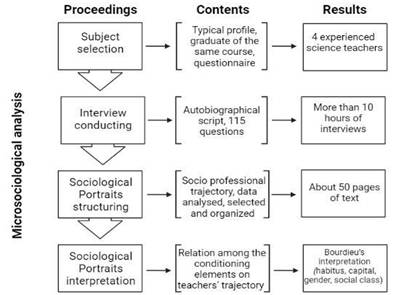
In this article we investigated the life trajectory of science teachers in Brazil. It is part of a study conducted by a macro-sociological analysis with graduates of the same chemistry teacher education program. The research was approved by an ethics committee and all processes followed the required standards. We chose Bourdieusian social theory to guide the design of this study because this theory reveals the effects of social inequalities on the agents' trajectories. Considering the characteristics of the teaching career in Brazil, this approach is important to understand that: 1) choosing the subjects (considering their social origin); 2) conducting the interviews (focused on assessing socio-professional trajectories); 3) organizing the literature on the issue (to relate the elements that influence career choice and not just taking them as isolated categories); and 4) carrying out the analysis (interpreting career choices using the concepts of habitus, capital, strategies, and social practice).
Context and participants
In Brazil, teacher training takes place in higher education courses in public or private institutions. Undergraduate teacher education programs are often easily accessible, low-cost, and highly employable, attracting students from public schools, families with low cultural capital and low income, elderly people, women, and white people (Gatti et al., 2019). The teachers in this study enrolled in a chemistry teacher education program at the same institution at different times. It also has some particularities, which justify the interest in studying subjects from this formative context, as it takes place at a public institution that is also an important chemistry research center, nationally and internationally recognized. This has a reflect in the students' education, which is highly focused on scientific subjects and research activities in the institution's laboratories. Thus, the job options for these graduates are broad: i) as chemistry and physics teachers at the high school level; mathematics at the elementary level; chemistry at the university level; and in technical and preparatory courses; ii) in management positions at schools; iii) as a researcher in some field of chemistry; iv) in the industry or private laboratories. Teachers can work in public or private institutions (schools and universities). Public ones may offer professional stability if the teacher has a permanent contract, private ones may pay higher salaries, but do not guarantee a stable career. This versatility attracts those who “[...] live on income [...]” (Bourdieu, 2015, p. 105) and need to guarantee a job to accumulate economic capital and maintain (or improve) their social position. Therefore, the experience in this formative context and the different professional possibilities shape the trajectories of these teachers and help understand why they choose the profession and stay in it.
Four teachers participated in the research. Small-scale studies are a common way to analyze this theme (Eick, 2002; Fraser-Abder, 2010; Gilbert, 2011; Hong, 2012; Doney, 2013; Snyder et al. 2013; Tricarico et al., 2015; Watters & Diezmann, 2015; Wong & Luft, 2015; Newberry & Allsop, 2017; Rinke & Mawhinney, 2017). We recognize the limitations of this type of study, but we believe that our deep interview method and in-depth biographical analysis have their own advantages.
Empirical data
We applied an online questionnaire to graduates of this undergraduate teacher education program in 2016 to identify those interested in participating in the research. Among the 79 respondents, we selected four (Beatrice Miles, Carla Carter, Cecilia Baker and Elizabeth Hoffman)2 based on the following criteria: i) they were currently teaching; ii) they corresponded to the typical profile3 of the Brazilian teacher, that is, a woman, between 30 and 40 years old, belonging to the worker class; iii) they had a postgraduate degree4; iv) they had a diversified professional experience. We selected this profile to ensure a representative sample of the set of Brazilian teachers, we were also concerned about the social class and gender of the subjects, in agreement with the theoretical framework adopted in this research. Thus, we could assess how different professional experiences influence the professional choices of subjects with similar educational and social trajectories. Our data was elaborated based on the interviews, conducted in 2018 by one of the authors of this article, in person and remotely: one with teachers Beatrice (remotely) and Cecilia (in person) and two with Carla (in person) and Elizabeth (in person and remotely). Each interview lasted two hours on average. With Carla and Elizabeth, we felt the need to do one more interview to obtain further information, with Beatrice and Cecilia just one interview was considered enough.
Semi-structured interviews were carried out (Costa & Lopes, 2011), leading the teachers to narrate their life stories and to understand their professional choices. Through an extensive script consisting of 115 questions about personal, school, academic and professional aspects, we sought to capture the class position, the volume of capital, the relationship with the family and the school, cultural practices, study habits, school experiences, the choice of higher education, professional experiences, school investment strategies, tastes and interests and the relationship with the profession. Some examples are: How and where did you get your basic education (study habits, family-school relation, extracurricular activities, etc.)? Why did you choose the chemistry teacher education program? Tell me about your professional experience (financial motivations, personal or otherwise to choose your profession, work conditions, etc.). Then, we elaborated their sociological portraits, a theoretical-methodological tool proposed by Bernard Lahire (2004), one of Bourdieu's successors, who articulates the sociological analysis of a phenomenon with the subject's narrative of their life. The sociological portrait is a text, with 10 to 20 pages, in chronological order covering personal, school, academic and professional trajectories, matching the speeches to the sociological interpretation. The portrait is not raw data, but rather data that is analyzed, selected, and organized. We use the portrait in an adapted way, as a methodological tool to systematize the subject's trajectory, as did Costa and Lopes (2011), Lima Junior et al. (2021) and Massi et al. (2022). The interview script, the questionnaire and the full sociological portraits are published in Agostini (2019).
Analysis
For the analysis in this article, we read the portraits and the interviews several times looking for evidence in their life story (report of personal experiences, perception about the career, opinion about the theme etc.) associated with the conditioning elements of the teaching choice, synthesized in five items in Table 2. To interpret the findings, we are guided by Bourdieu's sociology, investigating the role of social origin and gender in the process of choosing and staying in teaching. In Table 3 there are examples of how we analyzed each of the constructed conditioning elements (love, care, ability, calling, profession), associating the literature review, the empirical data and the theoretical interpretation.
Table 3 Examples of data analysis.
| Conditional elements (Review literature) | Empirical examples (Data, Sociological Portrait) | Analytical explanation (Theoretical interpretation) |
| Love | “She chose the teacher education course because she wanted to enter the same profession as her mother and chemistry because she ‘liked science’” (Cecilia, our emphasis) | The career choice is justified by a taste, apparently genuine, for the subject (science) and teaching |
| Care | “She likes ‘the relationship with the students’ and feels fulfilled because she can contribute to their ‘personal growth’ through teaching chemistry, showing ‘concern and care’” (Elizabeth, our emphasis) | Romantic and idealized view about the career condition and choice, consequences of stereotyped representations and the feminization of teaching |
| Ability | “She feels happy and fulfilled with her career, and she considers that she works at the dream school, where she can develop skills such as ‘autonomy and teamwork’ [...]” (Cecilia, our emphasis) | Pragmatic choice of a career in which one can develop abilities, practical sense |
| Calling | “She feels as if she has a ‘‘duty’ to give back to society’ the knowledge acquired at the university, ‘helping and taking care of students’” (Carla, our emphasis) | Possibility of having a socially relevant career and of being able to contribute to their original social group |
| Profession | Certain ‘characteristics of the profession’ contribute to permanence, such as ‘good salary, infrastructure, relationship with colleagues and flexible schedules’, consistent with her lifestyle (Beatrice, our emphasis) | Choice and investment in a career which fits their class’ lifestyle, strongly highlighted by the search for financial stability |
Source: Devised by the authors.
Since we performed a relational analysis, more than one element could be identified in a speech or excerpt from the sociological portrait. The analysis of the results consisted of identifying, describing, and interpreting these elements in a related way, using a sociological approach. Figure 1 presents a scheme synthesizing our methodology of analysis.
Results and discussion
This section is organized into two sub-sections. First, in Profile and socio-professional trajectory, we present the summary of the sociological portrait of each teacher, focusing on career choice and relationship with teaching, it is important to emphasize that this summary is also a sociological data analysis. As the portraits are each approximately 10 pages long, we only included their respective summaries. The complete sociological portraits are published in Agostini (2019). In these summaries we highlight the main results of the sociological analysis, using Bourdieusian concepts and our scheme presented in Table 3 and Figure 1. The excerpts in quotes indicate direct transcriptions of the teachers' speeches; the conditioning elements are highlighted in italics and indicated in parentheses. Next, in Sociological interpretation of professional trajectories, we discuss the interpretation of these elements, including, when necessary, other excerpts from the sociological portraits and interviews; in order to understand them relationally and not in isolation, we will analyze the conditional elements in relation to each other in addition, we relate our results with the literature in the area, presented in the initial sections.
Beatrice Miles
Age 365, black, single, no kids, $ 2,9006 monthly income. Mother and father are civil servants. Private high school, technical degree in nutrition, teaching and master's degrees in chemistry. Chemistry teacher in a public school for 8 years. She is currently in a school (Federal Institute of Education, Science and Technology) that gives her good working conditions, including a good salary. This type of institution is one of the few in Brazil that offers excellent working conditions to its teachers (Nascimento et al., 2020). Her choice ‘was extremely rational’, betting on a course that would guarantee opportunities and jobs. The first option was nutrition and the interest in chemistry arose in a technical course, expressing her ‘taste for science (love)’. Higher education was a dream come true. As an excellent student, she became involved in research, but she had a ‘taste for teaching (love)’ that was ‘my escape valve’. She followed the ‘natural path’ of becoming a postgraduate in chemistry at the same institution, aiming at working for it. She started teaching when she was approved in a public exam, guaranteeing professional stability. She moved from one school to another, always through exams, in search of ‘better working conditions (profession)’ and a ‘higher salary (profession)’, especially because she is single and depends only on her income. She considers herself professionally successful, she loves the classroom, ‘feels worthwhile at school (calling)’, and seeks to have a ‘close relationship with students (care)’. Certain characteristics of the profession contribute to permanence, such as ‘good salary, infrastructure, relationship with colleagues and flexible schedules (profession)’, consistent with her lifestyle. She feels satisfaction in teaching and “[...] a need to fulfill ‘a social debt’, as a purpose (calling) [...]” (our emphasis) for having studied at a public university. She complains about overwork and accumulation of functions, which have already made her think about leaving the profession. She plans to invest in her career with a PhD in education and to continue teaching in high school.
Carla Carter
Age 35, white, married, no kids, $ 2,900 monthly income. Mother does not work, and father is a factory worker. Public high school, technical degree in IT, teaching degree7 in chemistry and master's in education. Teacher of chemistry and physics in public and private schools for 10 years, as substitute teacher.8 Attending higher education was a late dream influenced by the desire to achieve a ‘better future’ with financial independence, ‘autonomy (ability) and stability (profession)’. She spent three years working to pay for a preparatory course. The option for chemistry was more practical than supported by her tastes, as she had an ‘affinity for physics (love)’, but she did not choose it because it was a ‘very masculine’ course. She then opted for chemistry, which is more feminized, less competitive, and more accessible to her reality, “[...] thinking of a course that was too difficult wouldn't do any good […] it would take ages to finish an engineering course”. Being at the university was a great opportunity; she was an average student and participated in activities that offered financial aid and helped her stay in the fight. In one of these activities, she decided she wanted to be a teacher, developing her love for teaching (‘love’). She started teaching physics at a private school. Facing difficulty in getting science classes, for being an inexperienced woman, she took a technical course in computer science, but did not work with it due to low wages and remained in the teaching profession because of ‘the love for the classroom (love)’ that ‘spoke louder’. She feels fulfilled as a teacher, except for low wages and instability, “[...] you never know what will happen [...] you don't know if you’re gonna be fired or not, it happens suddenly”. To guarantee a safer professional relationship, she works in three schools, in different cities, which is very tiring. She is passionate about the classroom, a successful teacher and beloved by students, “I love what I do! I really like teaching!”. She feels as if she has a ‘duty’ ‘to give back to society (calling) the knowledge acquired at the university, helping, and taking care of students (care)’. She plans to pursue a PhD in education, aiming at a public position as a teacher, which would ‘guarantee her stability and financial security (profession)’. With her husband, who is a chemist, the couple enjoys a comfortable financial condition.
Cecilia Baker
Age 36, white, married, no kids, $2,900 monthly income. Mother is a teacher and father is a businessman. Public high school, teaching degree in chemistry, master’s and PhD in education. Chemistry teacher in public and private schools for 13 years. She chose the teacher education program because she wanted to enter the same profession as her mother and chemistry because she ‘liked science (love)’. During the course, she was involved in research and teaching projects that offered financial aid, which helped her to sustain herself. She started teaching during the education program as a temporary teacher in public and private schools. Searching for higher salaries, she went through several schools and levels of education.9 She left two public positions as a teacher to work for a large and prestigious private school, which offered a ‘higher salary (profession)’, where she is currently working. She took a master's and PhD in education. She feels happy and fulfilled with her career, and she considers that she works at the ‘dream school’, where she can develop skills such as ‘autonomy and teamwork (ability), has an excellent infrastructure, administrative support (profession) and can work in a diversified way (profession)’. In the private sector, she found ‘good working conditions (profession)’ and a ‘consistent salary (profession)’ with her current standard of living, and together with her husband they enjoy a privileged class position in relation to their original families. She plans to work in a public university in the future, in search of ‘professional stability (profession)’.
Elizabeth Hoffman
Age 39, white, married, 2 children, $ 1,800 monthly income. Mother does not work, and father is a factory worker. Public high school, technical course in Chemistry, teaching and master's degrees in chemistry. Teacher of chemistry, physics and sciences in public and private schools and universities for 15 years. She took a technical course and teacher education at a young age, thinking of the job market. She acted10 as a teacher in elementary school and chose to pursue higher education to be able to teach at other levels. The technical course made working in the chemical industry a possibility, but she did not invest in this field due to the difficulty of working away from home. She chose the chemistry course because it was in the region where she lived, taught during the evenings, because she ‘liked science (love)’ and because of the ‘job market (profession)’. During the course, she was involved in research activities and teaching, followed by a master's degree in chemistry while working as an elementary school teacher. With the degree, she started teaching chemistry at high school, after being selected in another public exam, guaranteeing ‘financial stability (profession)’ and a ‘safe job (profession)’. As an income supplement, she teaches chemistry and sciences at a private school and at a private college for engineering students. She likes ‘the relationship with the students (love, care)’ and feels fulfilled because she can contribute to their ‘personal growth’ through teaching chemistry, showing ‘concern and care (care)’. She complains about ‘poor conditions (profession)’ and ‘low salary (profession)’ in public schools. She prefers teaching in private schools and in higher education and would work solely on these institutions if receiving a higher salary. Together with her husband, an economist, they invest in their children’s education in private schools. The flexibility of the teaching profession allows her to have some free time to follow her children's school routine. She plans to pursue a PhD in education and continue to teaching in high school.
Sociological interpretation of socio-professional trajectories
Choosing a profession is a complex process that begins long before entering the course and is strengthened along with personal and professional experiences. The class position dictates the rules of the game and the possible paths from the origins (Bourdieu, 1984). Although in different ways, the teachers counted on their parents' investment in their school trajectory and the belief in possible social ascension by education and work - a feeling shared by members of the dominated classes. Good school performance boosted this path, since school success was, in this case, an advantage condition for social success (Bourdieu, 2015). They knew studying was a way to ascend socially. Therefore, they invested time and effort into a long-term career and did their best in the struggle for social ascension. This self-determination and relationship with the school appear in the teachers' speech, as the love for study, science and teaching, related to the conditioning element that we call “love”.
The choice of the teacher education program was conscious and thoughtful: a career with less competition that offered professional opportunities, that is, a safe path with a likely chance of success, in the face of expectations and an uncertain future that we must fight to guarantee (Bourdieu, 2015). For Hodkinson and Sparkes (1997), the decisions for the profession are made in a pragmatic way, based on available information, experiences and chances. Teaching was the first option only for Cecilia; the others had other priorities but as they failed in other careers (Beatrice wanted to follow the Nutrition studies; Carla dreamed of being an engineer; and Elizabeth wanted to study Pharmaceutical Sciences), teaching chemistry became an option, and necessity became virtue. Access to information about the courses came into play in this case, as they provided ease of access, an evening shift (allowing work during the day) and a wide range of job opportunities. This information about the course, which is a kind of sociocultural capital, made it possible to choose professions in which they could develop certain skills, specific to the representations they had about the profession, related to the conditioning element that we call ‘ability’.
Attending higher education was a great opportunity, the teachers were the first of their families to study at a public university, the dream was worth all the dedication. Weiner et al. (1993) point out that the teaching career is a foothold in the middle classes, in USA context, as many teachers are the first of their families to attend university and expand the possibilities in the job market. Unlike the dominant classes whose economic capital allows to minimize losses in the event of failure, the dominated classes do not have a safety net and must rely only on failure or success (Bourdieu, 2015). In this way, their choices, conscious and certain, are often the only opportunity for advancement, so they must ‘put heart and soul into it’. Therefore, giving up the course or a hard-won job is not an option. The choice to stay is very conscious when considering these aspects.
Given the more or less accessible possibilities of working as a technician, researcher, industrial chemist, or teacher, they chose teaching due to their choices of employment and financial stability, guided by a kind of a practical sense of reality, engendered by the habitus that excludes the least likely destinations (Bourdieu, 2015). Added to this choice is the taste for science, manifested since the school period, and the representation of teaching as a socially important and respectable profession, which is also reflected in the conditioning elements of love and care. Moreover, this taste for science and teaching is perceived by female teachers as something natural and not as a socially conditioned interest. This result partially differs from the literature, which shows that scientific aspirations are potentially less thinkable for working-class girls (Archer et al., 2013). The female teachers in this study developed a taste for science, however, this aspiration is linked to an interest in the teaching career. In other words, they like science, but seek a career as science teachers and not as a scientist.
Gilbert's (2011) study showed that teaching is seen as a springboard for other careers, as a transition until finding another opportunity that meets economic needs and professional goals. Rinke and Mawhinney (2017) point out that teaching is a second option for subjects who choose other similar professional fields. There are reverse cases in which scientists move from the research field to teaching (Snyder et al. 2013; Watters & Diezmann, 2015). Our result shows that teaching was not the first option, but rather became the best choice, the most appropriate, given financial needs, professional and personal expectations: far from being the ideal dream, teaching was the possible dream.
Once teachers, opportunities began to open up and the career started to take shape: their choices happened due to the conditions presented and according to the schemes set by the habitus. Elements associated with love and profession are interconnected in this choice, since teaching emerged as an accessible job, a safe opportunity, and with the good experiences they continued on this path, as Elizabeth says, “I fell in love more as time went by”. They were avoiding the difficulties and adapting to the demands of the socio-professional context, and today they enjoy their work and feel fulfilled. They invested in a career suited to their lifestyles, which offered a satisfactory and stable salary, good conditions to practice the profession, pleasant relationships between colleagues, staff and students and the feeling that they do socially important work, linked to the conditioning of care. These were not easy paths, as instability and the need to work in more than one institution are elements that can potentially make teachers give up their career (Hong, 2012; Knell & Castro, 2014; Rinke & Mawhinney, 2017; Newberry & Allsop, 2017; Perryman & Calvert, 2020).
The professional choices related to work in several schools, associated with the characteristics of the profession, reflect the search for a higher salary (conditioning element: profession) and the possibility of developing potential skills, linked to ability. For Kelchtermans (2017), the turnover between schools to get a better position is a way that teachers find to circumvent the ‘flat career’ and an alternative to just leaving the profession. Turnover is reported as a very common practice by Johnson and Kardos (2008), Nguyen and Redding (2018) and Newberry and Allsop (2017). The teachers in our study act similarly. Moving to other schools in search of better opportunities (effective positions, with higher salaries, in better equipped schools, to work with another level of education) contributes to the permanence in teaching by finding contexts that satisfy their needs, interests and potentials. Salary is one of the most conditioning characteristics of the profession, being not only a survival factor but also the only way to achieve accumulation of financial capital. They work for their own or their family, in a way that the profession is neither a hobby nor a financial addition to basic wage. Working as a teacher is a necessity, and the low financial return generates dissatisfaction, stress, and the desire to seek other, more rewarding forms of work. To Viano et al. (2021), good wages and adequate work conditions are central to making teachers stay in the profession. As identified by Harrell et al. (2019) and Mizala and Ñopo (2016) the teaching profession is only beneficial in the face of a market that does not offer other employment opportunities with better salary gains. In the Brazilian case, professional stability compensates for low remuneration, which is also pointed out in the literature as one of the main evidences of deterioration in teaching (Madero, 2019; Price et al. 2012).
Associated with the conditioning element ‘calling’, the feeling of duty and social responsibility is found in several studies (Guarino et al. 2006; Watt et al., 2012; Knell & Castro, 2014; Heinz, 2015; Tricarico et al. 2015; Rinke & Mawhinney, 2017; Davoglio et al., 2017; Perryman & Calvert, 2020) and can be seen in our teachers, especially when they work in public schools, as stated by Carla: “[...] after coming from a public school, after living what they live [...], I think it's up to us to at least try to give something back”. Beatrice and Cecilia would remain in these schools despite the salary and poor working conditions, for the pleasure of contributing socially to these students and as a form of retribution. For Maguire (2001), teachers do what they do because of their class identities and subjectivities, as if there is a kind of affinity between the subjects of the same social group that try to make a difference among their peers.
The justifications for staying as teachers also include the interest in education and the love for the profession, commonly pointed out in the literature as an important conditioning element (Hong, 2012; Nogueira et al. 2011; Watt et al. 2012; Ens et al., 2014; Knell & Castro, 2014; Heinz, 2015; Rinke & Mawhinney, 2017; Davoglio et al., 2017; ), which we named love and calling and are present in the trajectory of the teachers in this study. The teachers legitimize their choices using a romantic and idealized view of their profession. This originates from stereotyped representations about teaching (as priesthood, love, or vocation) and the feminization of teaching. These aspects mitigate the effects of structural domination that mark the position of women in the labor market and are used as a compensation for the material, cultural, social, and symbolic shortages in teaching and in social conditions for the creation of educational practices in the Brazilian educational context. According to Price et al. (2012), the stereotype of the good teacher (resilient, altruistic, collaborative, loving, persistent and optimistic) conceals the real conditions of teaching occupation and minimizes the weight of social class in their professional choice.
There is a series of common-sense beliefs around teaching in people's imagination and daily life, which are associated with the conditioning elements for choosing this profession, as summarized in Table 2. The representations of the profession relate to the main factors that teachers list as motivators of their choices and are similar in different countries, as revealed by the TALIS results (Organization for Economic Co-operation and Development [OECD], 2019), surveys with the FIT-Choice scale (Watt et al., 2009, 2012; Richardson & Watt, 2016; Heinz et al. 2017) and in the reports analyzed in this article. For Hoyle (2001) these aspects make the profession unattractive and uninteresting. On the other hand, beyond that we identified in the literature, our data show that, despite the hardships, the teaching career was attractive to the teachers in this study. Their representations about the profession and their professional expectations made teaching as a possible and desired career.
Implication, limitation and conclusion
We highlight two contributions of this research to the field of sociology of education: i) the use of a sociological analysis that relates different conditioning elements in the social trajectory of the teacher, going beyond the categorization of reasons and setting the connection between class, gender and professional choice; ii) the presentation sociological portraits as a relevant method for reporting a subject's life story and interpreting it theoretically.
The limitations of a small-scale and homogeneous group could be met with a larger and more diverse sample, discussing racial issues and the trajectory of male or black teachers, identifying other possible conditions of professional choice. Our data refer to a very specific sample, micro-social processes, making it impossible to generalize the results. Furthermore, we recognized that the focus of the analysis was the relationship between social class and the teachers' professional choice and less on gender relations in this process, due to the theoretical framework used and the data collected. Further research is needed to understand in depth the relationship between gender and career choices.
The professional choice for teaching is not free or deliberate but conditioned by different elements intrinsically related to the agent's trajectory. Given the socioeconomic and gender conditions for choosing the undergraduate program and profession, the teachers in this study followed the most likely path: the one expected for their class, less risky and with guarantees of return, the possible dream. Certain professional paths were avoided or unthinkable due to the habitus or odds of success, so that other careers were not available to be chosen and the path to teaching was consolidated. It can be assumed that the characteristics of teaching in Brazil attract a professional profile that does not necessarily seek a teaching career, but rather a title that can guarantee multiple professional possibilities, security, and stability.
