




Serviços Personalizados
Journal

Artigo
 texto em
  Inglês (pdf)
 Artigo em XML
 Tradução automática
 Enviar este artigo por email
Compartilhar

 Permalink
Revista Internacional de Educação Superior
versão On-line ISSN 2446-9424
Rev. Int. Educ. Super. vol.10 Campinas 2024 Epub 29-Abr-2025
https://doi.org/10.20396/riesup.v10i00.8663742
Articles
The educational context of visually impaired people in two federal public education institutions in Rio Branco/AC: traces of a narrative in the reflective voice in the western Amazon.
, Research, analysis, Writing, Methodology, visualization, suggestions, supervision, Grammar, ABNT correction, Textual adjustments, bibliographic resources, suggestions on text preparation1
 http://orcid.org/0000-0001-5062-9075; lattes: 3273257780160942
, Research, analysis, Writing, Methodology, visualization, suggestions, supervision, Grammar, ABNT correction, Textual adjustments, bibliographic resources, suggestions on text preparation2
http://orcid.org/0000-0002-0027-5528; lattes: 7425147140892912
, Research, analysis, Writing, Methodology, visualization, suggestions, supervision, Grammar, ABNT correction, Textual adjustments, bibliographic resources, suggestions on text preparation3
http://orcid.org/0000-0002-6731-7032; lattes: 0526671133273062
1Instituto Federal do Acre Rio Branco, AC, Brasil
2Instituto Federal do Acre Rio Branco, AC, Brasil
3Instituto Federal do Acre Rio Branco, AC, Brasil
Introduction/Objective:
This research is based on the inclusion of visually impaired students and aims to investigate the number of visually impaired students in federal education institutions in the city of Rio Branco/AC, the effects of the inclusion process of visually impaired students, contextualize the numerical data the inclusive reality adopted in these spaces regarding the entry, permanence and conclusion of the respective courses and the narrative of one of the authors who is a person with visual impairment.
Methodology:
The study focused on the research universe of the Federal University of Acre and the Federal Institute of Acre, Campus Rio Branco. The research is based on a quantitative-qualitative research methodology, the procedures consider the bibliographic and field research analyzes.
Results/Conclusion:
It presents as results the reaffirmation of the contributions that endorse the debates about the inclusion of visually impaired students in federal educational institutions from the perspective of a theoretical and practical foundation experienced in the target institutions of the investigation.
KEYWORDS Deficiency; Educational inclusion; Federal Education Network.
Introdução/Objetivo:
A presente pesquisa baseia-se na inclusão de alunos com deficiência visual e objetiva investigar o quantitativo de alunos com deficiência visual em instituições de ensino federal na cidade de Rio Branco /AC, os efeitos do processo de inclusão dos discentes DV, contextualizar os dados numéricos à realidade inclusiva adotada nestes espaços quanto ao ingresso, permanência e conclusão dos respectivos cursos e a narrativa de um dos autores, pessoa com deficiência visual.
Metodologia:
O estudo concentrou-se no universo de pesquisa da Universidade Federal do Acre e do Instituto Federal do Acre, Campus Rio Branco. A pesquisa fundamentase numa metodologia de pesquisa quanti-qualitativa, os procedimentos consideram as análises bibliográficas e da pesquisa de campo.
Resultados/Conclusão:
Apresenta como resultados a reafirmação das contribuições que endossam os debates sobre a inclusão dos alunos com deficiência visual nas instituições federais de ensino na ótica de uma fundamentação teórica e prática vivenciada nas instituições alvos da investigação.
PALAVRAS-CHAVE Deficiência; Inclusão educacional; Rede Federal de Ensino.
Introducción/Objetivo:
Esta investigación se basa en la inclusión de estudiantes con discapacidad visual y tiene como objetivo investigar la cantidad de estudiantes con discapacidad visual en instituciones educativas federales en la ciudad de Rio Branco / AC, los efectos del proceso de inclusión de estudiantes de deficientes visuales, contextualizar los datos numéricos la realidad inclusiva adoptada en estos espacios en cuanto al ingreso, permanencia y conclusión de los respectivos cursos y la narrativa de uno de los autores que es una persona con discapacidad visual.
Metodología:
El estudio se centró en el universo de investigación de la Universidad Federal de Acre y el Instituto Federal de Acre, Campus Rio Branco. La investigación se basa en una metodología de investigación cuantitativa-cualitativa, los procedimientos tienen en cuenta los análisis bibliográficos y de investigación de campo.
Resultados/Conclusión:
Presenta como resultado la reafirmación de los aportes que avalan los debates sobre la inclusión de estudiantes con discapacidad visual en instituciones educativas federales desde la perspectiva de una base teórica y práctica vivida en las instituciones destinatarias de la investigación.
PALABRAS CLAVE Deficiencia; Inclusión educativa; Red de Educación Federal.
1 Introduction
This article is written in a tree-way co-authorship relationship. We are two women and one men, one doctor, a low vision master's student and a doctoral student, united on the roads of inclusion. We met at the Instituto Federal do Acre - IFAC and at the Universidade Federal do Acre. We decided to write in the following lines our differences: they are part of the research we built. In the writing of this text, there will be moments in which we and "I" will be used, because one of the authors is a person with disability, placing herself in the narrative during her reports and experiences.
It is based on the inclusion of students with visual deficiency and aims to investigate the number of students with this disability in the main campuses of two federal higher education institutions in the city of Rio Branco /AC, in addition to investigate the effects of the inclusion process of VD students, to contextualize the numerical data to the inclusive reality adopted in these spaces regarding the admission, permanence and conclusion of the respective courses and the narrative of one of the authors, being a person with visual impairment.
The study had as research universes the Federal University of Acre and the Federal Institute of Acre, Rio Branco Campus. The research is based on a quali-quantitative research methodology, and the procedures consider bibliographic and field research analyses. It presents as results the reaffirmation of the contributions which endorse the debates about the inclusion of visually impaired students in federal educational institutions, from the standpoint of a theoretical foundation and the practice experienced in the institutions targeted by the research.
The writing in screen was also concerned with presenting the historical and current panorama of people with visual deficiency (VD), considering enrollment, permanence, and conclusion of courses by students with visual deficiency in all levels and types of education offered by the Universidade Federal do Acre and Instituto Federal do Acre, in the Rio Branco Campus.
For that purpose, this study was carried out in the light of theoretical and methodological contributions from authors who deal with school inclusion of the public with visual deficiency(VD), of an interview with a former coordinator of the Inclusion Support Nucleus ISN/UFAC which reports his professional career and as a VD student and of numerical data obtained from the coordination of the accessibility centers of the referred institutions.
To present data that illustrate the educational barriers in school spaces, we tried to answer the following questions: how many students with visual deficiency entered the institutions in question from 1999 to 2020? How many finished their respective courses? How many are still studying? What is the number of dropouts? What are the effects of the inclusion process of students (VD)?
We worked with data obtained at the Federal University of Acre from the year 1999 to 2019 and at the Federal Institute of Acre, since its creation, 2010 to 2020. Based on the content analysis proposed by Silva and Fossá (2015), bringing notes that endorse the reality faced by students with visual impairment, either, through the public policies adopted or the lack of them.
This manuscript presents respectively the theoretical and legal aspects, analysis and discussion of the results, and final considerations.
The study is justified before the reality faced by students with visual deficiency in the educational field because, despite the specialized educational service (AEE) offered by Special Education from the perspective of Inclusive Education, it is noticeable the fragility of the education systems regarding the process of flexibility and curriculum adaptation in educational institutions.
2 Research methodology
The procedures of the study in question follow numerical data and interviews obtained in the researched spaces, therefore, it is field research. Furthermore, it is supported by a literature review for theoretical foundation, as stated by Gil (2008). Still referencing Gil (2008), the procedures of this study consist of literature review, statistical data collection, and descriptive and exploratory analysis of the numerical data.
This work is guided by the methods of case study according to Yin (2001) and content analysis to achieve the expected results as proposed by Silva and Fossá (2015).
The numerical data were obtained by e-mail requests to the coordinators of the inclusion support centers of the two researched Institutions (UFAC and IFAC Campus Rio Branco).
An interview script with 5 open questions was prepared, which was conducted with one of the former coordinators of the Inclusion Support Nucleus /ISN/UFAC, who is a person with disabilities and has experience as a user of the AEE. The participant signed an informed consent form. The interview occurred on November 4, 2020, via WhatsApp by audio message.
At IFAC, there was no interview with a person with visual deficiency (VD) because one of the researchers already fits this profile, a master's student at that institution and is placed throughout this manuscript.
3 Visual deficiency in an inclusive perspective
In this first moment, we seek to approach the theoretical contributions concerning the school inclusion of people with visual impairment. So, we start by bringing the concept of visual impairment:
Visual disability: blindness, in which the visual acuity is equal to or less than 0.05 in the better eye, with the best optical correction; low vision, which means visual acuity between 0.3 and 0.05 in the better eye, with the best optical correction; the cases in which the sum of the measurement of the visual field in both eyes is equal to or less than 60o; or the simultaneous occurrence of any of the previous conditions. (BRASIL 2004).
It is relevant to highlight that in 2019, the proposition of bill 1266 was approved, which attributed to people with monocular vision the same rights reserved to those with blindness and low vision.
According to data from the IBGE, people with visual deficiency in Brazil are already over 6.5 million, being the type of disability with the highest rate in Brazilian society (IBGE, 2010).
The Federal Constitution of 1988, in its article 205, states that:
Education, a right of all and duty of the State and of the family, will be promoted and encouraged with the collaboration of society, aiming at the full development of the person, his preparation for the exercise of citizenship and his qualification for work (BRASIL, 2020).
Pondering over the excerpt above, it is feasible to state that schooling is a fundamental, individual, collective right, therefore, it must be ensured to everyone regardless of the physical, sensory, or intellectual condition that the person is in.
Note that the 1988 Federal Constitution provides for access to schooling and equal conditions for all citizens; however, the realization of these rights is not reflected in practice. In 1996, the New Law of Directives and Bases of Education (LDB) was published. This law organizes, guides, defines, and regulates the Brazilian educational systems.
With the Declaration of Salamanca, in 1994, the educational systems gained a new configuration since this document defines guidelines on the adoption of public policies of inclusion for the target audience of Special Education in all educational institutions.
Schools should welcome all children, regardless of their physical, intellectual, social, emotional, linguistic, or other conditions. They should welcome children with disabilities and gifted children; children who are homeless and working; children from remote or nomadic populations; children from linguistic, ethnic, or cultural minorities and children from other disadvantaged or marginalized groups or areas (SALAMANCA DECLARATION p. 17-18).
The LDB 9394/96, states that Special Education is a type of education that permeates all levels and types of education and should preferably be offered in the regular education system. This potentiated social, political, and pedagogical ideal, ratifying several national and international movements and discussions, which led to the end of special classes. As Mendes (2006) points out about the importance of the radicalization of the debate on school inclusion in Brazil
Law 10.098 of 2000 establishes general standards for accessibility and ensures rights for people with disabilities to reach the highest levels of education (BRASIL, 2000).
Since the implementation of the national policy of Special Education from the perspective of Inclusive Education (BRASIL, 2008), the educational institutions have been going through a process of gradual adaptation, because in addition to the physical space, this change requires new perspectives, knowledge, and pedagogical practices to meet the target audience of Special Education. As Camargo (2017) says, these spaces need to assume and put into practice inclusive policies.
About Inclusive Education in higher education, Ferrari (2007) emphasizes the role of universities as plural spaces and points to three levels of challenges to be faced: the institutions' position on the goals and eligibility of students for their courses; the need for pedagogical training of higher education teachers for Inclusive Education; and, finally, an educational practice that enables the participation of students and teachers in recognizing differences and creating strategies to overcome the difficulties that arise.
Mantoan (2008) discusses school inclusion, its challenges, and the importance of its implementation. She emphasizes that this is an arduous process, both for educators and for students with disabilities, but it needs to happen in practice, since education is everyone's right and this right should also be guaranteed to the target audience of special education in a collaborative perspective and respect for differences.
According to Camargo (2017), the process of school inclusion for people with disabilities is configured in a multifaceted paradigm, because it is not restricted only to school spaces, but to all environments of society, therefore, accessibility is necessary in all social environments to ensure the rights of people with disabilities in order to exercise their full citizenship, education is a basic fundamental right that ensures this constitutional fulfillment and the law of guidelines and bases of current Brazilian education, by the educational principle of the universalization of education, ensures it in all its levels and types of education.
According to the portal of the Federal University of Acre, UFAC (2020), the Inclusion Support Nucleus - ISN, created by resolution number 10, of 2008, has the purpose of: conducting the policies and guidelines for inclusion and accessibility for students with disabilities, ensuring teaching, research, and extension actions.
In the Federal Institutes, Support Centers for People with Specific Educational Needs - NAPNE are adopted, created by resolution n. 24 of 2013, it is an institutional sector, propositional and advisory that mediates the inclusive actions on the campuses of the Institution.
Despite the existing barriers, the legislation aimed at inclusion contributes a lot to the greater schooling of people with disabilities. Besides those already mentioned, we highlight the Quotas Law, number 13.409/2016, which changes the law 12.711/2012 and includes the target audience of Special Education, ensuring the reservation of vacancies in high school and college technical courses in federal public institutions.
The barriers are:
Any obstacle, hindrance, attitude, or what limits or prevents the person's social participation, as well as the enjoyment, fruition, and exercise of their rights to accessibility, freedom of movement and expression, communication, access to information, understanding, circulation with safety among others (BRASIL, 2015).
Although these barriers hinder the full citizenship of these people, the reservation of vacancies has significantly increased the number of students with disabilities in the Federal Universities and Institutes, since there is a percentage of vacancies set aside for this public, with the purpose of providing access conditions.
4 The educational inclusion of people with visual deficiency at Ufac and Ifac /campus Rio Branco
In this section we present the research data in a contextualized way, aiming to demonstrate real aspects of the inclusive process of people with visual deficiency in public federal institutions based in the city of Rio Branco in the state of Acre.
The results below show systematically the access, permanence, and success of people with visual deficiency in the referred institutions. For a better understanding, we will first present the results and discussion about the Federal University of Acre - UFAC over a twenty (20) year period, and then about the Federal Institute of Acre - IFAC over a ten (10) year period.
In the above statement, an overview was sought with regards to the admission, permanence, and conclusion of VD scholars in higher education and post-graduation (lato sensu and stricto sensu). To do so, it was anchored on the theoretical contributions, in order to interrelate theory and practice, one of the founding principles of science.
The data above, translate into practice the challenges faced by academics with disabilities in the educational space, as advocated by Ferrari and Sekkel (2007), drawing attention to the importance of educational institutions taking a position on the objectives and eligibility of students in their courses and the need for pedagogical training of teachers in higher education for the education of students with disabilities.
Note that table 01, describes the picture of the outcome of the inclusive process of academics with visual deficiency in UFAC from a period of 20 years and signals that the ineffectiveness of the inclusion policies is still the great recurrent obstacle in educational spaces, the numbers reaffirm such proposition, in view, two decades, and only one hundred and ninety-nine (199) VD entered higher education and of these, seventy-eight (78) are already in the number of dropouts and only thirty-six (36) completed their courses, the need for a reflection on inclusive pedagogical practices is evident, that the institution works in a collaborative perspective with formative biases looking forward reflective, critical and human subjects.
Thus, an inclusive education is necessary, aiming at an integrative educational practice that enables the recognition of differences and the overcoming of difficulties that may arise. In an emancipatory perspective where teachers and students build relationships of mutual collaboration.
Borges et al. (2013) corroborates when discussing the themes: diversity, curriculum, and teacher training. Having inclusion as the central axis. The author questions the need for changes in the attitude of educators in relation to outdated paradigms when it comes to educational practices that elect a homogeneous student unacceptable in today's educational formats.
Considering the high dropout rate expressed in table 01, i.e., seventy-eight (78) students, it is inferred that the inclusive educational policies have not worked effectively, because this quantity represents almost half of the students with visual deficiency who entered the UFAC Campus Rio Branco in the last 20 years. The contributions of Ferrari and Sekkel (2007) and Borges et al. (2013), converge regarding the emerging demands in the educational field, both urge on the role of the school to promote equal conditions, teacher training, accessible curricula that respect differences and contemplate diversity.
The evasion rate in higher education, denoted in table 01 deserves attention, calling the attention to rethink the educational practices aiming at including, in practice, the people with visual impairment, in addition to enhancing a supportive and collaborative environment, with a view to eliminate the existing barriers as stated by Mantoan (2008).
Going back to table 1, we notice that between 1999 and 2008, only 14 people with visual deficiency enrolled in the Universidade Federal do Acre, at the Rio Branco campus. If since 1988 there is a Federal Constitution that establishes educational policies and equal conditions, recognizing the rights of people with disabilities, And being the UFAC federated since 1974 we could say that these rights were violated.
Table 1 Universidade Federal do Acre, Campus Rio Branco
| YEAR OF ENTRY | NUMBER OF STUDENTS | DEFICIENCY | SITUATION |
|---|---|---|---|
| 1999 | 01 | Blindness | Concluded. |
| 2001 | 01 | Blindness | Concluded. |
| 2002 |
02 |
Poor Vision |
01 Concluded. 01 quit |
| 2003 | 0 | ||
| 2004 | 01 | Poor Vision | Jubilated. |
| 2005 | 01 | Poor Vision | Concluded. |
| 2006 | 02 | Blindness | Concluded. |
| Poor Vision | Concluded. | ||
| 2007 |
04 |
04 Poor Vision |
02 Concluded. 02 quit |
| 2008 | 03 | 01 Blindness | 02 Concluded. |
| 02 Poor Vision | 01 Jubilated. | ||
| 2009 | 03 | 03 Poor Vision | 03 quit |
| 2010 | 0 | ||
| 2011 | 03 | 02 Poor Vision | Concluded. |
| 01 Blindness | 02 quit | ||
| 2012 | 14 | 12 Poor Vision | 02 Cursando |
|
|
|
02 Blindness |
01 quit 07 Jubilated. 04 Concluded. |
| 2013 | 22 | 20 Poor Vision | 09 Concluded. |
|
|
|
02 Blindness |
05 Jubilated. 07 quit |
| 2014 | 20 | 01 Blindness | 05 Cancellations. |
|
|
|
19 Poor Vision |
06 Jubilated. 01 quit 08 Concluded. |
| 2015 | 10 | 01 Blindness | 01 quit |
|
|
|
09 Poor Vision |
03 Graduating. 03 quit 03 Jubilated. |
| 2016 | 30 | 02 Blindness | 20 Graduating. |
|
|
|
28 Poor Vision |
07 quit. 03 Jubilated. |
| 2017 | 24 | 02 Blindness | 16 Graduating. |
|
|
|
22 Poor Vision |
05 quit. 03 Jubilated. |
| 2018 | 39 | 01 Blindness | 32 Graduating. |
| 38 Poor Vision | 07 quit | ||
| 2019 |
14 |
14 Poor Vision |
10 Graduating. 04 quit. |
| Total 199 | Concluded: 36 |
Source: Authors' research
I, one of the researchers, as a person with visual deficiency since birth, for facing several educational barriers and for working within the scope of Inclusion of people with disabilities for 11 years, besides being a specialist in Special Education from the inclusive perspective for seven years, I was approved in a public contest and work at the Inclusion Support Nucleus ISN/UFAC and experience the inclusive reality at IFAC/CRB as a student of the Master's Degree in Professional and Technological Education. I understand that the Specialized Educational Service (AEE) is essential for the effectiveness of the inclusion process of people with disabilities and should be discussed in all areas of society, as well as in scientific research conducted on inclusion, given that without this educational service most PcD students would certainly not have access to the school curriculum.
We highlight the role of specialized educational care:
Identify, elaborate, organize pedagogical and accessibility resources that eliminate barriers that hinder the full participation of people with disabilities in educational spaces. (BRASIL, 2011)
Therefore, it is feasible to conclude that the specialized educational service and every resource, linguistic, human, pedagogical and technological adaptation that allows the access of people with disabilities to the most diverse spheres of society, fundamental to ensure full citizenship. And whenever the users of this service need any resources directed to the school curriculum, it is configured as a Specialized Educational Service that must be offered, regardless of the government spheres, level, or type of education (BRASIL, 2011).
To endorse the discussion on the inclusion of VD students let's see excerpts of the interview conducted with one of the first coordinators of the Inclusion Support Nucleus /ISN, on 04 /11 /2020 via WhatsApp by audio message.
I am a person with visual deficiency since birth (low vision), I joined the UFAC in 2004 in the journalism course and soon after, I took the first position intended for PcD by UFAC as administrative technician. As a student I received what was the responsibility of the pro-reitoria of post-graduation, the support of a tape recorder, a fellow monitor, and enlarged texts, I dropped out of the course due to personal situations, only in 2014 I entered the law course and managed to finish. And now I am a lawyer. I worked in the ISN from 2008 to 2017 I acted as coordinator of the ISN in 2014. Source: authors' production (2020).
It highlights that the Accessibility Centers are sectors that centralize and, at the same time, decentralize the services, instruments, pedagogical adaptations of curricular accessibility in the light of the Specialized Educational Attendance (AEE) in the educational institutions and, as a user of the (AEE), makes the following ponderation:
From the legal and technical points of view, the AEE cannot be reduced to a multifunctional resource room because it is effective in several situations, for example, resource rooms are one of the instruments that make up the specialized educational service in basic education. In higher education, accessibility centers are adopted with specialized professionals who, through interaction with the course coordinators, teachers, and PcD students, create the mechanisms to assist the student in his/her own class. Even in basic education, the AEE goes beyond the resource room, extending to the various school spaces; in short, there are no specific environments for the AEE to happen, but people who need to be assisted in all levels and modalities of education.
His considerations about the specialized educational service, brings significant contributions, because the concept of (AEE) presents itself wide and positions like this, seek to overcome a reductionist view of this service of Special Education in inclusive perspective:
The emphasis given on the (AEE), is based on the importance of its effectiveness so that PcD students have conditions of access, permanence, and completion of their studies. In view of eliminating various educational barriers.
The main difficulty, I believe not only mine, but of all PcD, is the attitudinal barrier of people who are not proactive in welcoming us, this barrier generates all the others, when I joined the UFAC many sectors needed my services, but when they knew I had VD they simply did not accept it, using prejudice and disability.
To make clear the importance of emphasizing specialized educational care in the theory and practice of teaching students with disabilities we present its purpose:
Specialized support services aimed at eliminating barriers that may obstruct the schooling process of students with disabilities, global developmental disorders and high abilities or overdose. These services are a set of activities, accessibility and pedagogical resources organized institutionally and being continuously provided in two ways: complementary and supplementary (BRASIL 2011).
The (AEE), has the purpose and provides accessibility conditions in teaching and learning of PcD students, however, it does not assume the role of the school where students should receive quality education, regardless of being or not, people with disabilities.
I, one of the authors of this study, as a user of the resources offered by the (AEE), identify in these accessibility centers existing in the federal institutions, a costume that disguises very well the role of the (AEE), because the cores themselves are elitist in relation to the multifunctional resource rooms adopted in basic education and should be implemented in the sector of the referred accessibility centers to enable didactic-pedagogical adaptations in greater flow and possibilities, Since the teachers of multi-functional resource rooms live together daily, working directly with PcD students, while the professionals of the centers have the role of guiding teachers, producing some adapted materials, offering training to educators, articulating with the management, and "defending" the rights of PcD students, as long as they don't appear in the center to bother the "holders of knowledge about inclusion," when they should act in practice, giving all the necessary support to enable effective results for the students in question.
Although a lot still needs to be done in these centers regarding the technological preparation of the PcD students, to stimulate the sense of empathy and solidarity, and mainly to attend the students in order to solve their educational difficulties, as well as to review their guidelines and concepts about a service centered on the academics, even so, these centers contribute a lot to the schooling of PcD students in higher education.
It is worth mentioning that the Inclusion Support Nucleus/ISN/UFAC started its activities in 2008 timidly, because it did not have professional technicians, resources to adapt teaching materials and adequate physical space.
According to the interviewed coordinator with whom I share this information, in 2014 there was a breakthrough, because the ISN received its own building, with several spaces, including an auditorium with about 80 seats. It was equipped with a Braille printer and some assistive technologies of low and high complexity. It also has new specialized professionals, and I am one of the technicians that make up the team. I am a person with severe visual impairment, and active around inclusion, experiencing since birth the daily struggles regarding disability. These achievements are the fruit of years of struggle by people who believe in an inclusive education for all. This multiprofessional team works in the activities of the core since 2015 and has put into practice many inclusive actions, focused on students with disabilities. We can cite as examples: guidance as to the curricular accessibility of PcD students, together with the course coordination, specialized support to teachers and partnerships with the prorectories.
According to table 01, from 2009 to 2019, there was an increase of more than 90% in the number of visually impaired students at UFAC, one of the reasons was the fact that UFAC has joined the National High School Exam (ENEM) since 2010 and, also, put into practice the law of quotas 13.409/2016, the 2015 LLL and the inclusive actions performed by the Inclusion Support Center - ISN.
In this period, the number of monitoring scholarships increased from 14 to 50. Besides these, tutoring scholarships were created, which work as reinforcement in the subjects that students with disabilities have more difficulties and scholarships aimed at students with disabilities to support them in staying in and completing their courses.
I, one of the researchers, prepared a continuing education plan for the scholarship holders who support the students with disabilities, to provide a quality service. This training, besides preparing the scholarship students to deal with the target audience of Special Education, also offers a 60-hour/year certificate. We already have positive evaluations, several testimonials from students and teachers of the Rio Branco Campus and, especially, a reduction in subject retention. This project was started in 2015 and, from 2016 to 2019, there has been a significant reduction in the number of students with disabilities who drop out, which reflects in a reduction of the barriers faced.
Although we recognize significant advances in the institution, such as architectural, technological, assistance and curricular adaptation support, it is still necessary to overcome several pedagogical, administrative, and especially communicational and attitudinal barriers. A factor that corroborates this perception is that, in the period after the implementation of the national policy for Special Education (MEC, 2008), only 22 students completed their respective courses.
I, one of the researchers in the condition of PcD/VD affirm that the worst consequence of attitudinal barriers is the historical and identity erasure of people with disabilities, by most of their "representatives". Instead of facilitating the inclusive process, they make it more difficult. They are the owners of systematic speeches on behalf of people with disabilities, "defenders of the rights of these people, however, in practice, they silently watch the excluding situations of those who, in theory, would be their representatives".
I continue emphasizing that the lack of representation in the real context of multiple experiences ends up being one of the greatest obstacles to the effectiveness of inclusion, because for many of these people, people with disabilities only represent social status and financial stability. Inclusion must be conducted with the active participation of the excluded subjects and not idealized by people who do not feel the weight of exclusion.
Note the excerpt below regarding inclusion and respect for differences:
Inclusion is a paradigm that applies to the most varied physical and symbolic spaces. Groups of people, in inclusive contexts, have their characteristics recognized and valued. Therefore, effectively participating according to this paradigm, identity, difference, and diversity represent social advantages that favor the emergence and establishment of solidarity and collaboration relationships. In inclusive social contexts, such groups are not passive, responding to their change and acting on it. (CAMARGO, 2017, p. 01).
Regarding the dialectical interaction with the sociocultural object, this exchange promotes mutual transformation in subject and object. It breaks the ideology of the standard man and points to the urgency of adhering to the universal design. In addition to defining inclusion, a social practice that needs to be effective in all areas of society.
Camargo (2017) differs from Ferrari and Sekkel (2007) and Borges et al. (2013) by focusing on the inclusive process beyond the school walls.
For him, the school is only one of the propitious environments for dialectical social construction, however, not enough to include and keep people with disabilities free from prejudice and various exclusions after they leave these educational environments. He also reinforces that the main social axes: work, education, health, and safety need to create inclusive spaces from the social contexts, making solidarity and collaboration relationships possible.
5. VD scholars in post-graduation/ UFAC /CRB
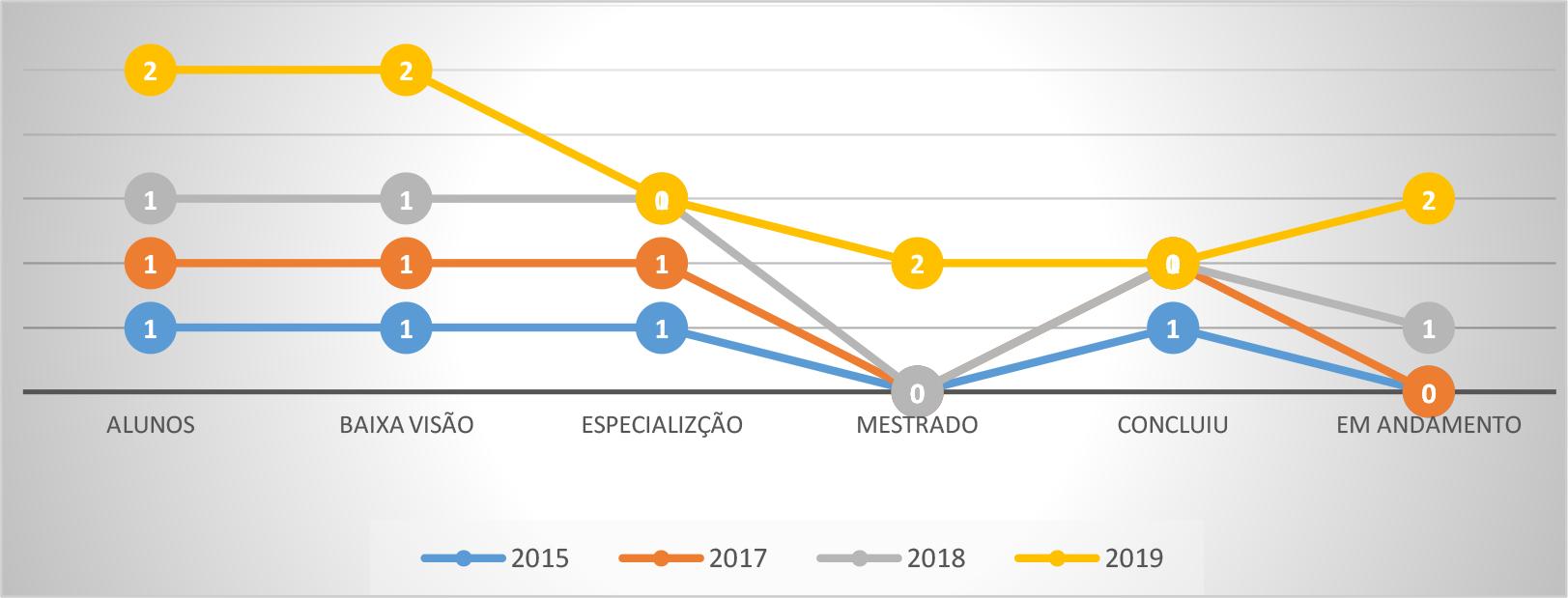
This subsection draws attention to the small number of students with visual deficiency who attend graduate courses, the largest number being at the specialization level, with a smaller number at the master's level and none so far, at the doctorate level.
Post-graduation courses are much more restricted to all students. However, if in the researched period, UFAC received around 1,000 students, if the 5% minimum vacancy reserve (FC 1988) is respected, destined to people with disabilities, there should be 50 vacancies filled by them. If the current average of scholars with disabilities enrolled in the institution in question is 500, according to the ISN coordination, going back to the data in table 01 which brings 199 with visual impairment, it theoretically means about 40% of the total.
We notice that only 05 students with visual deficiency got access, we call the attention that all of them have low vision. Even though they represent the majority in the scope of visual impairment, according to IBGE (2010), there are 6.5 million people with visual impairment, being 528,624 (blind) and 6,056,654 with low vision. It is noticeable that for those people with blindness, access is even more difficult. It is worth pointing out that the announcements of these courses cover candidates who have graduated from both the public and private education system.
Once again, we resort to Borges et al. (2013), which highlights the urgency of reflections on inclusion, as it is essential to provide equal conditions to those who, for some reason, are historically disadvantaged by lack of effective inclusive educational policies, putting them into practice is much more than offering vacancies in public notices to legally justify that it is fulfilling its legal role. When, what needs to be reviewed is the way candidates are selected. When it comes to selection, we are not suggesting here that it should be made easier for students with disabilities; on the contrary, these people do not seek this. What we suggest is that, if there are vacancies available, they should be filled by those who are entitled to them. In case there are no candidates with disabilities enrolled, the wide-open competition candidates could fill the vacancies. It is up to the institutions to deliberate on effective actions aimed at reducing barriers to ensure an emancipatory education for all.
During the analysis of the academics with visual impairment, it was identified that only from 2015 on, the entry of these students into graduate programs began. UFAC started offering these courses in 1996 and, currently, there are about 20 courses, including specialization, master’s, and doctoral degrees. It has about 1,000 students enrolled (PORTAL UFAC, 2020) of these, only five people with visual deficiency had access to these courses between 2015 and 2019, an average of one student with visual deficiency per year. This is an extremely low rate.
Such data reflects in practice what Ferrari (2007) states when he points out that Universities must take a position and elect resources, methods and techniques that contemplate all the scholars, making the curricula accessible and able to give effective conditions to students with disabilities regarding the admission, permanence, and completion of their courses. There are still no effective inclusive actions in this sense, because graduate education follows an elitist and meritocratic selective pattern, reducing the chances of people with disabilities to get in.
Given the current social and educational reality, it is necessary to rethink real policies capable of breaking with this archaic paradigm, since it is in the academy that reflection, critical thinking, and science are developed, where social relations and interactions must occur dialectically and contribute to overcoming difficulties.
6. Inclusion of VD students in IFAC /CRB
With the same purposes in analyzing the reality of VD students, we also consider the inclusive scenario of students with visual deficiency at the Federal Institute of Acre. For a better understanding, let's see a brief outline of the IFAC Rio Branco Campus.
The Federal Institute of Education, Science and Technology of Acre (IFAC) is an institution of higher and technical education, based in the capital city of Rio Branco. It started its activities in 2010 and offers several courses from high school integrated with technical courses, technical courses, higher education courses and graduate studies. In addition, it has four campuses distributed in the interior of the state.
It also has the Support Center for People with Specific Educational Needs (NAPNE), established by resolution number 23/2011, with the purpose of acting on various fronts within the inclusion (PORTAL IFAC, 2020).
Despite being a new institution, completing 10 years in 2020, it already presents rich contributions to the state of Acre. Forming technical professionals and teachers in an integrative perspective, aiming to break with the mercantilist educational model and propose that each subject become aware of their social role with themselves and with others. So that they can recognize themselves in the context in which they live as subjects of rights and can enjoy these rights in practice, thus being able to exercise the citizenship process in its entirety. (MOLL, 2018).
On the other hand, we realize that the reformulation of teaching rooted in concepts and prejudices is not an easy task, demanding changes in paradigms: political, cultural, economic, pedagogical, and social. Even acknowledging the difficulties in the effectiveness of an Omni lateral Education, several studies Moll (2018); Frigotto (2017); Ciavatta (2018), believe that this educational format is possible.
Regarding the inclusion process, this institute has been gradually advancing, but there are still many barriers to be eliminated. Mainly attitudinal, communicational, pedagogical, and technological. One of the main advances is the selection format for the professional master's degree, as it does not require eliminatory scores, thus giving people with disabilities the opportunity to compete against each other, and, in fact, allocating the vacancies reserved for that public.
It is worth pointing out that the selection format for the admission in the other courses does not follow the master's degree in professional and technological education. This is one of the reasons for the low adhesion of visually impaired students. UFAC uses the Enem/SISU scores to select its candidates and, according to the data surveyed, it is inferred that this was also one of the factors that has contributed to the growing number of enrollments in recent years.
The following chart shows the number of visually impaired students in the IFAC CRB.
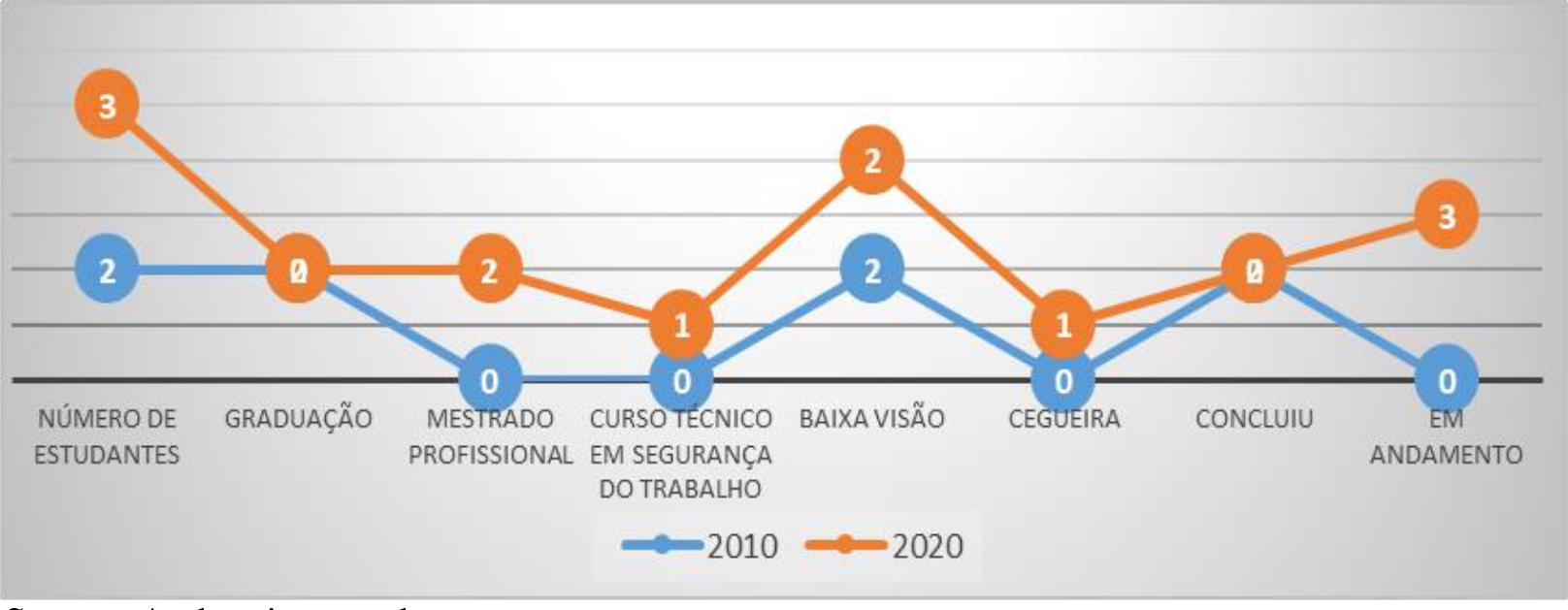
During the 10 years of IFAC/CRB/Xavier Maia, it was found that only five VD students entered the institution, two at the undergraduate level, one in the subsequent technical course in occupational safety and two in the professional master's degree according to the results shown. A positive factor is that there are no VD dropouts and that the two people who entered undergraduate studies have already completed their respective courses.
Note that in the period of ten years only five VD, had access to the courses offered by IFAC/CRB/Xavier Maia, such result converges with the reality described regarding the picture of inclusion of students with visual deficiency in Brazil, the higher the level of education, the less accessible to PcD/Low Vision and even less to those with Blindness.
I, one of the researchers, use the specialized educational service offered by NAPNE/IFAC and count on digital textual adaptations, mediation in the realization of the master's activities. There is already a minimal structure regarding the physical resources of accessibility, but there is a lack of planning, specialized professionals, an institutionalized inclusion policy, an assistive technology (AT) laboratory and a training plan for PcD students to use AT, moreover, it would be interesting to have a living environment where PcD students can interact with each other and propose activities that involve in this environment, students with and without disabilities in order to reduce prejudice and eliminate several educational barriers. Although the classroom is one of these spaces, if there is not a continuous work of inclusion of these students, it ends up being more of integration than inclusion.
In the continuity of the theme of inclusion in federal institutions of technological and higher education, it is relevant to reflect on the number of enrollments of students with disabilities in Brazil and in the city where the research was conducted.
In the paradox of the current societies between the right to higher education and the continuous excluding practices of students with disabilities, it is possible to say that their access to higher education in Brazil presents an evolution in the number of enrollments, from 20,530 in 2009 to 38,272 in 2017. However, the reflection of the movement of this access to the higher level is still very shy, making up a total of only 0.35% of students enrolled in public and private institutions (NEVES; MARCIEL; OLIVEIRA, 2019).
Let us register elements that influence the inclusion process within federal institutions: inclusive education is a recent reality in higher education, moreover, it involves political, cultural, historical economic and social aspects. And even having the right to education does not mean that people with disabilities will have access to this right as they should. Changing this scenario demands a reformulation in the practices and policies within the scope of inclusion. As FERRARI and SEKKEL, 2007, state.
These educational spaces have been undergoing gradual transformations regarding inclusive policies and actions aimed at the entrance, permanence, and conclusion of this public in their respective courses. It was also identified that these policies are still much less effective at the post-graduation level, since the number of enrollments in the researched institutions is still exceptionally low.
To demonstrate the low adherence of people with visual deficiency in higher levels of education, we present the number of these people in the city of Rio Branco/Acre. According to (IBGE, 2010) the population that fits in this group is 5,242 people. Therefore, the data expressed in this paper legitimize the objectives pointed out with the bias of discussing the inclusion in public federal institutions in Rio Branco/AC, as well as presenting an overview about the inclusive educational reality of people with visual deficiency in these multicultural spaces.
Considering the total number of VD people who entered the two federal institutions surveyed considering two decades, the lack of effectiveness of the inclusion policies in the academic field is still notorious.
Nevertheless, many of these students take upon themselves the responsibility for their schooling. In large classes, the didactic-pedagogical support is ineffective. The accessibility centers are also unable to establish effective relationships with educators, management, or the students with disabilities themselves, thus compromising the recognition of differences and respect for diversity
These centers must discuss the inclusive actions with the students with disabilities and stimulate the sense of empathy in those who deal directly with this public, starting with the very professionals who work with the purpose of providing adaptive conditions to enable accessible curricula.
It is important to highlight that the inclusion policies are the result of struggles for the rights of people with disabilities, culminating in historical and legal milestones such as: the Salamanca Declaration, which fostered changes in the Special Education guidelines in order to value human uniqueness; the United Nations Convention (UN, 2006) on the rights of people with disabilities; law 10. 098 / 2000, which deals with accessibility (BRASIL, 2000); the FC/88 (BRASIL, 1988) the National Policy for Special Education and the law 13146 (BRASIL, 2015).
Finally, considering Camargo (2017), the main axes of society: education, health, work, safety, and housing need joint action, in an inclusive perspective so that people with disabilities can have their rights guaranteed. Without integration of these fronts, essential in the exercise of citizenship, and if the inclusive process occurs, even if slowly, only in educational environments, we will hardly have an inclusive society, not enabling and free of prejudice.
6 Final considerations
The present writing has as its theme the inclusion of students with visual impairment, during the research and investigated the number of students with visual deficiency in federal educational institutions in the city of Rio Branco /AC, the effects of the inclusion process of VD students, contextualize the numerical data to the inclusive reality adopted in these spaces as the entry, permanence and completion of the respective courses and the narrative of one of the authors who is a person with visual deficiency and had as researched universe the Federal University of Acre and the Federal Institute of Acre. At UFAC in the period from 1999 to 2019 and at IFAC from 2010 to 2020.
According to the objectives proposed in this research we obtained significant results, since the methodology and procedures adopted were: the quali-quantitative approach, empirical and theoretical data, the case study method and content analysis, allowed a practical analysis about the reality of the inclusion of students with visual deficiency at the Rio Branco Campus of the Universidade Federal do Acre and at the Rio Branco/Xavier Maia Campus of the Instituto Federal do Acre.
Therefore, it was possible to answer the following questions raised in the beginning of the research: how many students with visual deficiency entered? How many concluded their respective courses? How many are still studying? What is the number of dropouts? What are the effects of the inclusion process of students (VD) at Universidade Federal do Acre from 1999 to 2019 and at Instituto Federal do Acre (since its creation) from 2010 to 2020, in a contextualized way before the reality experienced by students with visual impairment.
With this study, we realized that the access of the target audience investigated has increased significantly, however, the permanence and completion of their studies are still obstacles that require an institutionalized look focused on human uniqueness, since two hundred and four students (204) who entered, seventy-eight (78) did not continue in their respective courses, without considering those who are still in progress, eighty-eight (88), because there is no guarantee that all will finish. It is noteworthy that in the two stage institutions of the research, only thirty-eight (38) completed their respective courses.
In short, it was identified that inclusive educational policies still need reflections on knowledge and pedagogical practices, changes in institutional attitudes towards the inclusive process in order to eliminate educational barriers, prejudice and empowerment, as well as the need to value the rights of people with disabilities and respect for differences aiming curriculum accessibility to form reflective, critical, and autonomous people able to exercise their citizenship on equal terms with others.
REFERENCES
BRASIL. Lei n. 9.394, de 20 de dezembro de 1996. Estabelece as diretrizes e bases da educação nacional. Presidência da república. Secretária-geral. Subchefia para assuntos jurídicos. Brasília, 20 de dezembro de 1996. [ Links ]
BRASIL. Lei n. 10.098, de 19 de dezembro de 2000. Estabelece normas gerais e critérios básicos para a promoção da acessibilidade das pessoas portadoras de deficiência ou com mobilidade reduzida, e dá outra providência. Presidência da república. Secretária-geral. Subchefia para assuntos jurídicos. Brasília, 19 de dezembro de 2000. [ Links ]
BRASIL. Decreto nº 5.296, de 2 de dezembro de 2004. Regulamenta as Leis n. 10.048, de 8 de novembro de 2000, que dá prioridade de atendimento às pessoas que especifica, e 10.098, de 19 de dezembro de 2000, que estabelece normas gerais e critérios básicos para a promoção da acessibilidade das pessoas portadoras de deficiência ou com mobilidade reduzida, e dá outras providências. Diário Oficial da União, Brasília, DF, 13 dez. 2004. Disponível em: http://www.planalto.gov.br/ccivil_03/_ato2004-2006/2004/decreto/d5296.htm [ Links ]
BRASIL. Política Nacional de Educação Especial na Perspectiva da Educação Inclusiva. Brasília, janeiro de 2008. [ Links ]
BRASIL. Decreto n. 7.611, de 17 de novembro de 2011. Dispõe sobre a educação especial, o atendimento educacional especializado e dá outras providências. Presidência da república. Secretária-geral. Subchefia para assuntos jurídicos. Brasília, 17 de novembro de 2011. [ Links ]
BRASIL. Lei n. 13.146, de 6 de junho de 2015. Institui a Lei Brasileira de Inclusão da Pessoa com Deficiência (Estatuto da Pessoa com Deficiência). Presidência da república. Secretária-geral. Subchefia para assuntos jurídicos. Brasília, 6 de julho de 2015. [ Links ]
BRASIL. Constituição da República Federativa do Brasil: texto constitucional promulgado em 5 de outubro de 1988, com as alterações determinadas pelas Emendas Constitucionais de Revisão nos 1 a 6/94, pelas Emendas Constitucionais nos 1/92 a 91/2016 e pelo Decreto Legislativo no 186/2008. Brasília: Senado Federal, Coordenação de Edições Técnicas, 2016. [ Links ]
BRASIL. Lei n. 13.409, de 28 de dezembro de 2016. Altera a lei n. 12.711, de 29 de agosto de 2012, para dispor sobre a reserva de vagas para pessoas com deficiência nos cursos técnicos de nível médio e superior das instituições federais de ensino. Presidência da república. Secretária-geral. Subchefia para assuntos jurídicos. Brasília, 6 de julho de 2015; 194° da Independência e 147° da República. Brasília, 28 de dezembro de 2016. [ Links ]
BORGES, Adriana Costa; OLIVEIRA, Elaine. Cristina; PEREIRA, Ernesto. Flávio; OLIVEIRA, Márcio Divino. Reflexões Sobre a Inclusão, a Diversidade, o Currículo e a Formação de Professores. 2013. In Anais Eletrônicos do Congresso Acadêmico Científico da UEG de Porangatu. Acesso em: 20 de nov. 2021. [ Links ]
CAMARGO, Eder Pires. Inclusão social, educação inclusiva e educação especial: enlaces e desenlaces. Revista Ciência e Educação, v. 23, n. 1. Bauru: UNESP, 2017. [ Links ]
CIAVATTA, Maria. A reforma do ensino médio: uma leitura crítica da Lei 13.415/2017 - adaptação ou resistência. HOLOS, Natal, v. 4, n. 34, p. 207-222, jul. 2018. [ Links ]
DECLARAÇÃO DE SALAMANCA: Sobre Princípios, Políticas e Práticas na Área das Necessidades Educativas Especiais, 1994. [ Links ]
FRIGOTTO, Gaudencio. Dermeval Saviani e a centralidade ontológica do trabalho na formação do ‘homem novo”, artífice da sociedade socialista. Interface (Botucatu) [online]. 2017, vol.21, n.62, pp.509-519. Epub 25-maio-2017. ISSN 1807-5762. Disponível em: http://dx.doi.org/10.1590/1807-57622016.0967. Acesso em 15 de nov. de 2021. [ Links ]
GIL, Antonio, Carlos. Métodos e técnicas de pesquisa social.6. ed. - São Paulo: Atlas, 2008. [ Links ]
IBGE - INSTITUTO BRASILEIRO DE GEOGRAFIA E ESTATÍSTICA. Dados sobre pessoas com deficiências. Rio de Janeiro: IBGE, 2010. Disponível em: https://censo2010.ibge.gov.br/. Acesso em: 19 de nov. 2021. [ Links ]
INSTITUTO FEDERAL DE EDUCAÇÃO, CIÊNCIA E TECNOLOGIA. Resolução 23/2011. Institui, no âmbito do IFAC, o Núcleo de Atendimento as Pessoas com Necessidades Específicas - NAPNE e Aprova o seu Regulamento. Disponível em: <http://www.ifac.edu.br/index.php?option=com_docman&task=doc_details&gid=164&Itemid=120>. Acesso em 12 de novembro de 2021. [ Links ]
KERBAUY, Maria Teresa Miceli; SOUZA, Kellcia Rezende Souza. Abordagem quantiqualitativa: superação da dicotomia quantitativa-qualitativa na pesquisa em educação. Educação e Filosofia, Uberlândia, v. 31, n. 61, p. 21-44, jan./abr. 2017. [ Links ]
MANTOAN, Maria Tereza Egler. O desafio das diferenças nas escolas. P. 29. Inclusão escolar: caminhos, descaminhos, desafios, perspectivas. Rio de Janeiro, 2008. [ Links ]
MENDES, Enicéia Gonçalves. A radicalização do debate sobre inclusão escolar no Brasil. Artigo. Universidade Federal de São Carlos, Programa de Pós-Graduação em Educação Especial. 2006. [ Links ]
MOLL, Jaqueline. Educação integral uma nova forma de viver a vida. Centro de referência em educação integral. Publicado dia 28/11/2018. Disponível em: https://educacaointegral.org.br/reportagens/jaqueline-moll-educacao-integral-e-uma-novaforma-de-viver-a-vida/. Acesso em: 18 de nov. de 2021 [ Links ]
NEVES, Joana d’Arc. MACIEL, Rogerio. OLIVEIRA, Marcos Vinicius. Representações de práticas inclusivas: da realidade vivida aos caminhos da inclusão no ensino superior na Amazônia paraense. Rev. bras. Estud. pedagog., Brasília, v. 100, n. 255, p. 443-463, maio/ago. http://dx.doi.org/10.24109/2176-6681.rbep.100i255.3861. Disponível em: https://www.scielo.br/pdf/rbeped/v100n255/2176-6681-rbeped-100-255-443.pdf. Acesso em: 13 nov. 2020. [ Links ]
ORGANIZAÇÃO DAS NAÇÕES UNIDAS (ONU). Declaração dos direitos das pessoas deficientes. Disponível em: <http://portal.mec.gov.br/seesp/arquivos/pdf/dec_def.pdf>. Acesso em: 20 set. 2020. [ Links ]
SILVA, Andressa Henning; FOSSÁ, Maria Ivete. Trevisan Análise de conteúdo: Exemplo de aplicação da técnica para análise de dados qualitativos. Qualit@s Revista Eletrônica ISSN 1677 4280 Vol. 17. No 1. 2015. Acesso em: 13 nov. 2020. [ Links ]
UNIVERSIDADE FEDERAL DO ACRE. Conselho Universitário. Resolução n. 10, de 18 de setembro de 2008. Homologar a Resolução nº 14, de 30 de abril de 2008, da Reitoria, que criou, ad referendum do Conselho Universitário, o Núcleo de Apoio à Inclusão - NAI-UFAC, vinculado à Pró-Reitoria de Extensão e Cultura, cujas atribuições e competências serão estabelecidas no Regimento Geral da UFAC. 2018. Disponível em: http://www2.ufac.br/site/ocs/conselho-universitario/resolucoes/resolucoes-de-2008/resolucaono-10-de-18-de-setembro-de-2008. Acesso em 12 de novembro em 2021. [ Links ]
YIN, Robert K. Estudo de caso: planejamento e métodos / Robert K. Yin; trad. Daniel Grassi - 2.ed. -Porto Alegre: Bookman, 2001. [ Links ]
Availability of data and material: Not applicable.
Ethical approval: No conflicts of interest among authors.
Funding: Not applicable.
Acknowledgments:
Not applicable.
Received: January 12, 2021; Accepted: March 25, 2022; Published: October 30, 2022
 Este é um artigo publicado em acesso aberto sob uma licença Creative Commons.
