




Serviços Personalizados
Journal

Artigo
 texto em
  Inglês (pdf)
 Artigo em XML
 Tradução automática
 Enviar este artigo por email
Compartilhar

 Permalink
Educação Matemática Debate
versão On-line ISSN 2526-6136
Ed. Mat. Deb. vol.9 no.18 Montes Claros 2025
https://doi.org/10.46551/emd.v9n18a02
ARTICLE
Gender, sexuality and Mathematics in the curriculum

4Federal University of Mato Grosso do Sul. Campo Grande, MS — Brasil
5Texas Tech University. Lubbock, Texas — Estados Unidos
6Goiano Federal Institute. Urutaí, GO — Brasil
This research seeks to discuss issues of gender, sexuality, and school Mathematics curriculum, developing some relationships and connections, especially by moving away from the idea of curriculum as a normative document that organizes the educational space. In addition, curriculum is considered a discursive practice and a cultural artifact. The same logic applies to Mathematics, which, far from being a neutral and apolitical science, is a human production permeated by subjectivities and social issues. In this sense, situations such as how Mathematics textbooks address gender and sexuality issues, or how Mathematics teaching can or should be used to promote social justice involving queer subjects, are some of the topics covered in this article.
Keywords Mathematics Curriculum; Gender; Social Justice; Queer; Textbook
A presente pesquisa busca discutir questões de gênero, sexualidade e currículo de Matemática escolar, desenvolvendo algumas relações e conexões, principalmente ao se afastar a ideia de currículo como documento normativo que organiza o espaço educacional. Além disso, considera-se o currículo como uma prática discursiva e um artefato cultural. A mesma lógica se aplica à Matemática, que, longe de ser uma ciência neutra e apolítica, é uma produção humana atravessada por subjetividades e questões sociais. Nesse sentido, situações sobre como o livro didático de Matemática trabalha questões de gênero e sexualidade, ou como o ensino de Matemática pode ou deve ser utilizado para promover justiça social, envolvendo sujeitos queer, são alguns dos temas abordados neste artigo.
Palavras-chave Currículo de Matemática; Gênero; Justiça Social; Queer; Livro Didático
Esta investigación busca discutir cuestiones de género, sexualidad y currículo de Matemáticas escolares, desarrollando algunas relaciones y conexiones, especialmente al alejarse de la idea del currículo como un documento normativo que organiza el espacio educativo. Además, se considera el currículo como una práctica discursiva y un artefacto cultural. La misma lógica se aplica a las Matemáticas, que es una producción humana atravesada por subjetividades y cuestiones sociales. En este sentido, temas como cómo los libros de texto de Matemáticas abordan cuestiones de género y sexualidad, o cómo la enseñanza de las Matemáticas puede o debe ser utilizada para promover la justicia social, especialmente en relación con sujetos queer, son algunos de los temas abordados en este artículo.
Palabras clave Currículo de Matemáticas; Género; Justicia Social; Queer; Libro Escolar
1 Starting the conversation
Discussing gender, sexuality, and school curriculum is nothing new in the field of Mathematics Education, given the range of work and research on this topic in Brazil and abroad — we cite, for example, the work developed by the MatematiQueer research group at the Federal University of Rio de Janeiro. There are even arguments that suggest that this subject has already been exhausted, as well as criticism that Mathematics is not the place for this type of discussion, as it is a hard, neutral science based on abstract structures.
Firstly, gender and sexuality, as cultural artifacts, change over time, depending on the social and geographical context. It is an issue that is never exhausted, as it is always in flux. Mathematics, in turn, is a human production and, as such, is imbued with the subjectivities of the individuals who construct it, including the influences of their social positions. Therefore, it is not isolated from social, political, economic, and cultural issues.
In the school context, Mathematics is operated through the curriculum, a document that organizes the educational environment and its pedagogical practices. And, like Mathematics, the curriculum is also a human production, that is, in addition to establishing school norms, it is a cultural artifact and a discursive practice. Its development involves political and ideological disputes, although in common sense, “the curriculum would be limited to a document formally established by educational institutions and policies” (Monteiro, 2018, p. 91).
Thus, it becomes clear how important it is to understand how gender, sexuality, and school Mathematics curriculum are interconnected, especially with regard to the role of the curriculum in producing certain types of subjects. Furthermore, this relationship provides grounds for questioning the current curriculum and, consequently, seeking change.
The first part of the paper explores, in a discursive manner, how the school Mathematics curriculum acts to produce specific types of subjects, since the processes of teaching and learning Mathematics carry values and moralities that discipline and produce subjectivities in students, including with regard to citizenship. It discusses how the curriculum (re)produces a gendered system of reasoning, demonstrating, based on various studies and an example taken from the first author’s doctoral dissertation, that Mathematics textbooks, understood as part of the curriculum, delimit gender relations in the binary logic that shapes/separates/classifies individuals as men and women, while exploring mathematical content. In addition, the supposed fact that girls do not like Mathematics is also problematized.
The second part of the paper consists of a narrative written by the second author, containing excerpts from his doctoral dissertation and some work developed during his master’s degree. In the second part, the author also discusses how Mathematics textbooks in Brazil and abroad produce subjectivities that fix gender/sexuality positions when working with mathematical content. From a queer perspective — a theoretical approach that considers all sex/gender performativities that deviate from cisheteronormativity — the author discusses the teaching of Mathematics for social justice. From this perspective, queer students, when studying Mathematics, not only learn a fundamental discipline for their education and civic life, but also develop a critical awareness of the injustices they face because of who they are. Based on this awareness, they become capable of combating these injustices, contributing to the construction of a more egalitarian educational environment and society.
2 Mathematics curriculum and the (re)production of a generic reasoning system
The starting point is the assumption that school Mathematics is articulated together with, and through, moralities and values, promoting subjectivities grounded in the curriculum that embodies and recombines, through a kind of alchemy (Popkewitz, 2004), knowledge with political and cultural practices. The curriculum itself is a cultural practice that produces specific types of subjects at a given time and ensures integration through the participation of individuals, aiming to “ensure citizenship by organizing a kind of program, ordered by the curriculum, that prepares for the exercise of rights and duties” (Kroef, 2001, p. 110). In other words, school curriculum, including Mathematics, respond to the demands of their time, promoting specific subjectivities that shape possible ways of life.
Mathematics, also fulfilling its subjectivizing functions, has been approached as one of the main tools for the development of the school curriculum today, as well as one of the fundamental knowledge areas for the maintenance of contemporary ways of life (Valero, 2017, 2018). For this reason, it is one of the curriculum components for which there are high expectations for graduates of formal education in various parts of the world.
In the Western world, especially after World War II, mathematics and science have been gaining ground in basic school curriculum and are treated as essential subjects for the development of nations and overcoming the social ills that affect organized society.
In this way, Mathematics curriculum establish a close relationship with the constitution of a supposed global citizenship. The notion that “people need mathematics in their daily lives to participate as actively engaged citizens” (Pais, 2017, p. 1) is current and increasingly sophisticated, robust, and uncontroversial. As already mentioned, the amalgamated connection between citizenship and school Mathematics curriculum has been strengthening since the end of World War II; however, there is evidence that this movement predates that war (Ziols and Kirchgasler, 2021; Yolcu, 2017). Therefore, as an irrevocable part of the compulsory school curriculum, Mathematics articulates practices and ways of being and acting in the world (Tröhler, 2016; Popkewitz, 2004).
In this context, school Mathematics curriculum are not limited to the teaching and learning processes of their content, nor are they restricted to neutral, aseptic routines that are disconnected from the ethical, political, cultural, and social issues present in their exercises, content, pedagogical practices, and activities. Furthermore, they reflect how pedagogical processes, training, and routines have effects on both the objectification of knowledge and the subjectification of the individual. There are even indications that these curriculum and Mathematics itself, since their inception, favor certain groups in society and serve as instruments for specific understandings of the world that cater to equally specific modes of social organization, especially in the Western context (Kollosche, 2014).
The way in which these curriculum intersect with gender issues is at the heart of the discussions to be addressed in this paper. In Paraíso (2016), the teaching and learning functions of a curriculum are problematized from a gender perspective. The author argues that a gendered reasoning system can be identified in schools, producing specific curriculum. Furthermore, she points out that overcoming the inscription of possible ways of life to gender-determined instances and functions must be the path to the construction of new learning, new teaching, and new possibilities of existence.
It is a fact that one learns to live gender in social relations and, as will be demonstrated, also in Mathematics curriculum. However, although there is a generalized conception of what it means to be a man or a woman in contemporary and increasingly globalized society, these categories are by no means static or universal. In the Western world, sex and gender are often treated as synonyms, contrary to much research in the field of gender studies.
However, being a woman or a man is not limited to performing these roles, but also occupying a specific place in society. From a biological perspective, which supports the organizing rationality of Western society, this place is determined according to the reproductive capacity of the body, a concept defined by recognition technologies established through practices such as the chá revelação (gender reveal parties)1.
However, it seems to make more sense to assume that gender is constructed through regulatory practices (Butler, 1990). This implies understanding that the Mathematics curriculum, as cultural policy, produces subjectivities that constitute, as mentioned earlier, ways of being, existing, and acting in the world — after all, every space is formative.
It is important to highlight that research addressing Mathematics Education as cultural policy understands the school Mathematics curriculum as going beyond the processes of teaching and learning its content. The curriculum is understood as a set of practices embedded in a logic that produces subjectivities: “Mathematics Education is political because the historical constitution of knowledge and associated practices emerged and are part of the classifications and organizations that regulate social life and, within them, notions of who people are and should be” (Valero, 2018, p. 108).
It should be noted, however, that it is not assumed that the Mathematics curriculum — even though it is compulsory for all school-age children in Brazil — acts compulsively in the production of subjectivities. The fundamental issue is that the set of discursive and non-discursive practices sustains, elects, and organizes narratives that describe desired ways of life for certain times and spaces, allowing individuals to objectify themselves, compare themselves, measure themselves, see themselves, mirror themselves, adapt themselves, and subjectify themselves.
These curriculum are therefore understood as part of the list of requirements that ensure the [re]positioning of “subjects as citizens so that they can be governed” (Gallo, 2017, p. 77). Endowed with an appeal strongly linked to current aspirations for social and economic development, these curriculum “transform children into valuable or loyal citizens within the cultural value system of their respective nation-states” (Tröhler, 2016, p. 282) while producing processes of exclusion in order to position those who are not valuable, adequate — the abject.
This statement may sound disturbing; after all, it would be more reassuring to think of school knowledge acting for human and social development (Popkewitz, 2018). However, like alchemy, “school curriculum (including Mathematics) have historically been configured as a set of procedures for the constitution of a type of person” (Popkewitz, 2018, p. 78). In fact, students who are inserted in and confined to the school environment undergo a type of assimilation into the social group: “insidiously, they received the values of that society. They received socially desirable models of behavior, forms of ambition, elements of political behavior, so that this ritual of exclusion ends up taking the form of inclusion” (Foucault, 2015, p. 14). This occurs both in compulsory school education and at university, as Foucault discusses in the text from which this excerpt was taken.
From this point on, we will illustrate the ways in which these curriculum produce and naturalize practices derived from a gendered system of reasoning. The field of Mathematics Education research has been addressing gender issues for some time. In Leder (2019), it is possible to find a historical overview of how this issue has been addressed since the 1970s in the international arena by the academic community in this field. The factor that drew attention to the topic was the attempt to understand the low participation of women in the production of mathematical knowledge, an issue that had repercussions on the differences between school expectations for boys and girls.
Starting in the 1970s, Mathematics Education began to address the issue as a matter that required attention both in practice and in research in the field. During this period, the use of the term gender differences indicated that this issue was initially formulated as a biological problem, as it was assumed that the essence of male and female behavior was based on the biological configurations of human beings. This approach was in line with a Western interpretation of the issue, as the arguments supported differences in performance, aptitude, affinity, and interests based on the assumption of a natural predisposition of bodies.
With the advent of the 1980s, the use of the term gender marked a shift from the biological to the cultural field. During this period, it was assumed that there was a difference in the way male and female bodies related to Mathematics curriculum. Research pointed out that differences between the sexes were generated and reproduced as part of social, cultural, and economic dynamics. One of the results of the survey conducted by the author indicated that problems with math results, which favored male bodies, were almost nonexistent at the beginning of elementary school, becoming more evident in high school and becoming more pronounced as the levels of study advanced in certain areas of mathematical activity2. However, it seemed that the difference observed in the 1970s had almost disappeared and, at least in some so-called developed countries, this trend had even been reversed, favoring female bodies.
In the same decade, there was growing interest in gender research. The results of this research showed a connection between the differences in results between male and female bodies and the way in which school culture and Mathematics learning make assumptions about the ability, status, and possibilities attributed to different bodies. In other words, the different expectations placed on boys and girls had direct repercussions on their performance and engagement with this area of knowledge. In this sense, the male/female binary and its cultural/social/economic value and significance were considered the essence of differences in school results in Mathematics.
Leder (2019) further states that the adoption of different theoretical perspectives on gender and the existence of more detailed quantitative information on differences in results between types of students have diversified research and interventions in practice. The researcher identified several areas of attention, such as monitoring differences in school results and patterns of participation of male/female bodies in science, technology, and Mathematics at an advanced level. This last concern is related to the question of which bodies participate in the science and technology labor market, as they are considered a waste of human capital.
This point is supported by the ubiquitous movement for gender equality and the promotion of universal access to and engagement with knowledge related to science, technology, engineering, and Mathematics (STEM), which are considered an inescapable demand for the future of humanity (Unesco, 2015; 2019; Neto, 2024).
The review of international literature presented by Leder (2019) allows us to identify the change in notions of gender: gender as a biological characteristic of the sexes, as a cultural attribute of bodies in the male/female binary, and, more recently, as an attribute of bodies in an economic/productive order.
Currently, therefore, the issue of gender is being addressed in the field of Mathematics Education as a challenge to be faced and overcome for the inclusion of girls and women in the game of assimilation, application, and production of mathematical knowledge. However, the ways in which Mathematics curriculum have addressed gender issues in the 21st century still seem problematic from the perspective of reproducing gender stereotypes.
For example, Neto and Guida (2020), in considering Mathematics textbooks as part of the school curriculum and as producers of practices of subjectivity that discipline bodies, analyzed the gender stereotypes that impose on female bodies attributes such as caring for others, employment in socially and economically undervalued activities, among other attributes commonly associated with femininity. The authors mainly used images from textbooks illustrating various mathematical activities to produce the results presented in the paper. These image excerpts were also understood as rich material with potential for the production of narratives. The images were interpreted as synthesizing elements of concepts, ideas, practices and, therefore, addresses that could only acquire meaning and validation in a material with such academic and political strength as the textbook (Amorim, 2016).
Thus, the illustrations were interpreted as producing meanings that could not or would not achieve the dimension of a text, for example. A result can be seen in the image in Figure 1.
Note that there are two adult men around the bonfire: one of them is entertaining attendees of the June festival with the sound of an accordion, while the other is enjoying what appears to be a hot dog. Both are casually positioned in a scene that suggests the characteristic movement of these festivities. The second individual is positioned precisely next to a child who is doing the same things: eating and observing the picturesque celebration.
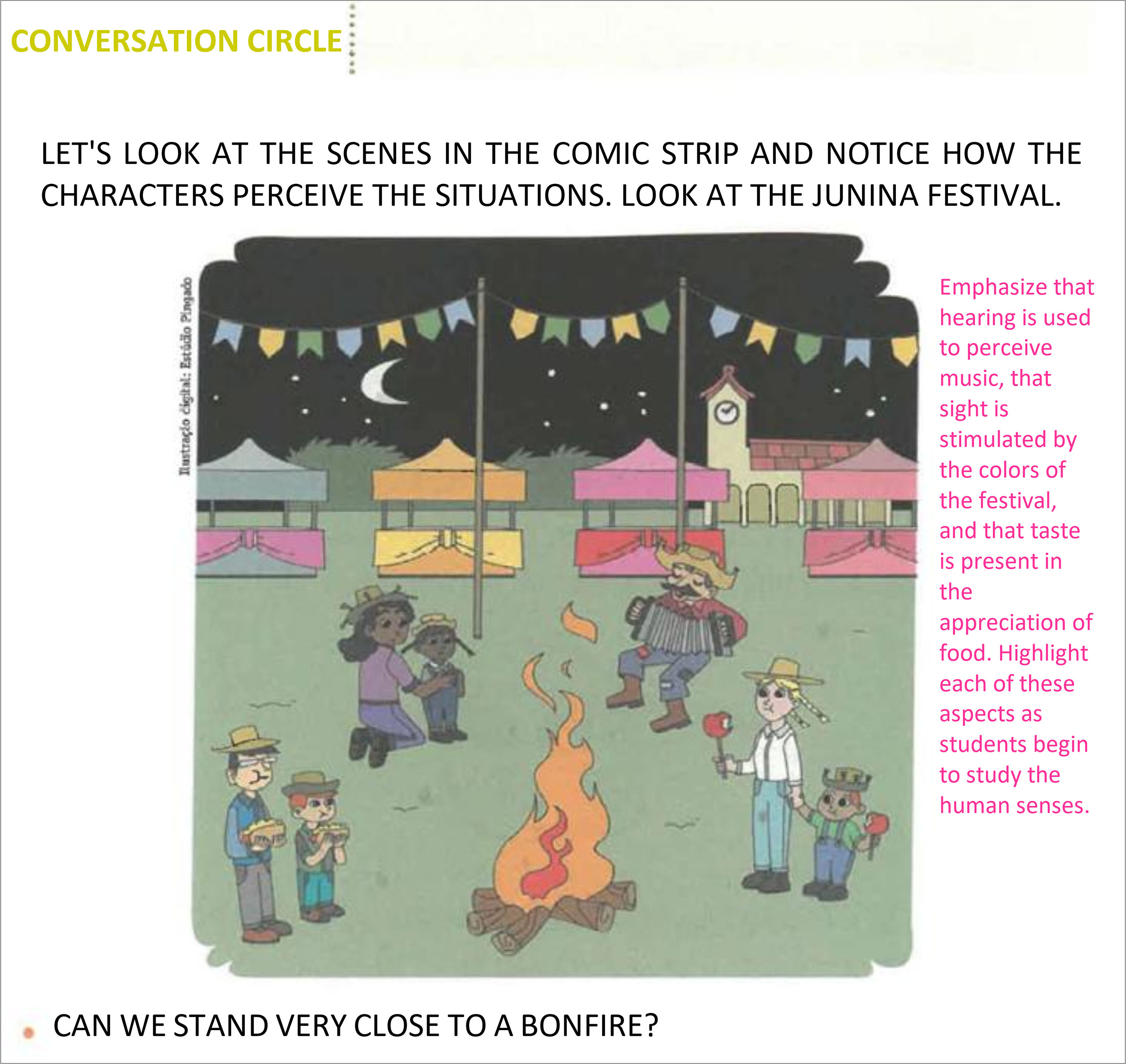
With markedly opposite behavior, the female characters appear to be more attentive, even concerned. Although one of them seems to enjoy the bonfire, she ensures that the child accompanying her remains by her side, holding her hands tightly. The other positions herself to protect the child next to her from the dangers posed by the bonfire. The second woman, in fact, does not even seem to be enjoying the festivities, as she is busy taking care of the child in her charge.
It seems that the female characters need to be constantly alert, managing and anticipating possible childhood outbursts. In addition, they need to have a keen sense of spatial location, as they must be able to assess and predict dangerous situations that may affect the children in their care. The diametrically opposite arrangement of the individuals suggests that men are given the opportunity to enjoy the festivities in a peaceful and carefree manner.
Thus, in addition to describing the attributes of the female and male bodies and the behavioral expectations associated with them, the activity requires a spatial understanding necessary for the exercise of being a woman.
In another study, Neto, Borges, and Alves (2021) analyze the perceptions and expectations of elementary school students regarding the relationship between the Mathematics they know and gender issues. Two findings emerged from this study. In the first, students report that they are unaware of women’s contribution to the production of mathematical knowledge. They regret that this is not a topic covered in their math classes and claim that women are not present in textbooks, in classes in general, or among the main figures who personify some element of this field. This erasure is perceived by students and provokes a discussion: why are they not present? After all, several examples are brought up to invalidate the idea that these people have not contributed.
The second finding that emerges from the discussions is the maxim, strongly rejected by the students in the group, that girls/women do not like Mathematics. This stereotype, which resonates in various instances of everyday life and also in Mathematics curriculum, was discussed by the group, which questioned its motivations and interests, as well as its repercussions in reality. This statement endorses Leder’s findings on Mathematics Education research in the 1970s, proving that some of these stereotypes have not yet been overcome and continue to mark people’s existence, defining their place in the world according to the reproductive functions of their bodies, as already mentioned.
Therefore, gender issues, as the curriculum problems that they are, should be addressed from this perspective in order to glimpse lines of escape, in line with what Paraiso (2016, p. 232) argues: “if what we need is joy, we need thoughts, reasoning, feelings, and sensations that resist shame and challenge the sadness experienced in a curriculum”.
Building Mathematics curriculum that serve to maintain gender stereotypes and imprison bodies, norms, and behaviors, defined since the chá revelação (gender reveal party), diminishes the human potential to imagine other possibilities, other ways of life, other lines of escape, other worlds. A math curriculum organized for the experience of sadness in a limiting life cannot produce viable, necessary, and urgent solutions for this world that increasingly demands hope.
3 About Mathematics textbooks, positionality, theorization, and teaching Mathematics for social justice
When I began studying gender and sexuality in Mathematics Education, I had already researched textbook analyses from different countries, comparing books from Brazil, Taiwan, and Singapore. At that time, I was enthusiastic about understanding how textbooks could or could not play a role in the mathematical literacy of students in basic education, that is, in the development of mathematical skills applicable to real-world issues (Ojose, 2011; OECD, 2013).
Much of this research found that textbooks from countries such as Singapore were highly contextual, and the Mathematics in these books was entirely focused on real-world situations, which could have implications for students’ mathematical literacy. The Taiwanese textbook also contextualized its problems well, while the Brazilian textbook offered fewer real-world problems and general connections between Mathematics and the real world (Ataide Pinheiro, 2017, 2020; Tso et al., 2018).
When I began my research on textbooks during work for my master’s degree, I and other researchers hypothesized that textbooks were still widely used by teachers in the classroom and played an important role in Mathematics Education (Alajmi, 2009; Kajender e Lovric, 2009; Pehkonen, 2004; Tanner and Tanner, 1980). I do not believe that our hypothesis was wrong. In fact, if it is correct — as other researchers believe — textbooks shape not only Mathematics instruction but also students’ learning and the development of their subjectivities as they interact with this material to learn more Mathematics.
Based on the hypothesis about the potential role of textbooks in student learning, I, the second author, together with the first author, decided to investigate gender representations in textbooks from different countries — specifically, the United States and Brazil. In our research, we wanted to explore the possible gender discourses that teachers and students might encounter in Middle School Mathematics textbooks (Neto and Ataide Pinheiro, 2021).
At that time, we decided to analyze two textbooks that are widely adopted in each country to understand the discursive constructions of gender present in these materials. After careful analysis, we found that the ways in which boys/men and girls/women were represented in the Brazilian textbook varied but reinforced traditional gender roles.
On the one hand, boys/men were often portrayed in high-paying occupations and in activities involving more challenging tasks, such as leadership, science, and business. On the other hand, girls/women were portrayed in positions that reinforced stereotypical gender roles in cisheteropatriarchal societies, such as domestic work, caregiving, and passive professions, with all kitchen-related tasks represented exclusively by girls/women. When the Brazilian textbook portrayed boys/men and girls/women in the context of general activities, we again found stereotypical gender discourses. Boys/men were mainly represented playing sports, while girls/women were portrayed in shopping activities.
We further found that, in the US textbook, the findings did not differ much from those found in the Brazilian textbook. Once again, stereotypical gender roles were assigned to boys/men and girls/women. Activities representations for boys/men showed them engaged in things such as sports, equipment design, cooking, teaching, music, entrepreneurship, and construction, while girls/women were portrayed in traditionally feminine roles, such as artists, bracelet makers, album creators, and teachers.
In summary, the US textbook characterized boys/men as often leading discussions and being more involved in mathematical tasks, while girls/women were portrayed in supporting roles. It was also found that in challenging problems in the US textbook, women were generally portrayed as needing help and making mistakes, suggesting that girls are more prone to errors in Mathematics compared to boys.
In 2021, when we completed and published our work, we were shocked and saddened to realize that even after so many efforts by feminist Mathematics Education researchers (Alderton, 2017; Boaler, 1997; Burton, 1995; Dunne and Johnston, 1992; Jaremus et al., 2020; Llewellyn, 2009; Ten Dam and Volman, 1995), we still faced many gender-related stereotypical discussions in Mathematics textbooks. Furthermore, the publishers of these textbooks were not attentive to disrupting these stereotypical and oppressive forms of gender construction in these materials.
Worse still, Mathematics textbooks did not challenge conceptions of gender outside traditional binaries. Even when they attempted to challenge gender norms, these materials still portrayed normative and problematic gender roles and sexuality (Rubel, 2016). One example is Danika McKellar’s series of textbooks, developed with the aim of combating the idea that women don’t do math. Although it questions the notion that this field is male dominated, the series assumes that its target audience is composed only of straight girls/women, thus ignoring non-normative sexualities (Rubel, 2016).
At this point, you may be wondering what I mean by gender, sexuality, and other terms. This was a question that also motivated me when I entered the field of gender research.
It is important to note that I am a Black, queer, immigrant man, born and raised in a small rural town (Brazlândia-DF, Brazil), about 50 kilometers from the Brazilian capital, Brasília. Before continuing my narrative, I would like to discuss the term queer, as it is a word I use frequently. I prefer to use queer instead of LGBTQIAPN+, because I conceptualize queer to be an umbrella term that signals my understanding of non-normative gender, sex, and sexuality as existing on a spectrum. The use of queer gives me a better understanding of subjectivities and challenges the fixed categories implied by the acronym LGBTQIAPN+.
Thus, queer designates a subjectivity that describes those whose sex, gender, and/or sexuality do not fit the norm. It is an umbrella term that encompasses a broad and fluid group of people who do not conform to normative expectations regarding sex, gender, and/or sexuality. In addition, it also functions as an adjective to characterize aspects related to these non-normative experiences. In the following paragraph, I delve deeper into the theorization of gender, sex, and sexuality.
When I moved to the US in 2017, I wanted to pursue further studies to better understand social contexts and their impact on Mathematics teaching and learning. Upon coming into contact with what many of us call critical Mathematics Education (Skovsmose, 2023), I developed a keen interest in social identities — at least that’s what I called them at the time — in the context of teaching and learning Mathematics. I wanted to understand issues of race, socioeconomic status, and gender in this area of knowledge.
Having struggled to understand my own gender and sexuality, I decided that this was the theme I wanted to explore and study more deeply. So, between 2017 and 2019, I immersed myself in reading research on gender in Mathematics Education and learned a great deal. As I did my PhD in the United States, I was informed by researchers there about these gender discussions. I came to understand gender as a social construct (Butler, 1990).
As a social construct, gender is not, and cannot be, an identity. Therefore, I learned to use the term identity very broadly, knowing that it is a recurring word in the context of Mathematics Education in the US. The reason I do not see gender as an identity is that, as a social construct, gender cannot be defined precisely and accurately. Different societies, communities, and nations have different understandings of what gender is and the expectations associated with it.
Since gender depends on the social context, which influences how people in these different societies understand it, gender identity, from a post-structural approach that I follow, is a fallacy. It makes more sense to discuss gender as a subjectivity. Different individuals perceive and understand their gender in different ways, making it impossible to have a precise definition of something like gender identity.
In fact, when I hear the term “gender identity,” I think of the desirable or predetermined meanings for gender. For example, when considering male (man) as a gender identity, I perceive that there are specific expectations about what that gender means in society and how someone with that gender should perform it. Nevertheless, male gender identity does not lead me to reflect on how an individual who identifies as a man understands his own gender.
After reading many texts on gender, I also realized that discussing gender without focusing on sex and sexuality was challenging, as these constructs are closely related and intersect in many ways (Butler, 1990). In fact, I noticed the rigorous and aligned connections between sex assigned at birth, societal gender signs, and, consequently, heteronormative expectations for sexuality. I discuss these theorizations in many of my publications (Ataide Pinheiro et al., 2025; Ataide Pinheiro, Chávez and Nguyen, 2025; Dias and Ataide Pinheiro, 2024), particularly my recent publication with the GEPEM Bulletin (Ataide Pinheiro, 2023). This strict alignment creates a system of norms in which the gender binary implies the sex binary and, therefore, normative romantic and sexual orientation.
Noting how gender, sex, and sexuality constructs are interconnected, I decided that in my research I wanted to work more broadly with constructs from queer theory to understand students’ experiences of gender and sexuality in the context of Mathematics. In 2021, post-COVID-19, I began collecting data for my doctoral dissertation studies.
At that time, the US National Council of Teachers of Mathematics (NCTM) had published a textbook discussing the teaching of Mathematics for social justice. Although this approach has been debated for many years by researchers and has been described as critical Mathematics Education, Mathematics for social justice, among others (Funez-Flores et al., 2024; Gutstein, 2006; Kokka, 2017, 2019, 2022), the textbook published by the NCTM went further by proposing Mathematics lesson plans for high school aligned with the US Common Core State Standards to support students in Mathematics learning.
The lessons proposed by the textbook varied in terms of the social subjectivities and unjust issues discussed. In particular, one specific lesson caught my attention: it proposed teaching about bullying and harassment that queer students face in US schools. As I read this lesson, I constantly asked myself how I would have felt if similar content had been implemented in a math classroom when I was in high school. I feared that my hidden self at the time would have felt extremely uncomfortable.
In addition to being in the closet, I doubted my own queerness because, in Brazil, being poor, Black, and queer is not socially accepted, at least not in the family and city where I grew up. So there was a lot of confusion in my mind, and I am sure I would have felt uncomfortable if that lesson had been taught in my own high school classroom.
But in 2021, I was no longer in high school or in Brazil. I was living in a foreign context and needed to research the experiences of queer students in classrooms that addressed queer issues. Surprisingly, or not, I couldn’t find any research on queer high school students and their perspectives on this type of teaching that challenges and combats their own injustices in societies like the United States. At that moment, I realized a gap in the research: there wasn’t enough information about the possible impacts of these lessons on queer students, whether they would be positive or negative.
Below, I briefly discuss what I proposed as the study for my doctoral dissertation and what I found regarding teaching Mathematics for social justice with queer students.
The fall of 2021 in the United States was just over a year after Covid-19 hit most regions of the country and profoundly changed everyday life. That same year, I proposed my thesis studies to my doctoral advisors and was approved to conduct my research on teaching Mathematics for social justice with queer students.
I remember that, that year, there were discussions about the intense attacks promoted through anti-queer laws, which would play an important role in education and everyday life in the United States. I remember a friend who worked in the Department of Education advising me to speed up my research, as new laws were being proposed that could soon prevent me from conducting studies with queer High School students.
My friend was right. In the years that followed, we saw many anti-queer laws drafted, proposed, and passed not only in Indiana, where my study was conducted, but across the US (Lavetes and Ramos, 2022; Walker, 2023). Fortunately, I was able to collect data through Social Justice Math to better understand these students’ experiences in school as queer individuals, in math, and in social justice math.
Social justice Mathematics is based on multiple approaches, making it a holistic practice. It incorporates principles of standards-based math instruction, complex instruction, culturally relevant pedagogy, and critical math education (Berry et al., 2020). These principles, designed specifically to promote equitable Mathematics Education, make social justice Mathematics Education a model of instruction that aims to support students in achieving high mathematical learning, developing critical awareness of social contexts, strengthening their cultural competence, and encouraging them to organize to promote social action and transformation.
In other publications, I have theorized extensively about this type of teaching (Ataide Pinheiro, 2022; 2023; Ataide Pinheiro and Chávez, 2023). However, in summary, it is important to note that teaching Mathematics for social justice generally involves three main phases.
The first phase consists of introducing a social injustice that affects certain groups in society. In this stage, based on the principles of critical Mathematics Education, students are empowered to work together, engage in dialogue (Freire, 2017), and learn collaboratively about the issue at hand.
In the second phase, students are encouraged to model social injustice through Mathematics and to understand how this inequality can impact their lives on multiple levels — personal, local, community, institutional, among others. At this point, Mathematics is used as a tool for analyzing and understanding these social injustices.
Finally, in the third phase, students are challenged to work together on concrete actions that can address the injustices studied. They are encouraged to think about strategies to confront them, seeking solutions that improve people’s lives at different levels — personal, local, community, institutional, among others — and to develop a public product that informs society about how to deal with the issue explored.
The teaching of Mathematics for social justice that I conducted with queer high school students followed the three phases described above. The three classes, entitled Listen to the Gay; Lesbian; Straight Education Network, aimed to introduce students to the injustices faced by queer students in schools, especially in relation to bullying and harassment directed at this population. The first class provided various resources to help them understand these injustices and their national impact on the lives of queer students.
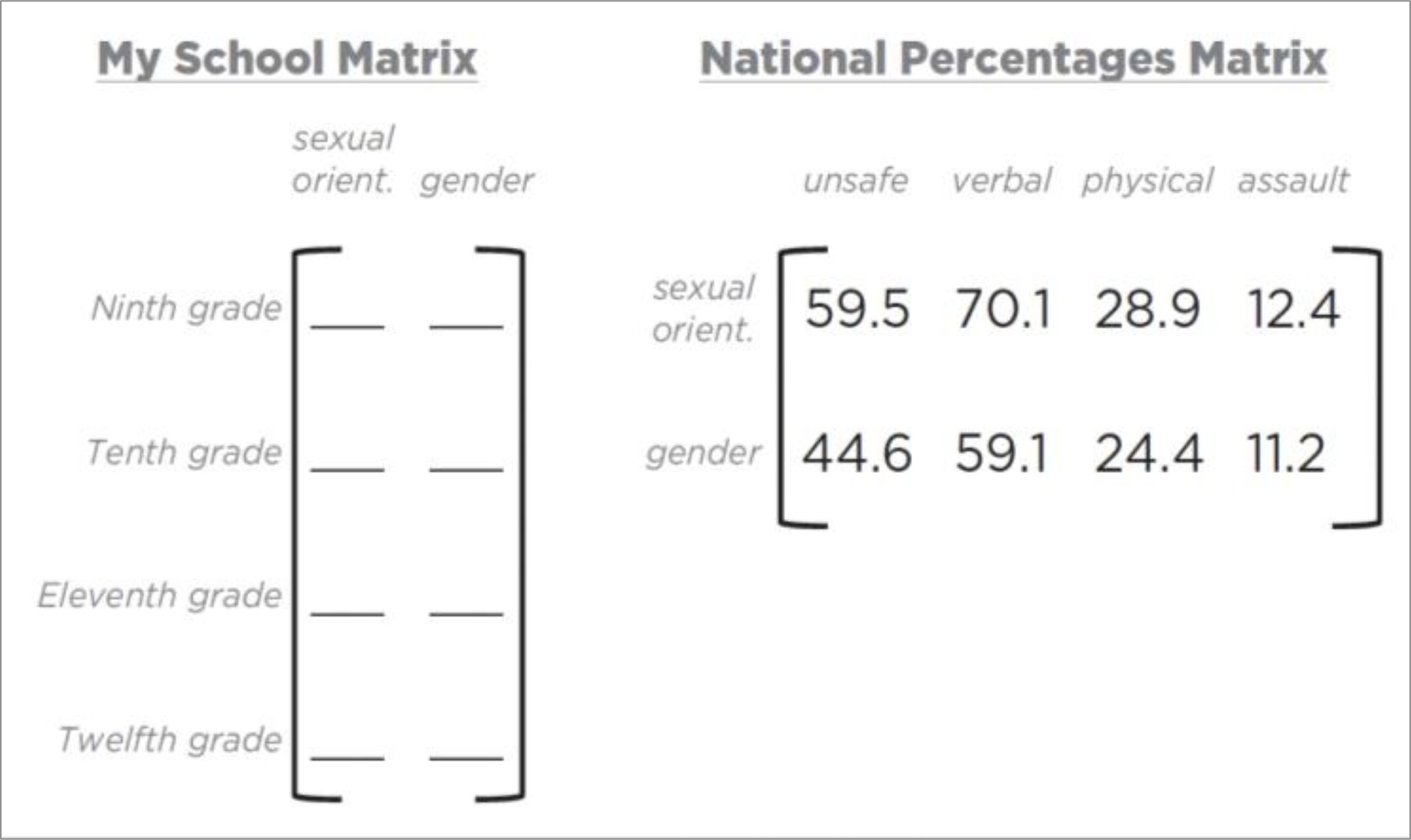
In the second phase, corresponding to the second class, students were asked to analyze how the national average of queer students who face bullying and harassment due to their gender and sexuality could manifest itself in their own high schools. To solve the problem proposed in this stage, students needed to investigate the number of students enrolled per year (from ninth to 12th grade) — it should be noted that in the US, High School covers four years —create matrices representing this distribution, and multiply the number of students by the percentage of the national average of people with non-normative gender (1% in the US) and non-normative sexuality (8%).
This calculation would give the approximate percentage of queer students in each year of high school, based on their non-normative gender and sexuality. Next, students should multiply this resulting matrix by the matrix of the percentage of students who possibly felt unsafe and/or suffered verbal, physical, or other types of violence due to their gender and/or sexuality — all of these percentages were provided to students. The problem involved multiplying a matrix representing the percentage distribution of students in their schools in grades 9 through 12 (a 4 × 2 matrix) by another matrix representing the national percentage for bullying and harassment related to gender and sexuality (a 2 × 4 matrix). Figure 2 represents these two matrices.
At the end of the second class, queer students were able to estimate the number of students in their own schools who had been victimized because of their gender and/or sexuality based on the national average of victimization experiences.
Finally, in the last phase of the lessons, corresponding to the third lesson, students were encouraged to work together with the numbers they found of students victimized due to their non-normative gender and sexuality. More importantly, they were encouraged to collaborate in finding viable actions to support the school community in developing critical awareness about these injustices faced by queer students in their own schools. Additionally, students were encouraged to create a public product that addressed these injustices.
In total, I worked with ten queer High School students in this study — six participated virtually via Zoom, and four in person — and taught them the three lessons from the textbook to address the injustices of bullying and harassment faced by queer high school students in the United States. After the lessons, I interviewed the students individually to understand their experiences with these lessons and their opinions on the implementation of these lessons in their classrooms. I also invited all ten students to a focus group interview to discuss the preliminary findings from the individual interviews. Of the ten students, five chose to join the focus group.
Although the results of this study have been published in my doctoral thesis and other publications (Ataide Pinheiro, 2022, 2023; Ataide Pinheiro and Chávez, 2023; Cox and Ataide Pinheiro, 2024), I report some excerpts of how students discussed their experiences with this type of lesson from the textbook by Berry et al. (2020).
The first major finding of my study concerns the excitement and happiness of queer high school students when engaging with math lessons that discussed their own subjectivities. Social justice math teaching showed these students a version of math that was very different from their previous experiences in formal schooling.
Students realized that engaging with social justice math allowed them to find a new mathematical subjectivity — something that most of them did not have in a meaningful way — and to develop as learners of the discipline. It was common for students to share that they did not consider themselves good at math, but that this teaching model, by addressing issues that were meaningful to them — namely, the injustices faced by queer students — made math more interesting and motivated them to focus in class and learn.
Although my study did not directly assess students’ mathematical learning, many mentioned how enriching the experience was, as they could see themselves reflected in the lessons, which dealt with topics relevant to their realities. For example, a queer student shared in an individual interview:
I’ll be honest, I’m not good at math. I’m not good at word problems. But not only the way you taught it, but the fact that the subject matter was something important to me definitely helped me focus more on it. As you know, social issues, and especially LGBT social issues, are very important to me, so it was easier for me to connect with the class. So even though I think matrices and things like that are out of my reach, there were still ways for me to follow along and understand what was going on because I could relate to the message.
When discussing how they would feel if these classes were implemented in their classrooms and the possibility of these activities taking place in their own schools, queer students mentioned a variety of scenarios, many of which depended on the type of institution they attended.
Students from rural and public schools expressed concern that these lessons would not work in their school environments due to possible retaliation from non-queer students, which could create an unsafe classroom environment and make it difficult for queer students to engage in the lesson. They also raised concerns about possible objections from parents and school administrators.
Students from rural and public schools particularly noted that if discussions about queer issues provoked adverse reactions, they would feel so uncomfortable or unsafe that they would be unable to concentrate on the lesson. Although these findings refer mainly to students in schools that are less friendly to queerness, students from schools that are more welcoming to queer subjectivities demonstrated that teaching Mathematics for social justice could significantly increase critical awareness of the injustices faced by queer students in schools. These lessons could be well received and have the potential to positively impact both queer and non-queer students, helping everyone develop critical awareness and normalize non-normative gender, sex, and sexuality subjectivities.
I conclude this narrative by emphasizing that teaching Mathematics for social justice is powerful, necessary, and urgent, especially considering the growing attacks on education in various parts of the world. This pedagogical approach aims to help students develop critical awareness of various injustices and become advocates for change while learning complex Mathematics.
However, teaching Mathematics for social justice may not always be feasible, which makes it essential to create alternative opportunities for its implementation. A major recommendation from high school students in my study was to offer this type of Mathematics as an extracurricular activity for students interested in learning the subject through the lens of social justice, with the possibility of eventually integrating these discussions into formal classrooms.
Teaching Mathematics for social justice, especially focused on issues of sex, gender, and sexuality, has the potential to challenge the normative constructs of these concepts, showing students that there are more than just binary categories of these constructs. In addition, it highlights the oppression and injustices faced by those whose gender, sex, and/or sexuality classifications fall outside established norms.
4 Concluding, but not exhausting, the conversation
The discussions in this paper show how much the school Mathematics curriculum is loaded with colonial/religious/patriarchal ideals of gender and sexuality, whether in teaching practices or in the production of textbooks, which establish binary logic as the only normal one and determine the social/work/sexual place of women and men.
This entire apparatus, forged in power relations, aims to produce subjectivities that construct/discipline bodies to occupy certain positions. Hence the importance of understanding, in order to question, challenge, and resist, for, as Foucault (1995, p. 248) asserts, “there is no power relation without resistance, without escape or flight”.
It is a resistance that seeks to confront imposed behavior, an exercise in subjectivation, with the aim of experiencing liberation from oppressive processes. Questioning the content of Mathematics textbooks during class about representations of gender/sexuality, or redirecting the teaching of Mathematics toward social justice, especially for so-called minority groups, such as the queer community, are excellent examples of resistance to the system that regulates bodies and ways of life.
It is unacceptable to think that, in the 21st century, girls are still being conditioned to believe that they are incapable of Mathematics, or that this discipline/science is being used as a cog in the conservative/neoliberal machine that drives the Western world.
This paper, like all others in the same vein, is an invitation to practice resistance/insurgency so that we can truly transform Mathematics Education into an instrument of social change and break the heterosexual patriarchal cisteme.
REFERENCES
ALAJMI, Amal Hussain. Addressing computational estimation in the Kuwaiti curriculum: teachers’ views. Journal of Mathematics Teacher Education, v. 12, n. 4, p. 263-283, 2009. https://doi.org/10.1007/s10857-009-9106-3 [ Links ]
ALDERTON, Julie. Kelly’s story: transformative identity work in primary Mathematics teacher education. Gender and Education, v. 32, n. 2, p. 145-160, 2017. https://doi.org/10.1080/09540253.2017.1336204 [ Links ]
AMORIM. Antonio Carlos. Olhares interessados para as imagens de um livro didático de Biologia. Revista de Educación en Biología, v. 19, n. 1, p. 83-99, 2016. https://doi.org/10.59524/2344-9225.v19.n1.22532 [ Links ]
ATAIDE PINHEIRO, Weverton. At the intersections: queer High School students’ experiences with the teaching of Mathematics for Social Justice. 2022. 324. These (Doctorate of Philosophy in the School Education). Indiana University. Bloomington. [ Links ]
ATAIDE PINHEIRO, Weverton. Gender and sexuality in Mathematics Education: queer High School students’ experiences in the United States. Boletim GEPEM, n. 83, p. 78-121, 2023. https://doi.org/10.4322/gepem.2023.013 [ Links ]
ATAIDE PINHEIRO, Weverton. Oportunidades para a literacia matemática em livros didáticos do Brasil, Taiwan e Cingapura. Pesquisas e Práticas Educativas, v. 1, n. 1, p. 1-20, 2020. https://doi.org/10.47321/PePE.2675-5149.2020.1.e202013 [ Links ]
ATAIDE PINHEIRO, Weverton. The analysis of cognitive demand and mathematical competencies: a case study of the Pythagorean theorem. 2017. 141f. Dissertation (Master of Science in Mathematics Education). National Taiwan Normal University, Taipei. [ Links ]
ATAIDE PINHEIRO, Weverton; BHARAJ, Pavneet Kaur; FRANCIS, Dionne Cross; DARWIN, Taylor Kirkpatrick; ESQUIBEL, Jesus; HALDER, Shreyashi. An investigation of gender biases in teacher-student interaction in Mathematics lessons within a virtual teaching simulator. In: LEE, Carrie Wilkerson; BONDURANT, Liza; SAPKOTA, Bima; HOWELL, Heather. (Org.). Promoting equity in approximations of practice for Mathematics teachers. Hershey: IGI Global, 2025. p. 201-228. https://doi.org/10.4018/979-8-3693-1164-6.ch009 [ Links ]
ATAIDE PINHEIRO, Weverton; CHÁVEZ, Rosa. Queer High School students’ takeaways from the teaching of Mathematics for social justice. In: LAMBERG, Teruni; MOSS, Diana (Ed.). Proceedings of the Forty-Fifth Annual Meeting of the North American Chapter of the International Group for the Psychology of Mathematics Education. v. 2. Reno: University of Nevada, 2023, p. 515-523. [ Links ]
ATAIDE PINHEIRO, Weverton; CHÁVEZ, Rosa; NGUYEN, Uusula. Exploring gendered experiences of high-achieving undergraduate women in Mathematics. International Journal of Education in Mathematics, Science, and Technology, v. 13, n. 1, p. 40-60, 2025. https://doi.org/10.46328/ijemst.4361 [ Links ]
BERRY, Robert. Q.; CONWAY, Basil. M.; LAWLER, Brian. R.; STALEY, John. W. High School Mathematics lessons to explore, understand, and respond to social injustice. 5th ed. Thousand Oaks: Corwin Press, 2020. [ Links ]
BOALER, Jo. Reclaiming school Mathematics: the girls fight back. Gender and Education, v. 9, n. 3, p. 285-305, 1997. https://doi.org/10.1080/09540259721268 [ Links ]
BURTON, Leone. Moving towards a feminist epistemology of Mathematics. Educational Studies in Mathematics, v. 28, n. 3, p. 275-291, 1995. https://doi.org/10.1007/bf01274177 [ Links ]
BUTLER, Judith P. Gender trouble: feminism and the subversion of identity. London: Routledge, 1990. [ Links ]
COX, Jennifer; ATAIDE PINHEIRO, Weverton. Advancing equitable and responsible research involving gender and sexuality within Mathematics Education. The Educational Forum, v. 88, n. 3, p. 283-308, 2024. https://doi.org/10.1080/00131725.2024.2339218 [ Links ]
DIAS, Ana; ATAIDE PINHEIRO, Weverton. A scoping review of research methodologies used on studies of gender and sexuality within Mathematics Education. Perspectivas da Educação Matemática, v. 17, n. 47, p. 1-27, 2024. https://doi.org/10.46312/pem.v17i47.21212 [ Links ]
DUNNE, Mairéad; JOHNSTON, Jayne. An awareness of epistemological assumptions: the case of gender studies. International Journal of Science Education, v. 14, n. 5, p. 515-526, 1992. https://doi.org/10.1080/095006992014050ria4 [ Links ]
FOUCAULT, Michel. Ditos e escritos IV: estratégia, poder-saber. 3. ed. Rio de Janeiro: Forense Universitária, 2015. [ Links ]
FOUCAULT, Michel. O sujeito e o poder. In: RABINOW, Paul; DREYFUS, Hubert. (Org.). Michel Foucault: uma trajetória filosófica: para além do estruturalismo e da hermenêutica. Tradução: Vera Porto. Rio de Janeiro: Forense-Universitária, 1995, p. 231-249. [ Links ]
FREIRE, Paulo. Pedagogia do oprimido. 64. ed. Rio de Janeiro: Paz e Terra, 2017. [ Links ]
FÚNEZ-FLORES, Jairo; ATAIDE PINHEIRO, Weverton; MENDOZA, Aixa Ávila; PHELPS, Rebekah; SHIVE, Elyssa Cherry. The sociopolitical turn in Mathematics Education and decolonial theory. London Review of Education, v. 22, n. 1, p. 1-12, 2024. https://doi.org/10.14324/LRE.22.1.13 [ Links ]
GALLO, Silvio. Biopolítica e subjetividade: resistência? Educar em Revista, v. 33, n. 66, p. 77-94, out./dez. 2017. https://doi.org/10.1590/0104-4060.53865 [ Links ]
GOMES, Ligia Baptista; CONDEIXA, Maria Cecilia Guedes; FIGUEIREDO, Maria Teresinha; VIDIGAL, Sonia Maria Pereira. Alfabetização Matemática e Ciências. 2º ano. São Paulo: Global Editora, 2014. [ Links ]
GUTSTEIN, Eric. Reading and writing the world with mathematics: toward a pedagogy for social justice. London: Routledge, 2006. [ Links ]
JAREMUS, Felicia; GORE, Jennifer; PRIETO-RODRIGUEZ, Elena; FRAY, Leanne. Girls are still being ‘counted out’: teacher expectations of high-level Mathematics students. Educational Studies in Mathematics, v. 105, n. 2, p. 219-236, 2020. https://doi.org/10.1007/s10649-020-09986-9 [ Links ]
KAJANDER, Ann; LOVRIC, Miroslav. Mathematics textbooks and their potential role in supporting misconceptions. International Journal of Mathematical Education in Science and Technology, v. 40, n. 2, p. 173-181, 2009. [ Links ]
KOKKA, Kari. Social justice Mathematics: Pedagogy of the oppressed or Pedagogy of the privileged? A comparative case study of students of historically marginalized and privileged backgrounds. 2017. 170f. These (Doctorate in Education). Harvard University. Cambridge. [ Links ]
KOKKA, Kari. Social justice pedagogy for whom? Developing privileged students’ critical mathematics consciousness. The Urban Review, v. 52, n. 4, p. 778-803, 2020. https://doi.org/10.1007/s11256-020-00578-8 [ Links ]
KOKKA, Kari. Toward a theory of affective pedagogical goals for social justice Mathematics. Journal for Research in Mathematics Education, v. 53, n. 2, p. 133-153, 2022. https://doi.org/10.5951/jresematheduc-2020-0270 [ Links ]
KOLLOSCHE, David. Mathematics and power: an alliance in the foundations of Mathematics and its teaching. ZDM Mathematics Education, v. 46, n. 7, p. 1061-1072, 2014. https://doi.org/10.1007/s11858-014-0584-0 [ Links ]
KROEF, Ada Beatriz Gallicchio. Interceptando currículos: produzindo novas subjetividades. Educação & Realidade, v. 26, n. 1, 2001. [ Links ]
LAVIETES, Matt; RAMOS, Elliott. Nearly 240 anti-LGBTQ bills filed in 2022 so far, most of them targeting trans people. NBC News, 2022. Disponível em https://www.nbcnews.com/nbc-out/out-politics-and-policy/nearly-240-anti-lgbtq-bills-filed-2022-far-targeting-trans-people-rcna20418. [ Links ]
LEDER, Gilah. Mathematics and gender: changing perspectives. In: GROUWS, Douglas (Ed.). Handbook of research on Mathematics teaching and learning. New York: Macmillan, 1992, p. 597-622. [ Links ]
LLEWELLYN, Anna. ‘Gender games’: a post-structural exploration of the prospective teacher, Mathematics and identity. Journal of Mathematics Teacher Education, v. 12, n. 6, p. 411-426, 2009. https://doi.org/10.1007/s10857-009-9109-0 [ Links ]
MONTEIRO, Alexandrina. Currículo como rizoma: o que se prolifera num campo (in)disciplinar? In: GODOY, Elenilton Vieira; SILVA, Marcio Antonio; SANTOS, Vinício de Macedo (Org.). Currículos de Matemática em debate: questões para políticas educacionais e para a pesquisa em Educação Matemática. São Paulo: Livraria da Física, 2018, p. 89-100. [ Links ]
NETO, Vanessa Franco. Garotas só querem somar: desenvolvimento sustentável, questões de gênero e as áreas STEM. Perspectivas da Educação Matemática, v. 17, n. 47, p. 1-19, 2024. https://doi.org/10.46312/pem.v17i47.21119 [ Links ]
NETO, Vanessa Franco; ATAIDE PINHEIRO, Weverton. Análise comparativa entre Brasil e os Estados Unidos: o problema de gênero em livros didáticos de Matemática. Ridema, v. 5, n. 1, 2021. https://doi.org/10.34019/2594-4673.2021.v5.33216 [ Links ]
NETO, Vanessa Franco; BORGES, Luiza; ALVES, Thays. Redes produtivas de saber/poder: gênero e Matemáticas sob análise de estudantes. Ripem, v. 11, n. 3, p. 173-188, 2021. https://doi.org/10.37001/ripem.v11i3.2833 [ Links ]
NETO, Vanessa Franco; GUIDA, Angela Maria. Constituição do sujeito-mãe nos livros didáticos de Matemática da Educação do Campo. Educação, v. 45, 2020. https://doi.org/10.5902/1984644438457 [ Links ]
OECD — Organisation for Economic Co-Operation and Development. PISA 2012 assessment and analytical framework: Mathematics, reading, science, problem solving and financial literacy. Paris: OECD Publishing, 2013. [ Links ]
OJOSE, Bobby. Mathematics literacy: Are we able to put the mathematics we learn into everyday use? Journal of Mathematics Education, v. 4, n. 1, p. 89-100, 2011. [ Links ]
PAIS, Alexandre. Mathematics Education as a matter of economy. In: PETERS, Michael. (Ed). Encyclopedia of Educational Philosophy and Theory. Singapore: Springer, 2016, p. 1-5. https://doi.org/10.1007/978-981-287-532-7_516-1 [ Links ]
PARAISO, Marluce Alves. Currículo e relações de gênero: entre o que se ensina e o que se pode aprender. Linhas Críticas, v. 17, n. 33, p. 206-237, 2016. [ Links ]
PEHKONEN, Leila. The magic circle of the textbook: an option or an obstacle for teacher change. In: Proceedings of the 28th Annual Meeting of the International Group for the Psychology of Mathematics Education. Bergen, 2004, p. 513-520. [ Links ]
POPKEWITZ, Thomas. The alchemy of the Mathematics curriculum: inscriptions and the fabrication of the child. American Educational Research Journal, v. 41, n. 1, p. 3-34, 2004. http://dx.doi.org/10.3102/00028312041001003 [ Links ]
RUBEL, Laurie. Speaking up and speaking out about gender in Mathematics. The Mathematics Teacher, v. 109, n. 6, p. 434-439, 2016. https://doi.org/10.5951/mathteacher.109.6.0434 [ Links ]
SKOVSMOSE, Ole. Critical Mathematics Education. Nova York: Springer, 2023. [ Links ]
TANNER, Daniel; TANNER, Laurel. Curriculum development: theory into practice. Columbus: Macmillan, 1980. [ Links ]
TEN DAM, Geert; VOLMAN, Monique. Feminist research and educational policy. Journal of Education Policy, v. 10, n. 2, p. 209-220, 1995. https://doi.org/10.1080/0268093950100206 [ Links ]
TRÖHLER, Daniel. Curriculum history or the educational construction of Europe in the long nineteenth century. European Educational Research Journal, v. 15, n. 3, p. 279-297, 2016. https://doi.org/10.1177/1474904116645111 [ Links ]
TSO, Tai-Yih; LEI, Kin Hang; ATAIDE PINHEIRO, Weverton; LU, Feng-Lin. Comparative implications of mathematical literacy between Taiwanese, Singaporean, and Brazilian textbooks: using the Pythagorean theorem as an example. Journal of Textbook Research, v. 11, n. 3, p. 33-62, 2018. [ Links ]
UNESCO — United Nations Educational, Scientific and Cultural Organization. Cracking the code: girls' and women's education in Science, Technology, Engineering and Mathematics (STEM). París: Unesco, 2019. https://doi.org/10.54675/QYHK2407 [ Links ]
UNESCO — United Nations Educational, Scientific and Cultural Organization. Eliminating gender bias in textbooks: pushing for policy reforms that promote gender equity in education. París: Unesco, 2015. [ Links ]
VALERO, Paola. Human capitals: school Mathematics and the making of the homus oeconomicus. Journal of Urban Mathematics Education, v. 11, n. 1-2, p. 103-117, 2018. [ Links ]
VALERO, Paola. Mathematics for all, economic growth, and the making of the citizen-worker. In: POPKEWITZ, Thomas; DIAZ, Jennifer; KIRCHGASLER, Christopher. (Ed.). A political sociology of educational knowledge: studies of exclusions and difference. New York: Routledge, 2017, p. 117-132. [ Links ]
VALERO, Paola; ORLANDER, Auli Arvola. Democracy and justice in Mathematics and Science curriculum. Research Encyclopedia of Education. Oxford: Oxford University Press, 2018. https://doi.org/10.1093/acrefore/9780190264093.013.126 [ Links ]
WALKER, Chris. More than 530 anti-LGBTQ bills have been proposed across the country in 2023. Truthout, 2 jun. 2023. Disponível em https://truthout.org/articles/more-than-530-anti-lgbtq-bills-have-been-proposed-across-the-country-in-2023. [ Links ]
YOLCU, Ayse. Historicizing “Math for all”. In: CHRONAKI, Anna. (Ed.). Mathematics Education and life at times of crisis. v. 2. Volos: University of Thessaly Press, 2017, 1011-1022. [ Links ]
ZIOLS, Ryan; KIRCHGASLER, Kathryn. Health and pathology: a brief history of the biopolitics of US Mathematics Education. Educational Studies in Mathematics, v. 108, n. 1-2, p. 123-142, 2021. http://dx.doi.org/10.1007/s10649-021-10110-8 [ Links ]
NoteThe translation of this paper from Portuguese into English was funded by the Minas Gerais State Research Foundation (Fapemig — Fundação de Amparo à Pesquisa do Estado de Minas Gerais), under Call for Proposals 8/2023.
1A common celebration in Brazil and the US in which parents announce the intended gender of a baby who often has not yet reached the second trimester of pregnancy.
Received: November 20, 2024; Accepted: January 15, 2025; Published: August 10, 2025
 Este é um artigo publicado em acesso aberto (Open Access) sob a licença Creative Commons Attribution Non-Commercial, que permite uso, distribuição e reprodução em qualquer meio, sem restrições desde que sem fins comerciais e que o trabalho original seja corretamente citado.
