




Serviços Personalizados
Journal

Artigo
 texto em
  Inglês (pdf)
 Artigo em XML
 Tradução automática
 Enviar este artigo por email
Compartilhar

 Permalink
Obutchénie. Revista de Didática e Psicologia Pedagógica
versão On-line ISSN 2526-7647
Obutchénie: R. de Didat. e Psic. Pedag. vol.8 Uberlândia 2024 Epub 10-Jun-2025
https://doi.org/10.14393/obv8.e2024-34
Artigo
Logical-historical movement of the polyhedron concept: the process of elaboration and development of a didactic sequence in Middle School1

2PhD student in the Graduate Program in Education at the Federal University of São Carlos, Brazil.
This article approaches the process of teaching the concept of polyhedron the final years of elementary school. In the materials available for teaching, the concept appears in situations that are enclosed within Geometry itself and can be solved mechanically. In this context, we used Didactic Engineering as a methodology to design and analyze the process of creating and developing a didactic sequence that considers the historical evolution of the concept, through its logical-historical movement, as well as the cognitive processes involved in learning geometric concepts. The aim is to offer mathematics teaching that promotes a broad understanding of this science. The logical- historical movement of the polyhedron concept helped us understand mathematics as a science developed by human beings and in constant transformation. The use of concrete materials allowed the manipulation and visualization of three-dimensional objects and facilitated the assimilation of the concept. The organization proposed by the methodology adopted was effective in achieving the stipulated objectives, but by segmenting the planning and experimentation phases of the activities, this approach leaves little room for unpredictability.
Keywords: Didactic Engineering; Geometry; Euler’s Gem
Este artigo aborda o processo de ensino do conceito de poliedro nos anos finais do Ensino Fundamental. Nos materiais disponíveis para o ensino, o conceito aparece em situações que se encerram dentro da própria Geometria e que podem ser resolvidas de forma mecânica. Nesse contexto, utilizamos como metodologia a Engenharia Didática para elaborar e analisar o processo de criação e desenvolvimento de uma sequência didática que considera a evolução histórica do conceito, por meio de seu movimento lógico-histórico, assim como os processos cognitivos envolvidos na aprendizagem de conceitos geométricos. O objetivo é oferecer um ensino de Matemática que promova ampla compreensão desta ciência. O movimento lógico- histórico do conceito de poliedro auxiliou no entendimento da Matemática como ciência desenvolvida por seres humanos e em constante transformação. A utilização de materiais concretos permitiu a manipulação e visualização de objetos tridimensionais e facilitou a assimilação do conceito. A organização proposta pela metodologia adotada foi eficaz na busca pelos objetivos estipulados, mas ao segmentar as fases de planejamento e experimentação das atividades, esta abordagem deixa pouco espaço para a imprevisibilidade.
Palavras-chave: Engenharia Didática; Geometria; Relação de Euler
Este artículo aborda el proceso de enseñanza del concepto de poliedro en los últimos años de la Educación Primaria. En los materiales disponibles para la enseñanza, el concepto aparece en situaciones que se cierran dentro de la propia Geometría y que pueden resolverse de forma mecánica. En este contexto, utilizamos como metodología la Ingeniería Didáctica para elaborar y analizar el proceso de creación y desarrollo de una secuencia didáctica que considera la evolución histórica del concepto, a través de su movimiento lógico-histórico, así como los procesos cognitivos involucrados en el aprendizaje de conceptos geométricos. El objetivo es ofrecer una enseñanza de Matemáticas que promueva una amplia comprensión de esta ciencia. El movimiento lógico-histórico del concepto de poliedro ayudó en la comprensión de las Matemáticas como ciencia desarrollada por seres humanos y en constante transformación. La utilización de materiales concretos permitió la manipulación y visualización de objetos tridimensionales y facilitó la asimilación del concepto. La organización propuesta por la metodología adoptada fue eficaz en la búsqueda de los objetivos establecidos, pero al segmentar las fases de planificación y experimentación de las actividades, este enfoque deja poco espacio para la imprevisibilidad.
Palabras clave: Ingeniería Didáctica; Geometría; Relación de Euler
1 Introduction
The concept of polyhedron is studied in the final years of elementary school, as part of the Geometry studies that make up the Mathematics curriculum in Brazil.
A subject related to this concept is the so-called Euler’s Gem, a contribution to Mathematics by the Swiss Leonhard Euler, which generalizes the relationship between the number of vertices, edges and faces of any polyhedron into an equality. In basic education, this relation is studied for convex polyhedra and generalized into the following sentence: the sum of the number of vertices and the number of faces is always equal to the number of edges plus two units.
In the teaching-learning process, we often come across this subject in situations that are enclosed within Geometry itself, and which can be solved in a mechanized way. For example, the activities proposed by the Cadernos do Aluno, support materials distributed by the São Paulo State Department of Education, consist of drawing up tables with the number of edges, vertices and faces of various convex polyhedra and checking that the relationship is valid in all cases.
The teaching proposal is very close to the Training Pedagogy problematized by Lima (1998). The main characteristic of this pedagogy is to carry out the following stages: 1) definition of the concept; 2) application of the concept; 3) training in the use of the concept; and 4) evaluation as a way of organizing the teaching process.
However, this approach can give the impression that Mathematical contents are not the result of research carried out by human beings and that they are ready, finished and have an end in themselves. Euler’s Gem is an important result that transformed paradigms in Geometry and was fundamental to the development of Topology, an important area of research in Mathematics.
In this context, the guiding question of this work arises: how can we develop a didactic sequence that approaches the concepts related to polyhedra in a critical manner, contextualizing the knowledge with the historical moments in which they were developed and articulating them with current research in Mathematics?
Thus, this research analyzes the process experienced by the author- researcher-teacher in the elaboration and development of a didactic sequence to teach the concept of polyhedron, considering the different historical moments in which this concept developed and transformed. The didactic sequence was developed for a class of twenty students in the last cycle of primary school at a public school in São Carlos - SP.
The methodology used was Didactic Engineering, which involves the development of teaching material for a given content and a qualitative analysis of the development process. In this way, Didactic Engineering is an instrument for designing a didactic sequence and also a research methodology.
Teaching-learning situations were created that consider the logical- historical movement of the concept, as theorized by Sousa (2018) and Saito and Dias (2013). This perspective proposes knowledge as mental content that is expressed through language and seeks to highlight the relationships that this knowledge has with objective reality in its historical process of construction and transformation. Logic, in this case, is the means by which thought reproduces the historical process of concept development.
Studies on the cognitive processes involved in an individual’s understanding of geometric concepts were also considered. Almouloud (2010) explains that geometric thought involves three cognitive processes that fulfill specific epistemological functions: visualization, construction and reasoning. In the didactic sequence developed, four forms of autonomous interpretation are present: sequential, perceptive, discursive and operative, according to the classification of the aforementioned author.
2 The designing development process
Our aim is to analyze the process of designing and developing a didactic sequence for teaching Euler’s Gem. In the teaching-learning situations that make up the sequence, we sought to consider the perspective of the logical-historical movement of the concept. We used Didactic Engineering as the methodology for the development and qualitative research.
This section provides a brief description of this methodology. Next, we present the theoretical frameworks that guided the development of the didactic sequence and the analysis of the development process.
2.1 Didadic Engineering
Didactic Engineering is a didactic work methodology that aims to develop, in addition to didactic material for a given content, a qualitative analysis of this development. Thus, Didactic Engineering is an instrument for conceiving a didactic sequence and also a research methodology, as Almouloud and Coutinho (2008) explain.
As a way of organizing pedagogical work, it enables the teacher to take an experimental approach, involving conception, development, observation and analysis of teaching sessions.
As a qualitative research tool, its object of analysis is the process of developing a learning situation or a sequence of learning situations, also known as a didactic sequence, on a given content, its experimentation in the classroom and the results obtained.
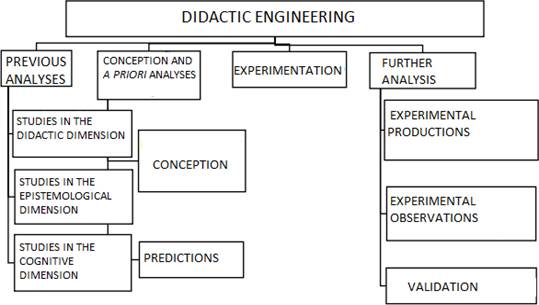
The methodology proposes that the research be carried out in four stages: prior analysis; conception and a priori analysis; experimentation; subsequent analysis and validation. These stages do not generally occur in a linear way, as Pommer (2008) explains. At times, the development of the work requires articulation, anticipation and overlapping of the elements that characterize the four stages.
In the first stage, prior analysis, a survey and bibliographic review of texts dealing with general didactic elements related to the content in question, as well as specific knowledge related to the research topic, are carried out.
The studies carried out at this stage should cover three dimensions: epistemological, didactic and cognitive. These studies can be taken up at other times in the research, as necessary, and make it possible to carry out the next stage: conception and a priori analysis of the didactic sequence.
In the conception and a priori analysis stage, the researcher must select some topics related to the content in question and its teaching, which are considered in the design of the didactic proposal. At this stage, the didactic sequence is developed and the a priori analysis takes on a descriptive and predictive nature, describing the learning situations and justifying the choices that led to the development of these situations, relating the content studied to the students’ possible responses and the challenges that may be encountered during the experimentation.
The third stage involves empirical experimentation with the didactic sequence developed. Through experimentation, the researcher can broaden their view of the research object and obtain records that can serve as tools for analysis in the subsequent stage.
The analysis of the results, which constitutes the fourth stage of the research developed along the lines of Didactic Engineering, is called a posteriori analysis, and consists of the evaluation and validation of the experience, using data collected during the application of the didactic sequence. Figure 1 shows a conceptual map with the stages of Didactic Engineering as a teaching methodology and the research results.
2.2 The previous analysis
The first stage, prior analysis, involved studies in three dimensions: didactic, epistemological and cognitive. As objects of study in the didactic dimension, the teaching of mathematics that considers the logical-historical movement of the concept (SOUSA, 2014; SAITO; DIAS, 2013) was studied.
Dialectical logic and history as a way of thinking make it possible to build relationships between the history of concepts and their essence, with the aim of presenting the concept to the student in a broader way. Understanding the process of creation and development of concepts gives the individual, in addition to knowing the human needs and aptitudes synthesized in them, the ability to elaborate new aspects and new relationships of movement for these concepts. Understanding, however, is not limited to the mechanical reproduction of facts, because in this process of understanding, the student creates, recreates and transforms the concepts involved, internalizing them in an individual way.
The approach to the process of concept development does not necessarily follow the chronological stages based on a traditional historiographical approach, as this “tends to reinforce the linearity of the concept development” (SAITO; DIAS, 2013, p. 95). Using historiographies based on evolutionism can give the impression that mathematical knowledge could only have followed this path and that all existing knowledge converges on the present moment, which would be the most improved stage of its development.
Through an approach that proposes studying concepts in their historical contexts and the movements they went through during their historical development, this impression is dissipated, since it becomes evident that their development is in a larger context, be it economic, social, political or cultural, and this is transformed according to the needs of individuals. As Sousa (2014) writes, this approach contributes to a sense of the totality of knowledge, that is, within a broad context that should not be disregarded.
As objects of study with an epistemological dimension, we used a historiography of Mathematics (EVES, 2004), a specific historiography of the concept of polyhedron (RICHESON, 2008), literary works (PLATO, 2011), (EUCLIDES, 2009) and articles published in the areas of Mathematics and History of Mathematics, such as Poincaré (2010), Sandifer (2007), Atiyah (2002) and Lloyd (2012), with the aim of analyzing the Logical-Historical Movement of the concept of polyhedron in the history of Mathematics.
The Greeks were the first human beings to dedicate themselves to the mathematical knowledge of solids, specifically the Pythagoreans. At that time, prosperity and democracy went hand in hand in Athens. Intellectual life revolved around the Agora. “There, farmers from the countryside, merchants and craftsmen from the city’s stores, and merchants and sailors fresh from the docks mingled and talked” (EVES, 2004, p. 92). At this point in history, deductive thinking emerged in human knowledge. “The empirical processes of the ancient East, sufficient to answer questions in the form of how, no longer sufficed for the more scientific inquiries in the form of why” (EVES, 2004, p. 94).
The first appearance of what were then called geometric solids, of which we have record is in the work Timaeus (PLATO, 2011). In the book, the philosopher sets out his theory about the composition of the universe and material things, associating the cubic shape with the element earth, due to the stability of the element and the solid, the solid figure of the triangular pyramid with fire, the octahedron with air and the icosahedron with water. Plato concludes his theory by associating the dodecahedron with the universe and its constellations.
The study of solids was taken up by the Greek mathematician Euclides of Alexandria, who, according to Eves (2004), was a student at Plato’s Academy and moved to the capital when the famous library was being built, founding the Alexandrian School of Mathematics. He wrote several books, the most famous of which is called “The Elements” (EUCLIDES, 2009). In Book XIII of the work, the author shows how to construct Plato’s five solids, making what Richeson (2008) claims to be the book’s most important contribution.
A long time later, the Swiss mathematician Leonhard Euler accepted Frederick the Great’s invitation and moved to Germany, taking up a chair at the Berlin Academy. Euler remained there for 25 years and, according to Richeson (2008), wrote two articles that revolutionized the study of polyhedra: Elementa Doutrinae Solidorum, in 1750, and Demonstratio nunnullarum insignium proprietatum quibus solida hedris planis inclusa sun praedita, in 1751. These were the only articles published by the mathematician that dealt with polyhedra and are very important in the history of this concept.
In the first, Euler begins his studies on what he calls Stereometry. For Sandifer (2007), reading this article gives the impression that Euler wrote several articles on this new subject, but he only wrote two. Using an analogy to polygons, which consist of points and line segments, Euler’s article proposes the study of solids seen as points, segments and planes. He calls the points anguli solidi, and represents them by the letter S, and the planes hedra, using the letter H to represent them. He calls the segments acies, represented by the letter A. These components of polyhedral are translated respectively as vertices, faces and edges.
Seven pages of the article are devoted to propositions related to solids. The major proposition enunciated by the Swiss is Proposition IV, which states that in every solid closed by planes, the sum of the number of solid angles [vertices] and the number of faces exceeds the number of edges by 2 (SANDIFER, 2007). In the second article, Euler proposes a demonstration for this proposition.
Euler’s work on polyhedra revolutionized mathematicians’ view of these objects and contributed to the emergence of Topology in the 20th century. As Richeson (2008) explains, while in Geometry it is crucial that the objects of study are rigid, as this is the only way to measure angles, lengths, deduce congruences and calculate areas and volumes, Topology discards this rigidity, as it obscures other mathematical properties underlying the object studied. For a geometrician, two triangles are considered equal if they are congruent, or at least similar. For a Topology researcher, two objects are considered equal if one can be transformed into the other through continuous transformations, such as flexing, twisting and stretching, for example. These spaces, under these conditions, are said to be homeomorphic.
One of the first works published in the field of Topology is called Analisis Situs (Poincaré, 2010) by the French mathematician Henri Poincaré in 1895. In this work, Poincaré systematically schematizes the knowledge already developed in the area and develops new concepts. Initially, Poincaré defines a variety, and polyhedra are studied as two-dimensional varieties, also called surfaces. In chapter 16 of Analysis Situs, called Euler’s Theorem, Poincaré generalizes Euler’s famous relation for any variety of dimension 𝑝.
Poincaré shows a way of calculating the Euler Characteristic of a surface, and concludes that for convex polyhedra this number will be equal to 2, regardless of the shape of the polyhedron. In fact, “the fact that the faces are flat is evidently unimportant [...] [the theorem] is also applicable to subdivisions of any closed surface into connected regions” (POINCARÉ, 2010, p. 61).
According to Richeson (2008), studies aimed at classifying surfaces began with Riemann in the 1850s. It was continued by Möbius, who showed that any compact orientable surface, that is, closed and without an edge, is homeomorphic to one of the forms he calls normal forms. The proof of the Classification Theorem for Compact Surfaces, in its complete version, which includes non-orientable surfaces, was completed rigorously by Max Dehn and Poul Heegaard in 1907. From this Theorem, it is possible to determine the Euler Characteristic of non-convex polyhedra that have ‘tunnels’ by observing the number of ‘tunnels’ that this polyhedron contains. Knowing that 2 − 2𝑔 is the is the Euler Characteristic of a torus of genus 𝑔, if the polyhedron in question has 𝑔 ‘tunnels’, by the Theorem it is homeomorphic to a torus of genus 𝑔, so 𝑉 − 𝐴 + 𝐹 = 2 − 2𝑔. If the polyhedron is non-convex, but does not have ‘tunnels’, this is homeomorphic to the sphere and, therefore,𝑉 − 𝐴 + 𝐹 = 2.
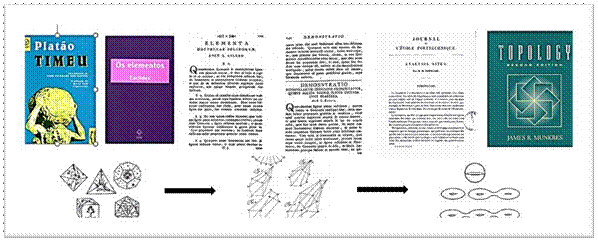
In short, more than two thousand years after its first appearance in Plato’s work, we now find an object quite different from the one envisioned by the Greek philosopher. These transformations that the concept of the polyhedron has undergone can be seen as reflections of the transformations that society and the individuals within it have undergone. Figure 2 shows the movement of appearances of the concept of polyhedra in three different works, written in different social and historical contexts and reflecting the specificities of each of these contexts.
With cognitive dimension studies, we seek to understand the cognitive processes involved in an individual’s understanding of geometric concepts. Almouloud (2010) explains that geometric thinking involves three cognitive processes that fulfill specific epistemological functions:
visualization, for the exploration and successive approximation of a complex situation;
construction of configurations, which can be worked on as a model in which the actions performed are represented and the results observed are related to the objects represented;
reasoning, which is the process that leads to the mathematical demonstration of the result and the explanation.
According to the author, these cognitive processes are intertwined and necessary for proficiency in Geometry. On the other hand, the heuristics of geometry problems give rise to autonomous forms of interpretation, of which the author distinguishes four:
sequential, requested in the construction tasks or in the description tasks with the aim of reproducing a figure:
perceptual, which is the interpretation of the shapes of the figure in a geometric situation;
discursive, which is the interpretation of the elements of the geometric figure, favoring the articulation of the statements and taking into account the semantic network of properties of the object:
operative, which is centered on the possible modifications of a starting figure and the perceptual reorganization that these modifications suggest.
When elaborating learning situations, we considered that teaching-learning situations that explore geometric concepts should highlight geometric figures with a heuristic role, taking into account the different apprehensions: perceptual, discursive, operative and sequential.
Demonstration should be an integral part of the teaching and learning process learning geometric concepts and logical-deductive reasoning. In this process, Almouloud (2010) also emphasizes the importance of registers of representation, in natural or mathematical language, as well as illustrations of geometric shapes.
2.3 Conception and a priori analysis
The didactic sequence is made up of three learning situations, which seek to understand the logical-historical movement of the concept (SOUSA, 2014; SAITO; DIAS, 2013) of polyhedra and the cognitive processes listed in Almouloud (2010).
The first learning situation is made up of two activities, and includes the ability to construct geometric solids from a plan, recognizing similarities and differences between polyhedra (such as prisms, pyramids and others), communicate mathematically, that is, describe, represent and present results accurately, identify characteristics of three-dimensional and two-dimensional geometric shapes, perceiving similarities and differences between them (flat and rounded surfaces, face shapes, symmetries).
The first activity in learning situation 1, called Dodecahedron of the Zodiac, was inspired by Plato’s work Timaeus (PLATO, 2011). One of the aims of this activity is to explore the planning of the dodecahedron, a solid made up of twelve regular pentagons, in a playful way. This activity articulates the cognitive processes of visualization and construction in geometric thinking,
according to the terms used by Almouloud (2010). The activity consists of cutting out and building the dodecahedron, based on the planification they received, and visualizing the object already built. On each face of the dodecahedron is a representation of a zodiac sign.
Once the dodecahedron has been built, each group of students receives a printed sheet with the main characteristics of each sign. With this information, students can socialize and identify some of the similarities they have with other classmates. The aim is to awaken feelings of belonging to a social group.
The second activity is based on Euclide’s first records of definitions of geometric solids. One of the aims of this activity is to familiarize students with mathematical language by exploring what a definition is within this science. Considering the mathematical definition as a basic element of demonstrations of mathematical results, it is important that it is explored in elementary school, because as Almouloud (2010, p. 132) points out, the initiation of demonstration plays an important role and can lead students in the final years of elementary school to better acquisition of geometric concepts and geometric skills.
The students work in pairs. Each pair chooses a polyhedron from among various types of polyhedra, convex, non-convex, some with ‘tunnels’, which are arranged in a box. After observing the solid, the student talks to their partner about the characteristics that define it and together they write a definition. At this stage, students are expected to ask questions about the characteristics and elements of polyhedra, such as faces, edges and vertices, among others.
Next, students should draw the polyhedron. It is hoped that by doing this, students will be encouraged to identify the faces of the polyhedron with polygons, which they will have to represent indirectly in their drawing.
After completing the representations and definitions of the polyhedra, the definitions are shared orally in a chat about the activity, in which everyone should feel free to explain the reasoning that led them to construct the definitions. Next, the groups collectively construct a definition of the objects studied in this lesson, called polyhedra in mathematics (a word of Greek origin that can be translated as several faces).
This activity combines the cognitive processes of visualization and reasoning, according to the terms used by Almouloud (2010). The student goes from simply observing an object to drawing up a text, in other words, drawing up semiotic records that translate their ideas into an explanatory discourse.
The second learning situation is made up of three activities that aim to develop the skills of identifying elements of a polyhedron such as faces, vertices and edges, collecting, organizing and describing data, establishing relationships between events and making predictions, identifying different possibilities in the composition and decomposition of three-dimensional figures and representing and solving problems using equations.
The groups of students are again given a polyhedron, which can be convex, non-convex, with or without tunnels, and are instructed to count the number of vertices, faces and edges of the polyhedron and write down the data of the objects. Once the data has been collected, it is organized in a table.
The aim of organizing the polyhedron data in a table is to question Euler’s Gem, which is unknown to students in the final years of elementary school. However, as not only convex polyhedra without tunnels are used, the contradiction is present and contributes to the development of knowledge through the construction and testing of hypotheses and the development of mathematical reasoning.
To explore the demonstration of Euler’s Gem, a cube made of manipulable material is used to show how the cuts that Euler used in his demonstration work, obtaining a tetrahedron after a certain number of cuts. This stage of the activity helps with the understanding of what a mathematical demonstration is, because as Duval writes, the “awareness [of what a demonstration is] arises from the interaction between the non-discursive representation produced and that of the discourse expressed” (ALMOULOUD, 2010, p. 128).
The second activity involves solving three questions taken from SARESP (Sistema de Avaliação de Rendimento Escolar do Estado de São Paulo - School Performance Assessment System of the State of São Paulo). They all deal with the concept of polyhedra based on the ideas developed by Leonhard Euler, and expand on the treatment given to objects in the previous activity.
In this activity, students articulate the epistemological functions of visualization and construction, as defined by Almouloud (2010). According to the author, the cognitive construction process takes place when the student links actions and concrete objects to the mathematical objects represented. In this case, students are given questions that have polyhedra represented so that they can observe characteristics of the objects in their mathematical representation.
The third activity aims to work on the form of apprehension that Almouloud (2010) calls operative. The activity consists of solving a question taken from the Banco de Questões da Olimpíada Brasileira de Matemática das Escolas Públicas (Questions Bank of the Brazilian Public-School Math Olympics) (Assis et al., 2015, p. 46).
Initially, the students only have access to the mathematical representation provided by the question and must solve the question as a team. However, anticipating that at this stage some students may find it difficult to visualize the transformations of the solid in question, we built the model in concrete material that allows them to visualize the cuts made in a cube and the new solid obtained.
According to Almouloud (2010), reconfiguration is the operation that makes it possible to obtain different figures from a given figure. The parts obtained by fractionation can be regrouped into several other subfigures, all within the starting figure. In this way, this operation makes it possible to set up various types of treatment, such as measuring areas and volumes by adding up elementary parts, for example, or the equivalence of intermediate regroupings.
The third learning situation seeks to bring polyhedra into the classroom as they are currently studied by researchers in the field of Topology, and includes the skills of collecting, organizing and describing data, establishing relationships between events and making predictions, identifying different possibilities in the composition and decomposition of three-dimensional figures.
The situation consists of just one activity, which consists of going back to the table drawn up in the previous situation, in which the numbers of edges, vertices and faces of the polyhedra are listed, to reflect on its generalization when the polyhedra have tunnels. When applying Euler’s Gem to polyhedra that have a tunnel, like the ones provided, the result is always zero. The activity is interesting because it takes up the polyhedra with tunnels, which we used at the beginning of this sequence and includes them in the study of polyhedra. In general, the study of polyhedra in textbooks is limited to the study of convex polyhedra.
Seeking to establish the differences between shapes, as studied in Topology, objects in the shape of a sphere and a torus are displayed, stimulating the imagination of how polyhedra without tunnels can be transformed into a sphere, and polyhedra with a tunnel can be transformed into a torus, without the need to cut or glue, introducing the concept of transformations that preserve the topology of these objects.
2.4 Experimentation and further analysis
After the elaboration stage and the a priori analysis, the didactic sequence was developed with a class of ninth-grade students from a public school in São Carlos/SP. The class has twenty-two students enrolled, but the number of people present varied greatly and only ten students took part in all the learning situations that make up the didactic sequence. However, this variation did not cause major conflicts in the development of the sequence.
All the proposed learning situations were carried out in pairs or groups. This method of working proved to be very efficient during implementation, as it facilitated the socialization of students’ previous knowledge, and together they were able to recall various Geometry topics.
In addition, carrying out the activities collectively helped ensure that everyone was able to take ownership of their knowledge during the development of the situations. Some students, once they understood the subjects covered, began to talk about them with their classmates. In the process, they helped others to understand and strengthened their own assimilation of the new knowledges.
As Oliveira (1997) explains, Vygotsky’s studies allow us to understand that the processes by which individuals acquire information, skills, attitudes, values and other components of their development are strongly linked to the individual’s relationship with their sociocultural environment and their situation as an organism that cannot fully develop without the support of other individuals, as was the case with the students who took part in the activity.
The use of manipulable materials proved to be extremely important in the development of the proposed learning situations, because without the manipulation of three-dimensional objects, the objectives of some learning situations were not achieved.
Almouloud (2010) proposes that a didactic sequence for teaching geometric concepts should contain “geometric figures that play a heuristic role, taking into account their different apprehensions: perceptual, discursive, operative and sequential”. In the case of this research, the objects developed for the sequence of learning situations contributed significantly to the construction of knowledge about the shape, composition and reconfiguration of the solids studied.
Most of the students present said they had never done any activities involving the planning and construction of polyhedra, even though these skills are part of the elementary school curriculum. When asked about the construction of the cube, which is usually done in the first cycle of elementary school, the students were divided.
Some were familiar with this construction and others said they had never had any contact with solid figure plannings. At this point, a broader dialog about polyhedron plannings was necessary, and some plannings of other polyhedra, such as the cube, pyramid and octahedron, were shown as examples. Although this was not part of the plan, it proved to be an opportune moment to present this knowledge.
The strategies created by the students to define the objects were basically based on the number of vertices, edges and faces and the geometric shapes of each face. All the students in the class showed that they were familiar with flat geometric figures and were able to identify triangular, square and hexagonal faces in the solids, among others. Some students confused two-dimensional and three-dimensional figures, revealing difficulties in recognizing the differences between the two types of geometric figures. These difficulties highlighted the need for a conversation and the showing of examples of flat shapes and three-dimensional shapes. Once again, an action was required that had not been planned.
The methodology proposed by Didactic Engineering, used to shape the development of this work and conduct the qualitative research, proved to be effective in achieving the established objectives. However, by dividing up the stages of planning and carrying out activities, this approach can, inadvertently, rigidify the educational process, restricting the scope for surprises.
Within the scope outlined in this study, unexpected gaps emerged in the planning stage during the experimental phase. Challenges such as the aforementioned lack of prior knowledge on the part of the students, as well as significant fluctuations in the number of participants, were identified and required continuous adaptation of the teaching plan. The malleability of the planning proved essential in order to revisit previous concepts as necessary and to continually adjust the results obtained.
In the activity involving the transformation of a cube into a tetrahedron through cuts, almost all the students had difficulty visualizing the process through its mathematical representation. This difficulty revealed that the students had not yet developed skills relating to the operative interpretations of a spatial geometric figure, as they were unable to mentally process the modifications, in this specific case a mereological modification, according to Almouloud (2010), undergone by the objects and visualize the result of this modification.
When they received the concrete material that allowed them to visualize the transformation empirically, many students spent time manipulating the material, which helped them understand the mereological operation and contributed to the development of operative apprehension.
As the students carried out the proposed activities, they became accustomed to working with the different registers and their transformations. Once they started with concrete representations of the solids, they created their own representations, mixing different registers in order to facilitate understanding, and were able to study other representations, which involve a greater capacity for abstraction. It was possible to see that this approach helped them understand the concepts.
Understanding the logical-historical movement of the polyhedron concept proved to be an interesting didactic perspective for dealing with issues related to the polyhedron concept. Through this approach, the transformations in the way a polyhedron is conceived in different eras and by individuals from different cultures became evident, helping to understand mathematics as a science developed by human beings and in constant transformation.
The introduction of topological concepts and the relationships between polyhedra, spheres and tori aroused the students’ interest in scientific Mathematics. During the application of the didactic sequence developed in this work, it was possible to notice that the rapprochement between Mathematics as a current research area and school Mathematics enabled the students to see Mathematics as a living science, current and in constant development.
3 Final considerations
This work analyzed the process of elaborating and developing a didactic sequence for teaching polyhedra with the participation of the History of Mathematics, understanding the conception of polyhedra by individuals from different cultures at different historical moments, through their logical-historical movement, to bring learning situations to the classroom that enabled dialogues between the culture of the school environment and the cultures in which the knowledge was conceived.
In the process of elaborating and developing the didactic sequence, we also considered the semiotic representation registers and their transformations in the study of a geometric concept. Through contact with different ways of representing a geometric object, the activities enabled students to articulate different cognitive processes that fulfill specific epistemological functions related to understanding the concept.
The use of concrete materials played a fundamental role, allowing the manipulation and visualization of three-dimensional objects, without which the objectives of the learning situations might not have been achieved. This highlights the importance of including geometric figures that play a heuristic role in the didactic sequence, as they made a significant contribution to building knowledge about the shape, composition and reconfigurations of the solids studied.
Teaching Spatial Geometry based only on theoretical content, without manipulable objects or situations involving the construction of solids, makes it difficult to assimilate the concepts involved. Without the possibility of visualizing these shapes, students will be unable to create mental records that make it possible to operate these shapes, a skill that should be developed in elementary school.
The approach proposed by Didactic Engineering, which is the methodology used to structure the development of this work, as well as a qualitative research method, proved to be effective in achieving the stipulated objectives. However, by segmenting the planning and experimentation phases of the activities, this approach can inadvertently stifle the educational process, leaving little room for unpredictability.
In the context of the sequence outlined in this study, during the experimental phase, unanticipated gaps emerged in the planning stage. Challenges such as the absence of prior knowledge on the part of the students and significant variations in the number of participants were observed, requiring constant adaptation of the lesson plan. Planning flexibility proved crucial in order to revisit previous concepts as necessary and to continually adjust the results achieved.
This experience highlights the failure to completely predict the teaching- learning process. It therefore demonstrates the importance of incorporating the flexibility right from the conception of the plan, recognizing that the unexpected is inherent in the educational process. A more adaptable methodological approach can enable a more effective response to students’ emerging needs and promote an even more dynamic and inclusive learning environment.
REFERENCES
ALMOULOUD, S. Ag. Registros de Representação Semiótica e Compreensão de Conceitos Geométricos. In: Machado, Silvia Dias Alcântara (org.). Aprendizagem em Matemática: registros de representação semiótica - Campinas, São Paulo. Papirus, p. 125-148. 2010. [ Links ]
ALMOULOUD, S. A. COUTINHO, C. Q. S. Engenharia Didática: características e seus usos em trabalhos apresentados no GT-19/ANPEd. REVEMAT - Revista Eletrônica de Educação Matemática. Vol. 3, 8. p. 62 - 77. UFSC, 2008. DOI: https://doi.org/10.5007/1981-1322.2008v3n1p62. [ Links ]
ASSIS, C. BARBOSA, R. FEITOSA, S. MIRANDA, T. OBMEP. Banco de questões 2015. Rio de Janeiro: IMPA, 2015. [ Links ]
ATIYAH, M. Mathematics on the 20th century. In: Bulletin of the London Mathematical Society, v. 34. Jan. 2002. DOI: https://doi.org/10.1112/S0024609301008566. [ Links ]
EUCLIDES. Os Elementos. Translated to Portuguese by Irineu Bicudo. São Paulo: Editora UNESP, 2009. [ Links ]
EVES, H. Introdução à História da Matemática. Translated to Portuguese by Hygino H Domingues. Campinas: Editora da UNICAMP, 2004. [ Links ]
LIMA, L. C. Da mecânica do pensamento ao pensamento emancipado da mecânica. In: Programa Integrar. Caderno do Professor: trabalho e tecnologia. CUT/SP, 1998, p. 95-103. [ Links ]
LIMA, W. F. R. Movimento lógico-histórico do conceito de poliedro. In: Anais doEncontro Mineiro de Educação Matemática: desafios e possibilidades da Educação Matemática durante e pós-pandemia. Anais... Pouso Alegre (MG) IFSULDEMINAS, 2021. DOI: https://doi.org/10.29327/147222.9-13. [ Links ]
LIMA, W. F. R. Uma sequência didática para o ensino de poliedros explorando o movimento lógico-histórico do conceito. 2017. Dissertation (Master’s in Mathematics) - Universidade Federal de São Carlos, São Carlos, 2017. [ Links ]
LLOYD, D. R. How old are the Platonic Solids? BSHM Bulletin: Journal of the British Society for the History of Mathematics, 27(3), p. 131-140, London: British Society for the History of Mathematics, 2012. DOI: https://doi.org/10.1080/17498430.2012.670845. [ Links ]
OLIVEIRA, Marta Kohl de. Vygotsky: aprendizado e desenvolvimento: um processo sócio-histórico. São Paulo: Scipione, 1997. [ Links ]
PLATÃO. Timeu-Crítias. Translated to Portuguese by Rodolfo Lopes. Coimbra: Centro de Estudos Clássicos e Humanísticos da Universidade de Coimbra, 2011. [ Links ]
POINCARÉ, H. Papers in Topology: Analysis Situs and Its Five Supplements. Translated by John Stillwell. Providence, RI: American National Society, 2010. [ Links ]
POMMER, W. M. Equações diofantinas lineares: um desafio motivador para alunos do ensino médio. 2008. 153 f. Dissertation (Master’s in Education) - Pontifícia Universidade Católica de São Paulo, São Paulo, 2008. [ Links ]
RICHESON, D. S. Euler’s Gem. The Polyhedron Formula and the Birth of Topology. Princeton: Princeton University Press, 2008. [ Links ]
SAITO, F.; DIAS, M. S. Interface entre História da Matemática e Ensino: uma atividade desenvolvida com base num documento do século XVI. Ciência & Educação, v. 19, n. 1, p. 89-111. Bauru: UNESP, 2013. DOI: https://doi.org/10.1590/S1516-73132013000100007. [ Links ]
SANDIFER, E. How Euler did it. Providence, Rhode Island: American Mathematical Society, 2007. DOI: http://dx.doi.org/10.1090/spec/052. [ Links ]
SOUSA, M. do C. de. O movimento lógico-histórico enquanto perspectiva didática para o ensino de matemática. Obutchénie. Revista De Didática E Psicologia Pedagógica, 1(4), 40-68, 2018. DOI: https://doi.org/10.14393/OBv2n1a2018-3. [ Links ]
Received: February 01, 2024; Accepted: March 01, 2024
 Este é um artigo publicado em acesso aberto sob uma licença Creative Commons
