




Serviços Personalizados
Journal

Artigo
 texto em
  Inglês (pdf)
 Artigo em XML
 Tradução automática
 Enviar este artigo por email
Compartilhar

 Permalink
Práticas Educativas, Memórias e Oralidades
versão On-line ISSN 2675-519X
Rev.Pemo vol.7 Fortaleza 2025 Epub 15-Maio-2025
https://doi.org/10.47149/pemo.v7.e13832
ARTICLE
Internationalization of the chemistry degree curriculum: a systematic look at the literature review
Licenciada em Química pela UECE. Mestra em Ensino de Ciências e Matemática pela UFC. Doutora em Educação pela UNISINOS. Integrante do Centro de Estudos Internacionais em Educação da UNISINOS.
, text production http://orcid.org/0000-0001-9103-617X; lattes: 4708675589119486
Doutora em Educação pela UNISINOS. É responsável pelo Centro de Estudos Internacionais em Educação (CEIE) da UNISINOS e Vice-coordenadora da Cátedra UNESCO Educação em Cidadania Global e Justiça Socioambiental.
, text productionhttp://orcid.org/0000-0003-1248-6805; lattes: 2495306840732131
iUniversidade do Vale do Rio dos Sinos, São Leopoldo, RS, Brasil. E-mail: suiane.alves@prof.ce.gov.br
iiUniversidade do Vale do Rio dos Sinos, São Leopoldo, RS, Brasil. E-mail: mjulieta.abba@gmail.com
This article is an excerpt from a doctoral research that aims to analyze the internationalization of the chemistry degree curriculum. Grounded in authors such as Abba (2018), Leask (2015, 2021) and Morosini (2018), this research was constructed based on the descriptors Internationalization of the Curriculum, Internationalization of Higher Education and Degree Course in Chemistry in order to identify in the main databases and digital repositories the works related to the theme in question. In this sense, it has as methodology the systematic literature review, presenting a quantitative-qualitative approach. Based on the research findings, 229 works were found, dating from the period between 1973-2022 and, of these, only one research is directly linked to the four descriptors mentioned above and 38 works are indirectly connected to at least one descriptor, evidencing that the theme is little explored and the real need to systematize and publicize the information found.
Keywords: Internationalization of the Curriculum; Internationalization of Higher Education; Degree Course in Chemistry
Este artigo é um recorte de uma pesquisa de doutorado que tem por objetivo analisar a internacionalização do currículo da licenciatura em Química. Fundamentada em autores como Abba (2018), Leask (2015, 2021) e Morosini (2018), esta pesquisa foi construída com base nos descritores Internacionalização do Currículo, Internacionalização da Educação Superior, Internacionalização do Ensino Superior e Licenciatura em Química, de modo a identificar, nas principais bases de dados e nos repositórios digitais, os trabalhos relacionados à temática em questão. Nesse sentido, tem como metodologia a revisão sistemática de literatura, apresentando uma abordagem quanti-qualitativa. Com base nos achados da pesquisa, foram encontrados 229 trabalhos, datando do período entre 1973-2022 e, dentre estes, apenas uma pesquisa apresenta-se diretamente ligada aos quatro descritores supracitados e 38 trabalhos encontram-se conectados de forma indireta a pelo menos um descritor, evidenciando que a temática é pouco explorada e a real necessidade de sistematizar e publicizar as informações encontradas.
Palavras-chave: Internacionalização do Currículo; Internacionalização da Educação Superior; Curso de Licenciatura em Química
1 Introduction
The internationalization of higher education has been expanding over the last few decades and has thus had an impact on the curriculum and pedagogical design of academic institutions. In this regard, it has been observed that teachers and students have sought to promote research in order to highlight the impact of this transformation, in which globalization and internationalization act as an instrument in the development and expansion of knowledge.
Researchers who have dedicated themselves to deepening the theoretical framework of internationalization include Abba (2018), Beneitone (2019), Knight (2020), Leask (2015, 2021) and Morosini (2018). In this context, it can be seen that the dialectic in the internationalization process goes hand in hand with the implementation of concrete actions that have culminated in the development of research and projects, the imperative of which has promoted the development of global competencies.
In this sense, Abba (2018) reiterates that investment in universities aims to motivate the development of concrete research, culminating in university internationalization. Therefore, the internationalization of the curriculum has made use of strategies in order to discern the stages of knowledge production in communion with the ideals of equity and education for all in a globalized world (Leask, 2015). In fact, viewing the curriculum from a global perspective requires recognizing the local and regional aspects that affect learning and broaden the students' literary framework.
Still in dialogue with the idea presented, Morosini (2018) stresses the fact that the disciplinary repertoire must be in dialogue with global needs, equipping the student with the repercussions of internationalization on the global stage, in which Higher Education Institutions play a leading role in developing research that can impact the curriculum.
Thus, the internationalization of the curriculum has become an emerging line of global education, which is faced with the opportunity to promote curricular alignment between academic institutions around the world, enabling the implementation of new ways of doing science through the use of various technologies and teaching-learning strategies that make it possible to deepen the theory of the various themes addressed by research groups and study programs based on the triad of teaching, research and extension.
For Beneitone (2019), academic institutions in Latin America have realized the need to promote an internationalized and interdisciplinary curriculum that provides students with an integral development based on the premises of global citizenship and interculturality.
In this construction process, it is worth mentioning global literacy, a term proposed by Leask (2021), which aims to prepare students from an international and intercultural perspective. The idealization of global literacy includes the mastery of technologies that make it possible to use academic databases, whose theoretical spectrum is used to support scientific work.
Still in relation to global literacy, chemistry stands out as essential to human beings, as it provides them with tools to make everyday choices (Beltran, 1991). Making use of chemistry in everyday life enables students to discern issues such as the acquisition and use of chemical products, the production of technology and nanoparticles, the preservation of natural resources in line with the concept of sustainability, among other actions that are immersed in chemical development.
Given the importance of chemistry in the global scenario and knowing that this area is imbued in the globalization process, it is understood that this process acts as a catalyst for internationalization (Knight, 2020), culminating in the development of Home and Cross-Border Internationalization.
In view of the dynamics of internationalization in the development and production of scientific knowledge, the importance of the literature review can be observed, which is a mechanism that helps to deepen theory, and is considered a research technique that seeks to promote conceptual grounding, highlighting the relevance of the work to be produced before the academic community (Cruz; Ferreira, 2023).
“The literature review has three subdivisions (Narrative Review, Systematic Review and Integrative Review), among which two of these topics gain prominence when preparing scientific research [...]” (Nazareth, 2021, p. 40).
In this sense, in relation to the systematic review, it stands out that “[...] it seeks to synthesize the evidence found in research, such as articles, theses and dissertations, and interpret the data collected in an analytical way, systematizing it in a way that allows reliable and accurate samples to be found” (Cruz; Ferreira, 2023, p. 4).
According to Souza and Aganette (2020), the concept of a reliable digital repository encompasses the definition of digital preservation aligned with the reliability and authenticity of the information provided, according to a report produced by the Research Libraries Group (RLG) and the Online Computer Library Center (OCLC).
“The digital universe transforms the concepts of traditional preservation: instead of guaranteeing the physical integrity of the object, it now specifies the generation and maintenance of the object whose intellectual integrity is its main characteristic” (Conway, 2001 apudSouza; Aganette, 2020, p. 3). In effect, the virtual registration of research makes digital certification possible, pointing to the responsibilities of the information made available to the academic community, making it possible to assess the potential risks of the digital content available in databases and digital repositories.
Thus, the concept of reliability attributed to databases and digital repositories is conferred by the fact that “[...] trust is linked to the guarantee that the information stored is complete and authentic, reflecting the content created by the authors who have placed their trust in keeping their data in a database for retrieval by various users” (Souza; Aganette, 2020, p. 4).
Thus, a systematic review focuses on the question or theme to be addressed, presenting clear objectives with pre-established analysis criteria, based on high-quality evidence (Nazareth, 2021). In this regard, this research is justified by the fact that the focus of this work is directly linked to the internationalization of the degree curriculum in chemistry, presenting precise objectives while seeking to revisit the literature already produced on the aforementioned subject, using documentary analysis as a method of data analysis.
Thus, the aim of this research is to analyze the internationalization of the chemistry degree curriculum, presenting a survey of academic papers in the main databases and digital repositories. This process was based on the systematization and analysis of the available data, since we sought to interpret the information obtained in an analytical way, characterizing it as a systematic literature review.
That said, this research is linked to the Universidade do Vale do Rio dos Sinos (UNISINOS) and the Centro de Estudos Internacionais (Center for International Studies - CEIE) of the same university. The CEIE aims to articulate the internationalization process among students, teachers and staff, encouraging the development of comparative and international studies in basic and higher education. Deliberating on academic exchange and research projects, it has an extensive collection available on the platform of the Red de Investigadores y Gestores en Internacionalización de la Educación Superior de América Latina (Redalint) regarding work on internationalization (CEIE, 2023).
2 Methodology
This research is characterized as a systematic literature review, which consists of a research technique that seeks to systematize the evidence found (Nazareth, 2021), as well as interpret the data obtained in an analytical way from consultations in reliable databases that give precision to the data made available.
With regard to the empirical field of research, we have: (1) Biblioteca Digital Brasileira de Teses e Dissertações (BDTD); (2) Portal de Periódicos da CAPES; (3) Consejo Latinoamericano de Ciencias Sociales (CLACSO); (4) Education Resources Information Center (ERIC); (5) Red de Investigadores y Gestores en Internacionalización de la Educación Superior de América Latina (Redalint); (6) Scientific Electronic Library (SCIELO); (7) SciVerse Scopus.
To this end, consultations were carried out in order to ascertain the literature produced on the internationalization of the degree curriculum in chemistry. Thus, the bibliographic survey was carried out using the Boolean Operator Strategies (AND, OR and NOT) (Institute of Education Sciences - IES, 2022).
In this regard, it should be reiterated that databases and digital repositories are virtual environments designed to showcase academic research, providing the theoretical and methodological basis for the work carried out by Higher Education Institutions, which is an essential part of scientific work. It is based on the use of descriptors that must be standardized according to the Education Resources Information Center (ERIC) (IES, 2022).
The descriptors used in the research were: (1) Internacionalização do Currículo; (2) Internacionalização da Educação Superior; (3) Internacionalização do Ensino Superior; (4) Licenciatura em Química, arranged as follows: “internacionalização do currículo” AND (“internacionalização da educação superior” OR “internacionalização do ensino superior”) AND “licenciatura em química”.
“[...] the choice of keywords was made retrospectively, since reading the publications initially selected, new nomenclatures emerged, implying the search for new sentences” (Dumez, 2011 apud Mariano Carvalho, 2020, p. 914).
It should be noted that the search also used descriptors in Spanish, “Internacionalización del curriculum” AND (“internacionalización del educación superior” OR internacionalización del ensenãnza superior) AND “química” and in English, “internationalization of curriculum” AND “internationalization of higher education” AND “chemistry”.
In the Brazilian context, publications are governed by the Associação Brasileira de Normas Técnicas (Brazilian Association of Technical Standards - ABNT) “[...] such as NBR 15472, also based on the Recomendação do Comitê Consultivo para Sistemas de Dados Espaciais (Recommendation of the Consultative Committee for Spatial Data Systems -CCSDS) 650.0-B-1:2002 (2011)” (Souza; Aganette, 2020, p. 5).
In terms of approach, this research has a mixed approach, i.e. quantitative and qualitative, which is present in the presentation and analysis of the results. The quantitative approach, according to Triviños (1987), is aimed at quantifying the data found during the collection of information from the empirical field. The qualitative approach is defined as the subjective analysis or meanings that people give to the various situations they experience (Minayo, 2013).
With regard to the method of data analysis, we used documentary analysis which, according to Bardin (1977), consists of a set of operations aimed at analyzing the content of a document in order to extract information that can refer to its consultation and/or citation in cases of theoretical foundation and, in this regard, we sought to interpret the data obtained in an analytical way regarding the internationalization of the undergraduate chemistry curriculum. Below is a presentation of the searches in the various databases.
3 Results and Discussion1
As shown previously, systematic reviews discuss specific issues, using explicit methods to review the literature and analyze the content under investigation.
Based on the searches carried out according to the predetermined descriptors, 229 papers were found from 1973-2022, distributed as follows: dissertations (13), theses (06), articles (144), books (10), book chapters (12), journal article (36), literature review (04), editorial (01), conference paper (03) (Alves; Abba, 2022) (table 1).
Table 1 Survey of scientific production in databases and repositories
| Type of work | Number of works (Absolute numbers) | Percentage (%) |
|---|---|---|
| Dissertations | 13 | 5,7% |
| Theses | 06 | 2,7% |
| Article | 145 | 66% |
| Books | 12 | 4,95% |
| Book Chapters | 09 | 4,95% |
| Journal Article | 36 | 12% |
| Literature Review | 04 | 1,8% |
| Editorial | 01 | 0,5% |
| Conference Paper | 03 | 1,4% |
Source: Alves and Abba (2022).
Table 1 shows the diversity of academic papers associated with the descriptors used in the main databases and digital repositories, providing theoretical support for the proposed reflections. Next, we present a survey of academic papers linked to BDTD.IBICT based on the main themes of this research.
The Instituto Brasileiro de Informação em Ciência e Tecnologia (Brazilian Institute of Information in Science and Technology - IBICT) is responsible for coordinating the Biblioteca Digital Brasileira de Teses e Dissertações (Brazilian Digital Library of Theses and Dissertations - BDTD), which integrates the information systems for theses and dissertations in Brazil's Higher Education Institutions, encouraging the recording of research through electronic publication (IBICT, 2022).
The BDTD, in partnership with Brazilian teaching and research institutions, enables the Brazilian C&T community to publish and disseminate its theses and dissertations produced in the country and abroad, giving greater visibility to national scientific production (IBICT, 2022).
The search in the BDTD database, using the descriptors “internacionalização do currículo” AND (“internacionalização do ensino superior” OR “internacionalização da educação superior”), obtained 122 results (BDTD.IBICT, 2022). Based on the descriptors “internacionalização do currículo” AND (“internacionalização do ensino superior” OR “internacionalização da educação superior”) AND “química”, five results were obtained, four dissertations and one thesis.
According to the documentary analysis of the data obtained in an analytical way on the internationalization of the degree curriculum in chemistry, searches in the database of the Biblioteca Digital Brasileira de Teses e Dissertações identified that the available works refer to Knight (2020) and Leask (2015), reflecting on the process of internationalization of higher education and addressing the different perspectives in relation to the curriculum, academic mobility programs, as well as their impact on degree courses. In this regard, Morosini (2018) points out that every discipline, from the perspective of internationalization, should be developed integrating international and intercultural themes. The following is a survey of academic works linked to the Portal de Periódicos da CAPES based on the main themes of this research.
The mission of the Portal de Periódicos da CAPES is to promote the strengthening of Postgraduate Programs in Brazil by democratizing online access to high-level international scientific information.
Among the objectives of the Portal de Periódicos CAPES are: (1) Promoting access to the Portal de Periódicos, promoting the sharing of Brazilian research at an international level; (2) Training the public to use the collection for their teaching, research and extension activities; (3) Development and diversification of the Portal's content through the acquisition of new titles and databases, taking into account the interests of the Brazilian academic community; (4) Expansion of the number of institutions using the Portal de Periódicos, according to the criteria of academic and research excellence defined by CAPES and the Ministry of Education (CAPES, 2022a).
When crossing the descriptors Internationalization of the Curriculum and Chemistry Degree, the Portal de Periódicos da CAPES database showed 19 results, distributed as follows: education (06), curriculum (04), education and research in education (03) and higher education (06) (CAPES, 2022b).
According to the searches, it was found that the subject of internationalization has been the subject of discussion in universities located in Brazil, Colombia, Spain and Paraguay, discussing the curricular dimension for the development of global competences, study programs, academic mobility, as well as its impact on degree courses and, in this dialogue, Knight (2020) argues that internationalization has been one of the fundamental factors in shaping higher education over the last five decades. The following is a survey of academic papers linked to the Consejo Latinoamericano de Ciencias Sociales (CLACSO) based on the main themes of this research.
The Consejo Latinoamericano de Ciencias Sociales is an international non-governmental organization with UNESCO associate status, founded in 1967. It currently brings together 883 Research Centers and Graduate Schools in the Social Sciences and Humanities in 56 countries in Latin America and other continents (CLACSO, 2022).
The searches in the CLACSO database showed that countries such as Argentina, Ecuador and Peru have promoted the publication of books on internationalization, addressing the importance of educational policies and internationalized study programs, including the environmental, cultural diversity and social inclusion dimensions and, in this regard, Abba (2018) shows that the development of internationalization at the levels of teaching, research and university management has promoted greater attraction of financial resources. The following is a survey of academic papers linked to the Education Resources Information Center (ERIC) database based on the main themes of this research.
The Education Resources Information Center (ERIC) is a digital library based on educational research and information, sponsored by the U.S. Department of Education's Institute of Education Sciences, aimed at providing a bibliographic and full-text database, based on virtual searches and grounded in education research and information (IES, 2022).
In the searches carried out, 29 papers were found with the descriptors “internationalization of curriculum” AND “chemistry” (IES, 2022). From the searches in the ERIC database, it emerged that, in general, this database presents works linked to chemistry based on themes such as chemistry laboratory, computer simulation experiments, organic chemistry, inorganic chemistry, physical chemistry, oxidation and chemical equilibrium, experimental chemical analysis, chromatography, chemical engineering, among other areas related to chemistry, whose works show that chemistry is related to the basic needs of human beings, in line with Beltran (1991). The following is a survey of academic papers linked to the Redalint database based on the main themes of this research.
The database of the Red de Investigadores y Gestores en Internacionalización de la Educación Superior de América Latina is a digital collection that seeks to promote access to publications on internationalization, as well as to promote exchanges between Higher Education Institutions in Latin America (Redalint, 2022).
The aim of this digital collection is to:
Collect and systematize bibliographic material on the internationalization of higher education;
Enabling a platform to host this material;
Promote free access to this information in order to share it with other researchers and managers interested in the subject (Redalint, 2022).
With more than 200 publications, it is a digital mechanism that brings together scientific production on internationalization in Latin America, imbricating the selection and analysis of data aimed at helping to reflect on production in this field of knowledge (Redalint, 2022).
In the Redalint digital collection, 18 results were found related to the theme of internationalization. It was found that countries such as Argentina, Brazil and Mexico have published articles, book chapters, dissertations and theses on this subject, addressing the importance of educational policies and study programs, dialoguing with the Latin American perspective of regional integration advocated by Beneitone (2019), giving the university a catalytic role in the various interfaces of teacher training from an international perspective. The following is a survey of academic papers linked to the SciELO database based on the main themes of this research.
The Scientific Electronic Library Online (SciELO) database is made up of all SciELO journals and aims to manage and operationalize manuscripts through digital management based on the efficiency and transparency of the evaluation process, providing users with access to works, as well as statistics to control the flow of manuscript management (SciELO, 2022).
From the searches, it was observed that the SciELO journal database shows 57,397 results in journals using the descriptor “internationalization of the curriculum”. Applying the Portuguese and English filter, it shows 7,521 results from journal-article results. Among the filtered works, 4,780 results are considered to be indexed citations (Science Citation Index Expanded) (SciELO, 2022).
Searches using the descriptors “internacionalização do currículo” AND “química” identified 81 papers. Searches of the SciELO database identified publications in Brazil, including articles and editorials on chemistry. Among the themes found in the various papers were degree courses, everyday chemistry, the impact of chemical knowledge in Latin America, experimentation and the role of the chemist in the new era, scientific literacy and didactic resources in chemistry teaching, strategies for the development of chemistry and study programs, chemists without borders and the new generation of leading chemists.
The reflections proposed by these works bring us back to the importance of internationalization and its interdisciplinary work in the development of global competences, giving this science a central aspect, as it equips citizens to demand the benefits of expanding chemical knowledge for society as a whole, being able to position themselves in the face of problems (Alves, 2021). The following is a survey of academic papers linked to the SciVerse Scopus database based on the main themes of this research.
The Scopus database is a multidisciplinary database of abstracts and citations of academic papers.
“Scopus analyzes a huge body of information to provide reliable data and metrics from various sources, which you can use to gain practical insights into institutions, authors and research areas” (Elsevier, 2022).
The searches showed that the descriptors “curriculum” AND “internationalization” resulted in 1,225 documents, 59 of which are directly and/or indirectly linked to the subject of this research. In this regard, it is worth noting that the most cited author in the papers is Betty Leask (Elsevier, 2022). In the searches, 59 papers were found with the descriptors “curriculum internationalization” AND “chemistry” (Elsevier, 2022).
Based on searches in the Scopus database, it was found that the papers published refer to the internationalization of the curriculum. We reiterate that the education journals with the most publications on this site are Educational Research Review, Journal of Accounting Education, Trends in Chemistry (Theory) (Elsevier, 2022).
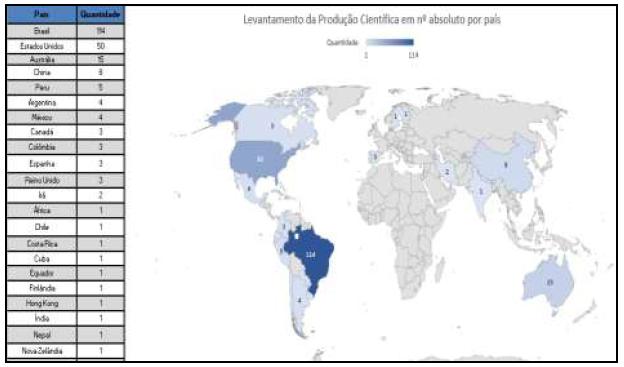
Based on an investigation of all the databases used, it emerged that the 10 countries most engaged in internationalization studies and research based on the descriptors used are Brazil, the United States, Australia, China, Peru, Argentina, Mexico, Colombia, Spain and Canada. It should be noted that 7 of the 10 countries mentioned above belong to the American continent, which means that the continent has been the scene of discussions and problematizations that cover the spectrum of the word internationalization, encompassing the etymology of the term, its uses and applications.
In this sense, it has become clear that the continent has been placed in a constructivist perspective, with the relative concern of governmental and academic entities with the development of university internationalization. The following is a total survey of scientific production in absolute numbers by country (table 2) (figure 1).
Table 2 Survey of scientific production in absolute numbers by country
| Country | Quantity (Absolute numbers) |
|---|---|
| Brazil | 114 |
| Mexico | 04 |
| Colombia | 03 |
| Spain | 03 |
| Uruguay | 01 |
| Paraguay | 01 |
| Costa Rica | 01 |
| Peru | 05 |
| Chile | 01 |
| United States | 50 |
| Australia | 15 |
| Ecuador | 01 |
| India | 01 |
| Hong Kong | 01 |
| Nepal | 01 |
| Argentina | 04 |
| China | 08 |
| Iran | 02 |
| Cuba | 01 |
| Portugal | 01 |
| United Kingdom | 03 |
| Canada | 03 |
| New Zealand | 01 |
| Shanghai | 01 |
| Africa | 01 |
| Sweden | 01 |
| Finland | 01 |
Source: Alves and Abba (2022).
Table 2 shows that Brazil, the United States and Australia are among the countries most engaged in studies and research on internationalization. Brazil is in 1st place, with 114 papers, a fact that is evident from the number of papers published. Next, you can see the number of papers published in the different databases and digital repositories.
(a) BDTD Portal: 05 papers from Brazil;
(b) Portal de Periódicos (CAPES) database: 08 papers from Brazil, 08 papers from Australia, 03 papers from Colombia, 03 papers from Spain, 03 papers from the United States, 01 paper from Paraguay, 01 paper from Uruguay, 01 paper from Mexico, 01 paper from Costa Rica, 01 paper from Peru and 01 paper from Chile;
(c) CLACSO database: 01 paper from Ecuador, 01 paper from Argentina and 04 papers from Peru;
(d) ERIC database: 28 papers from the United States;
(e) Redalint database: 19 papers from Brazil, 03 papers from Mexico and 03 papers from Argentina;
(f) SciELO database: 79 papers from Brazil;
(g) SciVerse Scopus database: 19 papers from the United States, 08 papers from China, 07 papers from Australia, 03 papers from Brazil, 03 papers from Canada, 03 papers from the United Kingdom, 02 papers from Iran, 01 paper from Cuba, 01 paper from Sweden, 01 paper from Portugal, 01 paper from New Zealand, 01 paper from Shanghai, 01 paper from Africa, 01 paper from India, 01 paper from Finland, 01 paper from Hong Kong and 01 paper from Nepal.
Still in relation to Brazil, the themes that have been studied by Brazilian researchers include: Internationalization of Higher Education, Internationalization of the Curriculum, International Degree Programs, international cooperation, academic mobility of teachers and students, basic education curriculum aligned with internationalization, global citizenship and interculturality.
In this dialogue, it is clear that Marília Costa Morosini is a Brazilian researcher who has excelled in research on the internationalization of basic and higher education. With a vast curriculum, Morosini is currently a CNPq 1A productivity scholarship holder, a member of the Ibero-American Association of University Teaching and Coordinator of the Centro de Estudos em Educação Superior (Center for Studies in Higher Education), being one of the main references of this research.
In relation to the United States, the country is in second place with 50 papers, and among the themes most explored by US researchers, include: Internationalization of Higher Education, Internationalization of the Curriculum, international mobility of programs and providers, double degrees, international cooperation, global rankings and offshore education.
Australia is in third place with 15 papers. Among the themes most worked on by Australian researchers are: Internationalization of the Curriculum, disciplinary theory and practice aligned with the Internationalization of the Curriculum, critical perspective of internationalization and internationalization policies in basic and higher education.
In this regard, Betty Leask is an Australian researcher who has stood out on the global stage with research into internationalization. She is a professor at La Trobe University in Australia and the editor of the Journal of International Studies in Education, making her one of the main references for this research.
Still in relation to the information found, it is possible to detect the leading role of Latin America in academic productions aligned with internationalization with approximately 60% of the works, evidencing the concern of Latin American countries to promote university internationalization. In line with the information found, Beneitone (2019) states that most Latin American countries have been reformulating their higher education systems in line with internationalization due to its importance within the knowledge society.
Source: Prepared by the authors (2022).
Figure 1 Map of the survey of scientific production in absolute numbers by country
In fact, the internationalization of higher education and the internationalization of the curriculum have been driving educational reform in various countries (Knight, 2020), based on ensuring curricular flexibility in the training of students based on the development of global competencies and skills.
Regarding the contributions of the studies found related to the internationalization of the degree curriculum in chemistry, it can be seen from the descriptors used in the different searches that the subject is little explored because, despite the number of studies found, there is no predominance of research focused on the internationalization of the degree curriculum in chemistry.
Thus, in line with the aim of this research, which is to analyze the internationalization of the degree curriculum in chemistry, presenting a survey of academic works in the main databases and digital repositories, among the databases searched, only one work related to the four descriptors used (and related to the research proposal) was found, which is the master's research entitled A formação inicial de professores de química e a internacionalização do ensino superior no Brasil, by the author Clóvis Reis da Silva Júnior, which was defended in 2017 at the University of São Paulo (USP) and is available on the BDTD Portal.IBICT.
In his dissertation, Silva Júnior (2017) reflects on the importance of the initial training of chemistry teachers for the development of teaching work, indicating the need for further theoretical study.
Next, there is a list of research that is indirectly related to the internationalization of the chemistry curriculum, with a total of 38 papers, which are available in the list of connections to the prescribed theme in the databases used (box 1).
Box 1 Works that are indirectly related to the internationalization of the chemistry curriculum
| Nº | Paper title |
|---|---|
| 1 | A Internacionalização do Ensino Superior e a Formação Inicial de Professores: um estudo do Programa Licenciaturas Internacionais na UFRN (2010-2013) |
| 2 | Perspectiva da Educação Superior a partir de um Olhar de Qualidade |
| 3 | Ciência sem Fronteiras: perspectivas da internacionalização e a experiência australiana |
| 4 | Cooperação Acadêmica Internacional da CAPES na Perspectiva do Programa Ciência sem Fronteiras |
| 5 | Monitoramento e Avaliação de Programas de Mobilidade Acadêmica Internacional: um estudo do Ciência sem Fronteiras |
| 6 | Currículo da Educação Básica Brasileira: convergências com o discurso educacional global em contexto de internacionalização |
| 7 | Internacionalização do Currículo: um estudo de caso com professores de ciências da natureza dos Estados do Ceará e Sergipe/Brasil |
| 8 | Uso del Enfoque CLIL como Estrategia de Internacionalización del Currículo en una Institución de Educación Superior Colombiana |
| 9 | La Internacionalización Universitaria, un Imperativo de la Educación Superior en el Contexto Latinoamericano Actual |
| 10 | Internacionalización y Europeización de la Educación Superior en Derecho: campus universitario internacionales y programas transfronteiriços de educación superior |
| 11 | El Impacto de las Estancias Internacionales en el Desarrollo de Competencias en Estudiantes de Doctorado y su Transferencia en Diversos Contextos |
| 12 | Potential for Chemistry in Multidisciplinary, Interdisciplinary, and Transdisciplinary Teaching Activities in Higher Education |
| 13 | Internacionalización y Educación ¿Semántica o Política? |
| 14 | Límites y Potencialidades para el Desarrollo de una Internacionalización de la Educación Superior Necesaria: estudio de caso de La UNILA (Brasil) y La ELAM (Cuba) |
| 15 | Caminhos da Internacionalização Universitária: o caso da UFRB |
| 16 | Dinámica de Internacionalización Universitaria en América Latina |
| 17 | As Ações Públicas de Internacionalização da Educação Superior no Brasil e o seu Alinhamento com a Política Externa Brasileira no Governo Dilma Rousseff 2011-2014 |
| 18 | A Internacionalização da Educação Superior: um estudo de caso da Universidade Federal de Santa Catarina |
| 19 | O Processo de Internacionalização da Universidade de São Paulo: um estudo em três áreas de conhecimento |
| 20 | Inovação, Universidade e Internacionalização: boas práticas na PUCRS |
| 21 | Internacionalização da Educação Superior e Política Externa Brasileira: estudo da criação da Universidade Federal da Integração Latino-Americana (UNILA) |
| 22 | A Formação de Professores de Química, Mudanças na Regulamentação e os Impactos na Estrutura em Cursos de Licenciatura em Química |
| 23 | Formação Docente no Ensino Superior de Química: contribuições dos programas de aperfeiçoamento de ensino |
| 24 | O Espaço da Prática de Ensino e do Estágio Curricular nos Cursos de Formação de Professores de Química da Internacionalização da Educação Superior Públicas Paulistas |
| 25 | A Graduação em Química: um novo químico para uma nova era |
| 26 | Internationalising Programmes in Higher Education: An educational development perspective |
| 27 | La Internacionalización de la Educación Superior: importância de la participación de los docentes en redes |
| 28 | Internationalization of Higher Education: impacts, challenges and future possibilities |
| 29 | Introduction of Internationalization into Higher Education Curricula |
| 30 | Internationalization at Home: a study of a comprehensive regional university |
| 31 | Internationalization of Humanities Disciplines in Chinese Higher Education |
| 32 | Internationalizing the Curriculum |
| 33 | Internationalization of the Curriculum: teaching and learning |
| 34 | Transformative Learning Through Internationalization of the Curriculum in Higher Education |
| 35 | The Internationalization of Curriculum Research |
| 36 | Internationalization: a transformative agenda for higher education? |
| 37 | Internationalization of the Chemistry Curriculum: two problem-based learning activities for undergraduate chemists |
| 38 | Estudos de Currículo: avanços e desafios no processo de internacionalização |
Source: Prepared by the authors (2022).
The works listed mobilize reflections on the internationalization process in various areas, dialoguing with authors such as Abba (2018), Beneitone (2019), Knight (2020), Leask (2015, 2021) and Morosini (2018), positioning the curriculum in the face of teacher training needs, making pedagogical practices a driving mechanism for internationalization.
Indeed, internationalization has been one of the crucial factors in shaping higher education in recent decades (Knight, 2020) and has been responsible for the inclusion of aspects such as Comparative Education, Borderless Education, Transnational Education, Virtual Education, Internationalization at Home and Cross-Border.
In view of the fact that the internationalization of the curriculum has become a fundamental aspect of the internationalization of higher education, academic productions contribute greatly to theoretical deepening in the area of study in question, affecting its epistemological and ontological deepening.
Thus, in line with the expansion of the internationalization of higher education, there is the internationalization of the chemistry degree curriculum, focusing on the development of actions motivated by the creative process, scientific research and socio-cultural intervention, culminating in activities such as academic mobility and the development of projects with a view to promoting global citizenship and interculturality.
4 Conclusions
In the course of this research, we sought to systematize and publicize the works related to the internationalization of the degree curriculum in chemistry available in the main databases and digital repositories. As an educational phenomenon, it can be seen that internationalization has had an impact on universities and the way the curriculum has been worked on in Higher Education Institutions and, in this regard, it has been possible to highlight the leading role of researchers from the American continent in academic productions aligned with university internationalization.
Based on the research findings, it was also possible to identify that Brazil, the United States and Australia are in the ranking of the three countries most engaged in studies and research on internationalization. Among the topics that have been studied by researchers are: Internationalization of Basic and Higher Education, Internationalization of the Curriculum, International Degree Programs, international cooperation and academic mobility of teachers and students.
In this regard, the importance of using reliable digital databases and repositories is clear as a way of enabling the theoretical basis of academic research and projects, providing digital certification and pointing to the responsibilities of the information made available to the academic community.
With regard to the internationalization of the degree curriculum in chemistry, it was found that the topic has been little explored, since publications on the subject are incipient and, given its relevance to the training of chemistry teachers, this research provides subsidies in order to encourage the development of work in this area.
In this way, it is hoped that this work will contribute to strengthening the internationalization of the degree curriculum in Chemistry, presenting the possibilities of deepening the content related to the subject and making it possible to visualize the dimensions worked on at local and global levels.
REFERENCES
ALVES, Suiane Costa; ABBA, Maria Julieta. Internacionalização do Currículo de Ciências da Natureza: uma breve análise a partir da revisão de literatura. In: OLIVEIRA, Arusha Kelly Carvalho de et al. (org.). Literatura popular: memórias e resistências. Fortaleza: Editora Imprece, 2022. v. 7. p. 391-401. [ Links ]
ALVES, Suiane Costa. Educação Ambiental e Interdisciplinaridade: proposta pedagógica de práticas laboratoriais no componente curricular de química. 1. ed. Recife: Even3 Publicações, 2021. E-book. Disponível em: https://publicacoes.even3.com.br /book/educacao-ambiental-e-interdisciplinaridade-459425. Acesso em: 21 mar. 2023. [ Links ]
BARDIN, Laurence. Análise de conteúdo. Lisboa: Edições 70, 1977. Documento em PDF. Disponível em: https://edisciplinas.usp.br/pluginfile.php/7684991/mod_resource/ content/1/BARDlN__L._1977._Analise_de_conteudo._Lisboa__edicoes__70__225.20191102-5693-11evk0e-with-cover-page-v2.pdf. Acesso em: 15 maio 2024. [ Links ]
BELTRAN, N. O.; CISCATO, C. A. M. Química. São Paulo: Editora Cortez, 1991. [ Links ]
BENEITONE, Pablo. Un modelo para analizar la internacionalización del currículo en las universidades. In: LEASK, Betty et al. (org.). Reimaginar la internacionalización del currículo: mejores prácticas y possibilidades prometedoras. 1. ed. Guadalajara: Universidad de Guadalajara, 2021. p. 59-90. [ Links ]
CENTRO DE ESTUDOS INTERNACIONAIS EM EDUCAÇÃO (CEIE). Atividades. São Leopoldo: CEIE, 2023. Disponível em: http://www.unisinos.br/ceie/atividades/. Acesso em: 21 fev. 2023. [ Links ]
CONSEJO LATINOAMERICANO DE CIENCIAS SOCIALES (CLACSO). Buenos Aires, 2022. Disponível em: https://www.clacso.org/. Acesso em: 9 jun. 2022. [ Links ]
COORDENAÇÃO DE APERFEIÇOAMENTO DE PESSOAL DE NÍVEL SUPERIOR (CAPES). Missão e objetivos. Brasília, DF: CAPES, 2022a. Disponível em: https://www-periodicos-capes-gov-br.ezl.periodicos.capes.gov.br/index.php/sobre/missao-e-objetivos.html. Acesso em: 9 jun. 2022. [ Links ]
COORDENAÇÃO DE APERFEIÇOAMENTO DE PESSOAL DE NÍVEL SUPERIOR (CAPES). Acesso CAFe. Brasília, DF: CAPES, 2022b. Disponível em: https://www-periodicos-capes-gov-br.ezl.periodicos.capes.gov.br/index.php/acesso-cafe.html. Acesso em: 9 jun. 2022. [ Links ]
CRUZ, Fabielle Rocha; FERREIRA, Jacques de Lima. Estudos de revisão em Educação: estado da arte e revisão sistemática. Revista Espaço Pedagógico, Passo Fundo, v. 30, e11512, p. 1-15, 2023. Disponível em: https://seer.upf.br/index.php/rep/article/view/11512. Acesso em: 9 jun. 2024. [ Links ]
ELSEVIER. Dados do Scopus. [S. l.]: Elsevier, 2022. Disponível em: https://www.elsevier.com/pt-br/products/scopus/data. Acesso em: 11 jun. 2022. [ Links ]
INSTITUTE OF EDUCATION SCIENCES (IES). Department of Education. National Center for Education Evaluation and Regional Assistance (NCEE). What is ERIC? Washington: IES, 2022. Disponível em: https://ies.ed.gov/ncee/projects/eric.asp. Acesso em: 9 jun. 2022. [ Links ]
INSTITUTO BRASILEIRO DE INFORMAÇÃO EM CIÊNCIA E TECNOLOGIA (IBICT). Biblioteca Digital Brasileira de Teses e Dissertações (BDTD). Brasília, DF: IBICT, 2022. Disponível em: https://bdtd.ibict.br/vufind/. Acesso em: 9 jun. 2022. [ Links ]
KNIGHT, Jane. Internacionalização da educação superior: conceitos, tendências e desafios. São Leopoldo: Oikos, 2020. [ Links ]
LEASK, Betty. Internationalizing the curriculum. United States: British Library, 2015. [ Links ]
LEASK, Betty. Reimaginar las mejores prácticas en la internacionalización del currículo. LEASK, Betty et al. (org.). Reimaginar la internacionalización del currículo: mejores prácticas y posibilidades prometedoras. 1. ed. Guadalajara: Universidad de Guadalajara, 2021. p. 21-58. [ Links ]
MARIANO CARVALHO, Yuri. Do velho ao novo: a revisão de literatura como método de fazer ciência. Revista Thema, Pelotas, v. 16, n. 4, p. 913-928, 2020. Disponível em: https://periodicos.ifsul.edu.br/index.php/thema/article/view/1328. Acesso em: 13 jun. 2024. [ Links ]
MINAYO, Maria Cecília de Souza. O desafio do conhecimento: pesquisa qualitativa em saúde. 13. ed. São Paulo: Hucitec, 2013. [ Links ]
MOROSINI, Marília Costa. Internacionalização do currículo: produção em organismos multilaterais. Revista Roteiro, [s. l.], v. 43, n. 1, jan./abr. 2018. Disponível em: https://periodicos.unoesc.edu.br/roteiro/article/view/13090. Acesso em: 27 mar. 2024. [ Links ]
NAZARETH, Camila Cristine Gomes. Revisão de Literatura e Revisão Sistemática: uma análise objetiva. Revista Fluminense de Odontologia, Ano XXVII, n. 55, jan.-jul., 2021. Disponível em: https://periodicos.uff.br/ijosd/article/view/43132. Acesso em: 31 jul. 2024. [ Links ]
RED DE INVESTIGADORES Y GESTORES EN INTERNACIONALIZACIÓN DE LA EDUCACIÓN SUPERIOR DE AMÉRICA LATINA (REDALINT). [S. l.]: REDALINT, 2022. Disponível em: https://acervo.redalint.org/. Acesso em: 10 jun. 2022. [ Links ]
SCIENTIFIC ELECTRONIC LIBRARY ONLINE (SCIELO). São Paulo: SciELO, 2022. Disponível em: https://www.scielo.br/. Acesso em: 14 jun. 2022. [ Links ]
SILVA JÚNIOR, Clóvis Reis da. A formação inicial de professores de química e a internacionalização do ensino superior no Brasil. 2017. Dissertação (Mestrado em Ciências) - Faculdade de Ciências, Filosofia e Letras, Universidade de São Paulo, Ribeirão Preto, 2017. Disponível em: https://teses.usp.br/teses/disponiveis/59/59140/tde-29032018-114210/pt-br.php. Acesso em: 8 dez. 2022. [ Links ]
SOUZA, Luciana Gonçalves Silva; AGANETTE, Elisângela Cristina. Repositórios digitais confiáveis: uma revisão da literatura nacional e internacional publicada em periódicos científicos. Informação & Sociedade, João Pessoa, v. 30, n. 1, p. 1-20, jan.-mar., 2020. Disponível em: https://periodicos.ufpb.br/ojs2/index.php/ies/article/view/45426. Acesso em: 10 jun. 2024. [ Links ]
TRIVIÑOS, Augusto Nibaldo Silva. Introdução à pesquisa em ciências sociais: a pesquisa qualitativa em educação. São Paulo: Atlas, 1987. [ Links ]
1There are small fragments of this text that have already been quoted in another publication of ours dated 2022.
How to cite this article (ABNT): ALVES, Suiane Costa; ABBA, Maria Julieta. Internacionalização do currículo da licenciatura em Química: um olhar sistematizado da revisão de literatura. Rev. Pemo, Fortaleza, v. 7, e13832, 2025. Available at: https://revistas.uece.br/index.php/revpemo/article/view/13832
Received: August 25, 2024; Accepted: December 24, 2024; Published: February 05, 2025
 Este é um artigo publicado em acesso aberto sob uma licença Creative Commons
