
“The civilizing lights of instruction”: social and educational practices of black brotherhoods in the 19th century

Cadernos de História da Educação
versão On-line ISSN 1982-7806
Cad. Hist. Educ. vol.24 Uberlândia 2025 Epub 12-Jan-2026
https://doi.org/10.14393/che-v24-e2025-32
PAPERS
“The civilizing lights of instruction”: social and educational practices of black brotherhoods in the 19th century1
3
 http://orcid.org/0000-0001-5074-4401; lattes: 5705471852776970
4
http://orcid.org/0000-0003-4604-6912; lattes: 1169208862869370
3Universidade de São Paulo (Brasil), jrribeiro@usp.br
4Instituto Federal de Educação, Ciência e Tecnologia de São Paulo (Brasil), wcghist@hotmail.com
Based on the investigation of a petition dated October 1878, in which 19 members of the Irmandade de Nossa Senhora do Rosário dos Homens Pretos de Sabará, Minas Gerais, requested the province's General Inspectorate of Public Education to open and fund a "first-letter class" organized by the brotherhood, this article analyzes the educational processes and practices involved in the establishment of this political-educational project. It also investigates other forms of sociability and solidarity-devotional, spiritual, and mutualistic-that involved some form of learning, exchange, and/or transmission of knowledge, wisdom, and beliefs. The objective was to understand the polysemy of the social meanings of education and the experience of educating oneself, in order to highlight the diversity of educational practices present in the brotherhood's associations in Minas Gerais in the second half of the 19th century.
Keywords: Education; Black Brotherhoods; Citizenship; Nineteenth Century.
A partir da investigação de um abaixo-assinado datado de outubro de 1878, no qual 19 confrades da Irmandade de Nossa Senhora do Rosário dos Homens Pretos de Sabará, em Minas Gerais, solicitavam à Inspetoria Geral da Instrução Pública da província a abertura e a subvenção de uma “aula de primeiras letras” organizada pela confraria, este artigo analisa os processos e práticas educativas envolvidos na constituição desse projeto político-educativo. Investiga-se, também, outras formas de sociabilidade e solidariedade - devocional, espiritual e mutualista - que implicaram algum tipo de aprendizado, troca e/ou transmissão de conhecimentos, saberes e crenças. O objetivo foi compreender a polissemia dos significados sociais da educação e da experiência do educar-se, a fim de evidenciar a diversidade de práticas educativas presentes no associativismo confrarial em Minas Gerais, na segunda metade do século XIX.
Palavras-chave: Práticas sociais e educativas; Associativismo confrarial; Cidadania; Educação no século XIX.
A partir de la investigación de una solicitud colectiva fechada en octubre de 1878, en la que 19 miembros de una Hermandad Negra en Brasil pedían a las autoridades públicas la apertura y el subsidio de una escuela, este artículo analiza el proyecto educativo desarrollado por dicha hermandad. También se investigan otras formas de sociabilidad y solidaridad - devocional, espiritual y mutualista - que implicaron algún tipo de aprendizaje, intercambio y/o transmisión de conocimientos, saberes y creencias. El objetivo es comprender la polisemia de los significados sociales de la educación, con el fin de evidenciar la diversidad de prácticas educativas presentes en las hermandades negras en Brasil durante la segunda mitad del siglo XIX.
Palabras clave: Educación; Hermandades Negras; Ciudadanía; Siglo XIX.
Introduction
There is extensive critical fortune about the history of confraternity associations in Brazil, spanning different timelines, especially during the colonial and imperial periods. In the field of history, the trajectory of lay brotherhoods and the experiences of their members have been approached from different analytical and methodological perspectives. It is beyond the scope of this article to undertake a "state-of-the-art" review of this historiography, as undertaken by Lucilene Reginaldo (2018). In the field of research and teaching in the History of Education, the history of confraternity associations remains a largely under-researched topic, present only in a few recent and embryonic studies.
These studies often investigate how the social practices, with a moral and/or religious basis, of lay brotherhoods acquired an educational character. In Paola Bessa Cunha's interpretation (2008, p. 47), "lay brotherhoods, as spaces of social coexistence, enabled the development of educational practices related to religion and also linked to the morality and ideals of civilization prevailing in the 18th and 19th centuries." Despite the recognition that confraternal associations, through lay brotherhoods and their political cultures, constituted an instance promoting educational practices, many gaps remain regarding the role of these religious institutions in shaping educational processes-both in the scope of what can be called moral and religious education (devotional practices, funeral rites, worship, and the celebration of the patron saint's feast), and in the dimension of formal education or instruction, such as learning trades and teaching reading and writing. In this sense, the educational behaviors created, experienced, and disseminated by confraternal associations, in their polysemy of forms, actions, and meanings, have not yet been established as a systematic object of research, either in the field of History or in the History of Education.
Based on an investigation of the documentation produced by the Irmandade de Nossa Senhora do Rosário dos Homens Pretos de Sabará, Minas Gerais-such as the Livro de Compromisso e Regimento, Livro de Receitas e Despesas, Livro de Entrada e o Livro de Atas de Deliberações da Mesa Administrativa, covering the period between the 1850s and 1890s-and, especially, on the analysis of a petition dated October 1878, in which 19 confreres petitioned the Inspetoria Geral da Instrução Pública of the province of Minas Gerais to open and fund a "first-letter class" organized by the confraternity, this article analyzes the educational processes and practices involved in the establishment of this political-educational project. We also investigated other forms of sociability and solidarity-devotional, spiritual, and mutualistic-that involved some form of learning, exchange, and/or transmission of knowledge, wisdom, and beliefs. Our goal was to understand the polysemy of the social meanings of education and the experience of education, in order to highlight the diversity of educational practices present in confraternal associations in Minas Gerais in the second half of the 19th century.
Black lay brotherhoods were collective aid associations dedicated to charitable works and the social, material, and spiritual protection, preferably of their own members. Committed to the worship of saints or patrons worshipped by Black populations (but not exclusively), such as Nossa Senhora do Rosário, São Benedito, Santo Elesbão, Santa Efigênia, and others, they played a significant social role as spaces for promoting identities, solidarity, and group cohesion among black individuals of varying legal status (enslaved, freed, and free) in a slave society (REGINALDO, 2018).
It was amid this associative political culture that some Black brotherhoods, in different parts of the country, especially throughout the 19th century, created different modalities of education aimed not only at their community of confreres, but in some cases, also at the general population. In addition to proposals for moral or religious education, associated with the individual's formation for life in society, there were also projects aimed at providing access to schooling and learning to read and write, evidencing these communities' interest in school as a socially valued device from the 19th century2 onward. This was the case, for example, with the Irmandade de Nossa Senhora do Rosário and São Benedito dos Homens Pretos, in Rio de Janeiro, founded in the 17th century. In the mid-1880s, it established an elementary school specifically, though not exclusively, for the orphaned sons and daughters of its members. According to Perses Maria Canellas da Cunha:
The Brotherhood's purpose was not only to educate the brothers, providing them with reading, writing, and arithmetic skills, but also to educate them to exercise their citizenship [...]. Beyond literacy, teaching reading and writing, the objective was to establish a new identity as a free and cultured citizen. [From this perspective], the creation of the school enabled its members to recreate a new identity based on freedom and education (CUNHA, 2004, p. 40, 41).3
In a study of the world of education in nineteenth-century Brazilian society, Alessandra Schueler and José Gonçalves Gondra (2008, p. 11) observed the multiplicity of educational experiences carried out "by societies, academies, associations, and various educational bodies that organized initiatives aimed at educating the population, constituted by 'good society,' but also by poor children, Black people, Indigenous people, immigrants, and women" who worked in the field of education in Imperial Brazil. Black brotherhoods were deeply integrated into this movement, which the authors called the “production of 19th-century educational forms” (GONDRA; SCHUELER, 2008, p. 16). In this context, we can highlight the educational experiences promoted by the Irmandade de São Benedito dos Homens Pretos, in São Luís do Maranhão, founded in 1821, which maintained elementary education activities for its members at intervals throughout the 19th century (GONDRA; SCHUELER, 2008, p. 247). Other brotherhoods, such as that of Nossa Senhora do Rosário dos Homens Pretos do Pelourinho, in Salvador, in the province of Bahia, did not directly create educational projects, but they fostered this type of educational initiative in other ways. In 1867, for example, this brotherhood "rented its church premises as a classroom to public schoolteacher Dr. Luiz Alvarez dos Santos, who set up his classroom in the Rosário Hall" (FARIAS, 1997, p. 75).
Regarding brotherhood associations in the province of Maranhão in the nineteenth century, Mariléia dos Santos Cruz investigated the trajectory of Black brotherhoods that developed educational practices aimed at promoting forms of education alongside schooling, such as the Sociedade Beneficente Fim-Humanitário in the capital of Maranhão, founded on October 22, 1879. In the author's words:
This entity-directly linked to the Senhor Bom Jesus da Cana Verde brotherhood, established in the Igreja das Mercês - declared its purpose "to assist its members in times of illness or death, and to contribute to the recovery of the freedom of those among them who are slaves." While the brotherhood focused on religious worship, the Sociedade Beneficente Fim-Humanitário focused on mutual aid among its members. In addition to promoting freedom among its members, the association also focused on promoting literacy among its illiterate members (CRUZ, 2008, p. 81).
As Itacir Marques da Luz (2016) pointed out, educational projects, of different formats and with distinct purposes, constituted fundamental elements in the associative dynamics of Black brotherhoods, enabling the sharing of values and knowledge among their members. These organizations established themselves as "instances of educability and identity affirmation for Black populations" across different historical timelines (LUZ, 2016, p. 138). Lúcia Regina Brito Pereira also investigated the expressions of sociability among black brotherhoods in Rio Grande do Sul in the nineteenth century, understanding them as educational fields created by (and for) black populations. In a study of the Irmandade de N. S. do Rosário dos Pretos de Porto Alegre, between the second half of the nineteenth century and the first decades of the twentieth century, the author pointed out that the primary school created by this brotherhood in 1903 was “especially intended for the support and free education of poor and unfortunate boys exposed to idleness, vice, and sometimes even crime” (PEREIRA, 2010, p. 84). The initiative seems to have been somewhat well-received in that society, so much so that, according to the author (2010, p. 84), the school was “one of the most traditional in the city of Porto Alegre.”
The many meanings attributed to education, both as a dimension of social life and as school instruction centered on learning to read and write and other knowledge considered elementary, were part of the political culture of confraternal associations over a broad period of time, not limited to the 19th century, as demonstrated by Lúcia Regina Brito Pereira's study of the educational projects of the Irmandade de N. S. do Rosário dos Pretos de Porto Alegre, developed in the early 20th century. A similar situation occurred with the brothers of the Irmandade de São Benedito of Campinas, in the interior of the state of São Paulo.
In the mid-1890s, this brotherhood began a project to build a school for its illiterate brothers. To this end, it created the Sociedade de Instrução São Benedito, whose purpose was "to maintain a school of instruction for the brothers and children of the brothers of the Irmandade de S. Benedito " (PEREIRA, 2001, p. 20). The experience of Black educational associations in Campinas, however, was more complex. According to José Galdino Pereira, in 1902, the brothers of São Benedito invited the then-Black teacher Francisco José de Oliveira to create a school to "teach the children of the city's men of color." Thus, "in the backyard of the Igreja de São Benedito, o Colégio São Benedito " was founded (PEREIRA, 2001, p. 25, 27, 49). This new initiative continued the project begun with the Sociedade de Instrução São Benedito, which, according to the author, was short-lived.
This brief historiographical summary highlights the analytical perspectives adopted by some of the studies dedicated to investigating the universe of educational forms and practices created and experimented within Black fraternal associations. We can infer that these educational projects were concerned with establishing training processes for members so they could integrate into the life of imperial and, later, republican society, according to socially accepted and legitimized references and values. One of these prerogatives concerned legal freedom, in the case of people subjected to the yoke of slavery; there was, however, also a political interpretation that associated education-understood as synonymous with school or schooling-with the more traditional meanings of citizenship, that is, upward social mobility and public respectability. These political values were not to be confused with the notion of political citizenship, that is, the right to vote or to be an elector and to actively participate in institutionalized politics. However, concepts that correlated citizenship and literacy became increasingly present, both in political-parliamentary debates and legislation, and in the social imagination, especially after the electoral reform of 1881, which established literacy as a requirement for electoral participation and the exercise of political rights (MAC CORD, 2014; SOUZA, 2020).
In this context, where the acquisition of rights gradually transformed into "privileges" due to the enormous bureaucratic and social difficulties that hindered citizens' voter registration, educational projects, in their diverse forms and purposes, carried out by different social groups, such as Black brotherhoods, can be interpreted as models of struggles and achievements that opened up gaps and precedents for the formulation of a more universalizing conception of education, especially schooling, as synonymous with citizenship rights. Indeed, as Mariana Mesquita (2022) observed, Black confraternal associations produced different meanings of citizenship based on their political cultures, with social and educational practices being one of their expressions. It is also through this interpretative lens that we investigate the experiences of the "first-letter class" of the Irmandade de N. S. do Rosário of Sabará.
"Defend, protect, and propagate the cause of Black brothers"
The beginnings of the Irmandade de N. S. do Rosário of Sabará date back to the city's very constitution, in the late 17th century. In 1718, the then-bishop of Rio de Janeiro, Francisco de São Jerônimo, approved the brotherhood's first commitment, which also stated that it had been awaiting a response to the document's request for approval for several years (PASSOS, 1942, p. 13). Its creation may have occurred concurrently with, or very close to, the construction of the first chapel dedicated to the Virgem do Rosário. According to memoirist Zoroastro Viana Passos (1942, p. 283), this temple "must have been built in 1701 or very close to that time." In any case, throughout the 18th and 19th centuries, it stood, protecting the images of Nossa Senhora do Rosário, São Benedito and São Caetano, and praising its community and its ancestors.
The profile of its members was quite diverse, both in terms of legal status (enslaved, freed, and free), social and racial status (Black, mixed-race, mixed-race, white), and ethnic status (African and Creole)-a characteristic also shared by the city's other Black brotherhoods (PASSOS, 1942, p. 327). In addition to practicing charity, expanding the Christian faith, and devoting themselves to Black saints, the Irmandade Nossa Senhora do Rosário served as a space for socialization and the formation of bonds of friendship, spiritual kinship, and, above all, ethnic and racial solidarity.
The brotherhood was responsible for the development of forms of Afro-Catholic devotion, a remodeled and significantly Africanized form of Catholicism. This experience manifested itself in cultural practices such as the Festa de Nossa Senhora do Rosário and the Black Reigns (or Congadas), in addition to the significant presence of fellows of African descent-from diverse backgrounds ethnic groups - until the mid-1850s, as recorded in the 1855 Livro de Entrada. This document listed the brotherhood's new members, indicating their origin, legal status, race, and gender (IRMANDADE, 1855). Consistent with a previous study (RIBEIRO, 2022), the decline in the presence of African confreres from the second half of the 1850s onward may have been a consequence of the Eusébio de Queirós Law (1850), which prohibited the Atlantic slave trade of Africans to Brazil.
In any case, the confreres (African or Brazilian) of the Irmandade Nossa Senhora do Rosário of Sabará promoted appropriations and reinventions of an Afro-diasporic Catholicism throughout the 19th century. Certainly, these ideals of religion and religiosity were present in the formation of its associative policy at various times, such as in 1878, when some of the members managed to approve the creation of a "benevolent society" within the brotherhood. According to its internal bylaws, the main objective of the "Sociedade do Rosário" was to "defend, protect, and propagate the cause of our Black brothers" (SOCIEDADE, 1879, p. 2). Although the Irmandade Nossa Senhora do Rosário of Sabará had established itself as an important associative space for the Black population, a group of members realized that its associative policy was insufficient to meet their needs, so they formed another association within the brotherhood.
The membership of the Sociedade do Rosário was comprised exclusively of the brotherhood's members, but membership was not compulsory; that is, only those who desired membership were allowed. According to its internal regulations, it was administered by a council composed of first and second secretaries and a treasurer. This same document organized its main lines of action, which were guided by the following purposes:
To assist brothers in poverty or suffering from serious and chronic illness (decrepitude, crippling, blindness, or any other illness that prevents them from working); to provide medicines through the pharmacy designated by the council; to assist the widows of brothers who live honestly; to assist the brothers' orphaned children; to hire a lawyer to assist the brothers whenever they need it; and to develop the civilizing light of instruction for the brothers through the creation of a primary school classroom run by an upright and honest citizen (SOCIEDADE, 1879, pp. 2-4). Our emphasis.4
The associative program of the Irmandade Nossa Senhora do Rosário, in turn, focused on devotion and charity as links in the formation of identities and protection among its members. In the first chapter of the 1871 Commitment, which governed the individuals who could comprise the brotherhood, the document dictated that it would be made up of Black people of both sexes, free, freed, or enslaved, without distinction of nationality or origin, as long as they professed the Catholic religion. White people could be admitted, but their presence would be limited to occupying positions of devotion. Finally, the chapter established that the brotherhood "had the purpose of providing collective support, promoting fellowship, and safeguarding the unity and interests of the Black brothers of the Rosary" (IRMANDADE, 1871, p. 2). 5
According to the members of the Sociedade do Rosário, the justification for creating the "first letters class" was based on the argument that "knowledge of the art of reading and writing [was] the only and precious element upon which the edifice of civilization rested and traced the principle of human material and moral happiness" (IRMANDADE, 1878, p. 14). This fragment is part of a petition dated October 1878, in which 19 "members of the respectable Irmandade Nossa Senhora do Rosário " - as recorded in the document - intended to petition the Diretor Geral da Instrução Pública of the province of Minas Gerais to open and fund a "first letters class" organized by the brotherhood, which the signatories identified as a "praiseworthy act of philanthropy for the Sabará community" (IRMANDADE, 1878, p. 14).
Drawing its arguments from the universalist and enlightened ideologies that circulated in the mid-19th century, in which elementary education, especially the nascent public schools, figured as models of civilizing reference, the rhetoric of the petition of the members of the Irmandade Nossa Senhora do Rosário emphasized the advantages of investing in the formal education of the population. According to the observation of José Gonçalves Gondra and Daniel Lemos:
The petitions or collective correspondences were documents that brought into play agents in movements, which sought to intervene and shape the school and its very functioning [...]. The individuals who signed the petitions captured, gathered, and established opinions and positions, which, to a large extent, can also be understood as a mechanism that led to the very constitution of these individuals as agents seeking to deliberate on issues of interest to them (GONDRA; LEMOS, 2006, p. 190, 191).
By recognizing that "knowledge of the art of reading and writing [was] the only and precious element upon which the edifice of civilization rested," the collective correspondence of the members of the Rosário de Sabará debated these individuals' conceptions and expectations regarding the notion of elementary education prevalent at that historical moment. In this sense, the process of transmitting knowledge and acquiring schooled knowledge could become means of achieving public respectability or better positions in the world of work, among many other possibilities, in that society. From this perspective:
In the petitions demanding the creation or funding of elementary schools, schooling was not exclusively configured as a project imposed by the State. Schooling, especially primary school, constituted a demand and demand of a minimally organized segment of the population who, by alerting the government to the lack of support or even schools, indicated the legitimacy they attributed to the schooling movement (GONDRA; LEMOS, 2006, p. 196).
The political interpretation of the members of the Irmandade Nossa Senhora do Rosário was perfectly integrated into the project of "monopolization of elementary school created by the State, which was consolidated throughout the 19th century, when the Brazilian provinces began to regulate the process of nationalization and implementation of elementary school, instituting a minimum curriculum, teaching materials and books, schooling time, teacher training, authorization to open schools, and certification" (VEIGA, 2013, p. 145). Despite the importance of the educational debate, not only among the political elite and legislators, but also among the general population, and without disregarding the specific realities of each province, there was no significant quantitative expansion of schooling opportunities throughout the country in the 19th century (FARIA FILHO, 2013).
Thus, it is worth considering that the perspective adopted in the petition of the members of the Rosário de Sabará interpreted elementary education - summarized in the idea of “knowledge of the art of reading and writing” - not as an end in itself, but as a political instrument for social organization through the dissemination of values and norms of behavior, both those hegemonic and in circulation in society, and those belonging to the political culture of confraternal associations. Considering that, for many Black individuals, “mastering the codes of writing and reading in nineteenth-century society could mean much more than knowing how to read/write/count, but could constitute one of the many possibilities for thinking about freedom” (VIANA; GOMES, 2020, p. 7), and considering the presence, in the Irmandade Nossa Senhora do Rosário, of confreres who lived under the condition of slavery, it is valid to assume that the “principle of human material and moral happiness,” provided by “knowledge of the art of reading and writing” - as expressed in the petition -, was related to the expectations of legal freedom and the possibility of constructing and experiencing an existence free from the stigmas of slavery.
José Gonçalves Gondra and Daniel Lemos (2006, p. 191) observed that petitions were "manuscripts that, if not written by everyone, were formally and publicly adopted by the collective of signatories." In this sense, according to the authors, "less than a personal writing, it was a group writing that outlined the lines of identification of a group, whose most pronounced feature referred to its demanding nature, as they were signatures that demanded, complained, denounced, proposed, requested, required, appealed, and pleaded" (GONDRA; LEMOS, 2006, p. 192).
These are relevant elements for addressing the educational concepts and practices present in a society in which elementary school was still a nascent institution and was far from being considered a right and necessity for the entire population, in its diversity of ethnic-racial origin, legal status, class, and gender. In this understanding, petitions demanding the creation or funding of elementary schools can be interpreted as a political expression of social demands for state-provided school-based education.
In this sense, we agree with the observations of Noemi Santos da Silva (2023), in her study of petitions drawn up by members of labor and abolitionist associations demanding the creation and funding of night classes in Curitiba, in the province of Paraná, in the last decades of the 19th century. For the author, these collective letters not only expressed, but also intended, distinct forms of struggle waged by Black individuals of different legal statuses in relation to the expansion of conceptions (legal or customary) of citizenship, based on demands for what they considered to be rights, such as access to formal education provided by the state.
From this perspective, it is possible to inquire about how the political-educational project of the "first letters class" was interpreted by the different members of the Irmandade Nossa Senhora do Rosário? The answer to this question involves investigating the meanings of the relationship between the brotherhood and its educational practices and the social roles that certain conceptions of written culture-"knowledge of the art of reading and writing"-occupied in its associative project. Initially, we note that it was common in the mid-19th century to use the expressions "class" or "chair" as synonyms for "school." In Cynthia Greive Veiga's interpretation (2013, p. 145), the "designations 'first letters,' 'elementary instruction,' or 'primary,' were in line with the expressions in circulation and referred to the minimum knowledge necessary to overcome ignorance and integrate civilized society: reading, writing, and arithmetic, with the possibility of adding other knowledge."
When discussing the concept of written cultures, Ana Maria de Oliveira Galvão (2010) observed that the learning, mastery, and use of reading and writing skills, and even other forms of knowledge, had a wide range of implications for individuals' lives. This is without taking into account the status that could arise from this "mastery," as it distinguished its holders as possessing some degree of literacy in a society that, despite having a majority of illiterates, lived immersed in the world of written culture and depended on it in the multiple spheres of public and private life.
The historiography dedicated to the study of the social and educational practices of lay brotherhoods in the 18th and 19th centuries admitted that a considerable part of the political-associative structure of these institutions revolved around codes of written cultures and the production of various symbolic forms and materials for cultivating forms of writing and reading (CUNHA, 2008). The varied documentation produced within the scope of confraternal associations - Livros de Compromisso, Livros de Receitas e Despesas, Livros de Entrada, Livros de Eleições, Livros de Termos e Deliberações, to name just a few examples - offer privileged information on the formats and uses of written cultures in the world of lay brotherhoods.
In the case of the Irmandade Nossa Senhora do Rosário of Sabará, among its diverse documentation carefully compiled throughout the 19th century, we once again focus our analysis on the petition drawn up in 1878. This was one of the few collective correspondences produced by the brotherhood's members, yet it presents relevant elements for understanding the diverse social positions, experiences, and expectations of different individuals. In this sense, the traces of some of the signatures present in the petition help us understand the possible levels of contact with the brothers' writing and reading styles and their relationship with written cultures.
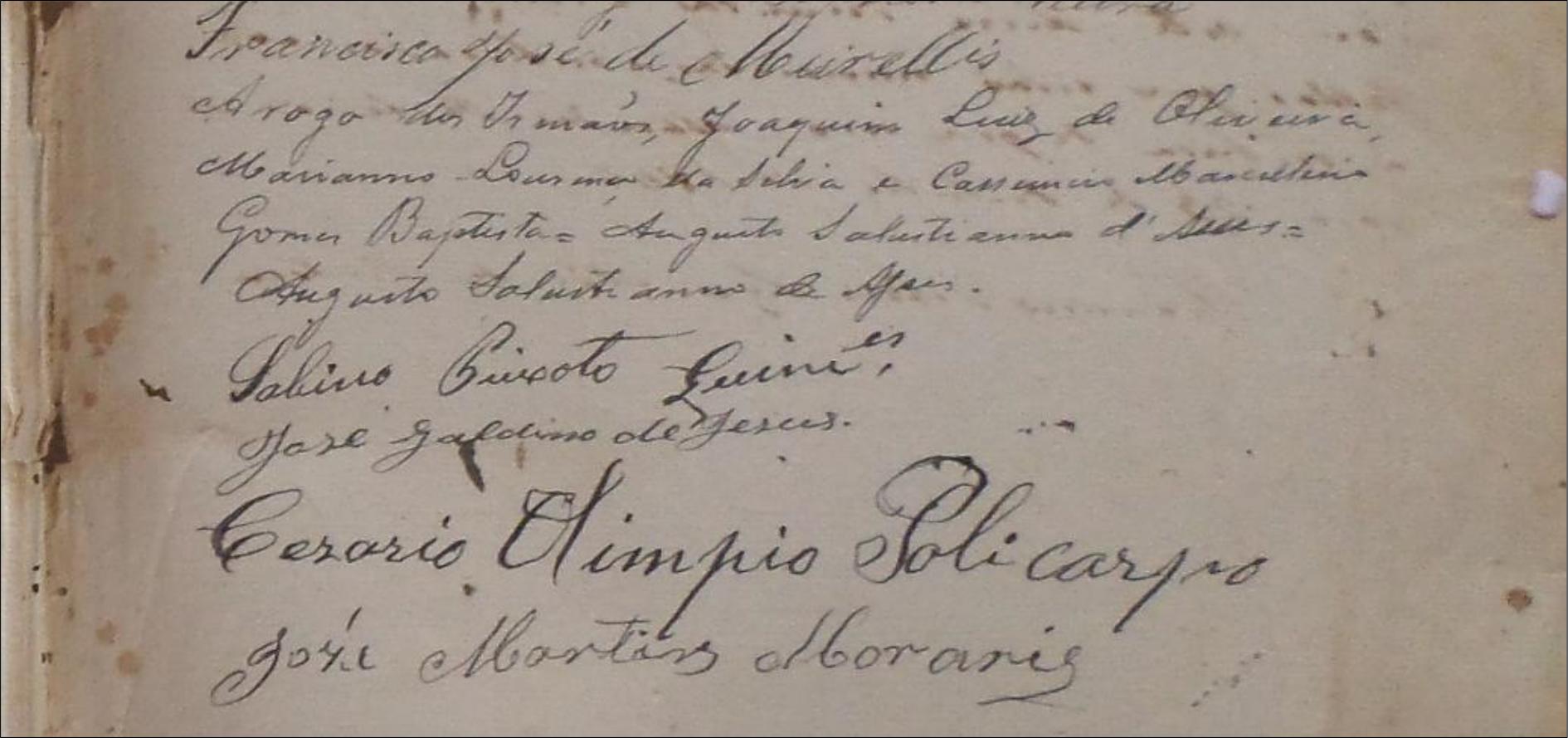
Source: IRMANDADE (1878, p. 14).
Figure 1 Petition of the brothers of the Irmandade Nossa Senhora do Rosário of Sabará (1878)
In the interpretation of José Gonçalves Gondra and Daniel Lemos (2006, p. 193), the "presence of a signature on petitions was considered an indicator of their holders' literacy and contact with the 'ABC'." Thus, for the authors, "the variation or repetition of the signature stroke was another indicator of the degree of proximity and practice in the act of writing" (GONDRA; LEMOS, 2006, p. 193) and, therefore, of familiarity, or at least contact, with forms of written cultures that circulated in nineteenth-century Brazil.
The irregular, wavering, and uncertain handwriting of Cesário Olímpio Policarpo and José Martins [sic] in signing their names may suggest rudimentary writing training or even sporadic contact with written cultures in their daily lives. Establishing bonds and forms of belonging to the social practices associated with these cultures-and the ideas derived from them-did not necessarily mean fully mastering the codes of reading and writing. These boundaries were often blurred. Perhaps this understanding was present in the way Joaquim Luiz de Oliveira, Mariano Lourenço da Silva, and Cassimiro [sic] Gomes Batista experienced and experimented with ways of interacting with written cultures. Everything indicates that they were illiterate, since their signatures were placed on the document "à rogo" by Augusto Salustiano da Silva. In this complex universe of written cultures, diverse social and political meanings were produced, depending on individuals' positions regarding the possession and mastery of knowledge considered useful and necessary, such as "knowledge of the art of reading and writing."
People with little mastery of the art of writing, along with many others who didn't know it but understood the rudiments of reading and writing, lived alongside individuals who possibly mastered such knowledge-such as Francisco José de Meirelles and Sabino [sic] Guimarães, who even abbreviated his last name, demonstrating familiarity with certain writing techniques. All were accustomed to and accustomed to the processes of disseminating knowledge involving writing in its various symbolic and material forms. In this sense, the actions of the members of the Irmandade Nossa Senhora do Rosário of Sabará conditioned the practices of cultivating writing, while also being conditioned by them, in a dialectical and inseparable relationship between representations and social practices.
Final Considerations
It was not possible to confirm whether the petition drafted by the members of the Irmandade Nossa Senhora do Rosário of Sabará was actually sent to the Inspetoria Geral da Instrução or other public administration bodies in the province of Minas Gerais. The collective correspondence was located among the brotherhood's documentation stored at the Casa Borba Gato/Museu do Ouro in Sabará, as part of a broader political-educational project, of which it was a member. Similarly, in our research of the 19th-century Minas Gerais public education document series available at the Arquivo Público Mineiro, we found no records of this brotherhood's educational projects. Although the petition was not forwarded to or acted upon by public authorities, the "first-letter class" project of the Sociedade do Rosário was materialized. At the beginning of the second half of 1881, for example, the brotherhood's Livro de Receitas e Despesas recorded expenses for "slate pencils (dozen), wooden pencils (dozen), slate (1), blank book (1), steel pens (1 box), black English ink (1 liter), and inkwell (1) for Professor João Teodoro de Miranda's class" (IRMANDADE, 1881).
There are, however, few references to the "first letters class" in the documentation of the Irmandade de N. S. do Rosário, likely because this enterprise was under the responsibility of the Sociedade do Rosário, which, as noted previously, was a separate institution. This latter association, however, did not produce documents regularly-we only found its bylaws. In any case, in May 1885, the Livro de Deliberações da Mesa Administrativa reported that the "night class taught by Professor Herculino Carlos do Couto Lima" had received a visit from the "literary delegate of the parish of Sabará, Honorable Captain Antônio Dias de Aguiar" (IRMANDADE, 1885, p. 3).
The document did not offer further details about this episode, so we do not know whether the literary delegate made the visit as part of his role as school inspector. Nor do we find any other information about the "night class," such as what was taught (subjects or teaching content) and how it was taught (teaching methods and pedagogical techniques). Professor Herculino Carlos do Couto Lima, in turn, built one of the longest-lasting formal schooling experiences in Sabará, with his "night classes" operating with some interruptions from 1879 to 1897. In investing in her analysis of the forms of subsidies for elementary education adopted by the Sabará City Council in the second half of the 19th century, Marileide Lopes dos Santos demonstrated that:
In the budget for the fiscal year 1879-1880, a budget for the city of Sabará's night classes, financed by its City Council, appeared for the first time [...]. The initiative came from the city's 2nd primary school teacher, Herculino Carlos do Couto Lima, who submitted a request to the City Council for financial assistance for the newly created class. The grant amounted to $24,000 to help maintain the class [...]. Over the years, the amount of the grant was progressively increased, rising from $100,000 in 1881 to $120,000 in 1883 (SANTOS, 2014, p. 89).
The Livro de Receitas e Despesas of Irmandade de N. S. do Rosário, for the period in question, contains no records of subsidies from either the province's coffers or the Sabará City Council. This may suggest a lack of aid or sponsorship from public agencies. This, as we have seen, did not impede investment in the creation and maintenance of its "first-letter class" and its "night class."
Even so, the political-educational project designed and developed by the Sabará brotherhood was part of a broader process of institutionalizing elementary education in nineteenth-century Brazil, a movement that was intensely contested by various individuals, groups, and social institutions. For example, before the emergence of the "night class" of the Irmandade de N. S. do Rosário, other proposals for formal education of this type had already been tried in Sabará. According to Vera Lúcia Nogueira (2019, p. 242), in 1872 the Sociedade Promotora da Instrução established a night school in the city. This endeavor, however, was short-lived. Furthermore, according to the author, "within the scope of the actions developed in collective spaces in imperial Brazil, associations such as brotherhoods were considered one of the most active forces emerging within civil society with the aim of contributing to the civilization of the population through written culture and the dissemination of enlightenment" (NOGUEIRA, 2019, p. 242).
In the province of Paraná, for example, despite the legislation that authorized the existence of night schools, "most of them [were] affected by the lack of provincial or municipal support, being closed after short periods of existence by the City Councils or the Legislative Assembly, which cited precarious resources, low student numbers, or a lack of teachers" (SILVA, 2017, p. 122). Investment in the night school project was spearheaded primarily by those most interested in these proposals-adults, workers, whether enslaved, freed, or free-who made up the public at these establishments and protested in the event of their closure, through petitions against school closures and by sending letters to authorities demanding “the implementation or restoration of classes” (SILVA, 2017, p. 122). These stories of “education and freedom,” as Noemi Santos da Silva pointed out, are relevant for us to consider “the meanings of access to school and literacy in the final years [of the 19th century], the height of the weakening of the institution of slavery in the Empire” (SILVA, 2017, p. 122).
From a similar historiographical perspective, Jucimar Cerqueira dos Santos, in a study of Bahia night schools in the late nineteenth century, argued that "the political debate on different types of education was one of the main demands raised by social strata seeking to consolidate Brazil as a nation" (SANTOS, 2021, p. 525). In the case of the Irmandade de N. S. do Rosário of Sabará, its documentation is replete with references to the word "instruction" (in the sense of teaching practical knowledge), a term used primarily as a metaphor for civilization. This, in several respects, brings together the expectations and meanings attributed by the members to "knowledge of the art of reading and writing," understood as both a condition and a quality of citizenship-a social status interpreted as synonymous with the entitlement to rights.
Such historical experiences indicate the need to undertake and consolidate historiographical reflections about the conceptions and expectations that guided the ways in which different individuals and social groups formulated, demanded, and claimed what they considered rights, as well as about the social tensions generated around these disputes. It is necessary to question "how Black men and women fought for education, literacy, schools, and teaching in a world surrounded by slavery, exclusion, and racism [...]. The most important thing for new research is the exercise of going beyond the analytical tone of the denunciations about the historical process of schooling (rejection and exclusion) of poor populations throughout the 19th century and "to delve into the-black-trajectories of those who fought for educational projects and their expectations" (MAC CORD; ARAÚJO; GOMES, 2017, p. 13). We hope that the experiences of the "civilizing lights of instruction," promoted by the "first letters class" of the Irmandade de N. S. do Rosário of Sabará, presented in this article, can contribute to the expansion of this historiographical debate on (and in) the history of education in nineteenth-century Brazil.
1The research that made this article possible was supported by the São Paulo Research Foundation - Fapesp (2019/03473-3). English version by Ana Maria Dionísio. E-mail: dionisio.anamaria@hotmail.com
↩2Some authors, such as Marcelo Mac Cord (2012) and Itacir Marques da Luz (2013), argue that the genesis of the social and educational practices of Black brotherhoods, both in the 19th century and earlier, was related to the educational cultures forged in the craft guilds, also known as irmandades embandeiradas, during the colonial period. These associations focused on organizing artisanal work and teaching crafts, as well as the rudiments of reading and writing. For a study of craft guilds in the captaincy of Minas Gerais, see José Newton Coelho Meneses (2013). About the teaching of artisanal and manufacturing trades in colonial and imperial Brazil, see Luiz Antônio Cunha (2000).
↩3In this same study, Perses Maria Canellas da Cunha (2004, p. 14) cited (but did not offer further details about) the experience of the Irmandade de Santa Catarina, also in the city of Rio de Janeiro, which in 1859 “maintained a literacy course for enslaved people”.
↩4It is worth noting that the Regimento da Sociedade do Rosário was not to be confused with the Compromisso of the brotherhood of the same name; that is, they were separate documents; the first, drafted in 1879, was annexed to the Compromisso of 1871.
↩5Throughout its existence, the brotherhood drafted three commitments, which registered the intentions of its membership with civil and ecclesiastical authorities. The first was produced in 1718, while the other two were drafted in 1842 and 1871, respectively.
↩REFERENCES
CRUZ, Mariléia dos Santos. Escravos, forros e ingênuos em processos educacionais e civilizatórios na sociedade escravista do Maranhão no século XIX. Tese (Doutorado em Educação) - Faculdade de Ciências e Letras, Universidade Estadual Paulista, Araraquara, 2008. [ Links ]
CUNHA, Luiz Antônio. O ensino de ofícios artesanais e manufatureiros no Brasil escravocrata. São Paulo: Editora da UNESP; Brasília: Flacso, 2000. [ Links ]
CUNHA, Paola Andrezza Bessa. Educação moral e discurso pedagógico nas associações religiosas leigas: Minas Gerais, séculos XVIII e XIX. In: VAGO, Tarcísio Mauro; OLIVEIRA, Bernardo Jefferson de (orgs.). Histórias de práticas educativas. Belo Horizonte: Editora da UFMG, 2008, p. 41-57. [ Links ]
CUNHA, Perses Maria Canellas da. Educação como forma de resistência: o caso da Irmandade de Nossa Senhora do Rosário e São Benedito dos Homens Pretos. Dissertação (Mestrado em Educação) - Faculdade de Educação, Universidade Federal Fluminense, Niterói, 2004. DOI: https://app.uff.br/riuff/handle/1/17709. [ Links ]
FARIA FILHO, Luciano Mendes de. O processo de escolarização na Província. In: RESENDE, Maria Efigênia Lage de; VILLALTA, Luiz Carlos (orgs.). História de Minas Gerais: a Província de Minas (v. 2). Belo Horizonte: Autêntica; Companhia do Tempo, 2013, p. 131-144. [ Links ]
FARIAS, Sara Oliveira. Irmãos de cor, de caridade e de crença: a Irmandade do Rosário do Pelourinho na Bahia do século XIX. Dissertação (Mestrado em História) - Faculdade de Filosofia e Ciências Humanas, Universidade Federal da Bahia, Salvador, 1997. [ Links ]
GALVÃO, Ana Maria de Oliveira. História das culturas do escrito: tendências e possibilidades de pesquisa. In: MARINHO, Marildes; CARVALHO, Gilcinei Teodoro (orgs.). Cultura escrita e letramento. Belo Horizonte: Editora da UFMG, 2010, p. 218-248. [ Links ]
GONDRA, José Gonçalves; LEMOS, Daniel Cavalcanti de Albuquerque. Poderes da assinatura: abaixo-assinados como fonte para a história da educação brasileira do século XIX. In: ROCHA, Heloísa Helena Pimenta (org.). Personagens, estratégias e saberes na construção da escola brasileira (séculos XIX e XX). Bragança Paulista: EDUSF, 2006, p. 189-206. [ Links ]
GONDRA, José Gonçalves; SCHUELER, Alessandra Frota Martinez de. Educação, poder e sociedade no Império brasileiro. São Paulo: Cortez, 2008. [ Links ]
IRMANDADE de N. S. do Rosário. Compromisso da Irmandade de N. S. do Rosário dos Homens Pretos de Sabará. Ouro Preto: Tipografia de J. F. de Paula Castro, 1871. [ Links ]
IRMANDADE de N. S. do Rosário. Livro de Atas (1878-1923). Sabará: Irmandade de N. S. do Rosário, 1878. [ Links ]
IRMANDADE de N. S. do Rosário. Livro de Atas de Deliberações da Mesa Administrativa (1883-1886). Sabará: Irmandade de N. S. do Rosário, 1885. [ Links ]
IRMANDADE de N. S. do Rosário. Livro de Entrada (1841-1906). Sabará: Irmandade de N. S. do Rosário, 1855. [ Links ]
IRMANDADE de N. S. do Rosário. Livros de Receitas e Despesas (1874-1892). Sabará: Irmandade de N. S. do Rosário, 1881. [ Links ]
LUZ, Itacir Marques da. Compassos letrados: artífices negros entre instrução e ofício no Recife (1840-1860). Recife: Editora UFPE, 2013. [ Links ]
LUZ, Itacir Marques da. Irmandade e educabilidade: um olhar sobre os arranjos associativos negros em Pernambuco na primeira metade do século XIX. Educação em Revista, Belo Horizonte, v. 32, n. 3, p. 119-142, 2016. DOI: https://doi.org/10.1590/0102-4698153830. [ Links ]
MAC CORD, Marcelo. Artífices da cidadania: mutualismo, educação e trabalho no Recife oitocentista. Campinas: Editora da UNICAMP, 2012. [ Links ]
MAC CORD, Marcelo. Imperial Sociedade dos Artistas Mecânicos e Liberais: mutualismo, cidadania e a Reforma Eleitoral de 1881 no Recife. In: MAC CORD, Marcelo; BATALHA, Cláudio H. de M. (orgs.). Organizar e proteger: trabalhadores, associações e mutualismo no Brasil (séculos XIX e XX). Campinas: Editora da UNICAMP, 2014, p. 153-192. [ Links ]
MAC CORD, Marcelo; ARAÚJO, Carlos Eduardo Moreira de; GOMES, Flávio. Para não dizer que não falei de flores: educação, história e exclusão. In: MAC CORD, Marcelo; ARAÚJO, Carlos Eduardo Moreira de; GOMES, Flávio (orgs.). Rascunhos cativos: educação, escolas e ensino no Brasil escravista. Rio de Janeiro: 7 Letras, 2017, p. 9-16. [ Links ]
MENESES, José Newton Coelho. Artes fabris e ofícios banais: o controle dos ofícios mecânicos pelas Câmaras de Lisboa e das Vilas de Minas Gerais (1750-1808). Belo Horizonte: Fino Traço, 2013. [ Links ]
MESQUITA, Mariana. Pelas contas do rosário: sentidos da cidadania na Irmandade de Homens Pretos de Salvador no pós-abolição (1888-1930). Teresina: Cancioneiro, 2022. [ Links ]
NOGUEIRA, Vera Lúcia. A educação dos adultos em Minas Gerais no século XIX. In: LOPES, Eliane Marta Teixeira; CHAMON, Carla Simone (orgs.). História da educação em Minas Gerais: da Colônia à República: Império (v. 2). Uberlândia: EDUFU, 2019, p. 227-256. [ Links ]
PASSOS, Zoroastro Viana. Em torno da história de Sabará (v. 2). Belo Horizonte: Imprensa Oficial do Estado de Minas Gerais, 1942. [ Links ]
PEREIRA, José Galdino. Os negros e a construção da sua cidadania: estudo do Colégio São Benedito e da Federação Paulista dos Homens de Cor de Campinas, 1896-1914. Dissertação (Mestrado em Educação) - Faculdade de Educação, Universidade Estadual de Campinas, Campinas, 2001. DOI: https://doi.org/10.47749/T/UNICAMP.2001.268018. [ Links ]
PEREIRA, Lúcia Regina Brito. Cultura e afrodescendência: organizações negras e suas estratégias educacionais em Porto Alegre (1872-2002). Reflexão & Ação, [S. l.], v. 18, n. 1, p. 77-99, 2010. DOI: https://doi.org/10.17058/rea.v18i1.1338. [ Links ]
REGINALDO, Lucilene. Irmandades. In: SCHWARCZ, Lilia; GOMES, Flávio (orgs.). Dicionário da escravidão e da liberdade: 50 textos críticos. São Paulo: Companhia das Letras, 2018, p. 268-274. [ Links ]
RIBEIRO, Jonatas Roque. A classe de cor: uma história do associativismo negro em Minas Gerais (1880-1910). Tese (Doutorado em História) - Instituto de Filosofia e Ciências Humanas, Universidade Estadual de Campinas, Campinas, 2022. DOI: https://hdl.handle.net/20.500.12733/5498. [ Links ]
SANTOS, Jucimar Cerqueira dos. Ingênuas(os) e libertas(os) nas escolas noturnas da Bahia no final do século XIX: euforia abolicionistas e escolas para ingênuas(os) na Bahia. In: MACHADO, Maria Helena P. T.; BRITO, Luciana da Cruz; VIANA, Iamara; GOMES, Flávio (orgs.). Ventres livres? Gênero, maternidade e legislação: Brasil e mundo atlântico, séculos XVIII e XIX. São Paulo: Editora da UNESP, 2021, p. 522-540. [ Links ]
SANTOS, Marileide Lopes dos. Instrução pública em Sabará/MG nos Oitocentos. In: VALLE, Ione Ribeiro; HAMDAN, Juliana Cesário; DAROS, Maria das Dores (orgs.). Moderno, modernidade e modernização: a educação nos projetos de Brasil - séculos XIX e XX (v. 2). Belo Horizonte: Mazza Edições, 2014, p. 81-96. [ Links ]
SILVA, Noemi Santos da. Direito de aprender: a educação nas lutas negras por emancipação (Paraná, 1853-1910). Tese (Doutorado em História) - Instituto de Filosofia e Ciências Humanas, Universidade Estadual de Campinas, Campinas, 2023. DOI: https://hdl.handle.net/20.500.12733/11339. [ Links ]
SILVA, Noemi Santos da. Um passo para a liberdade: experiências de instrução de escravos, libertos e ingênuos no Paraná provincial (1871-1888). In: MAC CORD, Marcelo; ARAÚJO, Carlos Eduardo Moreira de; GOMES, Flávio (orgs.). Rascunhos cativos: educação, escolas e ensino no Brasil escravista. Rio de Janeiro: 7 Letras, 2017, p. 121-138. [ Links ]
SOCIEDADE do Rosário. Regimento da Sociedade da Irmandade de N. S. do Rosário de Sabará. Ouro Preto: Tipografia da Atualidade, 1879. [ Links ]
SOUZA, Felipe Azevedo. A dissimulada arte de produzir exclusões: as reformas que encolheram o eleitorado brasileiro (1881-1930). Revista de História, São Paulo, n. 179, p. 1-35, 2020. DOI: https://doi.org/10.11606/issn.2316-9141.rh.2020.166560. [ Links ]
VEIGA, Cynthia Greive. Crianças pobres, negras e mestiças na organização da instrução elementar. In: RESENDE, Maria Efigênia Lage de; VILLALTA, Luiz Carlos (orgs.). História de Minas Gerais: a Província de Minas (v.2). Belo Horizonte: Autêntica; Companhia do Tempo, 2013, p. 145-160. [ Links ]
VIANA, Iamara da Silva; GOMES, Flávio. Letramento, escravidão e mocambos: livros encontrados em um rancho quilombola no Espírito Santo Oitocentista. Resgate: Revista Interdisciplinar de Cultura, Campinas, n. 28, p. e020023, 2020. [ Links ]
HISTORY
Received: April 08, 2025; Accepted: July 05, 2025
 Este é um artigo publicado em acesso aberto sob uma licença Creative Commons.