
The effectiveness of collaborative mind maps in learning and teaching applied technologies to Mathematics

Educação & Formação
versão On-line ISSN 2448-3583
Educ. Form. vol.9 Fortaleza 2024 Epub 16-Dez-2024
https://doi.org/10.25053/redufor.v9.e13292
Article
The effectiveness of collaborative mind maps in learning and teaching applied technologies to Mathematics
Leandro Blass, Universidade Federal do Pampa (Unipampa), Grupo de Pesquisa sobre Aprendizagens, Metodologias e Avaliação e Modelagem e Análise de Dados
PhD in Computational Modeling from Universidade do Estado do Rio de Janeiro (UERJ). Assistant Professor at Unipampa. Coordinator of the specialization Mathematics in Practice (UAB) and leader of the research groups “Grupo de Pesquisa sobre Aprendizagens, Metodologias e Avaliação” (Gama) and Modelagem e Análise de Dados (MAD). Researcher in active methodologies, mind maps, technologies in education and assessment in higher education.
, Project administration, formal analysis, conceptualization, data curation, writing first draft, writing review, editing, investigation, methodology, software, supervision, validation, and visualization3 http://orcid.org/0000-0003-2302-776X; lattes: 7385942137403019
Angélica Cristina Rhoden, Universidade Federal da Fronteira Sul (UFFS)
Postdoctoral candidate in Educational Technologies at UFFS, campus Chapecó, Graduated in Business Administration and licensed in Professional and Technological Education, with an emphasis on administration and active methodologies. Research and interest in: entrepreneurship, active methodologies and educational technologies, bioeconomy, regional and territorial development.
, Conceptualization, data curation, writing first draft, writing review, editing, investigation, methodology, validation, and visualization4http://orcid.org/0000-0003-0402-3763; lattes: 8990849756427408
3Universidade Federal do Pampa, Bagé, RS, Brasil
4Universidade Federal da Fronteira Sul, Chapecó, SC, Brasil
This article investigates the effectiveness of collaborative mind maps as a teaching and learning tool in the subject of Applied Technologies for Teaching Mathematics II. The research, conducted with Mathematics Education students, uses a mixed methodology, combining qualitative and quantitative analyses. Data was generated through a questionnaire and observations by the teacher. The results highlight that collaborative mind maps improve students' organization, information retention, and motivation. Additionally, they promote collaborative learning and the development of critical skills, such as creativity and critical thinking. Despite challenges related to clarity and organization, the tool proves effective in teaching and learning, offering an innovative approach to higher education. It is concluded that collaborative mind maps not only made teaching and learning effective but also fostered a more interactive and collaborative teaching environment.
Keywords: mind map; collaborative learning; teaching; learning.
Este artigo investiga a eficácia dos mapas mentais colaborativos como ferramenta de ensino e aprendizagem na disciplina de Tecnologias Aplicadas ao Ensino da Matemática II. A pesquisa, realizada com estudantes de licenciatura em Matemática, utiliza uma metodologia mista, combinando análises qualitativas e quantitativas. A geração de dados foi realizada por meio de um questionário e observações do professor. Os resultados encontrados destacam que os mapas mentais colaborativos melhoram a organização, a retenção de informações e a motivação dos estudantes. Além disso, promovem a aprendizagem colaborativa e o desenvolvimento de habilidades críticas, como criatividade e pensamento crítico. Apesar dos desafios relacionados à clareza e à organização, a ferramenta se mostra eficaz no ensino e na aprendizagem, oferecendo uma abordagem inovadora para o ensino superior. Conclui-se que os mapas mentais colaborativos não só tornaram eficazes o ensino e a aprendizagem, mas também promoveram um ambiente de ensino mais interativo e colaborativo.
Palavras-chave: mapa mental; aprendizagem colaborativa; ensino; aprendizagem.
Este artículo investiga la eficacia de los mapas mentales colaborativos como herramienta de enseñanza y aprendizaje en la asignatura de Tecnologías Aplicadas a la Enseñanza de las Matemáticas II. La investigación, realizada con estudiantes de licenciatura en Matemáticas, utiliza una metodología mixta, combinando análisis cualitativos y cuantitativos. Los datos se generaron mediante un cuestionario y observaciones de los profesores. Los resultados encontrados destacan que los mapas mentales colaborativos mejoran la organización, la retención de información y la motivación de los estudiantes. Además, promueven el aprendizaje colaborativo y el desarrollo de habilidades críticas, como la creatividad y el pensamiento crítico. A pesar de los desafíos relacionados con la claridad y la organización, la herramienta resulta eficaz en la enseñanza y el aprendizaje, ofreciendo un enfoque innovador para la educación superior. Se concluye que los mapas mentales colaborativos no solo hicieron que la enseñanza y el aprendizaje fueran eficaces, sino que también fomentaron un entorno de enseñanza más interactivo y colaborativo.
Palabras clave: mapa mental; aprendizaje colaborativo; enseñanza; aprendizaje.
1 Introduction
Mind mapping is a versatile instrument that enhances the understanding of any topic by organizing thoughts into hierarchies and categories (Buzan, B.; Buzan, T., 1996). This tool enables students to structure equations and reflect on their studies, emphasizing crucial keywords. The structure begins with a central idea and links to essential topics through branches, creating a network of interconnected nodes (Buzan, 2019). The mind map is a multisensory medium that uses color, images, and branches to organize and retain information. Its visual elements facilitate the study and organization of complex ideas and concepts (Day; Bellezza, 1983).
You can create mind maps either individually or collaboratively. When used individually, mind maps are an effective tool for helping students learn and understand concepts (Wu; Chen, 2018). When used collaboratively, they improve knowledge building and sharing. However, individual mind maps have weaknesses. They lack interactivity and make it difficult to understand other members' thought processes, which limits collaboration. (Zheng; Johnson; Zhou, 2020). This is because, according to Bandura's (1976) and Vygotsky's (1978) theories, knowledge evolves through social interactions. The available evidence indicates that collaborative mind mapping has a beneficial impact on learning outcomes. In their 2013 study, Wu et al. demonstrated the efficacy of integrating mind maps into a collective to enhance collaboration. Similarly, Zheng, Johnson, and Zhou (2020) combined the flipped classroom with collaborative mind maps, which led to improvements in students' self-efficacy, motivation, and performance. Araujo and Gadanidis (2020) place an emphasis on teacher training, while Fung and Liang (2023) highlight the effectiveness of collaborative mind maps, which effectively engage students in an active and collaborative manner.
The efficacy of collaborative mind mapping has been demonstrated through its capacity to enhance organizational skills, memory retention, and comprehension of concepts. Contemporary studies indicate that these visual learning tools not only facilitate individual learning but also foster collaborative learning and develop essential skills such as creativity and critical thinking (Zheng; Johnson; Zhou, 2020). This research seeks to contribute to the literature by providing empirical evidence on the benefits and challenges of collaborative mind maps in using technologies to teach Mathematics.
In view of the above, it seems pertinent to pose the following research question: how do students perceive the efficacy of collaborative mind maps as an innovative pedagogical instrument during the second semester of the 2023 academic year? This research project aims to investigate the effectiveness of collaborative mind maps as a teaching and learning tool in the discipline of Technologies Applied to Teaching Mathematics II, with a particular focus on students enrolled in the undergraduate Mathematics course at a federal public university in the southern region of Brazil. The research is defined by the teacher/researcher's disposition and the intention to innovate in their pedagogical practice and contribute to the training of Mathematics teachers.
Methodologically, the research is characterized as descriptive and exploratory, as it “[...] aims to provide greater familiarity with the problem, to make it more explicit or constituting hypotheses and improving ideas or discovering intuitions” (Gil, 2002, p. 41). The analyses were conducted in a qualitative stage, using the software Interface de R pour les Analyses Multidimensionnelles de Textes et de Questionnaires (IRaMuTeQ), and another quantitative stage, utilizing the Jamovi software, characterized as mixed research (Creswell, 2010). This research is part of the research project “Problem-solving, active methodologies, different ways of evaluating and the use of technologies in higher education” and is part of the Pesquisa sobre Aprendizagens, Metodologias e Avaliação (Gama).
2 Theoretical approach
The theoretical approach that guides this work is based on the study of mental maps, collaborative mental maps, and learning.
2.1 The mind maps
Mind maps help students with memorization and conceptual understanding as they are a unique approach to organizing and connecting information. The concept of mind mapping was initially developed by Tony Buzan in the 1960s as a note-taking technique (Buzan, B.; Buzan, T., 1996). Over time, it has become one of the most widely utilized strategies for a variety of purposes, including note-taking, concept organization, brainstorming, meta-learning, and visualization (Fu et al., 2019). A mind map is a personalized graphic structure that represents the content studied. According to B. Buzan and T. Buzan (1996), using different symbols in mind maps, such as graphs, images, colors, and numbers, can improve student learning.
A mind map is a graphic representation of ideas, concepts, or information that branch out from a central point. It allows for the visual organization of thoughts and the connection between different topics in a free-form way, without restrictions on its final structure. This flexibility encourages and promotes creative thinking (Davies, 2011). In this way, mind maps enable the visual representation of the way in which students conceive, assimilate, structure and apply knowledge. (Somers et al., 2014).
Mind maps are a highly effective tool for simplifying the understanding of any topic. Their visual, diagrammatic nature and intention to connect information make them ideal for stimulating activity in both hemispheres of the human brain, both the right and the left. According to Buzan (2019), the activities led by each cerebral hemisphere are distinct: the left hemisphere assumes responsibility for logic, arithmetic, and analysis, while the right hemisphere is in charge of creativity, imagination, and emotion. Mind maps are a useful tool for organizing, associating, contrasting, and categorizing information. They can be particularly beneficial in contexts that require thoughtful consideration, memory retention, strategic planning, and stimulation of creativity.
Many studies have highlighted the positive effects of incorporating mind maps in this context, particularly in terms of students' ability to assimilate content. These benefits include improving memorization, facilitating the understanding of concepts, stimulating creative thinking, and developing critical thinking skills, as indicated by studies such as those by Araujo (2019), Araujo and Gadanidis (2020), Badriah et al. (2024), Fung and Liang (2023), Yan et al. (2022), and Zheng, Johnson, and Zhou (2020).
2.2 Collaborative mind maps and collaborative learning
In this context, we were interested in exploring the potential benefits of collaborative mind mapping in education, particularly concerning teaching and learning at different levels. The use of collaborative mind maps is a multi-user application facilitated by technology and the use of the Internet. It offers functionality for synchronous interactions at a distance, co-editing, and mutual commenting. This allows group members to co-edit and revise synchronously or asynchronously, with the co-editing history being saved and discussed among collaborators. Moreover, the application of technology to foster collaborative learning can facilitate effective cognitive convergence by integrating individual contributions into a common construct (Hernández-Sellés; Muñoz-Carril; González-Sanmamed, 2020).
It is worth noting that the use of individual mind maps presents challenges, such as the lack of interactivity and the ability to understand the thought process of other students in the class, which potentially restricts the effects of interaction and collaboration between students. These shortcomings are attributed to the perspective of social learning theory, which posits that the majority of learning behaviors are acquired through observational models. In these models, a student builds an understanding of how a new behavior is performed by observing others (Bandura, 1976).
The research conducted by Wu et al. (2013) describes that the strategy used was to first use individual mind maps as a collaborative support strategy for group learning activities before using collaborative mind maps. The integration of individual mind maps into a collaborative mind map has been shown to enhance collaborative knowledge-building and sharing processes, as well as optimize creative thinking.
In this context, the inclusion of the flipped classroom with collaborative mind maps proved an innovative strategy. This approach facilitated the development of collaborative strategies during the pre-class learning phase, which led to more effective collaborative activities in real time. The joint use of these methodologies allowed collaboration in the organization of information from previously structured materials, contributing to a significant improvement in self-efficacy, motivation, and learning performance (Zheng; Johnson; Zhou, 2020).
A key objective is to provide teachers with the necessary training and support to deliver high-quality education that is tailored to the specific needs of students. This area underscores the necessity for teacher training to equip educators with the skills to navigate contemporary classroom challenges, promote innovative pedagogical methods, and ensure alignment with the ever-changing demands of the educational landscape. The study carried out by Araujo and Gadanidis (2020) explored how Mathematics teachers in-training interact and construct knowledge through collaborative mind maps, differentiating themselves from linear discussions in online forums and revealing unique semiotic possibilities offered by mind maps, including organization, dimensioning, and connection of ideas.
The growing emphasis on collaboration and innovation in the field of education has driven research into pedagogical strategies that promote the joint construction of knowledge. Among these approaches, the use of collaborative mind maps has emerged as a promising tool, offering new perspectives for teaching and learning. The study by Fung and Liang (2023) offers significant theoretical contributions to the application of collaborative mind mapping in science education. It integrates collaborative mind mapping and group work in the context of science education in Hong Kong, highlighting the effectiveness of this approach in improving learning by actively and collaboratively engaging students. Also, it points to the potential effectiveness of combining group work with other constructivist-based teaching techniques.
As previously stated, the use of collaborative mind maps is an effective method for enhancing collaborative learning. Dillenbourg (1999) argues that collaborative learning is an educational process where two or more individuals work together to build knowledge, solve problems, and complete tasks. This approach requires significant interaction between participants, with dialogue, exchange of ideas, and joint construction of meanings. Collaborative learning goes beyond the simple division of labor, reaching levels of negotiation and conflict resolution through consensus.
Thus, it can be understood that the main aspects of Dillenbourg's (1999) collaborative learning can be shared in the processes of implementing collaborative mind maps. These are defined by the following characteristics: interaction through constant communication and exchange of information and ideas; a common goal; collective knowledge construction, which refines ideas and expands them to the group; positive mutual dependence, which recognizes group success as linked to individual success; individual and group responsibility, in which each participant is responsible for their own learning as well as for the learning of the group; and active engagement, in which all group participants contribute significantly to the activities and discussions.
3 Methodology
The following section will provide a comprehensive account of the research methods employed, encompassing data production, participant recruitment, and the analytical tools utilized for both qualitative and quantitative data.
3.1 Data production and participants
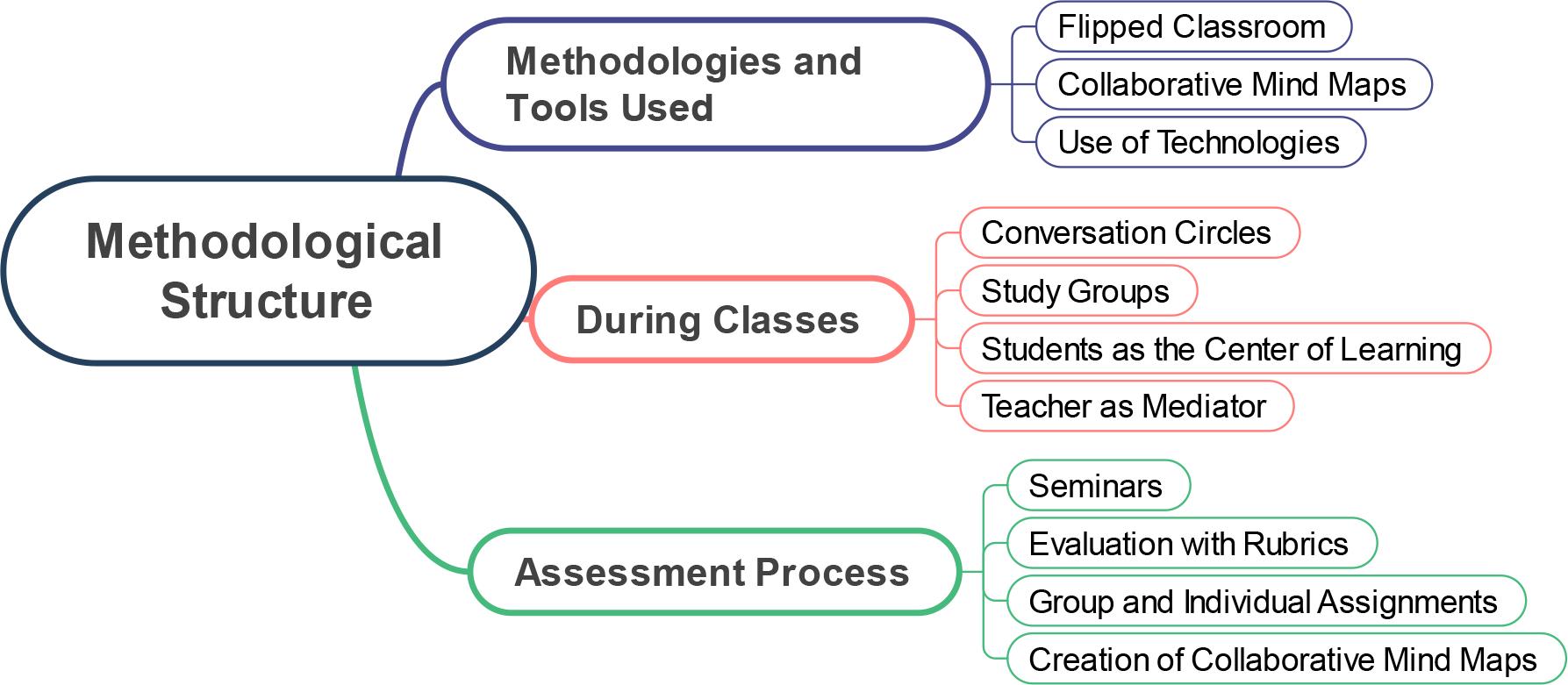
The selection of participants was intentional and also for convenience. In total, 12 students participated in the curricular component of Technologies Applied to Teaching Mathematics II, which corresponds to the fifth semester of the undergraduate course in Mathematics, in the second semester of 2023. All participants were identified as E_1 to E_12. At the beginning of the classes, the teacher/researcher of this study presented the methodological structure of the curricular component, as shown in Figure 1.
Source: Authors’ own elaboration (2024).
Figure 1 Methodological structure of the curricular component
The objective of creating collaborative mind maps was to provide effective support for the study of Technologies Applied to Teaching Mathematics II. Students utilized the Canva platform due to its compatibility, online accessibility, and cost-free availability. The aim was to facilitate the comprehension of concepts flexibly and adapt to the preferences of the groups during the 2023.2 semester. More than 20 mind maps were created, addressing high school technologies and content, within the context of active methodologies, such as the flipped classroom model, as illustrated in Figure 1.
At the end of the semester, students responded to a questionnaire designed by the instructor to assess the efficacy of collaborative mind mapping. The questionnaire yielded qualitative and quantitative data, which were subsequently analyzed in a stage after this section. In addition, participants were invited to complete and sign the Free and Informed Consent Form (FICF) through Google Forms, allowing the use of their data in this research.
3.2 Quantitative data analysis
Quantitative research is a method of testing objective theories by examining the relationship between variables. This is done by the researcher using numerical measures, closed hypotheses, standardized instruments, and statistical analysis to answer research questions (Creswell, 2010). In the current research, a statistical analysis was performed using the Jamovi software. For this purpose, the data from the questionnaire applied to the students, and the research subjects, were grouped as shown in Table 1.
Table 1 Questionnaire used to collect quantitative data
| 1) On a scale of 0 to 10, where 0 means “Ineffective” and 10 means “Very effective”, how effective do you consider the use of collaborative mind maps to be in improving your learning? |
| 2) On a scale of 0 to 10, where 0 means “Low motivation/engagement” and 10 means “High motivation/engagement”, how do you rate the impact of collaborative mind maps on your motivation and engagement in the learning process? |
| 3) On a scale of 0 to 10, where 0 means “Poor information retention” and 10 means “A lot of information retention”, what is the impact of collaborative mind mapping on your ability to retain information? |
| 4) On a scale of 0 to 10, where 0 means “Does not contribute to cognitive skills” and 10 means “Contributes significantly to cognitive skills”, how do you rate the influence of collaborative mind maps on the development of your cognitive skills? |
| 5) On a scale of 0 to 10, where 0 means “Negative perception” and 10 means “Positive perception”, what is your perception of the use of collaborative mind maps as a learning tool? |
| 6) On a scale of 0 to 10, where 0 means “Inferior to other methods” and 10 means “Superior to other methods”, how do you rate the use of collaborative mind maps compared to other traditional study methods? |
| 7) On a scale of 0 to 10, where 0 means “Does not influence creativity/visual thinking” and 10 means “Significantly influences creativity/visual thinking”, how do you perceive the influence of collaborative mind maps on the development of your creativity and visual thinking? |
| 8) On a scale of 0 to 10, where 0 means “Does not contribute to pedagogical approaches” and 10 means “Contributes significantly to pedagogical approaches”, how do you rate the usefulness of collaborative mind maps as part of pedagogical approaches? |
| 9) On a scale of 0 to 10, where 0 means “Difficulty using technology/tools” and 10 means “Ease of using technology/tools”, how accessible and easy to use do you consider mind mapping tools to be? |
| 10) On a scale of 0 to 10, where 0 means “Does not promote collaborative learning” and 10 means “Significantly promotes collaborative learning”, how do you perceive the role of collaborative mind maps in collaborative learning? |
| 11) On a scale of 0 to 10, where 0 means “Less effective in several courses” and 10 means “Effective in several courses”, how do you see the application of collaborative mind maps in different areas of knowledge? |
| 12) On a scale of 0 to 10, where 0 means “Difficult to assess and measure” and 10 means “Easy to assess and measure”, how do you rate the effectiveness of mind maps as a method of assessing and measuring learning? |
| 13) What are the benefits of using collaborative mind maps in the learning process? (Check all that apply). A. It improves engagement and active participation. B. It makes it easier to evaluate my own performance. C. It improves communication with my classmates. D. It develops my critical thinking skills. E. It allows me to make decisions about what is important to study. F. It increases my motivation to learn. G. It makes memorizing information easier. H. It facilitates the exchange of ideas and collaboration with my classmates. I. It makes the learning process more shared. J. It improves my understanding of the study topics. |
| 14) What are the challenges associated with using collaborative mind maps in the learning process? (Check all that apply). A. Difficulty coordinating teamwork. B. Risk of plagiarism or copying information from other colleagues. C. Lack of access to online collaboration tools. D. Students' lack of motivation due to increased workload. E. Interpersonal conflicts among group members. F. Need for prior training to use mind mapping tools. H. Information overload in collaborative mind maps. I. Challenge in maintaining organization and clarity in mind maps. J. Lack of adequate visual resources to represent complex concepts. |
| Qualitative open-ended question: Write a paragraph evaluating, reporting, and demonstrating your perception about the use of collaborative mind maps in the class and outside of class. |
Source: Authors’ own elaboration (2024).
When analyzing the quantitative data, calculations of measures of central tendency (mean, median, and mode) and measures of descriptive statistical dispersion (standard deviation, variance, minimum, and maximum) were performed. The theoretical basis for all statistical analyses was the work of Field (2021).
3.3 Qualitative data analysis
In qualitative research, “[...] data are typically collected in the participant’s environment, data analysis is inductively constructed from the particularities to the general themes and the interpretations made by the researcher about the meaning of the data”(Creswell, 2010, p. 27). Qualitative research is a way of exploring and understanding meanings by using non-numerical data (e.g. text, video, or audio) to analyze concepts, opinions, or experiences (Corbin; Strauss, 2015).
The analysis of the data produced via qualitative open-ended questions (located in Table 1: “Write a paragraph evaluating, reporting and demonstrating your perception about the use of collaborative mind maps in the class and outside of class”) was carried out using the IRaMuTeQ software. The software's main objective is to analyze the structure and organization of discourse, making it possible to inform the relationships between the lexical worlds that are most frequently enunciated by research participants (Camargo; Justo, 2013). A textual analysis of the students' responses to the open-ended question was conducted using Descending Hierarchical Classification (DHC) to identify the dendrogram with the most prominent classes. The higher the χ2 value, the more strongly the word is associated with the class. Words with χ2 values greater than 3.80 were excluded from the analysis (Lahlou, 2012). The following section will present and discuss the data.
4 Results and discussion
In the following sections, the research findings are presented, divided between quantitative and qualitative analyses, addressing students' perceptions about the use of collaborative mind maps.
4.1 Reflections from the quantitative dimension of research
Chart 1 presents the general data of descriptive statistics and central tendency for the questions in Chart1 1, with information about number of respondents (N), mean (M), median (Me), mode (Mo), standard deviation (SD), variance (Var), amplitude (Am), minimum (Min), maximum (Max). This questionnaire sought to investigate questions more directed to the teaching of Numerical Calculus and the use of mind maps.
Chart 1 General statistical description data for each question
| Questions | N | M | Me | Mo | DP | Var | Am | Min | Max |
|---|---|---|---|---|---|---|---|---|---|
| Q1 - Learning | 12 | 8.7 | 9.0 | 9.0 | 0.9 | 0.8 | 3.0 | 7.0 | 10.0 |
| Q2 - Engagement | 12 | 8.8 | 9.0 | 10.0 | 1.3 | 1.7 | 3.0 | 7.0 | 10.0 |
| Q3 - Information | 12 | 8.2 | 8.0 | 8.0 | 0.4 | 0.2 | 1.0 | 8.0 | 9.0 |
| Q4 - Abilities | 12 | 8.8 | 8.5 | 8.0 | 0.9 | 0.8 | 2.0 | 8.0 | 10.0 |
| Q5 - Perception | 12 | 8.8 | 9.0 | 8.0 | 1.0 | 1.1 | 3.0 | 7.0 | 10.0 |
| Q6 - Comparison | 12 | 8.3 | 8.0 | 10.0 | 1.7 | 2.8 | 4.0 | 6.0 | 10.0 |
| Q7 - Visual Thinking | 12 | 9.3 | 9.0 | 9.0 | 0.8 | 0.6 | 2.0 | 8.0 | 10.0 |
| Q8 - Approaches | 12 | 9.1 | 9.5 | 10.0 | 1.2 | 1.5 | 4.0 | 6.0 | 10.0 |
| Q9 - Propensity | 12 | 7.8 | 8.0 | 8.0 | 2.1 | 4.3 | 8.0 | 2.0 | 10.0 |
| Q10 - Collaborative | 12 | 8.9 | 9.0 | 9.0 | 1.0 | 1.0 | 3.0 | 7.0 | 10.0 |
| Q11 - Application | 12 | 9.2 | 9.5 | 10.0 | 1.0 | 1.1 | 3.0 | 7.0 | 10.0 |
| Q12 - Efficacy | 12 | 7.7 | 8.0 | 8.0 | 1.6 | 2.4 | 5.0 | 5.0 | 10.0 |
Source: Research data (2024).
Performing a general analysis of the results according to Chart 1, on average, participants expressed a positive perception regarding the use of collaborative mind maps as a pedagogical tool. However, it is important to note that some questions have a higher SD, such as “Propensity” (Q9) and “Comparison” (Q6), indicating greater variability in the responses. This indicates that there is a divergence of opinion on these matters, with some participants expressing a strong agreement and others a disagreement. This may be an area that requires further investigation.
Regarding the question “Engagement” (Q2), a high average stands out, suggesting that most participants feel highly engaged with the proposal of collaborative mind maps. Regarding the set of questions “Visual thinking” (Q7), “Approaches” (Q8), “Collaborative” (Q10) and “Application” (Q11), there was a strong agreement regarding the use of collaborative mind maps as a pedagogical tool in learning. These results provide a foundation for enhancing teaching methods and the use of collaborative mind maps as a learning tool.
Regarding the benefits, there is the question referenced in Table 1: “What are the benefits of using collaborative mind maps in the learning process? (Check all that apply)”.
As shown in Figure 2, the question allows researchers to assess the impact of using collaborative mind maps on the collaborative learning process (items H and I). This question is significant because it illustrates how students utilized collaborative mind maps. As illustrated in Figure 2, the overwhelming majority of students indicated that collaborative mind maps enhanced comprehension facilitated collaborative learning, promoted idea exchange with colleagues, aided memorization and information synthesis, and fostered critical thinking, self-assessment, and engagement skills.
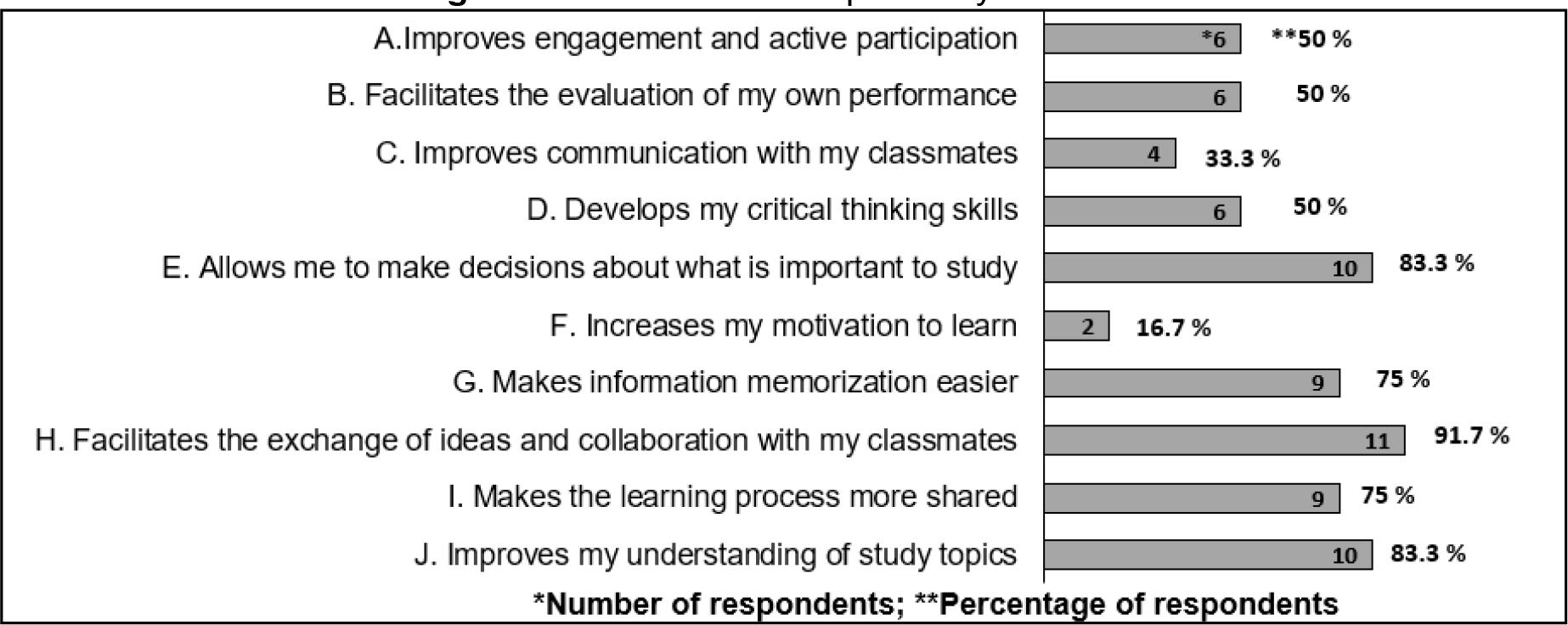
Figure 3 represents the results of the question about challenges: “What are the challenges associated with the use of collaborative mind maps in the learning process? (Check all that apply)”.
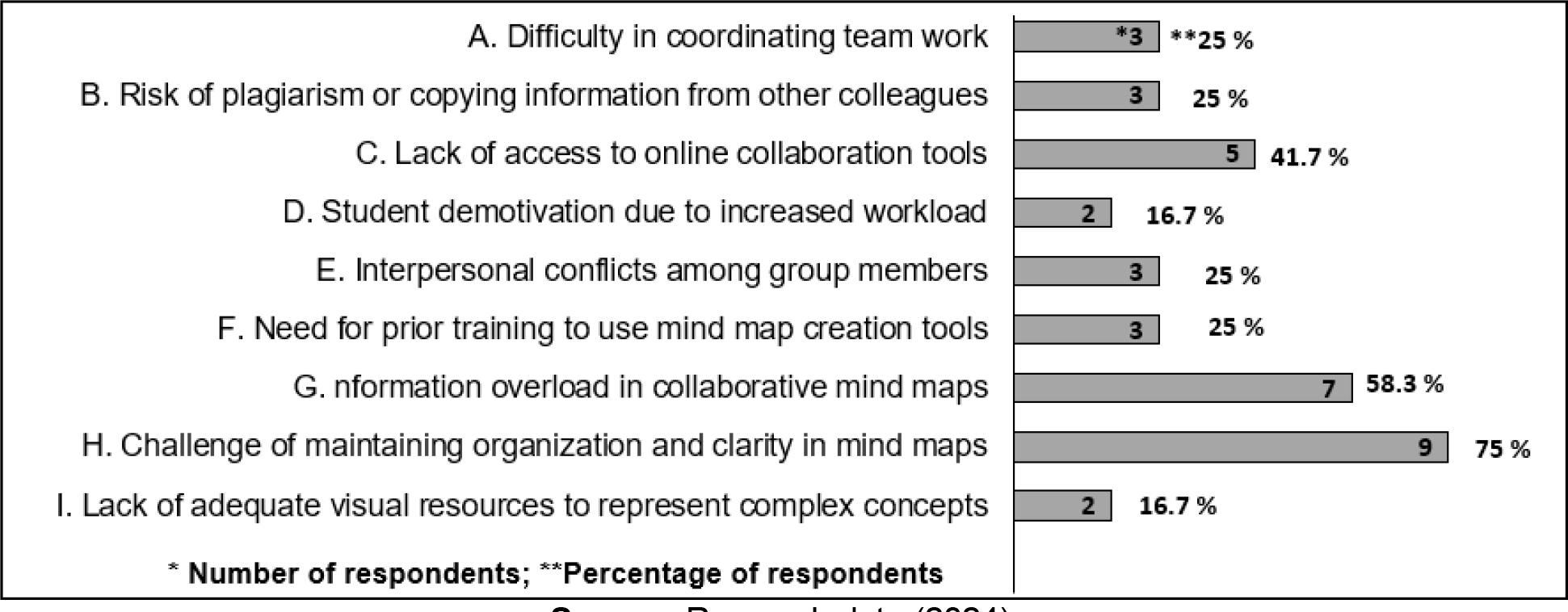
Based on the data presented in Figure 3, the students provided their perspectives on the particular obstacles they encountered when utilizing collaborative mind maps. The examination of these challenges is intended to enhance their pedagogical practices and direct future enhancements in the implementation of collaborative mind maps. As a result, the greatest number of reported issues can be attributed to maintaining organization and clarity, as all group members have the ability to edit simultaneously. Other challenges include information overload and a lack of effective digital collaboration tools for conveying complex concepts.
4.2 Reflections from the qualitative dimension of research
According to the analysis carried out via IRaMuTeQ software with CHD, which, according to Magno and Gonçalves (2023) and Martins et al. (2022), is very similar to Discursive Textual Analysis (DTA), it was possible to classify the textual corpus into classes. The textual corpus consisted of 12 texts, which correspond to the students' answers to the open question in Table 1: "Write a paragraph evaluating, reporting, and demonstrating your perception about the use of collaborative mind maps in the class and outside of class?". The textual corpus consisted of 12 texts, separated into 156 Text Segments (TSs), with 149 TSs being used, totaling 95.5% of the segments.
It is recommended to have a minimum percentage of 75% in the classification result (Camargo; Justo, 2016). The analysis yielded 3,221 instances of words, forms, or vocabulary, of which 994 were unique and 612 had a single occurrence. To categorize the words, the software employs the chi-square test (χ2), which gauges the strength of the association between the words and their respective class. This associative strength is analyzed when the test is greater than χ2 > 3.80 (Lahlou, 2012). The analyzed textual corpus was categorized into three classes, as represented in Figure 4.
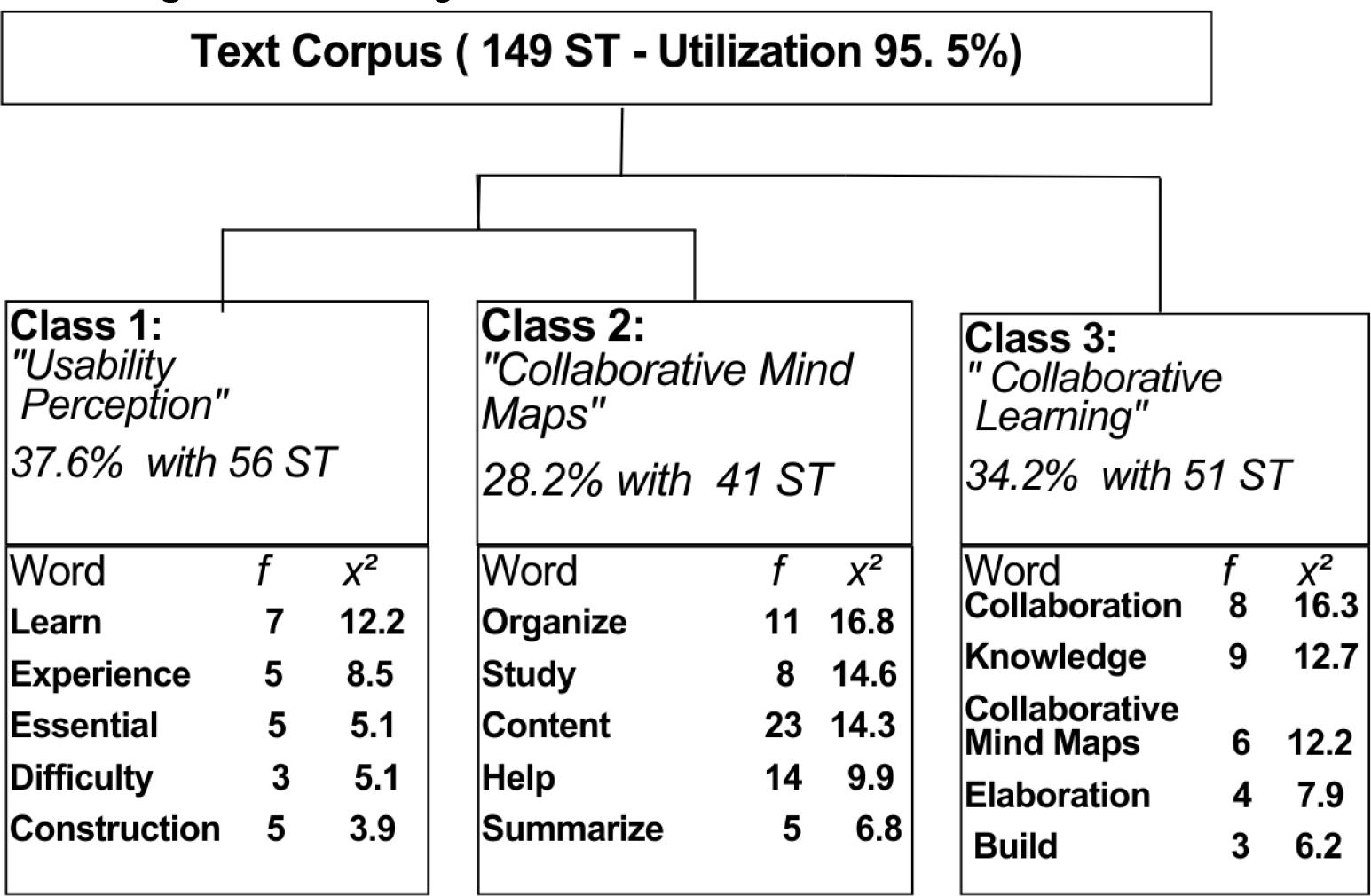
Regarding the CHD result, according to Figure 4, words are frequent (f) and the chi-square (χ2). Class 1, "Perception of usability", contains 37.6% (56 STs) of the analyzed corpus. This class includes items that represent students' perceptions of the usability of collaborative mind maps during class and extracurricular activities. It was decided to present the answers as they appeared in the questionnaire to preserve their originality.
“We encourage creativity when creating a mind map, and the collaborative aspect makes it even more interesting. Mind maps are great for any subject at any level, from elementary to high school. To learn content, it seems great to give students the task of creating collaborative mind maps; even if the school does not have the technology to do it on a computer, it can be done on a cell phone and, in the worst case scenario, in a notebook or on a sheet of paper (E_8)”.
“I've found that mind maps are a great way to summarize and identify main points on a given topic. I find it really challenging to summarize text because I tend to think that everything is important. With the maps, I can easily separate the main topics, which makes it much easier for me to summarize. It was a great experience overall. We exchanged a lot of ideas, helped each other out, and listened to the group's opinion to figure out how to organize the map and which topics to highlight (E_7)”.
“When you mind map together with others, you can create a comprehensive and meaningful mind map by working with multiple people. I noticed that my colleague and I are on the same page, and this involves everyone sharing their different perspectives, knowledge, and skills, which makes the final product richer and more complete, and it gets better with each class taught by the teacher (E_2)”.
“When we bring up the relationship between mind maps, we start to think about how to be objective while also working on the ideas of the topic. It helps me to analyze and interpret the topic in a different way, which is much more productive and encouraging (E_12)”.
Collaboration between students is emphasized as a key point, highlighting the exchange of ideas, mutual assistance and the ability to listen to the group's opinions in organizing the map. It is easy to summarize and identify essential information (E_7). Besides that, working together helps bring different points of view, knowledge, and skills together, which makes for more complete and meaningful mind maps (E_2). The responses of students E_2 and E_7 provide evidence of collaborative learning, as defined by Dillenbourg (1999, p. 5) as “a mutual engagement of participants in a coordinated effort to solve the problem together”.
Student E_8 highlights that the applicability of mind maps at different educational levels, whether in basic education or at university, is perceived as an accessible opportunity, even in the absence of specific technologies. Student E_12 mentions that the mind map approach is recognized for encouraging objectivity, providing a more productive and motivating way of analyzing and interpreting. In this respect, Yan et al. (2022) emphasize that the integration of mind mapping techniques in educational settings can enhance students' self-efficacy regarding creativity and academic achievement, allowing them to express ideas in a non-linear way and stimulating the development of higher-order skills, such as creativity.
Class 2, “Collaborative Mind Maps”, comprised 28.1% (41 STs) of the total corpus analyzed after the analysis emerged in the CHD. This class lists the experiences that most students had in elaborating collaborative mind maps.
“Collaborative mind maps helped me organize better and be more productive in my studies, select and synthesize content, work as a team (teaching and learning with the group), and handle digital resources better (in addition to learning about the resource, we learned how to handle it) (E_12)”.
“It's a great learning opportunity that lets you use your creativity and develop skills like summarizing content and choosing the most important aspects of certain topics to make things clearer. I'm learning a lot about mind maps in this subject because they open up a range of ways to study. Other methods we've studied complement these approaches in a way that contributes to learning. They also get students interested and involved in the classroom (E_1)”.
“Good for synthesizing content. Teamwork was used a lot; communication is also essential. The production of mind maps depends a lot on this. There was no conflict resolution because there were basically no conflicts up until now; empathy was very important, we always asked each other if what was being put on the mind map made sense or not, if it looked good this way or that way (E_8)”.
“Mind maps can be used to summarize content in an organized way so that the student can use it as a basis for studying for a test, for example, without forgetting anything (E_10)”. “Very good, because I can see where my weak points are. It makes it easier to organize; we have a guide to follow (E_9)”.
“I created a mind map of pyramids and prisms for 3rd-year high school students because they didn't like to copy, and since it was close to the test, I decided to create the maps to help them with the test and to study for it. From what I could tell, it helped a lot (E_7)”.
“Mind maps are great for quickly learning the main points about each topic, which makes it easier to study them later. It's also a great way to make sure you don't forget anything when you're talking about something. Mind maps helped me understand the main points or objectives of the topics we covered (E_3)”.
“Collaborative mind maps can be useful tools in learning Mathematics and other subjects, where each teacher has their own training, as they can help students understand and organize information visually and create connections between mathematical concepts, for example, and this helps the teacher to make a class more flexible, making it more interactive (E_2)”.
Students have indicated that collaborative mind mapping enhances the organization of studies and boosts productivity. Reports indicate that the capacity to select and synthesize content facilitates continuous learning (E_1 e E_12). Additionally, teamwork and communication were emphasized as essential, with the importance of collaborative work and empathy to validate each member's contributions being highlighted (E_1 e E_8).
A number of benefits were also identified. These included the ability to summarize content for study and assessment (E_10), the capacity to identify deficiencies and enhance organization (E_9), and the potential to assist high school students in exam preparation, resulting in significant improvement (E_7). Beyond that, mind maps facilitate the presentation of work, serving as guides and helping to remember the main points (E_3), they are useful in several subjects, helping students to understand and organize information visually and to create connections between concepts (E_2). These findings corroborate the collaborative learning advocated by Dillenbourg (1999), which emphasizes the joint construction of knowledge through interaction and exchange of ideas among participants.
Furthermore, the analysis of the responses revealed evidence that collaborative mind maps facilitated the self-regulation of learning. According to Pintrich (1999), some self-regulation strategies include the opportunity offered to individuals to organize their learning processes, the preparation of material that associates what has been recently learned with previous knowledge, the management of time and the study environment, and the organization that allows the correlation between knowledge. In this way, collaborative mind maps contribute to the learning process through self-regulation, increasing motivation, and helping to structure their learning (Tanriseven, 2014).
Class 3, “Learning”, encompasses 34.4% (51 STs) of the total corpus analyzed and was classified according to the responses after analysis. Students self-assess the use of collaborative mind maps when constructing in groups.
“Collaborative learning in the creation of collaborative mind maps refers to the teamwork process in which participants jointly contribute to the creation and development of shared mind maps (E_1)”.
“We always tried to collaborate in the group. We all contributed in a way that we could use what we thought was most relevant, within what was researched. I believe that the knowledge we built together was used by us in creating the map because we tried to decide together what would be best (E_4)”.
“For me, they helped, because the collaboration made me see the content from another person's perspective, reinforcing or even teaching something that I didn't fully understand at first (E_6)”. “The collaborative aspect, when used together with technology, enables both parties to work on these maps even from a distance, helping the process outside the classroom. In the classroom setting, the discussion about what should or should not be included consequently prompts critical thinking about any aspect we are addressing, such as accessibility. Creativity is another factor that emerges when we work as a team, as the constant debate generates new ideas all the time, adding not only to the mind maps themselves but also to the learning process (E_5)”.
“To facilitate collaboration, future teachers can use online mind mapping tools such as MindMeister, Coggle, or Miro, which allow real-time editing and sharing with colleagues and instructors. These tools can improve the efficiency and effectiveness of using mind maps in teacher training; there is also Canva, which is a widely used graphic design tool that can be very useful in assisting teachers in a variety of areas, from creating attractive teaching materials to promoting student engagement. The school just needs to provide the necessary tools for both parties to work and share ideas (E_2)”.
When analyzing the responses of students E_1, E_4, and E_6, the essence of collaborative learning stands out, in which teamwork and joint contribution are fundamental to the development of mind maps. This allowed for the exchange of perspectives, interaction, and mutual learning, reinforcing understanding and even teaching new concepts. In this context, Dillenbourg (1999, p. 6) posits that collaborative learning is characterized by a dynamic sharing of ideas and strategies, whereby participants construct knowledge collectively. The use of collaborative mind maps provides students with significant support, promoting moments of collaborative learning. This facilitates and motivates learning, resulting in group engagement (Zheng; Johnson; Zhou, 2020).
Finally, the responses from students E_2 and E_5 indicate that the online tool facilitated collaboration, demonstrating how technology enables real-time editing and sharing. Overall, collaborative mind maps encourage interaction between students, creating an active learning environment. Also, Araujo (2019) illustrated that these maps can be beneficial in facilitating online discussions and in supporting the collaborative construction of knowledge. They offer a visual representation of collective thinking, which improves the retention and organization of knowledge.
The interlocution between the research data and the theoretical framework on collaborative mind maps reveals advances in collaborative learning and using educational technologies. The analysis of the results shows that collaborative mind maps promote greater engagement, information retention, and the development of skills such as creativity and critical thinking, corroborating the theories of Bandura (1976) and Vygotsky (1978) about the importance of social interactions in learning. The use of Canva enhanced the collaborative process, as suggested by Zheng, Johnson, and Zhou (2020), increasing students' motivation and self-efficacy. It is worth noting that the difficulties encountered in the organization of maps during the creation process are in line with the limitations highlighted in the literature. To overcome these challenges, training students and teachers is crucial, ensuring that the use of collaborative mind maps is productive and effective, as highlighted by Araujo and Gadanidis (2020).
5 Final considerations
The results of this research show that collaborative mind maps are a powerful pedagogical tool, capable of transforming the dynamics of teaching and learning. Through the combination of qualitative and quantitative analyses, it was shown that using collaborative mind maps not only improves the organization and retention of information by students, but also promotes a more interactive and collaborative learning environment. Students reported increased motivation and engagement, highlighting the ability of mind maps to facilitate the joint construction of knowledge and the development of critical skills such as creativity and critical thinking.
Not only that but the implementation of collaborative mind maps has proven effective in improving communication and strengthening teamwork, essential aspects for students' academic and professional success. The challenges identified, such as the need for adequate training for the efficient use of the tool, underscore the importance of training teachers and students to maximize the benefits of this innovative approach. The qualitative analysis revealed that collaborative mind maps facilitated note-taking, information synthesis, assessment, knowledge sharing, goal-setting, personal expression, and study, differentiating it from the traditional teaching approach, in which the teacher is the sole transmitter of the content.
In conclusion, both qualitative and quantitative analyses confirmed the effectiveness of this approach, emphasizing its beneficial effects on memorization, organization, and understanding of content, as well as, consequently, on teaching and learning. Although the results are promising, the limitation of the sample indicates the need for future studies that replicate and expand these conclusions, consolidating the validity and generalization of these findings in the educational context. Future work could explore the development of collectively constructed cognitive and metacognitive skills.
Ad hoc experts::
Simone Varela and Daniela Karine Ramos
How to cite this article (ABNT)::
BLASS, Leandro; RHODEN, Angélica Cristina. A eficácia dos mapas mentais colaborativos na aprendizagem e ensino de tecnologias aplicadas à Matemática. Educação & Formação, Fortaleza, v. 9, e13292, 2024. Available at: https://revistas.uece.br/index.php/redufor/article/view/e13292
REFERENCES
ARAUJO, R. C. Collaborative mind mapping to support online discussion in teacher education. [S.l.]: 2019. [ Links ]
ARAUJO, R. C.; GADANIDIS, G. Online collaborative mind mapping in a mathematics teacher education program: A study on student interaction and knowledge construction. ZDM - Mathematics Education, [S.l.], v. 52, n. 5, p. 943-958, 2020. DOI: https://doi.org/10.1007/s11858-019-01125-w. [ Links ]
BADRIAH, L. et al. Collaborative mind mapping in RICOSRE learning model to improve students’ information literacy. International Journal of Evaluation and Research in Education, [S.l.], v. 13, n. 1, p. 559-569, 2024. [ Links ]
BANDURA, A. Social learning theory. Englewood Cliffs: Prentice-Hall, 1976. [ Links ]
BUZAN, B.; BUZAN, T. The mind map book: How to use radiant thinking to maximize your brain’s untapped potential. London: Penguin, 1996. [ Links ]
BUZAN, T. Dominando a técnica dos mapas mentais: guia completo de aprendizado e o uso da mais poderosa ferramenta de desenvolvimento da mente humana. São Paulo: Cultrix, 2019. [ Links ]
CAMARGO, B. V.; JUSTO, A. M. IRAMUTEQ: um software gratuito para análise de dados textuais. Temas em Psicologia, Ribeirão Preto, v. 21, n. 2, p. 513-518, 2013. [ Links ]
CAMARGO, B. V.; JUSTO, A. M. Tutorial para uso do software de análise textual IRAMUTEC. Laboratório de Psicologia Social da Comunicação e Cognição, Florianópolis, p. 32, 2016. [ Links ]
CORBIN, J.; STRAUSS, A. Basics of qualitative research: Techniques and procedures for developing grounded theory. 4. ed. Thousand Oaks: Sage, 2015. [ Links ]
CRESWELL, J. W. Projeto de pesquisa: métodos qualitativo, quantitativo e misto. 3. ed. Porto Alegre: Artmed, 2010. [ Links ]
DAVIES, M. Concept mapping, mind mapping and argument mapping: What are the differences and do they matter?. Higher Education, [S.l.], v. 62, n. 3, p. 279-301, 2011. [ Links ]
DAY, J. C.; BELLEZZA, F. S. The relation between visual imagery mediators and recall. Memory & Cognition, [S.l.], v. 11, n. 3, p. 251-257, 1983. [ Links ]
DILLENBOURG, P. What do you mean by collaborative learning?. In: DILLENBOURG, P. (ed.). Collaborative - learning: Cognitive and computational approaches. Oxford: Elsevier, 1999. p. 1-19. [ Links ]
FIELD, A. Descobrindo a estatística usando o SPSS. 2. ed. Porto Alegre: Artmed, 2021. [ Links ]
FU, Q. K. et al. Impacts of a mind mapping-based contextual gaming approach on EFL students’ writing performance, learning perceptions and generative uses in an English course. Computers and Education, [S.l.], v. 137, p. 59-77, 2019. DOI: https://doi.org/10.1016/j.compedu.2019.04.005. [ Links ]
FUNG, D.; LIANG, T. The effectiveness of collaborative mind mapping in Hong Kong Primary Science Classrooms. International Journal of Science and Mathematics Education, [S.l.], v. 21, n. 3, p. 899-922, 2023. DOI: https://doi.org/10.1007/s10763-022-10279-1. [ Links ]
GIL, A. C. Como elaborar projetos de pesquisa. 4. ed. São Paulo: Atlas, 2002. [ Links ]
HERNÁNDEZ-SELLÉS, N.; MUÑOZ-CARRIL, P.-C.; GONZÁLEZ-SANMAMED, M. Interaction in computer supported collaborative learning: an analysis of the implementation phase. International Journal of Educational Technology in Higher Education, [S.l.], v. 17, n. 1, p. 23, 2020. [ Links ]
LAHLOU, S. Text mining methods : na answer to Chartier and Meunier. Papers on Social Representation, [S.l.], v. 20, n. 38, p. 1-7, 2012. [ Links ]
MAGNO, C. M. V.; GONÇALVES, T. V. O. O testemunho em pesquisa narrativa e a análise textual discursiva associada ao Iramuteq. Amazônia: Revista de Educação em Ciências e Matemáticas, Manaus, v. 19, n. 42, p. 18-34, 2023. [ Links ]
MARTINS, K. N. et al. O software IRaMuTeQ como recurso para a análise textual discursiva. Revista Pesquisa Qualitativa, São Paulo, v. 10, n. 24, p. 213-232, 2022. DOI: http://dx.doi.org/10.33361/RPQ.2022.v.10.n.24.383. [ Links ]
PINTRICH, P. R. The role of motivation in promoting and sustaining self-regulated learning. International Journal of Educational Research, [S.l.], v. 31, n. 6, p. 459-470, 1999. Disponível em: https://linkinghub.elsevier.com/retrieve/pii/S0883035599000154. Acesso em: 10 jan. 2024. [ Links ]
SOMERS, M. J. et al. Using mind maps to study how business school students andfaculty organize and apply general business knowledge. International Journal of Management Education, [S.l.], v. 12, n. 1, p. 1-13, 2014. DOI: http://dx.doi.org/10.1016/j.ijme.2013.11.001. [ Links ]
TANRISEVEN, I. A tool that can be effective in the self-regulated learning of pre-service teachers: The mind map. Australian Journal of Teacher Education, [S.l.], v. 39, n. 1, p. 65-80, 2014. Disponível em: http://ro.ecu.edu.au/ajte/vol39/iss1/5. Acesso em: 10 jan. 2024. [ Links ]
VYGOTSKY, L. Mind in society: The development of higher psychological processes. Massachusetts: University Harvard, 1978. [ Links ]
WU, C. H. et al. A mindtool-based collaborative learning approach to enhancing students’ innovative performance in management courses. Australasian Journal of Educational Technology, [S.l.], v. 29, n. 1, p. 128-142, 2013. [ Links ]
WU, T. T.; CHEN, N. C. Combining e-books with mind mapping in a reciprocal teaching strategy for a classical Chinese course. Computers and Education, [S.l.], v. 116, p. 64-80, 2018. DOI: https://doi.org/10.1016/j.compedu.2017.08.012. [ Links ]
YAN, Z. et al. Enhancing students’ self-efficacy in creativity and learning performance in the context of english learning: The use of self-assessment mind maps. Frontiers in Psychology, [S.l.], v. 13, p. 1-11, 2022. Disponível em: https://www.frontiersin.org/articles/10.3389/fpsyg.2022.871781/full. [ Links ]
ZHENG, X.; JOHNSON, T. E; ZHOU, C. A pilot study examining the impact of collaborative mind mapping strategy in a flipped classroom: learning achievement, self-efficacy, motivation, and students’ acceptance. Educational Technology Research and Development, [S.l.], v. 68, n. 6, p. 3527-3545, 2020. DOI: https://doi.org/10.1007/s11423-020-09868-0. [ Links ]
HISTORY
Received: July 12, 2024; Accepted: October 21, 2024; Published: November 20, 2024
 Este é um artigo publicado em acesso aberto sob uma licença Creative Commons.