
The Mathematics Education Laboratory of the University of Minho, Portugal: a resilient history

Educação Matemática Debate
On-line version ISSN 2526-6136
Ed. Mat. Deb. vol.9 no.16 Montes Claros 2025
https://doi.org/10.46551/emd.v9n16a06
Articles
The Mathematics Education Laboratory of the University of Minho, Portugal: a resilient history

4Universidade do Estado da Bahia. Petrolina, PE — Brasil
5Universidade de Aveiro. Aveiro, Portugal
6Universidade do Minho. Braga, Portugal
The aim of this paper is to tell the story of the second Mathematics Education Laboratory set up in Higher Education in Portugal, at the University of Minho (LEM-Uminho) in Braga. The paper seeks to understand the perspectives inherent in its creation and evolution, to scrutinize the training practices that have taken place there and to identify the challenges facing its sustainability. This is a narrative investigation and, in order to produce and collect the data, we opted for interviews and documents focused on the laboratory. The analysis revealed that the LEM-UMinho was established in 1997 and that its creation and trajectory represent a continuous effort to promote training paths that have repercussions on humanized educational practices in Mathematics.
Keywords: Mathematics Education Laboratory; Teacher Education; Teaching and Learning Mathematics
Com o artigo, objetivamos narrar as trajetórias do segundo Laboratório de Educação Matemática instalado no Ensino Superior em Portugal, presente na Universidade do Minho (LEM-Uminho), em Braga. Busca-se, com o artigo, compreender as perspetivas inerentes à sua criação e evolução, perscrutar as práticas formativas que aí tiveram lugar e identificar os desafios que se colocam à sua sustentabilidade. Trata-se de uma investigação narrativa e, para a produção e coleta dos dados, optou-se pela realização de entrevista e por documentos focados nesse Laboratório. A análise revelou que o LEM-UMinho foi estabelecido em 1997 e que a sua criação e trajetória representam um esforço contínuo para promover percursos de formação que se repercutam em práticas educacionais humanizadas da Matemática.
Palavras-chave: Laboratório de Educação Matemática; Formação de Professores; Ensino e Aprendizagem da Matemática
Con el artículo, tenemos el objetivo narrar las trayectorias del segundo Laboratorio de Educación Matemática en la Educación Superior en Portugal, presente en la Universidad de Minho (LEM-Uminho), en Braga. El enfoque particular es comprender las perspectivas inherentes a su creación y evolución, escudriñar las prácticas formativas que tuvieron lugar allí e identificar los desafíos que enfrenta su sostenibilidad. Se trata de una investigación con enfoque narrativo que optó por realizar entrevistas y centrarse en documentos relacionados con este Laboratorio para la recopilación de datos. El análisis reveló que el LEM-Uminho fue establecido en 1997 y que su creación y trayectoria representan un esfuerzo continuo para promover prácticas educativas humanizadas relacionadas con la Matemática.
Palabras clave: Laboratorio de Educación Matemática; Formación de Docentes; Enseñanza y Aprendizaje de la Matemática
1 Introduction
Contemporary challenges have complexified the field of study of Teacher Education, requiring a constant revisiting of teacher training models and curricula. Given the various problems that emerge from reality and circumscribe the teaching and learning of mathematics in particular, there is a need to understand the challenges posed in search of answers.
One of the most pressing challenges is the integration of theory and practice, which must be reflected in the curricular structure of the courses that train teachers to teach mathematics. In this sense, the curricula of these courses need to provide training paths that bring future teachers closer to the school reality and, in particular, to the problems faced by this place, since it is their future professional space (Flores, 2014; Nascimento, Magalhães and Morais, 2017).
Thus, we start from the premise that it is important for the training courses in question to include contact, even if indirect, as early as possible with the school, in order to enable the development of skills that will allow them to act appropriately in this reality. Thus, there is also a need to organize structures that effectively enable the linking of theory and practice to take place (Cabrita, 2018; Silva, 2020; Meurer, Borges and Hermann, 2023).
The Mathematics Education Laboratory (LEM) has emerged as a structure with potential, capable of fostering the development of mathematical skills that are important for human progress and bringing future teachers closer to the school, right from the start of their education (Silva, 2020; Pereira, Santos and Pinheiro, 2022; Das, 2019; Coles and Helliwell, 2023).
Present in higher education institutions focused on Teacher Education, the Mathematics Education Laboratory can play an important role in teacher training and professional development, integrating the triptych of education, research and extension to the community. Thus, if it is effectively active, the proposed education paths can also have a positive impact on the teaching and learning of mathematics (Cabrita, 2004; Silva, 2020; Das, 2020).
However, we recognize that the decision to set up a laboratory structure, such as a LEM, in a higher education institution, while understanding its relevance and impact, involves a series of issues ranging from elements internal to the institution — such as, for example, the commitment of a group of trainers responsible for conducting the work, availability of physical space and financial resources, given that it is expensive to set up — to external factors, such as those linked to public policies and guidelines that guide teacher training in the country. What we have pointed out can be placed within a context of political dispute, something that is common in university environments, namely at the level of the guidelines that guide Teacher Education courses and the definition of curricula. In this way, the decision about what makes up a course’s curriculum is permeated by a variety of intentions, actions and interests that are planned and directed towards specific purposes. At the same time, there is also the unforeseen, the undetermined, the emergency that arises from the confrontation between the interests, tensions and individualities involved (Jesus and Ribeiro, 2023).
According to Apple (2008), Rodríguez (2020) and Jesus and Ribeiro (2023), the curriculum cannot be seen as a set of contents to be reproduced by teachers. This reveals a very limited vision. With regard to content, it is important to understand why one is selected over another by the groups in society that hold power and make decisions. But the most important thing is to understand which competences have been defined and how they are expected to be achieved.
The curriculum is considered one of the most crucial concepts in educational studies (Young, 2014). It is understood as one of the privileged spaces where knowledge and power, representation and control, discourse and regulation intertwine (Furtado and Carmo, 2020). It is therefore where the relationships that play a fundamental role in the formation of social identities are manifested and consolidated (Furtado and Carmo, 2020; Rodríguez, 2020). In short, curriculum, power and social identities are intrinsically linked. The curriculum is a materialization of social relations.
Understanding the importance of Mathematics Education Laboratories and the lack of studies analyzing the repercussions of the work carried out in them on teacher training and professional development in Portugal, post-doctoral research was carried out at the University of Aveiro, entitled Mathematics Education Laboratory (lem@tic) at the University of Aveiro: repercussions for Teacher Education and Mathematics teaching practice. Mathematics Education Laboratory (lem@tic) at the University of Aveiro: repercussions for the training and practice of teachers who teach mathematicsThe primary objective of this research is to understand the repercussions of the articulation between training, research and extension that the Mathematics Education Laboratory at the University of Aveiro (lem@tic) pursues in the training and practice of (future) elementary school teachers.
Although this paper does not focus in detail on the primary objective of the post-doctoral research, it does seek, in the wake of previous studies (Silva, Cabrita and Vale, 2024; Silva and Cabrita, 2024), to narrate the trajectories of the second Mathematics Education Laboratory (LEM) installed in a higher education institution in Portugal, in an attempt to understand the perspectives inherent in its creation and evolution, to scrutinize the training practices that have taken place there and to identify the challenges facing its sustainability.
We understand that the history of lem@tic, the third and last Mathematics Education Laboratory created in higher education in Portugal in 2001, is intrinsically linked to other laboratories that preceded it and therefore influenced it. This paper, as we have said, focuses on the second LEM in Portugal, present at the University of Minho, in Braga, and which precedes the main object of study of the research in progress.
What we are proposing by writing this paper is of significant importance, especially as there is no publication that deals with this subject or analyzes the repercussions of all the work carried out over the last 27 years of the existence of this second Mathematics Education Laboratory structure in Portugal.
It was also decided to adopt a narrative approach (Clandinin and Connelly, 2015) in order to explore the trajectories of this LEM, allowing the voices of the individuals involved in its creation and coordination over the years to be heard. This approach allows the conceptions of those who have narrated the stories related to this Laboratory to surface. To present the results, we adopted a first-person discourse.
2 Methodological Path
We took a strictly qualitative approach to our research. As evidenced by Zanatta and Costa (2012), this type of approach occupies a recognized place among the various possibilities for studying phenomena involving human beings and their social relationships, constituted in various environments.
According to the authors, a phenomenon can be better understood within the context in which it occurs and of which it is a part, and should be analyzed in an integrated way. Thus, the researcher goes into the field to try to understand the phenomenon under study from the perspective of the people involved in it, and to take into account all the relevant points of view (Zanatta and Costa, 2012).
Therefore, in order to better understand the phenomenon that circumscribes the research, the narrative was adopted both as a methodological strategy and as the research phenomenon itself (Clandinin and Connelly, 2015). We recognize its value in interpreting and attributing meaning to lived experiences.
Two categories emerge as essential, considering his problem. The first is experience. As defined by Larrosa (2002), experience is what passes through us, what happens to us, what impacts us, what touches us, and the condition for it to occur is to be immersed in a practice, in a doing, to be inserted in the world that surrounds us, that involves us, and that commits us or, sometimes, demands or imposes something on us. Working from this perspective implies understanding that the experience doesn’t begin with the investigation, but is accessed by inserting ourselves into it and doesn’t end, but continues (Larrosa, 2014). The other fundamental category is the narrative itself, which we understand as “a way of using language in the processes that organize life and lived experiences” (Maffioletti, 2016, p. 52). Narrating implies “considering that individuals interpret the world from a given perspective, from certain interests, motivations, desires, among others, reality cannot be conceived under the principle of universal validity” (Weller and Zardo, 2013, p. 132).
To collect the data, a survey was first carried out of the public Higher Education Institutions (HEI) in Portugal that offer Teacher Education courses. The websites of the institutions identified were then accessed in an attempt to contact professors linked to Mathematics Education by e-mail, in order to consult them about the existence of a LEM at the institution. Once this information was available, contact was made with the coordinators of these laboratories to present the research in progress and invite them to take part in the study and give a narrative interview.
As Weller and Zardo (2013, p. 133) point out, this type of interview is essential for understanding the “procedural structures of the life courses or trajectories of the subjects being researched”. In addition, according to the authors, “the act of recalling and narrating the experience in a sequential manner allows us to access the individual perspectives of the subjects in a natural way” (Weller and Zardo, 2013, p. 133). The interview was conducted in person, with the aim of establishing connections with the collaborators (Clandinin and Connelly, 2015) and gaining a deeper understanding of the Mathematics Education Laboratories present in Portugal. This was done during the visit to the institution, which allowed us to get to know them personally.
In addition, it was considered essential to explore the documentary material available, since these sources also offer valuable insights into history, helping us to tell it. Therefore, during the visits, the coordinators of the structures were asked for official documents, projects or other records related to the respective LEM.
The data was analyzed and interpreted using a narrative approach. Following the perspective highlighted by Crecci (2016), this narrative path considers the three-dimensional process, involving temporality (diachrony), personal and social interactions, as well as the context (scenario) in which the phenomenon in question is inserted. This allows meanings to be attributed to the experiences narrated by the research collaborators.
3 Data analysis
In this section, we present, analyze and interpret the results. It is important to highlight the relationship between the research question and the life stories of the authors of this paper, who have been committed to Mathematics Education Laboratories in their institutions for years; something that confers, as discussed by Clandinin and Connelly (2015), the character of a research puzzle.
We began by presenting the process of identifying the LEMs in public Teacher Education institutions in Portugal and concluded by discussing the second laboratory structure built in the country, seeking to understand the perspectives inherent in its creation and evolution, to scrutinize the training practices that have taken place there and to identify the challenges facing its sustainability.
3.1 Identification of LEM in higher education in Portugal
Prompted by the question Which public higher education institutions in Portugal that offer teacher education courses have Mathematics Education Laboratories?, we mapped the institutions (Silva and Cabrita, 2024). Of the 24 HEIs, and by cross-referencing the responses obtained by sending emails to teachers in the field of Mathematics Education who taught on the teacher training courses at these institutions, with the information collected from the websites and also from the data provided by the study supervisor, we identified the following Laboratories: at the School of Education of the Polytechnic Institute of Viana do Castelo (ESE-IPVC), created in 1989 (Silva, Cabrita and Vale, 2024); at the University of Minho (UMinho), created in 1997 and at the University of Aveiro (UA), inaugurated in 2001.
Subsequently, we made contact with the teachers responsible for creating or coordinating the Mathematics Education Laboratory and invited them to take part in the research, granting us an interview and providing documents focused on the LEM. All the teachers responded positively. We then scheduled a visit to see the laboratory structure and conduct the narrative interview in person.
This paper focuses on the second Mathematics Education Laboratory created at the University of Minho in Braga (LEM-UMinho) and, in particular, on the interview given by one of the collaborators in this research — Pedro Palhares. Documents, photos and texts are used throughout the narrative.
We seek to understand what Pedro Palhares’ narratives reveal about the history of the laboratory he coordinated, specifically in terms of the logic behind the conception and evolution of the LEM-UMinho, the activities carried out over time, as well as the future prospects for its maintenance, thus broadening our understanding of this structure. Throughout the text, reference will be made to E | T-PP-14-12-2023, referring to the interview (E) given by Pedro Palhares on the date indicated or to texts (T) provided by him on that date.
3.2 The LEM at the University of Minho: the second Mathematics Education Laboratory in the context of Higher Education in Portugal
After arriving in Viana do Castelo on December 7, 2023, where I got to know the first laboratory structure created in Portugal and interviewed Professor Isabel Vale, I began to organize my visit to LEM-UMinho in Braga. I contacted Pedro Palhares to establish the best date and time for the meeting. I expressed my flexibility, adjusting to his availability, taking into account his various commitments and activities. We scheduled the conversation for the morning of December 14, 2023.
On the day of the trip, I faced colder temperatures than usual. Leaving home at 4am, with the thermometer reading four degrees, the cold was surprising for someone used to higher temperatures, like me, a Bahian who, in Brazil, lives in the semi-arid northeast. However, I took it as part of the experience and headed towards Aveiro train station.
The first stop was Porto-Campanhã. When I arrived, the temperature was even lower. Porto was colder, accompanied by a fog that made it difficult to see the next train coming, except for the usual sound. After a few minutes of icy waiting, I set off in the direction of Braga. When I arrived, I planned to visit the city on the way to the University. I hoped that, unlike in Viana do Castelo, the weather would be sunny. I could accept the cold, as long as it wasn’t accompanied by rain.
As I explored the city, very involved in the experience, I realized that time was passing without me even noticing how far I had come. Not so quickly, I arrived at the University of Minho, but everything was on schedule, as I had planned to arrive an hour early. Following Pedro Palhares’ instructions, I arrived at the Institute of Education, ready to meet him. He arrived on time and we went straight to the Laboratory, shown in Figures 1 and 2.
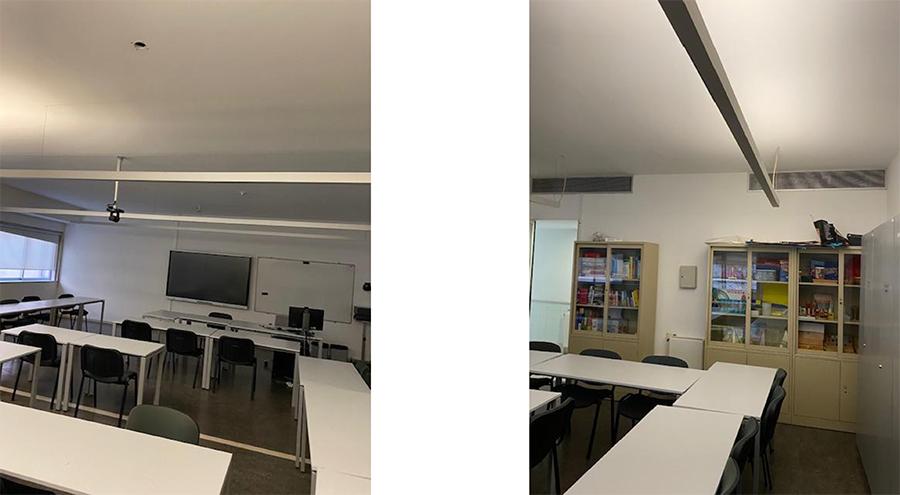
Along the way to the LEM-UMinho, Pedro Palhares shared with me, with a tone of regret and indignation, the changes that the Laboratory had undergone: now integrated into a resource room covering several areas. I understood the discouragement expressed, especially when I saw that the room that now houses the LEM is more like an ordinary classroom, with a few cupboards provided to store the materials to be used from the different areas of knowledge.
My first impression was that the potentially playful atmosphere that can characterize a Mathematics Education Laboratory, for doing mathematics (Silva, 2014; Silva, Souza and Cruz, 2020), was absent, at least for me, which aroused my curiosity about: “what are the reasons that lead an institution to make a certain decision?”. I wondered about the impact of this change on the structure and work carried out there. I hoped that this subject would come up later in the interview.
After introducing me to the space which, according to Pedro Palhares, was quite different compared to the past, we went to his office. We arrived, sat down and I had the feeling that, from the professor’s side, the interview could officially begin. I kept an eye on the schedule, aware of the time available, and tried to conduct the interview in such a way as to optimize it.
Pedro Manuel Baptista Palhares is an Associate Professor at the Institute of Education of the University of Minho, a member of the Research Center for Child Studies, having been the coordinator of the Child Development and Learning research group between 2011 and 2018, and then, for three years, deputy director of the Center. He also held the position of director of the Doctorate in Child Studies from 2011 to 2015. At international level, he held the position of vice-president of the International Commission for the Study and Improvement of Mathematics Teaching for five years. With an extensive academic output, Pedro Palhares is the author of more than 100 publications, including papers, books and book chapters.
3.3 The genesis of LEM-Uminho
To begin the interview, Pedro Palhares shared a little of his history and the trajectory of the LEM-UMinho that he helped found in 1997, at the former Institute of Child Studies at the University of Minho, in Braga. He also highlighted his participation in the creation of the Laboratory at the School of Education (ESE) of the Polytechnic Institute of Viana do Castelo, in 1989 — “By the way, I was one of the members of the Viana do Castelo Laboratory. At the time, we created a project to establish the Laboratory, funded by the Calouste Gulbenkian Foundation. Later, they received more support and therefore expanded. I was at ESE Viana do Castelo from 1988 to 1992” (E-PP-14-12-2023).
After this period, the teacher moved to Braga to work at the Instituto de Estudos da Criança, which at the time was the Teacher Education Center. When he arrived at the new institution, he drew up a project and proposed the creation of a Mathematics Education Laboratory, which was subsidized by the Rectory — “It was one of the first proposals for the education of teachers and early childhood educators. The Rectorate, at the time, granted a substantial sum” (E-PP-14-12-2023).
According to the professor, the purpose of the LEM was to provide a space that would support the initial and ongoing education of teachers who teach mathematics. From this perspective, the Laboratory would be an important structure for developing mathematical skills relevant to education, professional development and teaching practice (Silva, 2020; Pereira, Santos and Pinheiro, 2022; Das, 2020).
However, at that time, as highlighted by Pedro Palhares, the Rectorate’s support was mainly motivated by the initiative related to initial education, recognizing the Laboratory as a formative space capable of contributing positively to the education of future teachers who would teach mathematics (Cabrita, 2004; Silva, 2020; Das, 2020). When talking about the genesis and logic behind the creation of the LEM, he points out that
At the time, we had complementary education courses, that’s what they were called. In the old days, teachers had a bachelor’s degree and then they came and did this complementary course to get their degree. It was a period when we had a lot of teachers doing this course and, of course, the classes took place in the laboratory. They were trained in the use of materials and could make purchases and do work on the use of specific materials. It was a time of a lot of lab-related activities. There was an exclusive place for the laboratory, where only math classes took place.
(E-PP-14-12-2023)
As we have seen, the LEM-UMinho emerged as a space designed to support Teacher Education. This structure played a fundamental role in mathematics, being institutionally recognized as one of the entities responsible for training teachers who would teach this area. As the teacher pointed out, “sometimes we also received primary and pre-school classes and had activities prepared for [the students]. It was a time when the laboratory functioned comprehensively, supporting education and involving groups of students in different activities” (E-PP-14-12-2023). This reinforces the understanding of the importance of structuring teacher education and, consequently, a LEM, connected to school reality (Cabrita, 2004; Silva, 2020; Meurer, Borges and Hermann, 2023). The future teacher’s contact with the different realities of teaching and learning mathematics, with interaction with students, particularly elementary school students, strengthens the concept of the LEM-UMinho as a space that is formed from interaction with the school community. This proximity of the Laboratory to the school results in the development of various essential skills for teacher training and practice, something that is important throughout the initial training course (Cabrita, 2004; Silva, 2020).
As for the reasons that led him to propose and participate in the creation of the LEM, Pedro Palhares reveals that his motivation at the time was centered on the fact that math teaching was traditionally very abstract and disconnected from reality. According to the teacher, “it shouldn’t be like this, in my opinion, and manipulable material is one of the ways to make mathematics more tangible. This was therefore one of the aspects that I felt was important to incorporate into Teacher Education, so that students could develop a slightly different idea of mathematics” (E-PP-14-12-2023).
If we carefully examine the details of her narrative, we will notice that, just like Isabel Vale (Silva, Cabrita and Vale, 2024), she was initially uncomfortable with the nature of mathematics teaching, which was often so far removed from people’s realities that it alienated them from this area, which was seen as natural. In view of this, I recognized that the manipulation of various teaching materials, each with its own peculiarities, could bring people closer to mathematics. The material would thus be, in a metaphorical way, a bridge that would connect the individual to mathematics, effectively bringing them closer together (Cabrita, 2004; Silva, 2020; Pereira, Santos and Pinheiro, 2022).
Still reflecting on the motivations for proposing the creation of the Mathematics Education Laboratory at the University of Minho, the professor points out that
There were lots of sources of inspiration, weren’t there? But mainly from reading, from things that existed, for example, in the United States. At the time, we also had a colleague who was in the United States doing his doctorate, Domingos Fernandes, who was at the ESE in Viana do Castelo. I think he’s currently on the National Education Council. So he also brought knowledge of things that existed in the United States. And also from reading about things that existed, for example, in France. At the time, that had a lot of impact.
(E-PP-14-12-2023)
For the creation of LEM-UMinho, as well as for the creation of the Viana do Castelo Laboratory (Silva, Cabrita and Vale, 2024), the influence of professors who were sent to Boston University, the main city in the state of Massachusetts, in the United States of America (USA), is noteworthy. The reflections brought by these teachers, such as Domingos Fernandes, had a significant impact on the constitution of conceptions that guided the initial creation of Mathematics Education Laboratories.
As Morais, Costa and Costa (2014, p. 11) point out, personal relationships and professional life are intrinsically linked and influence decision-making. This is because they are “permeated by values, beliefs, tastes and experiences formed throughout their lives, in the most varied situations of social relationships”. Thus, the close location of the three existing Mathematics Education Laboratory structures in Portugal is no coincidence (Silva and Cabrita, 2024). We understand that the training practices and institutional partnerships established between their researchers have influenced the proposals for structures, projects and other practices.
As revealed in Pedro Palhares’ narratives, it can be seen that his participation in the creation of a LEM in Viana do Castelo, as well as the relationships established with work colleagues at the time, such as Domingos Fernandes and Isabel Vale, may have been relevant elements in the decision to propose the installation of a similar structure in the new work environment. In this vein, Silva (2018) asserts that experiences considered successful in personal trajectories are often recalled to support our professional practices.
3.4 Evolution of LEM-Uminho
Continuing his narrative, Pedro Palhares points out that the understanding of the LEM-UMinho only as a space for exploring various teaching materials remained present in the activities carried out for a long time. And he reflects that, “by using materials, we continue with the same Mathematics, only concretized and organized. One of the aspects of abstraction is that it dehumanizes mathematics. It seems to be something divine, not a human activity. It’s a science that was created through human activity, therefore” (E-PP-14-12-2023). Her view that the use of different materials does not make mathematics lesser corroborates what was also shared by Isabel Vale in a previous interview (Silva, Cabrita and Vale, 2024). In fact, based on our experiences as trainers, we have observed that there are still some prejudices regarding the use of teaching materials, which contradicts various productions, many of them the result of research, which highlight their importance in teaching and learning processes (Vale and Barbosa, 2021; Barbosa and Vale, 2023).
However, the teacher points out that, over time, his perspective has evolved, and he now sees the Laboratory as having the potential to guide training and practices with mathematics, based on different theoretical and methodological approaches. Currently, for example, he is particularly interested in Ethnomathematics. Thus, in addition to the manipulatives, he recognizes other aspects that connect mathematics to people’s lives. In his words,
Today, I’m very interested in ethnomathematics. And so there are other aspects that also bring mathematics into people’s lives, beyond teaching materials. Mathematics is not something transcendent that comes from above, it’s something that has to do with people’s lives. People naturally generate mathematical activity
(E-PP-14-12-2023).
As for the difficulties encountered in setting up the LEM-UMinho, she reveals that, initially, she didn’t face any major obstacles, receiving a lot of support and enthusiasm for the creation of the Laboratory. Together with her colleagues from the Mathematics area, she even published a paper on a teaching philosophy in Teacher Education, in which concrete materials played an important role (Palhares, Gomes and Mamede, 2001). However, he points out that difficulties arose when the space was transferred to a new building, when organic units were merged into the Institute of Education, which covers Teacher Education for secondary levels. In this context, some colleagues, mainly from other subject areas, didn’t recognize the importance of the materials, generating a certain shock and difficulties. This phase marked the loss of the Laboratory’s original physical facility, leading to the need to create a resource center. “Some of the original functions were also lost, such as the idea of involving children, holding exhibitions, visits, and also providing materials” (T-PP-14-12-2023). Therefore, “the most challenging part occurred during this transition to the new institutional context” (E-PP-14-12-2023).
At this point in the conversation, it became clear that the LEM-UMinho, initially conceived with enthusiasm by the university itself, was gradually losing its identity, especially in the face of the institution’s own initiatives, which resulted in the discontinuation of the educational practices previously developed. Given this context, the following question arose: What led the institution to interrupt, at a certain point, a work that, as reported, played a crucial role in the training of teachers who teach mathematics?
To find answers to the question raised, it is essential to revisit Pedro Palhares’ narratives, while considering the reflections of Apple (2008), Furtado and Carmo (2020), Rodriguez (2020) and Jesus and Ribeiro (2023). These authors point to the political and ideological nature of the curriculum, highlighting that it is shaped by a series of social forces, including conflicts and disputes over interests. These dynamics can directly influence institutional decisions about what is valued as relevant.
In this sense, based on what the aforementioned authors consider and on Pedro Palhares’ narratives, we can infer that when the decision was taken to remove the LEM-Uminho from its structure, part of the institutional body may have considered that this space was no longer relevant. Considering the complexities present in the processes of teaching and learning mathematics, many of which are revealed in the results of internal and external evaluations, uncertainty arose: What indicators were taken into account to support this decision?.
We understand that this decision contradicts productions that emphasize the importance of these structures within the scope of Teacher Education (Cabrita, 2004; Silva, 2020; Pereira, Santos and Pinheiro, 2022; Das, 2020; Coles and Helliwell, 2023; Meurer, Borges and Hermann, 2023, Silva, Cabrita and Vale, 2024). In this sense, it becomes relevant to report on how educational practices were developed at LEM-UMinho. This not only reinforces the teacher’s dismay, but also highlights the losses resulting from the decision taken.
3.5 LEM-Uminho’s educational practices
Pedro Palhares, when discussing the activities developed by LEM-UMinho, points out that although the three dimensions — training, research and community outreach — were not integrated into one, there was an attempt to intertwine them, recognizing their importance for Teacher Education (Cabrita, 2014; Silva, 2020; Silva, Souza and Santos, 2023; Silva, 2023). He mentions that this approach was evident at the Research Center, although this is no longer the case today, given the discontinuity of the work that was previously carried out.
With regard to research activities, the LEM-UMinho played an active role in promoting them, providing support for projects that were “aimed at studying the processes of teaching/learning mathematics, developing pedagogical proposals or adapting materials” (T-PP-14-12-2023). Although the initial focus of the Laboratory was to support training, as Pedro Palhares reports, as they evolved, they established a master’s degree which, at the time, was an academic master’s degree rather than a professional one.
Nowadays, although the format of the master’s degree has changed, this commitment to research is still present. “A lot of the work developed was supported by the Lab’s activities, addressing issues related to specific materials, including problem solving, for example” (E-PP-14-12-2023). Still on this subject, the teacher points out that
[...] it was essentially, at the time, the master’s degree, when the master’s degree in Mathematics Teaching and Learning came about. Not only in this laboratory, but also in the one in Viana do Castelo, because it was a joint master’s degree, and we did classes here and there, so both this laboratory, the one in the old building, and the one in Viana do Castelo supported this master’s degree
(E-PP-14-12-2023).
Regarding the extension practices carried out with the support of the LEM-UMinho, Pedro Palhares returns to the discussion about the loss of identity of the Laboratory, the result of the interruption of work that had been going on since its creation. He mentions that, with this interruption, there has been a decrease in interest in the Laboratory.
In addition, as part of a ministerial program of continuous training in mathematics for elementary school teachers (1st and 2nd cycles), which ran from 2006 to 2011, and in which Pedro Palhares, Isabel Vale and Isabel Cabrita participated as institutional coordinators, schools were encouraged to acquire and build their own materials, reducing the need to requisition them from the Mathematics Education Laboratories. From 2006, when the training we are referring to began, “the idea of making materials available directly to schools no longer made sense, as they were by then better equipped and the people trained to use these materials in their classrooms” (E-PP-14-12-2023). Adds:
What remained from then on was teaching, support here in training, which continues to exist. We continue in training, didactics and also in certain mathematics subjects. So, just this semester I had a Geometry and Measurement course in which I made extensive use of materials, for example. With materials, it’s much easier; they can see things much more easily and can then use the materials when they need to
(E-PP-14-12-2023).
Over the years, of activities developed, especially when they were more active in the old structure, it can be seen that, although not everyone showed interest — which is common in many situations — a considerable number of teachers trained at UMinho chose to address themes related to those explored in the Laboratory in their internship reports, for example. They explored themes such as problem-solving using teaching materials, incorporating these approaches into their practices during the internship and remaining adept at these methodologies, which shows, according to Pedro Palhares, a clear influence of the activities promoted by LEM-Uminho.
Thus, it is essential to understand that the Laboratory is an environment that, by its nature, fosters very relevant activities (Cabrita, 2004; Silva, 2020; Pereira, Santos and Pinheiro, 2022; Das, 2020; Coles and Helliwell, 2023; Meurer, Borges and Hermann, 2023). The most crucial component in a Laboratory is action, carried out by the people who make it up. Without activities, there isn’t really a laboratory, but that doesn’t exclude the need for a well-structured space. However, this requires institutional investment that recognizes and stimulates the educational practices that take place there.
Although it is not appropriate to generalize, as Professor Pedro Palhares observes, some teachers who experience the LEM-UMinho may choose not to use materials in their mathematics lessons. Two possible reasons for this choice:
One is to return to their origins, that is, to teach as they were taught. This happens a lot when a person lacks security, when they don’t gain security, and this makes them go back to what they have security in, which is the way they themselves were taught. The other is the social environment at school. So the teachers will say “there’s no time for that”, “we have to do it another way” and time is a constraint. They convince the new ones to do as they do and, therefore, miss out on this innovation. Some arrive at school and do as they know, as they like, and are confident in what they do. So they don’t have any problems. However, others who are insecure, personally, find it difficult to do things outside or away from the school environment where they are, don’t they? They have that difficulty
(E-PP-14-12-2023).
3.6 Challenges to the sustainability of LEM-UMinho
As discussed in the previous sections, one of the main challenges Pedro Palhares points out for the sustainability of the LEM-UMinho has been institutional decisions and actions, which have resulted in the space losing its identity and interrupting the work that had been going on there.
In addition to this internal challenge, caused by the institution itself, the educational scenario in Portugal must also be considered. On this point, Pedro Palhares reveals that
The problem is that there is a deep-rooted view among mathematicians. In Portugal, this is related to a certain political group that believes that mathematics should be taught without any connection to reality, that it should be abstract, that students should train a lot and, through this training, learn. This has become a political issue in Portugal. Not just in Portugal, in fact! In the United States, too, and later in Portugal. It became a political issue. So the mathematics curriculum in 2007 was advanced in the sense that mathematics should be contextualized, it should be linked to reality. Then came a curriculum that, at the time, with a right-wing government, imposed the removal of any mention of problem-solving and reality. So the curriculum was completely removed from the trends that had existed up to that point, and today we’re on the road back, but the curriculum is still very abstract
(E-PP-14-12-2023).
The Mathematics Education Laboratory today needs to be understood “not necessarily as a place. At one time, perhaps the idea of place made sense. However, nowadays, the question of location may not be so relevant” (E-PP-14-12-2023). Now, according to Pedro Palhares, it is important that the Laboratory plays a relevant role in humanizing mathematics. This is more urgent. This humanization occurs through contact with mathematics, without a doubt, with materials, such as games, and through human activities.
We finished the interview on time and I was happy to see that Pedro Palhares insists on resisting the attacks that try to make the work done by LEM-UMinho invisible, even without an exclusive physical space. This shows that there is a confrontation with attempts to discontinue its history. The Laboratory is still alive today, because what really defines this structure are the people and their actions. In this way, Pedro Palhares continues to fight so that the Laboratory is not forgotten.
4 Final considerations
In this paper, we describe some of the trajectories of the second Mathematics Education Laboratory created in Higher Education in Portugal, seeking to understand the perspectives inherent in its creation and evolution, to scrutinize the educational practices that have taken place there and to identify the challenges facing its sustainability.
At the end of the analysis of the LEM-UMinho, it becomes clear that its creation and trajectory represent not only a milestone in Mathematics Teacher Education, but also a continuous effort to promote innovative and humanized educational practices. The initiative to establish a structure dedicated to improving the teaching and learning of mathematics, as a unit responsible for this aspect in a higher education institution, shows the university’s commitment to offering quality education to future teachers and to contributing to their professional development, elements that can have a direct impact on the teaching and learning of mathematics.
The trajectory of the LEM-UMinho reveals not only its significant contribution to the education of teachers who teach mathematics, but also its confrontations with contemporary complexities, educational policies and the power relations present in the academic context. It is clear that it is important to reflect on institutional decisions that have a direct impact on the training and professional development of mathematics teachers, creating counter-hegemonic practices to dominant discourses.
The institutional decision to discontinue the work carried out by LEM-UMinho highlights the need for critical reflection on institutional policies and the conceptions of curriculum that underpin them. Understanding the curriculum as a space where knowledge and power intersect highlights the importance of considering the political and social dimensions that permeate educational decisions.
In view of this, it is essential that Higher Education institutions and professionals in the field of Mathematics Education promote constant dialogue and collaborative reflection on educational practices and curriculum policies, in order to expand and strengthen the existing Mathematics Education Laboratory structures in Portugal. Only with a critical and contextualized approach will it be possible to face the current challenges and promote a better Teacher Education in Mathematics in the country.
REFERENCES
APPLE, Michael. Ideologia e Currículo. Tradução de Vinicius Figueira. Porto Alegre: Artmed, 2008. [ Links ]
BARBOSA, Ana.; VALE, Isabel. Mobile Math trails: an experience in teacher training with Mathcitymap. Acta Scientiae, v. 5. n. 6, p. 157-182, nov./dec. 2023. https://doi.org/10.17648/acta.scientiae.7597 [ Links ]
CABRITA, Isabel. A abertura do LEM@tic à comunidade e o desenvolvimento profissional dos (futuros) educadores da infância. Revista da Escola Superior de Educação. v. 5, n. 1, p. 75-90, 2004. [ Links ]
CABRITA, Isabel. Didática da Matemática em cursos de formação de educadores e professores. Cadernos de Pesquisa, v. 48, n. 168, p. 532-549, abr./jun. 2018. https://doi.org/10.1590/198053145045 [ Links ]
CLANDININ, Jean CONNELLY, Michael. Pesquisa narrativa: experiência e história em pesquisa qualitativa. Uberlândia: EDUFU, 2015. [ Links ]
COLES, Alf; HELLIWELL, Tracy. The role of Mathematics teacher educators in preparing teachers of Mathematics to respond to global challenges within their classrooms. London Review of Education, v. 21, n. 1, p. 1-13, 2023. https://doi.org/10.14324/LRE.21.1.02 [ Links ]
CRECCI, Vanessa Moreira. Desenvolvimento profissional de educadores matemáticos participantes de uma comunidade fronteiriça entre escola e universidade. 2016. 325f. Tese (Doutorado em Educação). Universidade Estadual de Campinas. Campinas. https://doi.org/10.47749/T/UNICAMP.2016.966163 [ Links ]
DAS, Kaushik. Significant of Mathematics Laboratory Activities for Teaching and Learning. International Journal on Integrated Education, v. 2, n. 5, p. 19-25, 2019. https://doi.org/10.17605/ijie.v2i5.138 [ Links ]
FLORES, Maria Assunção. Formação e desenvolvimento profissionais de professores: contributos internacionais. Coimbra: Almedina, 2014. [ Links ]
FURTADO, Letícia dos Santos; CARMO, Eraldo Souza do. Para uma Pedagogia Cultural: o currículo e sua relação com a Educação Ribeirinha na Amazônia. e-Curriculum. v. 18, n. 4. 2020. https://doi.org/10.23925/1809-3876.2020v18i4p1712-1732 [ Links ]
JESUS, Adriana Regina; RIBEIRO, William de Goes. Currículo e disputas: políticas em torno da formação docente. Revista Espaço do Currículo. v. 16, n. 1, p. 1-11, 2023. https://doi.org/10.15687/rec.v16i1.66033 [ Links ]
LARROSA, Jorge. Notas sobre a experiência e o saber de experiência. Revista Brasileira de Educação, v. 19, p. 20-28, jan./abr. 2002. https://doi.org/10.1590/S1413-24782002000100003 [ Links ]
LARROSA, Jorge. Tremores: escritos sobre experiência. Tradução de Cristina Antunes e João Wanderley Geraldi. Belo Horizonte: Autêntica, 2014. [ Links ]
MAFFIOLETTI, Leda de Albuquerque. Reflexões sobre os fundamentos do método(auto)biográfico: inventando relações. In: BRAGANÇA, Inês Ferreira de Souza; ABRAHÃO, Maria Helena Machado Barbosa; FERREIRA, Maria Sales. (Org.). Perspectivas epistêmico-metodológicas da pesquisa (auto)biográfica. Curitiba: CRV, 2016, p. 51-66. [ Links ]
MEURER, Simone Xavier; BORGES, Fábio Alexandre; HERMANN, Wellington. O Laboratório de Ensino como espaço formativo para docentes que ensinam Matemática. Ensino em Re-Vista, v. 30, p. 1-26, 2023. https://doi.org/10.14393/ER-v30a2023-5 [ Links ]
MORAIS, Nicélia Lima; COSTA, Maria Antônia Teixeira; COSTA, Edinária Marinho. Trajetória de vida pessoal e profissional de uma professora do ensino primário na cidade de Apodi-RN. In: Anais do VI Fórum Internacional de Pedagogia. Porto Alegre, 2014, p. 1-12. [ Links ]
NASCIMENTO, Franc-Lane Sousa Carvalho; MAGALHÃES, Nadja Regina Sousa; MORAIS, Joelson Sousa. Formação e o desenvolvimento profissional na percepção do professor do Brasil e de Portugal. Olhar de Professor, v. 20, n. 1, p. 23-37, 2017. https://doi.org/10.5212/OlharProfr.v.20i1.0002 [ Links ]
PALHARES, Pedro; GOMES, Alexandra; MAMEDE, Ema. A formação para o ensino da Matemática no Pré-escolar e no 1º Ciclo: análise teórica e estudo de caso. Revista Portuguesa de Formação de Professores, v. 1, p. 87-101, 2001. [ Links ]
PEREIRA, Ana Carolina Costa; SANTOS, Joelma Nogueira; PINHEIRO, Ana Cláudia Mendonça. Prática de Laboratório de Matemática: concepções de licenciandos na construção de saberes docentes. Revista Internacional de Pesquisa em Educação Matemática, v. 12, n. 4, p. 1-17, set./dez. 2022. https://doi.org/10.37001/ripem.v12i4.2964 [ Links ]
RODRÍGUEZ, Milagros Elena. El des-ligaje de la biopolítica para el re-ligaje en la Educación Matemática Decolonial Transcompleja. Educação Matemática Debate, v. 4, n. 10, p. 1-19, 2020. https://doi.org/10.46551/emd.e202057 [ Links ]
SILVA, Américo Junior Nunes da. Querido diário... o que revelam as narrativas sobre ludicidade, formação e futura prática do professor que ensina(rá) Matemática nos Anos Iniciais. 2018. 348f. Tese (Doutorado em Educação). Universidade Federal de São Carlos, São Carlos. [ Links ]
SILVA, Américo Junior Nunes; SOUZA, Paloma Santos; SANTOS, Alessandra; Miranda, César. O Laboratório de Estudos e Pesquisas em Educação Matemática da UNEB e o constituir-se professor pesquisador: itinerários e narrativas de formação. Com a Palavra o Professor, v. 8, n. 20, p. 246–267, 2023. https://doi.org/10.23864/cpp.v8i20.874 [ Links ]
SILVA, Américo Junior Nunes. A extensão universitária como eixo articulador na formação de professores: ampliando o olhar acerca das práticas de um Laboratório de Educação Matemática localizado na Universidade do Estado da Bahia. In: DENDASCK, Carla Viana. (Org.). Ciências Humanas: atualização de área. São Paulo: Núcleo do Conhecimento, 2023, p. 76-85. [ Links ]
SILVA, Américo Junior Nunes. A ludicidade no laboratório: considerações sobre a formação do futuro professor de Matemática. Curitiba: Editora CRV, 2014. [ Links ]
SILVA, Américo Junior Nunes. O Laboratório de Educação Matemática e a Formação Inicial de Professores de Matemática. Revista Internacional Educon, v. 1, n. 1, p. 1-13, 2020. https://doi.org/10.47764/e20011001 [ Links ]
SILVA, Américo Junior Nunes; CABRITA, Isabel. Laboratórios de Educação Matemática no Ensino Superior em Portugal: o que revela um estudo bibliográfico?. 2024 [em avaliação]. [ Links ]
SILVA, Américo Junior Nunes; CABRITA, Isabel; VALE, Isabel. First Mathematics Education laboratory in Higher Education in Portugal: stories built with words. Revista Internacional de Pesquisa em Educação Matemática, v. 14, n. 2, p. 1-18, maio/ago. 2024. https://doi.org/10.37001/ripem.v14i2.3889 [ Links ]
SILVA, Américo Junior Nunes; SOUZA, Ivanete dos Santos de; CRUZ, Idelma Souza da. O ensino de Matemática nos Anos Finais e a ludicidade: o que pensam professora e alunos?. Educação Matemática Debate, v. 4, n. 10, p. 1-19, 2020. https://doi.org/10.24116/emd.e202018 [ Links ]
VALE, Isabel; BARBOSA, Ana. Active learning strategies for an effective Mathematics teaching and learning. European Journal of Science and Mathematics Education, v. 11, n. 3, p. 573-588, 2023. https://doi.org/10.30935/scimath/13135 [ Links ]
WELLER, Wivian; ZARDO, Sinara Pollom. Entrevista narrativa com especialistas: aportes metodológicos e exemplificação. Revista da FAEEBA, v. 22, n. 40, p. 131-143, 2013. https://doi.org/10.21879/faeeba2358-0194.2013.v22.n40.p131-143 [ Links ]
YOUNG, Michael Fullan David. Teoria do currículo: o que é e por que é importante. Cadernos de Pesquisa, São Paulo, v. 44, n. 151, p. 190-202, jan./mar. 2014. [ Links ]
ZANATTA, Jacir Alfonso; COSTA, Márcio Luis. Algumas reflexões sobre a pesquisa qualitativa nas Ciências Sociais. Estudos e Pesquisas em Psicologia. v. 12. n. 2, p. 344-359, 2012. [ Links ]
Acknowledgments
I would like to thank the State University of Bahia for allowing me to do my postdoctoral internship and for awarding me a scholarship through the Programa de Apoio à Capacitação de Docentes e Técnicos Administrativos (Program to Support the Training of Teachers and Administrative Technicians - PAC-DT). I would also like to thank the University of Aveiro and the supervisor for the opportunity, support, guidance and academic environment conducive to the development of the research, and the University of Minho and Professor Pedro Palhares for their partnership.
HISTORY
Received: May 21, 2024; Accepted: July 12, 2024; Published: March 01, 2025
 Esta obra está licenciada sob uma Licença Creative Commons Atribuição-NãoComercial-CompartilhaIgual 4.0 Internacional.