
Critical Financial Education in Teacher Education: an approach that problematizes different social contexts

Educação Matemática Debate
On-line version ISSN 2526-6136
Ed. Mat. Deb. vol.9 no.16 Montes Claros 2025
https://doi.org/10.46551/emd.v9n16a08
Articles
Critical Financial Education in Teacher Education: an approach that problematizes different social contexts

3Colégio Ao Cubo. Rio de Janeiro, RJ — Brasil
4Universidade Federal do Estado do Rio de Janeiro. Rio de Janeiro, RJ — Brasil
This study investigates the perceptions of Mathematics undergraduates about Financial Education, when confronted with a critical approach that contrasts different social contexts. The research was carried out with five undergraduates from a federal university in Rio de Janeiro, in two stages of data production: (1) a task on the concept of interest and decision-making; (2) an online conversation circle, with semi-structured questions and a fictitious classroom episode, confronting different social contexts that can manifest themselves at school. As a result of the research, we identified three perceptions of Financial Education in the context of its formative role: (a) personal financial management and capital accumulation; (b) critical social formation; (c) Mathematics as (in)certainty: regulation or social questioning?
Keywords: Financial Education; Critical Mathematics Education; Teachers Education
Este trabalho investiga percepções sobre Educação Financeira apresentadas por licenciandos em Matemática, quando confrontados com uma abordagem crítica que contrasta diferentes contextos sociais. A pesquisa foi desenvolvida com cinco licenciandos de uma universidade federal do Rio de Janeiro, em duas etapas de produção de dados: (1) uma tarefa sobre o conceito de juros e tomadas de decisão; (2) uma roda de conversa online, com perguntas semiestruturadas e um episódio fictício de sala de aula, confrontando diferentes contextos sociais que podem se manifestar na escola. Como resultados da pesquisa, identificamos três percepções sobre Educação Financeira no contexto do seu papel formativo: (a) gerenciamento financeiro pessoal e acúmulo de capital; (b) formação social crítica; (c) Matemática como (in)certeza: regulação ou questionamento social?.
Palavras-chave: Educação Financeira; Educação Matemática Crítica; Formação de Professores
Este trabajo investiga percepciones sobre la Educación Financiera que presentan los graduados en matemáticas, frente a un enfoque crítico contrastando diferentes contextos sociales. La investigación se desarrolló con cinco estudiantes de una universidad federal de Río de Janeiro, en dos etapas de producción de datos: (1) una tarea sobre el concepto de interés y toma de decisiones; (2) un círculo de conversación, con preguntas semiestructuradas y un episodio ficticio, confrontando diferentes contextos sociales que pueden manifestarse en la escuela. Como resultados de la investigación, identificamos tres percepciones sobre la Educación Financiera, en el contexto de su papel formativo: (a) gestión financiera personal y acumulación de capital; (b) formación social crítica; (c) las matemáticas como (in)certidumbre: ¿regulación o cuestionamiento social?.
Palabras clave: Educación Financiera; Educación en Matemática Crítica; Formación de Profesores
1 Initial thoughts
Studies on Financial Education in the school environment are constantly growing, with important results that lead us to reflect on the discussion of this topic in the classroom. This contributes to making individuals more aware and critical in their decision-making on financial issues. In 2017, with the publication of the National Common Curricular Base [Base Nacional Comum Curricular — BNCC], the most recent document guiding the curricula of states and municipalities throughout Brazil, Financial Education gained more space in the school universe.
Among the themes listed in the BNCC, it is recommended that Financial Education be incorporated from elementary school onwards, starting with the study of basic economic and financial concepts such as interest rates, inflation, financial investments and taxes, which are included as aspects to be covered in the Numbers thematic unit.
Another aspect to be considered in this thematic unit is the study of basic economic and financial concepts, with a view to educating students about finance. Thus, subjects such as interest rates, inflation, financial investments (profitability and liquidity of an investment) and taxes can be discussed. This thematic unit favors an interdisciplinary study involving the cultural, social, political and psychological dimensions, as well as the economic one, on the issues of consumption, work and money
(Brasil, 2017, p. 269).
Although it is recognized as an important topic, the inclusion of Financial Education in the school curriculum raises questions about the intentions and foundations that support its discussion in Basic Education. In this sense, we can ask what place Mathematics occupies in the financial education of students in basic education, or what political positions on education or social contexts it dialogues with and who it is aimed at.
Financial education has been widely discussed in Brazil since the creation of the Estratégia Nacional de Educação Financeira [National Financial Education Strategy — ENEF] in 2010 (Brasil, 2010). ENEF’s aim was to promote Financial Education actions, especially after the influence of the Organization for Economic Cooperation and Development — OECD, of which Brazil is not a member, but participates as a guest country. The understanding of what Financial Education is, according to the OECD (2005), was expressed in the following terms:
Financial education can be defined as “the process by which financial consumers/investors improve their understanding of financial products, concepts and risks and, through information, instruction and/or objective advice, develop the skills and confidence to become more aware of financial risks and opportunities, to make informed choices, to know where to go for help, and to take other effective actions to improve their financial well-being”. Financial education thus goes beyond the provision of financial information and advice, which should be regulated, as is already often the case, in particular for the protection of financial clients (i.e. consumers in contractual relationships).
(OECD, 2005, p. 4).
This perspective has been criticized for its focus on consumption and the management of personal financial investments, neglecting to question the dimensions of capital that act to maintain current social structures. (2012), for example, School Financial Education should not be restricted to introducing or promoting access to the rules of mechanical calculations to guide people in their consumption practices, but rather should favor the education and formation of more critical and conscious individual-consumers.
In this paper, we understand that Financial Education is related to a broader perception, which includes the critical social formation of the individual in relation to finances. This goes beyond the mere understanding of a set of techniques, tools, procedures and mathematical formulations whose sole purpose is to analyze investment or financing situations involving the value of money over time. As Pessoa, Muniz and Kistemann Jr. (2018) highlight, Financial Education, in school and out-of-school environments, should promote scenarios for critical discussion on topics that make it possible to go beyond solving Financial Math exercises, without restricting itself to a process of literacy or teaching minimum Financial Math content.
It is worth mentioning that this confusion of meanings about Financial Mathematics and Financial Education is reproduced in the BNCC curriculum document itself, since the term Financial Education is adopted in the skills to be developed in Primary School, while in the skills recommended for Secondary School, the term Financial Mathematics is chosen. In our view, as highlighted by Pessoa, Muniz and Kistemann Jr. (2018), despite being used as synonyms, these different terminologies demarcate distinct conceptual places. This distinction leads us to reflect on what perceptions guide not only the curriculum document, but also the math teachers who use it as a reference.
Considering these reflections, this paper presents the results of a research project that aimed to investigate the perceptions1 of Financial Education presented by teachers in Mathematics undergraduate education, when confronted with a critical approach that contrasts different social contexts, which can manifest themselves in the school environment. In carrying out an investigation with trainee teachers, our motivations were not centered on checking whether or not the participants knew a certain mathematical knowledge. Our aim was to promote reflection on the place of this mathematical knowledge when discussing Financial Education in Basic Education, especially from different social contexts that can manifest themselves in the classroom.
2 Critical Financial Education and Teacher Education
Degree courses, not just those in Mathematics, have received a lot of criticism in relation to the distance between their curricula and teaching and learning practices in Basic Education, as well as certain disconnections between specific subjects and those of didactic-pedagogical education. In the context of mathematics degrees, Moreira and Ferreira (2013) raise questions about the role of mathematics in teacher education. They point out that, at certain times, it is discussed that teachers should have a solid background in Mathematics, but without questioning what kind of Mathematics we are referring to or what would characterize such solidity in the context of their professional practice.
The research literature on mathematics teacher education has shown that the mathematical knowledge that an undergraduate needs to become a teacher is not of the same nature as the knowledge of a mathematician. Fiorentini and Oliveira (2013) understand mathematics as relational knowledge, situated in interactive learning processes, in which future teachers can prepare themselves during their undergraduate studies by analyzing classroom practices or practices reported by teachers. The authors emphasize that conceiving of mathematics in this way does not mean approaching it in an easier or more superficial way. On the contrary, they argue that a mathematics teacher should have a deep and diversified knowledge of mathematics as a social practice, especially with regard to school mathematics and the multiple mathematics mobilized in teaching practice.
Giraldo (2018) points out that the initial education of mathematics teachers should not create a “relationship of subordination” with the school, since the mathematical knowledge produced in the school context cannot be underestimated, avoiding disqualifying the school as a place of knowledge production. The author criticizes a naturalized perception of mathematics that takes academia as the place of reference for the production of knowledge, assuming that it supposedly serves as a parameter for teaching in schools. In this understanding, the school would only be a space where the mathematics produced in academia would be disseminated, without problematization or recognition of its potential as a producer of knowledge.
In contrast, Giraldo (2018) presents a notion of Problematized Mathematics for teacher education, which takes into account the historical processes of producing mathematical knowledge, as well as the school and its social functions. From the author’s perspective, mathematics, as a body of knowledge, was formed around the proposition of problems, and not from a Platonic view that prioritizes the presentation of answers or solutions.
In this sense, the quest to contextualize mathematics, with the aim of bringing students closer to its production processes, is emptied of meaning if these contexts are not conceived as possibilities for problematizing different understandings of the mathematical knowledge mobilized. Otherwise, they can become superficial representations of supposedly essentialized realities. Giraldo and Roque (2021) state that promoting teaching practices that do not imprison students in their own contexts is a political commitment of Mathematics Education, encouraging them to produce other realities, different from the social positions they occupy, and to challenge the view that Mathematics is a field restricted to a few.
In this study, we establish some parallels between the perspective of Problematized Mathematics, presented by Giraldo (2018) and Giraldo and Roque (2021), in the context of the place of Mathematics in teacher education, with Skovsmose’s (2001) proposal for Critical Mathematics Education, in which the author emphasizes how education must distance itself from a passive position that favors the maintenance of current power relations and the reproduction of social inequalities:
The basic axiom in Critical Education is that education should not serve as a passive reproduction of existing social relations and power relations. This axiom makes sense when we talk about critical competence, critical distance and critical engagement. Education has to play an active role in identifying and combating social disparities
(Skovsmose, 2001, p. 32).
The meaning of teaching and learning in Critical Mathematics Education is aimed at students’ participation and critical engagement in everyday problems that interest them. In this way, Skovsmose (2001) points out that this problem should follow a structure that includes: (1) the relevance of the problem; (2) the relationship of the problem to something important in society; (3) the engagement in the activity on the part of the students, being expanded to a political and social engagement.
In the context of Critical Mathematics Education, the teacher’s role is to promote critical learning that questions current social structures and contributes to social justice. According to Skovsmose (2000), this teaching position breaks with a traditional conception of mathematics teaching that has been oriented around the paradigm of exercise, towards scenarios of investigation in which the teacher’s authority is broken, in the face of the unpredictability of questions that emerge in environments of exploration and critical argumentation. The author also points out that promoting scenarios of investigation requires students and teachers to accept the invitation to move from a comfort zone to a risk zone, in which they must act collaboratively.
Through the critical perspective we have presented, it is possible to establish a relationship between the contexts of Problematized Mathematics, Critical Mathematics Education and Financial Education, considering that, in addition to economic aspects, Financial Education in schools needs to be concerned with the social, cultural and political contexts that the subject can develop, leading to reflection on the roles played by Mathematics in society.
Based on Kistemann Jr. (2011), we agree with his statement about how Mathematics Education, within a social context, can assume a critical role and means of transformation, transcending its face only as a discipline, supposedly restricted to the exact area, especially within a Financial Education context. Silva and Powell (2013) broaden this understanding by suggesting a School Financial Education perspective that does not focus on individual consumers, but on an education that, in its specific objectives, enables students to:
understand the basics of finance and economics in order to develop a critical reading of the financial information present in society;
learn to use knowledge of mathematics (school and financial) to support decision-making in financial matters;
develop analytical thinking on financial issues, i.e. thinking that allows them to assess opportunities, risks and pitfalls in financial matters;
develop a methodology for planning, managing and investing their finances by making mathematically based decisions in their personal lives and to help their families;
critically analyze current issues in consumer Society (Silva e Powell, 2013, p. 13).
School Financial Education, therefore, aims to guide students through the process of developing financial thinking, while being able to reflect and take critical positions as part of their Mathematical Education. We agree with these points made by the authors, but we feel the need to talk about the social contexts in which each individual lives. Therefore, let’s add that Critical Financial Education in Schools should contribute to social inclusion and the questioning of inequalities.
As Silva and Powell (2015) point out, the approach to Financial Education in Basic Education has manifested a diversity of views among educators on this subject, as well as conflicts of interest with the participation of financial institutions and private sector organizations in curriculum debates. (2011) questions what Financial Education would be of interest to banks, especially in the commercial context of encouraging people to take up the financial products they offer and maintaining the privileges of certain social groups.
In this sense, we have tried to establish a link between the view of mathematics in undergraduate courses, especially in the context of Financial Education, and teaching practice in Basic Education, presenting reflections emerging from a formative task on how this mathematics can manifest itself in the teacher’s future work, when we take into account different realities and social contexts. We therefore believe that this training task, as well as the reflections produced from it, can bring teacher education closer to the mathematical practices that are developed at school.
We would also like to point out that not only the methodological tools, but also the analysis of the data produced are conceived from the theoretical perspective adopted in this text, which considers Financial Education (Kistemann Jr., 2011; Silva and Powell, 2013), Mathematics (Skovsmose, 2000, 2001) and teacher education (Giraldo, 2018; Giraldo and Roque, 2021) from a critical social position. In the following section, we emphasize that these methodological aspects are not dissociated from this critical theoretical-methodological-social positioning.
3 Methodological aspects
This research is characterized as a qualitative investigation carried out with five students from the Mathematics degree course at the Federal University of the State of Rio de Janeiro (UNIRIO), where the first author completed his degree and the second author works as a teacher trainer in the same course. Among the participants, who had different experiences of training and teaching Financial Mathematics topics, there were four undergraduates and a recently returned teacher, whom we refer to by the following pseudonyms: Bruna, Caio, Daniel, Marcelo and Márcia.
This research is characterized as a qualitative investigation carried out with five students2 from the Mathematics degree course at the Federal University of the State of Rio de Janeiro (UNIRIO), where the first author completed his degree and the second author works as a teacher trainer in the same course. Among the participants, who had different experiences of training and teaching Financial Mathematics topics, there were four undergraduates and a recently returned teacher, whom we refer to by the following pseudonyms: Bruna, Caio, Daniel, Marcelo and Márcia.
Table 1 Information about the research participants
| Name | Entering the Degree Course | Attending the following semester | Did you study Financial Mathematics as an undergraduate? | Have you ever had to teach financial Mathematics? |
|---|---|---|---|---|
| Bruna | 2017.2 | 8th period | Yes | No |
| Caio | 2016.2 | 10th period | Yes | No |
| Daniel | 2016.2 | 10 th period | Yes | No |
| Marcelo | 2020.2 | 2 th period | No | Yes |
| Márcia | 2015.2 | Concluding | Yes | Yes |
Source: Own elaboration
The data was produced in two stages. The first involved a task presented on a remotely shared form, related to the analysis of a problem situation that dealt with the concept of interest and decision-making on payment methods. In addition, questions were asked to draw up a profile of the participants’ relationship with Financial Education. The second stage consisted of a round table discussion with five undergraduates who volunteered to take part in the meeting.
The proposal we developed (Table 2) was based on a task presented by Muniz (2016, p. 232), in which the student is asked to make a decision between two ways of paying for a product: in cash with a discount or in installments without interest. In the author’s original approach, there is no specification of the product or the context in which the problem takes place.
In order to broaden this approach and enable reflections that we consider to be lacking in work involving Financial Education, we reformulated its contextualization, with the aim of putting a magnifying glass on an idealized context that encourages consumption. We sought to investigate the position of the research participants regarding the naturalization or questioning of social contexts that are often idealized in mathematical problems in Basic Education. In this sense, the choice of naming the product, as well as proposing a value possibly inaccessible to the social condition of some students, was intended to provoke conflict between different realities that can emerge from the individual when making such a decision.
Table 2 Formative Task Statement
| In a high school class, a teacher asks her students to solve the following problem: To make your Black Friday consumer dream come true, a car dealership advertises the unmissable offer of a zero car, whose in-store price was R$ 60,000.00, which you can now buy by choosing between two new payment options: Option 1: Pay cash, with a 15% discount. Option 2: Pay within five years, with NO INTEREST, in sixty monthly installments of BRL1,000.00, with the first installment after thirty days, the second installment after sixty days and so on until the last installment. If you were to fulfill this consumer dream, what would be the best option: to buy in cash or in installments? Comparing the cash price with the installment price, do you think the store is charging interest? If so, what would be the interest rate charged by the store? |
Fonte: Prepared by the authors based on Muniz (2016, p. 232)
Considering these aspects, we felt that the task should not be restricted to solving a mathematical problem, but that it was necessary to distance ourselves from a view of judging the participants’ answers as right or wrong, with the aim of placing them in the shoes of teachers and observing how they positioned themselves in the face of classroom situations that permeate Financial Education in Basic Education. Therefore, in order to further expand the task presented by Muniz (2016), we based our proposal on the methodology of formative tasks proposed by Biza, Nardi and Zachariades (2007). From the authors’ perspective, the tasks follow the following structure, engaging the math teacher in education: in solving a specific mathematical problem; in analyzing student solutions (real or fictitious) to the proposed problem; in the feedback that would be given to the student based on the solutions presented.
Taking Biza, Nardi and Zachariades’ (2007) task methodology as a reference, the formative task we designed also featured three solutions from fictitious students — Ana, Bernardo and Carlos (Figure 1, 2 and 3). Each answer sought to invite the participants to take the place of teachers, analyzing these solutions, as well as the aspects they would take into account in the students’ decision-making, thus allowing our analysis of the meanings produced in this process.
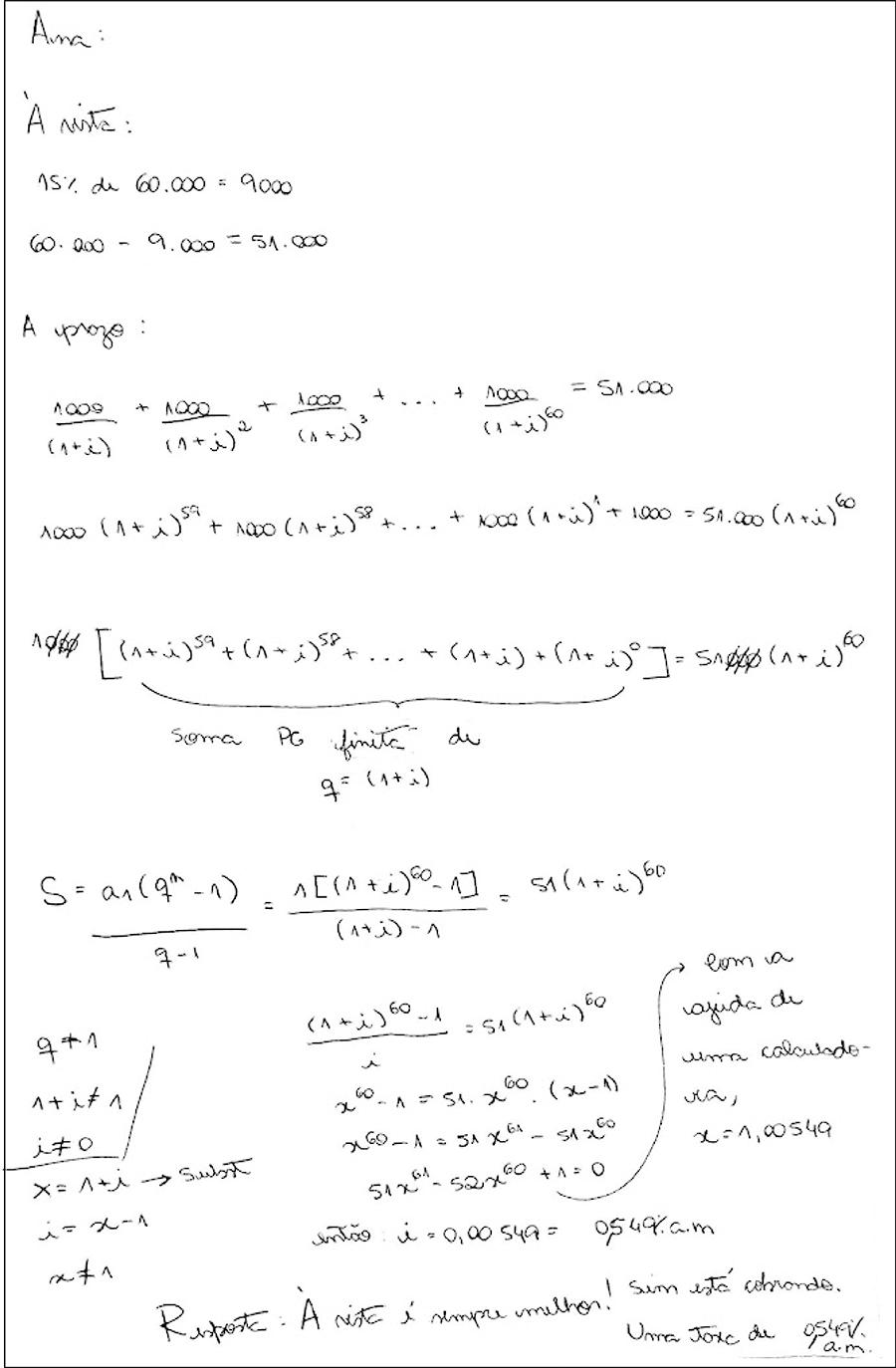
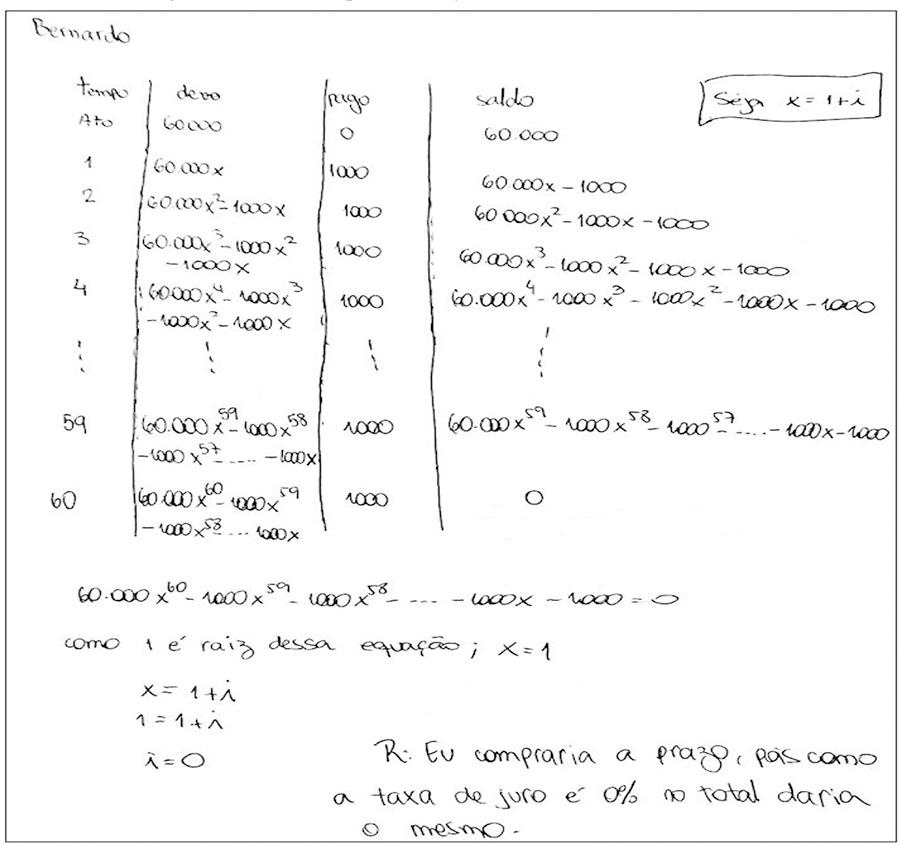
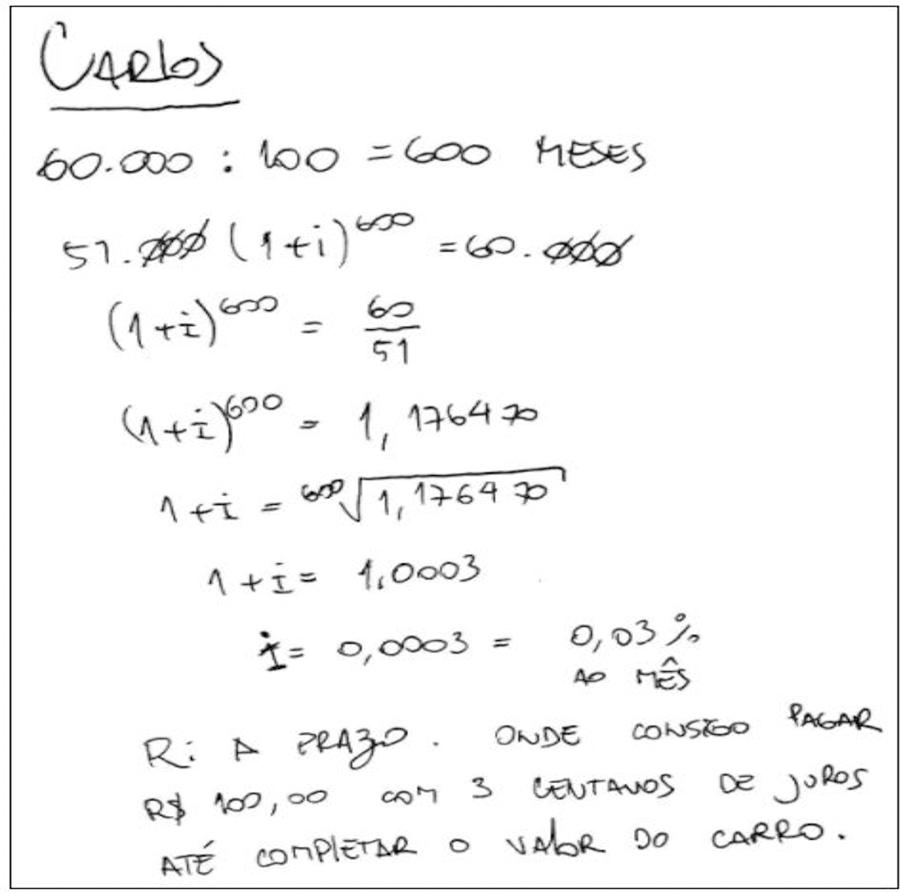
We would add that the mathematically correct resolution is the one presented by Ana. However, the purpose of the research is not to classify the error or success of the students in the proposed problem. Bernardo’s solution disregards the possibility of interest on the value of the car determined by the store (R$ 60,000.00) by taking that same price as the present value, thus finding a null value for the rate at the end. Carlos’ solution, on the other hand, disregards the monthly payments that will be made, considering the incidence of monthly interest without discounting these payments. In addition, Carlos assigns the value of R$ 100.00 to the installment of the car, unlike the value of R$ 1,000.00 presented in the problem.
In the second phase of data production, after sending the form with the task and the previous solutions, we called the participants together for a remote discussion. This conversation, recorded on video on the Google Meet platform, lasted two hours and was guided by a semi-structured script, although there was room for the interviewers and participants to ask questions outside of what was planned. The conversations held during the round table were transcribed for later analysis. In this text, we have chosen to present a section focusing on the results emerging from the second stage of data production.
In the context of our research, the second moment of data production also aimed to give continuity to the formative task, formulating a classroom situation that would provoke reflections on the answers that had been presented previously. In this part of the task, our intention was to provoke a contrast between different social contexts in a complementary classroom dialog, which presented, in a second moment, a hypothetical discussion about the solutions between a teacher and the three fictitious students Ana, Bernardo and Carlos (Table 3), as well as to provoke the critical positioning of the undergraduates in relation to the situation presented.
Table 3 Classroom episode involving Ana, Bernardo, Carlos and their teacher
| Classroom Episode | |
|---|---|
| Teacher: | Hi guys! I took a look at your solutions to the problem from the last lesson and saw that we had different ways of thinking. For example, Ana would buy in cash and justified it like this... (see Figure 1). Although I understood that you used the formula to solve the problem, I was curious about how you were thinking, Ana. Why do you think it’s better to buy the car in cash? |
| Ana: | I think it’s always better to buy in cash. I don’t understand why people love installments. Just read the problem and see how much cheaper the car is! At home, we pay for everything upfront. My parents, for example, change their cars every year and always pay cash. They even use the money they save on buying the car to pay for our end-of-year vacations. We drive a new car and can even travel, how wonderful! |
| Teacher: | I see, Ana. But is this problem situation always more advantageous for a cash purchase? Bernardo did it differently, for example. Explain to the class how you thought, Bernardo. Looking at your solution, it seems that you don’t agree with Ana... (see Figure 2) |
| Bernardo: | It’s not that I don’t agree, teacher. If I had the same conditions as Ana, I’d think about paying cash. The big problem with buying in installments is the interest. That’s what breaks it! As option 2 said it was interest-free and I don’t have the money to buy the car outright, I thought this was a better option. That way, I’d have more time to get the money together. Although I was a little suspicious as to whether this option was really interest-free... In my solution, I was trying to find an approximate interest rate, when compared to the cash value at the end of sixty months. By my calculations, I found the rate to be zero... I must have made a mistake, because I still think I’m going to end up paying too much, but we have to find a way to make a consumer dream come true. After all, who doesn’t want a car? |
| Teacher: | Absolutely, Bernardo! I think everyone wants one and, with discipline and hard work, everyone can raise the money to buy one. You just have to study hard and work hard to get there. It’s up to you! I just didn’t quite understand Carlos’ answer. I think you got the amount wrong, Carlos. The problem says that the amount of the installment is R$ 1,000.00 and not R$ 100,00 as you put it in your answer. I think that’s why you couldn’t get any further with your solution. It was a lack of attention... (see Figure 3) |
| Carlos: | Gee, teacher... It wasn’t a lack of attention. It’s just that I have no other option, I can’t pay more than that. Unfortunately, at home, my brother, mother and I are selling lunch to pay for dinner. My mother is unemployed at the moment... complicated, teacher. And it’s not for lack of effort on our part! My brother, for example, has been making deliveries on these cell phone apps. That’s what we’ve got left to survive. That’s even why we bought an old motorcycle from a neighbor, just as I did in my answer. We agreed with him that R$100 a month was the maximum we could spend. Then, with part of the money from the deliveries, we paid it off until the price of the bike was complete. We don’t even think about buying a car because, in our reality, it doesn’t make any sense. |
| Teacher: | Wow, Carlos! I didn’t know you were going through such difficulties. I hadn’t thought about the possibility. That’s why it’s good to hear how you were thinking when you wrote your answers. That way, we can see how a problem can lead to different ways of thinking. |
| Ana: | But, teacher, I’m confused now! What’s the right answer? I understand what Bernardo and Carlos said, but I think you’re complicating something that’s simple. In mathematics, it doesn’t matter what reality you live in, it’s universal. The right answer is only one, whether it’s in the South Zone, the North Zone, the West Zone, or anywhere else. For me, it’s obvious that the right answer is the one I found. Isn’t that right, teacher? |
Source: Own elaboration
When constructing the characters’ speeches, we thought we’d establish a speech for each of them that was related to the social context in which they would be inserted, making their choice explicit in relation to the situation presented. Therefore, we tried to simulate a heterogeneous classroom environment, taking situations from different social contexts and different economic realities and then, in the conversation round, putting the interviewees in a critical position to analyze, ponder and think about possible feedback that could be given to these students. In addition, this simulation aims to provoke reflections on how mathematics is often placed in a position of non-neutrality, which requires a critical stance from the teacher in the classroom, as we will discuss in the next section, which deals with the results of the research.
In the next section, we will present a discussion of the research results, outlining three perceptions of Financial Education that emerged from the analysis of the empirical data produced by the undergraduate students. The axes of analysis were identified from the perspective of Powell, Francisco and Maher (2004) for analyzing video data. In the analysis of the recordings of the conversation circles, critical events that dialogued with the research questions were first selected. The critical events were then transcribed and analyzed in the light of the theoretical perspective that underpins our investigation, considering the dimensions of Financial Education (Kistemann Jr., 2011; Silva and Powell, 2013), Mathematics (Skovsmose, 2000, 2001) and teacher education (Giraldo, 2018; Giraldo and Roque 2021), from a critical social position.
Below, we present the three perceptions that were identified in this methodological journey, based on the theoretical perspectives on which we rely.
4 Discussion of results
In this section, we discuss the perceptions that the undergraduate students presented when confronted with a critical approach to the subject of Financial Education, based on three axes of analysis: (a) personal financial management and capital accumulation; (b) critical social formation; (c) Mathematics as (in)certainty: regulation or social questioning? Although we have chosen to show these axes separately, due to the structure of the text, we believe that the episodes portrayed may describe aspects discussed in more than one axis or even contain reflections that will not be discussed in this analysis.
4.1 Personal financial management and capital accumulation
In this first axis, we identified perceptions that Financial Education was related to the organization and management of one’s own finances: knowing how to balance how much one earns and spends; planning one’s spending and debts; accumulating assets, in other words, knowing how to deal with money. Below are excerpts from the round table discussion that suggest that the participants’ perceptions of Financial Education are related to this.
The first question posed to the participants at the start of the discussion asked them what they thought Financial Education was.
Márcia: What I believe is most important in financial education is dealing with money in all its aspects, at all times. [...] So, if I had to say it in a very general way, I think that’s it: knowing how to deal with money and everything it entails in everyday life, or in terms of accumulating capital, assets, savings. There’s a very negative view of accumulating wealth. [...] It’s fundamental at all stages, not only for the impact of the price of any type of merchandise, because money has a price, it has a cost, but also for social well-being, for your life, for being part of a society and knowing how to deal with it. It’s knowing how to deal with money and how to make the best use of it.
Márcia’s speech illustrates the perception described in this first axis, characterizing ideas such as the accumulation of capital, goods, assets and savings as one of the basic aims of Financial Education. This perception was also reinforced by participant Caio, who said that his understanding was very similar to Márcia’s: “[...] knowing how to deal with your resources, teaching people to spend less than they earn [...]”.
Marcelo, on the other hand, conveyed a point of view on Financial Education that was more geared towards an investor, mentioning his experience with investments in the financial market. Based on this, he presented his understanding of how this subject should be approached: “[...] dealing with the basics in schools, for example, interest, inflation, the very basics of Financial Education”.
In their reports on their experiences with Financial Education in undergraduate courses, the participants mentioned that only one subject in the course dealt with this topic, called Financial Mathematics. We recognize that the lack of discussions on Financial Education in teacher education, from a broader perspective and not just an instrumental one, may be an obstacle to developing a perception of School Financial Education that does not focus on individual consumers, as suggested by Silva and Powell (2013).
At first, the participants’ discourse moved in this direction, highlighting Mathematics as a tool for individual wealth management, which motivated us to try to see if they had made a distinction between Financial Mathematics and Financial Education.
Bruna: In my mind, financial math is when you do math with money. And Financial Education, in my mind, would be you going into the classroom to teach students how to deal with their finances, it would be something more personal.
Márcia: I think one is an instrument of the other. Financial Mathematics is an instrument of Financial Education. Without Financial Mathematics, you can’t pass on the concepts, pass on the idea that you have money today and tomorrow you have another, that there is pricing. That’s what the interest rate is, the exchange rate is one way today and another way tomorrow, assets change in value.
Marcelo: I think they complement each other. I think Financial Education is about understanding the concepts as a person should, at least the basics, in order to manage their finances. And Financial Mathematics can be much more complex, what you use to be able to price things, for example.
We can see that the participants’ statements suggest that Financial Mathematics corresponds to something more technical and theoretical, relating to mathematical concepts that are applied to the analysis of financial data. In Márcia’s words, Financial Mathematics would be an instrument of Financial Education, the former being part of the latter. In Marcelo’s view, these different perspectives complement each other, since mathematical and economic concepts are fundamental to supporting a broader problematization of this issue.
On the other hand, Bruna brings up an element that shifts the discussion to another place: the classroom. By situating the debate in the classroom, thinking about Financial Education in the context of the future teaching performance of the undergraduates present there, the participant then presents reflections that go beyond the individual perspective presented until then: “[...] there is an issue there that even involves the student’s civic education”. In the second axis of analysis, we will discuss this idea of the place of Financial Education in the process of the critical social formation of an individual, enhanced by the second moment of the formative task.
4.2 Critical social education
In this second axis of analysis, we highlight that the participants’ view of Financial Education, identified in the previous section, appears to change when exposed to a context of social criticism, broadening their perceptions of this subject. We verified this in the conversation circle, when we presented the classroom dialog between the teacher and the three students (Ana, Bernardo and Carlos), in the continuity of the task we had formulated. Up until the presentation of the dialog in the conversation circle, the participants only had access to the written answers of the fictitious students Ana, Bernardo and Carlos, along with the wording of the proposed problem.
In analyzing the forms sent before the meeting, we identified that the amount of R$ 100.00 assigned to the installment in Carlos’s solution caused some surprise. However, it was only perceived as a deviation from the data presented in the problem. In the round table discussion, when the participants were confronted with Ana, Bernardo and Carlos’ statements and justifications in the classroom episode, their reactions and speeches took on new contours:
Márcia: I thought this kind of reaction was very nice. I wouldn’t put it like that, I wouldn’t structure the problem like that, because we really look at the student, we don’t see what’s behind it and what that student has put in. He put down the maximum amount he could afford, within the reality he was living in, and the car is very out of touch with reality. When we put together an example, an exercise, and when we talk about money, we have to put things that are close to anyone, regardless of whether they are in a different social position or not. I think it was good for me to learn, to have this kind of concern.
Caio: I thought Carlos’ situation was a tough one, because it didn’t even cross my mind, as much as we do everything we can for a more inclusive education and all that. It didn’t even cross my mind what this would do to the student, what he was going through. And it’s true, there are students who can’t afford it.
After reading the dialogues, we recognized another perception, different from the one presented in the previous axis, now considering a more critical perception, provoked by the contrast between the social contexts in which Ana, Bernardo and Carlos are inserted. We would point out that, up until this point in the research, this had not been taken into account. Márcia and Caio’s statements indicate that, from then on, the participants began to recognize the need for Financial Education not to be restricted to mathematical calculations that help individuals make decisions about consumption, but to promote, from the school context, the critical participation of individuals in questioning social inequalities, as highlighted by Kistemann Jr. (2011).
In this sense, Ana’s posture in the fictional dialog drew a lot of attention from the participants, highlighting questions that the construction of this character’s speech was intended to provoke in the debate.
Marcelo: What struck me most about Ana’s speech was when she said that she doesn’t understand how people love an installment plan, that all they have to do is read the problem and see how much cheaper the car is. The fact that she doesn’t know about other people’s realities and takes hers as a universal truth and, in the end, says so, even though she knows about other people’s realities. She didn’t care about others.
Bruna: I had the feeling that Ana was just repeating a speech she hears at home, you know? “People love to buy in installments”. Who told her that? Then she talks about her parents, my parents do this, my parents do that. So, clearly, she has a reference in the adults at home. [...] This is a situation that has everything to do with mathematics, financial education at the service of the student’s civic education. So, in what other context would Ana have this opportunity to deal with this kind of reality, to deal with a reality different from her own?
At this point, we see Marcelo’s discomfort with Ana’s speech, especially her lack of empathy with the rest of her classmates. Bruna feels that the speech is being reproduced without reflection, in other words, Ana is repeating something she hears at home. By highlighting the importance of the school making it possible for Ana to come into contact with realities other than the one she experiences, through discussions about Financial Education from a critical perspective, Bruna’s speech dialogues with Giraldo and Roque (2021), when the authors emphasize that teachers should promote mathematical practices that do not imprison students in their own contexts
In this sense, the questions posed, for example, by Marcelo and Bruna, reveal how Mathematics, through Financial Education, can play an important role in the critical social formation of the individual, approaching the perspective of Skovsmose (2001), when he highlights Critical Mathematics Education as a way of questioning the maintenance of current power relations and the reproduction of social inequalities.
4.3 Mathematics as (in)certainty: regulation or social questioning?
In this axis of analysis, we identified the participants’ perceptions of the place of certainty or uncertainty of Mathematics in the reflections we presented on Financial Education. Although the participants discussed the existence of different ways of thinking about Financial Education and reflected on various social contexts, at many times Mathematics still seems to demand a right or wrong, especially in the position of teacher. Analyzing the participants’ discourse, we identified a criticism of this view of mathematics as an ideology of certainty, as highlighted by Skovsmose (2001) and questioned, for example, in Bruna’s speech.
Bruna: There was a moment when Ana said: “In mathematics, it doesn’t matter what reality you live in, it’s universal” — Ana’s words. This business of people thinking that mathematics is the supreme of reason, that there is nothing purer, that it is logical, that it doesn’t matter if you live in the South Zone or the North Zone, mathematics affects you in the same way. I understand where this is coming from, but I think this question was a great example of how mathematics isn’t that truth, it doesn’t follow that ideology of certainty, that it’s the truest possible thing you can find. Because mathematics itself is still human. As much as we’re talking about values, which are absolute and, in a way, fixed things, they only make sense within a context. And it was great to see how the context of each of the students has a direct impact on their answers. I think Ana’s thinking is very common. And so, it’s a thought that, even before I started studying Mathematics Education, I thought that mathematics was the ultimate truth. And when we start studying, maybe not Pure Mathematics, but studying Mathematics Education and seeing what can happen in the classroom, realizing how these things impact the students, without a doubt, I think the perspective changes a lot about what mathematics is and what it’s for.
In this speech, we see the criticism of the bias of Mathematics as certainty and the recognition of Mathematics Education as a possibility for social questioning, aspects present in the perspective of Skovsmose’s Critical Mathematics Education (2000, 2001). By questioning the naturalization of a supposedly neutral place for mathematics, Bruna also exposes a perception that dialogues with Giraldo’s (2018) notion of problematized mathematics, which questions the bias of mathematics established as a universal body of knowledge that has always been and will always be the way we know it today or that evolves linearly from a more backward state to a more advanced state, without taking into account its multiple social production processes. At other times, Bruna also questioned the meritocratic tone about mathematics adopted in the teacher’s speech.
During the round table discussion, a discussion also arose about how the teacher would classify Bernardo and Carlos’ answers, as problematized in Daniel’s speech: “[...] in principle, the right way would be valid”. When we relate this sentence to Bruna’s reflection on mathematics as a regulatory instrument, we see Daniel’s concern as a teacher to take into account the student’s social context and, at the same time, also consider his responsibility to correct an exercise, saying whether the solution is right or wrong. In other words, demanding their position, through mathematics, on that social context.
Daniel: Oh man, I thought it was really cool what you showed us, because I’d never thought of it like that, you know? Now, I’m even going to take it with me, to think about applying questions in this way, like bringing a bit more of everyone’s reality and not thinking about something that can’t be someone else’s reality, you know? I’d never thought of that, and what I also liked was the importance of mistakes, which I thought was really cool. Through the mistakes, we brought up other important questions.
Caio: So... I don’t know if what I’m going to say is quite right, but I think the concern we had at first was just to give them the correct answer. This is the template. My first impression, when I saw the form, I also had a lot of difficulty, I’m terrible at Financial Mathematics, but I remember the first thing I looked at was Carlos’ answer, it didn’t make any sense to me. I remember that I answered, on the form, that I would sit down with each student and ask them to explain their reasoning. Perhaps not necessarily in public, but to make everyone comfortable. That’s what I think is happening here, we’re seeing each person’s solution and understanding their reality within a context.
Caio says that “[...] the concern we had at first was just to give them the correct answer. That’s the template”. This indicates an initial perception of mathematics as an instrument of regulation. During the conversation, the participant states that he has broadened his perspective on mathematics, now inserted in a place of uncertainty and as an instrument of social questioning: “[...] we are seeing each person’s solution and understanding their reality within a context”.
In this speech, we interpret that the participant is not only looking at the students’ resolution, but also at the importance of listening, of knowing why that answer was given and in what context it fits. By approaching a problematized approach to mathematics, according to Giraldo (2018), the participants begin to discuss the proposed problem from the different understandings that the diversity of social contexts makes possible, distancing themselves from a Platonic perception that takes as a reference the classification of the students’ answers into right or wrong, previously established by the teacher, based on mathematics as an instrument of regulation.
The speeches presented suggest that, initially, the participants analyzed the students’ answers through the paradigm of certainty (Skovsmose, 2000, 2001), in which mathematics regulated right and wrong, without questioning where those answers could have come from. During the conversation circle, especially after the presentation of the classroom episode that contrasted different social contexts, mathematics occupied a place of more uncertainty, so that the meanings of the mathematical concepts present in the students’ answers were also related to their social contexts, highlighted in the classroom dialogue between students and teachers.
5 Final considerations
In this paper, we discuss the results of a study that investigated the perceptions of Mathematics teachers in their initial education about Financial Education, which were highlighted in the following axes of analysis: (a) personal financial management and capital accumulation; (b) critical social education; (c) Mathematics as (in)certainty: regulation or social questioning?.
In the first axis, we identified among the participants the perception of Financial Education as a tool to better understand financial products and services, making the individual capable of questioning their choices and also being able to generate capital accumulation. Based on a task that problematized different social contexts, the participants broadened this understanding, recognizing the importance of a critical approach in teacher education, promoting reflections on the role of the educator in mediating discussions and questions about Financial Education in the school environment. We highlight this perception in the second axis of analysis, in which we identified a way of looking at the students’ mistakes, along with a power of listening that took into account their social contexts and places of origin. Finally, in the third axis, we identified the participants’ questioning of the place of mathematics as a science of rigour, opening up space for it to be situated in a place of uncertainty, conceiving of error not as a form of punishment, but situated in different social contexts mobilized in school mathematical practices and classroom interactions.
In this sense, when we situate mathematics as a science of certainty, we often see it as an instrument of regulation guided by certain validation norms, inserted in a social dynamic that establishes a dichotomy between right and wrong. On the other hand, by looking at mathematics as uncertainty, we can broaden these meanings and understand it as an instrument of social questioning, proposing a view of error that is guided by another prism, questioning possible interpretations and reasons that led to that answer. From this perspective, we take into account, for example, the social contexts in which the individual is inserted, opening up space for questioning the inequalities that are constituted in this social dynamic.
We recognize, therefore, that the perceptions identified point to the need for the initial education of mathematics teachers to promote education dynamics that situate Financial Education in this place of criticality, taking the various social contexts that are present in the classroom space as possibilities for social transformation and a critical (also financial) education.
Although critical education dynamics are established in initial teacher education, we recognize the challenge of also reaching in-service teachers, especially considering the scenario where, historically, Financial Education did not previously occupy the same centrality in school curricula and Mathematics degrees. In this sense, we point to the need to understand the perceptions of teachers working in Basic Education about Financial Education as issues to be investigated in future work.
Note
The translation of this paper from Portuguese into English was funded by the Minas Gerais State Research Foundation (Fapemig — Fundação de Amparo à Pesquisa do Estado de Minas Gerais), under Call for Proposals 8/2023.
1In this study, we have adopted the perspective of Melgarejo (1994), who understands perception as a partial process susceptible to change, whose construction of meanings in space and time is dynamic and constant, without necessarily implying the crystallization of a fixed set of past events and experiences. Perceptions directly influence and are influenced by the social circumstances in which the individual is situated.
↩2The undergraduate students in question took part in the empirical research on a voluntary basis, aware of the ethical issues involved, by signing an Informed Consent Form (ICF).
↩REFERENCES
BIZA, Irene; NARDI, Elena; ZACHARIADES, Theodossios. Using tasks to explore teacher knowledge in situation specific contexts. Journal of Mathematics Teacher Education, v. 10, n. 4-6, p. 301-309, 2007. https://doi.org/10.1007/s10857-007-9043-y [ Links ]
BRASIL. Decreto n. 7.397, de 22 de dezembro de 2010. Institui a Estratégia Nacional de Educação Financeira — ENEF, dispõe sobre a sua gestão e dá providências. Brasília: Diário Oficial da União, 23 dez. 2010. [ Links ]
BRASIL. Ministério da Educação. Secretaria de Educação Básica. Base Nacional Comum Curricular: Educação Infantil e Ensino Fundamental. Brasília: MEC/SEB, 2017. [ Links ]
FIORENTINI, Dario; OLIVEIRA, Ana Teresa. O lugar das Matemáticas na licenciatura em Matemática: que matemáticas e que práticas formativas? Bolema, v. 27, n. 47, p. 917-938, dez. 2013. https://doi.org/10.1590/S0103-636X2013000400011 [ Links ]
GIRALDO, Victor. Formação de professores de Matemática: para uma abordagem problematizada. Ciência e Cultura, v. 70, n. 1, p. 37-42, jan./mar. 2018. http://dx.doi.org/10.21800/2317-66602018000100012 [ Links ]
GIRALDO, Victor; ROQUE, Tatiana. Por uma Matemática problematizada: as ordens de (re)invenção. Perspectivas da Educação Matemática, v. 14, n. 35, p. 1-21, ago. 2021. https://doi.org/10.46312/pem.v14i35.13409 [ Links ]
KISTEMANN JR., Marco Aurélio. A produção de significados e a tomada de decisão de indivíduos consumidores. In: Anais do V Seminário Internacional de Pesquisa em Educação Matemática. Petrópolis, 2012, p. 1-19. [ Links ]
KISTEMANN JR., Marco Aurélio. Sobre a produção de significados e a tomada de decisão de indivíduos-consumidores. 2011. 540f. Tese (Doutorado em Educação Matemática). Universidade Estadual Paulista. Rio Claro. [ Links ]
MELGAREJO, Luz Maria Vargas. Sobre el concepto de percepción. Alteridades, n. 8, p. 47-53, 1994. [ Links ]
MOREIRA, Plinio Cavalcanti; FERREIRA, Ana Cristina. O lugar da Matemática na licenciatura em Matemática. Bolema, v. 27, n. 47, p. 981-1005, 2013. https://doi.org/10.1590/S0103-636X2013000400014 [ Links ]
MUNIZ, Ivail. Econs ou Humanos? Um estudo sobre a tomada de decisão em ambientes de Educação Financeira Escolar. 2016. 431f. Tese (Doutorado em Engenharia de Produção). Universidade Federal do Rio de Janeiro. Rio de Janeiro. [ Links ]
OCDE — Organização para a Cooperação e Desenvolvimento Econômico. Recommendation on principles and good practices for Financial Education and awareness. Paris: OECD/Directorate for Financial and Enterprise Affairs, jul. 2005. [ Links ]
PESSOA, Cristiane Azevêdo dos Santos; MUNIZ, Ivail; KISTEMANN JR, Marco Aurélio. Cenários sobre educação financeira escolar: entrelaçamentos entre a pesquisa, o currículo e a sala de aula de Matemática. Em Teia, v. 9, n. 1, p. 1-28, 2018. https://doi.org/10.36397/emteia.v9i1.236528 [ Links ]
POWELL, Arthur Belford; FRANCISCO, John; MAHER, Carolyn. Uma abordagem à análise dos dados de vídeo para investigar o desenvolvimento de idéias e raciocínios matemáticos de estudantes. Tradução de Antonio Olimpio Junior. Bolema, v. 17, n. 21, p. 81-140, 2004. [ Links ]
SILVA, Amarildo Melchíades; POWELL, Arthur Belford. Educação Financeira na escola: a perspectiva da organização para a cooperação e desenvolvimento econômico. Boletim GEPEM, n. 66, p. 3-19, 2015. https://doi.org/10.69906/GEPEM.2176-2988.2015.44 [ Links ]
SILVA, Amarildo Melchíades; POWELL, Arthur Belford. Um programa de Educação Financeira para a Matemática Escolar da Educação Básica. In: Anais do XI Encontro Nacional de Educação Matemática. Curitiba, 2013, p. 1-17. [ Links ]
SKOVSMOSE, Ole. Cenários para investigação. Bolema, v. 13, n. 14, p. 66-91, 2000. [ Links ]
SKOVSMOSE, Ole. Educação Matemática Crítica: a questão da democracia. Tradução de Abigail Lins e Jussara de Loiola Araújo. Campinas: Papirus 2001. [ Links ]
HISTORY
Received: March 30, 2024; Accepted: June 14, 2024; Published: March 17, 2025
 Esta obra está licenciada sob uma Licença Creative Commons Atribuição-NãoComercial-CompartilhaIgual 4.0 Internacional.