




 texto em
  Inglês (pdf)
 Artigo em XML
 Tradução automática
 Enviar este artigo por email
 Permalink

The research’s initial thread
The choice of both the phenomenology of Merleau-Ponty (1999), particularly because of the study on body, and the study on imagens through pathosformel, that is, the pathos formula (Warburg, 2012), is an intentional one, as they are connected to our experience as researchers in the fields of philosophy, dance and education. For Merleau-Ponty (1999), philosophy is an exercise and an attitude of relearning how to see the world. In this sense, we understand that image perception surpasses an illustrative perspective, being able to unveil and create polysemic meanings related to the body experience and its memories as a possibility of knowledge: for dancing, and for the body, in its intersubjective condition and its lived experience.
We can find this ontological condition of the body in the phenomenological stance of Maurice Merleau-Ponty, enabling the expression of a lived in being regarding their relationship with subjectivity and temporality. In turn, in Aby Warburg’s studies (2012), especially in the Mnémosyne Atlas, we find significant references of understanding memory as an acting force in the historicity of human condition. Both authors reflect on the ontological and historical aspects of knowledge.
In this research, images are considered to be not only as photographic or filmic records that perpetuate an instant of time in an illustrative way, but as a mnemonic locus. In such perspective, the image expresses a perceptive experience related to affections, emotions, passions, and knowledge. In the context of contemporary dance, the analyzed corpus consisted of four choreographic works by Jerôme Bel, intentionally chosen, which are: Véronique Doisneau, Pichet Klunchun and myself, Jérôme Bel, and Gala. Based on the phenomenological reductions and the study of images, we understand choreographic work as an intersubjective experience, an operation of perceptive life’s expressions that evokes memories, affections, experiences, and knowledges.
The choreographer Jerôme Bel, born in 1964, is the protagonist of an international artistic career with a body of work that is quite prolific. His first work was The name given by the author, from the year 1994, and his last was Dans voor actrice (Jolene de Keersmaeker), from the year 2021. His first works featured the incorporation of structuralist operations to dance, the isolation of primary elements of the spectacle, and the distancing of the choreographic language. These aspects reduced his plays to an operational minimum, aiming to perform a critical interpretation of the economy of means on stage and of the body in dance. In his following works, he took an interest in matters of the performer in his own subjectivity, performing a series of spectacles that came from the interpreter’s life. Regarding this shift of pattern in choreographic perspective, the specialized critic understood that there was a deconstruction through discourse and an attention to the subject’s crisis in contemporary times, as well as the methods of his representation on stage (RB Jérôme Bel, 2022).
In this paper, we present the methodological perspective of a phenomenology of body and images as an epistemological horizon for the knowledge of dancing and its aesthetic, poetic e educational inscriptions, based on its sensibility and in the idea of poetic creation. We present the appreciation of the choreographic works of Jerôme Bel and Gala, highlighting the relationships between body and education through images of the body the choreographic works themselves. The composition of boards and the disposition of images broaden our gaze by evoking memories and experiences which are capable of articulating knowledge in a sensitive and poetic manner. Such articulation enables the creation of meaning to the images, to the knowledge of the body and of the dance. In time, it is important to mention that the boards constitute a collection capable of moving our gaze, given the sensitive nature of images that affect our body and give life to our reflection around a phenomenology of the body that dances and that appreciates the choreographic works4.
By articulating fields of knowledge - such as philosophy, art and education - we broaden the understanding about the body in its ontological and epistemological conditions, giving meaning to the experiences which makes us perceive the world of life in an intersubjective perspective. Thus, our gaze moves in images, creating choreographies which potentializes our being, our life and our knowledge.
Intertwinings of the phenomenological reduction with the studies of Aby Warburg
The phenomenology is, at the same time, an attitude towards the world and a theoretical-methodological framework which considers that thoughts are immersed in the lived experience. In this sense, there is an ontological connection between subject and object and between man and world that is distanced from the dualism that marks occidental culture, especially the modern philosophy (Merleau-Ponty, 1979). Its purpose, as a method, lies in the unveiling of ways and paths through which the understanding of existence unfolds in intentional acts. We understand that, through an intentional movement, it is possible to build a network of meanings to the lived experiences.
The phenomenology understood as a method of research is a radical way of thinking (Martins; Bicudo, 2006). The phenomenological research surpasses the subjectivism and objectivism, “presenting a firm structure, while being neither entirely objective nor completely subjective” (Kahlmeyer-Mertens, 2016, p. 61). Knowledge unfolds and builds itself through the relationship with the world, with others, with culture. In this relationship, we create perceptions that broaden our understanding about phenomena, situations, and events. It is not about thinking pure and absolute essences, but considering them tied to the lifeworld or lebenswelt.
The lifeworld is a key concept from phenomenology which refers to a pre-reflexive world and to the attempt to describe the experience as it is. It seeks to understand what we can apprehend through the senses, through immediate perception in our direct contact with the world. This perception is not comprehended as an intellectual operation or a second act, but as the foundation of reflective processes and of knowledge production (Martins, 1992).
The phenomenological understanding of the senses and the interpretation of the world arises from a return of the things themselves, considering the facticity and the contingences of the world. Essence and existence are dimensions that happen through intertwining, closely connected to one another, in processes of building both meanings and alive relationships based on lived experiences by the being that inhabits the world and, in turn, is inhabited by it. The return to things themselves demands a rupture from our familiarity and complicity with the observed phenomenon. In this sense, the start of the phenomenological interrogation is found precisely on this meditative approach that guides the phenomena which happen in the lived world (Martins; Bicudo, 2006). We call this approach epoché or phenomenological reduction, which is a movement of a temporary suspension of beliefs, values, and judgments.
The phenomenological reduction is a research attitude in motion, such as the fisherman that casts his net into the sea and brings fishes and throbbing seaweed with it. The phenomenological reduction is a perceptive attitude capable of loosening the intentional threads that shape the phenomenon and set it apart from the natural attitude. Paradoxically, the biggest teaching that phenomenological reduction shows us is its own incompleteness, because we are immersed and involved in the plot of the world. The phenomenological reduction teaches us that our interpretations are a never-ending task, as they are bound to the temporal flow and to the fabric of the world (Merleau-Ponty, 1999).
The phenomenological reduction is marked by the consciousness’ intentionality. It enables us to throw ourselves into the world, to aim towards an object of knowledge, and to guide our attention in a reflective and comprehensive manner towards the intersubjective singularities that are highlighted in the experience. The consciousness’ intentionality implies “[…] recognizing consciousness itself as a project of the world, destined for a world which it neither encompasses nor possesses, but towards which it never ceases to be directed” (Merleau-Ponty, 1999, p. 15). In this operation of both familiarity and natural attitude suspension, along with the lived experience’s loosening of threads, our intentional approach preserves what is evident to us, that is, the phenomenon (Capalbo, 1987). We add that the phenomenological reduction - in its intentional motion of addressing itself to the world and inhabiting in the lived experiences - broadens our understanding: the knowledge of existence and of culture.
We recognize, in the nature of this choice, the inherent presence of uncertainties, of discontinuities, of brute data, and of paradoxes as constitutive elements of reflection. According to Martins and Bicudo (2006), phenomenology is a radical method, since it makes us stand before our own contradictions and doubts. Thus, research actions and strategies are thought to place us in motion, in the exercise of wonder, in order to loose the intentional threads in a way that interrogates our experience with dancing and the choreographic work in the perspective of elaborating a network of meanings able to mobilize knowledge in epistemological, ethical, and aesthetical perspectives such as the ones presented throughout this paper, based on the work of French choreographer Jerôme Bel.
The description of imagens allowed us to build units of meaning to develop significance horizons around choreographic work and its poetic and educational potentialities. The sources for this research included videos and photographs of choreographic works, in addition to data gathered from the YouTube platform and the choreographer official website, such as interviews, biographies, and critics. Additionally, we consulted other websites from artists to which Jerôme Bel has some kind of collaboration, such as the Thai dancer Pichet Klunchun. We also used the print screen resource to capture some images that were needed to elaborate the boards and to describe the scenic extracts.
We highlight that the images that are in this paper refer to data from this research, and, with exception to the choreography Gala, they were obtained from the YouTube Platform, Jerôme Bel’s website and the live spectacle, that is, in a public and open manner. For Gala, it was necessary to ask for the access code provided by the artist’s executive direction, via e-mail. In order to obtain this code, we made a registration that enabled us to download the video and analyze the piece for academic purposes.
In the appreciation of choreographic works, we consider the fleeting nature of dance and its energetic flow, experienced through bodily encounters. It is about a relationship of empathy between the artist and the audience that participates with their body when engaging with the work. We understand that occurrence not as lack of fragility, but as the nature of dance’s expressiveness and its scenic language. Aware of dance’s ephemeral nature, like Paul Valéry teaches us, we turn to videos as a means of bringing the work back to present through the implication of our gaze.
In the process of phenomenological reduction, once the extract choices were made, we described the scenes that stirred our perception, articulating our sensibility to the framework for appreciating choreographic works. In this motion, our task stumbled for significant gestures which could broaden our understanding of choreographic work. In our research, we realized that the movement of thought undergoes imaginative variations, visualizing incipient ideas in the choreographic images. By reflecting on these scenic extracts, we bring light to trails of memories in creative processes, as well as to dialogues with participants in seminars, workshops, and in the teaching practice.
We point out that the script of choreographic works which was used in this methodology comes from the study titled “Dance as a letter of the visible, of the body and the human movement”, and has Merleau-Ponty’s philosophy as main reference, combined with the motion analysis proposed by Rudolf Laban and Patrice Pavi’s analysis of spectacles. In our understanding, the script links the concepts and perspectives of Merleau-Ponty’s phenomenology with elements and aspects that are intrinsic to the dance and its choreographic works, such as gestures, motions, flows, intensities, atmospheres enabled by the lights, gazes and tensions. It comes along with structured and performative acts and enables us, in light of attitude and phenomenological method, to describe the body’s expressions, its poetics and aesthesias on stage.
In this sensitive germination of knowledge, alongside with the script for appreciation of choreographic works, we started to compose the boards, based on the methods and thoughts from the German historian Aby Warburg, in his L’Atlas Mnémosyne (Warburg, 2012). This atlas, in turn, remained unfinished due to the author’s demise. In the text Warburg, from Kant to Boas, French philosopher Claude Imbert explains us that the presentation of L’Atlas Mnémosyne was different and surprising, causing more doubts than enthusiasm, since it did not approach a cartography guided towards navigation or migration, nor a mapping of physical and geographical spaces, but rather a whole experience, interested in the “whys” and “hows” of images. Such process intended to “make empathy appear in acts, entrusting the [pathos] formula to the artist, which is the physical mediator of figures in which civil society acclimates its boldness, its fears, and propitiatory celebrations (Imbert, 2003, p. 13, our translation). Thus, through the formula of the pathos, found in cultural and artistic works, we can experience passions, feelings, and affections that mobilize us in our social, affective and historical existence. Warburg’s interest in images lies primarily in what enables us to access and understand human life through their expressive value - that is, how people see, think, live, act, and feel. Between 1927 and 1929, Aby Warburg developed his atlas project and presented it in a lecture at the Hertzian Library, in 1929. The presentation consisted of seventy panels in black fabric, in which there were a variety of photographs - around 1000 - of themes, epochs, stories, lives, arts, drawings, and memories (Imbert, 2003).
Regarding the board composition and the image disposition, Imbert (2003) mentions that, in Mnémosyne (Warburg, 2012), there are two main axes: orientation of space and pathos formula. Both approaches are the records of expressiveness driven by passion, showing how these passions are placed to serve a vital orientation. By articulating the author’s thoughts, based on Warburg (2012) and Did-Huberman (2013), we understand the pathosformule as a kind of social engram that, in its persistence, symbolically survives these times. This symbol contains a polarization of tensional energies and a circulation of expressive ways of life in its movement. In this motion, memory is presented as an interweaving of fields, meanings, and temporalities that sometimes diverge and sometimes converge. Thus, by creating a network of gaps through which details flow (fundamental elements to perceive survival), that which remains through repression is always ready to emerge from the depths of the body and its memories; as well as that which transforms time and remains in the works, reunited in the intelligibility of pathosformel (Didi-Huberman, 2013).
In this sense, memory is the explicitly clear guiding thread, to the point that it stood on a plaque over Warburg’s library door: “[…] memory mobilizes inalienable hereditary substratum” (Warburg, 2012, p. 54, our translation). It is a force that manifests in the course of human destiny as a common heritage, capable of associating tensions, polarities or soul-stirrings present on the social memory that emerges from the images to witness experiences that resisted oblivion (Didi-Huberman, 2013). Thus, we understand that Mnémosyne is a direct and imagistic experience of history, unmediated, given immediately by the movement of the gaze. It is not only a history built by great deeds, but also the ones intertwined with the stories of anonymous lives, of letter seals, of “dead archives”, of family photographs and ancient coins (Warburg, 2012).
Imbert (2003) mentions that Mnémosyne is “[…] a mental structure whose image is the final and explicit repository” (Imbert, 2003, p. 15, our translation). This image structure, in its intelligibility condition, distances itself from the mythological condition of frontispiece preserved in ancient documents, as well as refusing to be considered as an unbodied intellectual act expressed in a discourse, or as the decoding of a symbol that would assign to the image something other than it is. In this perspective of image intelligibility, Aby Warburg built his boards. He highlighted the value of image exposition and its potential to circulate expressive forms, within a visuality that surpassed the chronological linearity used to express passions and affections.
Within the intertwining of phenomenological reduction and study of images, the choice of photographs in our research followed the pathos formula as central element to uncover passions and evoke memories that survive and remain in us through the lived experiences with dance, choreographic works, education, and existence. Guided by this line of thought, we engaged with the videos and the material available on Jérôme Bel’s official website.
We point out that the board layouts have spatial orientations related to the expressions presented in the photographs and images that unveil our memories, as well as the presence of bodily poetics, aesthetics and techniques from past, present and future times, all makers of history’s common background: choreographic art. In the board’s layouts, we used black as a background and, echoing Aby Warburg’s boards, we distributed the images not according to chronological order but in relation to the poetics of the choreographic work and with the ideas brought by the interpretation of the theoretical references, thus composing the written text. For example, in the Véronique Doisneau choreographic work, we sought quadrangular symmetry. However, we also considered the imperfections and gaps created by the varying dimensions of photographs and their framings, as well as the verticality as an expressed quality inherent to classical aesthetics (Figure 1 - Véronique Doisneau).
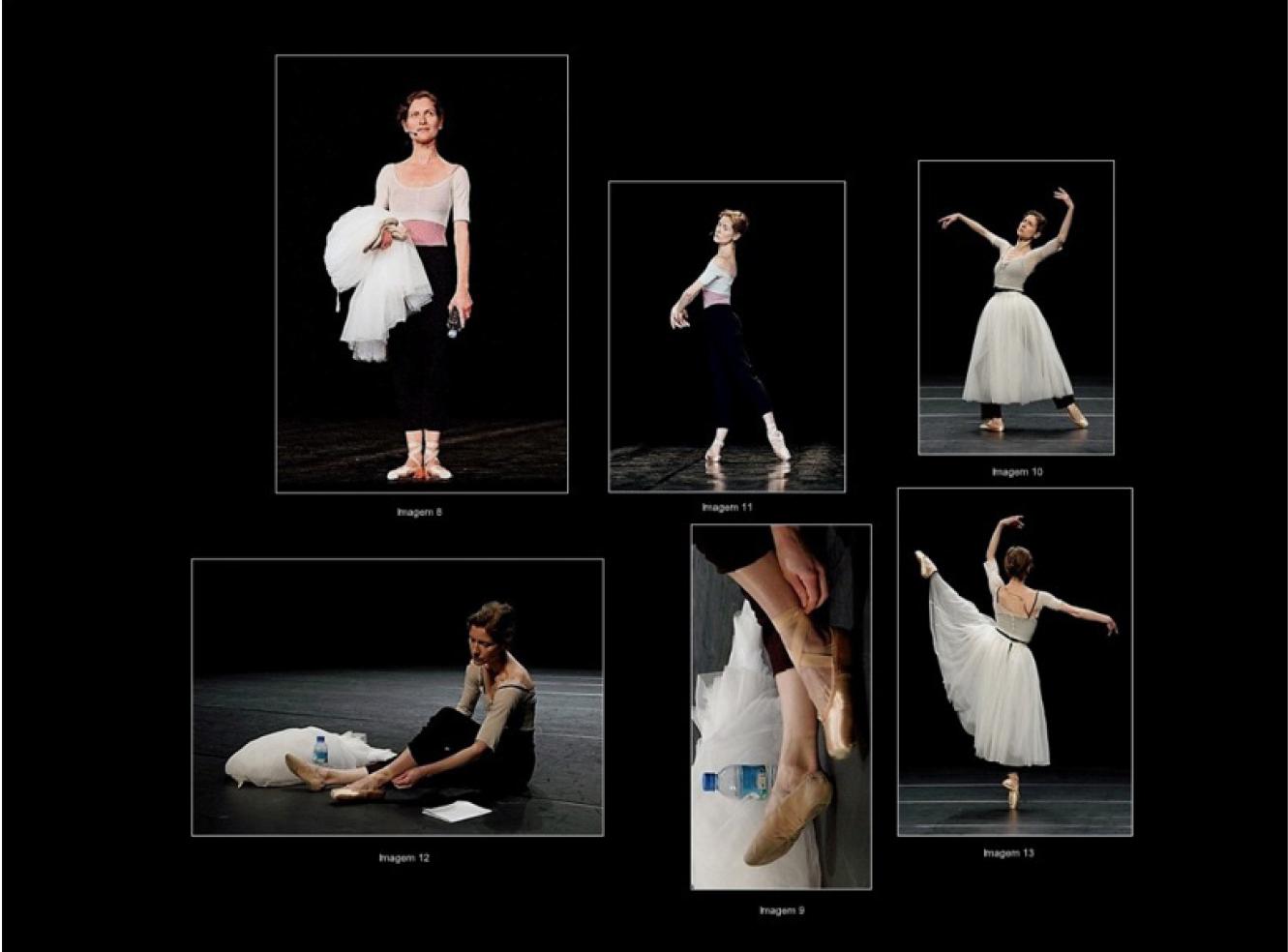
Source: RB Jerome Bel (https://www.jeromebel.fr/index.php?p=2&s=8&ctid=6, 28.04.2025).
Figure 1 Vérônique Doisneau
In Pichet Klunchun and myself, we seek horizontality, given the quality of the dialogue, the conference-like atmosphere in a conversation between two worlds (East and West) that shapes much of the choreography (Figure 2 - Pichet Klunchun and myself). In Jerôme Bel, we emphasize the proximity, the intimacy with the body: there are more detailed photographs, that connects the details with the whole picture, light and dark, visible and invisible. In Gala, we also sought horizontality, the stage’s wholeness populated by performers that whose improvisations, informality, and joy in the act of dancing blend together (Jérôme Bel and Gala will be discussed in greater detail further ahead). In Isadora Ducan, we highlight the movement of the draped fabric, the bare feet and arms of performer Elisabeth Schwartz that summon an encounter of poetic times, a return to nature, to the bacchantes, and to Isadora Duncan’s Sea (Figure 3 - Isadora Duncan).”
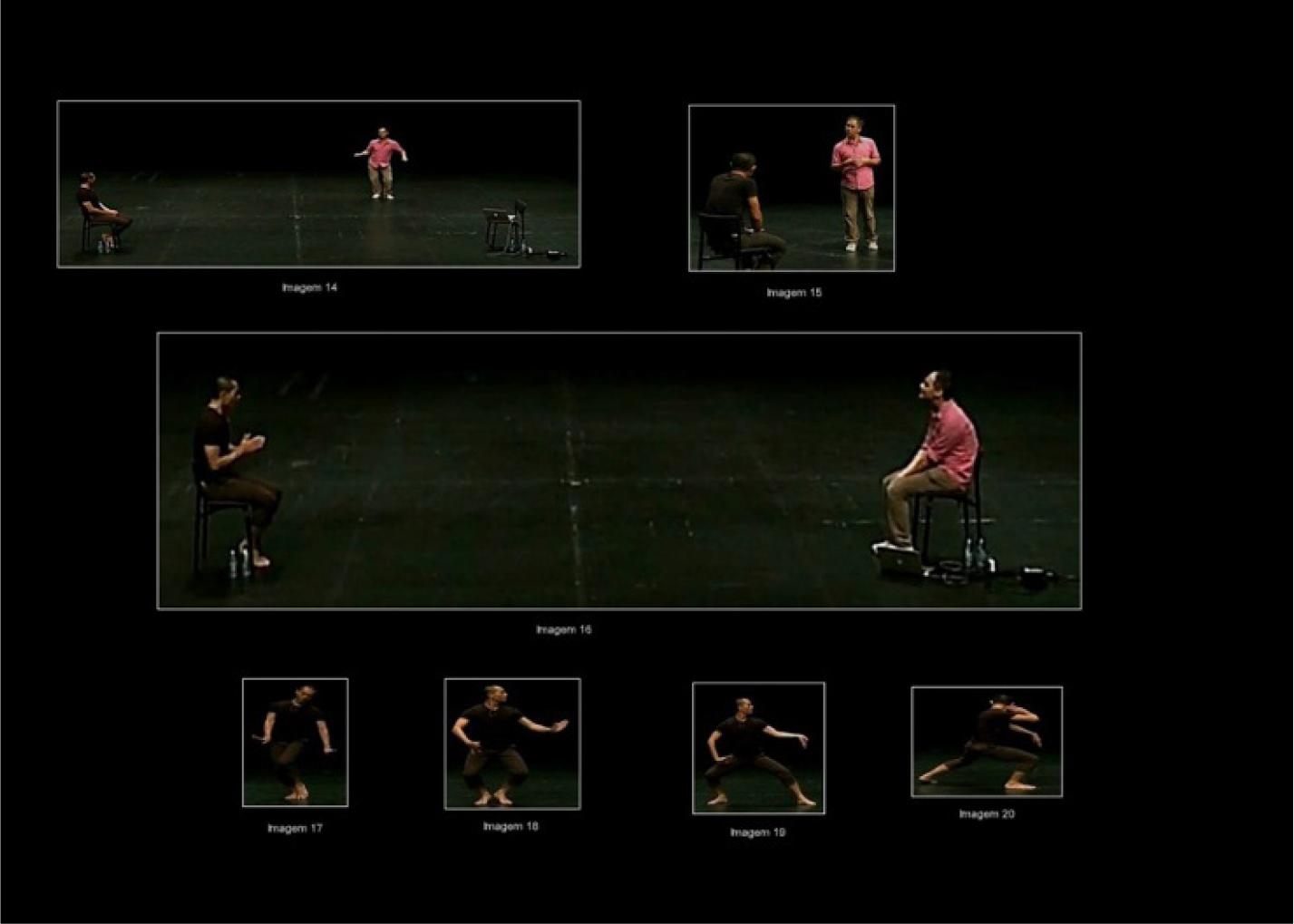
Source: RB Jerome Bel (https://www.jeromebel.fr/index.php?p=2&s=10&ctid=8, 28.04.2025).
Figure 2 Pìchet Klunchun and myself
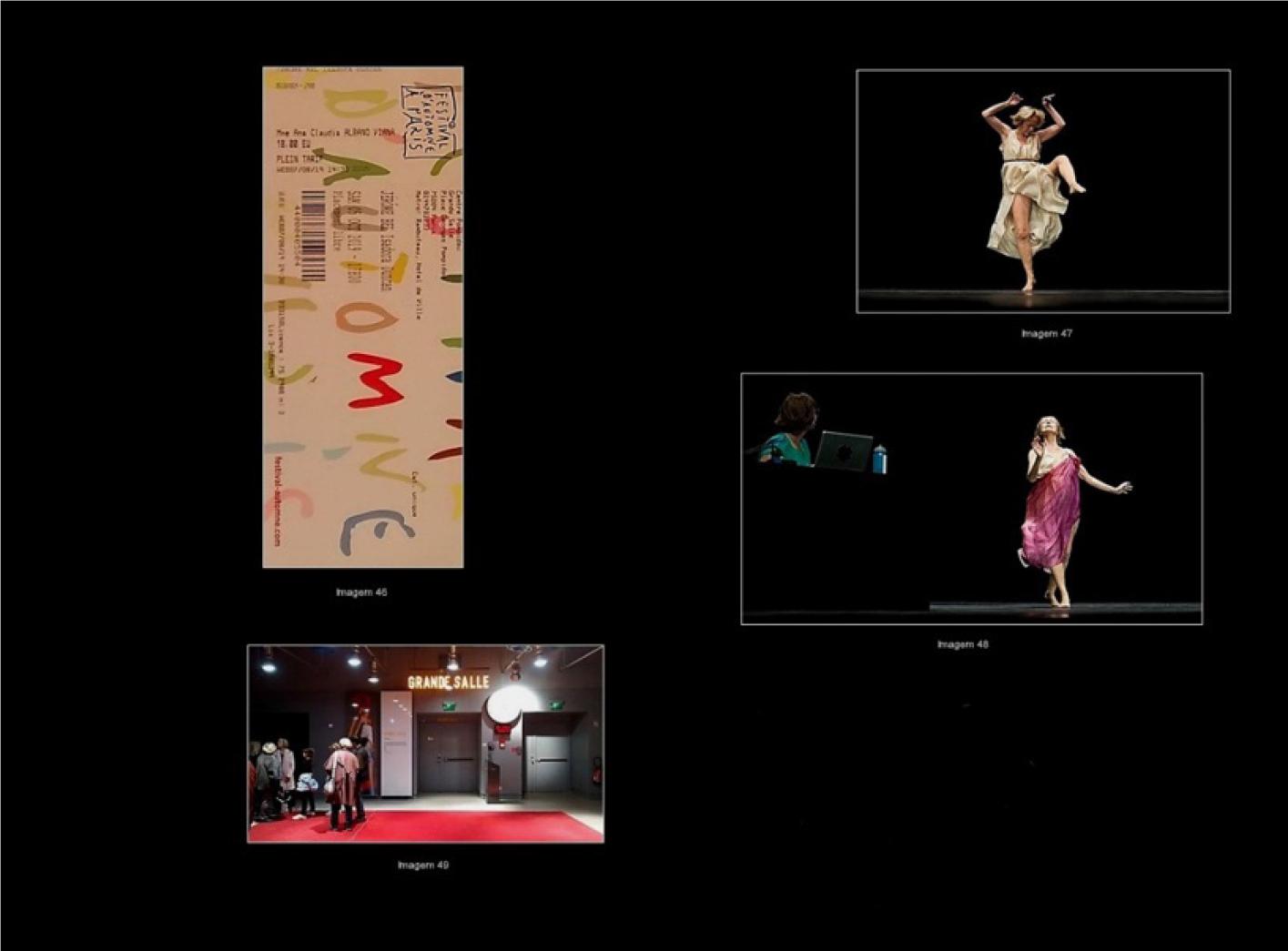
Source: images from permorfer Elisabeth Schwartz RB Jerome Bel (https://www.jeromebel.fr/index.php?p=2&s=74&ctid=6, 28.04.2025). Images of the ticket and of the theatre: Ana Cláudia Albano Viana, 2019.
Figure 3 Isadora Duncan
Throughout the text, the descriptions of scenic excerpts are composed, firstly, of data on the choreographic work, namely: premiere date, conception, performers, scenography, light, music and sound, costumes, productions and information about the video used for analysis; and, secondly, of direct descriptions and analyses of the scenic excerpts. In the phenomenological reduction process, by articulating the script on work appreciation and the making of the boards, we observed the maturation of our gaze and deepened the understanding of the lived experiences with dance, choreographic work and education.
In the choreographic appreciation of Véronique Doisneau, we highlight the poetics of the voice of the temporal flow as elements that compose the expression and the communication as a self-other system, unveiling the language as an intersubjective perception bound by both body and gesture. The work made us realize time not as a succession of “nows”, but as a field of presence lived in the bodily synthesis. The choreography enabled us to understand the relationship between body and time and language in a intersubjective process, opening our sensibility and perception to the existential shifts across a duration communicated through gestures and a spoken, expressive voice of existence, as proposed by Merleau-Ponty in Indirect language and the voices of silence (Merleau-Ponty, 1991a).
In the Pichet Klunchun and myself and choreography, we nuanced the aesthetic-sensitive body, emphasizing the chiasm between body and world. We understand that through this work, through the expressiveness of bodies in scene, it is possible to notice the mutual permeation of body and world, given the intercorporeality as this carnal adherence that constitutes us as subjects (Merleau-Ponty, 2006). The work also enabled us to realize the culture as a phenomenon that, simultaneously, presents both a singular perspective by its modulation and a universal meaning given the intersubjective dimension of the body or its intercorporeality. By intercorporeality, we understand the expression of the relation body-world, given that my corporeality also is constituted by the corporeality of others. Throughout my body, I can feel with the other (Merleau-Ponty, 1991b, 2005, 2006).
From this perspective, perceptual life is comprehended as the soil to the understanding of the world, knowledge and language, in intersubjective relationships that involve the gaze of the other and encompass other experiences, ways of being and feeling. The articulation exercise between Merleau-Ponty’s phenomenology and Warburg’s pathos formula enabled us this movement towards intercorporeality of the choreographic works and our experience with dance. The articulation between phenomenological reduction and pathos formula enabled us to look at the lived experience of dance throughout the poetic and educative expression of choreographic works that are inscribed on the history of dance and in other artistic trajectories. Through these references, we appreciate the work of Jerôme Bel, creating poetic and educative meanings that, as Warburg and the research of his methods would say, have exposition value, as they mobilize our body, our gaze, our affections, and our knowledge on themes, forms, aesthetics, and values that permeate the choreographic works and the experience with dance.
Images and movement of gaze in the choreographic work: notes on education as sensibility and creation
From the exposition of the works Jérôme Bel e Gala, we understand the relationships between bodily awareness and education, highlighting the notions of aesthesiological body, perception e body schema. We consider that these works, because of its images and poetics, unveil the body as a generative field of meaning, of sensibility, and of knowledge, providing us with elements to conceive an education that emerges from perception and empathy. To know and to interpret is, above all, a bodily orientation in space and an unveiling of perceived language. This comprehension strengthens perspectives, the attitudes and the processes of teaching-learning that seek to grasp the intertwining of sensible and intelligible data, nature and culture, body and its aesthesiology integrated to the educational phenomenon. In previous works, we presented the notion on aesthesiology which, according to Merleau-Ponty (2006), addresses the very nature of sensing, sensing with the body: one’s own body and the body of others, as we have explained with the notion of intercorporeality. Based on these references, we present some of the boards created on the research, highlighting our understanding of the body and its aesthesiology, its capacity to feel, from which knowledge and choreographic work itself emerge.
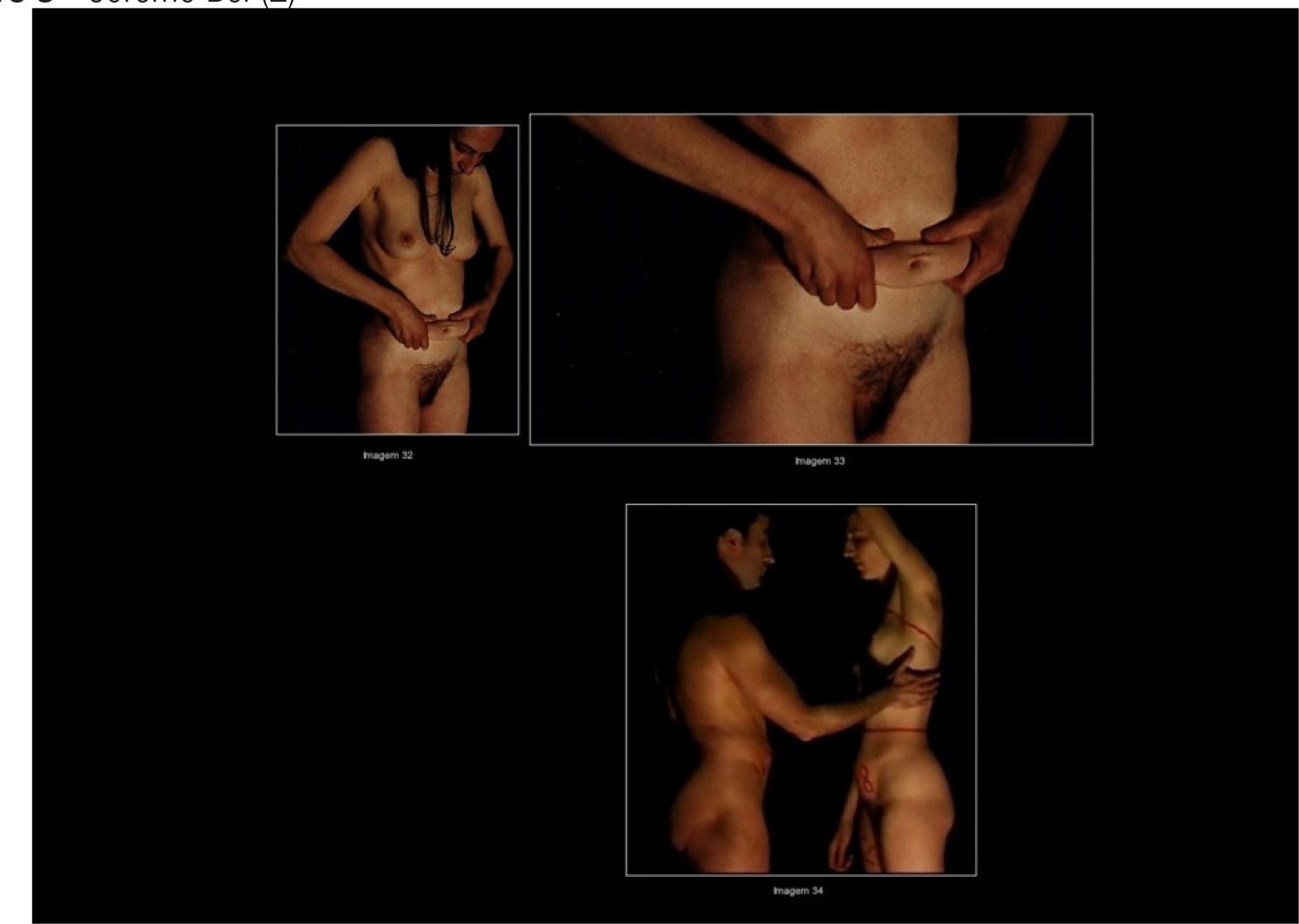
The Figure 4 - Jerôme Bel (1) and the Figure 5 - Jerôme Bel (2), which reference the work Jerôme Bel (1995), summon the body as an organ for feeling. By appreciating images of Figure 4 and they evoke, by making descriptions and exercising listening to the choreographer’s speech (also minding his tones); we find the scarcity and the black backdrop of a night filled with slashes of light. We live in a “turn inward” that gives us the sense of lack. The power that illumination must create a dialectic tension between visible and invisible reaches a point that it becomes distressing for those who want to see everything. At the same time, it educates us on the gaps and shadows, reminding us that our vision is limited and memory has lapses. We live these sensations not through a concept or a spiritual abstraction, but through the fascination that the work exerts in our gaze, captivating us. Thus, we feel and engage in the perceptive spectacle, evoking sensations, feelings e polymorphic meanings bound to our experiences. This movement of gaze, which is broadly a movement of the whole body in its sensitivity (as Merleau-Ponty also teaches us in his many works about the body, painting and philosophy), is capable of offering us other halos of interpretation and significance to our own experience and to the knowledge for the lived world, of history and of culture (Merleau-Ponty, 1964).
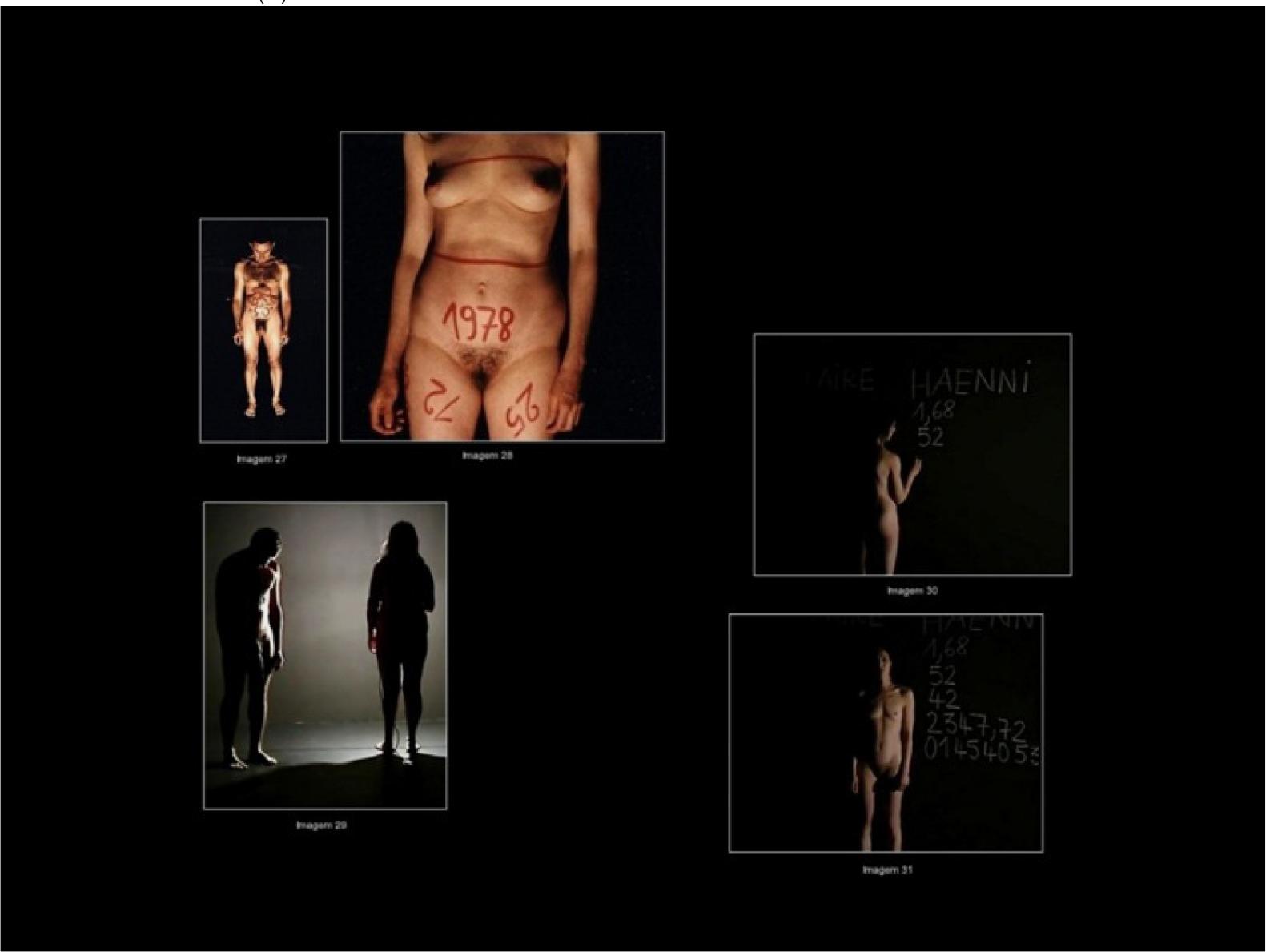
Source: Jérôme Bel - interview - Jerôme Bel (1995) - YouTube (https://www.youtube.com/watch?v=9Aggn9IMxTQ&t=914s, 28.04.2025).
Figure 4 Jérôme Bel (1)
Source: Jérôme Bel - interview - Jerôme Bel (1995) - YouTube (https://www.youtube.com/watch?v=9Aggn9IMxTQ&t=914s, 28.04.2025).
Figure 5 Jérôme Bel (2)
The images move our thoughts, in the perspective of rediscovering within them the same being who writes them. Before being a conceptual index, they express the act that takes hold on the body and circumscribe a significance zone to which it belongs (Merleau-Ponty, 1999). In the appreciation of images, we direct our gaze to the emptying of the body, that is, showing the interior through the act of urination. Thus, we go towards the innermost movements of the body: the sweat glands as they produce and release perspiration, the ureters in expelling urine, the skin in its renewal, the sensation of touch through the hand, the reversibility of the senses, and the body in its chiasm with the world.
The performer’s action of urinating on stage (Figure 4 - Jerôme Bel (1)), while standing, evokes not only internal motor processes, but also in the ways in which each place and cultural context creates its own manners of using the body, its techniques and habits (Mauss, 2003). There are certainly places in which culture creates other ways and experiences, like the neighbor from our childhood that, wearing long dresses, did not mind urinating while standing, just like the performer. These paths and experiences influence the very conformation of sensori-motor processes - which the objective thought can never fully observe in its microscope, but which trace, in fine lines, the possibilities of global reality within a microscopic context, as Merleau-Ponty (2006) suggests.
In the silence that permeates this choreographic work, the performer pulls at her skin, stretches it in every direction (Figure 5 - Jerôme Bel (2)). She is touching/touched, seer/seen. In her actions of showing us the body as it is, from its surface, and in fulfilling the choreographer’s desire to find other possibilities of relating with the body that goes beyond sexual relations, as he states, we perceive her through her gestures and feel our skins. We feel an urge to touch them, and in a movement of looking at the performer and to ourselves, while simultaneously touching our own bodies, we feel our humanity and female animality in our breasts and pubis, in the traces of our skins, the many textures it has, the stains of time. In this moment, we are intercorporeal coexistences.
The performer’s image also makes us think about this refolding that she does on herself, in seeing her touching her body with her own hands, while simultaneously touching your body with your own hands. In the reversible relation between hand and eye, we can understand that the performer’s body opens itself to the tactile experience of her hands, and even if each of them have a different tactile experience, they continue to touch a single body. Just as vision performs an operation in which the ocular channels offer us a single cyclopean sight, the paths traced by the tactile experience find one single being of experience. Even if, in its perceptive operation, tact cannot entirely encompass her back, it nonetheless continues to exist in its wholeness.
The changes that occurred in the tactile and visual world happen in sensory terrain of the body (Merleau-Ponty, 1999, 2005). Even if we recognize the differences and specificities in both the tactile and visual worlds, and that they are not transposable to one another in perfect accuracy and precision, it is possible, nonetheless, to acknowledge this reversibility and communicability of the senses, since the performer’s body is the being of perception and of experience in its entirety. In this sense, the performer’s body replaces her left hand, positioning itself as an extension of her co-presence, adding her world to his. They are participants of the same sensitive network that exists between them, that traverses them and extends beyond and beneath their skin. According to Merleau-Ponty (1991b, 2005), the unveiling of this transitivity from one body to another takes place in the event of synergic exchanges and in the expressiveness of movements. Through the establishment between body organs and between one body with another, as in a handshake, in touching another one’s body, in the sensitive listening, in the vociferation, in crying, in laughter, in the voice, in the cooperation of our organs, in the blushing of the skin whenever I feel anger or shame.
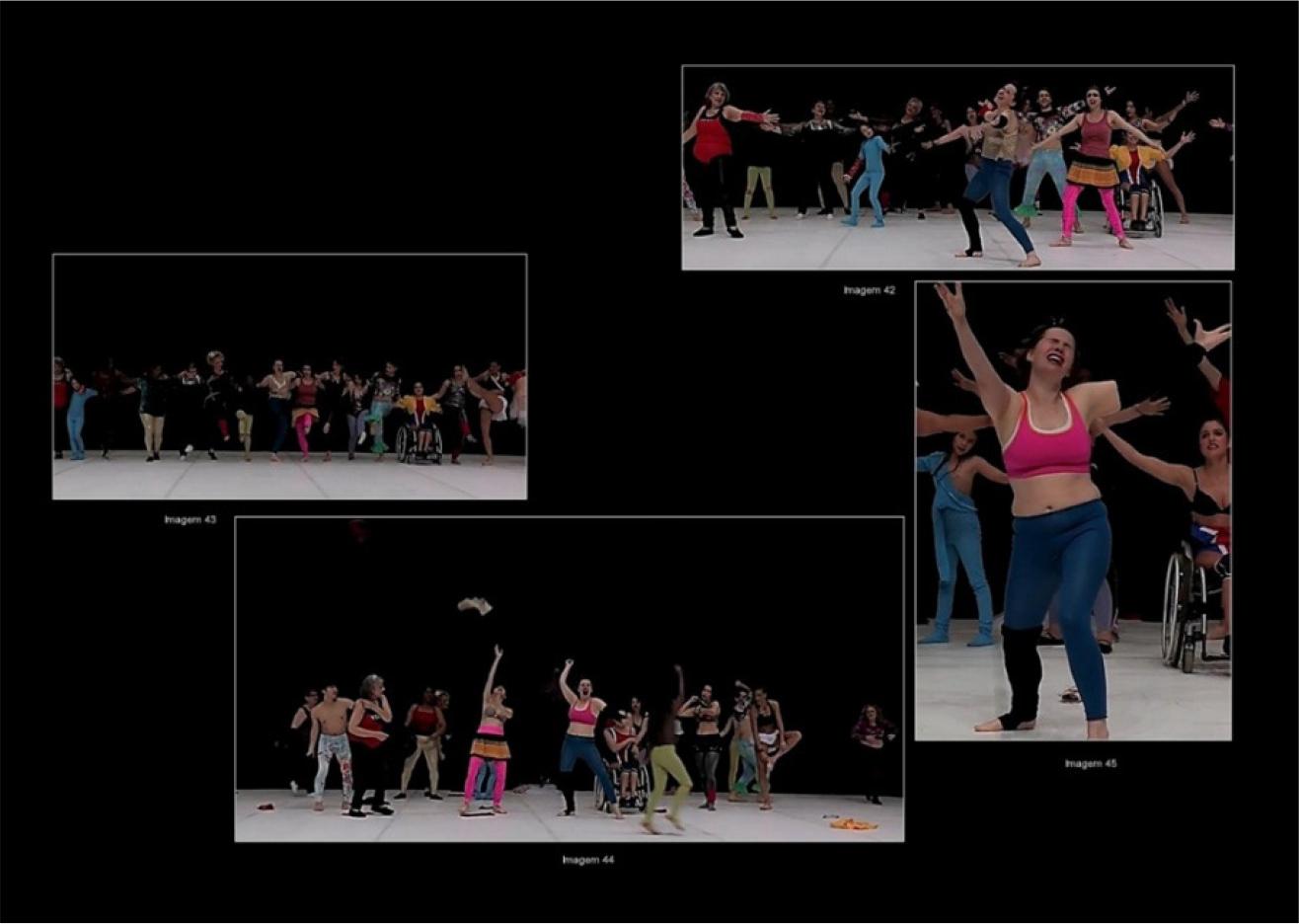
The figures 6 and 7, which refer to the work Gala (2015), evoke perceptual arrangements and various modulation. Each one realizes and interprets the world based on how their body experiences sensations, space and relationships with another. Simultaneously, we consider that the body opens the perception of dance as ecstasy and awe from its creative pulsation.
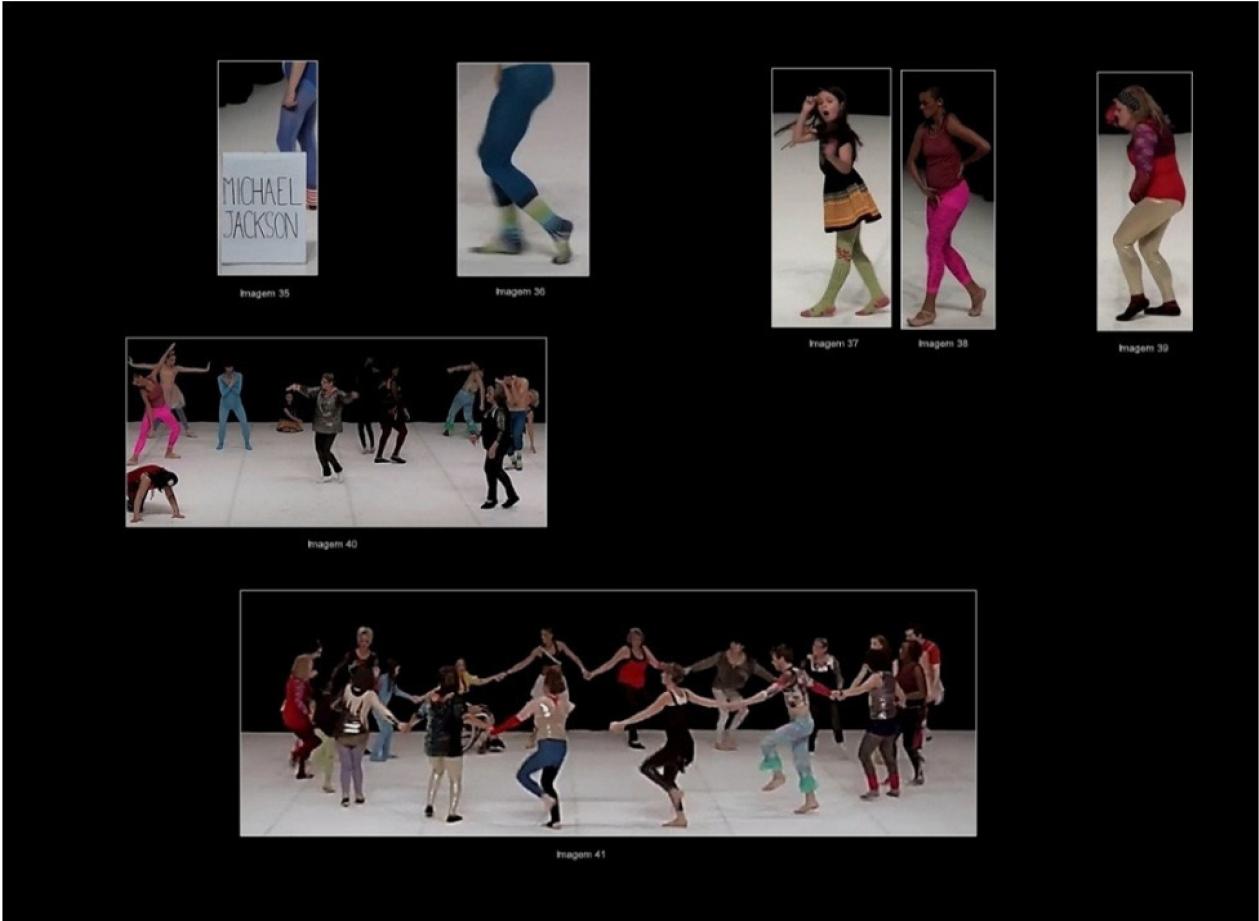
The involvement of the objective space by the body that dances gains other traces when it is traversed by many moonwalks, ranging from the ones that most resemble Michael’s performance to those that do not fully executes the movement (Figure 6 - Gala 1). In the improvisations, in the movements from side to side, passing through and among one another, all at once, we can perceive the body’s spatiality, and the intercorporeality n the different relationships constructed through encounters with the other.
Their bodies are not just a collection of juxtaposed organs, but an indivisible whole, a center of perspective that involves exterior space through movement. In this movement, objective space gains new affections, expressions and other symbolic meanings. For example, when the girl in the skirt enters and tells me through the physiognomy of her movement that she cares about her actions, that she is completely involved by the pleasure of executing this act. Or even when the lady in red, in her movement, touches her sex with her hand, while simultaneously arching her hips forward. Her action happens in such a rapid manner that it involves us in a shyness mingled with a desire to see and to be seen at that very act (Figure 6 - Gala (1)).
Like a system of intersensory equivalences, the bodily schema integrates the reflexiveness of senses. The images from the circle (Figure 6 - Gala (1)) and the images from Figure 7 - Gala (2) express ways of existing in the world and inhabiting space, in which the bodily schema is committed to both a totality and an expressiveness of the body. The image if the circle makes us realize that the “he physiognomy of this curve becomes recognizable through the fact that it changes direction at every instant and, in doing so, transforms itself” (Merleau-Ponty, 2006, p. 250).
The expressiveness of the performer’s body while dancing in circles gives us circularity. Merleau-Ponty (2006) tells us that before we define what a circle is, we feel it like this landscape that, in this work, manifests as a back-and-forth motion of crossed legs. Just like we feel the circularity, we also perceive, through the images at Figure 7 - Gala (2), the expansion and eruption of joy and ecstasy brought forth by the act of dancing collectively - unafraid to express rapture, pleasure, the erotic and the full potency of our body in ecstasy. Our bodies are invaded, penetrated by this joy composed of emotions that vibrate our sensibilities, broadening our perception of phenomena. Through this intercorporeal relation, our bodies come to know physiognomies, landscapes and other subjectivities - which are differentiations of the same world fabric - opening sensitive horizons for better understanding ourselves, others, and the world.
Opening towards other ways of seeing and understanding the body experience
Based on what has been presented, we return to phenomenological comprehension as the possibility of a rationality that neither denies nor manipulates the sensible but instead interrogates it. It is in the very unfolding of this research, loosening the intentional threads of knowledge that we can understand “things as they are”, describe them, reflect on them and arrive to a deeper understanding of the body experience.
From the reference of L’atlas mnémosyne (Warburg, 2012), in its evocative power of memories, we highlight the quality of seeking a history construction that is neither based on a linear notion nor on great deeds, but on the pathos formula. It is a matter of seeking discontinuities, giving value to time lapses, life, passions, seals, coins, and obituaries. For that, we must consider the intentionality of a gaze that expands to observe the world in which we live in and that constitutes part of our experience - namely, the world of dance and education. Regarding the choreographic work, we understand that Jerôme Bel’s work is not the only one that can contribute to the knowledge about its symbolic potency and ability to generate culture. In this research, we emphasize phenomenological appreciation and the work with images through the pathos formula provides us with a way of expanding that knowledge.
Within this intertwining of methods, there is our lived experience with dance and choreographic work in the imagistic and mnemonic construction of the body experience and of education. The boards function as a backdrop of memory, history and time, in our relationship with the world of dance and the choreographic works appreciated on the research’s corpus. We emphasize that, upon finishing the boards and visualizing each one of them, both isolated and together, we realized that they also provide us with the own motion of our thoughts during the process of phenomenological reduction, offering a horizon of comprehension to our research questions and objectives, as expressed in the units of meaning that constitute the structure of the phenomenological method.
In the appreciation of choreographic works, scenic excerpts and the expressiveness of bodies on stage, we come to understand choreographic work in a poetic and educational perspective. We also comprehend education as an experience of the other, engaging with studies of the body in the intercorporeal perspective. Images, in their expositional value, can broaden our gaze, our feeling, and our understanding of body, dance, and education as dimensions of our existence and our intersubjectivity.

