




Serviços Personalizados
Journal

Artigo
 texto em
  Inglês (pdf)
 Artigo em XML
 Tradução automática
 Enviar este artigo por email
Compartilhar

 Permalink
Revista de Ensino de Ciências e Matemática
versão On-line ISSN 2179-426X
Rev. Ensino Ciênc. Mat. vol.15 no.3 São Paulo jul./ago. 2024
https://doi.org/10.26843/rencima.v15n3a01
Articles
Mobile devices integrated into Mathematics teaching practice: contributions emerging from continuing training

1Universidade Luterana do Brasil – Canoas (RS), Brasil. karina.nunes@rede.ulbra.br
2Universidade Luterana do Brasil – Canoas (RS), Brasil. claudiag1959@gmail.com
This article presents the investigation of a Continuing Training course for Mathematics teachers in the final years of Elementary School, with a view to integrating mobile devices into teaching practice. In the theoretical framework, Digital Technologies, Didactic Sequences and the Technological model were addressed. Pedagogical Content Knowledge. The general objective of the research was to investigate the contributions of a continuing education course for the integration of mobile devices in the teaching practice of Mathematics teachers. As a result, it was found that the main contributions of the course to the participants' teaching practice refer to the expansion of their Knowledge about applications that address mathematical content, increasing teachers' confidence in integrating mobile devices, and the expansion of teachers' vision regarding the integration of technological resources, resulting from the sharing of experiences and the study of the theoretical basis covered during the course.
Keywords Mathematics Education; Continuing Teacher Training; Years end of Elementary School; TPACK; Devices Furniture
O presente artigo apresenta a investigação de um curso de Formação Continuada para professores de Matemática dos anos finais do Ensino Fundamental, com vistas para a integração de dispositivos móveis na prática docente. No referencial teórico, foram abordadas as Tecnologias Digitais, Sequências Didáticas e o modelo Technological Pedagogical Content Knowledge. O objetivo geral da pesquisa foi investigar as contribuições de um curso de formação continuada para a integração de dispositivos móveis na prática docente do professor de Matemática. Como resultado, constatou-se que as principais contribuições do curso para a prática docente dos participantes referem-se à expansão do conhecimento destes acerca de aplicativos que abordam conteúdos matemáticos; ao aumento da confiança dos docentes para integrar dispositivos móveis, e; a ampliação da visão dos professores referente a integração de recursos tecnológicos, decorrente do compartilhamento de vivências, experiências e do estudo da base teórica abordada durante o curso.
Palavras-chave Educação Matemática; Formação Continuada de Professores; Anos Finais do Ensino Fundamental; TPACK; Dispositivos Móveis
Este artículo presenta una investigación sobre un curso de Formación Continua para profesores de Matemáticas de los años finales de la Escuela Primaria, con el objetivo de integrar dispositivos móviles en la práctica docente. El marco teórico abordó Tecnologías Digitales, Secuencias Didácticas y el modelo Technological Pedagogical Content Knowledge. El objetivo general de la investigación fue investigar las contribuciones de un curso de Formación Continua a la integración de dispositivos móviles en la práctica docente de las Matemáticas. Como resultado, se encontró que las principales contribuciones del curso a la práctica docente de los participantes se refieren a la expansión de su conocimiento sobre aplicaciones que abordan contenidos matemáticos; el aumento de la confianza de los docentes para integrar dispositivos móviles; y la ampliación de la visión de los profesores con respecto a la integración de recursos tecnológicos, resultado del intercambio de experiencias y del estudio del marco teórico cubierto durante el curso.
Palabras clave Educación Matemática; Formación Continua de Profesores; Años Finales de la Educación Primaria; TPACK; Dispositivos Móviles
1 Introduction
This article is an excerpt from the Master's thesis defended in the Programa de Pós-Graduação em Ensino de Ciências e Matemática (PPGECIM), at Universidade Luterana do Brasil (ULBRA), in the line of research Information and Communication Technologies in Science and Mathematics Teaching.
Several researches indicate that today's society has adapted to Digital Information and Communication Technologies (DIT) at an increasingly accelerated pace, making the daily use of these tools common in various everyday activities and life in society. (Figueiredo and Groenwald, 2017; Homa and Groenwald, 2016, 2020; Monteiro et al., 2013; Oliveira and Scherer, 2013).
This growth increased considerably from 2020 onwards when the world population experienced the coronavirus pandemic (SARS-COV-2). In view of Law No. 13,979, of February 6, 2020, which established social isolation, making it impossible for basic activities to occur, such as face-to-face classes at all levels of Education, leading managers and teachers to make use of Digital Information Technologies and Communication – TDIC for the progress of the school year, venturing into emergency remote teaching established by the Ministry of Education.
This reality pointed to the need highlighted by Homa and Groenwald (2016) that Education and Mathematics Education must adapt to TDIC, seeking ways to integrate them into teaching planning under a new look at teaching and learning, a since these are powerful resources for teachers in their teaching practice, enabling significant changes in education. For the authors, "it is no longer possible to ignore the pedagogical potential that TDIC presents when incorporated into education" (Homa and Groenwald, 2020, p. 155).
Given the need to integrate TDIC into Education, some initial questions were considered for reflection: In what way(s) should TDIC be adapted? Does the teacher feel prepared to integrate technologies into their pedagogical planning? How to use mobile devices in order to make them meaningful tools in the teaching and learning process of students in the final years of Elementary School?
Therefore, the research theme was the Continuing Training of Mathematics teachers with a focus on the integration of mobile devices in teaching practice. It sought to answer the following question: What are the contributions of a Continuing Training course to the integration of mobile devices in the teaching practice of Mathematics teachers? With the general objective: Investigate the contributions of Continuing Training to the integration of mobile devices in the teaching practice of Mathematics teachers.
Next, the theoretical framework that supported the research is presented, focusing on three main pillars: Continuing Training, Digital Technologies and Technological Pedagogical Content Knowledge (TPACK), which discusses the Knowledge that the teacher needs to develop for an effective integration of technologies in the classroom; in addition to the steps developed during the investigation, as well as details of the Continuing Training course developed with Mathematics teachers.
2 Theoretical foundation
Continuing Teacher Training is an important path in the process of building teachers' Knowledge, as it makes it possible to delve deeper into topics and resources relevant to the classroom. Schnetzler (2002) relates Continuing Training with constant teacher improvement, highlighting that it makes it possible to bring emerging contributions from research on Education closer to their use to improve the teaching and learning process in the classroom.
It is understood that scientific research in the area of Education, particularly in Mathematics Education, is significant when its findings are not restricted only to academic publications, but extend to teachers who are actively involved in their professional practice, regardless of whether they are linked or not to an academic career.
Furthermore, in order to bring new contributions from Education research closer to teachers, in accordance with Urzetta and Cunha (2013), the need to abandon the idea of Continuing Training stands out.
As updating processes that occur through the acquisition of scientific, didactic and psychopedagogical information, decontextualized from the teacher's educational practice, to adopt a training concept that consists of building Knowledge and theories about teaching practice, based on critical reflection
(2013, p. 854).
For Figueiredo, Lobo da Costa and Llinares (2021, p. 7), “reflection on practice can be encouraged in continuing education through the sharing of experiences among peers and trainers”, which makes it possible to expand the notion reality of the classroom and the preparation of the teacher to face the most diverse situations that arise in everyday life.
Having said that, it is highlighted that Continuing Education with a focus on critical reflection on teaching practice needs to perceive the teacher in Training as a builder of his/her pedagogical performance, considering him/her in his entirety, involving his entire trajectory, his conceptions of life, of society, school, Education, their interests, needs, skills, as well as their fears, difficulties and limitations (Alvarado-Prado; Freitas and Freitas, 2010), thus favoring the teacher to build their training process with autonomy (Nóvoa, 1992).
It is also evident the importance of Continuing Training providing theoretical means that guide teachers in their decision-making. Zabala (1998, p.16) states that it is necessary to seek theoretical references "that allow us to base our practice, giving clues about the analysis criteria and the selection of possible alternatives for change".
It is believed that as important as enabling a Continuing Training course that encourages critical reflection on teaching practice is enabling a theoretical basis that meets this practice, enhancing conscious and consistent decision-making based on the reflections generated in Training.
This discussion contributes significantly to the reference to the integration of Digital Technologies (DT) in the school environment, since, according to the National Council of Teachers of Mathematics (NCTM) without well-planned professional development, teachers may feel insecure about using technology in their classes (NCTM, 2014).
According to Silva, Silva and Groenwald (2018), this statement is confirmed when they point out that the lack of Knowledge about technologies often prevents teachers from using such resources, highlighting that, without adequate Training, the integration of technologies in the educational environment loses its importance, since it does not occur with meaning. The importance of teachers acquiring theoretical Knowledge to plan and implement their classes using technology is also emphasized by Dias (2022).
Bittar (2011) states that the lack of preparation of teachers is one of the main arguments presented for the fact that it is still so common for there to be classes that do not explore the assistance of technology, despite the fact that since the 1980s, there have been several investigations that point to that this tool "can contribute in different ways to the Mathematics teaching and learning process" (p. 158).
It is worth highlighting here that Bittar (2011) considers that there is a difference between inserting and integrating DT in the classroom, where insertion implies a casual use and generally disconnected from a teacher's usual actions, and integration is the enhanced form of professional development, as it contributes to the teacher becoming autonomous in this use, since, by composing the professional's daily scenario, it allows him to elaborate and critically explore different situations for teaching content.
Therefore, integration cannot be defined by the amount or type of technology used but by how and why it should be used (Harris, 2008). In this sense, to integrate DT, it is essential to know the possibilities that the technologies offer and which ones suit the students, the content to be developed and the level of Education for which they are intended. Such Knowledge is widely discussed in the theory presented by Mishra and Koehler (2006), which discusses the knowledge base that teachers need to effectively integrate DT in the classroom.
Based on the contributions of Shulman (1986), Mishra and Koehler (2006) discuss three types of Knowledge and their intersections in dyads and the triad formed by them, as shown in Figure 1.
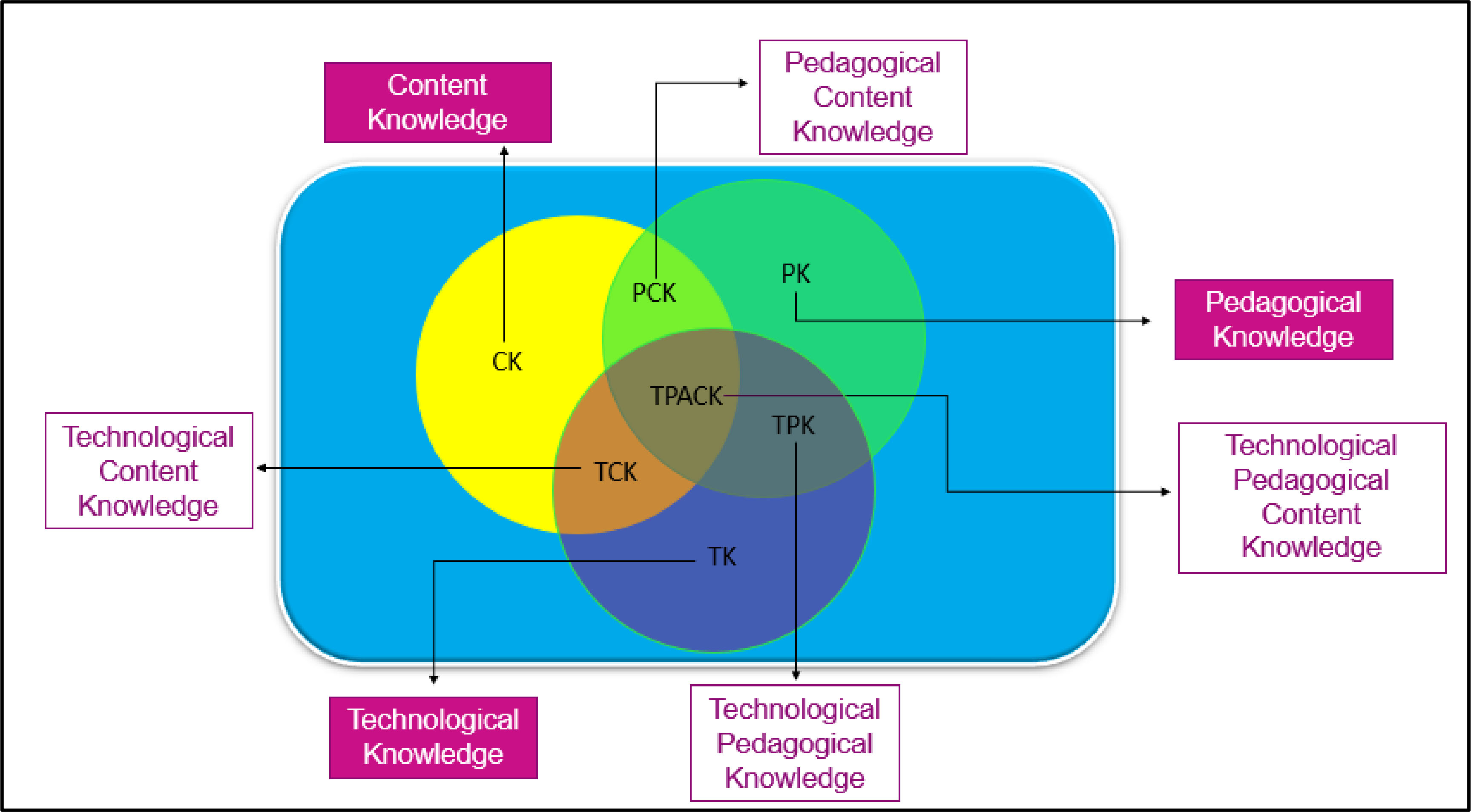
Source: Adapted from Mishra and Koehler (2006).
Figure 1 Technological Pedagogical Content Knowledge – TPACK
The definitions applied to each Knowledge and their relationships are described below:
Content Knowledge: concerns the subject that is learned or taught, that is, the curricular content.
Pedagogical Knowledge refers to the pedagogical strategies that teachers use to organize their educational practice, overriding the simple mastery of content knowledge to achieve broader objectives related to the construction of students' Knowledge.
Technological Knowledge: involves the skills necessary to use technological resources and allows the teacher to understand how to apply these resources productively, recognizing when technology can help or hinder the achievement of an objective.
Pedagogical Content Knowledge: represents the blending of content and pedagogy in an understanding of how specific topics, subjects, or problems are organized, represented, and adapted to students' diverse interests and abilities and presented for instruction.
Technological Knowledge of Content: It allows the teacher to know how to determine whether the chosen technological resource is appropriate for the approach to the content that will be developed, considering that such a choice may restrict the approach to the content and also, certain content may limit some technologies.
Pedagogical Technological Knowledge: it is the Knowledge of using technologies to implement different methods, which enables the understanding that the integration of technologies transforms the teaching and learning process of students.
Technological Pedagogical Content Knowledge: involves understanding ways to teach certain content through pedagogical techniques that integrate technologies.
The TPACK model is understood as an important theoretical framework to support and support teachers regarding the integration of DT into their classroom practice.
3 Methodology
The research developed used an applied and exploratory qualitative approach, developed through Continuing Training with a group of teachers who work in the final years of Elementary Education, in public and private schools.
Minayo (2001, p. 14) states that qualitative research: “works with the universe of meanings, motives, aspirations, beliefs, values and attitudes, which corresponds to a deeper space of relationships, processes and phenomena that cannot be reduced to the operationalization of variables”.
Qualitative research is concerned with aspects of reality that cannot be quantified, focusing on understanding and explaining the dynamics of social relationships (Gerhardt and Silveira, 2009).
It is understood that qualitative research offers support for a more detailed investigation, allowing connections to be established between teachers' Knowledge, their educational practice and the context in which they are inserted. This enriches the researcher's interaction with the research participants and allows greater clarity about the challenges, uncertainties and specific definitions of the subjects.
Furthermore, looking for ways to break the dichotomy between theory and teaching practice, the present investigation used Didactic Sequences – SD3 that integrated mobile devices into the development of mathematical content covered in the final years of Elementary School. Oliveira states that a didactic sequence is:
A simple procedure that comprises a set of activities connected to each other and does not require planning to delimit each stage and/or activity to work on disciplinary content in an integrated way for better dynamics in the teaching-learning process
(Oliveira, 2013, p 39).
In this sense, the activities that make up a Didactic Sequence must be interconnected, pointing towards the same objective(s), thus becoming a strong ally in the construction of Knowledge and an important tool for the integration of Digital Technologies.
3.1 Profile of Research Subjects
Aiming to identify the profile of teachers participating in the training course, a questionnaire was administered, via Google forms, consisting of thirteen questions. Seven Mathematics teachers who work in public and/or private education networks, from different locations, participated in the investigation (Table 1).
Table 1 Description of participants in the Continuing Training course
| Participant | Gender | Age | Municipality of residence | Education network where he teaches | Weekly workload |
|---|---|---|---|---|---|
| P1 | Masculine | 30 | Canoas/RS | Public | 31 to 40 hours |
| P2 | Feminine | 36 | Gonçalves/MG | Public and private | 31 to 40 hours |
| P3 | Feminine | 56 | Porto Alegre/RS | Toilet | From 21 to 30 hours |
| P4 | Masculine | 26 | Alvorada/RS | Public | Over 40 hours |
| P5 | Feminine | 44 | Natércia/MG | Public | Over 40 hours |
| P6 | Feminine | 41 | Porto Alegre/RS | Toilet | Up to 20 hours |
| P7 | Feminine | 40 | Canoas/RS | Public | 31 to 40 hours |
Source: The survey.
It was found that the teachers participating in the investigation formed a very varied group in terms of age; all participants in the Continuing Education course had a degree in Mathematics and at least one postgraduate course. Regarding weekly workload, one participant works up to 20 hours per week, one works from 21 to 30 hours per week, three work from 31 to 40 hours per week and one works over 40 hours per week.
When asked whether they had already worked with Digital Technologies in their classes before the pandemic period in which the course meetings were held, the seven respondents reported that they had previously been exposed to projects that dealt with the integration of Digital Technologies into pedagogical planning. Among them, four teachers indicated that their teaching practices underwent changes after the experience in question, either through the use of the technological resources studied or through improvements when using them. Furthermore, two teachers highlighted that they only had contact with this approach during their academic Training.
It was asked whether the teachers involved in the research had previous experience with Distance Learning (EaD) before the pandemic period, considering that they were all working with remote teaching during the quarantine. It was found that three teachers stated that they had never had contact with distance learning, while three teachers reported having previously been students in distance learning courses. Furthermore, one teacher highlighted having offered help informally through a digital environment.
Participants were asked whether they felt prepared to use Digital Technologies in the classroom. Six teachers stated that they felt prepared and of these, 1 teacher highlighted that despite feeling prepared he was not successful due to the technological impasses faced in the school environment. One teacher highlighted that, sometimes, he does not feel prepared due to the students' lack of equipment.
Regarding being prepared to work with distance learning, two teachers stated that they did not feel prepared, highlighting the student's difficulty in learning in this environment. A third teacher responded "more or less", mentioning the lack of appreciation and feedback from students. On the other hand, the other four teachers stated that they were prepared, with three of them highlighting the positive experience they had with their students during the quarantine period, which favored their adaptation to this teaching modality. The fourth teacher attributed his preparation to his search for new Knowledge through courses and Training.
They were also asked if their students used cell phones in the classroom and in which subject, and 6 teachers responded that cell phones are used by students, of which 4 stated that the use occurs in the Mathematics subject, 1 teacher stated that students only use the resource to attend classes and 1 teacher highlighted only the English language subject. Another teacher highlighted that because he changed schools, he did not have the opportunity to work on the resource with his students, although he used it at his previous school.
When asked what they think about the use of cell phones in the classroom, 3 teachers highlighted the importance of guided use of this resource, 1 teacher highlighted that this is an important resource and that it should not be "left aside", 1 teacher stated that the cell phone is a great ally, 1 teacher highlighted that "if used well, it helps a lot in classes" and 1 teacher highlighted that the cell phone must be linked to a pedagogical proposal and also shared a concern with the use of the tool, since, according to him, the tool is susceptible to distracting students when carrying out the proposed activities.
Finally, teachers were asked to suggest a Digital Technology resource to be used in Elementary School Mathematics classes in the final years (6th to 9th year). The resources mentioned included the use of cell phones, software GeoGebra, games and calculators. Additionally, one professor suggested an interactive course, although he did not specify any in particular.
A relevant point is that, although the majority of teachers have declared that they feel prepared to use Digital Technologies in their classes, many still show caution regarding the use of cell phones during teaching activities. They highlighted the importance of a well-structured pedagogical proposal for the use of these resources, highlighting a reflective process on the integration of Digital Technologies in teaching.
3.2 Structure of the Continuing Training courseIntegrating mobile devices in Mathematics Education
The Continuing Training course was offered to Mathematics teachers from public and private schools who worked in the final years of Elementary School. There were six meetings that took place weekly via the Meet platform from 7pm to 10pm and 12 hours of complementary activities, totaling 30 hours. The material presented at each meeting was available to participants in a class created on Google Classroom, along with recommendations for additional reading and/or questionnaires relating to the topic discussed at each meeting.
The meetings of the continuing education course offered (Figure 2) were scheduled with the aim of enabling teachers to take ownership of the concepts covered through discussions and reflections focused on teaching practice.
At the first meeting, the participants and the researcher were presented, as well as an overview of the proposed course. Also, the aim was to initially discuss the insertion and integration of Digital Technologies in Mathematics Education, in addition to encouraging dialogue between participants regarding the previous experiences of participating teachers, linked to the theme of the Continuing Training course offered.
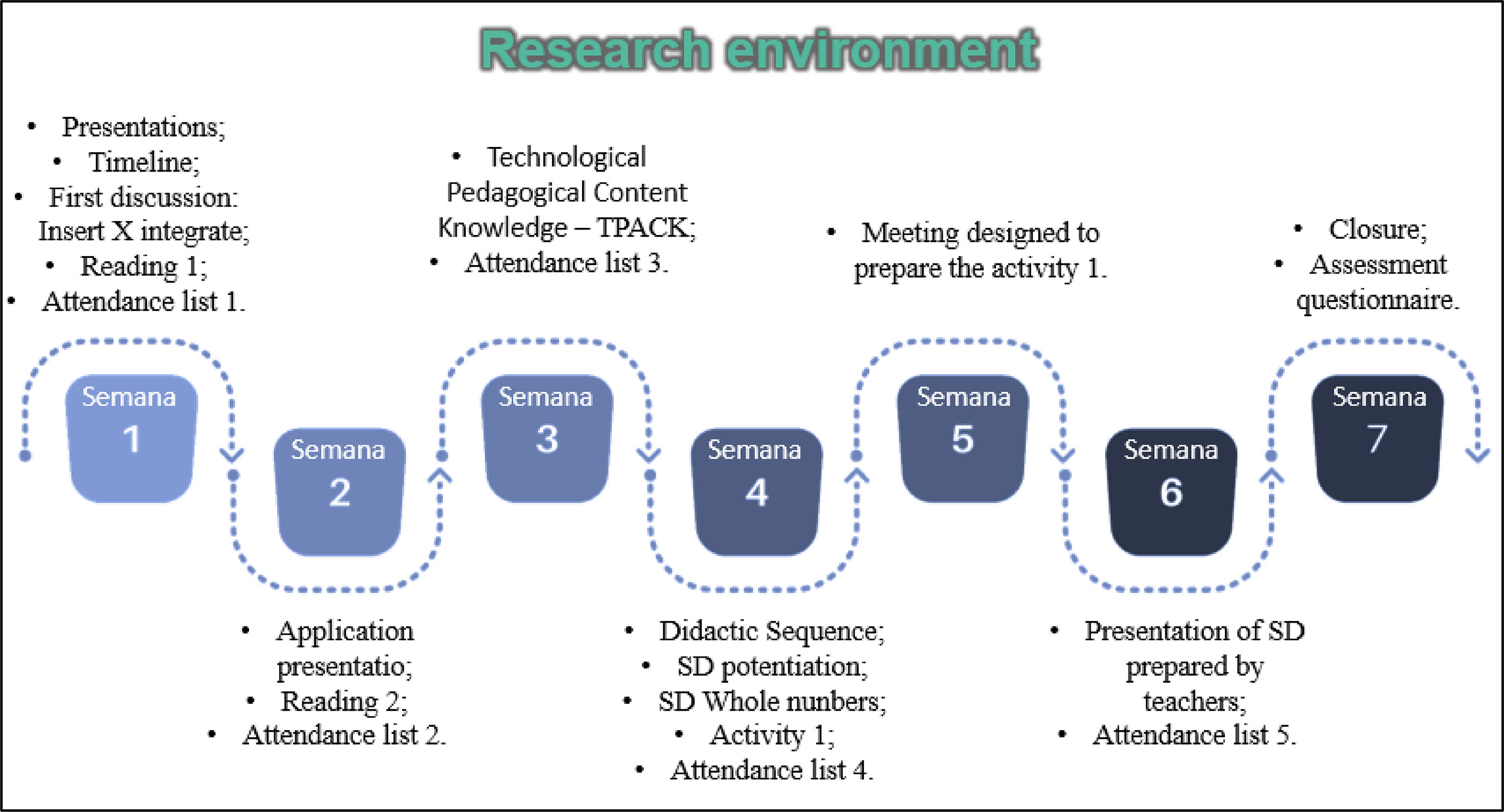
Source: The survey.
Figure 2 Summary of the organization of the Continuing Training course meetings offered
At the second meeting, the different possibilities of free applications available for mobile devices were discussed, involving mathematical content aimed at the final years of Elementary School, with examples of applications being presented.
In the third meeting, Technological Pedagogical Content Knowledge – TPACK was discussed, discussing the different knowledge bases necessary for an effective integration of Digital Technologies in the classroom and the relationships between them, according to the work of Mishra and Koehler (2006).
The fourth meeting was scheduled for discussions about the Didactic Sequence as an effective tool in the process of integrating mobile devices into teaching practice and two Didactic Sequences were presented, prepared by the researcher responsible for the investigation, that integrated mobile devices into their planning as a model for participants. Furthermore, Activity 1 was proposed, which aimed to create a Didactic Sequence by the participating teachers, with the content developed and the application(s) integrated into it being free to choose.
An extra moment was established between the fourth and fifth meetings, in which the researcher would be available if participants had doubts and/or issues to be discussed during their planning, with their participation not being mandatory. Of the seven participants, five SDs were considered for data analysis due to the criterion of integrating at least one application in the proposal.
The DS prepared by the participants were presented at the fifth meeting, providing a rich moment of reflection and discussion among the participants, with the aim of generating contributions for each Didactic Sequence presented. Frame Framepresents an overview of the SD presented at the aforementioned meeting.
Frame1 General overview of the Didactic Sequences created by the participating teachers
| Participant | School year | Content | Application used |
|---|---|---|---|
| P1 | 9th | Pythagoras theorem: metric relations in the right triangle | Pythagorea |
| P2 | 6th | Division of Natural numbers | Divisão |
| P5 | 7th | Geometry: angles and straight lines | Testes de Matemáticando |
| P6 | 6th | Geometry: polygons, and Fractions: comparing fractions | Mestre do Tangran |
| P7 | 6th | Adding and subtracting polynomials | Photomath |
Source: The survey.
At the sixth meeting, it was possible for each participant to clarify their perceptions regarding possible contributions generated from the Continuing Training course. Furthermore, a questionnaire was made available for teachers to evaluate the Continuing Training course.
At the end of each meeting, an online form developed to validate the subjects' participation was made available. In the analyses, the answers to the forms and the observations made by the researcher were taken into account.
4 Data analysis
The analyzes carried out, based on the data collected, refer to the themes covered in the Continuing Training course, namely: 1. Inserting versus Integrating Digital Technologies in Mathematics Education; 2. Applications for Mathematics Education; 3. Technological Pedagogical Content Knowledge – TPACK, and 4. Considerations of teachers participating in the research regarding the continuing education course. It is noteworthy that the discussion related to the Didactic Sequence, as well as the DS prepared by the research participants, will not be addressed in this article.
4.1 Insert versus Integrate Digital Technologies in Mathematics Education
This theme was addressed in the first meeting of the Continuing Training course with the intention of highlighting that, for a technological resource to actually contribute to the teaching and learning process, it is necessary to guarantee its effective integration into teaching planning, which implies in a conscious and intentional use that is related to the other proposed activities, aiming to achieve the previously defined educational objectives, which differs from the insertion of technological resources, since this uses such resources in a way disconnected from the work in the classroom, which ends up determining technology "as an extra instrument, something more that is not in fact in line with the teacher's actions" (Bittar, 2011, p. 159).
It was highlighted that the course sought paths and possibilities through collaboration between participating teachers for the integration of Digital Technologies, specifically, mobile devices such as smartphones and tablets.
After the researcher's discussion on the topic, the teachers were asked, "What are the paths taken so far, and what are the possibilities?", where the participants had the opportunity to make considerations, pointing out their points of view regarding the use of Digital Technologies in classroom based on their experiences, which yielded the following topics for analysis: i) the use of Digital Technologies by teachers is inevitable and ii ) the difficulties encountered in integrating Digital Technologies into teaching practice.
In frame 2 one can observe the comments from teachers P1 and P6 that highlight the first topic.
Frame 2 Teachers' considerations regarding the topic “the use of Digital Technologies by teachers is inevitable”
| Teacher | Comment |
|---|---|
| P1 | you can't escape it; wanting to discuss the teaching of Mathematics without technology is wanting to discuss Education without didactics. I think we are already at that moment where it is present [referring to technology in the classroom |
| P6 | [...] we will have to use this resource more and more. There's no way to escape! [...] Because, more than ever, now we will have to use our cell phones in the classroom, take [the students] to the computer lab, use the tablet we have at school. I think that everything we have gone through shows us, more now with the pandemic, that there is no going back [...] |
Source: The survey.
From discussions among participants, there was a consensus regarding the need to use Digital Technologies in teaching practice, considering that cell phones, tablets, among other technological resources, are integral elements of students' daily activities. In this sense, the participants considered it essential that such technologies be integrated into the Training of students in different areas of Knowledge.
Next, frame 3 presents the participants' statements that highlighted the second topic of analysis of this discussion.
Frame 3 Teachers' considerations regarding the topic "The difficulties encountered in integrating Digital Technologies into teaching practice"
| Teacher | Comment |
|---|---|
| P1 | “The format that the cell phone is built to attract your attention, to hold you there, [...] this environment is our biggest challenge. I think maturity is related, but this environment, it doesn’t let us mature, it’s not there for that!” |
| "[...] a concern even with our reality, if we stop and see, it is the student's obligation to bring a notebook to school, bring a pencil case, even if some municipalities provide material, we have always had this as an obligation family, that the student has their study material. I see that we are transposing this to cell phones, to technologies, we are saying that we can do things because the student has a cell phone. But then the cell phone is not like the notebook, it has this whole environment of social networks, internet that is another world there [...] and we are not aware of this environment, we are not worrying about it, we are not building it in our favor [...]." | |
| "We will no longer find resistance from people who don't want to use technology [...] but the fear we will always have is of this environment, always of this power of at least 2 thousand reais in the hands of children. It's a whole context that we don't know how to deal with [...] I think the question is no longer whether to use technology or not [...] it's a set of things that we don't understand how to deal with." | |
| P2 | "[...] I'm always very worried about managing the content. Here, my school is very small, so they charge a lot [...] and it seems that the coordinator, especially, thinks that us going to the computer room is dragging out the class." "Before the pandemic, I saw difficulty using applications in the classroom due to the maturity of students, especially elementary school II. Because they often thought it was dragging classes along to pass the time, I feel like they joke around more, they don't take what is proposed seriously [...]". |
| P6 | "[...] I was, in fact, trying to change, a very content-oriented teacher [...] we want to handle all the content, handle the textbook, especially working in a private school [...] ] and it wastes time taking the student to the laboratory, so, I think that the time lost taking them to the computer laboratory is due to the teacher perhaps not being familiar with the technologies and neither are the students. I think that from now on it will change [...] now we have had the space to get used to it, but this issue [...] I think I have to deal with all the content [...], So this means that we end up not using other methodologies in the classroom [...]. So the teachers I've worked with ended up inserting technology into one class or another to make a difference in the classes [...] and not actually integrating a tablet or something like that to give meaning to the content [...]." |
| I think that this public school student, I have no contact with, but, as he only has a cell phone that will only arrive later, he suddenly loses interest.” |
Source: The survey.
The main points highlighted as difficulties faced by the teachers subject to the investigation are also highlighted, namely: the maturity of students when working with cell phones in the classroom, as students sometimes do not understand this resource as a tool pedagogical; the ease of distraction for students during the proposed activities, given the many possibilities that cell phones offer, especially if the student has access to the internet; the time available for the syllabus, given that there is a curriculum that teachers need to deal with and, given this, they find it difficult to allocate time for the use of Digital Technologies; the lack of resources on the part of students, especially considering remote teaching, as according to teachers, some students share the same tool with other family members, which makes it difficult to access and carry out the proposed activities, and can even generate disinterest of the student in carrying out these; and, the lack of support that some teachers still find in the schools where they teach, when superiors and colleagues do not consider Digital Technology as a tool that enhances the construction of Knowledge.
It is understood from these discussions that there are many challenges and even barriers that still need to be addressed. Be faced and overcome by teachers for an effective integration of Digital Technologies into their teaching practices. From the infrastructure, the social context of students, prejudices and even the adaptation of both students and teachers, consider the use of Digital Technologies, especially cell phones and other mobile devices, as an important tool in the teaching and learning process.
However, it is noteworthy that it is through Knowledge that these difficulties can be faced, Knowledge can be developed through continuing education courses such as the one proposed in this investigation, which make it possible to expand existing Knowledge through the exchange of experiences between peers and a deeper theoretical approach, which provides a basis for teachers' decision-making, aiming for the effective integration of the resources in question. Furthermore, it can be inferred from statements made by participants in the course offered that the discussion enabled teachers to critically reflect on their practices, as they state that programmatic contents are a recurring concern that can interfere with the use of Digital Technologies. To Alarcão (1996), this reflection is an essential action that contributes to professional development and the construction of teaching identity, enabling teachers to be able to transform their practice and constitute themselves as autonomous subjects in search of changes in the educational context. It is considered even more important when this reflection makes it possible to seek paths that enable the integration of Digital Technologies into teaching practice, especially at a time when, often, these are the only resources that have ensured the continuity of fundamental activities in Education, due to the pandemic scenario that has been experienced in recent years.
4.2 Applications for Mathematics Education
The second meeting of the continuing education course offered was aimed at the presentation of applications focused on Mathematics Education. 10 applications were selected (Frame 4) available for the Android operating system, previously cataloged from the search carried out on the Google Play tool (https://play.google.com/store?hl = pt - BR&tab =r8), which were presented considering the application's potential, difficulty levels, content covered (when specified in the application), available tools and application configurations.
Frame 4 Applications presented at the second meeting of the course
| Name | Google Play search preview |
|---|---|
| 2248 |
|
| Testes de Matematicando |
|
| math Pieces |
|
| math Challenge |
|
| Mestre doTangram |

|
| Math Games |

|
| math duel |

|
| Mestre da Matemática Jogo Educativo e Exercícios |

|
| Matemática para a escola |

|
| Integer Calculation |
|
Source: The survey.
After the presentation of the applications by the researcher, teachers were asked to give their considerations about the applications presented and their expectations regarding their use. Based on the comments that the teachers made during the aforementioned meeting (Frame 5), it is observed that they showed great interest in the applications covered and stated that they would provide a more attractive and dynamic class.
Frame 5 Comments on the attendance list for the 2nd meeting of the continuing education course
| Teacher | Comment |
|---|---|
| P2 | “Great apps for use in the classroom and a super dynamic meeting where everyone could participate.” |
| P3 | “Theme is well presented, clear, well explained.” |
| P4 | “It was a sea of information and expositions about mathematical apps, now it will be necessary to explore the apps to gain mastery over the apps and be able to adapt them to the classes to be worked on.” |
| P5 | “The knowledge acquired was of great value, the use of apps in teaching helps a lot to awaken the students’ taste.” |
| P6 | "The meeting was very cool, the applications presented I believe will be well used, given that we are in a different and changing moment. Now the time has come for Education to increasingly use technology in schools. The next step is to evaluate each application and use them in the appropriate classes and years, remembering to have clear objectives for integrating them into the classroom." |
| P7 | I really enjoyed discovering new work possibilities using this attractive tool, the smartphone. Thank you very much." |
Source: The survey.
It is noteworthy that teachers P4 and P6 presented in their speeches points discussed in the first meeting of this continuing education course, as the integration of a technological resource includes the need to have mastery over the selected resource and to consider students with that you intend to use the resource, mainly considering your prior Knowledge (Mishra and Koehler, 2008).
It should also be noted that in this meeting, P2 and P6 raised questions regarding the elaboration of a Didactic Sequence designed to integrate Digital Technologies and applications as a tool that contributes to the construction of students' Knowledge, as they do not envisage possibilities, since that the concept of SD had not yet been addressed, as detailed in Frame 6.
Frame 6 Comments from teachers at the 2nd meeting of the continuing education course
| Teacher | Comment |
|---|---|
| P2 | Tangram mastered with the children to try to teach them figure congruence, but some students understood the idea and others didn't. Maybe it would have to be a more dynamic didactic sequence [...]." |
| P6 | “Now it’s time for us to explore what attracted us most and prepare something with the students, which is up to each grade, work to see if the students will like it, [...] if they will adhere to the idea of using this as a way for them to construct their knowledge, to fix the objects of knowledge” |
Source: The survey.
It is understood that such questions highlight what Oliveira (2015, p. 62) states that "the presence of technologies in the classroom does not ensure improvement in the teaching and learning process" (Oliveira, 2015, p. 62) and that there is a need to seek paths and possibilities that support teachers in breaking down barriers related to the integration of Digital Technologies, especially mobile devices, considering that the presentation of applications and the clear interest of teachers in taking them to the classroom, was not enough to provide the research subjects with subsidies for the effective integration of such resources into teaching planning.
Furthermore, the importance of developing Knowledge related to TPACK stands out, especially Technological Knowledge, which allows the teacher to recognize when technology can help or impede the achievement of an objective (Mishra and Koehler, 2008). It is understood that it is from this Knowledge that it is possible to determine whether a technology can be effectively integrated into teaching practice, contributing to the construction of Knowledge.
4.3 Technological Pedagogical Content Knowledge
The third meeting of the continuing education course was directed towards the discussion of Technological Pedagogical Content Knowledge (TPACK), in which the researcher presented the knowledge bases necessary for an effective integration of technologies in teaching practice, namely Pedagogical Knowledge, Knowledge Technological and Content Knowledge, in addition to the relationships between these bases (Mishra and Koehler, 2008).
From the approach of this reference with the teachers participating in the investigation, it was possible to provide a reflection on the issues that involve the integration of a technological resource, as it is understood that "the presence of technologies in the classroom does not ensure improvement in the process of teaching and learning" (Oliveira, 2015, p. 62) and goes beyond choosing a resource, as one must consider the content covered, the students' prior Knowledge, the potentialities and limitations of the technological resource that is intended to be used and the methodology that intended to be applied (Mishra and Koehler, 2008).
After the researcher's argument, some teachers commented on the subject, as shown in Frame 7.
Frame 7 Comments from teachers at the 3rd meeting of the continuing education course
| Teacher | Comment |
|---|---|
| P2 | “The approach of making learning happen by observing the TPACK spheres is super interesting [...]”. |
| P3 | “The topic is pertinent to many discussions and reflections, very interesting and addresses the reality in which we live[...]” |
| P6 | "Today's meeting was very interesting and important for me, with a great contribution to my growth. The subject (TPACK) is new to me; I really liked it because I am an observer of my practice, and it came in line with what I have always questioned myself throughout my 20-year journey in the classroom as a Mathematics teacher. I want to study this subject more, and I think this course, these meetings are very good for updating me in this new moment that we are living in the world". |
Source: The survey.
It is observed that the theme was well received by teachers, enabling a critical reflection on the participants' teaching practice, proving to be an important discussion in the professional development process.
It is understood that sometimes, in-service teachers lack theoretical support to guide their teaching practice. As Zabala (1998) states, there is a lot of talk about "updating" and that teachers must be open to new methodologies and resources that enhance the construction of Knowledge, however, it is highlighted that academic research often does not reach the teacher in practice.
Participants highlighted the importance of the knowledge bases presented and the relationships between them, especially with regard to Pedagogical Knowledge, as they agreed that it is from this knowledge base that the teacher will observe whether students have the necessary concepts to the construction of new Knowledge and maturity to develop certain activities.
Another point highlighted was in relation to the National Common Curricular Base (BNCC) which, according to teachers, favors the maturation of students in relation to the abstract contents of mathematics, since based on the normative document they begin to be developed in stages in different years, enabling greater student ownership, due to their maturity.
That said, it is understood that discussions like this contribute to the teacher feeling theoretically grounded in the exercise of their functions, seeking to integrate new resources, not because they are new or in evidence, but rather by appropriating them in order to explore all the potential they offer in the teaching and learning process.
4.4 Perceptions of teachers participating in the research regarding the Continuing Training course
Seeking to present to the reader the perception of teachers participating in the Continuing Training course developed, entitled “Integrating mobile devices into Mathematics Education”, an excerpt of the teachers' speech is presented at the last meeting held, as detailed in Frame 8.
Frame 8 Comments from participating teachers regarding the Continuing Training course
| Teacher | Comment |
|---|---|
| P1 | "[...] when we have each other's opinion, just someone to listen to, we start to visualize things that we hadn't imagined, so I think this interaction between colleagues is really cool; I've always valued it a lot, and I've always been It was missed because my school is small, so I'm the only Mathematics teacher there [...] thank you very much for listening, for evaluating and for the moment”. |
| P2 | It was really good, a unique, excellent experience and I think I learned more than I imagined. Excellent Karina, you are also an excellent teacher and researcher and I think you deal with all situations, leave us calm and seem like our long-time colleague [...]. I'm sure that when I return to the Mathematics classroom I will be much better able to talk to my students about technology than I was before [...] I believe I learned a lot”. |
| P3 | "The way you conducted this course made us feel very comfortable and the methodology was very calm, very accessible. I think we are on the right path [...] We are from different regions, but we identify a lot because our work as teachers ends up culminating in the same aspect, and it is good for us to share, exchange [...] some that those who have a little more "baggage" contribute to those who have a little less "baggage", and we are doing our part in this exchange. Very good [...] I found it very useful". |
| P4 | "I'll be very honest because it exceeded my expectations. Here the course was promoted through a group of Mathematics teachers from the network of schools where I work [...], and I was given the situation of working remotely, looking for strategies, and I'll be quite honest that at the beginning, I was thinking that It was going to be another course that I was going to give up halfway through, but as you brought the proposal, bringing the theoretical part, it started to really "grasp" me, draw my attention a lot and until we "concluded" last week with the sequences and being able to perceive other views regarding various content and experiences that colleagues have, this sharing of Knowledge, I think it was quite enriching [...] even more so as we have people from different states here, it's not always the same region, so the view on Education changes, although we try to have a purpose that is to educate, to teach, the perspectives are not the same, they are different ways of reaching the same objective. I think this was very rewarding; I was able to make the most of this exchange." |
| P6 | "My expectations were met; I really liked it. What I was looking for was to know a little more about some applications and that happened, and also to have more confidence [...] the way you presented the course made me stronger, both in theory and in practice. The theory came, supported and the practice for us to know. We saw the sequence, we saw that, like me, I am already walking in a very similar way and that gave me more confidence for the work." |
| P7 | “I really liked it and I agree when colleagues talk about this issue of exchange, I thank you for having mediated this, you showed me things there in the applications and through that I looked at it with a different perspective, then when I saw the idea of sequences [...] and to my colleagues [...] really cool, I thought it was very valid”. |
Source: The survey.
From the answers to the aforementioned questionnaire, it is inferred that teachers have been seeking new Knowledge in relation to Digital Technologies, as they understand the need to integrate such resources into their teaching practices, especially since the pandemic period experienced, not only in Brazil but throughout the world, causing social distancing that aimed to reduce the spread of the SARS-CoV-2 virus that causes the disease called COVID-19, which put Digital Technologies in the spotlight, especially with regard to Education.
It is understood that the teachers participating in the investigation understand that it is not valid to just insert TD, but rather that they must be integrated, aiming to make greater use of these resources, seeking to enhance the construction of students' Knowledge, and for this reason they are looking for courses with this theme.
Regarding the continuing education course Integrating mobile devices in Mathematics Education, teachers highlighted that it enabled a rich exchange of experiences between peers, duly mediated by the research teacher, a fact that stands out as it provided a favorable environment for learning, according to the statement of teachers P2, P3, P6 and P7.
Understanding that "learning is more than receiving or obtaining information and knowing or understanding it, it is making learning part of the being, implying developing with it", as stated by Alvarado-Prado, Freitas and Freitas (2010, p. 369), it is highlighted that, based on the answers in the "Final Assessment" questionnaire and the teachers' comments during the meetings, that the teachers felt part of the process of building their own Knowledge, as they felt at ease during the discussions and for being able to share their experiences and learn from the experiences of their colleagues. Factors that are in line with what Alvarado-Prado, Freitas and Freitas (2010) state when they highlight the importance of considering the trajectory of teachers, their conceptions of life, society, school, Education, their interests, needs, skills, as well as their fears, difficulties and limitations during a Continuing Training process with a view to the full professional and personal development of teachers in Training.
Furthermore, the statements of teachers P1, P3, P4 and P6 highlighted what Figueiredo, Lobo da Costa and Llinares (2021) state, that the sharing of experiences between teachers and trainers drives reflection on teaching practice, enabling that the teachers involved “prepare to face and live with changes and uncertainties” (Figueiredo, Lobo da Costa and Llinares, 2021, p. 6).
5 Final Considerations
Continuing Training is considered an important tool in building the Knowledge necessary for an effective integration of Digital Technologies in teaching planning. This also brings together emerging contributions from research on Education, encouraging critical reflection by teachers on their practices and helping to improve the teaching and learning process in the classroom.
Furthermore, the course offered to teachers contributed to their Knowledge of different applications that address mathematical content, and to them developing the ability to integrate DT into their planning.
Another important aspect to be considered is that teachers reported being prepared to incorporate mobile devices into their teaching practices. This is partly due to the fact that the continuing education course offered was not just limited to the presentation of technological resources, but also provided a solid theoretical basis so that teachers could better understand the topic. In this way, they were empowered to make more informed decisions about the integration of Digital Technologies in the classroom.
Continuing Training carried out remotely proved to be a valuable tool, as it enabled the participation of teachers from different regions, which enriched the discussions, promoting the sharing of experiences between peers and the teacher trainer. However, it can be inferred that a face-to-face proposal would allow greater interaction regarding the applications, since teachers could manipulate these resources together, with guidance from the trainer. This could strengthen teachers' ownership of technological resources. Furthermore, a face-to-face course would facilitate the possibility for teachers to work together in developing Didactic Sequences.
Therefore, it is noteworthy that Continuing Training for Mathematics teachers with a focus on the integration of mobile devices is characterized as an important path towards effective integration of Digital Technologies in the teaching practice of teachers in the final years of Elementary School.
REFERENCES
Brasil. Leinº 13.979, de6deFevereirode2020. Dispõe sobre as medidas para enfrentamento da emergência de saúde pública de importância internacional decorrente do coronavírus responsável pelo surto de 2019. Brasília: Diário Oficial da União, 6 de fev. de 2020. [ Links ]
ALARCÃO, I. Ser professor reflexivo. In: ALARCÃO, I. (Org.). Formação reflexiva de professores: estratégias de supervisão. Lisboa, Portugal: Porto, 1996, p. 171- 189. [ Links ]
ALVARADO-PRADO, L. E.; FREITAS, T. C.; FREITAS, C. A. Formação continuada de professores: alguns conceitos, interesses, necessidades e propostas. Revista Diálogo Educacional, Curitiba, v. 10, n. 30, p. 367-387, maio/ago. 2010. [ Links ]
BITTAR, M. A abordagem instrumental para o estudo da integração da tecnologia na prática pedagógica do professor de Matemática. Educar em Revista, Curitiba, v. 27, n. especial 1 - Dossiê Psicologia da Educação Matemática, p. 157-171, jun. 2011. [ Links ]
DIAS, M. de O. Digital technologies in Mathematics curricula and professional practices of brazilian and Portuguese teachers. Revista de Ensino de Ciências e Matemática, [S. l.], v. 13, n. 6, p. 1-22, 2022. [ Links ]
FIGUEIREDO, F. F.; GROENWALD, C. L. O. Produzindo problemas abertos utilizando Tecnologias Digitais no processo de formação inicial de professores de Matemática. Revista de Ensino de Ciências e Matemática, [S. l.], v. 8, n. 2, p. 95114, 2017. [ Links ]
FIGUEIREDO, S. A.; LOBO DA COSTA, N. M.; LLINARES, S. Olhar profissional para a docência com tecnologia: um estudo na formação continuada. Educação Matemática Debate, v. 5, n. 11, 1-23, 2021. [ Links ]
GERHARDT, T. E.; SILVEIRA, D. T. Métodos de pesquisa. Porto Alegre: Editora da UFRGS, 2009. [ Links ]
HARRIS, J. B. TPCK in-service education: assisting experienced teachers’ “planned improvisations”. In: AACTE Committee on Innovation and Technology. Handbook of Technological Pedagogical Content Knowledge for educators. New York: Routledge, 2008. Cap. 12, p. 251-272. [ Links ]
HOMA, A. I. R.; GROENWALD, C. L. O. Incluindo tecnologias no currículo de Matemática: planejando aulas com o recurso dos tablets. UNIÓN: Revista Iberoamericana de Educacion Matematica, n. 48, p. 22-40, out. 2016. [ Links ]
HOMA, A. I. R.; GROENWALD, C. L. O. Tecnologias digitais de informação e comunicação como recurso didático no currículo de matemática. Uniciência, Heredia, v. 34, n. 2, p. 153-170, dezembro de 2020. [ Links ]
MINAYO, M. C. S. (Org.). Pesquisa social: teoria, método e criatividade. Petrópolis: Vozes, 2001. [ Links ]
MISHRA, P.; KOEHLER, M. J. Technological Pedagogical Content Knowledge: A Framework for Teacher Knowledge. Teachers College Record, v. 108, n. 6, 1017- 1054, 2006. [ Links ]
MISHRA, P.; KOEHLER, M. Introducing Technological Pedagogical Knowledge. In: AACTE (Eds.). The handbook of technological pedagogical content knowledge for educators. New York, NY: MacMillan, 2008. p. 3‐30. [ Links ]
MONTEIRO, A. B. et al. Utilizando sequências didáticas eletrônicas no ensino e aprendizagem da matemática. In: VI Congresso Internacional de Ensino da Matemática. Canoas: ULBRA, 2013, p. 1-11. [ Links ]
NCTM. Principles to actions: ensuring mathematical sucess for all. Reston: National Council of Teachers of Mathematics, 2014. [ Links ]
NÓVOA, A. (coord.). Os professores e a sua formação. Lisboa: Dom Quixote, 1992. [ Links ]
OLIVEIRA, M. M. Sequência didática interativa no processo de formação de professores. Petrópolis, RJ: Vozes, 2013. [ Links ]
OLIVEIRA, Á. D. de; SCHERER, S. O papel do professor formador em uma ação de formação: uma experiência na abordagem construcionista. Revista Eletrônica de Educação, v. 7, n. 2, p. 97-114, nov. 2013. [ Links ]
OLIVEIRA, K. K. S. As percepções dos professores de Matemática da rede pública municipal de Aracaju/SE frente às Tecnologias Digitais na escola: da implantação ao processo de ensino. 2015. 78f. Dissertação (Mestrado em Ensino de Ciências e Matemática). Universidade Federal de Sergipe. São Cristóvão. [ Links ]
SCHNETZLER, R. P. Concepções e alertas sobre a formação continuada de professores de química. Química Nova na Escola. [S.l], n. 16, p. 15-20, nov. 2002. [ Links ]
SHULMAN, L. S. Those who understand: Knowledge growth in teaching. Educational Researcher, v. 15, n. 2, p. 4-14, 1986. [ Links ]
SILVA, L. T.; SILVA, K. N.; GROENWALD, C. L. O. A utilização de dispositivos móveis na Educação Matemática. Educação Matemática em Revista. Canoas, v. 23, n. 57, p. 59-76, mar. 2018. [ Links ]
URZETTA, F. C.; CUNHA, A. M. O. Análise de uma proposta colaborativa de formação continuada de professores de Ciências na perspectiva do desenvolvimento profissional docente. Ciência Educação, v. 9, n. 4, p. 841–858, 2013. [ Links ]
ZABALA, Antoni. A prática educativa: como ensinar. Porto Alegre: Artmed, 1998. [ Links ]
Thanks
To the Coordination for the Improvement of Higher Education Personnel (CAPES) for the Master's scholarship, which made the development of this research possible.
Received: April 26, 2023; Accepted: June 20, 2024; Published: July 01, 2024
 Este é um artigo publicado em acesso aberto (Open Access) sob a licença Creative Commons Attribution Non-Commercial, que permite uso, distribuição e reprodução em qualquer meio, sem restrições desde que sem fins comerciais e que o trabalho original seja corretamente citado.
