




Serviços Personalizados
Journal

Artigo
 texto em
  Inglês (pdf)
 Artigo em XML
 Tradução automática
 Enviar este artigo por email
Compartilhar

 Permalink
Obutchénie. Revista de Didática e Psicologia Pedagógica
versão On-line ISSN 2526-7647
Obutchénie: R. de Didat. e Psic. Pedag. vol.7 no.2 Uberlândia maio/ago. 2023 Epub 20-Ago-2025
https://doi.org/10.14393/obv7n2.a2023-69593
Dossiê - Sistema didático Zankov
Theoretical and methodological assumptions of the Zankovian Didactic System1

2Colégio Marista Diocesano - Uberaba-MG, Brasil.
3Programa de Pós-graduação em Educação da Universidade de Uberaba, Uberaba, MG, Brasil
4Supporting and funding by FAPEMIG - APQ-01914-17. Programa de Pós-graduação em Educação da Universidade de Uberaba, Uberaba, MG, Brasil
The didactic system developed by Leoniv V. Zankov is a great contribution to Didactics as a science. This system is scarcely known in Brazil, compared to the didactic systems of the activity created by Galperin-Talízina and Elkonin-Davidov-Repkin. However, studies that aim to deepen and disseminate Zankov's contributions are relevant to the development of Didactics. The objective is to make a systematization of the theoretical and methodological assumptions of the Zankovian didactic system. The methodology is the bibliographic review of the sources available in Brazil in Portuguese and Spanish. The analysis of the results brings numerous clarifications on the author's philosophical, psychological and didactic conceptions, in a theory that was built on the basis of longitudinal experimental results, in a large sample of the school population. The conclusions highlight the scientific relevance of the zankovian didactic assumptions, in the contemporary educational context, where there is a clear banalization of didactic science. They also highlight the limitations of the present study and offer suggestions for future research on the topic.
Keywords: Zankovian Didactic System; Leoniv V. Zankov; Developmental Didactics; Historical-Cultural Theory
O sistema didático elaborado por Leoniv V. Zankov é uma grande contribuição a Didática como ciência. Este sistema é escassamente conhecido no Brasil, se comparado aos sistemas didáticos da atividade criados por Galperin-Talízina e Elkonin-Davidov- Repkin. Porém, os estudos que visam aprofundar e divulgar as contribuições de Zankov são relevantes para o desenvolvimento da Didática. O objetivo é fazer uma sistematização dos pressupostos teóricos e metodológicos do sistema didático zankoviano. A metodologia é a revisão bibliográfica das fontes disponíveis no Brasil em língua portuguesa e em língua espanhola. A análise dos resultados traz numerosos esclarecimentos sobre as concepções filosóficas, psicológicas e didáticas do autor, numa teoria que foi construída com base nos resultados experimentais longitudinais, numa ampla amostra de população escolar. As conclusões destacam a relevância científica dos pressupostos didáticos zankovianos, no contexto educativo contemporâneo, onde se observa uma clara banalização da ciência didática. Também destacam as limitações do presente estudo e oferecem-se sugestões para pesquisas futuras sobre o tema.
Palavras-chave: Sistema Didático Zankoviano; Leoniv V. Zankov; Didática Desenvolvimental; Teoria Histórico-Cultural
El sistema didáctico elaborado por Leoniv V. Zankov es un gran aporte a la Didáctica como ciencia. Este sistema es poco conocido en Brasil, en comparación con los sistemas didácticos de la actividad creados por Galperin-Talízina y Elkonin-Davidov-Repkin. Sin embargo, los estudios que tienen como objetivo profundizar y difundir los aportes de Zankov son relevantes para el desarrollo de la Didáctica. El objetivo es sistematizar los presupuestos teóricos y metodológicos del sistema didáctico zankoviano. La metodología es una revisión bibliográfica de las fuentes disponibles en Brasil en portugués y español. El análisis de los resultados aporta numerosas aclaraciones sobre las concepciones filosóficas, psicológicas y didácticas del autor, en una teoría que se construyó a partir de resultados experimentales longitudinales, con una amplia muestra de población escolar. Las conclusiones destacan la relevancia científica de los presupuestos didácticos de Zankov, en el contexto educativo contemporáneo, donde se observa una clara banalización de la ciencia didáctica. También destacan las limitaciones del presente estudio y ofrecen sugerencias para futuras investigaciones sobre el tema.
Palabras clave: Sistema Didáctico Zankoviano; Leoniv V. Zankov; Didáctica Desarrolladora; Teoría Histórico-Cultural
1 Introdução
Leonid Vladimirovich Zankov (1901-1977), Soviet psychologist and frequenter of the circle of L. S. Vygotsky, was responsible for relevant scientific research in the former Soviet Union, in which he questioned the traditional methodology of primary education, marked, according to him, by the simplification of school material, the limitation of theoretical knowledge, and the valorization of the formation of habits, multiple repetitions. In overcoming traditional teaching, L. V. Zankov proposed that the school should enhance the formation of theoretical knowledge as well as the integral formation of students.
According to Aquino (2013) and Puentes and Aquino (2019), L. V. Zankov is one of the precursors of a new didactics, created from the assumptions of L. S. Vygotsky. For this, he created a didactic system based on Vygotskian concepts such as the Zone of Near Development, the unity between teaching and development, and the unity between the affective and the cognitive. Its experimental system was applied longitudinally in the former Soviet Union, with recognized scientific success.
In the 1950s, L. V. Zankov carried out with his colleagues from the Russian Academy of Pedagogical Sciences his study in which they compared lectures with classes that made use of visual aids. 25 elementary schools were involved in the research, and the unexpected result of this study was that student development was surprisingly slow in both approaches. In the continuity of the study, they realized that the limited scope of the curriculum and the monotonous practice of repetition contributed to this result (GUSEVA, 2017). Subsequently, a didactic system was implemented in stages. The first experiment was carried out through a pilot project in a single room in an elementary school in Moscow, where a pedagogical laboratory was created so that the researchers could follow the experimental room. By the early 1960s, it had reached more than 20 urban and rural schools, as L. V. Zankov and his group thought that the experiment should be carried out under varying conditions. A year later, that number had reached 100 rooms, with official support. In 1966-1967, there were more than 1200 rooms in different republics and territories of the former Soviet Union. The implementation involved the preparation of teachers, the production of experimental manuals, and consultation books for masters.
Considering the result of this implementation, L. V. Zankov's team developed school programs, materials, curricula, and textbooks based on Zankovian didactic principles. Thus, "many teaching techniques and methodologies for specific areas have been changed, and many new teaching methods have been developed." (ZANKOV,1984 apudGUSEVA, 2017, p. 238).
This article presents a synthesis of the theoretical and methodological assumptions of the Zankovian didactic system, based on the reading of his works and the collaborations of national and foreign authors. The methodology has been a bibliographic review of the texts available in Brazil in Portuguese. Initially, the didactic systems implemented in the former USSR in the twentieth century, which originated in the Historical-Cultural Theory, in whose context the Zankovian system is inserted, are addressed. Next, a comparison of the philosophical and psychological assumptions of L. V. Zankov's didactic system is made in order to present later the didactic principles enunciated by the author as well as methodological principles for the organization of the proposed experimental system. Finally, the students' development process is exposed, which includes observation activities, mental activities, and practical activities. These are considered units, which allow us to know the concrete laws of the whole from the relations between them.
2 The Zankovian system in the context of other systems
The historical-cultural conception of psychology is developed in the context of Soviet psychology research, beginning with the Socialist Revolution of 1917 and the formation of the Union of Soviet Socialist Republics (USSR), with the goal of establishing philosophical bases based on dialectical materialism, led by L. S. Vygotsky and his collaborators, including A. R. Lria and A. N. Leontiev. Theoretical and methodological approaches to the school context evolve in the framework of discussions on the topic of development and learning, which may be defined as didactic systems. (NÚÑEZ; LEÓN; RAMALHO, 2020).
These didactic systems, which developed from the Historical-Cultural Theory, were based on the Activity Theory and have the character of developmental teaching. Among the researchers who sought to continue the theses of L. S. Vygotsky in the 1940s, S. L. Rubinstein, A. N. Leontiev, P. Ya. Galperin, D. B. Elkonin, V. V. Davidov and V. V. Repkin; thus emerging, with the last three, the Theory of Study Activity and Developmental Learning.
E This is why it is possible to affirm that the Developmental Teaching of Activity still represents the most genuine pedagogical movement engendered within the historical-cultural approach of psychology and Marxist didactics, without, therefore, omitting the theoretical and methodological limitations associated with it, proper to a given historical moment and a certain level of development of science. (PUENTES; AQUINO, 2019, p. 348).
Developmental Teaching was organized into different systems, among them the Zakhovian one. They can be classified as developmental systems, those that have the theoretical matrix in L. S. Vygotsky, Rubinstein and A. N. Leontiev, but each of them has its own particular interpretation of some of the main postulates of these authors, primarily the postulates of L. S. Vygotsky, producing diverse positions and theoretical divergences, which we will not deepen here, because our objective is the presentation of the system of L. V. Zankov and not the comparison between them.
Thus, the Zankovian didactic system was not the only one that originated from the Vygotskian theses from a developmental perspective, because parallel to it, others developed such as Galperin-Taliszina and Elkonin-Davidov-Repkin, according to Longarezi (2018), have a common theoretical matrix but present particularities in the conception and implementation.
The Elkonin-Davidov-Repkin and Galperin-Talizina systems had their main theoretical references in the field of psychology, in L. S. Vygotsky, being the representatives of the Moscow school, centered on the study of activity. L. V. Zankov's system, on the other hand, was mainly oriented by the works of L. S. Vygotsky and K. D. Ushinski, whose studies emphasized the learning and development of students' personalities. With this, L. V. Zankov and his collaborators were pioneers in conducting longitudinal pedagogical experiments to prove L. S. Vigostsky's thesis that the period of schooling as a whole is the ideal period for teaching operations that require awareness and deliberate control, boosting the higher psychological functions to the ideal level of their maturation.
The didactic system of L. V. Zankov is a little-known system in Brazil and aroused the interest of the authors of this chapter by their declared concern with affectivity in teaching-learning relations, among other aspects that will be treated in this text.
In the Zankovian system, the importance of the role played by the methods that trigger the spheres of emotion and will is revealed, meeting the needs classified by the author as "spiritual"5. Unlike other systems, it emphasizes the relationship between the formation of human thought and emotions in understanding the being who learns as a complete and integral being. "No other didactic system has expressed concern for studying the relationship between cognitive and emotional aspects in the process of integral child development. The focus has always been on the development of cognitive functions." (PUENTES; Aquino, 2019, p. 361). Finally, the Zankovian system explicitly considers the aspects of the personality of the learner, understanding that emotions have a motivating force that can raise or reduce vital activity.
When analyzing the evolution of the developmental didactic system of L. V. Zankov against the systems of Galperin-Talizina and Elkonin-Davidov-Repkin, based on the assumptions of L. S. Vygotsky and S. L. Rubinstein, it is perceived that his attention was focused on the proposition of a didactic system that would allow to achieve the optimal result, that is, the integral development of the students, which considers together the affective and cognitive aspects of the learning process.
The author starts from the assumption that the relationship between teaching and development is determined by the specific methods used for the treatment of contents in the classroom, while the Elkonin-Davidov-Repkin system considers this relationship dependent on the content that integrates the school curriculum, from which the methods are only a derivation.
Davidov (1988), accepting the Vygotskian assumptions and those of Activity Theory, dedicated his work to the investigation of the "studying activity" of schoolchildren. The author considers that "... entering school marks the beginning of a new stage of the child's life, in which much is changed both in the aspect of external and internal organization" (p. 76). Thus, according to Davidov's assumptions, studying activity is the dominant activity of school-age children.
Davidov (1988) emphasizes in his studies the importance of knowing the characteristics of learning activities and how students perform their actions in the process of knowledge acquisition. Based on this understanding, students should be aware of their actions because, according to Davidov (1988, p. 178):
[...] the need for a study activity encourages students to assimilate the theoretical knowledge, that is, the motives that allow them to assimilate the procedures for the reproduction of this knowledge through the study actions directed to solve the study tasks (we recall that the task is the unit of the objective of the action and the conditions to achieve it)6. (our translation)
Thus, the author proposes a didactic model centered on the study activity that aims at the assimilation of theoretical knowledge based on a need and reasons stimulated by it and is accomplished through actions that materialize in study tasks. The Elkonin-Davidov-Repkin system emphasizes the formation of theoretical thought, even considering that this is the purpose of the school.
The other system, Galperin-Talizin, has as its precursor Pyotr Yakovlevich Galperin (1902-1988), an eminent scientist, physician, and psychologist of the former Russian Soviet Federative Socialist Republic and one of the collaborators of Vygotsky and Leontiev. P. YA. Galperin developed the Theory of the Planned Formation of Mental Actions and Concepts. This theory, according to Núñez, León e Ramalho (2020, p. 15), contributed to the understanding of the "phenomena and processes that occur during the formation of the mental plane and its dialectical interrelationship with the verbal and practical planes of the learning activity", as well as offered contributions to the orientation of teaching in the Near Development Zone (NDZ). With regard to the didactic system, the research and contributions of Nina Fiódorovna Talízina (1923-2018) play a fundamental role, applying Galperin's general propositions to the teaching-learning activity and seeking to demonstrate the close relationship between Vygotsky's Zone of Near Development and that of P. YA's Guiding Base of Action. Galperin (SOLOVIEVA; QUINTANAR, 2020).
The focus of this system is placed on human action as a process, which occurs in stages: the material or materialized, the concrete perceptive, the schematic perceptual, and the verbal. Human action, according to Galperin, has three functional moments: guidance, execution, and control. The orientation phase concerns the anticipated representation of the task by the student and the conditions necessary to perform it. This plan for future action was called the guiding basis of the action (BOA). For P. YA. Galperin (1959/2009), mental action can be considered the ability to mentally perform a transformation of the object.
Hence, according to Nunez, Leon, and Ramalho (2020, p. 15):
The Galperin-Talízina System is a way of explaining the dialectical nature of teaching-learning processes, in which learning is conceived as a specific type of guiding activity, revealing a point of view of what learning is in the school context and the role of teaching in school.
L. V. Zankov, in his didactic system, defends the general "optimal" development of the student, considering that one of the main objectives of his education system is "to awaken the independent, restless thought of the student, linked to living emotions" (ZANKOV, 1984, p. 62). "Optimal" development refers to the relationship between teaching and development in which the proper organization of the teaching process leads the student to a lot of learning, which, in turn, promotes his integral development. Integral development is understood as one that transforms the individual internally and externally, changing his way of seeing and interacting with the world.
In this sense, the author points out that
The important thing is not to limit instruction to empirical or theoretical knowledge. The correlation and the interrelationships that must exist between one and the other depend on the didactic attitude and on the peculiarities of each subject of study (ZANKOV, 1984, p. 36, our translation).7
Not limiting instruction to empirical or theoretical knowledge is the only way for the necessary interrelations to occur through the didactic attitude and the peculiarities of each subject. Thus, the teaching process that leads to development becomes broader and more open to the needs and desires of each student, producing the necessary environment for the appropriation of an optimal general formation.
L. V. Zankov highlighted the importance of implementing its system in a compatible educational context: "Teaching will contribute to the process of the general development of students not through the application of disconnected didactic principles but only through the implementation of the complete didactic system" (ZANKOV apudGUSEVA 2017, p.240).
This statement of L. V. Zankov is pertinent and coherent with the references on which it is based, in the sense of thinking of a didactic "system" and not sporadic, punctual didactic "actions" and "principles" that are unrelated. It is consistent with the principle of an organic relationship between part and whole, proper to the dialectical posture. To think of a didactic system is to think of the subjects it involves, the methods and processes of teaching and learning, the conditions as well as the contents, in an organic, grounded, and coherent way.
Despite the genuineness and its relevant aspects for didactic science, the systems derived from these theories still demand studies that will promote their dissemination, understanding, and application in the classrooms, making them capable of interfering in the process of school teaching and learning in the social, cultural, scientific, and educational context of the twenty-first century.
The philosophical presuppositions and psychological principles of L. V. Zankov's didactic system
Interpreting in his own way the main postulates of the authors, who established the bases of developmental teaching, primarily the postulates of L. S. Vygotsky, L. V. Zankov understands that the teaching that provides new psychological formations is developmental.
Questioning the teaching methods of his time, L. V. Zankov warns that they did not exploit to the maximum mental capacities, such as observation and thought, along with a positive attitude. Thus, it suggests other ways of approaching didactics that can lead the student to full development.
As Puentes and Aquino (2019, p. 458), state,
The Zankovian system believes that the relationship between teaching and development is determined by the specific methods used for the treatment of content in the classroom. His studies proved that the school did not use sufficiently effective methods and therefore did not exploit to the maximum the psychic reserves of the students for their development, especially the mental ones, such as the activities of observation, thought, and a positive attitude toward the process of obutchénie 8.
In presenting his object of study, the method, and the organization of the research he developed, La enseñanza y el desarrollo, L. V. Zankov indicates philosophical and psychological presuppositions. In relation to the object of the study, it states that "it consists in evidencing the objective pedagogical logic in the correspondence between teaching and development" (ZANKOV, 1984, p. 15). He was concerned with investigating the avenues of teaching that could lead to "optimal general development," while remaining faithful to the demands of Marxist-Leninist methodology and to the Vygotskian theses regarding teaching and development, in the sense that teaching must anticipate development.
In the search to evidence the objective pedagogical logic of the teaching-learning process, it is necessary to keep in mind that the action, or the task performed, does not evidence this logic; however, it guides the defined didactic work. Achieving a result or achieving a goal alone does not demonstrate the logic of the action taken. Objective logic is differentiated by expressing a certain order in the relations between phenomena and processes that interfere with objective reality. It is not a question of applying the results of the research in school practice but of investigating the logic of the teaching work that allows to achieve the expected results in the development of the students. Thus, Zankov (1984, p. 17) takes as a hypothesis of his investigation that "the structure of teaching is the cause of a certain process of general development in students".
Some questions have guided Zankov’s research, considering the experimental classes and those using traditional methodology:
Is there a limit to the development of students that is achieved through the traditional teaching methodology? If there is no limit, what should be the didactic system that leads to much better results in the development of students? What is the process of general student development through the traditional methodology and the experimental system of primary education?
Is it justifiable to suppose that, on the basis of substantial progress in the general development of schoolchildren, a really high-quality will be achieved in the assimilation of knowledge and in the mastery of habits?? (ZANKOV, 1984, p. 17, our translation9).
Hesse questions give the dimensions of your concerns and your research work. It is clear that he intended to compare the traditional methodology with another didactic system that would lead to superior results in the development of children.
Aquino (2013) makes a comparison of the assumptions that guided the Zankovian didactic system and presents them as the philosophical foundations of the system, from the perspective of materialist dialectics: The principle of "multilaterality" in the study of the object; the principle that all science must start from the facts given; the unity of the oppositions (reality-fantasy; object-representation); the principle that the law, which expresses a certain order of the necessary and stable relation between phenomena, is therefore narrow, incomplete, and approximate; the principle that the consequent activity of man is a form of objective process; These are the principles of a Marxist-Leninist methodology that must be observed, as L. V. Zankov (1984) affirms.
Regarding the principle of multilaterality, L. V. Zankov relies on Lenin when he considers that "in order to truly know the object, it is necessary to encompass and study all its aspects, all its links, and its "mediations." We will never achieve it completely, but the demand for multilaterality will prevent mistakes and stagnation.". (LENIN apud ZANKOV, 1984, p. 20). It affirms that the development of students should not be thought of in isolation but in the bonds of man with the outside world, in a movement of internal and external relations. In this sense, it uses the experiment because it is a general scientific method that allows to change the conditions of the observation of the phenomenon and its relations with other phenomena, seeking to find the causes and evidence of the laws of objective reality. It draws attention to the complexity of the pedagogical reality, which makes the experiment also complex, requiring the planning of the investigation in order to evidence the process of development of the students.
L.V. Zankov (1984), citing Engels, also considers, as one of his assumptions, that the approach to phenomena, the object of study, should not occur in an abstract way but start from the facts given, so that theoretical constructions must originate from them and not impose themselves on them.
Arguing that, in the study of thought, there is the unity of the reality-fantasy and object-representation contrasts, based on Lenin and Vygotsky, he indicates that in any generalization10, no matter how simple, "fantasy" is present. This assumption, in the understanding of the authors of this text, refers to the "rise from the abstract to the concrete", although this relationship is not explicit because the representation is an abstract moment. It is also contradictory and may not translate the concreteness of the phenomenon or object, hence the need to search for the essence translated into a concrete thought.
Defending the unity between fantasy and reality is perhaps a singularity of the Zankovian didactic system. Vygotsky, in his work La imaginación y el arte en la infancia, gives a different meaning to this pair, associating fantasy or imagination with the creative activity of the human brain.
To better understand the psychological mechanism of imagination and related creative activity, it is convenient to begin by explaining the link between fantasy and reality in human behavior. We have already noticed the incorrectness of the vulgar criterion that draws an impenetrable border between fantasy and reality (VIGOTSKY, 1998, p.5, our translation)11.
L. V. Zankov believes that "objective logic, discovered through scientific investigation, expresses a certain order, a causal, necessary, and stable relationship between the phenomena and processes of objective reality." Thus, when referring to the investigation of the objective relationship between the structure of teaching and the development of students, he states: "In our investigation, it means that the structure of teaching is the cause of a certain process of the general development of students" (ZANKOV, 1984, p. 17). This necessary and stable relationship is expressed by means of a law; however, according to Hegel, cited by L. V. Zankov (1984, p. 21), the law is always "narrow, incomplete, and approximate", because it translates the fixed elements.
Regarding the psychological aspects, according to Aquino (2013), L. V. Zankov relied on representatives of historical-cultural psychology, L. S. Vygotsky, S. L. Rubinstein, and A. N. Leontiev, in addition to contributions from other Russian psychologists such as I. Pávlov. It highlights the following assumptions present in Zakhovian research: "the development of the child's psyche is of a social nature, and that the source of development is cooperation and teaching" (p. 241); "the unity between consciousness and activity" (p. 242); "the principle of age-related steps" (p. 241); and "The Zone of Near Development (ZDP)" (p. 243), a construct by L. S. Vygotsky. To these principles cited by Aquino (2013), one more can be added, presented by L. V. Zankov (1984, p. 22), which is that of the "integrity of development".
L. V. Zankov (1984), in situating his research problem, expresses these principles. He maintains that, for L. S. Vygotsky, the investigation of human psychology has as its source the social environment to which man belongs and not his interior. In relation to the principle of age-related stages, it states that the basis for the characteristics of each stage lies in the "change of the functional structure of consciousness". "The general law of development," writes L. Vygotsky, "is that consciousness and mastery correspond only to a higher rung in the development of any function”.12 (ZANKOV, 1984, p. 8, our translation). In early childhood, perception is dominant in the system of interfunctional relationships; at preschool age, memory is dominant; at school age, voluntary attention and memory are dominant.
Continuing Vygotsky's postulate of unity between consciousness and activity and A. N. Leontiev's conceptualization of main activity, S. Rubinstein characterizes the game as the dominant activity in preschool; at school age, systematic study.
Dealing with the Near Development Zone (NDZ), L. V. Zankov (1984) recalls that teaching should act not on already mature functions (the current development zone), but on those still in the process of maturation (the potential development zone), thus creating a development zone resulting from the distance between the current and the potential (the proximal development zone). In the NDZ, internal and external processes occur, both relevant to child development, as described by Vygotsky:
The importance of teaching comes from the fact that it creates the zone of proximal development; that is, it stimulates the child's interest in the environment, which in turn awakens the processes of internal development. Once awakened, development will advance only through interaction with the environment and through interpersonal relationships. And despite the need for external stimulation, intellectual maturation or growth will be an internal and individual achievement for each child. (VYGOTSKY, 1991 apudGUSEVA, 2017, p. 228).
This quote helps to understand that between teaching and development there is no direct causal relationship; that is, the processes of teaching and the processes of development do not coincide in their trajectories, a fact already verified by L. S. Vygotsky, with which L. V. Zankov agreed. Development presupposes interpersonal relationships and requires external stimulation, but it also depends on the individual internal processes of each student. For this reason, it cannot be guaranteed that an optimal organization of teaching will cause the optimal development of all students.
Based on the integrity of development, L. V. Zankov considers that, when taking as an object of study the general development of school-age children, it would be an irregular way to think of this general development as the sum of psychic processes: sensation, perception, memory, etc. The author considers that integrality is not a sum of isolated parts but that it constitutes an indivisible whole. By this means, it is necessary to analyze the psychic development of the child from his interactions with the world in an upward movement that leads to the essence of the phenomena.
Regarding teaching and child development, L. V. Zankov, based on L. S. Vygotsky, considers that teaching should not only aim at cognitive development but also at emotional development. According to Guseva (2017, p. 227), "the Zankovian system defends that early childhood education should stimulate the cognitive (mind), volitional (motivation), and affective (emotions) development of the student", thus involving elements capable of stimulating the optimal development of the individual.
This intentionality was verified by Ferola (2019), when interviewing the Russian professor Natalia Nechaeva, a researcher in the laboratory of the Academy of Pedagogical Sciences, led by L. V. Zankov, who explained it beautifully through the metaphor "mind, heart, and hands", referencing the uniqueness of these three lines of development in its system and attributing to it the reason for the recognition of the Zankovian system around the world.
For L. V. Zankov, there is no teaching or learning if there is no transformation of the human being. For this transformation to occur, it is necessary that the student feels and that he perceives the emotions associated with knowledge, a fact that can help positively when the related emotions are good or negatively when these emotions are not good, generating a possible aversion to the content and an increase in the difficulty of his learning.
In his experiment, from the first stage and throughout his development, he sought to find, through the process of mediation by the teacher, the various aspects of the personality and feelings of the student. Thus, the movement of the experimental system could reveal, with great transparency, the passage from one stage to another, the active role that the methodology has regarding the emotional sphere, in addition to the will of the students and their spiritual needs. It is worth considering that in the general and emotional characteristics that are present in psychological science, emotion is characterized as an attitude of man towards the world, of what he experiences, experiences, and performs in the form of feeling.
According to L. V. Zankov (1984, p. 63),
Emotion is characterized as man's attitude toward the world, even that which he experiences and accomplishes in the form of direct feeling. Emotions express the state of the subject and his attitude towards the object. [...] Emotions have a motivating force. They can increase or reduce vital activity; therein lies its dynamic importance. (our translation)13
Emotions, in general, are characterized by a positive and a negative sense, such as satisfaction and dissatisfaction, joy and sadness. With positive emotions come spiritual elevation, sympathy, and admiration; within negative emotions are anger, revulsion, and frustration. The emotions mentioned, as well as others, operate in different ways and are distinguished by different qualities and nuances. In general, the types of emotions stand out due to the spheres and psychic activities of man and the various faces of his activities before the world: intellectual, moral, and ethical. These would be, then, for L. V. Zankov, the various facets of a man's attitude.
Emotions have a motivational force and can raise or reduce vital activity. Quoting Lenin, he writes: "Without human emotions, there has not been, there is not, and there will not be a human search for truth" (ZANKOV, 1984, p. 63). For an active and creative work of thought, it is of paramount importance that a man, when faced with something incomprehensible, raises questions that surprise him and that stimulate his emotions. The incomprehensible generates astonishment because the doubt generated in the face of the lack of evidence forces man to perform the work to the end to achieve full thought, even with all the difficulties that may arise along the way. Passion and joy influence the accomplishment of work and studies, leading the student to have more strength and energy for practice. On the other hand, boredom and frustration hold him back. In this sense, it can be understood that emphasizing the role of emotions in the mobilization of the student for learning potentiates the sense of "need" in the Activity Theory
Didactic principles of L. V. Zankov
L. V. Zankov found that traditional teaching methodologies emphasized the development of knowledge, skills, and practices, which led him to broaden these objectives to encompass integral cognitive development, beginning with the adjustment of the role of the teacher, who would no longer assume the position of instructor, passing to that of guide of the learning process.
In this new conception, the teacher remains with the functions previously assigned to him, such as that of performing the organization of the content and that of didactic mediation, but absorbs the characteristic of the one who points out ways through the organization of the learning process, guided by clear principles, that promote the evolution of the student in function of the content.
To direct in his system the action of the teacher and the whole teaching-learning process, L. V. Zankov was based on five didactic principles in order to promote the general development of the student and a greater effectiveness of teaching. These principles were structured during the stages of the experiment. They are:
The Role of the Rector of theoretical knowledge
Teaching to a high degree of difficulty
Fast-paced progress
Students' understanding of the study process
Careful lesson planning to promote the learning of each particular student
The last principle, according to L. V. Zankov (1984), defines the field of action of others because the organization of teaching is a condition for others to be affected. It also highlights that these principles are linked to each other but act on different planes and are distinguished by their functions.
First principle: The role of the rector of theoretical knowledge
The formation of theoretical concepts or theoretical thought is a concern of L. S. Vygotsky and his followers. They emphasize that the role of teaching is to promote the formation of theoretical thinking and not empirical thinking. Resende (2019) draws a parallel between them, based on Davidov.
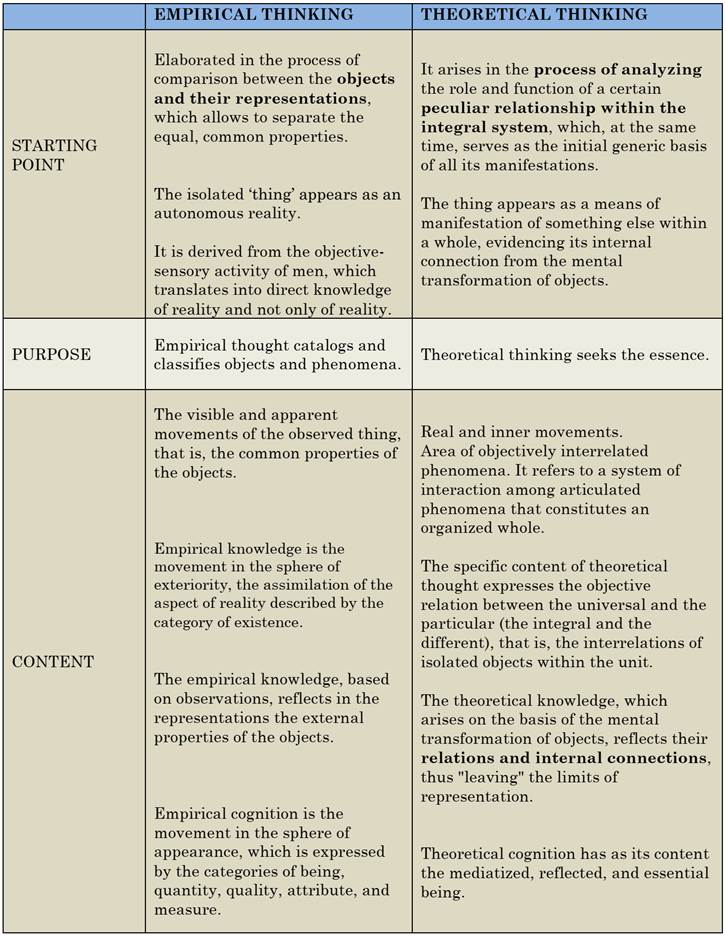
Source: RESENDE, 2019, p. 307. Elaborated on the basis of DAVIDOV (1988, p. 154-155) and DAVÝDOV (1982).
Table 01 - Parallel between empirical thought and theoretical thought from Davidov's perspective.
It is clear that empirical thinking is based on external, apparent aspects of the object, is in the sphere of appearance, and has the purpose of cataloging, of classifying, while theoretical thinking aims at internal connections, arises from the mental transformation of objects, and is in search of the essence within a whole, of an integral system.
Although L. V. Zankov was concerned with the formation of scientific concepts, giving them the role of "rector" in the proposed didactic system, he also stressed the importance of considering the sphere of emotion and will of the students in order to obtain the integral development of the student.
L. V. Zankov (1984) associates this principle with the next, stating that the high degree of difficulty implies arriving at knowledge of the interdependence of phenomena and their substantial internal relation, which allows us to say to the essence, going beyond the empirical level of thought.
In the Zankovian system, students are encouraged to verbalize their observations on the subject studied, while the teacher directs attention to the patterns and connections evidenced by them, leading them to deduction and explanation of the nature of relationships. The emphasis should be on concepts and not on the manipulation skills of mathematical or linguistic signs, although L. V. Zankov values the formation of habits and skills that become more developed when they are linked to a deeper understanding of concepts.
In the example presented by Guseva (2017), in a geometry class, what is observed is that the teacher presents a geometric element in a figure—the diagonal—and goes instigating and questioning until the student reaches a more complete concept, containing all the necessary elements, which go beyond the immediately observable.
This type of approach to knowledge guides the teaching-learning process that has the student as the protagonist of the appropriation of his knowledge, but not alone. There is a collective construction, guided by the teacher, that will lead the students to the concept, but at different moments of the process, thus respecting each individual, their limitations, and their abilities.
Second Principle: Teaching at a high degree of difficulty
L. V. Zankov (1984) states that one of the aspects of this principle is the overcoming of difficulties. In didactics, the concept of difficulty applies in different contexts and meanings. By referring to work in a broad psychological-social sense, the author relies on K. Ushinski when he develops the idea that work without difficulties does not exist.
Working with a high degree of difficulty does not mean demanding too much from students, but encouraging them to always overcome obstacles and impose on their brains "not lazy" work, thus escaping from the mere repetition and reproduction typical of traditional teaching.
The principle of teaching to a high degree of difficulty is not characterized by raising a kind of abstract "pattern of difficulty", but, above all, it evidences the spiritual forces of the child by providing space and direction. "If the school supplies and study methods are such that they do not present difficulties for the students that they will have to overcome, the development of the children is operated in a weak and dull way." (ZANKOV, 1984, p. 30) It is also not about generating a tension that prevents the student from walking; for this reason, it is necessary to have a measure of it, i.e., that the material applied to the students can be understood by them. He must assume that the students are making an effort.
The measure of difficulty, in our way of understanding it, does not aim to diminish one's difficulty but acts as an indispensable member in the consequent application of the principle. In part, this is conditioned by the fact that, when applied, study material is offered that can be understood by students. If this measure of difficulty is not observed, the child, not finding himself in a position to assimilate the material that is supplied to him, will imperceptibly walk the path of mechanical memory. So, the high level of difficulty of the positive factor becomes negative (ZANKOV, 1984, p. 30, our translation).14
It is indispensable for the student to understand the material offered to him, but the author highlights the need for this understanding not to become boring or, on the contrary, insurmountable. Understanding is essential, but the gradual challenges are what will lead the student to the next phase, a new step in the appropriation of knowledge.
The author also highlights the need for careful selection of previously thought activities, aiming at the conscious gradation of the level of difficulty required by them. This selection, properly applied, challenges the student not to simply repeat what has already been seen but to develop mechanisms and structures such as to lead him to a new and higher level of understanding and reasoning that makes him the owner of ideas and not only a reproducer of them.
Based on the ideas of L. S. Vigotski (1998), according to which daily school activities should regularly expose students to new or unusual situations, in which solutions challenge and expand problem-solving skills, each class should be provocative, systemically inducing complex mental operations that promote rapid and complete development. According to this principle, it is necessary to ensure that students work out the strategies by themselves because, for L. V. Zankov, integral development is inhibited every time the student is denied the opportunity to face or solve challenges (GUSEVA, 2017, p. 230).
As the principle of teaching for a high degree of difficulty also determines the structure of the teaching content, the study material is not only broader and deeper but also carries a qualitative particularity and is related to the protagonism of theoretical knowledge, which is the first principle treated. "Therefore, no difficulty is taken into account but that which consists in the knowledge of the interdependence of phenomena, their substantial internal connection" (ZANKOV, 1984, p. 31).
This principle interferes with the organization of teaching as well as directly with the content of books, handouts, and textbooks of all kinds because it requires an organization and depth that leads the student to the appropriation of a web of elementary and auxiliary concepts that will guide him to a larger and more comprehensive concept. The application of the concept demands that we think through all the complexity of its web to make the content studied alive and an integral part of structures that will make them into mechanisms ready to be triggered in the resolution of problems in the student's life.
Third principle: Advance at a great pace
This principle starts from the realization that students are better stimulated by variety than by repetition. L. V. Zankov noted that: "Prioritizing endless exercises and the monotonous excess of evaluations produces mental laziness and spiritual apathy and serves to impede development rather than facilitate it" (ZANKOV apud GUSEVA, 2017, p. 232).
Therefore, rhythm should not be seen as an end but as a means of promoting development (ZANKOV, 1966, apud GUSEVA, 2017, p. 232). Thus, in the Zankovian model, evaluations and repetitions of content occur in the use of new contents because these trigger the previous knowledge and,to proceed, it is necessary to apply them properly, showing mastery. The more challenging the new content, the more applied the previous concepts will be, so there is no interruption of content or rhythm in the learning process.
We can affirm that there is here the valorization of previous knowledge, in the sense that they are incorporated into the new ones and become the previous ones for a next stage. It is the metaphor of the spiral in the assimilation of knowledge: as a concept is taken up, it grows in complexity and depth. The statement of L. V. Zankov (1984, p. 32, our translation) that: "The incessant enrichment of the student's intellect with a content creates favorable conditions for a broader and deeper understanding of the data obtained, since they are part of a developed system"15, proves this understanding. This principle is associated with the previous one because it also depends on the type of exercises that are proposed to the students, whether they are repetitively impoverishing or challengingly instigating.
It is known that the Zankovian system does not intend to hasten the activities carried out in the classroom, nor does it want the development to take place forcefully; it actually wants to create favorable conditions for the development to be awakened, thus developing the potential of the student and avoiding unnecessary repetitions.
Fourth principle: Understanding by students of the study process
This principle concerns the self-knowledge or self-regulation of learning by the student, which involves several aspects of the learning experience. L. V. Zankov explained that, in this principle, there is the intervention of various psychic activities, the involvement of the student with the appropriation of the fundamentals of the disposition of the material, the need to learn the concrete elements, and the sense of concrete thought.
Explaining this principle, L. V. Zankov (1984) explores an example of the teaching of mathematics present in the early years of schooling, the teaching of the table (fundamental facts of operations). It shows that if the student appropriates the commutative property of multiplication by studying the multiplication table, the number of facts is reduced to half of what it would be in his conventional study because if, when studying the "table of 2", the student learns that 2 x 3 = 6, then, when studying the "table of 3", the fact 3 x 2 was already appropriate. If the student understands this important relationship between the factors, which is the commutative property, an element of theoretical thinking about the operation of multiplication, he will understand the process of study and will also be advancing at a great pace. In addition, being able to exercise self-awareness about their process of appropriating this content.
Fifth principle: Careful planning of lessons to promote the learning of each particular student.
Contrary to the organization that is normally done in schools and classes, where students are classified and organized according to their performance, L. V. Zankov considers any kind of segregation or joining of students contrary to the nature of learning and development. For him, every student is able to progress in his development, except in cases with pathological impairments. The pace of learning may vary according to the personal difficulties of each student, but it is necessary that students considered weak or strong follow together the journey of learning. (GUSEVA, 2017).
The unexpected, the surprising, and the unprecedented are factors that can arouse people's curiosity. When it comes to education, this curiosity can improve interest, involvement, reasoning, and learning. L. S. Vygotsky says that "an emotionally significant fact is absorbed more easily and better fixed than a fact to which the child is indifferent" (VIGOTSKI, 1993, p. 141).
Based on this principle, L. G. Guseva (2017) presents some conditions for development and learning. Firstly, the curricular content should seek to put the student in a state of constant alert. For this, classes should start with an element of surprise and students should be encouraged to participate with ideas, suggestions, and opinions, thus getting involved with the process of solving problems. Because, in a receptive environment for learning, even the most insecure student will naturally contribute with creative efforts to the success of the group.
To generate an environment of this type, it is necessary to invest in a climate of comfort and safety, and this is part of the affection given to students. Thus, affectivity is a prerequisite for a good environment and, consequently, a good class.
Another important point in this process is the creation of opportunities for students to make choices. This will be perceived by students as shared responsibility, developing the individual sense of responsibility for learning and development. In the Zankovian system, students are encouraged to:
To be achieved, the Zankovian didactic principles demand a combination of contents, methods, exploration of concepts, and harmony of the environment with people and processes.
L. G. Guseva (2017) presents the characteristics of the ideal class, according to L. V. Zankov:
Interdisciplinarity;
Increased gradual presentation of the themes;
Element of promotion of curiosity;
Inclusion of all those involved in the process.
Also, in the interdisciplinary aspect, he adds:
Acquiring a broad base of knowledge and skills gives the student the opportunity to know the relevance of specific concepts in a wide variety of contexts. Interdisciplinary teaching also marks the learning process with a variety of practical activities that, at the same time, stimulate and expand the child's affective, cognitive, and social capacities (GUSEVA, 2017, p. 236).
It is interesting to observe that the vision of interdisciplinarity in teaching that marked and continues to mark the curricular guidelines and pedagogical discourses from the 1990s on, including being present in the assumptions of the National Curricular Parameters, was already present in the Zankovian system in the 1950s and 1960s.
The Zankovian model has as a prerogative the presentation of two contents that form a network of essential knowledge for the formation of the concept exponentially; the concepts considered simple are previously introduced and gradually revised through invariably more abstract questions being observed within a new context. This characteristic of the class concretizes the principle of Fast-paced progress in the study of the program material as well as the formation of theoretical concepts.
This approach requires that the lessons be properly organized, aiming to incorporate and relate what has been learned with what is about to be introduced. Thus, each activity broadens the understanding of the previous content to a higher level of generalization.
The highlight is the insertion of elements of incongruity or dissonance, which is a necessary characteristic for a good learning experience because these anomalies tend to raise students' attention to the subject studied, promoting comparisons and analyses of dissonant factors and leading them to ask questions—in short, research and critical thinking.
In this sense, there are characteristics of the Zankovian system that are innovative compared to conventional didactics. They are, according to Guseva (2017):
1) There is no emphasis on the formal evaluation of the contents presented; attention is focused on the development of the student and not on the performance of the teacher; fieldwork is privileged with the student getting his hands dirty; thought-provoking activities are proposed instead of memorization and repetition; there is the encouragement of interdisciplinarity; the teacher acts with discretion, always encouraging the exploration of new concepts; it encourages research, discussion, observation, analysis, and creative resolution.
2) Starting from the knowledge that the child does not focus attention for a long time, it proposes shorter class times and greater diversity.
3) It also proposes the careful planning of the class, as we have already discussed.
Thus, the Zankovian model places in the existing relations in the teaching and learning process affectivity and complicity, seeking the integral development of the student and valuing aspects that are not external to this development, as are the grades. Moreover, one of the great merits of Zankov is that he was one of the first educational scientists to endow Didactics with scientific principles, which reinforces the scientific character of this discipline.
The process of student development in the Zankovian system
L. V. Zankov (1984) considers that the development of students occurs according to three units, in the same sense presented by L. S. Vygotsky. It is not a question of elements, which together form the whole, but of a division into units that allows one to know the concrete laws of the whole from the relations between them. Thus, they are units of the development of the students: the activity of observation, the activity of mental or intellectual thought, and the practical activities. Making comparative studies between the experimental classes and the current ones, L. V. Zankov sought to answer the research question, "What typical traits should possess the didactic system that will lead to optimal results in the general development of the students?" (ZANKOV, 1984, p. 89).
Observation activities
It is essential and necessary to study the development of observation activities in the process of experimental methodology since it is a fundamental element for the process of perception in the organization of teaching work. In this sense, Rubinstein wrote:
The whole process of knowing objective reality takes place, at first, in the child through sensations and perceptions. Since the receptive organs themselves develop very quickly, the development of perception consists essentially in the development of the meaning of the sensitive data of perception and awareness of their objective content (RUBINSTEIN, 1973, p. 197).
This development of the senses and perception is, according to the author, directly associated with the perception of objective content and awareness of the world. Thus, the author goes on to say that "This development leads to an ever deeper cognitive penetration of the objective content of objective reality and manifests itself in an increasingly conscious execution of the receptive process." (RUBINSTEIN, 1973, p. 197).
Thus, the importance of the observation stage is perceived because it contains tangible elements to measure the quality of the student's study activity and the complexity of the results achieved in individual development. In this sense, L. V. Zankov (1984, p. 90) states:
However, there is no reason to erase the relationships between reasoning and observation. The objective of observation is the directly perceived object, whose knowledge consists in highlighting and contrasting, in uniting its parts, aspects, and qualities, sensory data. (Our translation).16
It is also known that there are different processes of perception that vary according to the particularities of each object and the planned tasks. Thus, the observation activity takes place in different ways for each student. L. V. Zankov also points out that in the treatises of psychology, it is pointed out that there are different types of processes of perception and observation discovered in children.
For experimental research, it is necessary to focus on the difference between the types of observation and perception. It is necessary to pay attention to the general changes that appear in certain teaching processes because observation is a complex activity of which perception is an integral part. But as perception becomes a conscious act, a directed operation, it becomes observation.
According to S. L. Rubinstein (1973, p. 34), "The perception of the child is formed within the evolutionary process of his concrete activity. It develops within the process of guided activity, of practical, objective action." Thus, the proposal comes as a task that provides students with the possibility of observation without, however, imposing on them a narrow pattern of observation or limitations. Observation happens through successive possibilities, without asking them questions of a minute nature that lead them to a finding of only one part or a specific particularity of the object.
Still, according to S. L. Rubinstein, sensation and perception are closely linked to each other because they are reflections of the objective reality that is expressed through the senses, whose reality exists independently of consciousness, hence the importance of affectivity to access the sensory organs that will activate these elements.
L. V. Zankov (1984) indicates that the experiments showed that, in the experimental classes, there is an inner impulse of the students in relation to the cognitive activity, whereas in the control classes, it was possible to verify that the impulse of the students was quickly exhausted and that there was an absence of emotional reactions. Such absence compromises the attitude of man in the world because, according to Zankov (1984, p. 63),
Emotion is characterized as man's attitude toward the world, toward what he experiences and performs in the form of direct feeling. Emotions express the state of the subject and his attitude toward the object. (Our translation)17.
Thus, if there is no presence of emotional reactions on the part of the students, or if this is quickly exhausted, there are no impulses in the student that lead him to advance with the proper quality in his studies, impairing his performance and learning attributes.
Mental activity
Starting from the assumption that mental activity is fundamental for the general development of students, L. V. Zankov begins his reflection on mental activity, remembering that thought is studied by various sciences, such as genealogy, logic, psychology, and the physiology of the higher system. However, when dealing with the investigation of the process of the general development of school-age children, he does so through the bias of the psychology of thought. Thus, it states that:
The progress of thought in its ontogenesis appears first of all and above all in the fact that its qualitative changes occur and have a guiding character, from the inferior to the superior. The basis of the study of the development of students' mental activity is the postulate about the diversity of the forms of thought, their substantial mutual relations, and their interconditioned movement (ZANKOV, 1984, p. 102, our translation).NKOV, 1984, p. 102, tradução nossa).18
In this sense, it can be deduced that qualitative changes in thought occur in an upward movement, from the lower to the higher, including analysis and synthesis, abstraction, and generalization. In this process, according to S. Rubinstein, cited by L. V. Zankov (1984), the object of knowledge enters into new relations, which lead to new qualities, generating a new content for the object, a new concept. For us, this means that the concept develops, expands, and deepens in the successive approximations of the subject to the object.
As for the development of theoretical thought, S. L. Rubinstein (1973, p. 17) explains that when it develops:
Neither sensory-motor thought (evident and real) nor evident-imaginative thought undoubtedly disappears, but they transform and perfect themselves, rising by themselves to a higher step. Between them, infinitely complex interrelationships are established, which vary individually from one case to another.
This explanation of Rubinstein corroborates the above: the progress of thought occurs from lower planes to higher planes of complexity in a process of interrelations between the various forms of thought, evidencing the transformations that occur. For this reason, L. V. Zankov (1984) understands that the purpose of psychological investigation of thought and its development is based on highlighting mental activities as a process and, as far as possible, establishing the laws that regulate it.
The previously mentioned movement made the focus of L. V. Zankov's investigation in relation to mental activities the quality of the objects of knowledge that are the basis of observation and not the word, as L. S. Vygotsky did. Let's see how this process of observation helps in the formation of an understanding of the ideas presented.
Analysis and synthesis, abstraction, and generalization could act sometimes on an evidently metaphorical plane and sometimes on a verbal-logical plane in their various correlations. Thanks to this, the possibility of investigating the dynamics of mental activity at real levels was created, which led from the embryonic forms of perception of the common character of objects to the highest possible level. (ZANKOV, 1984, p. 103, our translation).19
In this movement of abstraction and generalization, of analysis and synthesis, from the initial forms of perception of the common character of objects, there is the transformation of the object studied into a "new" object. Each time the movement is repeated and this process is carried out, new characteristics are found. That is why the basic postulate of the study of the mental activity of students is the diversity of forms of thought.
Although L. S. Vygotsky sought to highlight the functional role of the word in the formation of the concept, L. V. Zankov, in his didactic system, used the observation of the object to promote analysis and synthesis, abstraction, and generalization, which sometimes acted as a metaphorical evident plane and sometimes in a logical verbal plane in its various correlations. Exemplifying this process, L. V. Zankov (1984) presents a situation related to the identification of spatial geometric figures and establishes levels in the grouping of figures by children in the early years, going from simpler levels to more complex levels, which depended on the form of teaching and the individual characteristics of the students.
Thus, it was observed that the students of the experimental classes always tried to substantiate their actions and explain them verbally, while most of the students of the control classes were based on inductions and external indications and did not care if the answer was correct or not. The students of the experimental classes demonstrated the desire to perform the task until the end, striving to find arguments to substantiate their actions, while those of the regular classes were indifferent to the answer given.
The other unit in the process of student development, alongside observation activity and mental activity, is practical activity.
Practical activities
Practical activities are essential for the overall development of students. The concrete practical reality is characterized not only by dexterity and motor habits but also by the development of the sensory sphere, spatial concepts, and mental activity, evidencing emotive-volitional aspects of psychic activity. "The specific character of practical activities consists in the fact that in them there is a particular relationship between thought and action" (ZANKOV, 1984, p. 119). It is clear that there is no separation between mental activity and practical activity and that one cannot be accomplished without the other. They have particularities, but they constitute a unity.
In practical activity, according to the author, he is interested in analyzing the means and procedure of action in the task, as well as the qualitative aspects of this action, speed, precision, the existence of self-control in the process of the activity, and the character of the errors committed.
In the example presented of making a cardboard box, L. V. Zankov (1984) highlights three important steps in the execution of the task: the planning that consisted in the choice of procedures and means of performing the task; the execution and verbal explanation, during which the student should enumerate the different operations in their appropriate order, associating them with the thought in the planning phase; that is, a form of self-control of activity.
In the presentation of the phases of the students' development activities: observation, mental activity, and practical activity, we can see that they were treated, in fact, as units because one is present in the other. Moreover, these activities make clear the rise from the abstract to the concrete, a procedure dear to the materialistic dialectical method.
In Conclusion
In the context of Brazilian education, especially in the second decade of the twenty-first century, it is faced with teaching proposals, present in the legal provisions (National Common Curriculum Base/NCCB - BNCC in Portuguese - Law 13.415/2017 that changes the organization of High School, among others), whose centrality is the development of skills, the "know-how", the valorization of what is applicable in the day to day, specialization, and early options, which impoverish the role of teaching and school. In this context, studying, presenting, proposing, and testing didactic systems that are based on other assumptions is urgent and necessary. We are not advocating the transposition of models adopted in other countries, in historical and cultural contexts different from ours, but discussing theories, assumptions, and experiences that can illuminate paths for an education that goes beyond neoliberal and capitalist interests, to educate for the market, for consumerism, for competition. .
The Zankovian didactic system, as it is treated here, has elements that can greatly contribute to the integral development of children and young people in school education, having clear and grounded relations between teaching and human development. Although it considers the guiding role of theoretical knowledge, its purpose is the integral development of the student, including cognitive, emotional, and volitional aspects.
In the treatise, some aspects that may be present in research, in the organization of didactic systems, and in the organization of teaching in all spaces and levels are highlighted: interdisciplinarity, the gradual presentation of themes, the promotion of curiosity, the inclusion of all those involved in the process, the appreciation of feelings and imagination, and the recognition that, in the development of the student, units of a whole are the activities of observation, mental or theoretical activity, and practical activity.
Every system has limitations because reality is dynamic and flows. However, the system presented has assumptions that have a proven scientific basis and that can support articulated, long-lasting, more organic, and less punctual proposals. Proposals that seek the optimal integral development of the human being of the twenty-first century.
The main limitation of the present study is the fact that we worked only with texts available in Brazil, in Portuguese or Spanish. Future research on the subject could: a) search for scientific articles from the last five years in international databases, such as Scopus and Scielo, in Russian, English, and Spanish; b) expand the team of researchers with mastery of these languages; c) make a systematic literature review according to the PRISMA methodology (2020).
REFERENCES
AQUINO, O. F. L. V. Zankov: aproximações a sua vida e obra. In: LONGAREZI, A. M.; PUENTES, R. V. (Org.). Ensino Desenvolvimental: vida, pensamento e obra dos principais representantes russos. 1 ed. Uberlândia: EDUFU, 2012, p. 233 - 261. [ Links ]
DAVIDOV, V. V. La enseñanza escolar y el desarrollo psíquico: investigación psicológica teórica y experimental. Moscú: Editorial Progresso, 1988. [ Links ]
FEROLA, Bianca Carvalho. O desenvolvimento integral na obra de L.V. Zankov (1957-1977): um olhar para os princípios e orientações metodológicas. 2019. 78 f. Dissertação (Mestrado em Educação) - Universidade Federal de Uberlândia, Uberlândia, 2021. DOI: http://doi.org/10.14393/ufu.di.2021.5510. [ Links ]
GUSEVA, L. G. Transição na educação russa: o sistema zankoviano. In: LONGAREZI, A. M.; PUENTES, R. V. (Orgs.). Fundamentos psicológicos e didáticos do ensino desenvolvimental. Uberlândia, MG: EDUFU, 2017. Biblioteca Psicopedagógica Didática. Ensino Desenvolvimental. v. 5. [ Links ]
NÚÑEZ, I. B.; LEÓN, G. F.; RAMALHO, B. L. (2020). Apresentação: O Sistema Galperin-Talízina na Didática Desenvolvimental: Elementos iniciais de uma contextualização. Obutchénie. Revista de Didática e Psicologia Pedagógica, 4(1), 9-31. DOI: https://doi.org/10.14393/OBv4n1.a2020-56541. [ Links ]
PUENTES, R. V.; AQUINO, O. F. Ensino desenvolvimental da atividade: uma introdução ao estudo do sistema zankoviano (1957-1977). Linhas Crí ticas, [S. l.], v. 24, p. e20106, 2019. Disponível em: Disponível em: https://periodicos.unb.br/index.php/linhascriticas/article/view/20106 . Acesso em: 3 fev. 2022. DOI: https://doi.org/10.26512/lc.v24i0.20106. [ Links ]
RESENDE, M. R. O pensamento teórico segundo Davídov: abstração e generalização substantivas e a educação matemática. In: PUENTES, R. V.; LONGAREZI, A. M. (Orgs.) Ensino Desenvolvimental: sistema Elkonin-Davídov-Repkin. Campinas, SP: Mercado de Letras; Uberlândia, MG: Edufu, 2019. [ Links ]
RUBINSTEIN, S. L. Princípios de psicologia geral: sensação e percepção. Lisboa: Estampa, 1973. v. 3 [ Links ]
SOLOVIEVA, Y; QUINTANAR, L. Las acciones mentales y el problema de las etapas de su formación: siguiendo a Galperin y Talízina. Obutchénie. Revista de Didática e Psicologia Pedagógica, [S. l.], v. 4, n. 1, p. 59-85, 2020. Disponível em:Disponível em:https://seer.ufu.br/index.php/Obutchenie/article/view/56472 . Acesso em: 3 fev. 2022. DOI: https://doi.org/10.14393/OBv4n1.a2020-56472. [ Links ]
VIGOTSKI, L. S. Pensamento e Linguagem. São Paulo: Martins Fontes, 1993 [ Links ]
ZANKOV, L. V. La enseñanza y el desarrollo. Traducción del ruso por Vicente Pertegaz. Moscú: Editorial Progreso, 1975. (Traducción al español, 1984). [ Links ]
1This chapter contains parts of the PhD thesis of Djalma Gonçalves Pereira, under the guidance of PhD Professor Marilene Ribeiro Resende, entitled “The organization of the teaching-learning of logarithms in the perspective of Leonid V. Zankov”, defended in 2020, in the Postgraduate Program in Education of the University of Uberaba. Research Project, “Algebraic contents in high school: discussions and proposals from the perspective of cultural historical theory”, approved by FAPEMIG, according to Notice nº. 001/2017. APQ-01914-17. Translation by Amanda Nury Pacheco - amanda.nury.pacheco@gmail.com.
6[...] la necesidad de una actividad de estudio alienta a los estudiantes a asimilar el conocimiento teórico, es decir, las razones que les permiten asimilar los procedimientos para la reproducción de este conocimiento a través de acciones de estudio, destinadas a resolver las tareas de estudio. (recuerde que la tarea es la unidad del objetivo de la acción y las condiciones para lograrlo) (DAVIDOV, 1988, p.178)
7Lo importante es no limitar la instrucción a los conocimientos empíricos o teóricos. La correlación y las interrelaciones que debe haber entre los unos y los otros dependen de la actitud didáctica, y también de la peculiaridad de cada materia de estudio. (ZANKOV, 1984, p. 36).
9¿Es un límite el desarrollo de los escolares que se logra mediante a metodología tradición al de la enseñanza? Si no es un límite, ¿cuál deberá ser el sistema didáctico que reporte muchos mayores resultados en el desarrollo de los escolares? ¿Cuál es el proceso del desarrollo general de los escolares mediante la metodología tradicional y mediante el sistema experimental de la enseñanza primaria? ¿Está justificada a suposición de que, sobre la base de un progreso sustancial en el desarrollo general de os escolares, se logrará una calidad realmente elevada en la asimilación de los conocimientos y el dominio de los hábitos? (ZANKOV, 1984, p. 17).
10The 'generalization' and 'meaning' of the word are synonymous. Every generalization, every formation of concepts, is the most specific, authentic, and indisputable act of thought. Consequently, we are allowed to consider the meaning of the word as a phenomenon of thought. (VIGOTSKI, 1993, p.398)
11Para comprender mejor el mecanismo psicológico de la imaginación y de la actividad creadora con ella relacionada, es conveniente empezar explicando la vinculación existente entre la fantasía y la realidad en la conducta humana. Advertimos ya lo incorrecto del criterio vulgar que traza una frontera impenetrable entre fantasía y realidad. (VIGOTSKY, 1998, p.5).
12La ley general del desarrollo - escribe L. Vigotski - consiste en que la conciencia y el dominio corresponden tan sólo a un peldaño superior en el desarrollo de cualquier función. (ZANKOV, 1984, p. 8).
13La emoción se caracteriza como la actitud del hombre ante el mundo, hacia aquello que experimenta y realiza en forma de sentimiento directo. Las emociones expresan el estado del sujeto y su actitud ante el objeto. [...] Las emociones tienen una fuerza motivadora. Pueden elevar o reducir la actividad vital; en eso estriba su importancia dinámica. (ZANKOV, 1984, p. 63)
14La medida de la dificultad, a nuestro modo de entender, no está encaminada a disminuir la propia dificultad, sino que actúa como un integrante indispensable en la aplicación consecuente del principio. En parte, ello es condicionado por el hecho de que, al aplicarse, se ofrece un material de estudio que puede ser comprendido por los escolares. Si no se observa la medida de la dificultad, el niño, al no hallarse en condiciones de asimilar el material que se le proporciona, insensiblemente marchará por la vía del recuerdo mecánico. Entonces, el alto nivel de dificultad, de factor positivo se convierte en negativo. (ZANKOV, 1984, p. 30).
15El enriquecimiento incesante del intelecto del escolar con un contenido diverso crea condiciones favorables para una comprensión más y más honda de los datos obtenidos, puesto que se enmarcan en un sistema ampliamente desarrollado. (ZANKOV, 1984, p. 32).
16Pero no hay motivos para borrar la diferencia existente entre la observación y el razonamiento. El objetivo de la observación es el objeto directamente percibido, cuyo conocimiento consiste en destacar y contrastar, en unir sus partes, aspectos y cualidades, dados sensorialmente. (ZANKOV, 1984, p. 90).
17La emoción se caracteriza como la actitud del hombre ante el mundo, hacia aquello que experimenta y realiza en forma de sentimiento directo. Las emociones, expresan el estado del sujeto y su actitud ante el objeto. (ZANKOV, 1984, p. 63).
18El progreso del pensamiento en la ontogenia aparece, ante todo y, sobre todo, en el hecho de que se operan sus cambios cualitativos que tienen un carácter orientador: de lo inferior a lo superior. La base del estudio del desarrollo de la actividad mental del escolar es el postulado acerca de la diversidad de las formas de pensamiento, de sus relaciones mutuas sustanciales, de su movimiento intercondicionado. (ZANKOV, 1984, p. 102).
19El análisis y la síntesis, la abstracción y la generalización podían actuar ora en un plano evidente metafórico, ora en un plano verbal-lógico, en sus diversas correlaciones. Gracias a ello, se creó la posibilidad de investigar la dinámica de las formas embrionarias de percepción del carácter común de los objetos al nivel más elevado posible.
Received: March 01, 2022; Accepted: July 01, 2023
 Este é um artigo publicado em acesso aberto sob uma licença Creative Commons
